Bloomberg

Twitter Shares Slump As Musk Deal Backtrack Sets Scene for Legal Battle 

(Bloomberg) — Twitter Inc. shares tumbled in premarket trading after Elon Musk walked away from his $44 billion deal to buy the company, setting the scene for a disruptive legal battle.

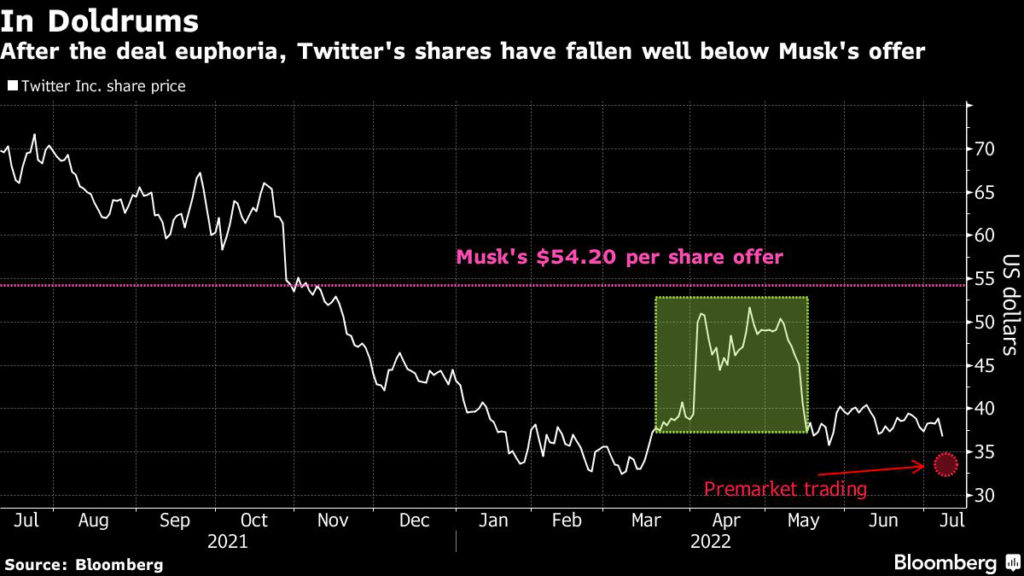
Shares fell 7.2% to $34.17 as of 6:40 a.m. in premarket trading Monday, on track to erase about $2 billion in market value, after Musk backed out of an agreement to buy the social-media giant and take it private. Shares in Tesla Inc., the electric carmaker that Musk leads, fell 0.3%.

Twitter shares have been trading well below the $54.20-per-share offer Musk made in April. The billionaire alleges that Twitter misrepresented user data, with the number of spam bots on the platform much higher than the company has disclosed. The stock has also been falling along with the tech sector amid rising interest rates.

“It’s not a huge surprise to anyone that Musk is trying to abandon the deal,” said Vital Knowledge founder Adam Crisafulli. “The problem, though, is that this whole saga was probably quite disruptive over the last few months, which could weigh on Twitter’s performance not only in the second quarter but third quarter too.”

Read more: Musk Effort to Kill Deal Leaves Twitter With Only Bad Options

With a $1 billion breakup fee on the line, traders are bracing for more chaos as Twitter takes Musk to court. 

Twitter Chairman Bret Taylor said the company will pursue legal action in order to close the transaction “on the price and terms agreed by Mr. Musk.” The company has hired merger-law heavyweight Wachtell, Lipton, Rosen & Katz and aims to file suit early this week, according to people familiar with the company’s plans, who asked not to be identified because the matter is private.

Twitter has denied Musk’s claims, saying bots are less than 5% of the total users, with executives repeating as recently as Thursday that their estimates are accurate.

“They are going to require Musk to do the deal even though he says it is terminated, and they have what I would say is a greater than 50% chance that they will win,” said market strategist Cabot Henderson, who has a focus on merger arbitrage and special situations at JonesTrading. 

“Musk getting away with just paying $1 billion would be a big win for him.”

All eyes will be on the company’s quarterly earnings results expected to be released later this month. For its first-quarter financials, revenue rose to $1.2 billion, missing analysts’ estimates amid in a slowdown in advertising.

“The company is well known but it’s not a great business,” said Kimberly Forrest, founder and chief investment officer of Bokeh Capital Partners. “Wall Street needs companies to show revenue and/or earnings growth. Twitter doesn’t seem to have a plan to grow either at this point.”

(Updates share price moves throughout. Adds more commentary in last paragraph.)

More stories like this are available on bloomberg.com

©2022 Bloomberg L.P.

Xiaomi-Backer Snags $3.2 Billion as China Startup Hopes Grow

(Bloomberg) — Qiming Venture Partners raised $3.2 billion across two new funds, joining Sequoia China and IDG in securing fresh capital as investors grow more sanguine about the country’s startup arena.

Qiming, known for early bets on tech giants from Bilibili Inc. and ByteDance Ltd. to Meituan and Xiaomi Corp., becomes at least the third venture house in recent weeks to home in on significant new capital. The firm closed its oversubscribed USD Fund VIII at $2.5 billion and also raised roughly $700 million in the first closing of a yuan-denominated fund, both aimed at the technology, consumer and health-care sectors. Qiming now manages $9.4 billion across 18 funds, it said in a statement on Monday.

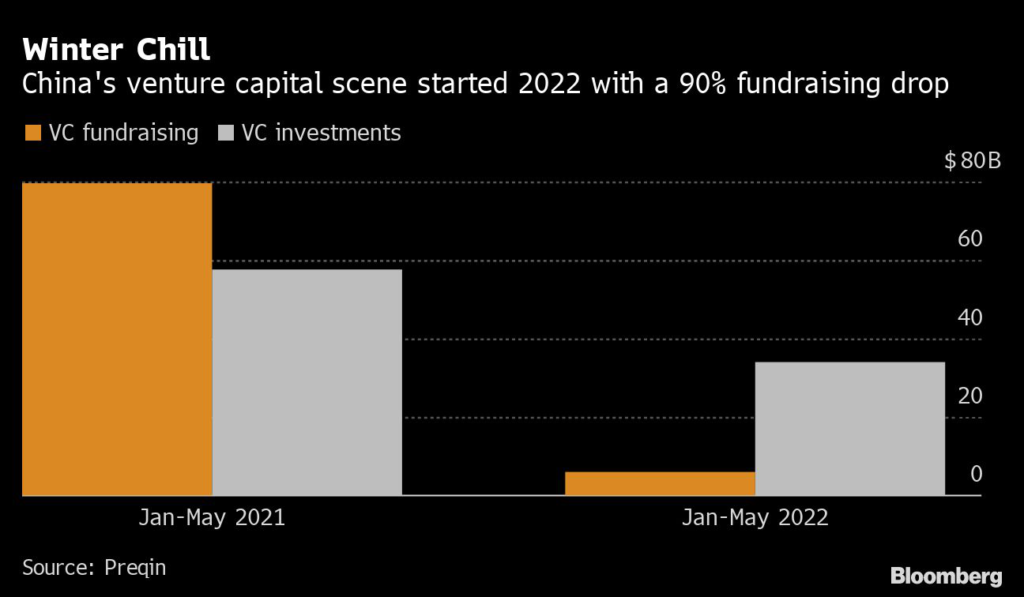
Venture funding in China plummeted at the start of this year as the government’s far-reaching crackdown on consumer internet, gaming and fintech hit valuations across public and private markets. VC and private equity funds raised only $6.2 billion in the first five months of 2022, a 90% drop from the previous year, while startup investments slowed 40% to $34 billion, according to data from research firm Preqin.

Read more: Top Tech Dealmaker Warns China’s VC Winter Is Far From Over

Read more: China Tech Investor Defies Skeptics With $900 Million Fundraise

Investors remain cautious about regulatory uncertainty but recent weeks have shown signs of improving sentiment, as Sequoia China secured about $9 billion for investments in tech and consumer firms. IDG Capital is poised to raise about $900 million for a new China-focused fund backed mostly by existing investors. Early-stage investor BlueRun Ventures China also reached the final close of a second dual-currency fund of more than 5.5 billion yuan ($817 million) in May, according to a company statement.

Founded in 2006, Qiming has backed over 480 companies. The company has made over 180 exits, it said in the statement. Managing Partners Duane Kuang, Nisa Leung, William Hu and Gary Rieschel will lead Fund VIII, the firm said.

Read more: Sequoia China Raises $9 Billion as Investors Flock to Big Funds

(Updates with portfolio companies in the second paragraph)

More stories like this are available on bloomberg.com

©2022 Bloomberg L.P.

Byju’s Struggles to Close $800 Million Funding as Investors Balk

(Bloomberg) — Indian online education provider Byju’s is struggling to close a funding round of $800 million as a global technology rout weighs on valuations.  

Investors including Sumeru Ventures and little-known firm Oxshott haven’t transferred about $250 million of the targeted amount because of “macroeconomic reasons,” a Byju’s spokeswoman said Monday without elaborating. The two firms should come through by the end of August, she added. Founder Byju Raveendran however has completed an injection of about $400 million into the startup as part of the round, the spokeswoman said.

The delayed funding for India’s most valuable startup is likely to trigger renewed concerns about India’s consumer technology industry, where public valuations on major players from Zomato Ltd. to Paytm have plummeted in recent months. The completed fundraising would have valued the startup at $22 billion, and Raveendran’s investment was a rare instance of an Indian founder taking part in a venture capital round at a late-stage startup. Sumeru Ventures didn’t respond to an email seeking comment.

Bangalore-based company Byju’s, backed by Bond Capital, Silver Lake Management, Naspers Ltd. and Tiger Global Management, has been seeking to expand abroad through big acquisitions. It offered more than $1 billion to buy US-listed edtech company 2U Inc., even as it initially pushed back payments to take over test-preparation provider Aakash Educational Services, Bloomberg News reported last month.

Raveendran, 42, the son of educators, founded his startup in 2015. Byju’s, whose parent company is formally known as Think & Learn Pvt, is the largest of a crop of startups that over the past decade have thrived on India’s growing mobile connections and investment from abroad.

More stories like this are available on bloomberg.com

©2022 Bloomberg L.P.

Hackers Are Helping to Speed Up China’s Electric Scooter Boom

(Bloomberg) —

Chinese drivers are souping up their electric scooters, helping to grow one of the most successful corners of battery-powered transportation.

Electric two-wheelers sold by companies like Niu Technologies have proved to be incredibly well-received in China’s megacities by delivery drivers and commuters who need to bypass traffic and travel short distances in little time. Their popularity has endured despite a 2019 move by the government to force manufacturers to cap speeds at 25 kilometers (16 miles) per hour.

Drivers and sellers have fought back by hacking software and taking online tutorials that allow them to bypass the controls, enabling some advanced models to hit speeds of 50 kph or more.

“Everybody does it,” said Zhao, a 25-year-old rider, who asked not to be identified by his full name since the practice is against government rules. He asked a salesman to remove the controls before he even drove his new scooter off the lot last summer. “If you don’t do it, you will be the slowest on the road,” he said.

Enthusiasts like Zhao have helped the electric scooter market to boom in China. Sales have grown from about 20 million in 2015 to 30 million last year, according to BloombergNEF, and the fleet of electric two-wheelers already outnumbers fuel-burning models. China is expected to account for 97% of all electric two-wheeler sales this year.

No data exists on speed-hacking, but analysts and drivers say it happens for the majority of scooters sold. The practice is especially prevalent for the delivery drivers who are the lifeblood of major Chinese cities and need the extra speed to beat delivery time limits set by their platforms, said Siyi Mi, a BNEF analyst.

Tutorials to get around the speed limits can easily be found on social media platforms such as Douyin and Little Red Book, China’s versions of TikTok and Instagram. Buyers and sellers will explain how to approach retailers about hacking the software, and how to cut a wire under the seat to turn off a government-required alarm that begins sounding when scooters surpass 25 kph.

The speed regulation was prompted by public safety concerns, including that delivery drivers often swerve back and forth between sidewalks, bike lanes and the road in order to avoid traffic. Information about enforcement has been limited, but three retailers in Zhejiang were fined 5,000 yuan ($745) each for offering illegal adjustments, and scooter owners that accepted them were also punished, according to NetEase News. 

China’s two-wheeler market will probably plateau in sales this year or next, according to BNEF. While there will always be a niche among delivery drivers, many Chinese are expected to graduate to the comfort of a four-wheeler as the economy continues to grow. The electric scooter market is expected to shift, with India and Southeast Asia becoming the major growth regions.

More stories like this are available on bloomberg.com

©2022 Bloomberg L.P.

Thailand Plans $37 Billion Smart City to Support Industrial Hub

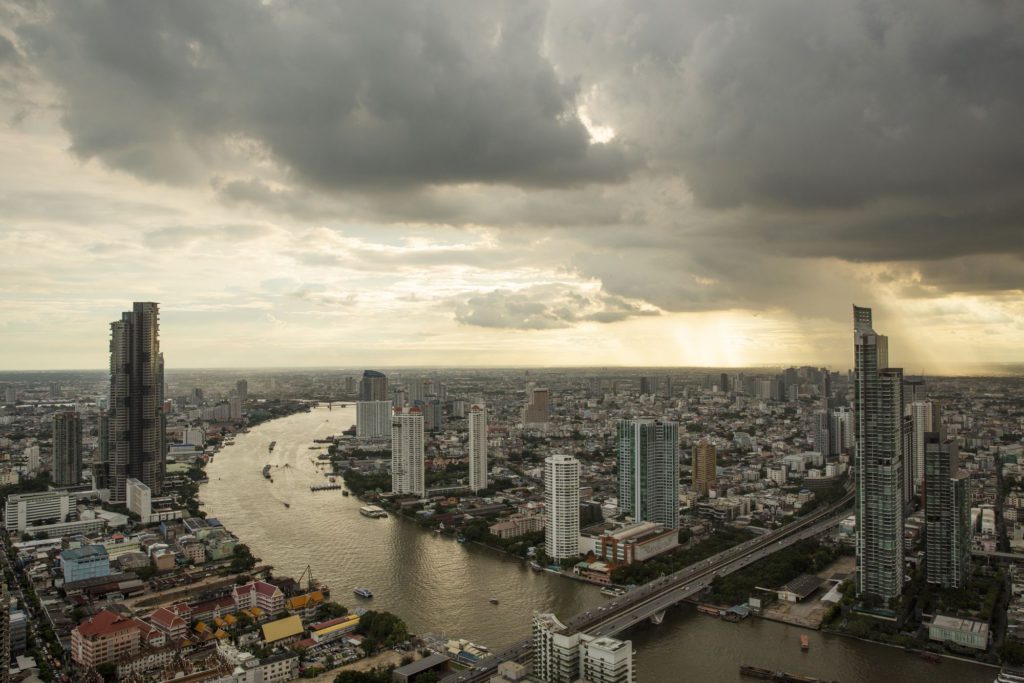
(Bloomberg) — Thailand is planning to build a $37 billion smart city in an industrial hub near Bangkok that’s already drawn billions of dollars of investment pledges from global automotive, robotics, healthcare and logistics companies.  

A master-plan to build the city in Huai Yai subdistrict of Chonburi province, some 160 kilometers (99 miles) southeast of Bangkok, was approved by a panel chaired by Prime Minister Prayuth Chan-Ocha on Monday. The yet-to-be-named city will be spread over 14,619 rais (2,340 hectares) of land and will cost 1.34 trillion baht ($37 billion) over the next 10 years, officials said. 

The project will comprise five business centers for companies to rent as commercial areas, Kanit Sangsubhan, secretary-general of the Eastern Economic Corridor, told reporters. These will include a hub to house regional headquarters of firms, a financial center, and areas for precision medicine, international research and development, and future industries such as clean energy and 5G technology, he said. 

The residential quarter of the new city will be designed to accommodate 350,000 people by 2032, and generate 200,000 direct jobs, Kanit said. Residents will be mostly those employed in the industrial area, which is set to draw investments of about 2.2 trillion baht over the next 5 years, he said.

“The new city will be livable for the new generation of people as well as operate as business centers” Kanit said. “We created this new project to compensate for the income Thailand lost during the pandemic.”  

The new city with its business centers can add an estimated 2 trillion baht to Thailand’s gross domestic product within 10 years, and the value of assets after a 50-year concession period will see a fivefold jump, the government said in a statement. 

Prayuth’s government has touted the Eastern Economic Corridor, a development project whose goals include urbanization, spurring advanced industries and adding infrastructure, to bolster the nation’s pace of economic growth that lags behind neighbors such as Indonesia and Vietnam.

The Eastern Economic Corridor comprises three provinces that historically have been the country’s manufacturing hub and currently contributes as much as one-fifth of the Thai economy. Its output is growing 6%-7% each year, faster than the rest of the country, according to officials.

More stories like this are available on bloomberg.com

©2022 Bloomberg L.P.

Omers Agrees to Acquire UK Utility Contractor Network Plus

(Bloomberg) — Omers, the Canadian pension fund manager, agreed to acquire British utility services provider Network Plus.

The fund’s private equity arm reached a deal to buy Network Plus from its management and private equity firm Livingbridge, Omers said in a statement Monday, confirming an earlier Bloomberg News report. The transaction was set to value the business at around £600 million ($718 million), people with knowledge of the matter have said.

Network Plus is a contractor for major UK utilities and infrastructure firms, providing services such as project planning, construction and maintenance. It helps hook up gas connections, lay power lines, install underground internet cables, inspect water pipelines and fix wastewater blockages. 

The company, based in a suburb of Manchester, has a team of more than 5,000 workers spread across 85 locations in the UK, according to Monday’s statement. Its customers include Cadent Gas Ltd., National Grid Plc, Yorkshire Water, Wales & West Utilities Ltd., Manchester Airport Group and Network Rail, its website shows.

Investors ranging from pension funds to private equity firms have been pouring money into infrastructure plays as they seek to generate stable, recurring returns. PAI Partners is exploring a potential $2 billion sale of rival British utility contractor M Group Services, Bloomberg News reported in March. 

More stories like this are available on bloomberg.com

©2022 Bloomberg L.P.

What Does a Melting Glacier Sound Like? More Data for Climate Scientists

(Bloomberg) —

The sound of melting glaciers is disturbingly similar to the psychedelic tunes that made Jim Morrison’s The Doors one of the greatest rock and roll bands of all times. 

That was my first thought as I listened to recordings of the Kongsvegen glacier in Svalbard by Ugo Nanni, a researcher from the University of Oslo who records glacier sounds using a seismometer. He post-processes the frequencies to make the sounds audible.

Interestingly, Nanni’s research plays into Morrison’s 1969 prediction that in the future music would be made by “one person with a lot of machines, tapes and electronic setups.” What Morrison probably never imagined was that music and machines would be used to make climate change research. 

While young, the study of global warming through sound has boomed in recent years. The logic is simple — just as thermometers record heat waves and pluviometers register rainfall, sound recording devices capture the audible aspects of climate change that traditional research has so far missed. 

Nanni’s work is advancing what we know about the forces inside a glacier as it melts. When ice breaks it generates tiny vibrations that can be be picked up by seismometers.  These recordings can not only help predict future changes in mass loss in Greenland and Antarctica, but they also can be used for assessing glacial hazards.

  • Want to lead a more climate-conscious life? Bloomberg Green wants to answer your questions. Take our brief survey and tell us what you’d like to know.

Ice isn’t the only noisy subject of interest. In March, Italian researchers concluded that sound travels faster and lasts longer before fading away in warmer water, meaning that oceans are getting louder in certain areas as global warming heats up the planet. The study published in journal Earth’s Future identified the Greenland Sea and a patch of the northwestern Atlantic Ocean east of Newfoundland as hotspots where sound speeds will increase the most. This will likely affect marine wildlife like whales and dolphins, which depend on sounds to eat, communicate and find each other. 

In Indonesia, marine noises from one of the world’s largest reef restoration projects, near Sulawesi island, are helping researchers develop an artificial intelligence program that can automatically detect whether coral is healthy or degraded.  Scientists used underwater microphones to record one-minute soundbites from sites with 90 to 95% and 0 to 20% coral cover, representing healthy and unhealthy eco-states, respectively, and trained a machine learning algorithm to recognize the difference.

Back on dry land, cheap microphones and even smartphones are allowing scientists to measure everything, from how the relationship between pairs of Yellow-breasted Boubou in Nigeria and Cameroon changes with the weather and climate, to the impact of aircraft noise on protected forests in France.

Some projects sit on the intersection between art and science. Nigerian artist Emeka Ogboh’s recordings of the soundscapes of Lagos are a valuable document of how human and natural life interact in one of the world’s largest and busiest metropolises. 

“There’s anthrophony, which is the sounds humans and machinery make, and there’s biophony, which is the sounds animals make when you hear vocalizations of animals, and there’s geophony, the sound of weather elements,” Ogboh told the audience at the New European Bauhaus Festival last month. “This all comes together and it’s what makes our environment.”

The man who came up with this classification for sounds is Bernie Krause, a former Motown studio guitarist with a knack for electronic music who introduced the synthesizer to bands like The Byrds, The Rolling Stones and — of course — The Doors. 

“I also did the helicopter sounds and a third of the score for Apocalypse Now, one of over 130 feature films I did either synth effects and, or music,” he said in an interview. “Then, I quit, went back to school to earn a PhD in Creative Sound Arts with an internship in bioacoustics, and never looked back.”

Krause’s 2019 paper with French Entomologist Jérôme Sueur, titled Climate change is breaking Earth’s beat, is among the most widely cited by researchers studying sounds and climate. And his Wild Sanctuary project is possibly the longest-running attempt to record how the Earth sounds. He has been capturing soundbites of nature, from humpback whales to Rwanda’s mountain gorillas, since 1968.

“These signature soundscapes of each environment are narratives of place,” he says. “Most important, these biophonies convey the condition of that habitat through a measure of the vocal density and diversity of non-human animals present — in healthy habitats, animals tend to vocalize in relationship to one another, just like instruments in an orchestra.” Earth’s sounds are changing. On dark days, one might almost hear Jim Morrison lamenting the tortured planet on When the Music’s Over: “What have they done to the earth, yeah? / What have they done to our fair sister?”Krause, however, feels nature is humming a tune for a slightly more hopeful David Bowie aphorism: “[Tomorrow] belongs to those who can hear it coming.”

More stories like this are available on bloomberg.com

©2022 Bloomberg L.P.

Mercedes Sales Decline 16% as Supply-Chain Woes Continue

(Bloomberg) — Mercedes-Benz Group AG sold 16% fewer cars during the second quarter as Covid-related lockdowns and a prolonged shortage of semiconductors continued to weigh on production.

Deliveries in China, the world’s largest car market, declined 25%, while sales in Europe fell 10%, the Stuttgart-based automaker said in a statement Monday.

“We are making every effort to fulfill customer expectations, despite the current supply restrictions,” said Britta Seeger, the management board member responsible for marketing and sales.

The auto industry is still feeling the pain of supply-chain disruptions and shortages of components such as semiconductors, particularly amid a broad transition to electric vehicles that are dependent on increasingly sophisticated software. BMW AG said last week that its sales declined almost 20% in the second quarter. 

Ongoing supply-chain problems could jeopardize Mercedes’s plan to cut back on entry-level vehicles in order to focus on higher-end cars that deliver bigger profits. Mercedes said a dearth of chips contributed to a 16% decline in sales for the top-end luxury category.

EV sales were a bright spot in Mercedes’s report, with its EQ sales nearly doubling to 23,500 units compared to the same period last year. The first half of the year saw the brand’s EV sales rising to 45,400 units — an increase of 134%.

“The electric ramp up is gaining traction,” Seeger said. “It shows that we offer compelling electric vehicles our customers desire.”


More stories like this are available on bloomberg.com

©2022 Bloomberg L.P.

Black Gun Owners Are Eager to Flex Carry Powers After New York Law Falls

(Bloomberg Law) — Black gun rights groups are seizing on a Supreme Court ruling that makes it easier to carry handguns in public, touting it as an important vindication of their rights to self-defense and an opportunity to reshape the debate in the Black community over gun ownership six years after the killing of Philando Castile.

The justices in a 6-3 decision in June struck down a New York state law on concealed carry that restricted the carrying of handguns in public by most people.

The decision, coming amid a wave of mass shootings, has sparked worries about public safety, and raised questions about whether gun owners of color, such as Castile, would enjoy the same privileges as others. Castile, a Black man in Minnesota who had a permit for his firearm, was shot and killed by police during a 2016 traffic stop.

Philip Smith, founder and national president of the National African American Gun Association, which filed an amicus brief against the New York law, said the court ruling reinforces the rights of gun owners like Castile.

“When he was shot by that officer, after watching that video, I told our members, make sure you can still carry in your state. The one thing we cannot do is to act cowardly and to shudder in the corner like we don’t deserve to have a gun,” Smith said. “We’re going to stand tall and exercise our Second Amendment rights.”

But critics of the ruling say Black gun owners won’t be treated the same as other groups. They said the decision will lead to more guns on the streets and more deadly encounters between Black men and law enforcement.

“I think we’re sadly going to see more incidents like that, with police fearing that anyone they encounter will have a gun,” said John B. King, a former Obama Education secretary now running for Maryland governor.

Black Gun Owners Mobilize

In their amicus brief to the Supreme Court opposing the N.Y. law, NAAGA, which said it was founded in 2015 to “defend the Second Amendment rights of members of the African American community,” pointed to the history of laws denying gun rights for Black Americans.

“Such laws often included arbitrary prohibitions on the carrying of firearms with parallels to New York’s current law. Such laws invariably discriminate against the poor and minorities,” the brief said.

Another group, Black Guns Matter, also asked the justices to strike down the N.Y. law. “Armed self-defense has always been vitally important to the African American community,” their brief said.

Following the ruling, representatives of those groups said they would push efforts to promote legal gun ownership and education in the Black community.

“For the last five years, we’ve given classes on how to legally purchase, store, transport, own and train with firearms,” said Maj Toure, founder of Black Guns Matter. “We’ve traveled around the country, going to these areas that have the most violent crime—Chicago, St. Louis, New Orleans, Philly, New York, Compton, L.A.—every year we give these classes all the year for free.”

Toure said their efforts aim to reduce violent crime by promoting responsible ownership and self-defense. The group launched the Solutionary Center in Philadelphia, where residents can also learn about “trades, skills, conflict resolution, employment and other areas that improve neighborhoods and quality of life,” according to its website.

Increased Ownership

Smith from NAAGA said his group’s larger aim is to change the perception of Black people with guns.

“When I first started the organization, about seven years ago, I did a Google search of Black people and guns together,” he said. “It’s a very negative view of African Americans.

“What we try to do, and we do this every day, is put out positive imagery of Black folks with guns, families going to the range together, hunting together, shooting competitively,” he added.

There is also data that suggests more Black Americans may be buying guns. The National Shooting Sports Foundation, a firearm industry trade group, in a 2020 survey said retailers reported a 58% increase in sales to customers they identified as Black during the first half of that year, compared to the first half of 2019. More than 90% of retailers in 2021 reported an increase of Black men and almost 87% percent an increase of Black women purchasing firearms.

Gregory Parks, a professor of law at Wake Forest University, said the rise in hate crimes and the many recent high-profile cases of police killings may be pushing Black people toward gun ownership.

“I also own guns and I conceal carry, but I don’t have a super expansive view of the Second Amendment,” he said. “If other folks are going to be carrying, I’m going to be carrying too.”

Policing Challenges

Democratic-run states fearing a surge in violence are already trying to counter the court’s ruling and find ways to keep firearms off the streets.

New York Gov. Kathy Hochul (D) on July 1 signed legislation that bars concealed carry in certain location such as churches, theaters, schools, and on public transportation, and expands the criteria for people trying to get concealed carry permits to include firearm safety training. Applicants could be disqualified for convictions over weapons possession or recent drug or alcohol-related misdemeanors.

Adam Skaggs, chief counsel and policy director at the Giffords Law Center to Prevent Gun Violence, said a spike in gun ownership could heighten reliance on “stand your ground” laws in states which allow people to defend themselves if they feel threatened. He added that Black gun owners using guns for claimed self-defense will still face racial bias.

“If a white person claims ‘stand your ground’ in shooting a Black person, they’re much more likely to effectively get away with that killing than if the roles are reversed,” Skaggs said. “Overall in the aggregate you’re going to make it much more likely that more Black Americans are going to be shot and killed.”

Candace McCoy, a criminal justice professor at John Jay College of Criminal Justice, cautioned that when police see weapons in public their first thought is about safety—not whether that person is legally carrying.

“Police aren’t really thinking initially, whether the carry is necessarily legal or illegal. They’re thinking whether they’re in danger,” McCoy said.

More guns on the street will certainly make law enforcement’s job more difficult, said Frederick L. Thomas, president of the National Organization of Black Law Enforcement Executives (NOBLE).

“We at NOBLE feel that increased gun ownership and easier access to guns makes the job for law enforcement that more challenging. It is our hope that this recent court ruling will not increase negative interaction with any communities or citizens,” Thomas said.

But Corey Pegues, a Black retired deputy inspector at the New York Police Department, said he doesn’t know if the Supreme Court ruling will make interactions between the Black community, including gun owners, and the police, any worse.

“Black citizens are already hunted by the police, and I don’t know how much more hunting they can do,” he said.

(Everytown for Gun Safety advocates for universal background checks and other gun control measures. Bloomberg Law is operated by entities controlled by Michael Bloomberg, who serves as a member of Everytown for Gun Safety’s advisory board.)

To contact the reporter on this story: Ayanna Alexander in Washington at aalexander@bloomberglaw.com

To contact the editors responsible for this story: Meghashyam Mali at mmali@bloombergindustry.com; Bernie Kohn at bkohn@bloomberglaw.com

More stories like this are available on bloomberg.com

©2022 Bloomberg L.P.

Russia Seeks to Punish Expats Who Criticize War on Social Media

(Bloomberg) — Michael Nacke, a popular YouTube personality based in Lithuania, said his phone started blowing up with text messages one May evening asking if he was a “foreign agent.” 

Friends and family had spotted his name in a news article claiming that Nacke, a Russian native, had been charged with disseminating false information about that country’s “special military operation” in Ukraine. The charge stemmed from a March 16 video about an alleged Russian attack on a Ukrainian nuclear power plant in Zaporizhzhia, an incident the Kremlin denied.

It turns out Nacke wasn’t designated an agent, but charged under a new Russian law that bans anyone from criticizing military operations in Ukraine. If he returns home to Russia, Nacke faces as many as 10 years in prison.

“This law is the most stupid thing in history,” Nacke says. “If you say anything about the military being guilty of anything at all they will try to destroy you.”Nacke is one of several Russian-born social media influencers living outside the country that Moscow is trying to censor using a combination of criminal charges and pressure on technology companies, according to a series of interviews and Russian court documents obtained by Bloomberg News. The effort to silence critical expats living outside Russian borders coincides with a broader crackdown on dissent closer to home.  Authorities have detained more than 16,300 people in Russia for voicing opposition to the war, according to the Russian human rights group OVD-Info, for alleged crimes including placing antiwar leaflets in a grocery store and holding signs that say “Mir,” the Russian word for “peace.” 

While the exact number of Russians charged in absentia is difficult to quantify, Moscow is already using the fake news law, passed in March, to stifle independent voices on social media platforms where many young people consume their news, according to Stanislav Seleznev, a lawyer at Net Freedoms Project. Besides Nacke, Russia has charged several other expatriates who have criticized the war on social media. Journalist Izabella Evloeva, for instance, who lives in Latvia, was sentenced to three years in prison for saying that the “Z” sign — embraced by supporters of the war in Ukraine —  was “a synonym for aggression, death, pain and shameless manipulation” on her Telegram channel in March. Violetta Grudina, an ally of Kremlin critic Alexey Navalny who left Russia in 2021, was charged in June with allegedly spreading false information about the armed forces on social media. Journalist Alexander Nevzorov, who has averaged up to 2.5 million views on each YouTube video, was arrested in absentia in March with the same charges.Other expats who have been charged under the fake news law include science-fiction writer Dmitry Glukhovsky,  lifestyle influencer Veronika Belotserkovskaya, and journalist Andrei Soldatov.Soldatov, who lives in London, only realized he had been charged when he began receiving strange texts from banks where he held an account in Russia, which he thought were phishing attacks. It was only because the bank passed along information that he found out he faced ten years in prison for “spreading fake news about Russia’s National Guard” on YouTube. Soldatov had recently critiqued the Russian military’s effectiveness during the early stages of the Ukrainian invasion on another journalist’s YouTube channel. However, he believes he was under scrutiny for his critical reporting on Russia’s Federal Security Service (FSB), but that they used his YouTube appearance as an excuse to prosecute him. “There’s a normal psychological reaction to try and find this funny, but it is not,” Soldatov says. “My family is still in Moscow, and my 70-year-old father is under investigation. They’ve stolen my money, and I have to be careful where I travel.” Soldatov was advised by a lawyer not to travel to Serbia, Hungary, Turkey or Georgia, he said. His case will be tried in the coming weeks, but he expects to be found guilty.  “I don’t think Putin’s strategy is effective because Russians who are critical and want to know what is really going on in Ukraine are relying on journalists in exile and moving to YouTube and Telegram.”The Russian Embassy in Washington didn’t respond to a request for comment. 

Arrests relating to freedom of expression in Russia have been growing steadily since 2006, according to Oleg Kozlovsky, a researcher focused on Russia at Amnesty International. Since the invasion of Ukraine, though, the scale and severity of such prosecutions have surpassed any prior censorship efforts, he said. 

In all, since the February invasion of Ukraine, Russian authorities have arrested, fined or imposed restrictions on more than 2,170 people in and outside the country, according to Net Freedom’s Seleznev, who analyzed sudrf.ru, the web portal for courts in the Russian Federation. Some of these charges fall under the new fake news law, along with laws banning “public actions aimed at discrediting” Russian Armed Forces and calling to withdraw troops, he says. 

Meanwhile, access to the internet has been restricted.

Russian technology giant VK Co Ltd. has been blocking independent media outlets and human rights groups. Yandex NV, a key news source for Russian citizens, has been removing similar content from its search engine and news aggregator. Bytedance Ltd.-owned TikTok stopped all Russians from uploading videos after the law came into effect on March 6.

Western companies are similarly under scrutiny, and at least one US-based social media platform has urged Russian expats to remove videos critical of the war, at the behest of the Kremlin. The government also labeled Meta Platforms Inc.’s Facebook and Instagram as “extremist” organizations. While many Russians use virtual private networks to hide their connections to the site, the “extremist” designation makes it especially risky for anyone to publish anything on the sites. Google’s YouTube removed videos in Russia from influencer Svetlana Sokova, a Russian living in Spain who regularly criticizes the government, after Roskomnadzor, the Kremlin’s media censorship agency, requested that she be taken offline. The videos remained viewable outside of her native country. Sokova later received a message from a lawyer in warning her that she had been charged with extremism and inciting violence against the government in absentia and that she should await a trial date.

YouTube restored Sokova’s channel after Bloomberg News questioned the reason for its removal.

Emails from YouTube’s legal team, seen by Bloomberg News, show how the company has asked some Russians who criticize the military to remove their videos when Roskomnadzor requests it. In the messages, YouTube warns users that their videos may be blocked if they do not delete it themselves. A YouTube spokesperson said that the company removes content that violates local Russian laws after a legal request and an internal review.

Nacke has received dozens of emails from YouTube dating back to March 2021 asking him to delete his videos due to requests from Roskomnadzor, he said. Danila Poperechny, a Russian stand-up comedian and YouTube personality, recently revealed similar requests to remove his own videos on Telegram, telling his followers he’d comply because he needed to return to Russia and feared he would be put in jail.

“The answer is very simple: for me, ‘Russia’ is not the decisions of the state, laws and stickers on cars,” Poperechny said. “It is the people close, dear and dear to me, most of whom are in this country forever.”

“Is it worth losing the opportunity to see them because of some video that our authorities did not like and that you all have already watched?”

YouTube will remove content that violates local Russian laws only after a valid legal request is made and a thorough review is completed, Ivy Choi, a YouTube spokesperson said. Google was fined 14 million rubles, or $255,000, for not complying with Rokomnadzor’s requests in April. Russian prosecutors are also marking social media influencers as “foreign agents” for publicizing their critiques. Among those designated as a foreign agent since February are political scientist Ekaterina Schulmann, journalist Alexey Pivovarov, blogger Yuri Dud, LGBTQ activist Karen Shainyan and Alexey Venediktov, former head of a radio station shuttered by authorities. Together, they have about 15 million YouTube subscribers. They were either outside the country when they were charged, or left as a result.

The people marked as foreign agents are required to include a 24-word disclaimer on every social media post and YouTube, Instagram and TikTok video or face criminal charges and detention upon their return home. 

“The point is to destroy the audience’s trust as in the mass consciousness as the term ‘foreign agent’ is closely associated with Stalinist repressions, and to jeopardize their advertising revenue as advertisers contact them less,” says Maria Kuznetsova, a spokesperson the human rights group OVD-Info.The disclaimers alienate advertisers who provide crucial revenue for Russian video creators in and out of the country, and have become an effective way for the Kremlin to cut off vital revenue sources for independent voices, experts said. While there’s no current data to suggest how much content creators have lost as a result, Meduza, an independent media outlet that operates from Latvia, recently said it has lost 90% of its advertising revenues after being designated a foreign agent in 2021, Kuznetsova says. “Russia definitely wants to cause self-censorship,” says Christopher Paul, senior social scientist at the RAND Corporation. “The authorities also seem to be more willing now to go after their non-political critics like bloggers even if it risks alienating their followers.”Roskomnadzor, Russia’s censorship agency, is using algorithms and human investigators to trawl comments shared on technology platforms to find illegal content, according to Seleznev, of the Net Freedoms Project. Russians charged in-absentia under the fake news law are added to an international wanted list and often have their property in Russia seized, Seleznev says.

Russia’s self-silencing tactics have been particularly effective during the war in Ukraine, according to Nacke, Amnesty’s Kozlovsky, and Paul, of RAND.Mikhail Petrov, a St. Petersburg University student, booked a ticket out of Russia in the first week of March, when the new law was introduced. The 23-year-old had built a lively following on TikTok and Instagram. He had just uploaded a clip comparing the war in Ukraine to World War II, which was clocking up almost one million views and put him at risk of arrest. He’s now living at the home of an Instagram follower in Tbilisi, Georgia.What was supposed to be a one month trip has been extended indefinitely, and Petrov is searching for an apartment amid rising prices as Russians flood the rental market in neighboring countries. Some landlords are less than keen to house his countrymen, Petrov says. The income generated by Petrov’s blog is in Rubles and sanctions make it difficult for him to extract his earnings.“You leave your country and you never know what you’re going to do and whether you are going to come back,” says Mikhail Petrov. 

For Nacke, the actions from the Russian authorities could present an opportunity. 

He hopes that Russians will continue to watch his channels, through virtual private networks if necessary, to hear a different side to the story. He is acutely aware of how the Russian Federation wants to be loved by its people.“I had often asked myself whether doing YouTube videos could actually do something to stop Putin and whether I should go be a humanitarian or something more useful instead,” he says. 

“But my case creates a risk for them, that people might believe me, and I’ll continue to upload in the hope that will help stop this war.” 

More stories like this are available on bloomberg.com

©2022 Bloomberg L.P.

Close Bitnami banner
Bitnami