
Bloomberg

Musk Effort to Void Twitter Buyout Sets Up Delaware Court Fight

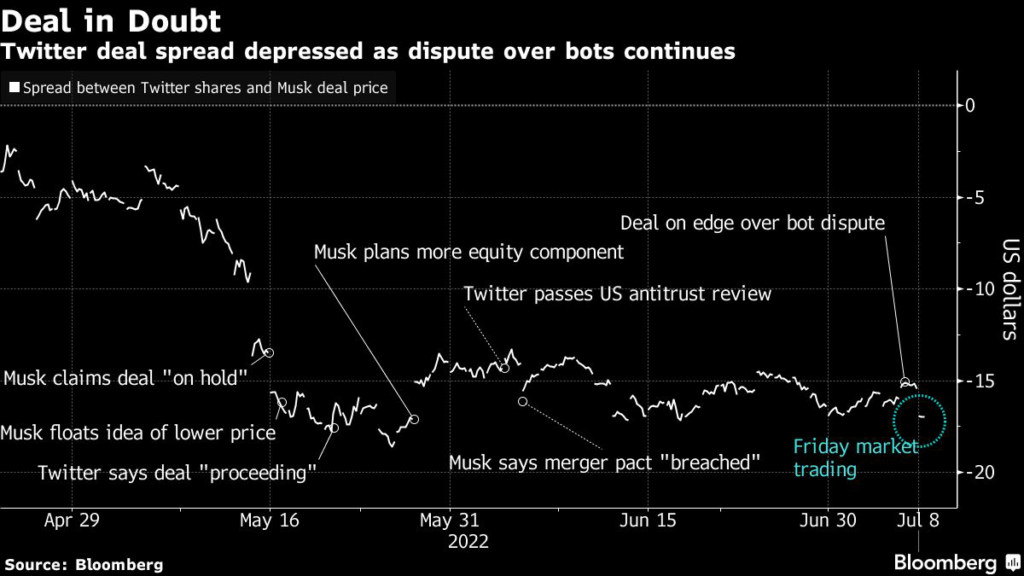
(Bloomberg) — Elon Musk’s move to dump his $44 billion deal for Twitter Inc. sets the stage for a titanic legal battle in a Delaware court that typically frowns on efforts to back out of merger agreements.

Minutes after Musk disclosed his intention to exit the deal, Twitter Chairman Bret Taylor responded with an unequivocal threat to take the world’s richest person to court.

“We are committed to closing the transaction on the price and terms agreed upon with Mr. Musk and plan to pursue legal action to enforce the merger agreement,” Twitter said in a statement. “We are confident we will prevail in the Delaware Court of Chancery.”

The Tesla Inc. co-founder is trying to blow up his own $54.20-a-share offer, claiming Twitter failed to fully disclose how much of the platform’s traffic is driven by spam and fake accounts known as bots. Twitter, now trading below $40 a share, has countered that it has provided Musk with that information and he’s obligated to complete the deal reached in April. 

As with many other high-profile transactions, Twitter and Musk agreed that any legal disputes must be heard by Delaware courts, which are well versed in quickly sorting merger-and-acquisition complexities. Based on previous merger fights, efforts to terminate a deal can play out within a few months, often ending with settlements to avoid further wrangling.

Negotiating Ploy

Musk’s decision to publicly pull the plug on the deal is probably nothing more than a negotiating ploy, said Charles Elson, a retired University of Delaware professor and former head of the school’s Weinberg Center for Corporate Governance.

Despite Musk’s assertion that Twitter’s handling of the bots issue amounts to breach of the buyout agreement that justifies canceling the deal, he and his lawyers know they’ll have an extremely difficult time making that claim, Elson said.

“This is not a material adverse change,” Elson said. “That’s just a negotiating position. He knows the Delaware courts are extremely reluctant to find something like that in these deals.”

In his letter Friday, Musk repeated his claims that Twitter has failed to show that no more than 5% of its users are automated bots. He also contends that Twitter broke the agreement by deviating from its normal course of business by firing executives and imposing a hiring freeze.

Following Musk’s disclosure, Twitter’s shares fell about 5% after the close of regular trading. The shares, which have fallen about 15% this year, closed regular trading Friday at $36.81, giving the company a market value of $28 billion.

Chancery Powers

Any suit by Twitter or Musk over enforcing or voiding the deal will be heard by a Delaware Chancery Court judge. The state is the corporate home to more than half of U.S. public companies, including Twitter, and more than 60% of Fortune 500 firms. There, chancery judges — business law experts — hear cases without juries and can’t award punitive damages.

Under Delaware court rules, either Musk or Twitter would be able to ask a judge to put its case on a fast track, accelerating deadlines for exchanges of pre-trial information and enabling a quick trial. Under state law, judges can order parties to consummate a merger if the objector fails to make a legitimate case for walking away.

The judges also have a say over whether breakup fees must be paid. In the Musk-Twitter deal, that fee is for $1 billion.

Un-Patchable Hole

To escape the deal, Musk must prove some “unexpected fundamental, permanent adverse event” has occurred that blew an un-patchable hole in the transaction, said Larry Hamermesh, a University of Pennsylvania law professor. 

Chancery judges have only recognized one case in which a so-called material adverse event occurred.

That case involved Fresenius SE’s $4.3 billion buyout bid in 2018 for rival drugmaker Akorn Inc. A Delaware judge blessed Fresenius’ decision to walk away from the deal after finding Akorn executives hid an array of problems that cast doubt on the validity of data backing up approval for some drugs and profitability of its operations.

No matter what happens in the legal arena, the jockeying over Twitter has left some deals lawyers marveling over Musk’s chutzpah and predicting he’ll get a price cut.

“Even after Twitter’s statement that it is sticking to its guns, the board might well be tempted to take a haircut in an effort to end what is, I think, perhaps the weirdest major-merger process in the last 50 years, if not ever,” said Robert Profusek, head of the merger-and-acquisition department at the Los Angeles based law firm Jones Day.

Musk is slated to speak Saturday at Allen & Co.’s Sun Valley Conference in Idaho and the deal is certain to be the elephant in the room regardless of whether he addresses it directly, especially with Twitter Chief Executive Officer Parag Agrawal also present at the conference.

More stories like this are available on bloomberg.com

©2022 Bloomberg L.P.
Twitter Shares Sink After Musk Says He’s Ending Acquisition Bid

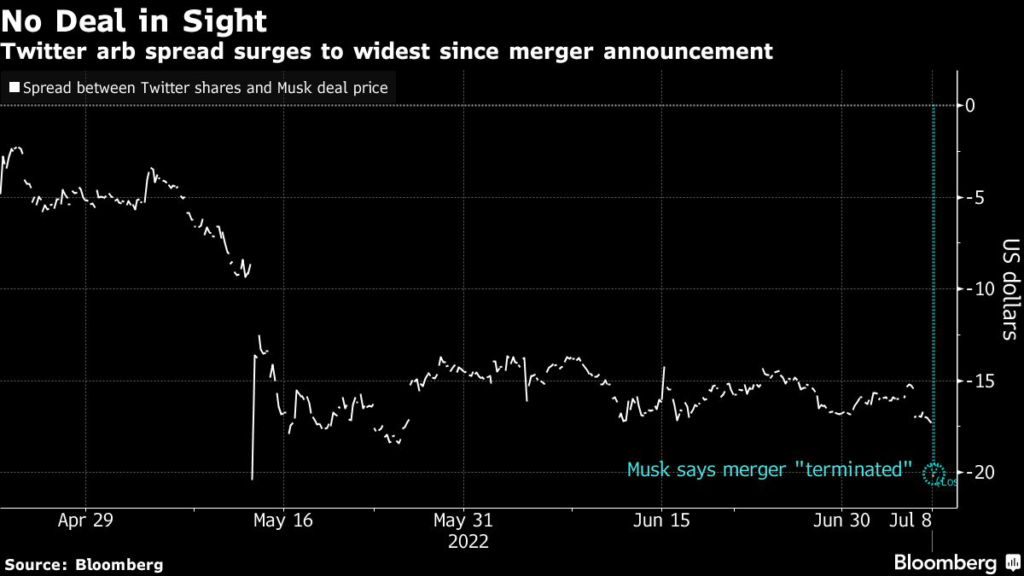
(Bloomberg) — Twitter Inc. shares dropped late on Friday after Elon Musk said he’s terminating the $44 billion agreement to acquire the social media company. 

The stock fell as much as 9% in postmarket trading after a regulatory filing from Musk laid out his case for abandoning the deal. The news sent shares of Tesla Inc., the electric car maker that Musk leads, up as much as 3% while social media peers Snap Inc. and Pinterest slid about 1%.

Twitter shares have been on a rollercoaster ride since Musk offered to buy the company in late April but have fared better than other technology stocks, which have been under pressure amid surging inflation and Federal Reserve efforts to tame it. Twitter shares had fallen 15% this year as of Friday’s closing price, compared with a drop of 26% for the Nasdaq 100.

Read more: Tesla Shares Edge Higher After Musk Walks Away From Twitter Deal

Analysts at Wedbush called the deal collapse a “disaster scenario” for Twitter, which now may face a protracted legal battle with Musk. Bloomberg Intelligence analysts Mandeep Singh and Ashley Kim said without Musk, Twitter could potentially draw a rival bid. 

“We believe Twitter could find a competing offer, given a number of big names have been linked to acquisition talk, including Disney, Google, Salesforce.com, Microsoft and Verizon,” the analysts said. “Any competing bid from private equity would be at least 15-20% lower than Musk’s $44 billion offer.”

Twitter’s board said it is committed to the acquisition and plans to pursue legal action to enforce the terms of the deal. 


More stories like this are available on bloomberg.com

©2022 Bloomberg L.P.

Tesla Shares Edge Higher After Musk Walks Away From Twitter Deal

(Bloomberg) — Tesla Inc. shares rose late Friday after Chief Executive Officer Elon Musk said he’s walking away from his $44 billion bid to buy Twitter Inc., giving investors in the electric-vehicle company a measure of relief that its leader might be slightly less distracted.

There’s always been a “key man” risk with Musk. The 51-year-old billionaire already oversees four companies — Tesla, SpaceX, Neuralink and the Boring Company — and his involvement is critical to each of them. His bid to buy Twitter has been an overhang on Tesla’s stock: How could a top executive who is already stretched among several different ventures take on yet another company?

Read more: Elon Musk’s Pursuit of Twitter Accentuates Tesla’s Key-Man Risk

Musk’s retreat from the Twitter deal now kicks off a major legal battle, with the social-media platform saying Friday it plans legal action to enforce the agreement.

For Tesla investors, though, Musk’s decision sparked a mini relief rally. The shares rose 2.1% as of 6:13 p.m. Friday after regular trading in New York.

More stories like this are available on bloomberg.com

©2022 Bloomberg L.P.

Crypto Miner Marathon’s 54% Surge Still Leaves Stock Deep in Red

(Bloomberg) — Crypto mining giant Marathon Digital Holdings Inc. had its best weekly gain since February 2021, leading a rally in digital-asset shares as the crypto market enjoyed a respite from recent steep declines. The stock’s gains, while impressive, were nowhere near enough to erase losses incurred this year.

Marathon surged 54% in a holiday-shortened week to close at $8.51 in Nasdaq trading, with Bitcoin on track for its biggest weekly gain since March. Other top public miners also rose: Riot Blockchain and Core Scientific each advanced more than 30%. Even after the gains, Marathon is down almost 75% so far in 2022, while the broader NYSE FactSet Global Blockchain Technologies Index is down 65%, reflecting a tumble in cryptocurrencies that wiped out some $2 trillion in market value since last fall.

Las Vegas-based Marathon outpaced its rivals after announcing Thursday that it added 4,769 Bitcoin back to its balance sheet following a decision to unwind an investment in New York Digital Investment Group. That brings its total holdings to 10,055 coins, or about $200 million worth. Marathon is one of the few miners that have held on to all of their mined coins in the prolonged “crypto winter.” Others have been forced to sell part of their holdings to cover operational costs and repay debt as digital-asset price declines squeeze their profit margins. Core Scientific sold nearly 80% of its Bitcoin holdings, while Riot increased its sale in June compared to previous months. 

Marathon also reported a better-than-expected cash position, according to D.A. Davidson analyst Chris Brendler. And unlike other major miners, Marathon uses third-party operators to run its machines rather than building its own facilities, which requires hefty overhead costs and more debt. 

More stories like this are available on bloomberg.com

©2022 Bloomberg L.P.
Biden Lauds CIA for Punching ‘Gigantic Hole’ in Putin’s Playbook

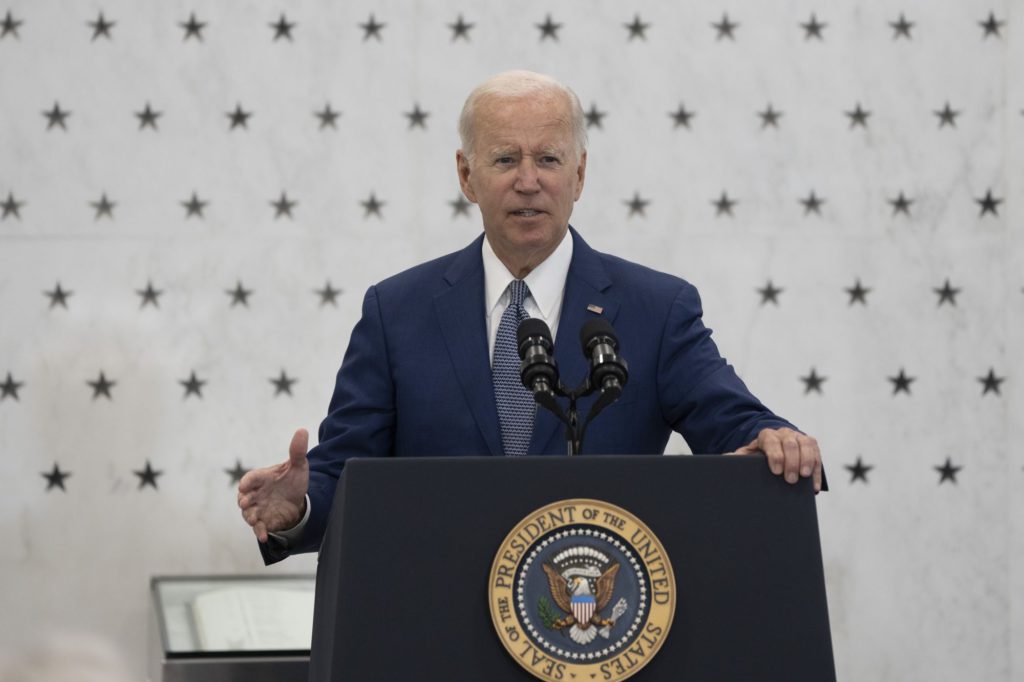
(Bloomberg) — President Joe Biden praised the Central Intelligence Agency’s efforts to expose Russia’s plans to invade Ukraine, telling the staff that they had “punched a gigantic hole” in President Vladimir Putin’s objectives. 

“It was thanks to the incredible work of our intelligence professionals that we were able to forewarn the world what Vladimir Putin was planning in Ukraine,” Biden said during his first visit as president to CIA headquarters in Langley, Virginia. “We saw what he was doing. You saw it, the forces he was amassing, the plans he was making.”

Biden has sought to restore ties with the CIA and the intelligence community that were damaged under President Donald Trump, who routinely cast doubt on the agencies’ findings and accused them of being part of a “deep state” determined to undermine him. 

The president said when he was out of office he “missed waking up every morning and seeing the PDB,” referring to the high-level national security briefing materials produced by the intelligence community for the president and other top US officials.

In the prelude to Russia’s Feb. 24 invasion of Ukraine, Biden and administration officials publicized the typically secretive work of the CIA, in an effort to warn Kyiv and the rest of the world of Putin’s intentions.

Read More: U.S. Spies Made Right Call on Russia Invasion, Buying Biden Time

Biden authorized the declassification of information regarding Russian troop movements and even Putin’s thinking before the assault began. The information was credited with robbing the Kremlin of the element of surprise, as well as building international support for sanctions against Russia and military aid to Ukraine.

The visit commemorated the 75th anniversary of the CIA, founded in the years after World War II, and thank officers for their work.

“So often you have to keep your identity secret, sometimes even in death, that we don’t get a chance to thank you enough for all that you do,” Biden said. “For 75 years, our nation’s intelligence professionals have worked unceasingly and sacrificed willingly to make our country safer.”

“Exposing Putin’s playbook punched a gigantic hole in the pretense and discredited his lies about what we were doing in Ukraine,” he added. 

The successful disclosures helped bolster the credibility of US intelligence that had been damaged during the Iraq War, and at a time when officials are warning of grave threats posed by Russia and China. 

US officials, however, have admitted that they underestimated Ukraine’s ability to defend itself even after they accurately predicted an invasion. 

The Ukraine crisis unfolded after the CIA had been caught up in Washington finger-pointing following last summer’s Taliban victory of Afghanistan and the disastrous US withdrawal following two decades of war. 

Intelligence agencies are conducting internal reviews after the US predicted that Afghan President Ashraf Ghani would hold on to power for months. Instead, he fled the country as the Taliban entered the capital, Kabul. 

Read More: Trump Rejects Notion of Feud With CIA in Day-One Visit

Biden’s appearance on Friday contrasted sharply with Trump’s first presidential visit to CIA headquarters in January 2017, right after he took office, an event that encapsulated his tense relationship with the intelligence services. 

Standing in front of a wall of stars commemorating agency officers who died in service to their country, Trump delivered a rambling speech in which he lashed out at the news media, mused on the crowd size at his inauguration the day before and suggested he would loosen rules on torture put in place by President Barack Obama. 

He rejected the notion that he had been in a “feud” with the intelligence community over its investigation into Russian hacking of Democratic Party officials’ email accounts during the 2016 campaign. After winning election, Trump had repeatedly questioned the community’s findings.

More stories like this are available on bloomberg.com

©2022 Bloomberg L.P.

Rogers Apologizes as Network Collapse Paralyzes Canadian Business, Consumers

(Bloomberg) — Rogers Communications Inc. apologized to customers after a major network failure shut down wireless and internet services, causing problems for payment systems, automated teller machines and phone connections in Canada.

The network collapse started early Friday morning and continued into the afternoon. The company gave no hints on the source of the problem but said it was making progress on solving it. “We know how much you rely on our networks. Today we have let you down,” the company said on Twitter at 3:20 p.m. Toronto time. 

Kye Prigg, an executive in Rogers’ networks division, told Canadian Broadcasting Corp. that he couldn’t say when the system will return to normal. Greg Fergus, parliamentary secretary to Prime Minister Justin Trudeau, told the news outlet the government does not believe it was the result of a cyberattack. 

The long disruption is a black eye for the country’s largest wireless provider, which is trying to persuade regulators to allow it to buy an even larger share of Canada’s telecommunications infrastructure. Rogers is in the process of an acquisition of Shaw Communications Inc., a C$20 billion ($15.4 billion) deal that would give it control over wireline and wireless networks that serve millions of customers in western Canada and the central province of Ontario. The deal still requires the approval of the country’s antitrust body, which opposes it, and the federal government. 

Royal Bank of Canada said the network failure was affecting all financial institutions in Canada. Interac, a payment system that’s used by all the banks, said the problems hit its debit card and funds-transfer services. 

Desjardins Group, which serves 7.5 million people, mostly in Quebec, said electronic funds transfers weren’t available. “Rogers customers who attempt to use our services may encounter certain difficulties. We recommend our members and customers to use our ATMs if they need cash,” spokesman Jean-Benoît Turcotti said. 

Some government offices also lost their connections — including the Canadian Radio-television and Telecommunications Commission, the agency that regulates communications services, which said on Twitter that its phone lines weren’t working properly. 

The outage has impacted the work day of businesses and executives all across Canada. Sameer Uplenchwar, chief financial officer of HeliosX Lithium & Technologies Corp., said he had to cancel plans to attend events at the Calgary Stampede and stay home because he cannot risk being disconnected from work. 

“It’s kind of a blessing in disguise that Western Canada doesn’t have Rogers at home right now,” said Uplenchwar, who uses Telus Corp., a Shaw competitor, for his home internet connection. 

Police services in places including Toronto and Waterloo, Ontario, alerted the public that Rogers customers may have difficulty connecting with 911. 

Air Canada said its call centers were hit by the glitch, just as the airline is dealing with a wave of flight delays and cancellations amid a labor crunch in the aviation sector. Travelers entering Canada were also having issues completing information on an app used by the country’s border agency. 

(Updates with comments from Rogers official and government official in third paragraph.)

More stories like this are available on bloomberg.com

©2022 Bloomberg L.P.

Banks, Payments Hit as Rogers Suffers Major Network Failure in Canada

(Bloomberg) — Rogers Communications Inc. apologized to customers after a major network failure shut down wireless and internet services, causing problems for payment systems, automated teller machines and phone connections in Canada.

The network collapse started early Friday morning and continued into the afternoon. The company gave no hints on the source of the problem but said it was making progress on solving it. “We know how much you rely on our networks. Today we have let you down,” the company said on Twitter at 3:20 p.m. Toronto time. A Rogers spokesperson couldn’t be reached for comment. 

The long disruption is a black eye for a company that’s trying to persuade regulators to allow it to buy an even larger share of Canada’s telecommunications infrastructure. Rogers is in the process of trying to acquire Shaw Communications Inc., a C$20 billion ($15.4 billion) deal that would give it control over wireline and wireless networks that serve millions of customers in western Canada and the central province of Ontario. 

Royal Bank of Canada said the network failure was affecting all financial institutions in Canada. Interac, a payment system that’s used by all the banks, said the problems hit its debit card and funds-transfer services. 

Desjardins Group, which serves 7.5 million people, mostly in Quebec, said electronic funds transfers weren’t available. “Rogers customers who attempt to use our services may encounter certain difficulties. We recommend our members and customers to use our ATMs if they need cash,” spokesman Jean-Benoît Turcotti said. 

Some government offices also lost their connections — including the Canadian Radio-television and Telecommunications Commission, the agency that regulates communications services, which said on Twitter that its phone lines weren’t working properly. 

The outage has impacted the work day of businesses and executives all across Canada. Sameer Uplenchwar, chief financial officer of HeliosX Lithium & Technologies Corp., said he had to cancel plans to attend events at the Calgary Stampede and stay home because he cannot risk being disconnected from work. 

“It’s kind of a blessing in disguise that Western Canada doesn’t have Rogers at home right now,” said Uplenchwar, who uses Telus Corp., a Shaw competitor, for his home internet connection. 

Police services in places including Toronto and Waterloo, Ontario, alerted the public that Rogers customers may have difficulty connecting with 911. 

Air Canada said its call centers were hit by the glitch, just as the airline is dealing with a wave of flight delays and cancellations amid a labor crunch in the aviation sector. Travelers entering Canada were also having issues completing information on an app used by the country’s border agency. 

(Updates with additional information from the first paragraph)

More stories like this are available on bloomberg.com

©2022 Bloomberg L.P.

Voyager Judge Gets a Lesson in Crypto as Bankruptcy Case Kicks Off

(Bloomberg) — The judge overseeing crypto lender Voyager Digital Ltd.’s first-of-its-kind bankruptcy got a crash course in digital assets on Friday in the company’s first appearance in court.

Judge Michael Wiles, who said he’s relatively new to crypto, received a real-time primer on concepts like staking and stablecoins from a lawyer for Voyager. The crypto platform filed for Chapter 11 protection earlier this week, and its users likely won’t get all of their holdings returned.  

Both the lawyer and Wiles acknowledged the murky legal questions hanging over the case — like how, exactly, a bankruptcy court should treat digital assets. 

“I think for many of us this is unchartered territory,” Joshua Sussberg, a Kirkland & Ellis lawyer representing Voyager, said in the hearing. “There will be many potential legal issues of first impression.”

Wiles quickly dug into Voyager’s relationship with account holders, pressing Sussberg for details on whether the company acts as a custodian for customer money or whether users are more like depositors at a bank. Of particular interest to Wiles is the $350 million held by Metropolitan Commercial Bank on behalf of customers. 

“That money belongs to those customers and will go to those customers,” Sussberg said, adding that the company will have to sort through who owns what and conduct a fraud prevention process before returning the money. 

As for the rest of Voyager’s assets — including $1.3 billion of commingled crypto — the company plans to gives users a yet-undetermined slice of the crypto they’re owed, stock in Voyager, tokens tied to the platform and their share of any money recovered from now-bankrupt hedge fund Three Arrows Capital. 

That plan could change if Voyager is able to find a buyer for its business. The company has identified “some interested parties” and will continue to pursue a sale, Christopher Marcus of Kirkland & Ellis said in the hearing. In the meantime, Voyager is parrying threats to it business like banks trying to close their accounts, states trying to void their money transmitter licenses, and angry customers threatening the company’s management.

“We are focused on a path forward,” Marcus said. “It is not correct to think that there is no hope.”

The bankruptcy is Voyager Digital Holdings Inc., 22-10943, U.S. Bankruptcy Court for the Southern District of New York (Manhattan).

More stories like this are available on bloomberg.com

©2022 Bloomberg L.P.
Google Offers Concessions to Thwart US Antitrust Case, WSJ Says

(Bloomberg) — Alphabet Inc.’s Google has offered concessions to change certain aspects of its advertising business in an attempt to head off a possible US antitrust lawsuit, the Wall Street Journal reported Friday.

Google has proposed splitting part of its business that auctions and places ads on websites and apps into a separate company that would still remain under the Alphabet umbrella, the newspaper reported, citing people familiar with the matter. That new unit could possibly be valued at tens of billions of dollars, depending on what assets it contained, according to the Journal.

“We have been engaging constructively with regulators to address their concerns,” a Google spokesperson said. “As we’ve said before, we have no plans to sell or exit this business, and we’re deeply committed to providing value to a wide array of publisher and advertiser partners in a highly competitive sector. Rigorous competition in ad technology has made online ads more relevant, reduced fees, and expanded options for publishers and advertisers.

The US Department of Justice declined to comment.

The Justice Department has been conducting a long-running investigation into Google’s digital advertising practices amid allegations that the search giant abuses its position as both a broker and auctioneer of digital ads, allowing it to funnel business to its sites at the expense of rivals. Google has disputed that it dominates the ad tech market, arguing that the space is crowded with major companies competing for business. 

The department is preparing a lawsuit alleging Google’s ad-tech practices are anticompetitive, and could file it as soon as this summer, the Journal said.

(Updates with comment from Google)

More stories like this are available on bloomberg.com

©2022 Bloomberg L.P.

Tegna Deal Won’t Lead to Newsroom Job Cuts, Standard General Tells FCC

(Bloomberg) — Standard General LP rejected arguments its purchase of broadcaster Tegna Inc. would lead to newsroom job cuts and higher cable-TV bills, telling regulators the deal would benefit the public.

The proposed transaction, worth $5.4 billion, excluding debt, would bring Tegna under management with “a proven track record of enhancing stations’ service to their local communities,” Standard General told the Federal Communications Commission in a July 7 filing posted Friday on the agency website.

Standard General has said that Deb McDermott, who has more than 20 years of experience in broadcast TV, will become CEO of the business. Tegna owns 64 TV stations. Cox Media Group, an Apollo Global Management Inc. affiliate, and Tegna, joined in the filing. A fund managed by Apollo is investing in the deal.

The transaction, proposed in February, needs approval from the FCC, which is in a 2-to-2 partisan split as a nominee who would give Democrats a majority awaits Senate confirmation. The agency is led by Chairwoman Jessica Rosenworcel, a Democrat selected by President Joe Biden, whose administration has criticized mergers that lead to “excessive concentration.”

Pay-TV providers earlier told the FCC that the transaction could lead to higher fees for cable companies and their subscribers, and labor groups said there could be newsroom cuts.

The applicants pushed back, saying competitive pressure from online providers can check price increases by pay-TV providers.

“Newsroom staff cuts are not part of Standard General’s plan for the post-transaction,” the companies said in the filing.

More stories like this are available on bloomberg.com

©2022 Bloomberg L.P.

Close Bitnami banner
Bitnami