
Bloomberg

Carmakers Start to Starve Combustion Models Out of Existence

(Bloomberg) —

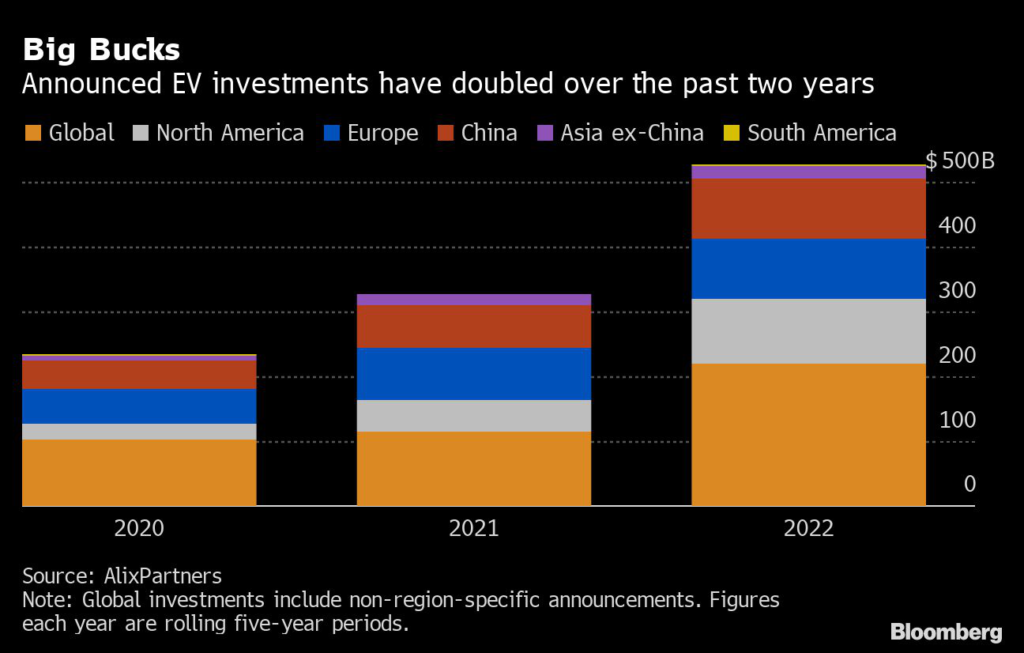
Automakers have announced a whopping $526 billion collective investment in electric vehicles through 2026, more than double the amount they mapped out over a similar forward time frame a couple years ago.

Since the industry isn’t doubling its total capital spending, all that investment in EVs — tallied by consulting firm AlixPartners — will come at the expense of development dollars for new and redesigned internal combustion engine vehicles.

Makes sense, right? The hot growth is in EVs. But hang on. General Motors has said it aspires to go all-electric by 2035, and other companies are saying 2040 or later. That means consumers will be able to buy a brand new gasoline-burning vehicle for another 15 or 20 years.

If models running on fuel will be available that far into the future, but most of the investment is going into EVs, auto dealers will be selling some very stale sets of wheels in the coming years.

What will those cars look like? For starters, automakers will not be investing in sprucing up their powertrains. Engines and transmissions are going to get awfully long in the tooth, since automakers can now see a point at which they’ll be phasing them out altogether.

Changes to powertrains will be done for reasons of efficiency and to meet tougher emissions rules, not to make cars faster or smoother.

Styling also could take a back seat. As carmakers watch sales of their combustion models decline, they’re more likely to tweak on the margins, rather than go through the rigmarole of complete redesigns. Mark Wakefield, who runs AlixPartners’s auto industry practice, said some vehicles could get the kind of freshening that costs $100 million or so. All-new models tend to cost $1 billion or more.

BofA Global Research recently forecast in its closely watched Car Wars report that by 2026, the US market will have about 135 different EVs for sale, and an equal number of internal combustion vehicles.

If automakers spend less on their traditional models, those cars could eventually become more of a bargain hunter’s option for consumers who can’t afford EVs, or don’t have plentiful access to charging infrastructure.

This could also mean some interim pain both for automakers and their suppliers, who will start to struggle as sales volumes drop. AlixPartners estimates it could cost the big manufacturers and their Tier 1 suppliers $70 billion between now and 2030 to either fund new sources of internal combustion vehicle parts, or help vendors survive the transition.

As for profits, this too will get tricky. As EV volumes rise, margins should get better. Tesla has certainly proven EVs can make money when sold in big numbers. ICE margins could get worse with lower volumes, but BofA analyst John Murphy sees lower investment helping preserve profits.

All of these shifting dynamics could accelerate consumer interest in EVs. While ICE vehicles go begging for investment and get fewer styling changes, they’ll be less compelling. Consumers will look at new EVs with fresh styling, faster acceleration and smoother ride and vote with their wallets.

After test driving EVs, going back to a gasoline-burning SUV will feel like driving a tractor, Wakefield said. Think about consumers and their smartphones. A decade ago, only a third of Americans used them. As more people tried them, flip phones seemed so yesteryear awfully quick.

More stories like this are available on bloomberg.com

©2022 Bloomberg L.P.

Kids in Business Suits Drive Record Sales of ‘Minions’ Film

(Bloomberg) — Australian teen Bill Hirst timed it right last week when he posted a clip on TikTok of himself and other youngsters in business suits headed to the opening of “Minions: The Rise of Gru.”

Within hours, the video had reached 10,000 views. By morning it hit 6 million. Now, it’s nearing 37 million — and counting — one of scores of “Minions”-related postings to go viral and help turn the Universal Pictures film into one of the year’s big hits.

Click here to see the TikTok video

It’s a happy ending for Universal, part of Comcast Corp., and Illumination Entertainment, the animation studio that made the picture. Executives at the production company spent the past couple years building a following for “Minions” on TikTok to see how it might influence turnout for the film. Illumination, run by Chris Meledandri, had long wrestled with how to sustain interest in its movie franchises between releases.

While Walt Disney Co. engages its fans year-round with TV shows, theme parks, toys, and fan events, Illumination goes comparatively quiet in between movie hits like the “Minions” predecessor “Despicable Me” and “The Secret Life of Pets.”

TikTok, a social-media platform for user-generated clips, provides a sweet spot for companies looking to reach young consumers. That proved especially true with the latest “Minions” film, which features a neatly clad supervillain named Gru and the namesake sidekicks. 

Illumination posted its first video to the “Minions” account in February 2020, ahead of the original release date for the film. When the pandemic delayed the debut, Illumination kept posting. The clips included videos featuring the minions and star Steve Carell, who provides the voice of Gru. The audience grew to more than 4 million people.

Then last week, social media interest exploded — driven by clips of teens showing up at theaters dressed like Gru, in business suits, ties and dark sunglasses. The hashtag “minioncult” attracted more than 390 million views, while the hashtag “gentleminions” drew more than 47 million.

Participants often mimicked Gru’s evil pose -– their hands clasped and held under their chins. Some showed up at the theaters with a snack adored by the “Minions” characters: bananas.

Hirst, the Australian teen, credits a friend for coming up with the idea to be part of the trend. Once they arrived at the theater, they saw they weren’t alone.

“We saw another group that was dressed up as minions,” Hirst said. “And then we also saw a smaller group in suits as well, so we just started mingling with them.” 

Sales Record

The result has been record sales for the summer release. In the US “Minions: The Rise of Gru” brought in holiday weekend revenue of $123.1 million, the most for a Fourth of July release. The global sales tallied $248 million as of Thursday, according to Box Office Mojo.

Illumination’s marketing efforts have played a big role. Yeat, a rapper with a penchant for going viral on TikTok, released a song titled “Rich Minion,” which was later used by the company to promote the film. Many teens subsequently embedded the tune in their TikTok videos under the gentleminions hashtag.

Such collaborations have helped the film attract a large teen audience, with 13- to 17-year-olds making up over 30% of the movie’s opening weekend audience, according to Shawn Robbins, chief analyst with Boxoffice Pro.

“That’s exactly the audience that grew up with the original ‘Despicable’ movies when they started coming out a little over a decade ago,” Robbins said. “Wherever the trends are starting, which is largely on TikTok, that’s often going to be a good indicator of where there might be breakout potential for an audience.”

Despite the overwhelming enthusiasm from fans across the globe, not all cinemas are welcoming the throngs. 

The British publication the Guardian reported some theaters were barring unaccompanied children wearing suits because some groups had been loud and disruptive, making it hard for others to enjoy the movie.

A spokesperson for the Odeon chain told the newspaper that the company had to restrict access in some places “due to a small number of incidents.”

More stories like this are available on bloomberg.com

©2022 Bloomberg L.P.
SPAC Investors Are Eyeing New Targets: Good Companies That Grow

(Bloomberg) — The SPAC market is off to a brutal start to 2022, but a few bright spots with key similarities may point to a way out of the morass — find solid businesses with room to grow.

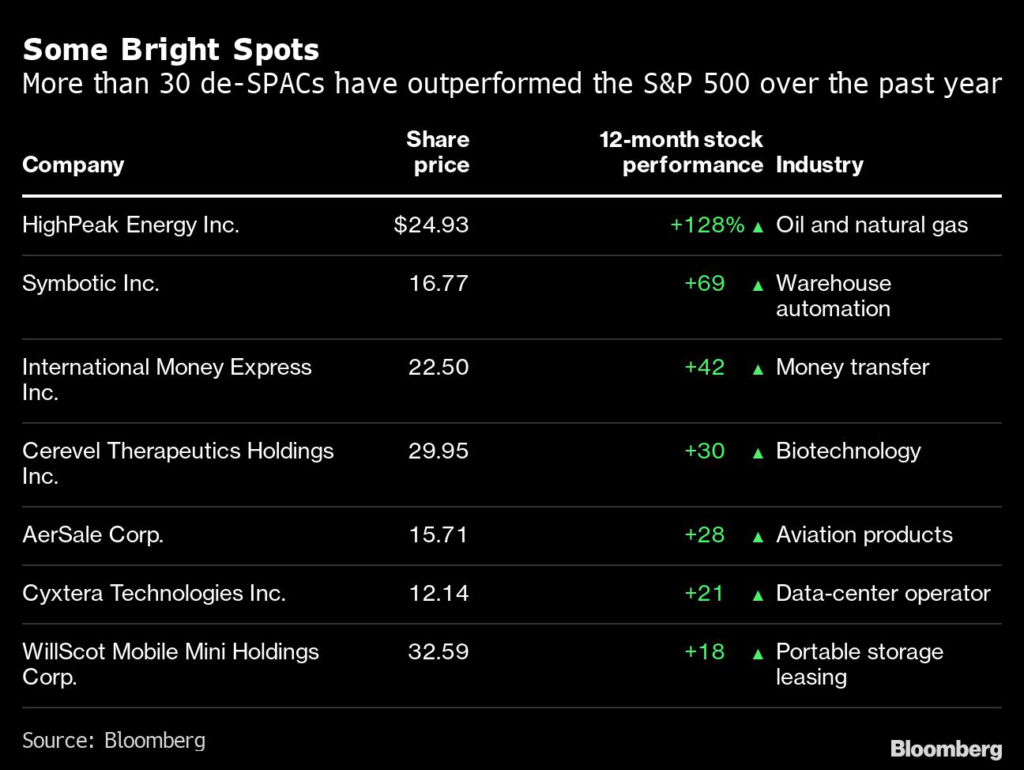
HighPeak Energy Inc., an oil and gas company, has doubled over the past year as crude prices surged. Warehouse automation firm Symbotic Inc.’s rally makes it the best performer among firms that went public by merging with a special-purpose acquisition company this year. And WillScot Mobile Mini Holdings Corp. analysts remain overwhelmingly optimistic on its outlook even after it tripled since its 2017 debut.

Of the 375 firms that went public by merging with a SPAC in the last five years, just 34, or less than 10%, have outperformed the S&P 500 Index over the past 12 months, according to data compiled and analyzed by Bloomberg. The group’s median gain of 5.6% is a sign that SPACs can be viable financing vehicles when properly used. 

Many of the top de-SPACs have the same characteristics: revenue generation paired with expectations for further growth, Bloomberg data show. Mergers and expanded ventures have bolstered many of the companies, while experienced SPAC sponsors that are dedicated to building out the businesses are showing they can drive success rates. 

“Platform stocks are good examples of companies that management and sponsors of the SPAC aren’t just bringing public as a partial exit, but have real plans to develop it,” said Alex Gavrish, chief executive officer of research firm Etalon Capital. 

WillScot Mobile is a prime example of a de-SPAC that has made a string of deals to transform into a platform company, making it more attractive to investors, he said. Bowlero Corp., up 21% from a December debut, has outperformed and carries a reasonable valuation with the potential to benefit from the recovery of the entertainment industry, Gavrish said.

This is not the case for most of the companies that cashed in on the SPAC craze over the past two years, which were largely in fast-growing, speculative industries like cryptocurrencies and electric vehicles. As a result shareholders suffering dizzying bouts of volatility and big selloffs. 

A glut of deal-needy sponsors paired with a looming wall of deadlines has pushed SPACs to target companies that are generating revenue now over those burning cash in hopes that investors will stick around. Online jeweler Blue Nile Inc. will go public through a tie-up with Mudrick Capital Acquisition Corp. II, while rental home company Appreciate agreed to merge with PropTech Investment Corp. II.

SPACs are called blank checks because they raise cash through a public offering with the goal of buying a private business, which is chosen later, within a certain time time frame, typically about two years. When the stock market was setting records, an insatiable demand for SPACs created a backlog. Now more than 700 need to find or close deals, nearly twice the number of successful mergers that have been completed since 2019. 

The SPAC industry has been hit by heightened regulatory scrutiny and a broader risk-off investing environment where money managers are shying away from money-burning companies. One basket of 25 risky former SPACs has shed 82% from a peak early last year, and the IPOX SPAC Index, a group of both current and former SPACs has been nearly cut in half over that stretch. 

“In 2022, the market has favored companies with positive free cash flow,” said Benjamin Kwasnick, founder of SPAC Research. “And the stock prices of growth companies that aren’t yet profitable have struggled.”

More stories like this are available on bloomberg.com

©2022 Bloomberg L.P.
TCS Profit Misses Estimates as Recession Fears Hit IT Spending

(Bloomberg) — Tata Consultancy Services Ltd. posted disappointing earnings after fears of a global recession spurred sharp cutbacks in technology spending.

Asia’s largest IT services company reported net income of 94.8 billion rupees, versus the 99.04 billion rupees average of analysts’ projections. Revenue rose 16% to 527.6 billion rupees.

TCS and smaller rival Infosys Ltd. are grappling with rapidly shrinking IT budgets as corporations around the world gauge the potential for a recession. European companies in particular may pull back more than in the US, given the war in Ukraine as well as heightened inflation across the region. 

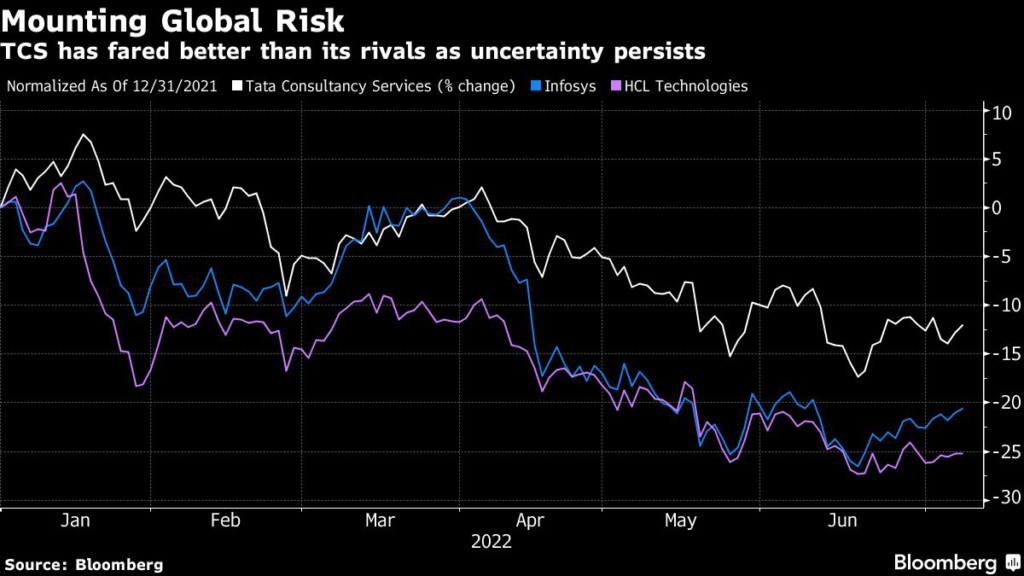
Europe accounts for about a third of TCS’s revenue. But the company has been trying to manage wage inflation while shopping newer cloud services to US clients, particularly in the finance sector. The company has shed more than 10% of its market value in 2022, outperforming Infosys.

What Bloomberg Intelligence Says

Tata Consultancy Services may indicate a pullback in discretionary IT spending fueled by rising macroeconomic issues, which in turn could lead to a slowdown in large contract signings. Though we expect IT spending to remain steady in the financial services vertical, it’s possible that clients in retail and transportation pull back some. Europe could also be an area where new projects see delays, especially those tied to legacy technologies. North America could continue to show strong appetite for emerging technologies, especially cloud.

– Anurag Rana, analyst

Click here for the research.

The June quarter is typically a strong period for the company, said Kotak Institutional Equities analyst Kawaljeet Saluja. Over the longer term, TCS’s efforts to expand its portfolio of newer digital services should support earnings.

TCS, which employs over half-a-million around the world, the bulk of them in India, doesn’t typically provide a sales outlook. Infosys in June gave a revenue projection that trailed analyst estimates, signaling slowing demand for software and IT services as companies exit work-from-home arrangements in a post-pandemic world. The company will report earnings later in July.


More stories like this are available on bloomberg.com

©2022 Bloomberg L.P.
Overnight 20% Price Jump Supercharges Argentine Inflation Crisis

(Bloomberg) — On Sunday morning, Argentines woke up early and rushed to the grocery store, the bakery, the liquor store, the mall, wherever they could go to stock up fast.

The night before a political bombshell had dropped: the economy minister, Martin Guzman, had suddenly resigned. And Argentines, long accustomed to financial chaos, knew the current crisis was about to get a lot worse. So before the peso could plunge when markets reopened, and before retailers could jack up prices, they wanted to buy the essentials as soon as possible. 

It became a race against inflation in a country that already had one of the highest rates anywhere — an annual 60% as of May. Argentina’s parallel exchange rate, untethered from the government’s strict currency controls, has fallen 17% so far this week, prompting Buenos Aires shop owners to post signs announcing a 20% mark-up on all listed prices. 

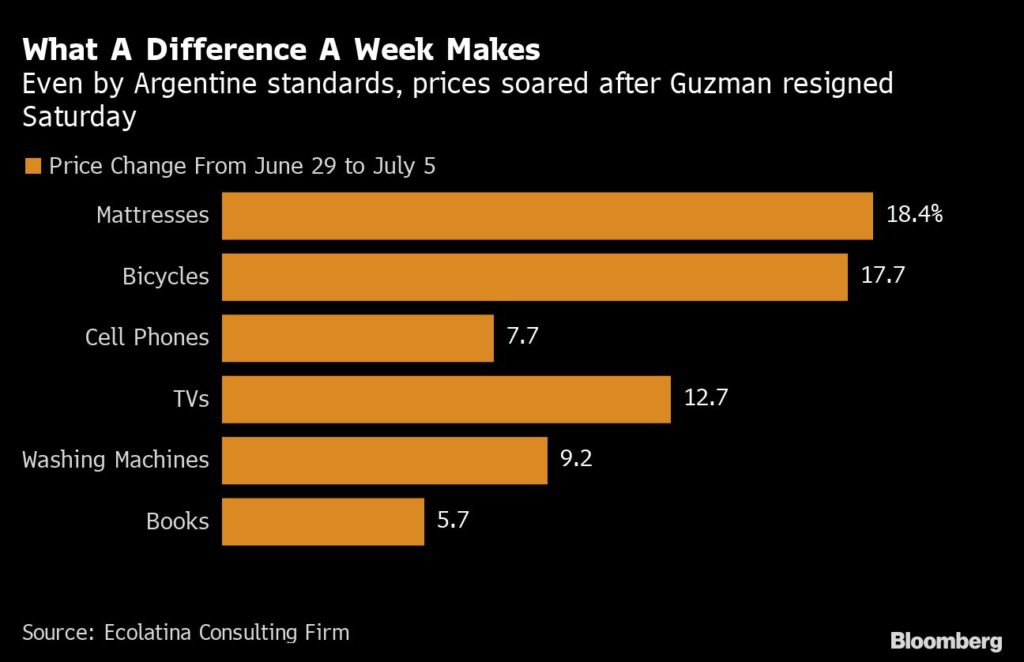
Prices on mattresses and bicycles jumped 18% in just one week, while TVs now cost 13% more and price tags on cell phones swelled 8%, according to high-frequency data analyzed by Buenos Aires-based consulting firm Ecolatina.

“Nobody has a strategy, we’re just living in the moment,” Maximiliano Martinez, manager of a small appliance store on a commercial strip in Buenos Aires, said Thursday afternoon. Like others, Martinez raised prices on all items in his store — coffee machines, toasters, blenders, headphones — by 20%. He says his suppliers immediately jacked up their prices by 35%. He’s looking to buy digital price tags, he said, because it’s becoming difficult to keep up with constantly rising prices. “I can’t get around to changing all the price tags.”

Even in a global economy suddenly roiled by inflation, this is extreme. And it raises the specter that the perennial inflation spiral here is entering a breakneck new phase that will heap more pressure on embattled President Alberto Fernandez and more pain on a population that’s been losing purchasing power for years.

Guzman, while no favorite of Wall Street, was seen as the guarantor of the government’s tenuous, and crucial, financing pact with the International Monetary Fund. The country’s hard currency reserves are dwindling; its foreign bonds, which were just restructured in 2020 after a third default this century, are trading at a mere 20 cents on the dollar; and the gap between the parallel exchange rate — 295 pesos per dollar — and the official exchange rate — 127 per dollar — has blown out to levels not seen since the last devaluation panic in 2020.

To make matters worse, Fernandez is locked in a turf war with his powerful vice president, Cristina Fernandez de Kirchner. Guzman got caught in the middle. His replacement, a little-known economist named Silvina Batakis, is seen as more aligned with Kirchner, a former president herself and the leader of the more radical and populist wing of the ruling coalition.

Do’s and Don’ts

You don’t want to be on Kirchner’s bad side, especially on prices. Just ask Federico Braun. The president of Argentina’s La Anonima supermarket chain joked at a business conference in June that he’s “marking up prices everyday” due to high inflation. That day, Kirchner and lawmakers loyal to her lashed out against him, sparking a public relations nightmare. 

It’s not just big names. Even small businesses fear customer backlash for hiking prices. One Buenos Aires bakery manager was raising prices once every two months last year. Now he’s looking to raise almost weekly. The manager, who asked not to be named for fear of losing customers, says so far this year his inputs have soared with butter prices up 80%, milk almost 100% and wheat 120%. 

The manager reported that customers rushed Sunday and Monday to buy bags of imported coffee beans, stocking up before prices spiked or shortages emerged. Business owners themselves are stocking up, too. Victor Natasi, owner of the Autre Monde wine shop in Buenos Aires, is doubling down on his strategy with his suppliers.

“The first thing is to buy high-end wines that gain value over time and have good shelf life before the price goes up,” says Natasi. If you don’t stock up fast, “there could be a sudden mark up of 20% to 30% from one day to the next.” 

More stories like this are available on bloomberg.com

©2022 Bloomberg L.P.
This High-Tech Trailer Delivers Green Power When Climate Disaster Strikes

(Bloomberg) —

When a wildfire, hurricane or heat wave strikes and the power grid fails, portable diesel generators are often fired up to provide electricity. That, however, adds environmental insult to injury as the highly polluting devices contribute to atmospheric warming that drives climate-related disasters.  

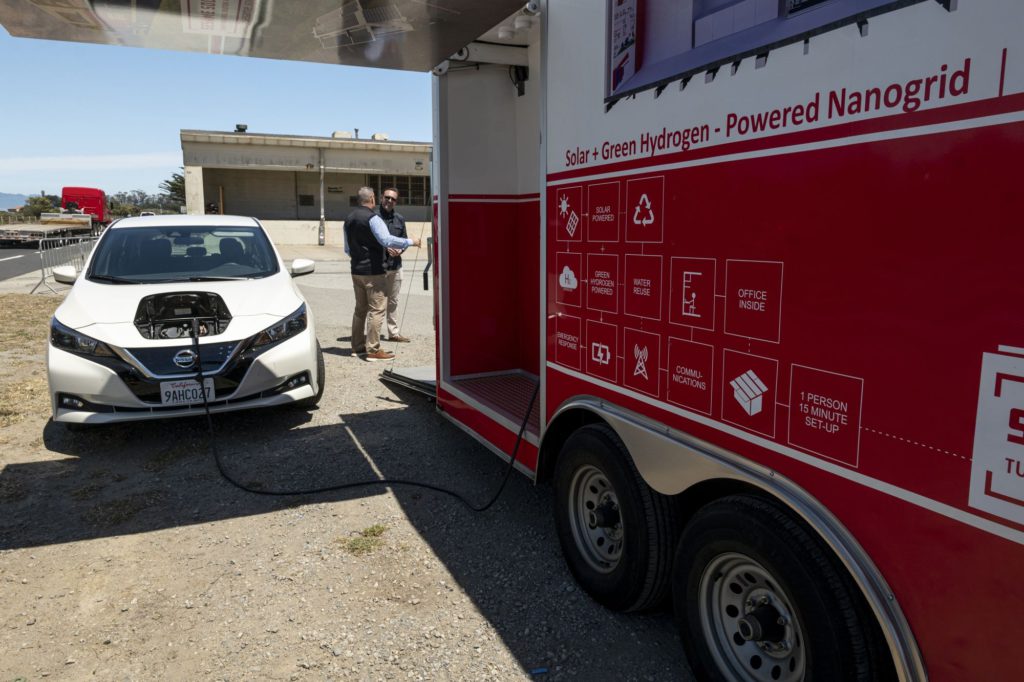
A demonstration of a solution to that conundrum recently rolled into San Francisco in the form of a 20-foot trailer that generates carbon-free electricity from onboard solar panels, battery packs and a fuel cell powered by green hydrogen. Called a Nanogrid by manufacturer Sesame Solar, the trailer can be towed – preferably by an electric pickup truck – to stricken communities to serve as a neighborhood power station, communications center or medical clinic.

“It’s the world’s first mobile renewable-powered Nanogrid,” says Sesame Solar co-founder Lauren Flanagan, standing outside the red-and-white demo trailer parked within view of the Golden Gate Bridge. A nanogrid is a self-contained energy-generation system that usually serves a single location, such as a building, or in this case, a trailer.

David Mallory, a manager in the enforcement division of the California Air Resources Board, says a large spike in the use of diesel generators by residents and companies in recent years in response to more frequent blackouts “is a big concern.” Besides their climate impact, diesel generators emit particulate matter that can cause heart and lung disease.

He says the agency, which is the state’s principal climate regulator, encourages companies to adopt low-to-no emissions technology like Sesame Solar’s Nanogrid. “That’s exactly the kind of thing that we’re interested in,” says Mallory. “We think that this is an example of a good alternate technology that we hope will begin to be used in the future as opposed to diesel engines and other more emitting technologies.”

Sesame’s Nanogrids sell for between $100,000 and $300,00, depending on their size and power capacity. Flanagan says the company anticipates eventually offering Nanogrids as a service where trailers could be deployed as needed, for instance, during hurricane season.

The Nanogrid is not necessarily designed to keep the lights on in individual homes but to give corporations, relief agencies and governments the ability provide essential services after a disaster. Telecommunications companies have deployed Nanogrids to provide internet service during blackouts while a humanitarian organization used a Nanogrid as a mobile medical clinic after a 2017 hurricane struck the Caribbean country of Dominica. Over the past five years, Jackson, Michigan-based Sesame has sold nearly 60 Nanogrids. The US Air Force and Comcast Corp. are among the company’s customers.

The addition of green hydrogen to its newest model means the Nanogrid can operate fossil-fuel free continuously in a disaster area. Sesame says it has no known direct competitors that offer completely renewable mobile backup power.

The Nanogrid that was on display in San Francisco generates 4-kilowatts of electricity from solar panels installed on the roof and on retractable wings. The panels charge batteries that can store about 40 kilowatt-hours of electricity. (Other models produce between 3 kilowatts and 20 kilowatts with up to 150 kilowatt-hours of storage.)

A fuel cell supplies electricity to keep the batteries charged when the sun is not shining. The hydrogen that powers this trailer’s 4-kilowatt fuel cell is produced by an onboard electrolyzer that uses solar-generated electricity to split water molecules into hydrogen and oxygen. The system can store about 2 kilograms of compressed hydrogen gas and the trailer carries a seven-day supply of water for the electrolyzer.

Flanagan says the extra generating capacity provided by the fuel cell means less battery storage is needed, reducing the trailer’s construction cost. The Nanogrid can also serve as a 5G Wi-Fi hotspot and power water purification systems.

“If there’s a wildfire and there’s a lot of smoke in the air, the solar is going to operate at lower efficiency,” says Flanagan, Sesame’s chief executive officer. “If you have a huge demand for power, you can just run off the green hydrogen fuel cell.”

The Nanogrid in San Francisco featured a Level 2 electric vehicle charger that was plugged into a Nissan Leaf. More intense and widespread wildfires in recent years have destroyed not just electrical infrastructure but gas stations and fuel depots. Flanagan pointed out that a Nanogrid hitched to an electric truck, such as a Ford F-150 Lightning, could keep the vehicle fully charged during relief operations, though towing a large load like a trailer would reduce its range.

The interior of this Nanogrid has been configured as an office with workstations, a whiteboard and a bathroom. The electrolyzer sits in a cabinet next to the water tank.

EnerSys, an industrial battery and energy storage technology company, has purchased Nanogrids from Sesame for deployment by its customers, including large telecoms.

“When something catastrophic comes through and takes all of the power down, both businesses and households are looking for connectivity,” says John Hewitt, vice president, broadband communications, at EnerSys.

“We’ve done ones for providing wireless access, as well as powering portable showers and toilets for first responders,” he adds.

Hewitt says he expects that the growing frequency of weather-related disasters as well as society’s dependence on high-speed internet access to drive sales of backup power systems like Nanogrids.

“Being diesel-free is a significant benefit,” he says.

More stories like this are available on bloomberg.com

©2022 Bloomberg L.P.
Bitcoin Is on Course for Its Biggest Weekly Gain Since October

(Bloomberg) — Bitcoin is on course for its best weekly gain since October last year, helped by a return of risk appetite in global markets more broadly.

The largest cryptocurrency by market capitalization was up more than 13% for the week so far as of 10:33 a.m. on Friday in London. It gave up some gains after briefly trading above $22,000, as news of the killing of former Japanese Prime Minister Shinzo Abe triggered a stock market retreat. 

Read more: US Index Futures Slide; Abe’s Death Shocks Traders: Markets Wrap

Other tokens like Ether, Avalanche and Solana have also had a strong run in recent days, helping to take the overall market value of cryptocurrencies back close to $1 trillion, according to CoinGecko data.

A stocks rally is providing much-needed relief for battered virtual coins amid the positive correlation between the two asset classes. Bitcoin remains more than 50% lower in 2022, hurt by monetary tightening and a string of blowups in a digital-asset sector that’s still sobering up after binging on leverage.

“Risk markets are up across the board” and thus “it’s not surprising that crypto is trading higher,” said Ben McMillan, chief investment officer at IDX Digital Assets. “After a cascade of bad news and large liquidations, many crypto investors are still sitting on the sidelines waiting for the next shoe to drop.”

A barrage of economic risks and the threat of more de-leveraging remain a concern in crypto. News that customers of bankrupt broker Voyager Digital Ltd. likely won’t get all their money back has struck a new kind of fear into investors who have typically been able to stomach big market downturns. 

“A lot of the institutional holders of Bitcoin may be particularly sensitive to the general way that the economy is moving,” said Jared Madfes, partner at Tribe Capital.  

If the US jobs report Friday “comes back really weak, inflation comes back even worse, and it looks like a number of the geopolitical issues that are influencing the prices on a number of these core economy assets are not improving, I can’t imagine that that is short-term bullish for Bitcoin,” Madfes said.

(Updates with latest Bitcoin move in second paragraph.)

More stories like this are available on bloomberg.com

©2022 Bloomberg L.P.
India’s Route: Crypto Regulation Through Taxation

  • Listen to Bloomberg Crypto on the iHeartRadio App
  • Listen to Bloomberg Crypto on Apple Podcasts
  • Listen to Bloomberg Crypto on Spotify 

(Bloomberg) — It feels like every country in the world is figuring out how they want to regulate crypto — or if they’ll even allow it to exist at all.  India is seen as one of the fastest-growing markets for crypto trading, something its government isn’t too keen about. Bloomberg reporter Sidhartha Shukla joins me today to discuss India’s complicated history of crypto regulation, why they’re turning to taxes to curb speculation on the asset classes, and the potential lessons for other countries.

Follow us on Twitter @crypto, and subscribe to the Bloomberg Crypto Newsletter at https://bloom.bg/cryptonewsletter

More stories like this are available on bloomberg.com

©2022 Bloomberg L.P.
Yellen Heads to Asia With Russia Oil-Price-Cap Top of Mission

(Bloomberg) — Treasury Secretary Janet Yellen is heading out on her first trip to Asia since taking office, aiming to use sit-downs with global counterparts to help build momentum for a complex effort to cap prices for Russian oil.

Yellen, who previously traveled to the region as Federal Reserve chair, departs Saturday on a 10-day trip that includes stops in Tokyo and Seoul. In between, she’ll attend the Group of 20 finance ministers gathering in Bali, Indonesia, July 15-16.

The trip poses a fresh economic-diplomacy challenge for the Treasury chief, who led talks last year on a global corporate-tax deal — though one that’s now proving a struggle to complete. Group of Seven leaders last week instructed their ministers to explore the Russia oil-price-cap plan favored by the US, putting Yellen’s role in the spotlight.

The aim is an arrangement to ban, by the end of this year, the insurance and transport services needed to ship Russian crude and petroleum products unless the oil is purchased below an agreed price.

Read More: US, Allies Discuss Capping Russian Oil Price at $40-$60 a Barrel

US Treasury officials signaled that the price cap is a central focus of the trip, saying Yellen would pursue the topic at each of her three stops. Speaking to reporters Thursday, they added that US officials have been discussing the plan with a growing circle of governments, without offering specifics.

The goal is to limit the revenue Moscow earns from oil exports without driving Russian oil off the global market, and thus causing prices to once again soar. But critics have called it too complex to work in practice. It’s also unclear whether countries like China and India, both G-20 members who are among the largest buyers of Russian oil, would cooperate.

Meantime, Russia’s expected presence at the G-20 meetings could prove contentious — as was the case at a spring gathering in Washington — preventing the group from issuing an official communique. Those statements are typically stuffed with watered-down language on general goals, but can signal progress toward coordinated action on pressing global issues. 

“It’s hard to see how a group like the G-20, with Russia as a member, is going to agree on much of anything,” said Matthew Goodman, senior vice president for economics at the Center for Strategic and International Studies in Washington. “Half of the people won’t agree to anything with Russia in the room, and the other half won’t agree to anything without Russia in the room.”

Yellen’s focus may be forced to shift somewhat to the bilateral and small group meetings to advance the Biden administration’s agenda, Goodman said.

US Secretary of State Antony Blinken appears to be taking a similar approach this week at a gathering of G-20 foreign ministers.

Among Yellen’s expected other priorities on the trip:

  • Maintaining the international alliance that’s imposing sanctions on Russia over its invasion of Ukraine
  • Keeping alive the somewhat troubled pact on global corporate taxes
  • Urging progress on pandemic preparedness, climate change and food security
  • Doing more to help heavily indebted countries as they struggle with a strengthening US dollar and slowing global growth

On the debt-relief front, China has proved a challenge for Yellen and her developed-nation counterparts. Beijing, the dominant official lender to poor countries, has shown little enthusiasm for a new G-20 program, known as the Common Framework, meant to streamline the process of organizing creditors to act jointly with struggling debtors.

At a meeting in Bonn, Germany last month, G-7 finance ministers called out China, urging it to “contribute constructively” on debt treatment.

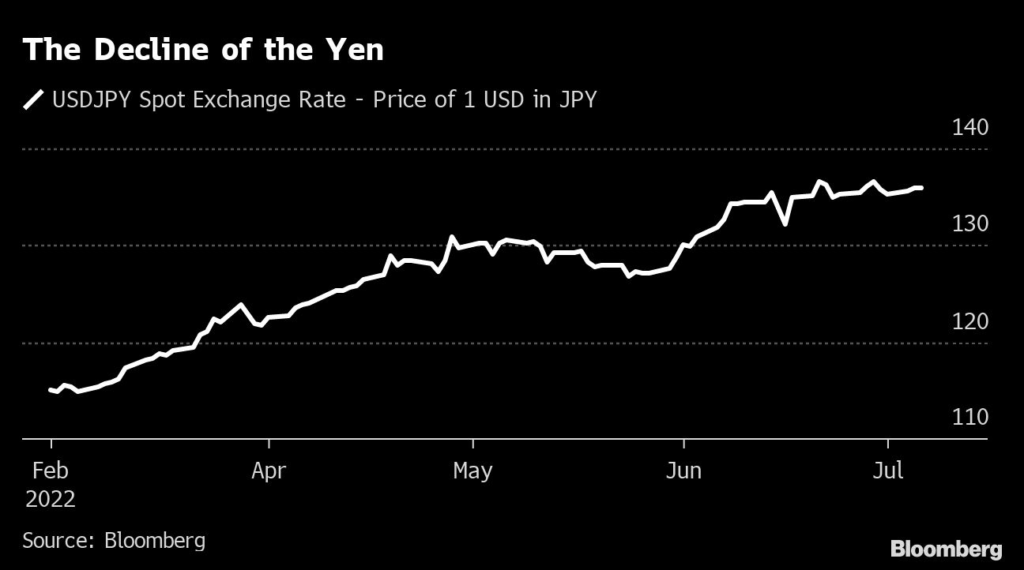
On her first stop, in Tokyo July 10-12, Yellen will likely hear concerns about the strengthening of the US dollar against the yen in recent months. Japan’s currency has tumbled in recent weeks to the lowest since 1998, in a trend that’s sapped household purchasing power and stoked concern in the administration of Prime Minister Fumio Kishida.

While few observers think there’s any likelihood of coordinated US-Japan foreign-exchange intervention at this point, it wouldn’t be a surprise for currency matters to come up in Yellen’s meetings. 

“My assumption is the Japanese will want some kind of reassurance on the continued strengthening of the dollar that — under certain circumstances — the Treasury would agree to coordinated intervention to slow or stop depreciation of key currencies,” said Adam Posen, president of the Peterson Institute for International Economics in Washington.

Asked about the topic during the press briefing, a Treasury official declined to comment.

Yellen will also visit Seoul after the G-20. South Korea, Asia’s fourth-largest economy, has also seen currency depreciation. It’s also featured as a key component of talks on strengthening semiconductor supply chains; President Joe Biden visited the nation in May.

More stories like this are available on bloomberg.com

©2022 Bloomberg L.P.

BMW Says Sales Drop 20% in Second Quarter Despite EV Surge

(Bloomberg) — BMW AG said sales declined nearly 20% in the second quarter even as electric-vehicle deliveries surged in the same period. 

The Munich-based carmaker said Friday its sales dropped to about 563,536 BMW, Mini and Rolls Royce vehicles, including a 28% decline in China. In Europe and the US, sales fell by about one-fifth. 

Despite the overall drop, deliveries of electric vehicles more than doubled in the first half of the year, compared to 2021. BMW said it’s on course to meet its target of doubling EV sales this year. 

BMW and its rivals have shifted production to higher-margin models and as output has been hampered by the semiconductor shortage and other supply-chain problems. At the same time, automakers are ramping up their EV production and sales. 

Last year, the luxury-car maker navigated the chip shortage comparatively better than its competitors. In the first three months of 2022, BMW’s deliveries declined at half the rate of peers Mercedes-Benz AG and Volkswagen AG’s premium brand Audi. 

The industry is still feeling the pain of supply-chain disruptions and shortages of components such as semiconductors. BMW’s production chief Milan Nedeljkovic said in May that he is confident the company will meet the output targets it set at the beginning of the year. 

Intermittent Covid lockdowns dealt a significant blow to sales in China, where deliveries fell by 28% to 170,220 vehicles during the second quarter. In Europe, sales of BMW and Mini vehicles declined by 19.4% to 213,913 vehicles, while US sales slumped 20.6% to 84,036. 

BMW is expanding its range of fully-electric vehicles this year with the i7 luxury sedan, the iX1 compact SUV and an i3 sedan in China. From January to June, the carmaker’s sales of fully-electric BMWs and Mini brand cars rose 110% to 75,891 vehicles world-wide. BMW said it has now more than 34,000 orders across Europe for its fully-electric i4 coupe.  

(Updates with additional sales data beginning in second paragraph.)

More stories like this are available on bloomberg.com

©2022 Bloomberg L.P.

Close Bitnami banner
Bitnami
