Bloomberg

Insight Partners Holds Talks to Raise New $20 Billion Fund

(Bloomberg) — Insight Partners, the technology-focused investment firm, is in talks to raise a new $20 billion flagship fund just months after collecting the same amount for a predecessor vehicle, people with knowledge of the matter said.

The New York-based company, which invests in technology, software and internet-based businesses, has begun early-stage discussions with prospective investors for its 13th fund, said the people, who asked not to be identified as the talks are private. 

An Insight representative declined to comment. 

The firm closed closed its last $20 billion fund, Insight Venture Partners XII LP, in February and still has about $11.3 billion of dry powder, according to data compiled by Bloomberg. The fundraising efforts come at a tumultuous time for the technology industry, with companies that had grown into behemoths in the last couple of years taking valuation cuts.

Read More: Klarna Discussing Valuation Cut to $6 Billion From $45.6 Billion

Insight had backing from institutional investors including California Public Employees’ Retirement System, New York State Common Retirement Fund for its last fund. The firm, which has more than $30 billion in capital commitments, counts FTX, Fanatics, HelloFresh, Calm, N26 and Delivery Hero among its current portfolio companies, its website shows. The firm has made bets in the past on tech stalwarts including Twitter Inc.

Insight is led by co-founder Jeff Horing and managing director Deven Parekh. 


(Updates throughout)

More stories like this are available on bloomberg.com

©2022 Bloomberg L.P.

TikTok Owner Loses Musical.ly Co-Founder After Edtech Flop

(Bloomberg) — One of the brains behind the app that morphed to become TikTok has left its Chinese parent ByteDance Ltd., after Beijing’s year-long regulatory crackdown scuppered an expansion into gaming and education.

Louis Yang, a co-founder of Musical.ly — the app acquired by ByteDance in 2017 and merged with TikTok — quit his job at the Beijing-based firm last week, according to a person familiar with the matter. Yang was last in charge of ByteDance’s foray into educational gadgets, which was frustrated by Beijing’s clampdown on online tutoring services and apps last summer, said the person, asking not to be identified discussing private information.

Under his guidance, the company introduced its first hardware product in 2020, a desktop lamp with a built-in touchscreen and voice assistant to help children learn. Sales of the $100 gadget were sluggish and ByteDance has since shut down most of its online education business to comply with Beijing’s tighter regulations on the after-school tutoring industry, laying off hundreds of employees in the process.

ByteDance didn’t respond to a request for comment, while Yang didn’t respond to a LinkedIn message. Chinese tech blog Late Post first reported Yang’s departure.

Read more: ByteDance Lays Off Hundreds After China’s Tutoring Crackdown

Similar to fellow Chinese tech leaders Alibaba Group Holding Ltd. and Tencent Holdings Ltd., ByteDance is streamlining operations to prioritize profitability ahead of aggressive expansion. Over the past year, the TikTok purveyor also offloaded a stock trading app and disbanded its venture investment arm. It shut down a game development studio acquired just three years ago, slashing more than a hundred jobs in a major setback to its ambitions of challenging Tencent in mobile gaming.

Yang co-created the lip-syncing app Musical.ly with his longtime friend Alex Zhu in 2014, quickly winning over American teens. ByteDance acquired Musical.ly for about $800 million in 2017 when it had 100 million users. ByteDance then folded the app into its own short-video service TikTok in 2018, after failing to get traction in the US market.

Zhu remains a key executive at ByteDance, after temporarily serving as TikTok’s head at one point.

(Updates with details on Musical.ly in the sixth paragraph)

More stories like this are available on bloomberg.com

©2022 Bloomberg L.P.

Volkswagen’s Software Chief Envisions Pay-as-You-Go Autonomy

(Bloomberg) —

Volkswagen AG Chief Executive Officer Herbert Diess has said his company can remain a leading auto manufacturer and bypass Tesla Inc. only if it steps up its software game. That makes the company’s Cariad unit a linchpin of its long-term success.

So far, things haven’t gone smoothly. The division — set up in 2020 after a previous digital push went awry — introduced a toolkit for VW’s ID series of electric cars, the first model of which debuted with missing features. Development of a premium software architecture has been plagued by infighting, delaying models including a battery-powered version of Porsche’s Macan compact sport utility vehicle.

VW is working to build an operating system that’s scalable across its brands and capable of frequent over-the-air updates to enable enhancements such as driver-assistance features — areas where Tesla is well ahead. VW’s supervisory board, which is scheduled to meet later Friday, is concerned about shortcomings at Cariad and seeking an overhaul of the business to speed up decision-making, German media have reported.

Bloomberg’s Monica Raymunt spoke with Cariad’s CEO Dirk Hilgenberg about VW’s software push. Here’s an excerpt of the interview, edited for length and clarity.

You were appointed CEO of VW’s software unit two years ago. What has changed since then?

When I came people had just started at Cariad. Everyone was fully committed and eager to make things come true. But there was also a big backpack with a lot of tasks in it that needed to be sorted out. We did that, and we’re still doing that because it’s part of the mission. Some ideas did materialize and some we needed to correct because reality hits and you need to deliver software.

The layout for our next group-wide architecture is similar to what Tesla had initially brought in, but we wanted to jump a step further ahead. That means high integration, more compute power and of course a different scope. We have vehicles starting from the entry level to the latest luxury Bentley, which of course have very different software and hardware needs.

What are some of the challenges you’ve encountered developing this architecture?

We don’t want to develop functionality twice; we want to have timely delivery on the standard operating procedures, and that means we have to pursue a different software development path. Not for every platform to be new again, but continuously developing software to the next stage based on what’s already there — allowing you to piggyback on what you’ve already done well.

But of course the vehicle is much more complex than business applications, for example, so we have to make sure that data protection, security and safety is on a completely different level.

Is there a way to monetize these different features?

There’s a new business model already out there — a subscription model, or function-on-demand — where the AI will tell you, you can drive autonomously if you want, for the next 50 miles. We would support that. We could give you autonomous driving for the next 50 miles, so you can relax or sleep or do whatever.

We don’t have Level 4 autonomy yet, but you can see that in some areas, driver-assistance functions can be offered by AI. And this kind of service can create time in the vehicle — to work, relax, watch a movie or communicate with the other people inside the vehicle. That experience space is one where you can also earn money if you offer services. You have to make sure to have what we call a digital services platform that lets the outside world in — Google, Apple, Amazon —  where you can bring your accounts to stream and be entertained, or where you can work with office products, do a videoconference or prepare yourself for the next meeting. This is the product we want to sell. The product is our platforms. 

Cariad has the ambition to deliver over-the-air updates every two weeks. How is that going?

Small updates of platforms can be done within a week. If you really want to do a function release, then that package is pretty big. We don’t want to disturb the customer too often, and you want to make sure it’s running with a very low failure rate. Our volume and premium architectures enable continuous updatability. 

With the next group-wide architecture we can even speed up the update cycles and will enable daily updates of smaller features like the infotainment system and the apps. Cariad’s role is to work continuously on the releases, and the brands can then choose from this development and select their update cycles. But it has to be done in due process. We also don’t want to overwhelm customers with an update every week.Cariad inherited different software structures that already were in development from VW. Did you need to deliver on some of them in the short term, and at the same time shape the architectures of the future?

Yes, in ironman terms, we’re just getting out of the water and now we’re on the bike. We still have a marathon ahead of us. Transformation is an active process; it’s a lot of friction. But it’s 20% technical challenge and 80% change — mental change, cultural change.

The classic automotive industry always worked in modules. In software, that doesn’t work anymore, you need a seamless toolchain. You need to think end-to-end.

More stories like this are available on bloomberg.com

©2022 Bloomberg L.P.

TSMC Sales Soar 44% in Another Sign of Resilient Tech Demand

(Bloomberg) — Taiwan Semiconductor Manufacturing Co. reported better-than-expected quarterly revenue, providing another signal that electronics demand is holding up better than feared.

The world’s largest contract chipmaker booked NT$534.1 billion ($17.9 billion) of revenue for the second quarter, according to Bloomberg’s calculations, compared with the average analysts’ estimate of NT$519 billion. 

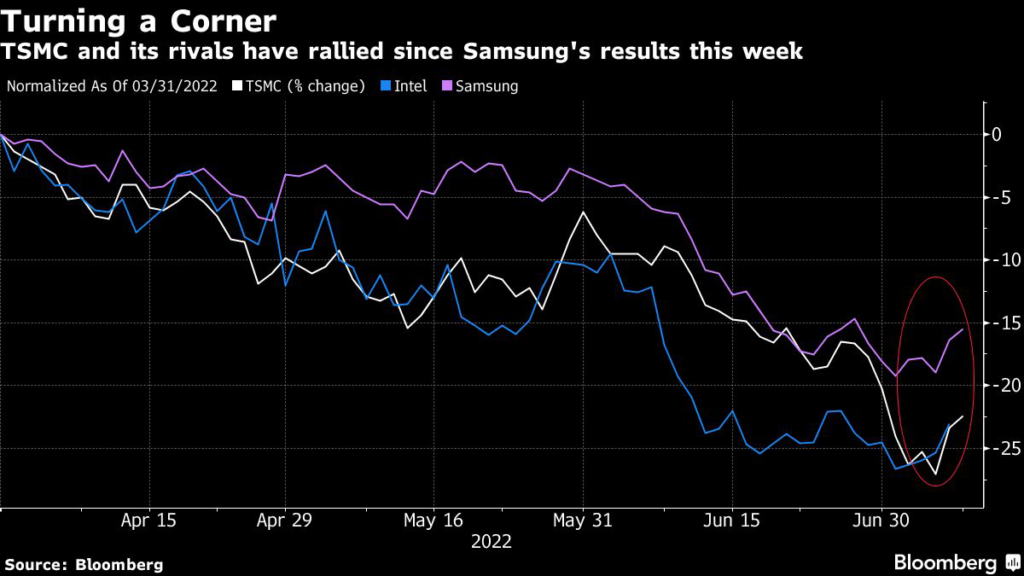
The results from Apple Inc.’s most important chipmaker may allay investors’ worst fears about the impact of weakening demand and soaring costs on the $550 billion semiconductor industry. On Thursday, Samsung Electronics Co. also reported a better-than-anticipated 21% jump in revenue, triggering an Asian stock rally.

While concerns linger about the longer-term impact of a potential global recession, investors seized on Samsung’s top-line expansion as a sign that chip stocks may have been oversold. TSMC may be able to exceed its goal of growing sales by 30% in US dollar terms this year, said Jeff Pu, an analyst with Haitong International Securities.

“TSMC’s second-quarter sales is slightly lower than the most recent market expectations,” Pu said. “But the company’s third quarter revenue may outperform consensus, aided by its price hike and Apple’s new product launch.”

Read more: Samsung Sparks $30 Billion Tech Rally After 21% Sales Jump

TSMC, the world’s most advanced maker of silicon chips, has benefited from its most important customer. Over the past year and a half, Apple has launched five types of Mac chips. The Taiwanese firm also continues to ride the auto industry’s growing demand for semiconductors as cars become more digitized. 

Signs are emerging that the chip supply issues that plagued gadget companies and automakers for more than a year are easing. Auto executives have said they are seeing an improvement in component supply, while delivery times for chips fell by one day in June. 

Shares of TSMC closed up 2.1% on Friday ahead of the revenue announcement, but are still down 24% this year after a broader tech selloff on recession worries. 

“Robust demand for high-performance computing and automotive chips should prevail, while negative impacts from a weaker smartphone-chip demand outlook may not kick in until 4Q,” Bloomberg Intelligence analyst Charles Shum wrote in a note ahead of TSMC’s Friday announcement.

(Updates with analyst’s comment from the fourth paragraph)

More stories like this are available on bloomberg.com

©2022 Bloomberg L.P.

Solar Startup’s Nitori Deal Shows Japan’s Corporate Energy Push

(Bloomberg) — A Japanese startup backed by a former key SoftBank Group Corp. executive struck a clean energy agreement with furniture giant Nitori Holdings Co., tapping rising demand for power deals by companies aiming to curb emissions.

Tokyo-based Sustech Inc. will equip Nitori’s stores and warehouses with solar panels under a corporate power purchase agreement, Chief Executive Officer Yusuke Tanno said in an interview. Sustech will provide 80 megawatts of capacity and 100 gigawatt-hours of power by fiscal 2030, equivalent to powering 23,000 households annually, he said.

Companies in Japan are stepping up efforts to secure contracts for cleaner energy as they aim to respond to pressure from investors and consumers to lower greenhouse gas emissions. Agreements covering the purchase of about 164 megawatts of power were signed by corporate entities in the first five months this year, already an annual record and a rise from 91 megawatts in 2021, BloombergNEF analyst Isshu Kikuma wrote in a May report.

Read more: Corporate PPA Deals in Japan on Course for a Record Year: BNEF

Sustech, founded last year, raised 450 million yen ($3.3 million) in April, and counts former Softbank executive Katsunori Sago as a lead investor.

More stories like this are available on bloomberg.com

©2022 Bloomberg L.P.

 Embattled Crypto Lender Celsius Accused of Fraud by Ex-Employee in Suit

(Bloomberg) — Celsius Network, the crypto lender that froze assets last month, used customer funds to manipulate the price of its proprietary token and lost hundreds of millions of dollars by failing to hedge risk, a former money manager for the company said in a lawsuit.

Celsius amassed more than $20 billion in assets by offering interest rates as high as 18% to customers who deposited their cryptocurrencies. Founder Alex Mashinsky dismissed skepticism about whether that was sustainable, saying the company was able to earn high rates itself. 

But Celsius was in fact struggling to cover the payouts and suffered “severe exchange rate losses” due to the fluctuating values of different coins, according to a complaint filed Thursday in New York state court by KeyFi Inc., the company founded by the former money manager, Jason Stone.

Stone, who called Celsius a Ponzi scheme in the complaint, said it cheated him out of potentially hundreds of millions of dollars in pay. 

A spokesperson for Celsius didn’t immediately respond to a request for comment. Kyle Roche, KeyFi’s lawyer, declined to comment.

Read More: Crypto Debacle at Celsius Rattles Market Already Shaken by Terra

The allegations come amid a credit crisis in cryptocurrency markets. Hedge fund Three Arrows Capital was ordered into liquidation last month, broker Voyager Digital Ltd. filed for bankruptcy this week and other firms offering high-yield products including Babel Finance and Vauld have suspended withdrawals. 

Celsius’s customers have been unable to access their funds since June 12. The company said on June 30 that it’s considering restructuring its debts.

More than a million people entrusted their savings to Celsius, according to the company. The appeal was obvious: The rates it paid were tens or hundreds of times higher than traditional savings accounts. 

Behind the scenes, Celsius was investing customer funds in risky trading strategies, without proper controls, according to the lawsuit. Starting in August 2020, Celsius started transferring hundreds of millions of dollars to Stone’s company, KeyFi. 

What’s Crypto Lending? Why Did Investors Get Burned?: QuickTake

Though the two firms didn’t have a written agreement, Stone was given the private cryptographic keys to the funds, meaning he could have run off with them, according to the complaint.

Stone was tasked with investing the money through DeFi. Short for “decentralized finance,” it’s a constellation of apps that let users borrow, lend and trade with each other, without middlemen. 

At the time, many of the apps were paying users huge rewards in proprietary cryptocurrencies. KeyFi earned more than $800 million for Celsius through DeFi strategies, according to the lawsuit. Stone says Celsius was supposed to pay him a 20% share of most of that but never did.

The problem, according to Stone, was that Celsius mainly took deposits in Bitcoin and Ethereum, but his strategies earned rewards in other coins. That meant that if Bitcoin and Ethereum went up faster than the others, Celsius could end up owing more than it had, even if it was earning money. 

Celsius also kept track of customers’ deposits in U.S. dollar terms, even if they were actually owed Bitcoin or other tokens, according to the suit. When this error was discovered, it resulted in “a $100-$200 million hole on its balance sheet,” Stone alleged.

Celsius raised $50 million in 2018 by selling a proprietary token, CEL, and the company and its executives held large stocks of the cryptocurrency. 

Stone now claims that Celsius in 2020 used $90 million worth of Bitcoin deposits to “artificially inflate” the price of CEL. He says that let Mashinsky “enrich himself,” and enabled Celsius to borrow against its CEL holdings. He also says that Celsius borrowed 1 billion Tethers from the stablecoin issuer to cover the hole in its balance sheet.

Stone says he ended his relationship with Celsius in March 2021 once he discovered the improprieties. In a thread on Twitter, Stone wrote that Celsius “assured me they had risk management and hedging in place. But in late Feb 2021, we discovered Celsius had lied to us.”

Read More: Celsius Is Latest Decentralized Finance Crisis to Rock Crypto

While he was managing money for Celsius, Stone also ran a popular anonymous Twitter account under the name 0xb1, former employees of the company told Bloomberg Businessweek in January. 

That account’s collection of nonfungible tokens — digital art — gained so much attention that in October, Creative Artists Agency agreed to represent it for licensing deals. 0xb1 paid more than $1 million for the “demon mutant ape” it uses as its profile picture. 

Stone says in the lawsuit that Celsius allowed him to buy NFTs as a kind of advance on his share of the trading profits. He alleges that after he left the company, Mashinsky transferred some of them to his wife’s wallet.

The case is KeyFi Inc. v. Celsius Network Ltd. and Celsius KeyFi LLC, New York State Supreme Court

More stories like this are available on bloomberg.com

©2022 Bloomberg L.P.

Crypto Lender Celsius Accused of Being ‘Ponzi Scheme’

(Bloomberg) —

Celsius Network, the crypto lender that froze assets last month, used customer funds to manipulate the price of its proprietary token and lost hundreds of millions of dollars by failing to hedge risk, a former money manager for the company said in a lawsuit.

Celsius amassed more than $20 billion in assets by offering interest rates as high as 18% to customers who deposited their cryptocurrencies. Founder Alex Mashinsky dismissed skepticism about whether that was sustainable, saying the company was able to earn high rates itself. 

But Celsius was in fact struggling to cover the payouts and suffered “severe exchange rate losses” due to the fluctuating values of different coins, according to a complaint filed Thursday in New York state court by KeyFi Inc., the company founded by the former money manager, Jason Stone.

Stone, who called Celsius a Ponzi scheme in the complaint, said it cheated him out of potentially hundreds of millions of dollars in pay. 

A spokesperson for Celsius didn’t immediately respond to a request for comment. Kyle Roche, KeyFi’s lawyer, declined to comment.

Read More: Crypto Debacle at Celsius Rattles Market Already Shaken by Terra

The allegations come amid a credit crisis in cryptocurrency markets. Hedge fund Three Arrows Capital was ordered into liquidation last month, broker Voyager Digital Ltd. filed for bankruptcy this week and other firms offering high-yield products including Babel Finance and Vauld have suspended withdrawals. 

Celsius’s customers have been unable to access their funds since June 12. The company said on June 30 that it’s considering restructuring its debts.

More than a million people entrusted their savings to Celsius, according to the company. The appeal was obvious: The rates it paid were tens or hundreds of times higher than traditional savings accounts. 

Behind the scenes, Celsius was investing customer funds in risky trading strategies, without proper controls, according to the lawsuit. Starting in August 2020, Celsius started transferring hundreds of millions of dollars to Stone’s company, KeyFi. 

What’s Crypto Lending? Why Did Investors Get Burned?: QuickTake

Though the two firms didn’t have a written agreement, Stone was given the private cryptographic keys to the funds, meaning he could have run off with them, according to the complaint.

Stone was tasked with investing the money through DeFi. Short for “decentralized finance,” it’s a constellation of apps that let users borrow, lend and trade with each other, without middlemen. 

At the time, many of the apps were paying users huge rewards in proprietary cryptocurrencies. KeyFi earned more than $800 million for Celsius through DeFi strategies, according to the lawsuit. Stone says Celsius was supposed to pay him a 20% share of most of that but never did.

The problem, according to Stone, was that Celsius mainly took deposits in Bitcoin and Ethereum, but his strategies earned rewards in other coins. That meant that if Bitcoin and Ethereum went up faster than the others, Celsius could end up owing more than it had, even if it was earning money. 

Celsius also kept track of customers’ deposits in U.S. dollar terms, even if they were actually owed Bitcoin or other tokens, according to the suit. When this error was discovered, it resulted in “a $100-$200 million hole on its balance sheet,” Stone alleged.

Celsius raised $50 million in 2018 by selling a proprietary token, CEL, and the company and its executives held large stocks of the cryptocurrency. 

Stone now claims that Celsius in 2020 used $90 million worth of Bitcoin deposits to “artificially inflate” the price of CEL. He says that let Mashinsky “enrich himself,” and enabled Celsius to borrow against its CEL holdings. He also says that Celsius borrowed 1 billion Tethers from the stablecoin issuer to cover the hole in its balance sheet.

Stone says he ended his relationship with Celsius in March 2021 once he discovered the improprieties. In a thread on Twitter, Stone wrote that Celsius “assured me they had risk management and hedging in place. But in late Feb 2021, we discovered Celsius had lied to us.”

Read More: Celsius Is Latest Decentralized Finance Crisis to Rock Crypto

While he was managing money for Celsius, Stone also ran a popular anonymous Twitter account under the name 0xb1, former employees of the company told Bloomberg Businessweek in January. 

That account’s collection of nonfungible tokens — digital art — gained so much attention that in October, Creative Artists Agency agreed to represent it for licensing deals. 0xb1 paid more than $1 million for the “demon mutant ape” it uses as its profile picture. 

Stone says in the lawsuit that Celsius allowed him to buy NFTs as a kind of advance on his share of the trading profits. He alleges that after he left the company, Mashinsky transferred some of them to his wife’s wallet.

The case is KeyFi Inc. v. Celsius Network Ltd. and Celsius KeyFi LLC, New York State Supreme Court

More stories like this are available on bloomberg.com

©2022 Bloomberg L.P.

China’s Cabinet Stresses Cybersecurity After Data Leak

(Bloomberg) — China’s cabinet stressed the need to bolster information security, following a huge leak of personal data that could be the largest cyber-attack in the country’s history. 

A State Council meeting led by Premier Li Keqiang emphasized the need “to improve security management provisions, raise protection abilities, protect personal information, privacy and commercial confidentiality in accordance with the law,” according to the official Xinhua News Agency. These measures would allow the public and businesses to “operate with a peace of mind,” the report added. 

Xinhua didn’t directly reference the breach, and other state media agencies have so far been silent about the incident. Earlier this week, unknown hackers claimed to have stolen data on as many as a billion Chinese residents after breaching a Shanghai police database. The purported theft of more than 23 terabytes of information has exposed potential data and security lapses and set the technology industry abuzz.

If verified, the massive data leak could be a black-eye for Xi Jinping’s administration, which has in past years gone after tech firms such as Didi Global Inc. for data security violations.

“The breach has clearly caught the attention of China’s top leadership — and no wonder,” said Kendra Schaefer, a partner at Beijing-based consultancy Trivium China. “It is particularly embarrassing for a government body to be the source of the largest known data breach in China’s history, particularly at a time when data security has become one of China’s top policy priorities.”

Read: Hacker’s Record Theft Claim Exposes Dangers of China Data Trove

Questions remain about how the unknown hackers apparently gained access to the trove run by the Ministry of Public Security’s Shanghai branch, which according to online posts included data detailing user activity from popular Chinese apps, addresses and phone numbers. A seller had asked for 10 Bitcoin, worth around $200,000, in exchange for the data.

“China is long overdue for experiencing a breach of this scale,” said Daron Hartvigsen, managing director at global advisory firm StoneTurn. “Historically, China is often disregarded as a viable target for criminal cyber-exploitation. Threat actors typically focus on targets likely to cave to ransom and extortion demands. It is not clear if this business model will result in similar financial returns in China.” 

Xi has long identified data as key for governing and driving Asia’s largest economy. The meeting on Wednesday also discussed the need to investigate and address activities that abuse information and violate the legitimate rights of individuals and enterprises, according to the report.

(Updates with analyst’s comment from the fourth paragraph. A previous version was corrected to reflect an analyst’s proper title.)

More stories like this are available on bloomberg.com

©2022 Bloomberg L.P.
Musk Arrives at Sun Valley Retreat With Speech Planned Saturday

(Bloomberg) — Elon Musk arrived Thursday evening at Allen & Co.’s Sun Valley Conference, joining the technology and media elite at the mountain retreat, according to a person familiar with the matter. 

Musk is slated to speak to the attendees on Saturday. Whether he’ll address his fight over his $44 billion agreement to buy Twitter Inc. remains to be seen.

The billionaire Tesla Inc. and SpaceX chief executive officer has cast doubt on the deal, questioning whether Twitter is accurately reporting the number of spam bots on the service. Twitter has repeatedly said that spam bots represent less than 5% of its total user base, adding that it intends to hold Musk to his agreement.

Earlier Thursday at the conference, Twitter CEO Parag Agrawal didn’t respond to a question on whether he’s worried about Musk walking away from the deal. Twitter Chief Financial Officer Ned Segal, also an attendee, said nothing when asked whether a report that the deal could fall apart is accurate.

More stories like this are available on bloomberg.com

©2022 Bloomberg L.P.

Amazon Inks Big Office Lease in Singapore, Business Times Says

(Bloomberg) — Amazon.com Inc. has signed a lease for about 369,000 square feet (34,200 square meters) at the new IOI Central Boulevard Towers in Singapore, the Business Times reported without citing where it got the information from.

The tech giant’s lease comprises both office floors of 70,000 sq ft each in the development’s podium, and all nine office levels of 25,400 sq ft each in the East Tower, according to the report. The development, located in the Marina Bay area, is expected to be completed in October 2023. 

Amazon recently took over three floors of office space from Citigroup Inc. as tech companies continue to chip away at the dominance of banks in the city-state’s central business district. 

The tech giant’s reported move also adds to a trend of global firms bulking up their presence in Singapore to manage or expand their Asian operations, particularly as the appeal of Hong Kong diminishes. 

As the maiden big-name anchor tenant in IOI Central Boulevard Towers, Amazon may be paying a gross effective monthly rental of around S$10 ($7) per sq ft while Malaysia-listed developer IOI Properties Group Bhd is said to be targeting about S$12-14 per sq ft a month for the project, the report added citing market speculation.

More stories like this are available on bloomberg.com

©2022 Bloomberg L.P.
Close Bitnami banner
Bitnami