
Bloomberg

Burning Trains Reveal Wrath of Millions Without Jobs in India

(Bloomberg) — A military recruitment plan in India that sparked last month’s violent protests is turning the spotlight on an unemployment crisis plaguing the $3.2 trillion economy, along with Prime Minister Narendra Modi’s campaign pledges on jobs.

Behind the unrest is a new policy to enlist young men as soldiers on four-year contracts without pension, replacing the current 15-year service that entails full retirement benefits. Modi’s government says the program will boost employment by supplying a trained, disciplined workforce to local industry. Critics say that it would be similar to hiring for the gig economy and won’t lead to high-quality jobs. The program has already started luring a record number of applicants, but it has also provoked a furious backlash from some quarters.

Many pinning their hopes on the military for a secure future say the shortened term has delivered a gut-punch to their career plans. Some others say it deprives them of higher education in their prime years, and worse still, offers no job assurance after completion. Angry youth facing bleak job prospects blocked rail traffic, highways in many states for days about three weeks ago. Some even set trains on fire.

The intensity of those protests has largely died down now, but the rage hasn’t. With the backing of opposition parties and other powerful lobby groups such as farmers, they’re all betting Modi will drop the idea, just like he buckled under pressure earlier to scrap planned farm-produce and land-ownership reforms.

Modi, however, is undeterred. After vowing to create millions of jobs in his campaign speeches, he is under tremendous pressure to show he’s making progress on those promises. The army hiring program — called “Agnipath,” or path of fire in Hindi — is one of his key game plans to win a third consecutive five-year term. Yet, with the next national elections less than two years away, time isn’t on his side. Runaway inflation is threatening to derail a fragile post-pandemic economic recovery, while discontent continues to simmer over unemployment. 

About two-thirds of India’s almost 1.4 billion people are between the ages of 15 and 64. More than half of the 900 million of legal working age have given up looking for formal or informal jobs. Highlighting the scale of despair, 18,000 people — including Ph.D. students — applied for 42 government-advertised positions as cooks, gardeners and peons in the northern state of Himachal Pradesh last year. Catering to this scramble for coveted public-sector jobs, Modi has unveiled a separate plan to hire a million people within 18 months to fill vacancies in various government departments. 

“While unemployment is a big issue, unemployment combined with high inflation is an even bigger issue,” said Akhil Bery, director of South Asia Initiatives at the Asia Society Policy Institute. “The protests just add to the number of challenges the government is facing.”

Yet Modi’s political star faces little risk of fading. A survey released by LocalCircles in May showed his approval ratings were at the highest since the start of the pandemic. About 67% of 64,000 people polled said his government has met or exceeded expectations in the second term. But inflation and unemployment remain a concern, according to the survey.

Many unemployed, young people believe Modi is talking about jobs now because of impending elections, but they are still unwavering in their support for the leader.  

“I voted for Modi last time, and will vote for him again,” said Parmanand Yadav, 24, who lives in Rewari in the northern state of Haryana. “He might not have created jobs, but under him there is less corruption and better infrastructure.”

More broadly, the violent backlash has exposed the failure of successive governments to address the unfolding crisis as population nearly quadrupled to almost 1.4 billion in 70 years. It also brings into focus the economy’s over-reliance on the public sector for jobs and an inadequate education infrastructure that can’t supply enough skilled workers for local industries, despite having produced some of the world’s top managers such as Alphabet Inc.’s Sundar Pichai and Microsoft Corp.’s Satya Nadella. 

The Centre for Monitoring Indian Economy estimates the unemployment in the 20-24 age group was 43.7% in June and the overall rate was 7.8%. That compares with 18.4% for the 16-24 category in China, which is also facing a worsening crisis as it struggles with Covid-19 outbreaks and disruptive shutdowns. Employment generation hasn’t kept pace with economic growth, making competition fierce, particularly for government jobs that promise stability and life-time benefits. 

The allure of state jobs dates back to the days of Soviet-style central planning, when the government had monopoly over a range of industries from airlines to steel production and banking. When the economy was liberalized in parts starting in the 1990s, the private sector — including technology, telecommunications and gig-economy startups like food-delivery service Zomato Ltd. and ride-hailing service Ola — has helped add jobs. However, the pace hasn’t been quick enough to absorb the millions graduating from schools and colleges every year.

Then there’s the military. India’s army, navy and air force usually take in about a combined 65,000 annually, with an equal number retiring every year. Some communities have traditionally relied on the defense forces for their livelihood, grooming generations for long military careers.

Many training academies operated by retired army brass have mushroomed around some of these regions, preparing men in their late teens and early 20s for a shot at a military career.  

“But the new policy has lowered morale’’ and shattered the dreams of aspirants, said Jai Bhagwan, director of Haryana Lions Defence Academy, based in Dongra Ahir village in Haryana. Students there pay as much as 7,000 rupees ($88) a month each as fees.  

In a small village of Pranpura in the same state, a three-hour drive from capital New Delhi, scores of men in their early 20s lounge about with a sense of dejection.

“This way, I will retire before I turn 25,” said Deepak Yadav, 20, adding he took part in some of the peaceful protests. “Our parents started motivating us from an early age to join the army because other jobs are not easily available. Now nothing is left.”

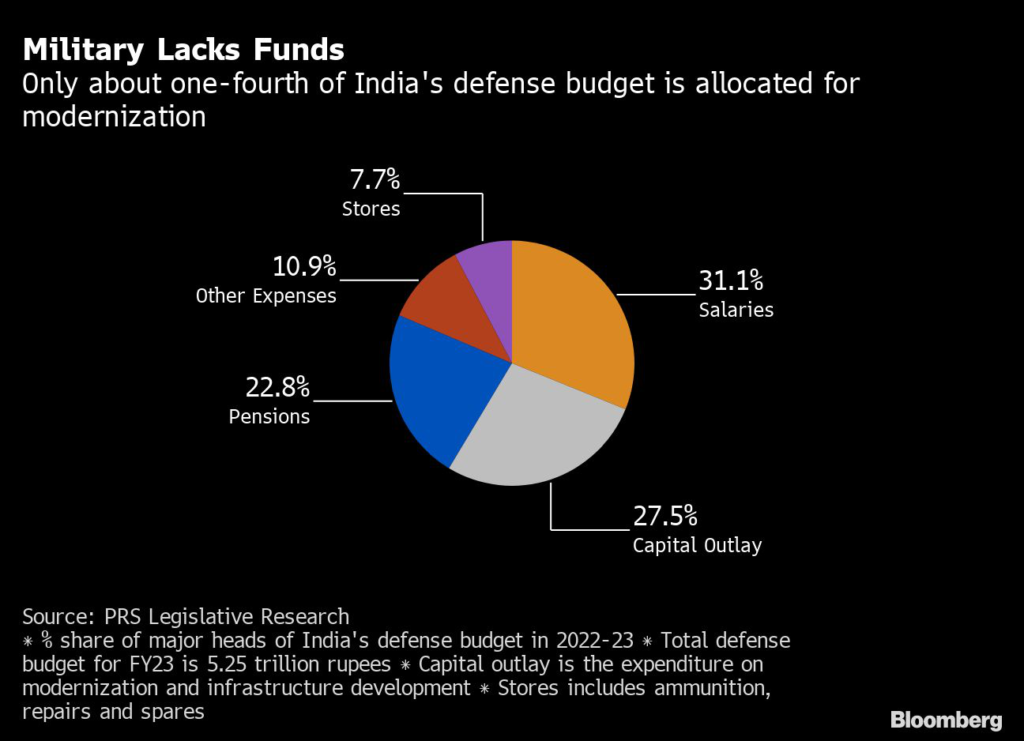
The defense recruitment plan is for those aged between 17 ½ and 23. After completing the four-year program, 25% will be inducted into regular service. The broader aim is to make the armed forces younger and fitter. The other objective is to slash pension bills and boost spending on military modernization — an issue that’s gained urgency after deadly border clashes with Chinese troops in 2020. Only a quarter of India’s defense budget is allocated for modernization, according to PRS Legislative Research.

Despite all the criticism, the recruitment plan is already gaining enough traction. The Indian Air Force said it has received a record 750,000 applications, while the army and navy have yet to provide numbers. 

The protests by the unemployed have been nowhere close in scale to last year’s uncompromising, months-long demonstrations by farmers, who camped outside New Delhi in what was practically a siege of the national capital, until Modi caved in and repealed three contentious farm laws. Yadav and others want to replicate that successful strategy to get Modi to scrap the defense recruitment policy.  

“If we protest like farmers, why won’t they take it back?” said Yadav, vowing to cast his first vote for the party that promises job opportunities for him. 

Political parties and farmers are now rallying behind the unemployed, sensing an opportunity to dent Modi’s poll prospects. Petitioners seeking to void the plan have approached the Supreme Court, which will hear their pleas next week. Some leaders are also saying the short-term contract will blunt the operational effectiveness of the armed forces.

“This is not a fight for youth and employment, this is a fight for the nation’s future,” political activist Yogendra Yadav told a gathering of farmers on June 24 in Rewari, about 20 kilometers from Pranpura village. “This is just the beginning of the agitation. As an employment opportunity, it’s a joke,” he said, referring to the defense recruitment plan.

The three Yadavs are unrelated to one another.

The government says employment generation is its primary concern, and has cited various data to support its stance that the labor market is recovering after the pandemic. On the other hand, Modi’s opponents say he’s failed to keep his promises. Representatives for the Prime Minister’s Office and the labor ministry didn’t respond to emails seeking comment. 

One possible fix for the unemployment crisis is to incentivize the private sector to create jobs at a fast pace and take the sheen off the defense recruitment process, said Devashish Mitra, an economics professor at Syracuse University in New York.

“The solution really is factor-market reforms,” he said, referring to changes in land and labor laws. “Otherwise, there are likely to be continuing protests, that might fuel economic instability.”

Until then, there’s no end in sight for the anxiety faced by thousands training to join the army. 

“Now I have only one chance left,” said Dilshad Khan, 21, who comes from a family of soldiers and is now training at the Haryana Lions Defence Academy. “It’s do or die now.”


More stories like this are available on bloomberg.com

©2022 Bloomberg L.P.

Comedian Lewis Black Sues Pandora Over Streaming of His Comedy Bits

(Bloomberg) — Comedian Lewis Black, who has turned angry rants into a career, is irate with streaming giant Pandora, which he claims is airing his material without permission.

The recurring guest on Comedy Central’s “The Daily Show” sued Pandora Media LLC for copyright infringement, seeking more than $10 million in damages, in the complaint filed Thursday in Los Angeles federal court.

Black’s claim is the latest in a series of lawsuits brought by comedians against Pandora that may reveal how the streaming industry deals with novel licensing issues around the growing popularity of spoken word content. Comedians say streaming platforms need to pay them — as the authors of jokes — in the same way songwriters are paid royalties for writing lyrics.

“Pandora did what most goliaths do: it decided it would infringe now to ensure it had this very valuable intellectual property on its platform to remain competitive, and deal with the consequences later,” Black said in the complaint. “Later is now.”

Pandora, which was acquired by Sirius XM Holdings Inc. in 2019, says on its website that it’s the largest digital broadcast and streaming music provider in the US, with 70 million listeners and users each month.

Sirius declined to comment on Black’s claim, but in responding to a group of similar lawsuits in May, that included claims from the estates of Robin Williams and George Carlin, Pandora said decadeslong tradition of licensing the use of comedy recordings is being threatened.

Until now, no comedian has ever licensed separately or collected a separate and additional royalty for the reproduction, or distribution of the underlying jokes embodied in any of their comedy recordings, Pandora said. Distributors pay the source, or creator, of the final product — usually a recording label, the company said.

“Comedy, like every other copyright-intensive industry except the dysfunctional music licensing market, has always followed a ‘licensing at the source’ model,” Pandora said.

But Spoken Giants, which represents hundreds of comics and their estates, including Black, said streaming services like Sirius and Pandora should have learned a lesson from their futile battles with songwriters over royalties. The group dismissed Pandora’s claim that royalties should be paid to the source.

“It’s the equivalent of saying a license with Columbia Records to stream a Bob Dylan album negates the need to also pay songwriting royalties to him,” Jim King, chief executive officer of Spoken Giants, said in an emailed statement.

Pandora used 68 of Black’s works without permission, according to the complaint. He’d be entitled to $150,000 for copyright infringement for each work under current law, Black said in the complaint.

“Mr. Black once famously quipped in the wake of the Enron Scandal: ‘You don’t want another Enron? Here’s your law: If a company can’t explain in one sentence what it does, it’s illegal,”’ Black’s lawyers wrote in the complaint. “The exact same thing is true here: If a company can’t explain in one sentence how it has a license to use copyrighted works, it’s copyright infringement.”

The case is Black v. Pandora Media LLC, 2:22-cv-04634, US District Court, Central District of California (Los Angeles).

(Updates with Pandora’s defense in sixth paragraph.)

More stories like this are available on bloomberg.com

©2022 Bloomberg L.P.

The Electric Car Market is About to Get Crazy (and Confusing)

(Bloomberg) — The early days of any new technology tend to be — to put it technically — insane. Airlines in the 1960s, PCs in the 1980s, iPhone apps in the 2000s. Their origin stories all are similar: there’s a crush of new product, a marketing dash for FOMO-motivated customers and piles of money to burn as companies buy into the new game.

The US electric car market right now is no exception. And that’s where Bloomberg Green’s Electric Car Ratings come in.


In an effort to make sense of this mad market — to catalogue in close-to-real-time every one of the EVs on offer at the moment — we’ve produced a rating of electric cars. The dashboard covers every new fully battery-powered vehicle available for sale in the US, calling out metrics from price and range to charging speed and number of seats.

Electric cars are drastically cleaner than conventional gasoline vehicles, particularly as renewable power starts to comprise more of the grid. However, there’s a growing awareness that none of this 5,000-pound hardware comes without a carbon cost; there’s no such thing as a “zero-emission vehicle,” as they have been branded by policymakers and early champions. Steel body panels don’t grow on trees. Lithium doesn’t just flow out of the ground and into battery plants. And electricity — even the stuff coming from solar panels — isn’t captured without a great deal of capital and carbon expense.

That’s why our EV ratings also measure how “green” each of these machines is with a formula based on the economy of the vehicle, how far it travels relative to how many pounds it weighs, and the size of its battery. The economy part of the equation is weighted at 70% of the score, which is roughly equivalent to the amount of an EV’s emissions that come from driving. The remainder of an EV’s carbon footprint comes from its manufacturing, especially the construction of the battery. Thus, in our model, battery size serves as a proxy for all manufacturing impacts and is weighted at 30%. How we arrived at these decisions and some additional context is spelled out at length in our methodology.

The dashboard will be updated when new models are introduced and key metrics change; at the moment, The Lucid Air Dream Edition Range tops the list of green machines (we updated since first publishing on Wednesday, correcting a key stat). It travels up to 520 miles at a time, thanks in part to an aerodynamic design and super-efficient electric motors. GMC’s Hummer EV brings up the rear with its massive battery and a chassis geared for off-road brawn rather than on-road economy.

In the US alone, there are about 33 electric vehicles on sale right now — almost triple the number of choices a year ago. By this time next year, there will be dozens more, including a bunch of super-sized pickup trucks that Americans covet. There hasn’t been this many new new cars since Henry Ford stopped fiddling with steam engines and got down to business.

North Americans will purchase about 1.4 million electric vehicles this year, the majority of which will be fully electric, not hybrid, according to BloombergNEF estimates. They made up more than 6% of new sales in the first quarter. And the industry is shifting even faster in Asia and Europe, where almost 10% of new vehicles purchased are now entirely battery powered. 

For carmakers, the electric race is existential; for customers, however, it’s bewildering. As if it weren’t hard enough to keep track of the blitz of new machines hitting dealerships, car companies are redirecting their publicity dollars to tout battery-powered models that won’t hit the streets for years. General Motors “revealed” its Chevrolet Silverado EV in January, though the first customers won’t get the truck until next spring. It’s anyone’s guess when we might see the Tesla Cybertruck Musk pulled the cover off of nearly three years ago. Every company in the game is pushing a parade of EVs while trying to make good on pledges to sunset internal-combustion models by self-imposed deadlines.

There’s an argument to be made that EV demand, for so long a rounding error in the car business, is actually outstripping supply. A few months ago, one in four Americans surveyed told J.D. Power they were “very likely” to go electric with their next car purchase, and that was before fighting in Ukraine pushed gas prices to a record high.

Waitlists for the newest, hottest models — such as the Hyundai Ioniq 5 — are stretching for months and steep mark-ups to the sticker price are the norm. Ford Motor has gone so far as to stop taking orders for its new F-150 Lightning and its Mustang Mach-E until its factories can catch up with demand; meanwhile it’s hustling to open more assembly lines.

When Nissan introduced the Leaf in 2010, an electric car was a small, funky looking hatchback, short on range and long on virtue signaling. Over the following decade, Tesla made them into sporty status symbols. Now the legacy automakers have begun churning out pickups and SUVs every bit as powerful as their combustion engine predecessors, and far quicker. These are finally no-compromise vehicles and convincing consumers to buy them is a critical step in the climate fight. The next impactful step, perhaps 10 years from now, will be convincing them to buy only as many EVs as they really need.

The car market may never be this crazy and confusing again. This is our attempt to make sense of it. If you are shopping for a new ride, investing in these companies or are just among the increasing crowd of the EV-curious, come back here anytime to see how the race is shaping up and, of course, which machine is out front.

(Corrects sixth paragraph, with the Lucid Air as the highest scorer as of publication of the dashboard.)

More stories like this are available on bloomberg.com

©2022 Bloomberg L.P.
Crypto Needs Consistent Regulation Across Nations, US Treasury Says

(Bloomberg) — The US and its foreign allies must work together to create shared standards for regulating cryptocurrencies to make it harder for bad actors to get away with crimes, Treasury said Thursday. 

“Uneven regulation, supervision, and compliance across jurisdictions creates opportunities for arbitrage and raises risks to financial stability and the protection of consumers, investors, businesses, and markets,” Treasury said in a news release. Inadequate anti-money laundering and terrorism financing rules across different countries make it harder for the US to investigate illicit transactions when money flows offshore, such as with ransomware payments, the department said. 

The need for shared standard-setting was one of the topics addressed in a framework for international cooperation the department said it delivered to President Joe Biden Thursday. Treasury was directed to develop the framework — in coordination with other agencies like the State and Commerce Departments — under the White House’s March executive order calling for an government-wide strategy for digital assets.

As part of the framework, Treasury also said the US must continue to work with international partners and be a leader in the discussions on central bank digital currencies, or CBDCs, and digital payment architectures more generally.

The Federal Reserve as been exploring the possibility of a US CBDC but no final decision has been reached.

“Such international work should continue to address the full spectrum of issues and challenges raised by digital assets, including financial stability; consumer and investor protection, and business risks; and money laundering, terrorist financing, proliferation financing, sanctions evasion, and other illicit activities,” the department said. 

Treasury committed to continue working within several key intergovernmental organizations, including the G7, G20, and the Organization for Economic Cooperation and Development.

More stories like this are available on bloomberg.com

©2022 Bloomberg L.P.
Facebook Accessed Deleted User Data, Fired Screener Claims

(Bloomberg) — A former Facebook content screener says he was fired for raising alarms about a company protocol allowing employees to resurrect data that users deleted.

Brennan Lawson sued Meta Platforms Inc., Facebook’s parent, Tuesday in California claiming he was informed about the new protocol during a staff meeting in late 2018 and immediately questioned its legality. Soon after, he said he was fired and remained unemployed for 18 months. He’s seeking more than $3 million in compensation plus punitive damages.

“These claims are without merit and we will defend ourselves against them vigorously,” a Meta spokesperson said in a statement.

The protocol allowed members of the social network’s Global Escalation Team “to circumvent Facebook’s normal privacy protocols” by retrieving data from the Messenger app “that users had chosen to delete,” according to Lawson’s complaint.

The protocol appeared to violate European Union digital privacy rules and a Federal Trade Commission order that required Facebook to accurately inform users about its data retention policies, according to the complaint.

Lawson said he realized he was on “shaky ground” for questioning the legality of the practice and fearful he’d be fired if he pressed the issue. He was fired in July 2019, for allegedly improper use of a Facebook administrative tool. He claims that was pretextual and an act of retaliation for his complaint.

The Escalation Team used the protocol to help law enforcement agencies in investigations of users, Lawson said.

“Law enforcement would ask questions about the suspect’s use of the platform, such as who the suspect was messaging, when messages were sent, and even what those messages contained,” Lawson claimed. “To keep Facebook in the good graces of the government, the Escalations Team would utilize the back-end protocol to provide answers for the law enforcement agency and then determine how much to share.”

The case is Lawson v. Meta Platforms Inc., 22-civ-02723, California Superior Court, San Mateo County (Redwood City).

(Updates with Meta statement)

More stories like this are available on bloomberg.com

©2022 Bloomberg L.P.

Musk Twitter Deal May Collapse Over Bots, Washington Post Says

(Bloomberg) — Elon Musk’s $44 billion proposed takeover of Twitter Inc. is in “serious jeopardy,” the Washington Post reported, citing three people familiar with the matter.

Musk’s team has concluded that Twitter can’t verify its figures on spam accounts, a major issue that the Tesla Inc. chief executive officer has complained about. The billionaire’s camp has “stopped engaging” in discussions around funding the deal, the newspaper said, citing one of the people.

Earlier Thursday, Twitter executives maintained that spam bot accounts make up less than 5% of the social media service’s total user base. Musk has complained that the number of bots is much higher and has threatened to walk away from the deal over the issue.

A Twitter spokesperson didn’t immediately respond to requests for comment.

Twitter has said it is willing to go to court to hold Musk to the purchase.

More stories like this are available on bloomberg.com

©2022 Bloomberg L.P.
Nasdaq Win Streak Is Fueled by Tech Losers Turning Into Winners

(Bloomberg) — A rally in risk assets this week is sending traders to some of the most speculative corners of the technology sector, where gains in beleaguered stocks are more than double those of Nasdaq 100’s advance.

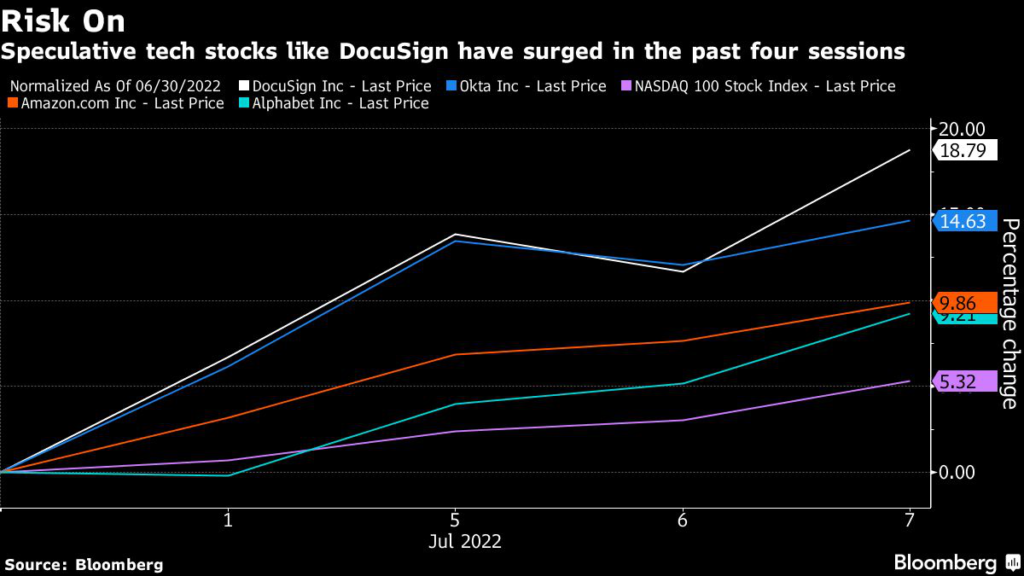
Shares in e-signature company DocuSign Inc., cybersecurity software maker Okta Inc. and Atlassian Corp. have jumped 19%, 15% and 14% respectively as a four-day rally in the Nasdaq 100 gains momentum. The tech-heavy index is up 5% this week, on track for its longest stretch of gains since March. 

While most of the gains in the Nasdaq and other broad indexes is coming from tech stalwarts such as Apple Inc., Amazon Inc. and Microsoft Inc., higher demand for companies with lower profitability and higher valuations, indicates investors’ willingness to embrace more risk. 

For now, at least. 

This week’s rally has occurred amid a drop in US Treasury yields, whose rapid rise this year has made the technology sector one of the worst performing in the stock market. 

The selloff has weighed most heavily on the shares of companies such as Netflix Inc. and software maker Zscaler Inc., which are down 69% and 48% so far in 2022. Overall, a group of unprofitable tech companies tracked by Goldman Sachs is down more than 40% this year, compared with 26% drop for the Nasdaq 100.

“A lot of these names are down 60% to 70% in some cases, so it’s understandable for them to have some type of bounce here,” said Michael O’Rourke, chief market strategist at Jonestrading.

Netflix is up 5.2%, while Zscaler has gained 7% this week. The Nasdaq 100 ended the session 2.2% higher.

Thursday’s broad advance came after the number of Americans applying for jobless benefits rose, offsetting fears that the Federal Reserve may require more interest-rate hikes if labor market growth is slowing. The Labor Department’s monthly jobs report is due on Friday. 

Attention next week will turn to the start of the second-quarter earnings season, with anxieties still running high about a potential recession and in tech, slowing demand for everything from seminconductors, to iPhones. However, better-than-expected results from Samsung Electronics on Thursday helped spark gains in chipmakers.

Jason Benowitz, a senior portfolio manager at Roosevelt Investments, said the prospect of more tightening from the Fed brings too many risks.  

“We are waiting for clearer signs that we are closer to a bottom and we’re not there yet,” he said. 


More stories like this are available on bloomberg.com

©2022 Bloomberg L.P.

‘Wonder Woman’ Lynda Carter Talks Trans Support After Bette Midler Dustup

(Bloomberg) — Lynda Carter wants the “war on women” to stop, and that includes trans women.The star of  the “Wonder Woman” TV series in the 1970s tweeted out her support for the transgender community on Tuesday, and the post has since generated nearly 200,000 likes and 36,000 retweets.“It just seems like such an unnecessary fight to pick,’’ Carter, 70, said in an interview with Bloomberg  News. “There’s a war on women right now, there’s a war against voting rights for minorities. There’s a bigger picture here. They deserve their own choices as everyone wants their freedom.”  

Her comments come amid recent backlash toward celebrities Bette Midler, J.K. Rowling and Macy Gray after comments by them that some view as transphobic.Carter has been a longtime supporter of LGBTQ rights, finding it difficult to see others being bullied. She recalled in the early years of her career, her makeup artist was a gay man who was not comfortable coming out. As Carter learned more about the community, she felt frustrated there was so much secrecy and bigotry when it was “just only a part of a person.”“I don’t know a huge portion of what all those people feel like and for any one of us to pass judgment on what that is, I think it’s just insane,” Carter said.Wonder Woman has remained a feminist icon for generations with many people embracing the superhero character’s strength. When she played the role, Carter wanted fans to recognize the difference between right and wrong.

“I react very strongly to seeing anyone being abused, so I think that what I endowed in Wonder Woman was a piece of myself in that regard,” she said.Over the last couple of days stars Midler and Gray saw their comments erupt on social media. “The First Wives Club” actress was hit with a backlash after saying in a Twitter post Monday that:  “They don’t call us ‘women’ anymore; they call us ‘birthing people’ or ‘menstruators,’ and even ‘people with vaginas!’ Don’t let them erase you!”She later responded that “there was no intention of anything exclusionary or transphobic in what I said;  it wasn’t about that.” Gray, an R&B singer whose hits include “I Try,” said in an interview on the British TV show “Piers Morgan Uncensored’’ that “just because you go change your parts, doesn’t make you a woman.” Gray later put out a statement saying her comments had been misunderstood.  “I have nothing but love for the LGBTQ+ and transgender community and have been a supporter since day one,” she said in a statement provided to Billboard.The Human Rights Campaign, a Washington-based advocacy group for the LGBTQ community, estimates that there are more than 2 million people in the US identifying as transgender.  In 2021, the group tracked a record 50 fatal attacks against transgender people.

More stories like this are available on bloomberg.com

©2022 Bloomberg L.P.

Mt. Gox Creditors Inch Closer to Repayment as Bitcoin Dump Looms

(Bloomberg) — Creditors of the defunct cryptocurrency exchange Mt. Gox are closer to getting repaid, according to a July 6 letter by the business’s Japanese bankruptcy trustee.

The trustee is asking creditors to register online and indicate how they want to receive their repayments. When payments will be made, and specific amounts were not outlined in the letter.

A disbursement could put pressure on Bitcoin price. The trustee held a trove of 141,686 Bitcoin, as well as cash and Bitcoin Cash coins as of September 2019, according to prior documents. 

“Some Mt. Gox creditors will get Bitcoin. Some will sell them,” said Aaron Brown, a crypto investor who writes for Bloomberg Opinion. “It won’t be a significant fraction of total Bitcoin trading volume, but it might push prices down. The decline might spook some other people and we might see a further drop.”

Tokyo-based Mt. Gox — once the world’s biggest Bitcoin exchange — suspended all trading and went offline in February 2014 after losing about 850,000 Bitcoin valued at about $500 million at the time. Some of its holdings have subsequently been found. The coins are currently valued at more than $2.9 billion, based on Bitcoin trading at close to $21,000.

Read more: Mt. Gox Bitcoin Repayment Plan Gains Final Approval From Trustee

Once the coins are sold, that could affect Bitcoin prices, which have slid sharply in recent months amid the Terra blockchain collapse and crypto companies such as hedge fund Three Arrows Capital filing for bankruptcy.

The trustee also said it will not accept claims or transfers from the end of August “until all or part of the repayments made as initial repayments is completed for safe and secure Repayments,” according to the letter. 

More stories like this are available on bloomberg.com

©2022 Bloomberg L.P.
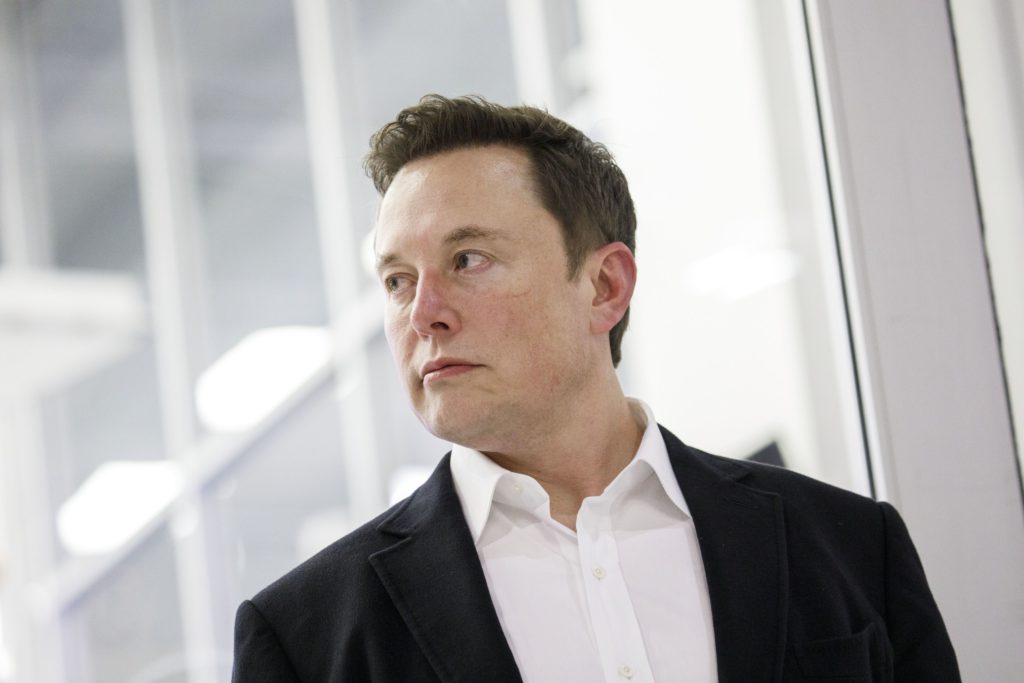
Musk Spurs 90,000 Messages to FCC Over 5G Dispute With Dish Network 

(Bloomberg) — US regulators received more than 90,000 messages after Elon Musk’s Starlink asked subscribers to rally to his side in an airwaves dispute with Dish Network Corp.

At issue are frequencies that Dish wants to use for fast 5G service. Musk’s SpaceX said the proposed service would block signals from his Starlink fleet of satellites, which offers wireless broadband through small antennas mounted on rural homes and businesses. Dish said its 5G won’t interfere with Starlink.

On Thursday, a coalition that includes Dish pushed back against Musk’s campaign, saying “Starlink has initiated a public misinformation campaign by falsely telling customers and the public that coexistence is not possible.”

The Federal Communications Commission is weighing the issue and hasn’t indicated when it may decide whether to open the airwaves to 5G use. 

The agency’s docket on the matter had received 201 submissions as of early last week. The number grew to 95,703 by midday Thursday, after Starlink emailed customers last week asking them to support the service and offering a link to contact the FCC. 

“Starlink reached out to their subscribers and told them something that’s not true, and that’s what’s caused some of those folks to write in,” said Jeffrey Blum, executive vice president for external and legislative affairs at Dish.

A spokesman for Starlink declined to comment.

More stories like this are available on bloomberg.com

©2022 Bloomberg L.P.

Close Bitnami banner
Bitnami
