

Bloomberg

FDIC Probing How Bankrupt Crypto Broker Voyager Marketed Itself

(Bloomberg) — The Federal Deposit Insurance Corporation, which protects customers in the event of certain types of bank failures, is looking into how bankrupt digital-asset firm Voyager Digital Ltd. marketed itself to customers, a spokesperson for the agency said.

Voyager, the latest casualty of the turmoil in the crypto markets, has publicly said that any US dollars deposited with the firm are covered by FDIC insurance, thanks to its partnership with Metropolitan Commercial Bank. Wording posted in 2019 on a company web page stated that this protection would take effect in the “rare event your USD funds are compromised due to the company or our banking partner’s failure,” according to the Wayback Machine, which keeps an archive of Internet content. 

But that wording was since modified and as of Thursday removes the explicit references to company or bank failures, instead saying, “in the rare event your USD funds are compromised, you are guaranteed a full reimbursement (up to $250,000), so the cash you hold with Voyager is protected.” Meanwhile, Metropolitan Commercial Bank issued a statement recently informing Voyager customers that FDIC insurance coverage would only be offered if the bank itself failed and not in event of Voyager’s failure. Voyager declined to comment when asked about the FDIC probe or why it changed the language on its website.

The US government has been increasingly concerned about companies making false advertisements to consumers about deposit insurance. FDIC in May put out a final rule barring firms from making those kinds of misrepresentations or misusing the FDIC name or logo. Those that violate the rule face enforcement action, including penalties. At the same time, the Consumer Financial Protection Bureau issued a warning on the topic, saying the “issue has taken on renewed importance with the emergence of financial technologies — such as crypto-assets, including stablecoins.” 

The FDIC spokesperson emphasized in an email Thursday that while Metropolitan Commercial Bank is FDIC-insured, Voyager is not. Therefore deposit insurance does not protect customers against Voyager’s default, bankruptcy, withdrawal freeze, or loss in value of products, the spokesperson said. The CFPB declined to comment. Voyager paused customer deposits and withdrawals last week and then filed for Chapter 11 bankruptcy late Tuesday. 

Social media has been abuzz with confused and frustrated customers who fear they’ll never get reimbursed for their crypto and cash holdings. Some said they felt misled by the company’s prior statements about FDIC insurance. 

Normally such insurance would cover up to $250,000 in losses per depositor — sometimes more if a customer holds several different types of accounts. 

The fine print in Voyager’s user agreement was clear about FDIC protection only applying if the partner bank failed but that’s something average retail investors often overlook, said Frances Coppola, a financial blogger who has written about the firm’s issues. 

Some of Voyager’s marketing materials were misleading, even if it’s unclear whether the firm did anything legally wrong, she said. “It’s mis-selling.”

More stories like this are available on bloomberg.com

©2022 Bloomberg L.P.

Home Prices Are Starting to Buckle in Tech-Fueled San Francisco

(Bloomberg) — San Francisco, one of the most-expensive US cities for housing, is starting to see prices fall for the first time since the depths of the pandemic.

The median house price in the city dropped 3% from a year earlier to $1.89 million in June, according to a report Thursday by brokerage Compass Inc., after cresting above a record $2 million in the previous three months. The latest price was still 20% above the level in March 2020, when Covid-19 lockdowns began.

“It’s probable, though not yet certain, that one of the longest, most dramatic real estate market upcycles in history — oddly enough, supercharged by a deadly, worldwide pandemic — peaked this past spring,” Patrick Carlisle, San Francisco Bay area market analyst for Compass, wrote in a note Thursday.

Home sales and price gains have cooled nationally as interest rates soared this spring after the Federal Reserve moved to tame inflation. Sellers have begun to slash asking prices in the most overheated US markets, such as Las Vegas, Denver, Austin and Nashville. Yet many of those areas are still recording prices that are above year-earlier levels, but are just appreciating at a slower pace.

San Francisco has been hit particularly hard by a slow return of office workers after the pandemic and residents departing for cheaper cities. And the tech industry, a major driver of local wealth, is facing a downturn, with stocks declining and several startups laying off workers.

In the broader Bay Area, including Silicon Valley and the East Bay, house prices rose 2% year over year in June to a median $1.43 million, Compass reported. It was the slowest growth since May 2020, when they were flat year over year.

In the intervening two years, Bay Area prices climbed at an annual double-digit pace, buoyed by a combination of record-low mortgage rates, soaring stock-investment wealth and demand for space by people working from home.

Bay Area homes are taking longer to sell and bidding wars are less intense, leading to a smaller share of sales above listing prices, Carlisle said in his report. But there’s unlikely to be a housing crash comparable to 2008, he said, because most owners today have affordable mortgages and won’t be forced to sell.

“A correction is not a crash,” he wrote.

More stories like this are available on bloomberg.com

©2022 Bloomberg L.P.
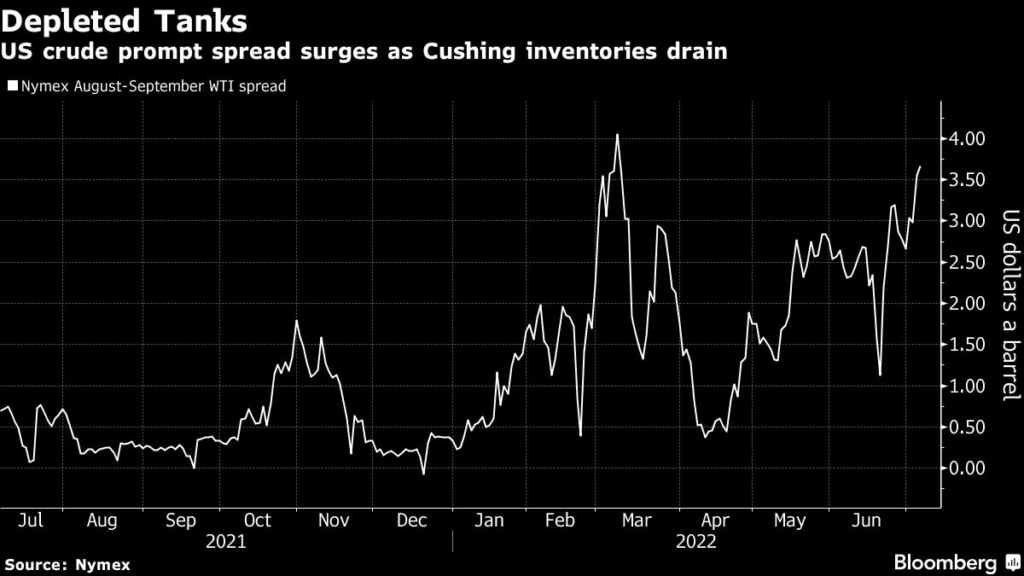
Oil Spreads Rocket as Traders Scour for US Crude Supplies

(Bloomberg) — The heart of the US physical oil markets is screaming for supplies even as headline prices swing due to worries about a global recession.

The US crude prompt timespread, which closely reflects the supply and demand balances at the country’s biggest storage hub in Cushing, Oklahoma, has surged to the highest level since March at nearly $4 a barrel. Stockpiles at the delivery point for benchmark US crude futures are hovering at levels that are considered a minimum requirement to maintain operations. 

In the Permian Basin’s hub in Midland, Texas, it’s a similar story. Barrels available in July are trading at around $3.50 a barrel above those in August, dealers said. Last week, the spread was narrower by $1 a barrel, they added. Inventories at Midland have drawn over 400,000 barrels since last month, said Geoffrey Craig, global energy analyst at Ursa Space, which uses satellite data to track storage levels. Compared with last year, stockpiles in this area are about 600,000 barrels lower.

The shortages are somewhat at odds with the larger narrative in oil markets this week. Headline prices have whipsawed as fears of a global recession have gripped the market, prompting worries about whether demand can withstand a weak economy.

“A lot of old school analysts, including me, are pointing at the spreads as a good reason not to believe in a big liquidation fire sale,” said Robert Yawger, director of the futures division at Mizuho Securities USA. 

“The super backwardation implies shortage,” he said. Backwardation is a market pattern where the supplies for immediate delivery are trading at a premium to those in the future.

Beyond the spreads, there are other bullish signs. Demand for US crude in overseas markets remains robust. Despite weekly fluctuations, on a four-week basis, outflows are keeping above the 3 million barrel a day mark, a sweet spot among traders in the industry when determining the health of the market. In addition, offshore Louisiana crudes this week are trading at the strongest levels against Nymex oil futures in roughly two months.

More stories like this are available on bloomberg.com

©2022 Bloomberg L.P.

Amazon and N.Y. Port Authority Scrap Newark Airport Deal

(Bloomberg) — Amazon.com Inc. and the Port Authority of New York and New Jersey scrapped plans for a new air cargo facility at Newark Liberty International Airport, a project that local activists had criticized.

“Unfortunately, the Port Authority and Amazon have been unable to reach an agreement on final lease terms and mutually concluded that further negotiations will not resolve the outstanding issues,” Port Authority of New York and New Jersey Chief Operating Officer Huntley Lawrence said in a statement.

In August 2021, Amazon’s cargo airline launched plans to spend $125 million to transform two existing buildings at the airport. The agency was set to receive $157 million in rent over a 20-year lease and an upfront payment of $150 million. 

Newark and Elizabeth, New Jersey residents opposed to the proposal said it would impact the surrounding communities that are already being affected by air pollution and associated health-related issues like asthma from airport and port emissions. 

Opponents also decried the potential loss of high-paying union jobs. Last year, New Jersey Governor Phil Murphy had said the project would create 1,000 jobs.

“The growth of air cargo and the redevelopment of airport facilities in a manner that benefits the region as well as the local community remain a top priority of the Port Authority. Moving forward, the Agency will examine options and determine the best future utilization of these cargo facilities,” Lawrence said. 

“After months of good faith negotiations with the Port Authority of New York & New Jersey, we’re disappointed to report that we’ve been unable to reach a final deal for the regional air hub at Newark Liberty International Airport,” Amazon spokesperson Maria Boschetti said in a statement. The company sees continued investments in the state, she added. 

(Updates with Amazon.com statement in sixth paragraph.)

More stories like this are available on bloomberg.com

©2022 Bloomberg L.P.

Insight Partners Seeks to Raise New $20 Billion Fund Amid Tumult

(Bloomberg) — Insight Partners, the technology-focused investment firm, is in talks to raise a new $20 billion flagship fund just months after collecting that amount for a predecessor vehicle, according to people with knowledge of the matter.

The New York-based company, which seeks to make bets on fast-growing technology, software and internet-based businesses, has begun early-stage discussions with prospective investors for its 13th fund, said the people, who requested anonymity as the talks are private. 

An Insight representative declined to comment. 

Insight said in February it closed on $20 billion for its 12th flagship vehicle, Insight Venture Partners XII LP, and that it typically invests between $5 million and $500 million in its companies, reflecting its ability to bet on early-stage startups as well as more mature companies through leveraged buyouts. California Public Employees’ Retirement System, New York State Common Retirement Fund, Commonwealth of Pennsylvania Public School Employees’ Retirement System and the Texas Municipal Retirement System invested in that fund, data compiled by Bloomberg show. It has about $11.3 billion of dry powder remaining, according to the data. 

The firm, which has more than $30 billion in capital commitments, counts FTX, Fanatics, HelloFresh, Calm, N26 and Delivery Hero among its current portfolio companies, its website shows. Its prior bets include Twitter Inc., Shopify Inc., Qualtrics International Inc., Cvent Holding Corp. and Pluralsight Inc. 

Insight’s fundraising efforts come at a tumultuous time for closely held technology companies, many of which are facing valuation resets following steep declines in the shares of publicly traded peers. The firm is led by executives including co-founder Jeff Horing and managing director Deven Parekh. 

Read more: Klarna Discussing Valuation Cut to $6 Billion From $45.6 Billion

More stories like this are available on bloomberg.com

©2022 Bloomberg L.P.
 DeFi Magic and Credit Default Swaps Converge in Opaque Lending Market

(Bloomberg) — Credit default swaps are hard enough to figure out. Shadow lenders and their repackaging of cash flows from loans into securities come with their own complexities. And cryptocurrencies, well, they can be as mind-bending as anything financial alchemists have ever dreamed up.

A new product combines all three into one.

It’s from fintech company Percent Technologies and Anzen, a new player in the corner of crypto known as decentralized finance, or DeFi. The idea is to use capital that crypto enthusiasts have stashed into stablecoins to offer investors in Percent’s high-yield securitizations protection from a default.

It’s not an obvious time to launch an insurance-like product backed by cryptocurrencies, amid a rout that’s in a few months wiped out a couple trillion dollars in value. Worries about stablecoins — which are akin to money-market funds in conventional finance, a place to park cash — and the failure of a prominent one have fueled the slump.

Adding to the uncertainty, Anzen has only been around since January, its plans to attract outside capital and generate returns are vague, and its founders are anonymous.

That hasn’t deterred Percent founder and Chief Executive Nelson Chu from forging ahead with the partnership, which will allow buyers of Percent’s structured notes to receive a payout if defaults in the underlying loans rise above a pre-defined threshold, similarly to what happens in the more than $10 trillion dollar market for credit default swaps.

“It is very timely to launch a CDS product given the volatility that we are seeing,” Chu said in an interview. “We are trying to take advantage of a dislocation and offering a product that is very valuable in the economy we are looking at.”

In a crucial difference with the traditional CDS market, capital to cover potential losses in the Percent investments will not come from an institution taking the opposite side of the trade. 

Instead — and this is where the DeFi magic comes in — it will come from a reserve fund consisting of stablecoins staked on the Anzen protocol as well as interest and principal amortization payments contributed by Percent. The risk for investors will ultimately depend on the quality of those assets and their availability to cover losses.

CDS are not widely understood except among hard-core Wall Street professionals, and this product takes things a step further, a concern for Julia Lu, a partner at law firm Ashurst who specializes in derivatives and structured credit markets.

“It is a clever way of solving an issue, which is that in the true private credit market, CDS is difficult to obtain,” she said. “But I am concerned as to whether people understand the risks.”

Anzen has so far contributed $250,000 of its own USD Coin (USDC), one of the best-known stablecoins pegged to the US dollar, to capitalize the reserve pool, which investors can monitor in real time. For now, the pool only backs a $614,092 blended note Percent sold last month.

Junk or Stable

“In CDS, you try to protect yourself from the credit risk of the underlying asset, but at the same time you take credit risk of the counterparty,” said Athanassios Diplas, a veteran derivatives trader. And so any buyer of such a thing is forced to deal with the fact that the pool of assets backing it “could be full of stable stuff or could be full of junk,” he said.

Anzen plans to attract outside investors with yet-to-be-determined yield-farming opportunities to grow reserves. In a Medium post earlier this year, the company said its goal is “to create a perpetually scaling reserve pool” that can generate sustainable yields “indefinitely.” While Anzen’s founders remain anonymous, Chu said they are people he has known for some time and have backing from well-known institutions in the crypto space.

Initially, the default protection offered by Anzen will only kick in after Percent investors have already absorbed losses worth 10% of the notes’ face value. It would cover as much as an additional 10% of losses with a limitation of 2.5% for each underlying asset in default, according to documents seen by Bloomberg. Investors may be able to customize the level of coverage in future offerings, Chu said.

Percent is not new to esoteric offerings. Its platform was built to connect accredited investors looking for double-digit returns in private credit with non-traditional lenders in need of financing. 

Taking a page off a playbook that big banks have been using for decades to repackage mortgages and auto loans into securities, Percent helps originators bundle hundreds of loans into short-term notes that can generate returns as high as 18%.

Opportunities offered on the Percent platform run the gamut from loans backed by motorcycles that are used as taxis in Sub-Saharan Africa to point-of-sale financing for Botox injections and other aesthetic treatments. The company has underwritten more than $850 million of transactions since 2018, according to its website.

The note it sold with the default protection provided by Anzen will acquire exposure to a rotating set of individual deals offered on Percent’s platform, potentially including small business loans, crypto loans as well as receivables from app and game developers, the documents show. The arrangement will be reported to Depository Trust & Clearing Corp., according to the documents.

Percent, which was previously known as Cadence, isn’t entirely unknown on Wall Street. Last year it served as a co-bookrunner on a whole-business securitization led by Jefferies Financial Group Inc.

(Adds size of the CDS market in the 6th paragraph. An earlier version of this story was corrected to fix the description of Percent in the third paragraph.)

More stories like this are available on bloomberg.com

©2022 Bloomberg L.P.
Twitter Gains as Officials Explain Bot Math in Response to Elon Musk

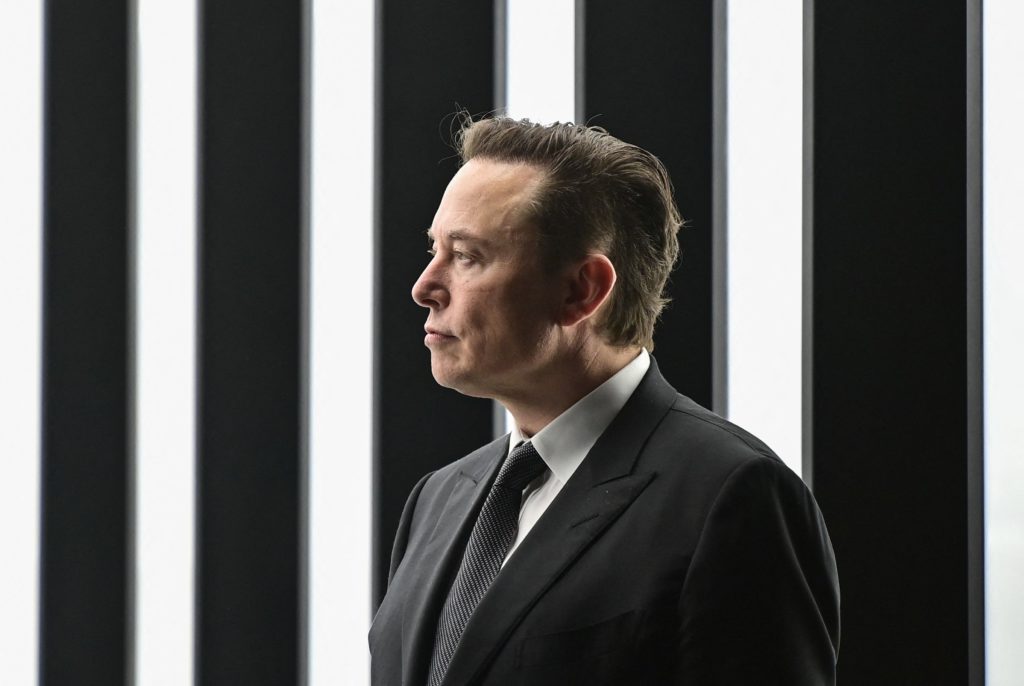
(Bloomberg) — Executives from Twitter Inc. tried to better explain how the company calculates the number of spam bot accounts on the service, and reiterated that the number is low, tackling a topic that’s been a hangup for Tesla Inc. Chief Executive Officer Elon Musk, who has a deal to buy the social network.

Twitter shares gained as much as 3.4% to $39.51 on news about the briefing. The stock dropped 12% this year through Wednesday’s close.

Twitter has repeatedly said that the number of spam bots on the service represent less than 5% of its total user base. Musk, meanwhile, has complained that the number of bots on Twitter is much higher, and has threatened to walk away from his agreement to buy the company for $44 billion until he gets confirmation about Twitter’s bot percentage. 

Twitter executives said Thursday in a media briefing that the company manually reviews thousands of accounts each quarter to determine the 5% number, and estimates that the actual number is well below what’s disclosed in filings. The company also uses internal data to confirm the bot number, including things like IP addresses or phone numbers to determine if an account is run by a human. 

Musk has demanded an audit of Twitter’s estimates. Twitter reiterated that they are sharing some data with Musk, and working with his team within the confines of the purchase agreement. An executive declined to comment on what data was being shared with Musk, but said that the company does not share internal data with outsiders due to privacy concerns. 

Twitter previously gave Musk access to the company’s “fire hose” of public tweets, but that data only includes public tweet data, not private account data. 

A Twitter executive cautioned that it would not be possible for an outsider to accurately estimate the number of bots on the service without that data. The executives asked not to be identified by name.

(Updates with shares in the second paragraph)

More stories like this are available on bloomberg.com

©2022 Bloomberg L.P.
Musk Tweets About Underpopulation After Report He Fathered Twins With Employee

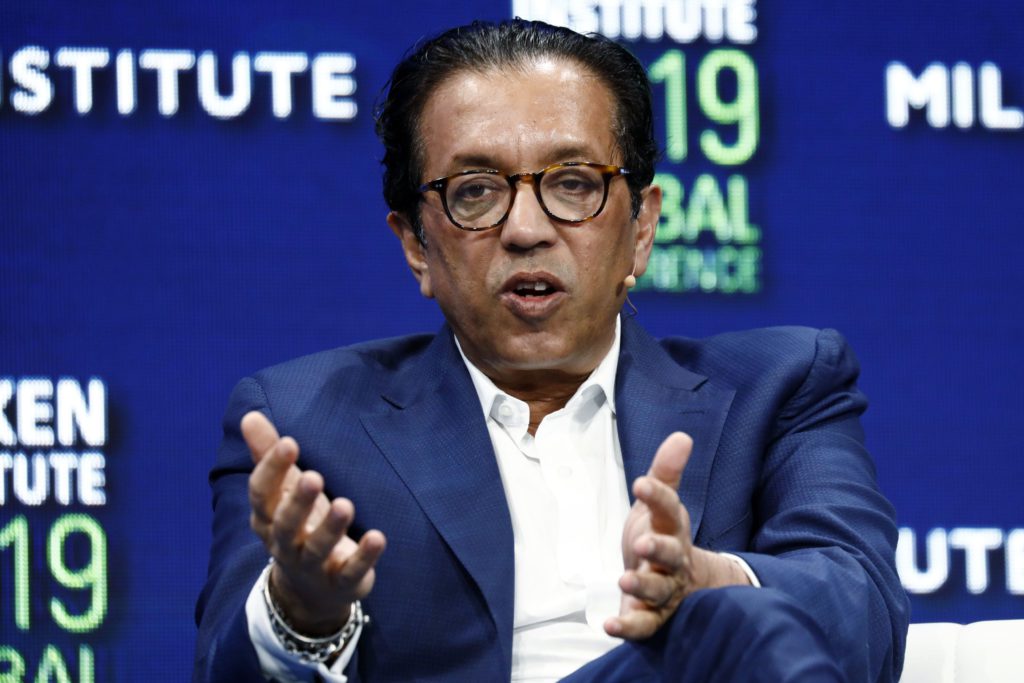
(Bloomberg) — Billionaire Elon Musk is the father of eight-month-old twins born to a senior executive at his artificial intelligence startup Neuralink, Insider reported, citing a court document.

Musk and the executive asked a Texas judge in April to change the children’s names to reflect both their surnames, Insider said. The request was granted, according to the report.

The two babies would bring Musk’s total known children to nine. He has advocated for increasing the population as part of his vision for colonizing other planets. In a series of tweets after the news was widely reported, Elon Musk asked several times about underpopulation and even asked whether Tesla should design a “highly configurable Robovan for people & cargo.” 

Neuralink, a closely held company controlled by Musk, and Musk didn’t immediately respond to emailed inquiries, and Bloomberg couldn’t immediately obtain a copy of the court document.

(Updates with latest Elon Musk tweets starting in third paragraph.)

More stories like this are available on bloomberg.com

©2022 Bloomberg L.P.

SoftBank’s Rajeev Misra to Step Back to Launch New Fund

(Bloomberg) — Rajeev Misra is stepping back from his main roles at SoftBank Group Corp., marking the exit of one of the key architects of the Japanese conglomerate’s sometimes chaotic evolution into the world’s largest technology investor. 

A key lieutenant of SoftBank’s founder Masayoshi Son, Misra will retain a senior position with the group’s first $100 billion Vision Fund, but relinquish other roles, people familiar with the matter said.  

Misra recently held talks with Son in Tokyo, during which he told his boss of his plans to leave to pursue his own venture, according to the people, who asked not to be identified discussing confidential information. 

He’s already secured more than $6 billion in backing for a new fund that’ll target a mix of strategies, the people said. Akshay Naheta, a former colleague of Misra, alongside SoftBank managing partners Yanni Pipilis and Munish Varma, have held discussions to join Misra’s venture, some of the people said. 

Abu Dhabi conglomerate Royal Group, which is led by Sheikh Tahnoon Bin Zayed Al Nahyan, and ADQ, one of the the emirate’s sovereign wealth funds, have committed money to Misra’s fund, separate people said.

Deliberations are ongoing and no final decisions on the fund’s size or the timing of its launch have been made, according to the people. Plans could also still falter, they said. A representative for SoftBank confirmed Misra’s decision to step back. 

Misra will continue as CEO of the initial Vision Fund, and become vice chairman of SoftBank’s wider investment arm, with Son taking over Misra’s positions, according to an internal memo seen by Bloomberg. 

Misra’s decision to step back at SoftBank will complete a hollowing out of the conglomerate’s most senior investing ranks, which had been bolstered over the years by a raft of hires from bulge-bracket banks. 

The 60-year-old former Deutsche Bank AG executive made the Vision Fund one of the biggest champions of high-flying Silicon Valley startups before public stumbles and internal strife dimmed its star. The fund’s attempts to regain its footing have been hampered by a drop in tech valuations, which resulted in a record loss for SoftBank in the quarter ended in March. 

After joining Deutsche Bank in 1997, Misra rose through the ranks to become a key deputy to then CEO Anshu Jain. After short spells at UBS Group AG and Fortress Investment Group, Misra landed at SoftBank in 2014. He’d already built a relationship with Son by helping him to finance difficult deals. 

The original Vision Fund would gather almost $100 billion, including $45 billion from Saudi Arabia’s Public Investment Fund, as well as capital from Apple Inc., the government of Abu Dhabi and others. Under the aegis of Misra and other former Deutsche Bank executives, Vision Fund helped start the trend of investing massive amounts in startups — which caused valuations to soar.

In its first year of investing, Vision Fund committed $65 billion to acquire big stakes in the likes of Uber Technologies Inc., WeWork, and Slack Technologies Inc. 

But bets began to sour. SoftBank’s investment in WeWork collapsed, eventually leading the investor to bail out the remote working startup. A complex side-deal with Wirecard AG, which netted SoftBank executives a significant profit, led to criticism after the German payments firm also failed. 

While deploying a wave of capital at startups, Misra also clashed with senior rivals including former chief operating officer Marcelo Claure and president Nikesh Arora, ultimately outlasting them both.

(Updates with Misra’s backers in fifth paragraph.)

More stories like this are available on bloomberg.com

©2022 Bloomberg L.P.

YouTube Says Its TikTok Rival Is a Hit With Musicians

(Bloomberg) — Pop singer JVKE has been posting short clips of himself dancing and clowning around on YouTube’s Shorts video platform for more than a year.

In one, he sings into a soda bottle. In another, he pretends to show what to do if you catch your girlfriend cheating on you. Spoiler alert: It involves writing a new song.

All the screen time is paying off. The singer, who got his start posting clips on TikTok, now has over 1.8 million subscribers on YouTube, more than two-thirds of them added this year. YouTube, a division of Alphabet Inc.’s Google unit, wants more musicians to make short-form videos for its platform.

In data shared exclusively with Bloomberg, the social media site said artists are using Shorts, its TikTok competitor, to rapidly grow their subscribers. In addition to JVKE, others benefiting from the product include singers Madilyn Bailey, Cooper Alan and Emeline, who increased their subscriber counts by 480,000, 290,000 and 150,000, respectively.

“It is a very important opportunity that both the fans and the artists have,” Lyor Cohen, YouTube’s global head of music, said in an interview.

Cohen is excited about the music industry’s opportunity in the short-form space, though he’s also “deeply concerned” some viewers might only watch short-form content without exploring an artist’s deeper, longer-form work, like music videos and interviews. He called short-form videos that don’t link to long-form content “junk food.”

“I think short-form video could help crowdsource and make it easier for kids to find the soundtrack of their youth, but then you have to be prompted, and it has to lead you [to long-form content], so it’s not empty calories, but it leads you to learning and discovering and becoming a fan,” Cohen said.

YouTube introduced Shorts two years ago. It focuses on videos under one minute in length. The opportunity to link to longer videos, and thus generate even more ad revenue is great, however. As of April, Shorts containing content from other longer-form videos, not just music-oriented ones, generated over 100 billion views, YouTube said. The company is targeting “multiformat creators” who make both long- and short-form content. YouTube is paying some record labels and musicians to create Shorts.

Still, a backlash from artists making all this content has begun. Some, including Halsey, have spoken out about the pressure to create viral TikTok moments. Cohen said Shorts would thrive because artists could pick either the long-form or short-form path, or do both.

“We truly trust our artists to guide how they want to express themselves and communicate with their fans,” said Nicki Shamel, senior vice president of global commercial partnerships at AWAL, which partners with artists to create and distribute their content.  “And quite honestly, that has to be a personal choice, and something that is authentic to them, but for many artists, short-form content is a low pressure, fun and inspiring way to interact with and communicate to their fans.”

YouTube said in June it reached more than 1.5 billion monthly logged-in Shorts viewers, and, as of April of this year had 30 billion daily views. At the same time, TikTok increased its maximum video length to 10 minutes earlier this year in an effort to become a complete video destination. It started in 2016 at just 15 seconds.

(Updates terms with record labels and musicians in fourth paragraph from the bottom.)

More stories like this are available on bloomberg.com

©2022 Bloomberg L.P.

Close Bitnami banner
Bitnami