Bloomberg

HBO Max Returns to Amazon Prime in Bid to Lure New Subscribers

(Bloomberg) — Warner Bros. Discovery Inc. will once again sell HBO Max through Amazon Prime in a bid to bring millions of new subscribers to its flagship streaming service. 

Amazon.com Inc. customers will be able to sign up for HBO Max through the retailer’s store for online video channels and watch its programs within Amazon’s main streaming service. The deal also covers Warner Bros. Discovery’s new streaming service that will combine HBO Max with Discovery’s other assets.

Warner Bros. Discovery Chief Executive Officer David Zaslav is reversing a move by the previous leaders of HBO Max, as Bloomberg News previously reported he was considering. HBO Max was available through Amazon for long enough to sign up about 5 million customers. But WarnerMedia CEO Jason Kilar yanked it from the service in September 2021 because he wanted HBO Max to have more control over the user interface and billing. 

While streaming services such as Paramount+ and Starz have signed up millions of customers through Amazon, the largest streaming services, such as Netflix and Disney+, have eschewed doing so. When Amazon sells the channel, it collects some of the revenue and controls the relationship with customers.

Warner Bros. Discovery is cutting costs and looking for ways to boost revenue in order to pay down its billions of dollars in debt. The company had 94.9 million total streaming subscribers as of the end of September and plans to introduce a new streaming service in the first half of next year. 

“Warner Bros. Discovery is committed to making HBO Max available to as broad an audience as possible while also advancing our data-driven approach to understanding our customers and best serving their viewing interests,” Bruce Campbell, chief revenue and strategy officer at Warner Bros. Discovery, said in a statement.

More stories like this are available on bloomberg.com

©2022 Bloomberg L.P.

What Exactly Are Crypto Diehards (Re)Building? (Podcast)

(Bloomberg) — Listen to Bloomberg Crypto on the iHeartRadio App, Apple Podcasts or  Spotify.

“It’s time to rebuild” is a catchy phrase often uttered by crypto enthusiasts after massive implosions, such as FTX’s. In the aftermath of these events, investors are known to imagine all the potential for growth following the downturns. 

But it seems that the time for rebuilding has come again and again in the crypto industry this year. Far too often, some might say. So, while crypto believers say: Let’s rebuild, the question remains: Rebuild what exactly?

Bloomberg crypto blogger Emily Nicolle joins senior editor Philip Lagerkranser in this episode to talk about what (if anything) might be getting rebuilt.

Subscribe to the Bloomberg Crypto Newsletter at https://bloom.bg/cryptonewsletter 

This podcast is produced by the Bloomberg Crypto Podcast team: Supervising producer: Vicki Vergolina, Senior Producer: Janet Babin, Producers: Sharon Beriro and Muhammad Farouk, Associate Producers: Mo Andam and Ty Butler. Sound Design/Engineer:  Desta Wondirad.

More stories like this are available on bloomberg.com

©2022 Bloomberg L.P.

Tim Cook, Biden to Help TSMC Unveil $40 Billion US Chip Buildout

(Bloomberg) — Apple Inc. Chief Executive Officer Tim Cook and Advanced Micro Devices Inc. CEO Lisa Su will join President Joe Biden on Tuesday at an Arizona event for Taiwan Semiconductor Manufacturing Co., where the chipmaker will announce plans to bolster its investment in the state to $40 billion and construct a second production facility.

Cook, Su and Biden will be at the site of a $12 billion plant in Phoenix that TSMC is already building, a showcase in the administration’s efforts to encourage companies to bring more chip manufacturing to the US and prevent a repeat of the supply disruptions over the last two years that cost companies hundreds of billions in sales. 

TSMC ramped up its plans after major customers, including Apple, urged the Taiwanese chipmaker to build more advanced semiconductors in the US, Bloomberg News reported. Cook has told employees his company plans to source chips from the Arizona plant under construction.

Earlier: Apple Prepares to Get Made-in-US Chips in Pivot From Asia

TSMC’s expanded plans and Cook’s appearance, previously reported by Bloomberg, amount to a victory lap for Biden in a state crucial to an expected reelection bid in 2024. Carrying Arizona helped him win the presidency in 2020 and Democrats there won narrow elections for governor and a US Senate seat in November’s midterm elections. 

Biden in August signed into law the Chips and Science Act, offering $50 billion in incentives for companies to produce semiconductors in the US. TSMC is likely to receive billions in subsidies. The president has touted his efforts to boost US chip manufacturing in visits to facilities across the country. 

National Economic Council Director Brian Deese told reporters Monday that both Apple and AMD “will be sourcing significant chips from TSMC’s Arizona facility,” and that the second TSMC site will begin construction in the coming year with production slated to begin in 2026.

“We’re really seeing the success of this long-term strategy that both US companies and global companies are making the decision to invest and expand here,” said Deese.

Read more: TSMC Plans to Make More Advanced Chips in US at Urging of Apple

When the two plants are up and running, they will eventually produce more than 600,000 wafers annually. That volume is about 4% of TSMC’s total global output in 2021.

The president is expected to be joined at the event, intended to celebrate a key construction milestone at the Phoenix site, by Commerce Secretary Gina Raimondo and TSMC executives, including founder Morris Chang, Chairman Mark Liu and Chief Executive Officer C.C. Wei. Nvidia Corp. chief Jensen Huang is also slated to attend.

The plant will make advanced 4-nanometer chips when it comes online in 2024 and the second facility will make even more sophisticated 3-nanometer chips. However, when TSMC begins to make 3-nanometer chips in the US in 2026, its technology in Arizona will still lag at least one generation behind what’s available in Taiwan.

TSMC is the world’s go-to supplier for chips powering everything from smartphones to electric vehicles, and most of its production is still centered in Taiwan. 

China’s threats to Taiwan have raised concerns about the world’s heavy reliance on that region for supplies of semiconductors. 

TSMC’s customers have pressed the company to roll out its latest technologies simultaneously in the US and Taiwan, Bloomberg News reported, which would help fulfill a Biden administration goal of having the most cutting-edge chips in the world produced on US soil. But Taiwanese and company officials have said they intend to keep the latest technology at home.

In addition to the over 10,000 construction workers who helped with construction of the site, TSMC Arizona’s two fabrication plants are expected to create an additional 10,000 high-paying high-tech jobs, including 4,500 direct TSMC jobs.

More stories like this are available on bloomberg.com

©2022 Bloomberg L.P.

Russia Independent TV Network Stripped of License in Latvia

(Bloomberg) — Russia’s most prominent independent TV channel will lose its operating license after Latvian regulators cited it for violations in its coverage of the war in Ukraine, but the outlet said it would try to continue to broadcast online.

TV Dozhd (‘Rain’) set off a storm of criticism last week when an anchor appeared to advocate sending supplies to mobilized Russian troops fighting in Ukraine. The journalist later apologized and was fired. Like several other independent media outlets, Dozhd fled Russia after the start of the war and set up operations in Latvia, a European Union and NATO member that’s become one of Europe’s fiercest critics of the war.

Regulators there originally had fined Dozhd for the latest violations. But Tuesday, Ivars Abolins, the chairman of the broadcasting authority, said the channel would lose its license effective Dec. 8, citing “threats to the security of the state and public order” and three recent violations of rules. 

“Latvian laws must be observed and respected by everyone,” he said in Twitter. The regulator will seek to block Dozhd in YouTube in Latvia, as well, he said.

He cited Dozhd broadcasts showing a map of Crimea as part of Russia, calling the Russian army “our army,” and the correspondent’s comments on supporting troops last week.

Dozhd called the accusations “unfair and absurd” and vowed to continue broadcasting on YouTube. The Latvian order, which can be appealed, means the channel will have to suspend broadcasts on cable networks, Dozhd said on Twitter.

Latvia has made granting any aid to Russia’s military a criminal offense. The country’s security service said last week that it is conducting a probe into the Dozhd broadcast that mentioned helping Russian troops.

(Updates with regulator, network comment from fourth paragraph)

More stories like this are available on bloomberg.com

©2022 Bloomberg L.P.

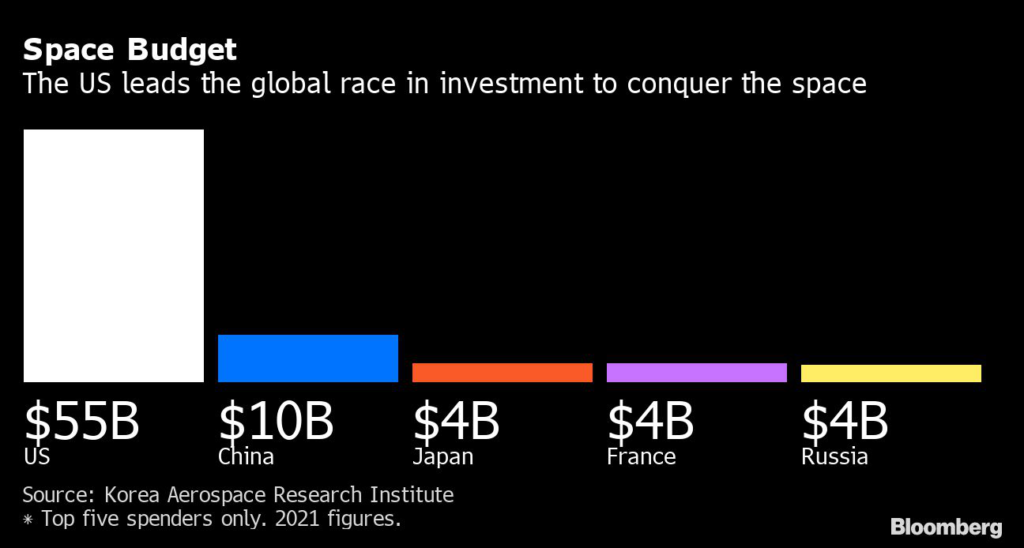
South Korea Sees Space Exploration as Shaping Global Economy

(Bloomberg) — Space development can reshape the world economic order, a South Korean official said, as Seoul works to expand its prowess among a small group of countries capable of developing and launching their own space vehicles.

Titanium, platinum and rare-earth materials are among commodities South Korea should be able to independently excavate in space missions given their importance for future economic growth, Kwon Hyunjoon, director-general of the Science Ministry’s space and nuclear bureau, said in a briefing Tuesday.

South Korea is trying to play catchup in the global space race after launching its home-grown, three-stage Nuri rocket about a year ago. President Yoon Suk Yeol said last month his country plans to land a spacecraft on the moon in 2032 as it searches for minerals on the lunar surface. After that, South Korea will aim to touch down on Mars by 2045.

South Korea Launches New Rocket in Boost to Space Program

The country’s space program has been hit by a series of delays and troubles over the years and still has a while to go before it can reach the more advanced levels of neighbors China and Japan. On top of that, it remains to be seen if there is a cost-efficient way to extract resources on the moon, which would likely require a source for hydrogen and oxygen that could be used to power rockets, a research paper on lunar propellant production said.

Kwon compared the space race to the “Age of Discovery,” which he said “made a massive difference between countries able to transport men and materials across the seas and those that couldn’t.” The U.S. would be a key partner in space development rather than China, he added.

South Korea plans to spend more than 2 trillion won ($1.5 billion) to build a rocket to reach the moon and about 680 billion won on a landing craft, Kwon said.

The government will take the lead in jump-starting demand for spacecraft given the small domestic industry, he said. South Korea will initially focus on the market for satellites in low earth orbit, which would form a bigger share of the entire space industry Kwon estimated to be about 1,100 trillion won by 2040. 

More stories like this are available on bloomberg.com

©2022 Bloomberg L.P.
Apple Expands Do-It-Yourself Repair for Macs, iPhones to Europe

(Bloomberg) — Apple Inc. will begin letting customers in eight European countries repair their own devices, expanding a program that rolled out in the US earlier this year. 

The offering, known as Self Service Repair, will now allow users in France, Belgium, Germany, Poland, Spain, the UK, Italy and Sweden to buy parts online for the iPhone SE, iPhone 12, iPhone 13 and certain laptops so they can conduct their own repairs. As part of the program, announced Tuesday, a customer can rent a large repair toolkit for about €60 ($63), buy individual parts and receive how-to manuals from Apple.

Apple doesn’t recommend that most consumers fix their own devices, but right-to-repair advocacy groups pushed the company for years to permit the practice. The program first launched in the US in April.

Apple, based in Cupertino, California, hasn’t yet expanded the effort to include the iPhone 14 or Macs with newer M2 chips.

From the archive: Why Consumers Are Fighting Tech for ‘Right to Repair’: QuickTake

More stories like this are available on bloomberg.com

©2022 Bloomberg L.P.

UK Finalizing Plans for Crypto Regulation After FTX Implosion

(Bloomberg) — The UK is finalizing plans for regulation of the crypto sector, moving ahead with plans to make Britain a hub for the industry as it grapples with the fallout from FTX’s collapse.

The Treasury will shortly launch a consultation on the new regulatory regime, according to people familiar with the matter, who asked not be named discussing private matter.

The package may include provisions for how to deal with the collapse of companies and restrictions on the advertising of products, according to the Financial Times, which reported the news earlier.

In April, Rishi Sunak spoke of making the UK a post-Brexit “crypto hub,” announcing a plan for government oversight of stablecoins and said it would consult on regulating a wider set of cryptoasset activities. Currently the UK’s Financial Conduct Authority only has an anti-money laundering registration process for crypto companies, although it has repeatedly warned investors about the risks of investing in crypto.

Read More: UK Signals Crypto Engagement With Stablecoin Regulation, NFT

The news comes with the UK government set to announce a package aimed at boosting growth in financial services and the City of London on Friday. City Minister Andrew Griffith said last week the UK sees opportunity in fiat-backed stablecoins.

More stories like this are available on bloomberg.com

©2022 Bloomberg L.P.

Republicans Urge Biden to Be Tough on Chinese Solar Gear Over Human Rights

(Bloomberg) — Republicans are warning the Biden administration not to prioritize green energy goals over enforcing federal import restrictions meant to discourage alleged human rights abuses in China.

The directive from Republican Representatives Mike Gallagher and Chris Smith, as well as Senators Marco Rubio and Tom Cotton, signals tough oversight of the issue after the GOP takes control of the House in January. Trade curbs in the Uyghur Forced Labor Prevention Act are already thwarting imports of solar panels and other gear critical to renewable power projects, potentially at the expense of clean energy goals in the Inflation Reduction Act. 

“We urge you to fully enforce the Uyghur Forced Labor Prevention Act as required by law, particularly when it comes to solar panels made with forced labor, which will get subsidies, grants and tax credits under the IRA,” the lawmakers say in a letter to Homeland Security Secretary Alejandro Mayorkas and the acting head of US Customs and Border Protection. “American taxpayers cannot be allowed to subsidize the effective enslavement of the Uyghurs and other predominantly Muslim ethnic groups.”

Under the one-year-old UFLPA, the US government assumes anything made even partially in the Chinese manufacturing hub of Xinjiang is produced with forced labor and can’t be imported into America. Companies can win exemptions if they are able to provide “clear and convincing evidence” the goods are free of force. The US accuses China of requiring hundreds of thousands of detainees -– mostly Uyghur Muslims or other minorities –- to work against their will in Xinjiang, allegations Beijing denies.

China hit back at the lawmakers on Tuesday, with Foreign Ministry spokeswoman Mao Ning saying at a regular press briefing in Beijing that the UFLPA was “based on lies that seriously disrupt normal photovoltaic trade between China and the US.”

Xinjiang is also a major supplier of polysilicon, a metal used in most solar panels today. And the restrictions have already led to the seizure and detention of hundreds of shipments containing solar gear. Some exporters preemptively have halted shipments to the US over concerns they’ll be detained at the border, contributing to a decline in renewable power installations and cancellations of new projects, the American Clean Power Association has said.

“After more than four months of solar panels being reviewed under the UFLPA, none have been rejected and instead they remain stuck in limbo with no end in sight,” Jason Clark, interim president of the ACPA said in a statement Monday. 

The Republicans make clear they want the administration to take a harder line enforcing the law, especially as the IRA drives more demand for renewable power imports. That includes potentially blacklisting firms such as Longi Green Energy Technology Co., Jinko Solar Co. and Trina Solar Co., whose products have been detained, the lawmakers say.

Trina said in a statement that it has normal operations in many countries and regions and abides by local rules and regulations, including in the US. Representatives of Jinko and Longi Green did not immediately respond to requests for comment. 

John Smirnow, general counsel of the Solar Energy Industries Association, said the industry “has made remarkable progress decoupling its supply chain from Xinjiang,” and “leading solar importers have demonstrated their compliance with the Uyghur Forced Labor Prevention Act.”

House Republicans have already signaled more oversight of issues around China next year. Representative Kevin McCarthy has said he’d form a select committee on China if elected speaker of the House, an evolution of a Republican-only task force he established in 2020. Gallagher was part of that task force, too. 

–With assistance from Luz Ding and Lucille Liu.

(Updates with comment from China’s Foreign Ministry.)

More stories like this are available on bloomberg.com

©2022 Bloomberg L.P.
Goldman Sachs Plans to Invest in Crypto Companies: Reuters

(Bloomberg) — Goldman Sachs Group Inc. plans to invest tens of millions of dollars in crypto firms, Reuters reports, citing an interview with Mathew McDermott, global head of digital assets at the company.

  • It plans to buy or invest in crypto firms after the collapse of FTX exchange hurt investor interest and valuations, McDermott told the news service
    • “We do see some really interesting opportunities, priced much more sensibly”
    • Goldman is doing due diligence on a number of different crypto firms
  • He told Reuters that “FTX was a poster child in many parts of the ecosystem”
    • “But to reiterate, the underlying technology continues to perform”
  • NOTE: Bankman-Fried Says He Will Testify Before US House (Video)


More stories like this are available on bloomberg.com

©2022 Bloomberg L.P.
Jack Dorsey’s Block Invests in Renewable Bitcoin Miner Gridless in Africa

(Bloomberg) — Jack Dorsey’s Block Inc. is among the companies contributing to a funding round for a Bitcoin miner in Africa fired by renewable power. 

Digital payments firm Block and venture capital investor Stillmark have led a $2 million seed investment in Gridless, a miner that harnesses small-scale renewable energy grids in rural Africa, Block said in a Dec. 6 statement. 

Bitcoin mining is an energy-intensive process in which electricity-guzzling computers secure the digital-asset’s blockchain by validating transaction data and unlocking tokens as a reward in return. Some studies estimate that the annual energy consumption involved exceeds the amount entire countries like Belgium use. 

The investment is Block’s latest effort to push for sustainable and decentralized mining operations. It has recruited veteran crypto-mining engineers and managers to build out its mining unit and develop projects that can encourage individuals to mine Bitcoin. Most of the computing power for Bitcoin mining is currently from industrial-scale centers. 

Gridless seeks to harness excess energy at small-scale renewable power sites in rural Africa, according to the statement. It has contracted five project pilots in rural Kenya with HydroBox, an African hydroelectric energy company, three of which are currently operational. Gridless plans to expand to other parts of East Africa in the near future, it said.

Mining profitability is heavily dependent on energy costs. The industry has been battered by persistently high electricity prices, a 66% slide in Bitcoin over the past year and stiff competition.

More stories like this are available on bloomberg.com

©2022 Bloomberg L.P.
Close Bitnami banner
Bitnami