
Bloomberg

Texas Economy Defies Abortion Politics With Business Rewards

(Bloomberg) — If Texas is a test for how socially conservative US states will fare economically in the post-Roe world, then they’ll hold up just fine.

More than a year after passing the country’s most restrictive abortion law, Texas boasts the largest number of Fortune 500 company headquarters of any state. In the latest sign of the Lone Star State’s enduring allure, Chevron Corp. announced plans to relocate workers to Houston just hours after the US Supreme Court struck down Roe v. Wade.

Other southern and Mountain states have been a magnet for Americans in recent years, a trend that accelerated during the pandemic and boosted growth in cities across Florida, Arizona, Idaho and Utah. These states, led by Republican governors, are now all trying to further restrict abortion — if not outright ban it.

“There will no doubt be people who won’t come to Texas or other southern states as a result of these policies, but, by and large, these things are determined by the dollars and cents,” said Brandon Rottinghaus, a political science professor at the University of Houston. “Businesses are getting more or less what they want from Texas — that is low taxes, modest regulation and the freedom to influence their own destiny.”

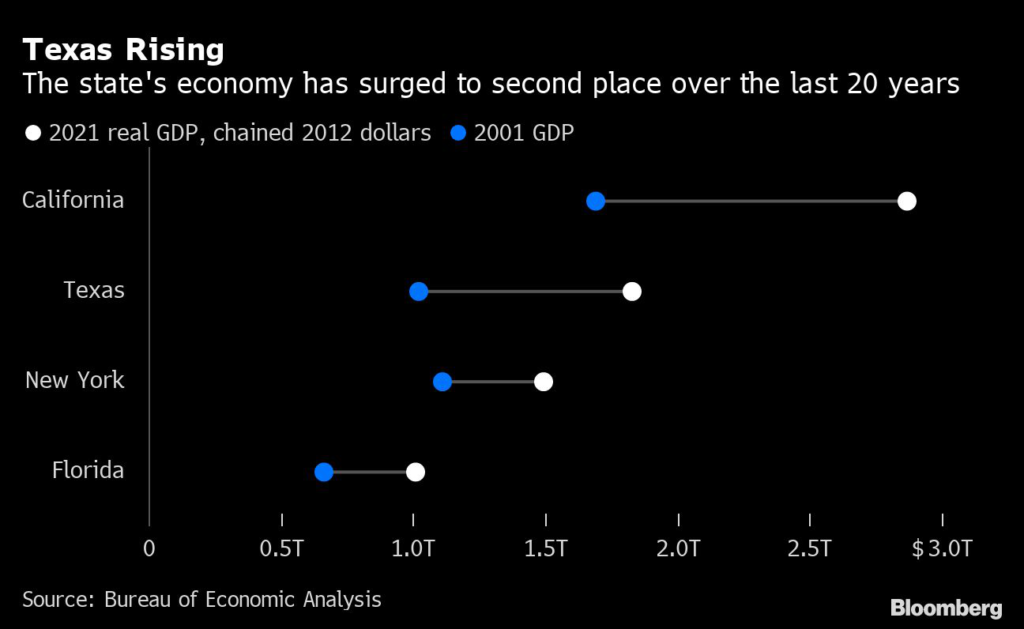
Texas has for decades hung its hat on being a business-friendly state. Its population boom propelled it to the second-biggest economy, after California, and it’s among the fastest-growing in the past 20 years. None of the restrictive laws passed by the state legislature and signed by Republican Governor Greg Abbott are threatening its prosperity in the foreseeable future. 

Even Austin, long a liberal bastion, hasn’t seen a brain drain. 

The economic risk is over the long term. Some state politicians, emboldened by a conservative Supreme Court, are already talking about punishing businesses that fund employees’ out-of-state travel for procedures. Reproductive-rights advocates have warned that in-vitro fertilization treatments could also be targeted. That would slowly chip away at the influx of people and companies willing to move to those places.

For now, low taxes on corporations and plenty of incentives outweigh any concerns about politics, reproductive rights and widening inequalities. 

Texans, whether newcomers or natives, are unlikely to leave. The state is the “stickiest” in the US, retaining more of its population than any other, according to a study by the Dallas Federal Reserve’s Pia Orrenius and Madeline Zavodny of the University of North Florida.

“Very few people leave Texas, largely because of abundant economic opportunities,” the economists wrote, adding that the state has an above-average business formation rate.

A low cost of living and plenty of space don’t hurt, either. Chevron specifically cited lower housing prices in its offer to relocate employees from California, where the median home price is more than double that of Texas. 

Diversified Economy

A relentless focus on growth has helped diversify the state’s economy beyond energy. 

The Metroplex, home to Dallas and Forth Worth, has seen an influx of financial services firms. Houston, once mainly an oil town, is home to the world’s largest children’s and cancer hospitals. Austin, Texas’s capital, has blossomed into a major tech hub — Tesla Inc. and Oracle Corp. are among the latest high-profile arrivals. 

Although many transplants to Texas have come from more left-leaning places like California and New York, they have proved to be more conservative than thought. Newcomers voted for Republican Ted Cruz in his 2018 Senate re-election bit at a higher rate than those born in the state, according to a CNN exit poll.

But the fall of Roe may eventually become a deterrent. 

Cutting access to health care may pose challenges to businesses recruiting talent to the state, according to Shea Cuthbertson, president elect of Austin Women in Technology, a nonprofit networking organization. The state laws will add a financial burden on employers offering travel for care — something startups can hardly afford, she said. 

“The bottom line is that restrictive health-care policies significantly hurt people and will have a negative impact on the technology sector in Texas,” Cuthbertson said by email. “Ultimately, this will take away from diversity of thought, innovation, and equity in the workplace.”

The appeal of states like Texas may erode over time, according to Mark Zandi, chief economist at Moody’s Analytics. 

“The overturn of Roe may also result in many smaller, but important, hard-to-see economic consequences,” Zandi said. Colleges in states that ban abortion could see fewer applicants from the rest of the country and world, who tend to be more socially liberal, he said.

Rising Inequality

Economists say bans will disproportionately hurt lower-income groups and minorities.

Professionals working for corporate giants like JPMorgan Chase & Co. or Walt Disney Co. will get travel expenses covered if they need out-of-state abortions — at least until states try to outlaw the practice. But the majority of women living in states with severe restrictions or bans don’t work for companies that provide that benefit — and Medicaid in most states doesn’t cover abortion.

Research shows that women forced to carry a child to term are four times as likely to live below the poverty line even years after the birth. They tend to have lower wages later in life. About 40% of Texas residents are Hispanic and the state has one of the biggest median-income gaps between White and Hispanic residents.

“There will be a negative macroeconomic effect,” said Sarah Miller, assistant professor of business economics and public policy at the University of Michigan’s Ross School of Business.

Miller was among more than 150 economists who submitted an amicus brief to the Supreme Court arguing to uphold Roe v. Wade, saying that access to reproductive care had a positive effect on women’s overall lives.

“This is going to increase inequality — we’re already seeing it,” she said.

(Adds transplants’ political views in the 14th paragraph. A previous version of the story corrected the spelling of Tesla.)

More stories like this are available on bloomberg.com

©2022 Bloomberg L.P.
US College Students Are Shunning Oil-Industry Degrees for ESG Future

(Bloomberg) — Scott Lindberg’s dream of becoming a petroleum engineer was fueled by childhood drives through Texas oil country with his energy-consultant father, passing pumpjacks and pipeline hubs that kept the world’s biggest economy humming.

But after recently graduating with honors from the University of Texas at Austin with a petroleum-engineering degree, Lindberg is turning his back on the oil industry and plans to attend law school instead. His disenchantment is rooted in concern that fossil fuels may not have much of a future given increasing pressure from politicians, activists and investors to pivot toward more climate-friendly energy sources.

The 22-year-old Houston-area native illustrates an alarming trend for the top US petroleum-engineering programs, where enrollments are dwindling despite the surge in crude prices that historically prompted more aspirants to join the industry. 

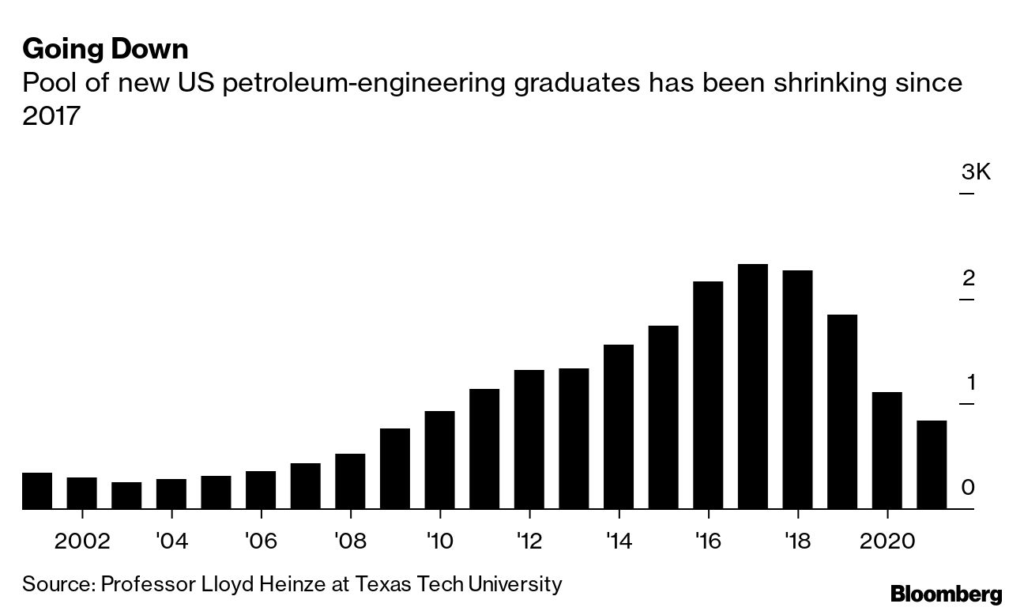
This year, the number of new petroleum-engineering graduates in the US is expected to total about 400 — an 83% decline from 2017, when they peaked at more than 2,300, according to Lloyd Heinze, a Texas Tech University professor who tracks annual enrollments at more than three dozen petroleum schools around the world. 

“I was kind of concerned that if we eventually get to a point where fossil fuels are so disfavored that the jobs simply don’t exist before I plan to retire,” Lindberg said. “I could lose my career if I stayed.” 

At Lindberg’s alma mater — which he attended on a full scholarship — undergraduate enrollment in petroleum engineering dropped 11% between 2018 and 2021. Although benchmark American crude prices climbed 25% during that period, it was perhaps the most-volatile era in the modern oil industry: in early 2020, the price temporarily went negative for the first time in history as energy demand collapsed in the wake of a worsening global pandemic. 

Historically, however, petroleum schools have seen influxes of new students when oil booms and the sector goes on hiring sprees. But with US crude up more than 30% so far this year, the link appears to be broken.

“Personally, I think we are heading to a bit of a crisis,” said Jennifer Miskimins, who leads the petroleum-engineering department at the Colorado School of Mines, one of the world’s premier oil universities. “As petroleum engineers age, the industry will need to replace a retiring cohort of Baby Boomers. But we are not seeing enough petroleum engineers to fill the demand.” 

During the shale revolution that unfolded during the first decade-and-a-half of this century, enrollments soared and bachelor’s degrees reached a record 2,326 in 2017, Texas Tech’s Heinze said. That will tumble to about 400 this year and remain in the 200-to-400 range annually for the next 10 years or so, he estimated.  

The reason why enrollment numbers no longer correlate with oil prices, according to Colorado School of Mines’s Miskimins, is partly due to the energy transition. More students and parents are turned off by the sector not necessarily because they are environmental advocates, but because they have concluded the switch will make oil and natural gas obsolete in five or 10 years, she said. 

To cope with falling petroleum-engineering enrollments, universities across the country are trying to adapt. For example, the University of Texas is offering a new minor in sustainable energy where students can take a wide array of environmentally-minded classes. 

And many students that matriculate with petroleum-engineering degrees are putting those skills to work in non-oil fields, said Jon E. Olson, the department chair of petroleum and geosystems engineering at UT. Roughly 25 of the 75 companies that hired graduates of the department’s class of 2020 were involved in the tech, financial, environmental and consulting sectors, he said.  

“We always tell students in their first lesson, you are entering a super cyclical industry, and you need to be prepared for that,” Miskimins said. 

More stories like this are available on bloomberg.com

©2022 Bloomberg L.P.

Allen & Co. Conference Starts Amid ‘Turmoil’: Sun Valley Update

(Bloomberg) — Some of the world’s top business tycoons are heading to Idaho for Allen & Co.’s annual conference, which started Wednesday. 

Recession fears, rising interest rates, the crypto crash and scores of other business and economic worries will be top of mind as leaders in technology, media and finance gather for the annual Sun Valley Conference. 

Warner Bros. Discovery Inc. Chief Executive Officer David Zaslav told reporters as he arrived Tuesday that the media industry will focus on creating fewer, better shows as the streaming TV wars enter a new phase. 

“I think it’s gonna be a great week — lotta turmoil in the business,” Zaslav said. “But that means, I think, a lot of opportunity.”

Others who have arrived include Robert Kraft, Brian Grazer and Jeffrey Katzenberg.

More stories like this are available on bloomberg.com

©2022 Bloomberg L.P.

Microsoft Cloud Executive Leaves After Allegations of Verbal Abuse

(Bloomberg) — Microsoft Corp. cloud Vice President Tom Keane said he’s leaving the software giant, where he’s spent 21 years. His departure comes after a report in May by Insider that accused Keane of verbally abusing staff.

Keane spent nine years overseeing infrastructure for Microsoft’s Azure cloud, working on projects like data center expansion and security. More recently he’s been overseeing technology to help move Microsoft’s cloud-computing business into newer areas like 5G and space. 

Keane didn’t provide details on his next move in a post on LinkedIn, except to say he’s “taking the next step in my career to build on the world’s computer.” 

Insider reported Keane made an employee cry in a public meeting and that staffers called him “King Tom” behind his back, citing interviews with unnamed employees. 

Microsoft declined to comment. Keane didn’t immediately reply to a request for comment via LinkedIn.


More stories like this are available on bloomberg.com

©2022 Bloomberg L.P.
White House Nominates Denver Airport Chief for Top FAA Post

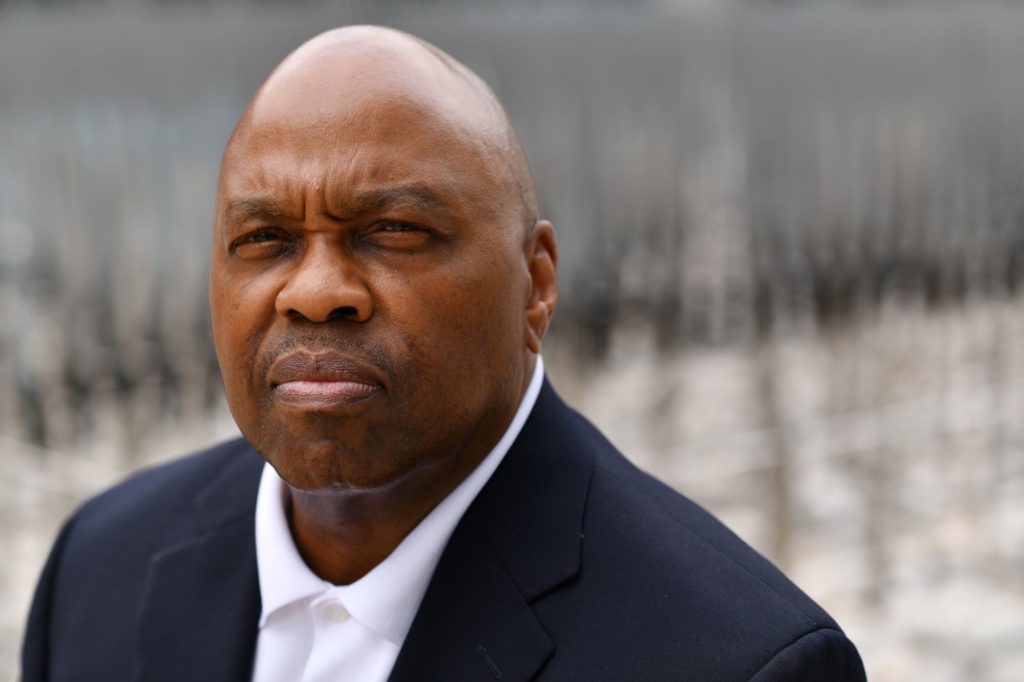
(Bloomberg) — The White House is tapping Phil Washington, the director of Denver International Airport, to lead the Federal Aviation Administration.

The nomination, announced Wednesday in a statement, is to fill a post that has been without a Senate-confirmed leader since Steve Dickson resigned from the aviation agency in March, about halfway through his five-year term. Washington, who Bloomberg reported last month was in line to receive the nomination, will now face confirmation in the closely divided Senate.

If approved, Washington will face a long list of challenges as the FAA attempts to impose multiple reforms targeting how airliners are certified, prompted by two fatal crashes on Boeing Co. 737 Max jets, and mediates a dispute between telecommunication companies and airlines over new 5G service. 

The agency is also under fire from airlines over air traffic control issues that have contributed to flight cancellations.

Earlier: United Air Blames FAA’s Control System for Snarling US Aviation

Washington headed President Joe Biden’s transition team for transportation-related agencies after the 2020 election. He became head of Denver’s airport about a year ago. He previously served as chief executive officer of the Los Angeles County Metropolitan Transportation Authority for six years and was CEO of Denver Regional Transportation District before that.

More stories like this are available on bloomberg.com

©2022 Bloomberg L.P.
Apple Launches iPhone Security Tool to Block Targeted Attacks

(Bloomberg) — Apple Inc. introduced a security tool for iPhone, iPad and Mac devices that is designed to prevent targeted cyberattacks on high-profile users such as activists, journalists and government officials. 

The optional feature, called Lockdown Mode, will offer “extreme” protection for a “very small number of users who face grave, targeted attacks,” Apple said Wednesday in a statement. The tool vastly reduces the number of physical and digital ways for an attacker to hack a user’s device. Apple said the feature is aimed primarily at trying to combat attacks from “spyware” sold by NSO Group and other companies, particularly to state-sponsored groups. 

Over the past several years, state-sponsored entities have hacked high-profile users by gaining remote access to data on their iPhones. Last year, Bloomberg News reported that a number of US State Department employees were hacked and notified by Apple. In November, Apple sued NSO Group, saying the Israel-based company develops tools like Pegasus spyware to abuse and harm Apple users.

Apple said a small number of its users have been targeted by such attacks across 150 countries. The iPhone maker recently put in place a feature that notifies users who are the subject of state-sponsored cyberattacks. That notification system will be updated to inform those people about the new Lockdown Mode, Apple said. 

Lockdown Mode will affect the Messages app, FaceTime, Apple online services, configuration profiles, the Safari web browser and wired connections. 

With the tool in place, the Messages app will block attachments other than images and disable link previews. Those are two common mechanisms that hackers use to infiltrate devices remotely. The web browser, another frequent conduit for hackers, will also be severely limited, with restrictions on certain fonts, web languages and features involving reading PDFs and previewing content.

In FaceTime, users won’t be able to receive calls from an individual that they haven’t previously called within the preceding 30 days.

Lockdown mode can be turned on using a toggle at the bottom of the privacy menu within the settings app on Apple devices. During the set up, users will be warned that enabling the tool will mean the device “will not function as it typically does” and that “apps, websites, and features will be strictly limited for security and some experiences will be completely unavailable,” according to screenshots of the feature shared by Apple.

Alphabet Inc.’s Google offers similar tools for high-profile users, warning them when they are targeted by state-sponsored hackers and promoting strong authentication techniques as a defensive measure.

Apple plans to release Lockdown Mode as part of the upcoming iOS 16, iPadOS 16 and macOS Ventura operating system updates in the next few months. It is also going into testing this week as part of the third beta for developers. The company didn’t say when versions of the feature may arrive on other Apple operating systems, including watchOS for the Apple Watch, but said it plans to add new protections in the future.

Other online services will also get changes in Lockdown Mode, but Apple didn’t specify the exact differences. Features like CarPlay that in some cases require a wired connection won’t work unless a user inputs their passcode, while new configuration profiles and device enrollments into enterprise management software also won’t work in this mode. 

Apple also said it would pay researchers a security bounty of as much as $2 million if they find ways to bypass Lockdown Mode and help improve its protections. The company is also giving a $10 million grant to the Dignity and Justice Fund, established and advised by the Ford Foundation, to support the investigation and prevention of highly targeted cyberattacks.  

More stories like this are available on bloomberg.com

©2022 Bloomberg L.P.
Investors Take Bitcoin Off Exchanges as Crypto Winter Settles In

(Bloomberg) — As the crypto winter deepens, only the staunchest Bitcoin investors are still holding onto their tokens — but not on the exchanges. 

Investors in the world’s biggest cryptocurrency are going into hibernation mode with on-chain activity dropping by 13% in early July from November’s highs — levels last seen in the bear phases of 2018 and 2019 when Bitcoin was worth less than $10,000 — according to a Glassnode analysis.

The risk-off market mood is spreading to the cryptocurrency exchanges as investors withdraw and stow their coins off-line in crypto wallets instead. The exchanges have seen their balances drop more than 20% from a Jan. 20 peak, according to Glassnode. 

“Bitcoin has seen a near complete expulsion of market tourists, leaving the resolve of HODLers as the last line standing,” according to a Glassnode newsletter dated July 4. Bitcoin fell below $20,000 last month for the first time since 2020. 

While several activity levels — a demand indicator — have trended downward in recent weeks, there still appears to be a stable holder base, as prices hover around $20,000. HODLers — stalwart investors who refuse to sell — are evident as Glassnode says relatively flat transaction activity shows continued Bitcoin consolidation.

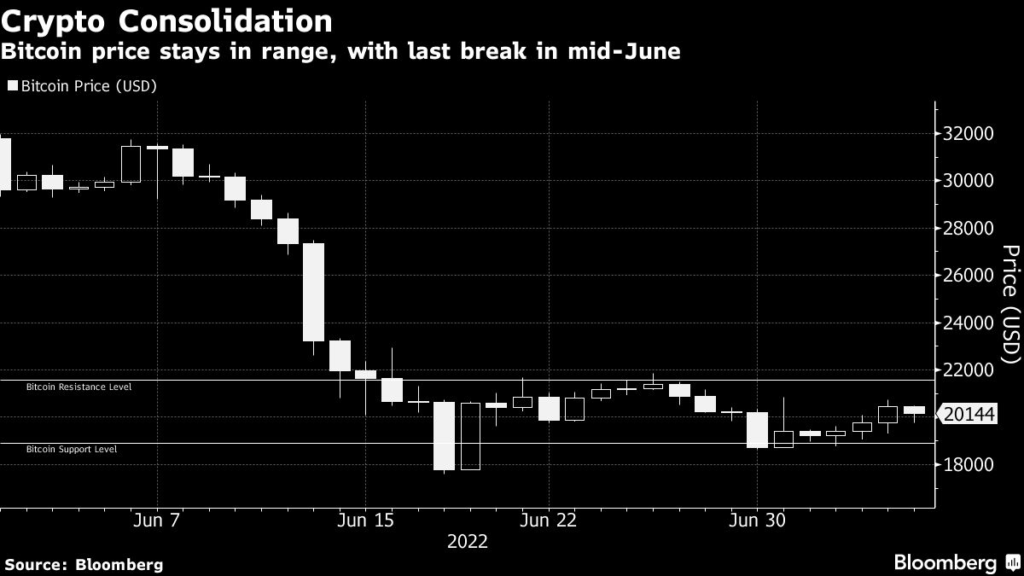
Key levels to watch for Bitcoin are $18,910, a level that prices have dipped below twice in mid-June, and $21,557, around its late-June highs, according to Craig Johnson, chief market technician at Piper Sandler Companies.

“There’s no fundamentals for crypto, of course. It’s just purely price action,” Johnson said in an interview on Friday. “You’re just going to look at this and say, until you break out of that range — up or down — you are not going to make any conclusion that there’s a trend change yet. We’re just short-term consolidating in the context of a longer-term downtrend.” 

A close above $26,000 or $28,000 could finally put a stop to the downward slide the token has been on since April, Johnson said.

The rout in Bitcoin has hit Coinbase Global Inc. the hardest as the exchange saw a drop of 450,000 Bitcoin over the last two years. Binance, which recently partnered with TikTok creator Khaby Lame and soccer star Cristiano Ronaldo, has seen an increase of 300,000 Bitcoin over the same timespan, making it the most popular Bitcoin exchange, per Glassnode and TXMC.

Recent breaks in operations, such as Coinflex’s and Vauld’s pause in withdrawals and CoinLoan’s reduction in withdrawal amounts, have decreased investor trust in exchanges. Illiquid supply increased by 223,000 Bitcoin in June as investors migrated funds to wallets from exchanges, according to Glassnode data. Of that 223,000, large-scale crypto holders made up much of that outflow from the exchanges as they withdrew over 140,000 tokens in June. These whales have been responsible for exchange outflows of almost 8.7 million, or over 40% of the global supply of Bitcoin.

“The Bitcoin bear is in full swing, and in its wake, the HODLers of last resort are the last ones standing,” Glassnode said. 

More stories like this are available on bloomberg.com

©2022 Bloomberg L.P.
Omers Nears Deal for UK Utility Contractor Network Plus

(Bloomberg) — Omers, the Canadian pension fund manager, is nearing a deal to acquire British utility services provider Network Plus, people with knowledge of the matter said. 

The investment firm could announce an agreement to buy Network Plus as soon as this week, the people said, asking not to be identified because the information is private. A deal could value the business at around £600 million ($714 million), according to the people. 

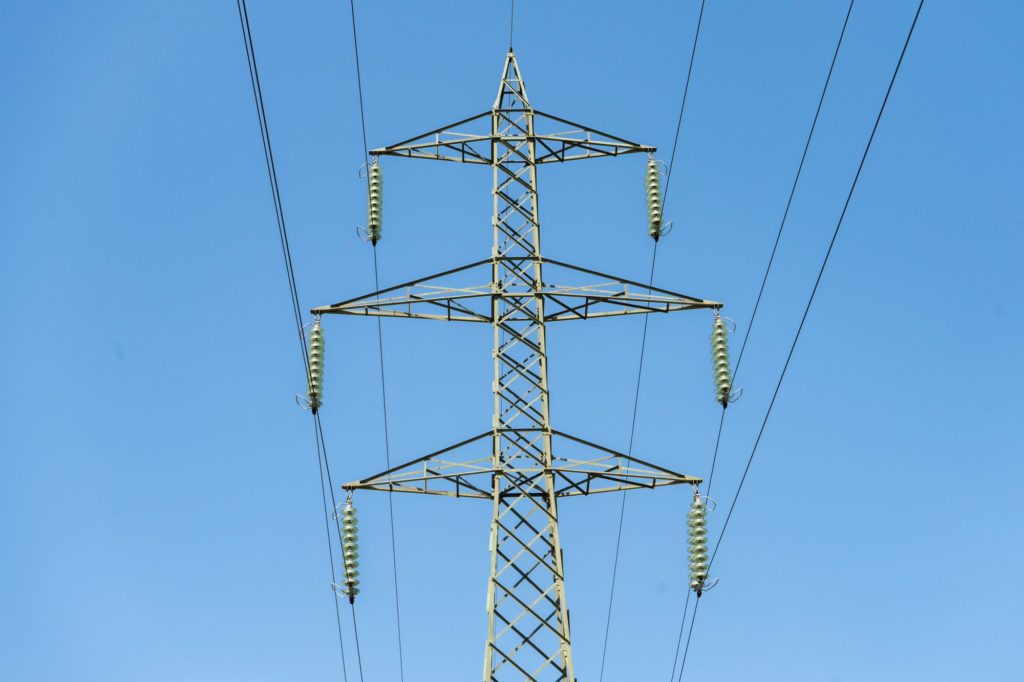
Network Plus is a contractor for major UK utilities and infrastructure firms, providing services such as project planning, construction and maintenance. It helps hook up gas connections, lay power lines, install underground internet cables, inspect water pipelines and fix wastewater blockages. 

The company’s customers include Cadent Gas Ltd., National Grid Plc, Yorkshire Water, Wales & West Utilities Ltd., Manchester Airport Group and Network Rail, according to its website. 

Investors ranging from pension funds to private equity firms have been pouring money into infrastructure plays as they seek to generate stable, recurring returns. PAI Partners is exploring a potential $2 billion sale of rival British utility contractor M Group Services, Bloomberg News reported in March. 

Talks over a deal for Network Plus are ongoing and could still fall apart, the people said. A representative for Omers declined to comment, while calls to Network Plus’s office weren’t answered. 

More stories like this are available on bloomberg.com

©2022 Bloomberg L.P.
DoorDash Shares Tumble as Amazon Takes Stake in Grubhub

(Bloomberg) — Food delivery company DoorDash Inc. shares sank on Wednesday after Amazon.com Inc. agreed to take a stake in rival Grubhub’s business.

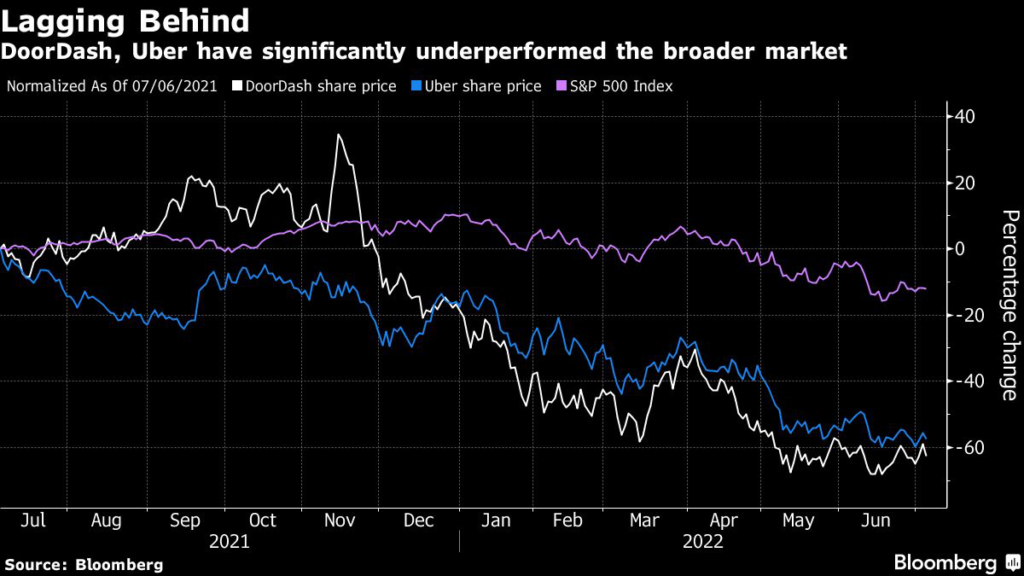
The San Francisco-based startup tumbled as much as 11% in New York trading, taking the stock down more than 70% from the highs touched in November. Ride-hailing service Uber Technologies Inc., which also has a food-delivery unit, fell over 4%. 

This latest move by Amazon further lowers the odds of a food-delivery duopoly for Uber and DoorDash in the US, Bloomberg Intelligence analyst Mandeep Singh wrote in a note. 

The Grubhub deal is part of a partnership where Amazon will offer US Prime users a one-year membership to the food delivery service. Grubhub is owned by Just Eat Takeaway.com NV, whose shares surged in Amsterdam on Wednesday.

“Amazon.com’s stake in Grubhub looks similar to its expansion in the UK food-delivery market with its share of Deliveroo and is undoubtedly going to pressure order-volume growth for Uber and DoorDash,” BI analyst Singh said. 

The rout in DoorDash’s stock this year has come as the severity of the pandemic waned and people started stepping out, weighing on demand for online food delivery. In addition, investors have also been moving away from unprofitable, riskier assets in favor of safer havens in the face of a looming recession. 

More stories like this are available on bloomberg.com

©2022 Bloomberg L.P.

Used Car Startup Kavak to Invest $180 Million in Global Push

(Bloomberg) — Mexican used car startup Kavak is branching out into three more Latin American countries and launching its first foothold outside the region in Turkey as it seeks to prove it can expand its “super app” online business model across emerging markets.   

Currently Latin America’s most valuable startup, Kavak is planing to invest $120 million in Colombia, Chile and Peru and at least $60 million in Turkey after setting up initial operations late last year, said founder and Chief Executive Officer Carlos Garcia Ottati in an interview. However, Kavak is also cutting costs across Mexico, Brazil and Argentina as the economic environment worsens, he said.

The company will hire more than 300 people in the Andean region and set up reconditioning centers with the capacity to process 3,000 cars a month, Kavak said in a statement.

“We’re confident the expansion is something the company needs to do, but we’re doing it conservatively,” Garcia Ottati said, speaking at the firm’s Mexico City headquarters. The company’s five years of experience and proven technology would allow it to become profitable more quickly in the new territories with smaller investments, he said. “We’re going to get to a bigger scale, faster.”

Kavak, which offers clients used cars through brick-and-mortar “hubs” and online, was valued at $8.7 billion in a private fund raising last September. But like other technology startups around the world, the company has found itself under increasing pressure to turn a profit as investors recoil from risky ventures. Phoenix-based online used car dealer Carvana Co. has tumbled more than 90% from its peak in August amid doubts that it can make its business model profitable. 

Garcia Ottati said Kavak was solving a different set of problems in emerging markets, where around 90% of deals take place between individuals, by providing a “super app” that aimed to build lifetime customers who look to Kavak for swapping cars, financing, insurance, warranties and even paying parking tickets.

“We’re solving fraud, we’re solving access to financing, and we’re using technology to grow this,” he said. Turkey had already shown promising growth that could end up justifying more investment, he said. “I think this is going to be probably one of our fastest growing profitable markets if we continue in the current direction,” he said.

Kavak already has 1,000 cars of inventory in Turkey, four operating centers in Istanbul and it aims to reach 300,000 transactions in the country by 2025, the company said. Overall, Kavak is now in 24 cities and has more than 8,000 employees.


(Adds details on Andean region, Turkey operations in third and eighth paragraphs.)

More stories like this are available on bloomberg.com

©2022 Bloomberg L.P.

Close Bitnami banner
Bitnami