

Bloomberg

Voyager Account Holders Likely Won’t Get All Their Crypto Back

(Bloomberg) — Account holders at now-bankrupt Voyager Digital Ltd. shouldn’t expect to get all their crypto back as the company reorganizes. 

The crypto brokerage and lender filed for Chapter 11 bankruptcy late Tuesday, renewing unresolved legal questions about how digital assets will interact with US insolvency law. One thing is certain: Voyager doesn’t intend to simply give users back their Bitcoin, Ether and other assets stored on the platform. 

The company’s plan to exit bankruptcy plainly says it expects account holders to be “impaired” by the Chapter 11 process, meaning they won’t be getting back exactly what they’re owed. Voyager intends to repay users with a mix of the crypto they deposited, stock in the restructured company, Voyager tokens and money recovered from bankrupt hedge fund Three Arrows Capital, court papers show. Three Arrows owes Voyager more than $650 million. 

Customers with US dollar deposits in their accounts will be able to reclaim that money “after a reconciliation and fraud prevention process” is completed with Metropolitan Commercial Bank, according to a statement from Voyager.

Tangled Crypto

Voyager doesn’t keep user assets in designated wallets for each customer. It instead mixes deposited crypto into asset-specific pots, like ones for Bitcoin and Ether, according to court papers. The company has about $1.3 billion of crypto assets on its platform, it said in the statement.  

Voyager also lends deposits to third parties to pay interest to customers, a dynamic that users agree to when they sign up for the platform, Chief Executive Officer Stephen Ehrlich said in sworn bankruptcy papers. Billionaire Sam Bankman-Fried’s Alameda Research, Mike Novogratz’s Galaxy Digital LLC and Wintermute Trading Ltd are among those that owed Voyager on account of crypto loans as of its bankruptcy filing, Ehrlich said.

Three Arrows Capital owes Voyager more than $650 million, making the embattled hedge fund by far Voyager’s largest loan counterparty. In total, Voyager has about $1.12 billion worth of loans to third parties outstanding.

The company will need to wade through legal proceedings in the British Virgin Islands to recoup any of Three Arrows loan, fighting with all of the hedge fund’s other creditors to get repaid. 

The bankruptcy is Voyager Digital Holdings Inc., 22-10943, U.S. Bankruptcy Court for the Southern District of New York (Manhattan).

Take our survey: MLIV Pulse: What Is the Future for All Things Crypto?

More stories like this are available on bloomberg.com

©2022 Bloomberg L.P.

Gaming VC Firm Konvoy Ventures Raises $150 Million Fund

(Bloomberg) — The cryptocurrency industry is in crisis, but investors like Konvoy Ventures still see potential. The gaming-focused VC firm has raised $150 million for a new fund, which it plans to announce Wednesday. It will aim to spend about 20% to 30% of that money on blockchain and crypto-related games. 

Konvoy Ventures, founded in 2018 by brothers Josh and Jason Chapman and their childhood friend Jackson Vaughan, has already made big bets on blockchain technology. The Denver-based firm backed Sky Mavis, the developer of Axie Infinity, a virtual world where players breed and battle monsters attached to nonfungible tokens — one of the best-known blockchain games, and one of the most controversial. The firm also invested in Genopets, a game where players will be able to grow and evolve an NFT pet through real-world physical exercise, and Ready Player Me, a platform for designing virtual avatars that can wear NFTs. 

The use of blockchain and NFTs in gaming has attracted criticism. Some players argue that these elements don’t improve their experience and are just another way for gaming companies to profit. A $620 million hack also hit a blockchain network used by Axie Infinity in March, raising questions over the security of these games and whether the VCs backing them should be required to bail them out.

Jason Chapman, managing partner at Konvoy Ventures, declined to comment on whether his firm had participated in a $150 million funding round to help Sky Mavis reimburse players. But he said in an interview that the firm was prepared to help its portfolio companies weather a tougher market environment. 

“We’re excited to back them through the thick and thin,” he said. 

His brother Josh said that the firm will consider making token-based investments instead of seeking equity. And outside of crypto, he said the firm will continue backing more typical gaming startups — including those that develop gaming infrastructure and intersect with industries like fashion, health care and education.

“One hundred percent exposure to crypto would not be the right strategy for us, but 0% would also be the wrong strategy,” Josh Chapman said in an interview. 

The brothers argued that, while changes in the gaming world often elicit pushback, blockchain has the potential to improve players’ experiences, including letting them potentially make money while playing. 

“This is just going to be another technology set that most people in games get to use,” Jason Chapman said. 

More stories like this are available on bloomberg.com

©2022 Bloomberg L.P.
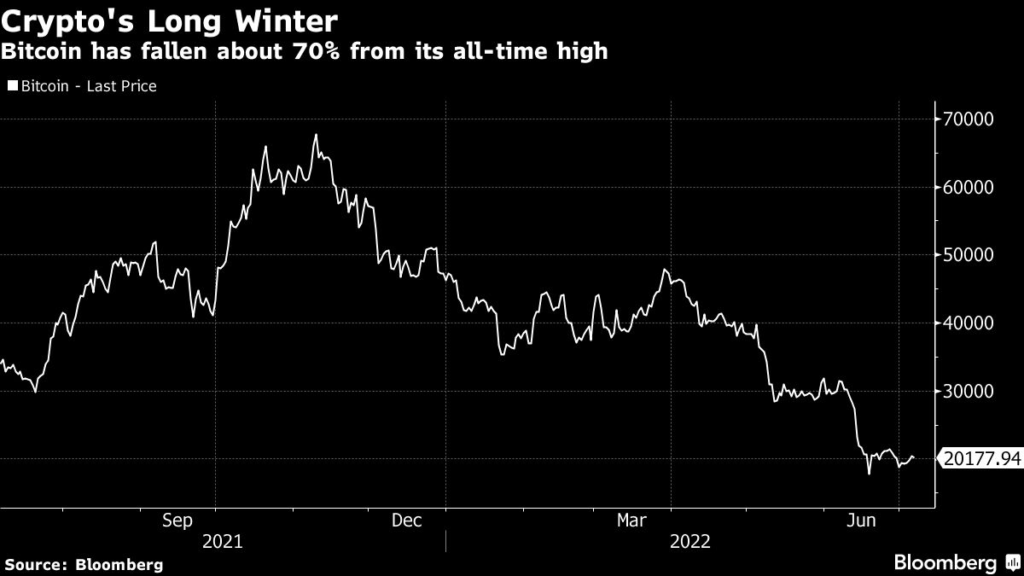
UK’s Crypto Strategy ‘Back to Square One’ as Sunak, Glen Quit

(Bloomberg) — The UK’s plan to turn itself into a global crypto hub just suffered a major setback, with the initiative’s two most important backers quitting Prime Minister Boris Johnson’s government. 

Chancellor of the Exchequer Rishi Sunak and Economic Secretary to the Treasury John Glen were the architects of a campaign launched in April to strengthen the nation’s image as a crypto-friendly jurisdiction. That push came after years of regulatory caution that prompted many crypto companies to relocate elsewhere.  

  • Listen:  Won’t Anyone Think of the UK Crypto Investor? (Podcast)

But after the two quit their positions in Johnson’s cabinet this week in the midst of a political scandal, crypto proponents are concerned that the strategy may fizzle. Sunak and Glen made overtures to the sector in recent months, meeting with executives in an effort to formulate a more cohesive strategy on digital assets. 

“You don’t write effective policy without knowing what you’re doing,” said Ian Taylor, the head of British crypto industry group CryptoUK, which regularly engages with politicians on crypto. “We’re back to square one.”

Nadhim Zahawi, the former vaccines minister, will replace Sunak as chancellor, while Glen’s successor has yet to be named. Implementing the crypto push, which included introducing regulation for stablecoins as well as giving new powers to the financial regulator, will likely take longer now as the new ministers get up to speed, Taylor said. 

  • Take our survey: MLIV Pulse: What Is the Future for All Things Crypto?

The resignations come just as the Financial Services Bill is set to overhaul key parts of the City, and ahead of the July 19 Mansion House dinner, where Sunak was expected to discuss crypto and the UK’s plan for a central bank digital currency, among other things.

Glen was the government’s de facto crypto czar, spearheading efforts to bridge differences between the industry and regulators. Over the past 18 months, he visited cities like San Fransisco, Washington and Madrid to meet with crypto companies and regulators, providing both himself and Sunak with Silicon Valley experience which digital asset leaders believe is key to ministerial education in this area.

“Glen has been a champion of fintech for a long time, relatively speaking, and generally ‘gets’ what’s needed,” said Sarah Kocianski, an independent fintech strategy consultant. “Whoever takes over will likely have a lot less industry experience and that will make filling his shoes harder.”

  • Read more: Britain’s Crypto List: Here Are the People to Watch 

The European Union last week reached a provisional agreement on its landmark crypto legislation, the Markets in Cryptoassets bill (MiCA), paving the way for common rules across all 27 member states. Other popular crypto destinations like Dubai and Singapore are also putting in place more comprehensive regulatory frameworks, enticing businesses to set up away from British shores. 

Sunak’s and Glen’s successors will also have to contend with divisions within the country on how to handle crypto. The Bank of England said in its July financial stability report that the industry requires tougher rules, with “extreme volatility” in recent months revealing fundamental weaknesses in the crypto market. 

“There’s still a lot of interest inside the Conservative party for making the UK a crypto hub,” said Stephen Diehl, a software engineer and crypto skeptic who advises European governments on digital asset policy. “But even in government there’s still a lot of debate.” BOE Governor Andrew Bailey and his staff “seem to be the other faction that’s more opposed.” 

More stories like this are available on bloomberg.com

©2022 Bloomberg L.P.
Citi Hires Goldman’s Michael Guarino for Health-Care Tech Deals

(Bloomberg) — Citigroup Inc. hired Michael Guarino from Goldman Sachs Group Inc. as North America head of health-care technology, with the company betting on growing demand for investment-banking services in the sector.

Guarino will join in October as a managing director based in New York. At Goldman Sachs, he focused on both health-care technology and health-care services more broadly, according to a memo Wednesday from Chuck Adams, global head of health-care, consumer and retail investment banking at Citigroup. A bank spokesman confirmed the contents of the memo.

“Health-care technology represents a strategically important sector,” Adams said in the memo, “and is positioned for growth.”

Adams joined Citigroup from Goldman Sachs last year to oversee a new global health-care, consumer and wellness “super group,” and has been building out the team after some departures. Citigroup is making a push to win more mandates in health care, and is shifting investment-banking resources “toward growth companies, particularly those in the industries that are converging,” Chief Executive Officer Jane Fraser said at an investor day this year.

At Goldman Sachs, Guarino advised on some of the industry’s highest-profile deals, including Cerner Corp.’s $29 billion sale to Oracle Corp. and Medline Industries Inc.’s $34 billion purchase by Blackstone Inc., Carlyle Group Inc. and Hellman & Friedman, according to the memo from Adams.

More stories like this are available on bloomberg.com

©2022 Bloomberg L.P.
Chip Delivery Times Fall by a Day as Companies See Some Relief

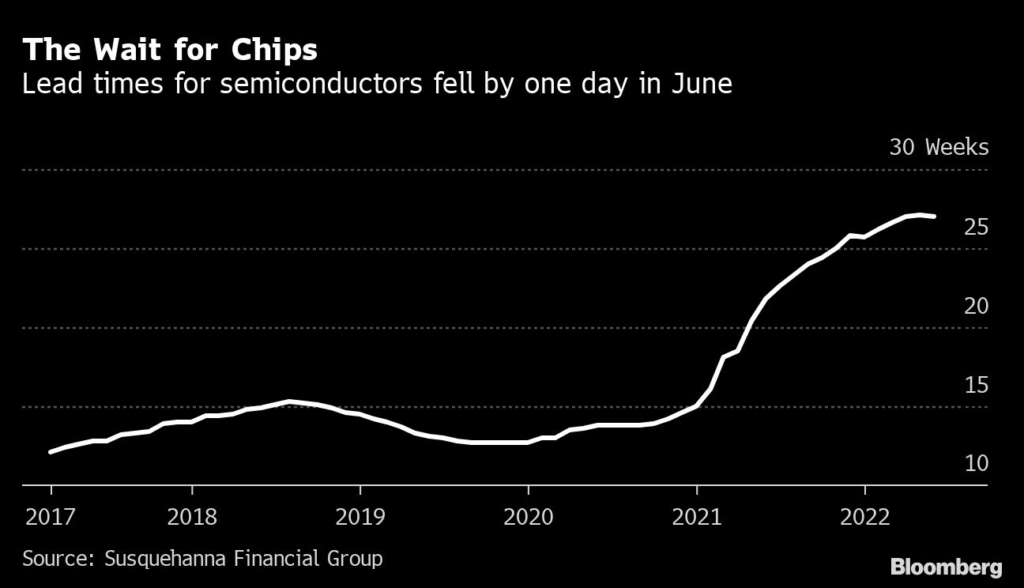
(Bloomberg) — The delivery times for semiconductors fell by a day in June, a sign of modest relief after chronic shortages that have plagued automakers and other industries for more than a year.

Lead times — a closely watched gap between when a semiconductor is ordered and when it is delivered — averaged 27 weeks last month, compared with 27.1 weeks in May, according to research by Susquehanna Financial Group. The measure was also 27 weeks in April. 

“There are some signs of supply chain inflation easing and price increases slowing, but other pockets remain,” said Susquehanna analyst Chris Rolland in a research note on Wednesday. “Among key companies we track, NONE posted record-high LTs, perhaps another sign of ‘peak cycle.’”

Susquehanna said that leading or predictive company-specific data show contractions in lead times for the second month in a row, with some declines of as much as 45%. Some of the largest declines were for microcontroller units, or MCUs, as well as power management and memory chips. 

Field-programmable gate arrays, or FPGA, lead times remain “maxed out at our 52-week cap and are likely THE most constrained part in the ecosystem,” the report said. Susquehanna added that FPGA shortages affect networking, optical and telecommunications gear.

Chip bottlenecks have hit companies from Toyota Motor Corp. to Apple Inc., costing them billions of dollars in lost revenue because they can’t get enough semiconductors to meet demand for their products. 

Citibank analysts forecast this week that semiconductor sales will rise 13% for 2022. But they cautioned about risks because of a downturn in personal computers and smartphones, along with their projection of a recession.

More stories like this are available on bloomberg.com

©2022 Bloomberg L.P.
Piper Sandler to Acquire DBO Partners in Tech-Banking Expansion

(Bloomberg) — Piper Sandler Cos. agreed to buy DBO Partners to expand its technology investment-banking business. 

“The addition of DBO significantly increases our presence and capabilities in the technology sector and is an important step toward building a leading technology investment-banking practice,” Michael Dillahunt, global head of investment banking and capital markets at Piper Sandler, said in a statement Wednesday.

Terms of the transaction weren’t disclosed.

DBO Partners co-founders Gordon Dean, Mark Bradley, and Nick Osborne will join Piper Sandler’s technology investment-banking group, which has more than 50 professionals. Osborne will become co-head of the group with Steve Schmidt, while Dean will be vice chairman of investment banking and Bradley will serve as chairman of financial-sponsor coverage, according to the statement.

Last month, Minneapolis-based Piper Sandler said it formed a European consumer team after completing the acquisition of London-based advisory firm Stamford Partners LLP. 

Piper Sandler shares have plunged 35% this year, a steeper drop than the 18% decline in the S&P Smallcap Financials Index. The stock fell 1.2% to $112.39 at 10:27 a.m. in New York.

The transaction is expected to be completed in the fourth quarter. Sullivan and Cromwell served as legal advisers to Piper Sandler. Wachtell, Lipton, Rosen and Katz was DBO’s legal adviser, and KBW was its financial adviser.

More stories like this are available on bloomberg.com

©2022 Bloomberg L.P.
Bank of England Says Digital Pounds Unlikely to Work Like Cash

(Bloomberg) — The Bank of England is unlikely to offer a digital form of the pound that works like banknotes, opting instead for an instrument managed through some sort of account.

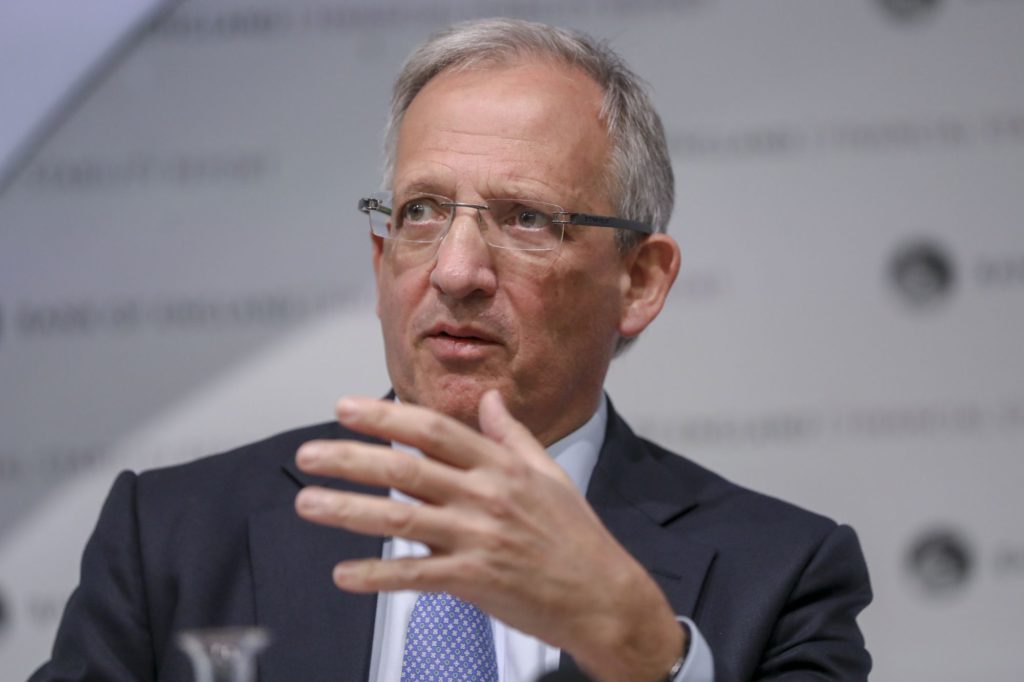
Deputy Governor Jon Cunliffe, who is overseeing the BOE’s work on central bank digital currencies, said policy makers are thinking about how to make the pound work better for consumers in online transactions.

However, the new form of currency is unlikely to be a “bearer” instrument like banknotes, where no information is recorder about the holder. That reflects concerns that new digital pounds could be used in crime and money laundering.

“I think it’s very unlikely that any of us would issue a retail CBDC as a bearer instrument,” Cunliffe said at a panel discussion in London on Wednesday. “It would probably be some form of account-based instrument.”

The BOE along with other central banks is studying how to adapt currencies for online technology as more transactions move onto the internet and toward credit and debit cards. With cash declining as a payment method across the US and Europe, the BOE and is looking at new forms of the pound that appeal to consumers.

That’s elevating a number of issues about the appropriate role central banks play in issuing digital currencies and whether those would compete with securities like Bitcoin.

“We will produce the asset and the rails” — or the system to transact with the currency — “but the interface with the public would actually be done by private-sector payment providers,” Cunliffe said.

The BOE plans to release a consultation paper at the end of the year about how a retail CBDC might look. Cunliffe said it’s unlikely that any digital pounds will start trading within the next three years, that it’s more likely in five or more years.

“It could be banks that will have the customer accounts payable to integrate money into their digital applications,” he said. “There are other models. One model is we allow the private sector to do the tokenization, to provide their own money that we back one-for-one with central bank money.”

The government will have do decide whether the BOE can issue digital pounds and in what form. Cunliffe said the decision will be based on what’s most efficient and secure.

More stories like this are available on bloomberg.com

©2022 Bloomberg L.P.

Tesla Pulled Levers on Pricing and Cost During a Tough Quarter

(Bloomberg) —

It began with a bang — a huge party celebrating the opening of its newest plant in Austin, Texas — but Tesla’s second quarter didn’t stay ebullient.

As battery material costs soared and its most productive plant shut down for weeks amid Shanghai’s Covid outbreak, Chief Executive Officer Elon Musk took several steps to buoy revenue and rein in expenses: raising prices, pausing hiring and cutting jobs.

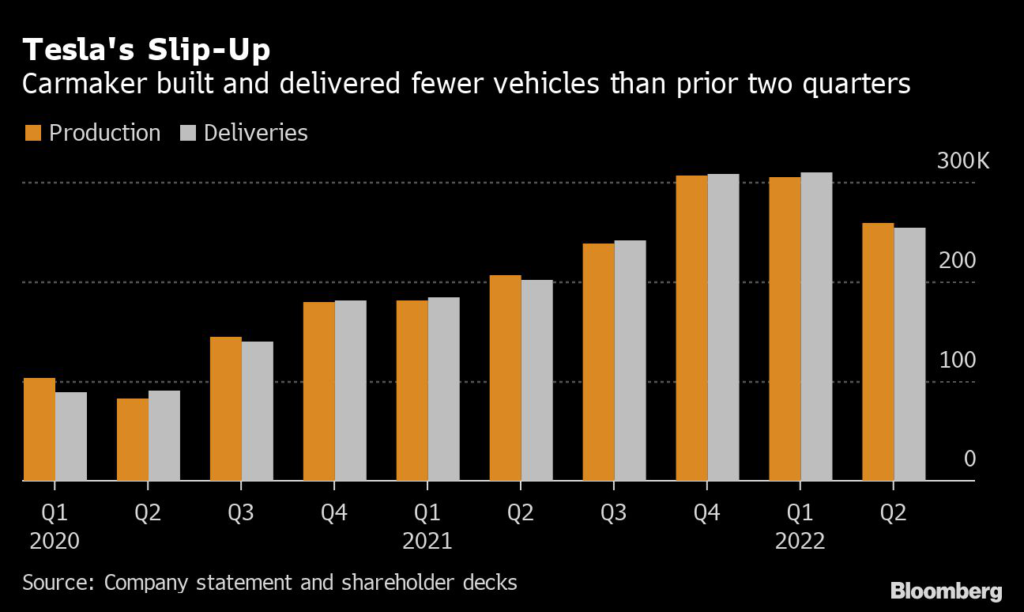
Tesla was unable to “pull a rabbit out of a hat,” as Musk put it during the last earnings call in April. While he suggested then there was a chance output would snap back from the disruption in Shanghai and the company might come close to its first-quarter production total, Tesla came up short by almost 47,000 vehicles.

The question now is just how effective Musk and his master of coin, CFO Zachary Kirkhorn, were in limiting the damage to earnings. The company has been crafty in the past with its end-of-quarter pushes, pulling all sorts of levers to get cars to customers and shore up results. While Musk reportedly predicted this one would be “nutty,” he’s seen worse. The risks to Tesla were existential when it struggled to ramp up production of the Model 3 in 2018.

Tesla’s challenges now aren’t life-or-death, but in squaring its pricing changes and belt-tightening with Musk’s priorities and ambitions.

While its mission is to accelerate the world’s transition to sustainable energy, Teslas are increasingly unattainable for mainstream consumers.

And while Musk told a fan club during the quarter that solving self-driving is the difference between Tesla being worth a lot and “ basically zero,” it’s dismissed roughly 200 employees who annotated data for its Autopilot team and closed their office in San Mateo, California.

In fairness, Tesla is far from the only automaker dealing with more demand for its vehicles than it’s able to produce as well as rising commodity prices and energy costs, leaving manufacturers with little choice but to charge customers more. Tesla also is trying to automate more of its annotation work and has been expanding its data-labeling team in Buffalo, New York.

Whereas Tesla’s straightforward price increases may only start flowing through to its financials in the second half — the changes apply to new orders, and wait times for certain models are months long — one alteration to how it’s charging customers will kick in quicker. Toward the end of last month, Tesla brought back what it’s billed as Enhanced Autopilot, a much cheaper suite of features than its Full-Self Driving package. The former costs $6,000, half the price of the latter.

The blog Electrek’s take on this was that Tesla is probably aiming to improve its margins with an Enhanced Autopilot offering that will have a higher take rate. The change doesn’t cost the company anything, since it equips cars with the same hardware and has the ability to activate software over-the-air.

Musk tends to speak frankly about the economy and has said recently the US probably is in recession or headed for one. When it comes time to talk Tesla, though, he’s generally more inclined to assure investors of rosy days ahead. The company has already provided a hint of this: In reporting second quarter deliveries of 254,695 vehicles, short of what analysts were expecting, Tesla took pains to note that it produced more cars in June than any month in its history.

More stories like this are available on bloomberg.com

©2022 Bloomberg L.P.
Rivian Jumps After Boosting EV Output, Reaffirming Annual Goal

(Bloomberg) — Rivian Automotive Inc.’s shares surged after the electric-vehicle maker reaffirmed its annual production target and revealed accelerated output in the second quarter, buoying the company as it works to overcome parts shortages and other supply-chain snags.

The EV startup built 4,401 vehicles in the period, according to a statement Wednesday, up from 2,553 in the first quarter. That keeps Rivian on track to produce 25,000 units this year across its three products. The manufacturer, backed by founder and Chief Executive Officer R.J. Scaringe, also delivered 4,467 vehicles to customers in the second quarter.

Backed by billions of dollars from Wall Street titans and investors like Ford Motor Co. and Amazon.com Inc., Rivian is seen as a potential challenger to market leader Tesla Inc. But Rivian has stumbled since its blockbuster listing in November, facing parts shortages and related issues that have hampered efforts to ramp up production.

Shares of the Irvine, California-based company jumped 7.4% at 9:40 a.m. in New York. The stock plunged 74% this year through Tuesday’s close, far worse than the broader market slump.

Rivian builds two consumer battery-electric cars: the R1T pickup and a sport utility vehicle called the R1S. It also manufacturers electric delivery vans for Amazon, for which rivian has a contract to deliver 100,000 units to the e-commerce giant by the end of the decade.

More stories like this are available on bloomberg.com

©2022 Bloomberg L.P.

Betting Against Tech Is Finally a Winning Trade as Short Sellers Sit on $20 Billion Profit

(Bloomberg) — Betting against tech has become a winning trade, with short sellers sitting on billions in paper profits as growth stocks slump.

A historic rout in the so-called FAANG cohort — Facebook owner Meta Platforms Inc., Apple Inc., Amazon.com Inc., Netflix Inc. and Google parent Alphabet Inc. — has delivered $19.8 billion in mark-to-market profits for investors speculating on declines as of June 30, according to data-analytics firm S3 Partners.

“It was difficult to short for a while, because a lot of liquidity hit the marketplace,” said Brad Lamensdorf, a portfolio manager of the AdvisorShares Ranger Equity Bear ETF. “However, the past year or so has been a really great environment for us.” Lamensdorf’s fund has returned 22% this year by shorting stocks.

The windfall has been a long time coming. Spectacular gains for tech megacaps over recent years resulted in paper losses of nearly $16 billion last year and almost $20 billion in 2020 for those shorting the FAANG group, according to S3’s calculations.

“The buy-the-dip mentality made it very difficult to short in the past, because even if you were right about bad news, no one cared,” said Bill Fleckenstein, president of Fleckenstein Capital. “People laughed off problems all throughout 2021, but that’s not the case anymore.”

The tide has turned for previously unstoppable tech giants, with the NYSE FANG+ Index down 31% and poised for its first annual decline on record, according to Bloomberg data going back to 2014. Investors have been fleeing growth stocks — priced on earnings expected in the future — in anticipation of further supersized interest rates hikes from the Federal Reserve and amid concerns about recession. 

Short sellers borrow shares and sell them, hoping to buy them back at a lower price to profit from the difference. But getting the timing right is crucial. If share prices rise, they can lose money instead — as was the case in 2020 and 2021, when the NYSE FANG+ Index soared.

Fleckenstein said he had stopped shorting in the past few years, even though many companies got “absurdly” priced, because quantitative easing prevented deep selloffs. “It has obviously gotten easier this year, though I still haven’t gotten too aggressive, since there’s so much volatility,” he said. 

After years of outsized gains on optimism about big tech’s ability to continue its rapid growth, bets against the group have remained fairly small. Short interest as a percentage of total shares outstanding is less than 3% in all of the FAANG stocks, according to S3 data.

And given the nosedive already experienced this year — with the Nasdaq 100 down about 28% — it may get harder to make money betting on further declines for the sector. There also appears to be some optimism in the first three trading days of the second half of the year as the tech-heavy gauge adds almost 3% in that time period with investors embracing risk after the rout.

“The easy money has been made on the short side,” said Dennis Dick, head of markets structure and a proprietary trader at Bright Trading. “It’s gonna be tougher going forward.”

Tech Chart of the Day

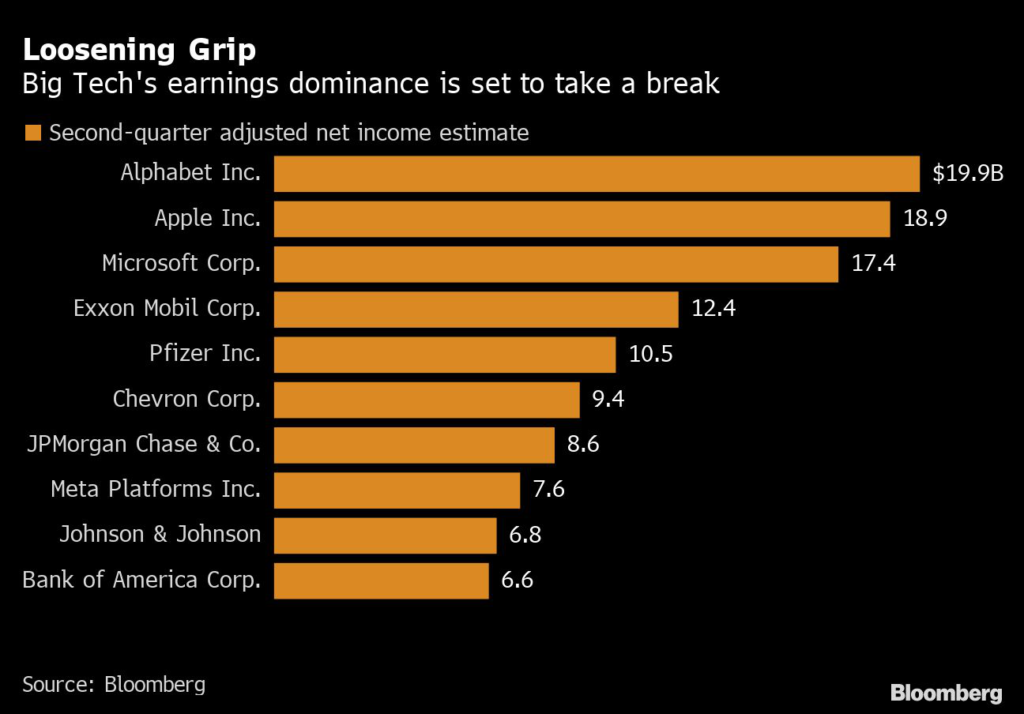
Big Tech’s earnings dominance is set to take a break as only four US technology firms — Alphabet, Apple, Microsoft Corp., and Meta Platforms — are expected to be among the top-ten earners in the latest batch of earnings reports. That’s the lowest level in at least two years, according to data compiled by Bloomberg. 

Top Tech Stories

  • The US is pushing the Netherlands to ban ASML Holding NV from selling to China mainstream technology essential in making a large chunk of the world’s chips, expanding its campaign to curb the country’s rise, according to people familiar with the matter.
    • ASML shares rose in Europe, amid a broader rebound for tech shares, with analysts saying that a full China chip tool sales ban is unlikely.
    • Washington’s latest move to restrain Beijing from fostering its chipmaking industry is powering China’s semiconductor stocks as the US restrictions could fire up support for homegrown technology.
  • Some of Wall Street’s biggest brokerages have reiterated their bullish calls for Alibaba Group Holding Ltd., suggesting more gains may be in store after the e-commerce giant surged from a mid-March low.
  • Hong Kong is likely to see more dual-traded companies shift toward primary listings in the financial hub as they seek inclusion in trading links with mainland China, according to the city’s exchange chief.
  • TikTok’s admission that some China-based workers have access to data on US users provided fresh ammunition to a Republican member of the Federal Communications Commission who is trying to get the video-sharing service dropped from major app stores.
  • Broadcom Inc.’s $61 billion deal for VMware Inc. will move forward after a rival bidder failed to emerge to break up the deal for the cloud-computing company during its so-called “go-shop” period, according to people familiar with the matter.

(Updates stock move in paragraph 10.)

More stories like this are available on bloomberg.com

©2022 Bloomberg L.P.

Close Bitnami banner
Bitnami