

Bloomberg

Voyager Seeks Bankruptcy as Crypto Mogul’s Lifeline Fails

(Bloomberg) — Crypto broker Voyager Digital Ltd. filed for Chapter 11 bankruptcy protection just weeks after getting a lifeline from billionaire Sam Bankman-Fried’s Alameda Research, citing market volatility and the collapse of a hedge fund it had lent money to. 

The firm and two affiliates, Voyager Digital LLC and Voyager Digital Holdings, took the step in the Southern District of New York, a filing showed on Wednesday.

Voyager, which secured a credit line worth about $485 million from Alameda in mid-June, is among a growing list of casualties of a market collapse that’s seen about $2 trillion wiped off the value of cryptocurrencies. Its filing listed Alameda as the biggest single creditor, with a $75 million unsecured loan.  

“We strongly believe in the future of the industry but the prolonged volatility in the crypto markets, and the default of Three Arrows Capital, require us to take this decisive action,” Chief Executive Officer Stephen Ehrlich said on Twitter, referring to the crypto hedge fund that defaulted on a $675 million loan from Voyager. 

Voyager listed assets and liabilities of between $1 billion and $10 billion, respectively, in its Chapter 11 filing. 

The company has about $1.3 billion of crypto assets on its platform and $350 million in a so-called For Benefit of Customers account at Metropolitan Commercial Bank, in addition to its claims against Three Arrows, according to a separate statement. It also has more than $110 million in cash and “owned crypto assets” on hand. 

Last month, Voyager issued a notice of default to Three Arrows on the loan. It is “actively” pursuing recovery from the hedge fund, including through the court-ordered liquidation process in the British Virgin Islands, Ehrlich tweeted. 

Read more: Crypto Hedge Fund Three Arrows Set for Liquidation

Besides trading and lending, Voyager also offers staking — a way of earning rewards for holding certain cryptocurrencies — and yield products. Firms in that space including Celsius Network, Babel Finance and Vauld have suspended withdrawals since early June as liquidity dried up. Singapore-based Vauld is in discussions to be acquired by rival Nexo, the companies said on Tuesday. 

“Voyager’s bankruptcy filing basically confirms that the crypto lender did use its customers’ funds as a source of dollar liquidity and lent them to entities like 3AC as a leveraged trade of sorts while it would constantly borrow money itself to meet current withdrawal requests,” said Mikkel Morch, executive director at crypto hedge fund ARK36, using the acronym for Three Arrows Capital.  

Stock Implosion

Trading, deposits, withdrawals and loyalty rewards on the Voyager platform remain temporarily suspended, Ehrlich said. Clients who have crypto in their accounts will receive a mix of their digital assets, proceeds from the Three Arrows recovery, shares in a reorganized Voyager and Voyager tokens. 

The Voyager coin has tumbled 98% from its peak, according to CoinGecko. 

Customers with US dollars in their accounts “will receive access to those funds after a reconciliation and fraud prevention process is completed with Metropolitan Commercial Bank,” Ehrlich said in the tweet.

Shares in Voyager plunged 42% on Monday, slashing its market value to C$66 million ($51 million). The company was valued at C$2.7 billion at the start of the year.   

Rapid Unwinding

Tighter monetary policy from central banks seeking to stem a global surge in inflation has weighted heavily on digital tokens, one of last year’s frothiest asset classes. The rout that started in late 2021 gathered pace with the collapse of the TerraUSD stablecoin in May, then worsened further as Bitcoin suffered its biggest-ever monthly drop in June.  

With rapid unwinding of leverage blowing up companies across the cryptosphere, Bankman-Fried emerged as a lender of last resort, providing credit to Voyager and striking a deal to inject capital into BlockFi Inc. Bankman-Fried, the co-founder of crypto exchange FTX US, is also open to exploring acquisitions of battered crypto miners, he said in an interview last week. 

“The big question is can FTX backstop everything, they’re becoming a central bank-like lender of last resort,” said Simon Taylor, head of strategy and content at crypto fraud prevention startup Sardine.

Bitcoin was down 1.2% at $20,196 on Wednesday morning in Europe, taking this year’s decline to 57%. 

(Updates with details on assets in fifth paragraph.)

More stories like this are available on bloomberg.com

©2022 Bloomberg L.P.
Taiwan Inflation Hits 14-Year High, Adding to Economy’s Woes

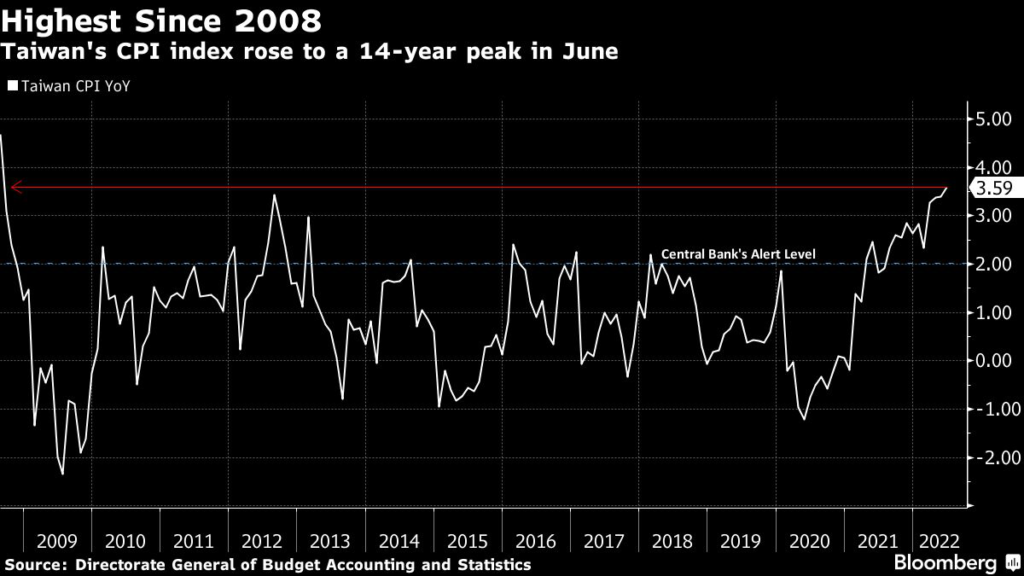
(Bloomberg) — Taiwan’s consumer inflation in June reached the highest level in 14 years, a swell that will put pressure on officials to consider how best to balance the possibility of interest rate hikes this year without hurting the local economy. 

The consumer price index reached 3.59% last month, the Directorate General of Budget Accounting and Statistics said in a Wednesday statement. That’s roughly in line with the 3.6% rise in a Bloomberg survey of economists, and the highest level since August 2008.

CPI has now risen above 3% for four straight months. It’s also been above 2% — the milestone set by the central bank as an alert level — for nearly a year. 

Global inflation is on the rise, pressuring many economies as the cost of commodities soared earlier this year after Russia invaded Ukraine. 

June’s CPI jump in Taiwan is likely near the peak, said Meng Chye Phoo, senior economist in Standard Chartered Plc in Taiwan. He added, though, that the concern is whether inflation stays above 3% in the coming months, meaning Taiwan’s central bank will have to balance economic growth with inflation. 

The central bank delivered a smaller-than-expected increase to its benchmark interest rate last month, along with moves to reduce liquidity in the banking sector as officials tried to rein in inflation without hurting growth. Governor Yang Chin-long at the time called the decision “very difficult,” adding that while inflation was “certain to rise further,” authorities “also had to consider the potential hurt to sectors reliant on domestic demand.”

Read More: Taiwan Delivers Smaller-Than-Expected Interest Rate Hike

Phoo said he expects the central bank to stay on its tightening course, and foresees further rate hikes in September and December. The extent to the bank’s hawkishness depends on data ahead of its next meeting.

Spillover effects from heightened prices are already impacting Taiwan, where the industrial sector was just hit with its first power price increase in four years as the state-owned utility grapples with soaring fuel costs. Affected users include Taiwan Semiconductor Manufacturing Co., the world’s largest contract chipmaker, and the higher electricity rates will likely pressure Taiwan’s manufacturers even more, weighing on producer prices. PPI in May grew nearly 14% from a year prior.

Agricultural disruption caused by rainy weather has pushed up the cost of fruits and vegetables, said Tieying Ma, economist at DBS Group Holdings Ltd., earlier this week before the inflation data was released. Ma noted, though, that global energy and food prices have showed tentative signs of stabilization.

Ma said that the pressure for monetary policy tightening will likely be reduced to some extent toward the fourth quarter as inflation may moderate and concerns about a slowdown in growth may increase. Taiwan’s strongest economic expansion in a decade cooled in the first quarter, and the government in May cut its annual forecast for economic growth to 3.91% as surging prices and Covid outbreaks cloud the outlook.

(Updates with comments from Standard Chartered economist.)

More stories like this are available on bloomberg.com

©2022 Bloomberg L.P.

Amazon Will Take Stake in Grubhub, Offer Prime Users Membership

(Bloomberg) — Just Eat Takeaway.com NV’s shares jumped the most in almost four years after Amazon.com Inc. agreed to take a stake in its Grubhub business. 

The stake is part of a partnership where Amazon will offer US Prime users a one-year membership to the food delivery service, the Dutch company said in a statement on Wednesday. 

The deal is a vital boost for Just Eat Takeaway, which has seen its share price crash more than 65% this year hitting a record low on Tuesday. The company also faces internal turmoil after it launched an investigation into its chief operating officer’s personal conduct and its chairman stepped down in May.

Amazon will receive options for a 2% stake in Grubhub and will have the opportunity to increase the holding to 15%, Just Eat said. Amazon’s stake is in the form of warrants, which will vest depending on how well the partnership performs and how many new customers it attracts. 

Just Eat shares jumped as much as 20% in Amsterdam on Wednesday, the biggest intraday gain since December 2018, and were up 17% at 11:06 a.m. local time. The stock has declined 67% this year. 

“The Amazon partnership is both material and welcome,” Jefferies analyst Giles Thorne said in a note to investors. “Grubhub has secured not just a very powerful partner, but also a very efficient acquisition channel. For a hitherto stranded asset and dead-weight to the JET equity, this is positive news.” 

The membership agreement will renew every year unless Amazon or Grubhub terminates it, and Just Eat will continue to explore a full or partial sale of the US business, Just Eat said. The company announced plans to find an investor or bidder for the US business in April, less than a year after buying Grubhub for $7.3 billion. 

Grubhub also attracted preliminary interest from private equity firms including Apollo Global Management Inc., Bloomberg reported in June.

Just Eat Chief Executive Officer Jitse Groen is under pressure to find a way to reignite growth after a slew of competitors took market share and restaurants that had been closed during the Covid-19 lockdowns reopened to diners. 

Read More: Just Eat Weighs Grubhub Sale in Tough Food Delivery Market

In a presentation to analysts and investors in October, Groen laid out a strategy to grow in the US, targeting suburbs in key markets and trialling mini warehouses in New York for faster order fulfillment. 

The Amazon deal will be neutral for Grubhub’s financial results this year and add to cash flow and earnings starting in 2023, Just Eat said in the statement.


(Updates throughout)

More stories like this are available on bloomberg.com

©2022 Bloomberg L.P.

Just Eat Shares Jump After Amazon Strikes Deal with Grubhub

(Bloomberg) — Just Eat Takeaway.com NV’s shares jumped the most in almost four years after Amazon.com Inc. agreed to take a stake in its Grubhub business. 

The stake is part of a partnership where Amazon will offer US Prime users a one-year membership to the food delivery service, the Dutch company said in a statement on Wednesday. 

The deal is a vital boost for Just Eat Takeaway, which has seen its share price crash more than 65% this year hitting a record low on Tuesday. The company also faces internal turmoil after it launched an investigation into its chief operating officer’s personal conduct and its chairman stepped down in May.

Amazon will receive options for a 2% stake in Grubhub and will have the opportunity to increase the holding to 15%, Just Eat said. Amazon’s stake is in the form of warrants, which will vest depending on how well the partnership performs and how many new customers it attracts. 

Just Eat shares jumped as much as 20% in Amsterdam on Wednesday, the biggest intraday gain since December 2018, and were up 17% at 11:06 a.m. local time. The stock has declined 67% this year. 

“The Amazon partnership is both material and welcome,” Jefferies analyst Giles Thorne said in a note to investors. “Grubhub has secured not just a very powerful partner, but also a very efficient acquisition channel. For a hitherto stranded asset and dead-weight to the JET equity, this is positive news.” 

The membership agreement will renew every year unless Amazon or Grubhub terminates it, and Just Eat will continue to explore a full or partial sale of the US business, Just Eat said. The company announced plans to find an investor or bidder for the US business in April, less than a year after buying Grubhub for $7.3 billion. 

Grubhub also attracted preliminary interest from private equity firms including Apollo Global Management Inc., Bloomberg reported in June.

Just Eat Chief Executive Officer Jitse Groen is under pressure to find a way to reignite growth after a slew of competitors took market share and restaurants that had been closed during the Covid-19 lockdowns reopened to diners. 

Read More: Just Eat Weighs Grubhub Sale in Tough Food Delivery Market

In a presentation to analysts and investors in October, Groen laid out a strategy to grow in the US, targeting suburbs in key markets and trialling mini warehouses in New York for faster order fulfillment. 

The Amazon deal will be neutral for Grubhub’s financial results this year and add to cash flow and earnings starting in 2023, Just Eat said in the statement.


(Updates throughout)

More stories like this are available on bloomberg.com

©2022 Bloomberg L.P.
China Accuses US of ‘Technological Terrorism’ as Chip Curbs Grow

(Bloomberg) — China accused the US of “technological terrorism” in pushing to stop ASML Holding NV and Nikon Corp. from selling key chipmaking technology to the country, in some of its strongest criticism yet of Washington’s efforts.

Chinese Foreign Ministry spokesman Zhao Lijian lashed out at Washington after Bloomberg News reported the US is lobbying allies to stop the sale of mainstream technology essential for making a large chunk of the world’s chips, expanding a years-long campaign to curb the country’s rise. He didn’t say whether China planned any retaliatory measures in response to the move. 

“This is yet another example of the US practice of coercive diplomacy by abusing state power and wielding technological hegemony. It is classic technological terrorism,” Zhao told a regular news briefing Wednesday in Beijing. “This will only remind all countries of the risks of technology dependence on the US and prompt them to become independent and self-reliant at a faster pace.”

The proposed restriction would expand an existing moratorium on the sale of the most advanced systems to China, in an attempt to thwart the country’s plans to become a world leader in chip production. If the Netherlands agrees, it would broaden significantly the range and class of chipmaking gear now forbidden from heading to China, potentially dealing a serious blow to Chinese chipmakers from Semiconductor Manufacturing International Corp. to Hua Hong Semiconductor Ltd.

US Pushes for ASML to Stop Selling Chipmaking Gear to China

American officials are lobbying their Dutch counterparts to bar ASML from selling some of its older deep ultraviolet lithography, or DUV, systems, people familiar with the matter said. These machines are a generation behind cutting-edge but still the most common method used for making certain less-advanced chips required by cars, phones, computers and even robots. 

Washington is also trying to exert pressure on Japan to stop shipping the same technology to Chinese chipmakers, one of the people said. Japan’s Nikon competes with ASML in the area.

“Chinese chipmakers have been hoarding second-hand equipment since the Trump era,” said Amir Anvarzadeh of Asymmetric Advisors. Banning the most advanced tools was “clearly not enough to halt China’s advancement in semiconductors, especially since much of the chips used for defense purposes are using geometries that were far less advanced.”

(Updates with details of US trade measures)

More stories like this are available on bloomberg.com

©2022 Bloomberg L.P.

Billionaire’s Jeweler Pays $7.5 Million Crypto Ransom to Hackers

(Bloomberg) — Luxury British jeweler Graff Diamonds Corp. paid $7.5 million ransom in Bitcoin to a Russian hacking gang after it leaked data on the jeweler’s high-profile clients, according to a London lawsuit.

Graff, that counts Middle East royalty among its client base, sued its insurer for losses over the extortion saying that the payment should be covered under their policy. The Travelers Companies Inc. is refusing to pay the jeweler’s loss caused by the Bitcoin ransom, Graff alleges.

Ransomware group Conti attacked the high-society jeweler in September 2021, leaking data about the Saudi, UAE and Qatar royal families. Conti apologized to the families in an unusual move for a hacking group, but threatened to leak more of Graff’s data. 

“Our goal is to publish as much of Graff’s information as possible regarding the financial declarations made by the US-UK-EU neo-liberal plutocracy, which engages in obnoxiously expensive purchases when their nations are crumbling under economic duress,” the group said according to reports at the time.

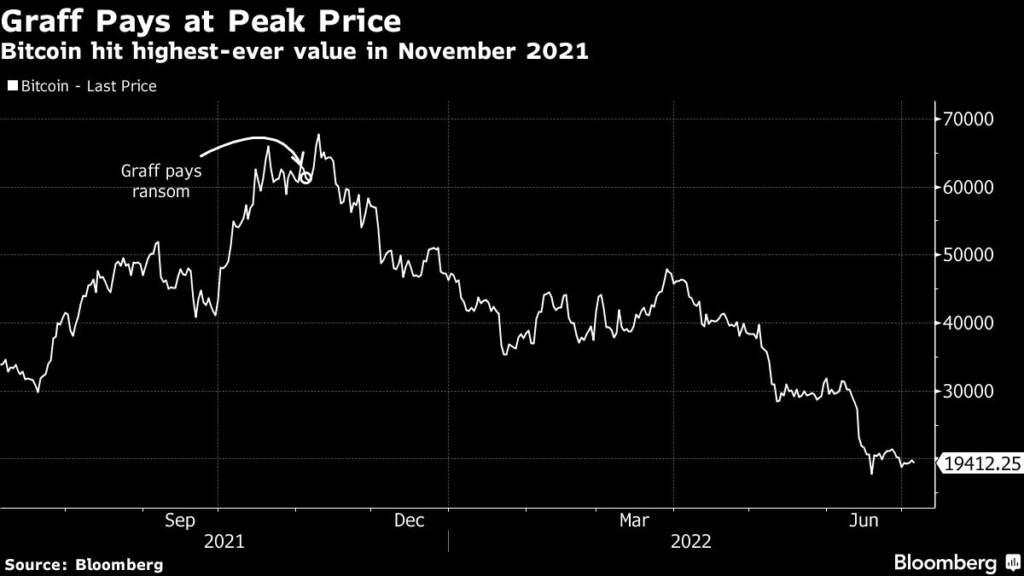
Conti accepted Graff’s offer of half their initial demand of $15 million to a Bitcoin wallet on Nov. 3, 2021 to stop more of its data being published. Since then, the price of Bitcoin has plummeted, meaning Graff paid the ransom at one of Bitcoin’s highest-ever prices. 

It is not clear if Conti cashed out the Bitcoin payment at that time. Graff’s payment would have been worth 118 Bitcoin on Nov. 4 — but in London on Tuesday, 118 Bitcoin was worth a much-lower $2.3 million.

“The criminals threatened targeted publication of our customers private purchases,” a Graff spokesperson said. “We were determined to take all possible steps to protect their interests and so negotiated a payment which successfully neutralized that threat.” 

“We are extremely frustrated and disappointed by Travelers’ attempt to avoid settlement of this insured risk. They have left us with no option but to bring these recovery proceedings at the High Court,” they said.

Laurence Graff controls the closely held jeweler and is worth $5.9 billion according to the Bloomberg Billionaire Index.

Representatives at Travelers did not respond to multiple requests for comment. Lawyers representing the insurer declined to comment.

More stories like this are available on bloomberg.com

©2022 Bloomberg L.P.

Gender Fluidity In The Metaverse

  • Listen to Bloomberg Crypto on the iHeartRadio App
  • Listen to Bloomberg Crypto on Apple Podcasts
  • Listen to Bloomberg Crypto on Spotify 

(Bloomberg) — Experimenting with who you are online, especially if those identities are really different from who you present to the analogue world, is not a new concept. Neal Stephenson famously coined the phrase “metaverse” back in 1992. So it’s no surprise that folks are using newish technologies like crypto and the blockchain to play with their self-expression. Some are even using blockchain-enabled structures to monetize their experiments with identity, including their gender presentation. 

In this episode, you’ll hear from Bloomberg reporter Emily Nicolle and Florence Smith Nicholls, a doctoral student who researches games, ethics and artificial intelligence.

Follow us on Twitter @crypto, and subscribe to the Bloomberg Crypto Newsletter at https://bloom.bg/cryptonewsletter

More stories like this are available on bloomberg.com

©2022 Bloomberg L.P.

These Are the Five Electric Motorcycles You Need to Know Now

(Bloomberg) — On June 17, Norton Motorcycles announced it would build an electric motorcycle.

Representatives from the 124-year-old British brand, which is known for its successful racing motorcycles and cafe racers, and is now owned by TVS Motor Co., told Bloomberg they would work with partners in the UK to make a motorbike that would have both racing performance and touring range.

That dual goal—power and mileage—is what the companies making electric motorcycles today are sprinting to accomplish.

Startups like Zero and Energica have brought top-quality battery-powered motorcycles to market for years now. Others, like Tarform, have promised electric bikes but have yet to deliver many. Meanwhile, Kawasaki has pledged it will be all-electric by 2035—despite not currently selling any electric-powered motorcycles. (I’m not counting the new electric bike for kids it announced earlier this month.) BMW has made electric scooters for a decade but no electric motorcycles have emerged, other than some very intriguing concepts. Even Harley-Davidson has spun off a new company, called LiveWire, to make $23,000 electric motorbikes.

Then there are the handful of electric scooters on the market—the bulk of which are sold outside the United States—which are characterized by their smaller bodies, lighter weights, and lesser horsepower. Segway makes them; so do more obscure companies like Aventura, Ola, Ather, and Hero. This type of two-wheeled EV is perfect for short spins around the neighborhood but less ideal for highway use because of its inability to hit higher speeds.  

  • See also: Bloomberg Green’s Electric Car Ratings

Detractors claim electric motorcycles are little more than plug-in appliances, while fans point to their exciting riding performance and ability to deliver an even purer riding experience with none of the distracting engine noise, dirty emissions, or intensive maintenance of regular bikes.

While we wait for Norton’s entry to the range, here are some of the best electric motorcycles and scooters on the market today.

LiveWire One ($22,799)

At 562 pounds, the LiveWire One is the heaviest motorcycle on this list, and this weight cuts into its riding range—146 city miles at full charge, or just 95 of combined highway and city riding. But its 30-inch seat height and clever engineering make it accessible for riders of all sizes and abilities. 

The LiveWire One will charge to 80% in just 40 minutes on a DC fast charger. 

An upcoming LiveWire S2 Del Mar motorbike includes snazzy colorways and a lighter frame. 

BMW CE 04 ($11,795)

With its long flat seat and tiny windscreen, BMW provides the oddest-looking two-wheeler EV on this list, but the CE 04’s 80 miles of city range and 42 horsepower earn it a place in the scooter category.

But contrary to appearance, the 30-inch seat is barely lower than those of other motorcycles on this list; an optional pad bolsters it 1.5 inches higher. At 509 pounds, it’s lighter—but not by much—than the Zero SR/S. A full LED headlight, ABS, and electronic reverse come standard. Extras such as heated grips, a luggage carrier, and an anti-theft alarm system are optional. 

The company says it will charge to 80% full in 65 minutes on a quick charger. Top speed is 75 mph.

Vespa Elettrica ($7,949)

The most affordable option on this list, the Vespa Elettrica combines the charms of the 76-year-old Tuscan brand with modern technology.

This is the electric two-wheeler that you need when you just want to drive around the neighborhood to the local coffee spot or bookstore. With a top speed of 44 mph, it has a range of 62 city miles (43 miles in higher-powered riding at faster speeds) and a charge time of four hours on a 220-volt outlet.

 Its 31-inch seat height accommodates most riders. Yes, even though it’s a scooter, the law says you’ll need a motorcycle license to ride it.

Zero SR/S ($20,595)

The best all-around offering on this list, the 110-horsepower  Zero SR/S combines nimble ridability at highway speeds with well-made craftsmanship and ergonomic design.

With a weight of 518 pounds, the Zero SR/S is one of the heavier bikes on this list, but that doesn’t keep it from significant speed. It can reach speeds of 124 mph and has a class-leading range of 156 miles of city riding. (Charging to 95% capacity takes 54 minutes on a rapid charger.)

Manufactured in Santa Cruz, Calif., the SR/S will receive new software and performance upgrades in September.

One to Wait for: Tarform Luna ($24,000)

I haven’t tested this one, and neither has the market, but I like the way it looks so far. With the Luna, Tarform at least presents another modern take on a motorcycle made in the USA. The Brooklyn-based company says it will get 120 miles of range and fill up to 80% of that range in just 50 minutes on a household outlet.

Clad in a hammered-aluminum-style body, the 440-pound, 55-horsepower Luna goes to 60 mph in 3.8 seconds and hits a top speed of 120 mph.

Scrambler and Race editions are currently open for reservations. The company website claims deliveries will begin this summer.

More stories like this are available on bloomberg.com

©2022 Bloomberg L.P.
Young Mexican Mayor Is Sudden Prospect to Challenge Ruling Party

(Bloomberg) — As anti-establishment fervor spreads across Latin America, one leader has been spared — Mexican President Andres Manuel Lopez Obrador. But he can’t run again, and polls suggest the man best positioned to challenge his party is a 36-year-old first-term mayor.

The unexpected — and unannounced — opponent has run Monterrey, Mexico’s second-largest city, for less than a year and his nationwide popularity stems not from innovative urban policies but simply from his name — Luis Donaldo Colosio Riojas. 

His charismatic father, Luis Donaldo Colosio Murrieta, was assassinated on the presidential campaign trail in 1994 two weeks after crying “Let’s change!” in a speech calling for the reform of his party, which had ruled Mexico for six decades in what was known as the “perfect dictatorship.” With the major opposition parties in the doldrums, a slew of polls suggests Colosio Riojas from the small Movimiento Ciudadano party might now be the change Lopez Obrador’s detractors are seeking.

“People need to believe in someone and it seems that he’s kind of filling that need,” said Gabriela de la Paz, a political scientist at Tec de Monterrey University. “The important thing is that he’s not associated with corruption.”

With Lopez Obrador out of the running, the two leaders from his leftist Morena Party expected to be candidates are Foreign Minister Marcelo Ebrard and Mexico City Mayor Claudia Sheinbaum. They are among the best-known figures in Mexican politics yet in a May poll, 26% of respondents said they’d vote for Colosio, 34% for Ebrard and 33% for Sheinbaum.

And Colosio hasn’t even declared any interest in running.

When asked about his poll numbers by Reforma newspaper, Colosio said he was “grateful” for the support but it would be “premature and irresponsible” to get distracted from his job running Monterrey, the country’s industrial capital. 

In an interview with Bloomberg News in his office, Colosio declined to speak about the presidential polls but addressed his popular appeal.

Sharing his father’s name is “a great opportunity to have people take you in and listen to you, but it gives you double the responsibility to be at the top of your game and meet that expectation, because we’re at a moment where we won’t tolerate more disappointment.”

He added that, like his father, he believed that “government, above all, should be human and have people’s welfare and leveling the playing field as its first goal.” 

Colosio, who dabbled in acting and theater production before becoming a lawyer and auditioned unsuccessfully for “Latin American Idol,” gesticulated dramatically to emphasize his points throughout the interview in Monterrey’s Municipal Palace. A framed Star Wars poster leaned against the wall next to him, apparently yet to be hung.

Part of Colosio’s appeal seems to be that he’s not associated with any recent catastrophe — Covid-19 and the collapse a year ago of a metro line in Mexico City that killed 26 and injured 98. Ebrard built the line when he was mayor and Sheinbaum was in charge of its maintenance. 

United Opposition

To have a shot, Colosio would need to unite the main opposition parties, which have formed a coalition that his Movimiento Ciudadano has so far refused to join. The PRI, which was Colosio’s father’s party, is mired in a leadership fight and its alliance with the conservative PAN and center-left PRD trails far behind AMLO’s Morena party. The big challenge for Morena is to keep dominating Mexican politics without AMLO, as the president is known, at the helm. 

Read More: Mexico’s Ruling Party Expands Power With Local Election Wins

In the interview, Colosio, who served one term as a state lawmaker before becoming mayor, didn’t always have the ready answers that come quickly from the lips of more rehearsed politicians. He struggled initially to answer when asked who his political heroes were, before saying he preferred “social” figures who fight for equality like his father, Mahatma Gandhi, Martin Luther King and Nelson Mandela.

Colosio has made bureaucratic innovation a central goal in his three-year term, which ends in 2024. He has created an office for open government that, among other things, seeks to create a digital profile on the blockchain for each citizen that he hopes will help people and businesses get through red tape “in a matter of days instead of months.”

Above all, his personal story is compelling. His father was assassinated when he was eight and only months later his mother died of pancreatic cancer. She was pregnant with his sister when diagnosed and, despite the clear risk posed by the pregnancy, she didn’t abort. Colosio says that has informed his own support for abortion in a deeply conservative state.

“My mother had two things that are today denied to most women in Mexico,” he said. “First, the education needed to be able to make the best decision at the time. Second, the right to decide.” 

Another issue Colosio faces is water. State water authority Agua y Drenaje has cut access in Monterrey to just six hours a day, leaving many citizens with no water at all. He said the city wants to help provide water sanitation for some parts that are poorly served: “That way we can contribute to more responsible consumption by the municipality.” 

Read More: AMLO Calls on Companies to Cut Water Use Amid Historic Shortage

He called for “lateral thinking” to solve the crisis, which he argues won’t harm Monterrey’s reputation as a hub for business excellence in Latin America. “This whole region of the country has known how to overcome numerous water crises through citizen restraint, administrative restructuring and the development of our infrastructure,” he added.

More stories like this are available on bloomberg.com

©2022 Bloomberg L.P.

SenseTime Plunge Raises Stakes for Slew of China Lockup Lifts

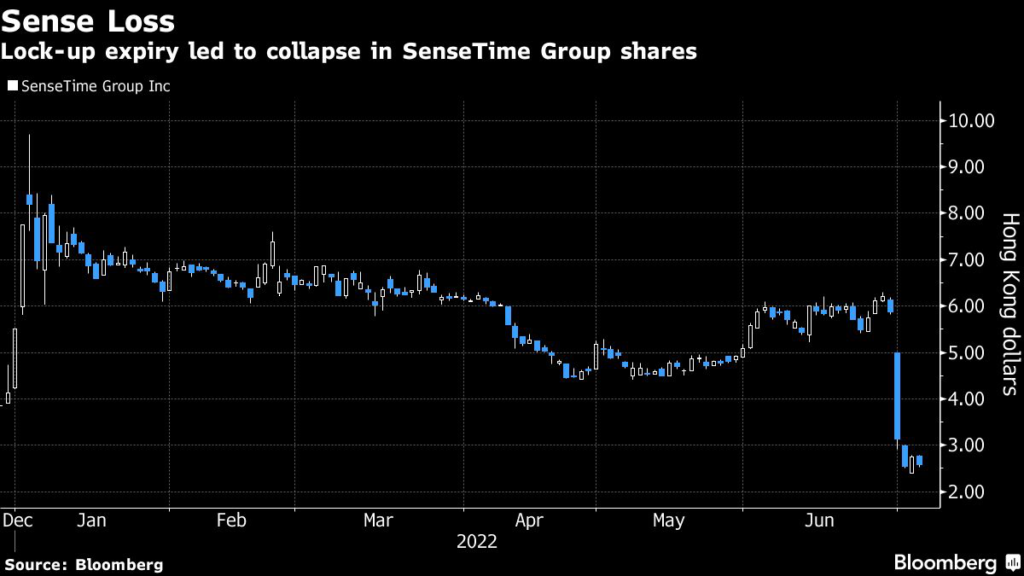
(Bloomberg) — SenseTime Group Inc.’s share price collapse after a lock-up period expired has heaped pressure on other Chinese companies that face similar situations this month.

More than 260 billion yuan ($39 billion) of restricted shares from 76 companies listed on the Star board in Shanghai — home to China’s new-economy listings — are scheduled to be free for sale this month, according to China International Capital Corp. The value could “hit a peak” for the year in July, analysts including Qiusuo Li wrote in a recent note. 

Lock-up expiries have been thrust into the spotlight since shares of artificial-intelligence software maker SenseTime more than halved and dropped below their IPO price immediately after restrictions on sales by cornerstone investors ended last week. 

With Chinese shares on the cusp of a new bull market after rallying from a trough earlier this year, traders are acutely sensitive to investors taking the opportunity to sell.

Shares in the Star market that are poised to be unlocked are mostly in the electronics, high-end manufacturing and health-care sectors, the CICC report said. They include shares of electronic-components manufacturer Montage Technology Co. and China Railway Signal & Communication Corp.

In Hong Kong, electric-vehicle maker XPeng Inc. will see the lock-up period on about 350 million Class B shares end on Wednesday — about a fifth of those outstanding — according to data compiled by Bloomberg. Those unlisted shares are all held by Chairman Xiaopeng He, coming up for sale one year on from the company’s initial public offering in the city.

China Tech Rally Sends Insiders Rushing for Exits: Tech Watch

“Experience shows that unlocking of restricted shares and stock sales by important shareholders may place short-term pressure on share prices,” according to the CICC team.

More stories like this are available on bloomberg.com

©2022 Bloomberg L.P.

Close Bitnami banner
Bitnami