Bloomberg

Dutch University Recovers $550,000 in Ransom From 2019 Hack

(Bloomberg) — A Dutch university has managed to successfully recover a ransom paid to hackers in 2019 and plans to use recouped funds to help students in need.

The ransomware attack at the University of Maastricht occurred on December 23, 2019, and it prevented students and staff from gaining access to email, research and data platforms. 

The university ended up paying 30 Bitcoins in ransom, which at the time was worth about 197,000 euros ($218,000), according to a spokesperson from the university. The payment was made after “extremely difficult deliberations” in which university officials weighed police advice and the moral objection against paying ransom against the interests of students and staff who could no longer access their data.

In April this year, however, the Dutch public prosecution service was able to trace and seize some of the ransom: cryptocurrencies had increased in value to approximately 500,000 euros, according to a statement from the university on Saturday.

An important factor in the investigation was investigators ability to trace the cryptocurrency, as Dutch police saw the Bitcoins being funneled into different wallets. 

Police froze a crypto wallet in early 2020 which contained part of the paid ransom, according to the university. The value of the cryptocurrencies at that time was 40,000 euros. 

Meanwhile, an information request submitted to the broker hosting a wallet that received 4.5 Bitcoins led to the authorities tracking down its owner – a Ukrainian individual who police didn’t identify. Dutch police traveled to Ukraine in 2021 and worked closely with local law enforcement there to complete the seizure. 

The assets were then transferred to the government and were directly converted into regular fiat. Police declined to say who was behind the attack. 

“You can compare it to a home burglary,” said Metten Bergmeijer, team leader from the cybercrime team of the Limburg police. “As the police, we do not repair the door that the burglars destroyed, but we are interested in the fingerprints or other traces left on that door in our investigation.”

Despite the jump in value, the recovered sum does not exceed the costs incurred by the university, a spokesperson told Bloomberg. When the advisory fees of rebuilding the university’s cybersecurity architecture are taken into account, the total damage exceeds the amount recovered. 

The university is planning to use the retrieved funds for students in need, whether to compensate those hardest-hit by the pandemic, or other vulnerable students.

More stories like this are available on bloomberg.com

©2022 Bloomberg L.P.

Goldman Sachs Sees Kotak Mahindra Bank Doubling Market Value

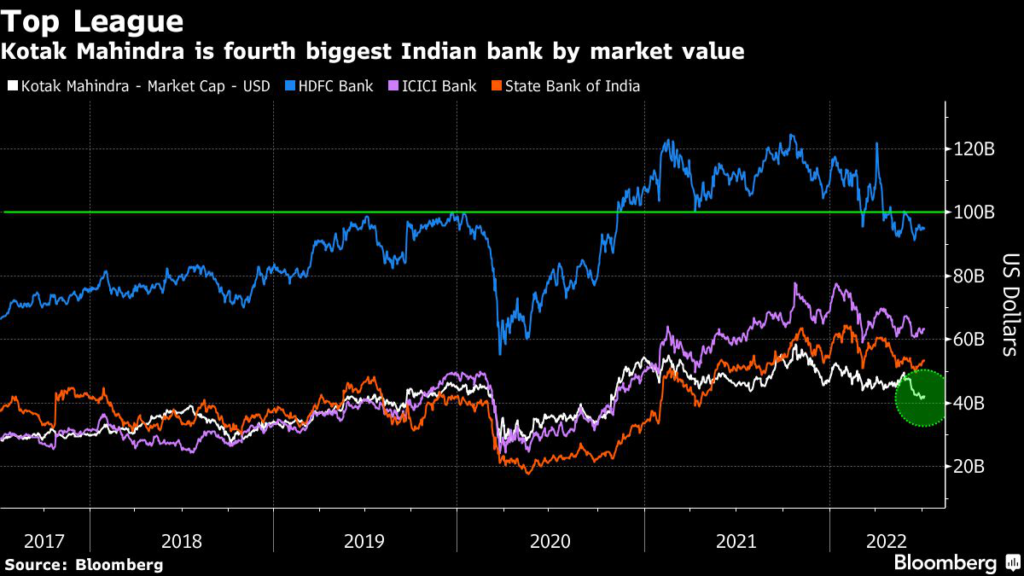
(Bloomberg) — Kotak Mahindra Bank Ltd., controlled by Asia’s richest financier, Uday Kotak, is set to double its value over the next five years, as its lending business transforms with the help of digital channels, according to Goldman Sachs Group Inc.

The Mumbai-based lender is set to deliver sustainable operating profit and loan growth as it deploys excess equity capital, Goldman analysts wrote in a July 5 note, having upgraded the company to a buy recommendation from neutral. The bank’s valuation may rise beyond $100 billion by 2027, according to the note.

Kotak’s efforts to expand its online banking footprint are showing early signs of benefit, as one-third of its loan disbursal to unsecured borrowers happened through its digital platform during the March quarter. Credit growth in India’s banking system has jumped to a three-year high as the economy shows signs of a revival.

Shares of Kotak Mahindra have underperformed the Nifty Bank Index over the past two years, with its valuation plunging to one-standard deviation below the mean. The bank’s shares jumped 2.3% to 1,701.9 rupees ($21.5) as of 12:51 pm in Mumbai trading, paring this year’s losses to 5%.

More stories like this are available on bloomberg.com

©2022 Bloomberg L.P.

Volkswagen CEO Eyes ‘Big Moves’ in China to Gain Thousands of Coders

(Bloomberg) — Volkswagen AG is planning major investments in China to employ “several thousand” software engineers and catch up with local rivals when it comes to equipping cars with the latest digital technology, Chief Executive Officer Herbert Diess said.

“It’s probably not enough just to hire people from other companies,” Diess said in video posted this week on LinkedIn. “We are considering also big moves in China.”

Keeping up with offerings from Chinese manufacturers is becoming a challenge for Western automakers. The likes of XPeng Inc., Nio Inc. and BYD Co. are equipping their vehicles with karaoke microphones and sophisticated cameras for singing and streaming, while also providing connectivity to features such as in-car payment and social media.

READ: Volkswagen Pulls Out All the Stops to Address China Challenges

Diess has identified software as a key differentiator. He regularly cites Nokia’s failure to keep up with the iPhone as a cautionary tale and has said self-driving functions will bring about an even more fundamental transformation of the industry than batteries.

China is Volkswagen’s biggest market and a key driver of its profit. The manufacturer delivered roughly 40% of its vehicles there in the first quarter. It employs more than 90,000 people in the country and operates over 40 vehicle and components factories along with partners.

Tapping into local tastes is crucial to win over customers in China, where electric-car adoption is accelerating and homegrown startups are quickly gaining scale.

“Developing this in Europe will not work,” Diess said. “We are going to have a software team in China, for China.”

(Updates with China context in fifth paragraph. A previous version of this story misstated the timing of Diess’s LinkedIn post.)

More stories like this are available on bloomberg.com

©2022 Bloomberg L.P.

US Wants Dutch Supplier to Stop Selling Chipmaking Gear to China

(Bloomberg) — The US is pushing the Netherlands to ban ASML Holding NV from selling to China mainstream technology essential in making a large chunk of the world’s chips, expanding its campaign to curb the country’s rise, according to people familiar with the matter.

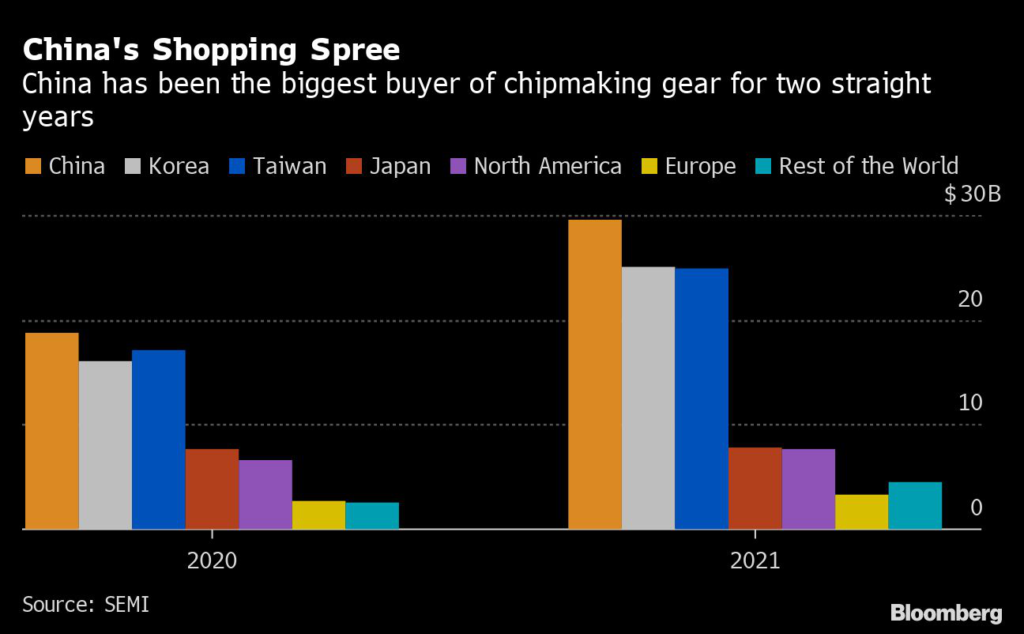
Washington’s proposed restriction would expand an existing moratorium on the sale of the most advanced systems to China, in an attempt to thwart China’s plans to become a world leader in chip production. If the Netherlands agrees, it would broaden significantly the range and class of chipmaking gear now forbidden from heading to China, potentially dealing a serious blow to Chinese chipmakers from Semiconductor Manufacturing International Corp. to Hua Hong Semiconductor Ltd. 

American officials are lobbying their Dutch counterparts to bar ASML from selling some of its older deep ultraviolet lithography, or DUV, systems, the people said. These machines are a generation behind cutting-edge but still the most common method in making certain less-advanced chips required by cars, phones, computers and even robots. 

Shares of ASML gained as much as 2.6% in Amsterdam on Wednesday. Its American Depository Receipts closed down 3.9% on Tuesday following Bloomberg’s initial report. Nikon Corp., a smaller rival to the Dutch firm in that sphere of chipmaking gear technology, closed down 5.1% in Tokyo on Wednesday. 

The issue arose during US Deputy Commerce Secretary Don Graves’s visit to the Netherlands and Belgium in late May and early June to discuss supply chain issues, said the people, who asked not to be identified because the discussions were private. During that trip, Graves also visited ASML’s headquarters in Veldhoven and met Chief Executive Officer Peter Wennink. 

What Bloomberg Intelligence Says

ASML’s sales could narrow by 5-10% if it’s banned from selling deep ultraviolet tools in China. As the chip equipment maker’s revenue already reflects a ban on extreme ultraviolet tool shipments to the country, it may experience less impact vs. peers such as Applied Materials which derives 25-30% of its sales from China.

– Masahiro Wakasugi and Brian Moran, analysts

Click here for the research.

The Dutch government has yet to agree to any additional restrictions on ASML’s exports to Chinese chipmakers, which could hurt the country’s trade ties with China, the people said. ASML is already unable to ship its most advanced extreme ultraviolet, or EUV, lithography systems, which cost about 160 million euros ($164 million) per unit, to China as it cannot obtain an export license from the Dutch government.

The US push on ASML comes as President Joe Biden separately considers easing some of the Trump-era tariffs on consumer goods from China. While China may welcome such a move at a time of tense relations between the two powers, Biden’s administration has continued his predecessor’s efforts to restrict China’s access to US technology.

The US Department of Commerce and the Dutch Ministry of Foreign Affairs declined to comment.

“The discussion is not new. No decisions have been made and we do not want to speculate or comment on rumors,” an ASML spokeswoman said. 

ASML is the world’s top maker of lithography systems, machines that perform a crucial step in the process of creating semiconductors. ASML’s dominance of the market for that type of equipment means that further cutting China off from access to its products would undermine the Asian country’s ambitions to make itself more self-sufficient in production of the crucial electronic components.

“China’s share of the global chip-equipment market is negligible,” said Alex Capri, a research fellow at the Asia-based Hinrich Foundation, characterizing chip production as “a choke point” in China’s plans to bulk up its semiconductor muscle.

The older generation of machinery, DUV, is less capable than more advanced EUV lithography equipment but remains indispensable in manufacturing many of the types of chips that are currently experiencing acute shortages. Washington is focused on banning sales of the most advanced type of DUV technology, immersion lithography machines, the people said.

American officials are also trying to exert pressure on Japan to stop shipping the same technology to Chinese chipmakers, one of the people said. Japan’s Nikon competes with ASML in this area.

Immersion lithography is also known as argon fluoride immersion, or simply ArFi. According to China-based Founder Securities, ASML sold 81 ArFi systems in 2021, compared with four from Nikon, giving the Dutch firm a 95% market share. 

“We have no information regarding this matter,” a Nikon spokeswoman said.

READ: China’s Chipmaking Power Grows Despite US Effort to Counter It

Dutch Prime Minister Mark Rutte said in June he is against reconsidering trade relations with China and called for the EU to develop its own policies toward Beijing. China is the Netherlands’ third-biggest trade partner after Germany and Belgium.

ASML opposes a ban on sales of DUV lithography equipment to Chinese customers because it is already a mature technology, Wennink said earlier this year. Chinese-based facilities, run by either domestic or foreign companies, account for 14.7% of ASML’s total revenue in 2021, according to company disclosures and data compiled by Bloomberg.

ASML is also alleging potential IP infringement by a Chinese tech firm supported by the country’s government.

US efforts to block the export of chipmaking equipment began under the Trump administration. Washington pressured the Dutch government to prevent sales of EUV lithography systems, which are required to produce the most sophisticated semiconductors and in which ASML has a monopoly. 

Major US chip-equipment makers including Applied Materials Inc. and Lam Research Corp. are already banned from selling certain advanced products to SMIC due to national security concerns. The potential DUV ban could further hit SMIC and its Chinese peers. 

“Lithography equipment is the most difficult equipment for China to replace when it comes to semiconductor production,” said Johnson Wang, an analyst at Taiwan Institute of Economic Research. “Without access to foreign DUV lithography equipment, the progress of China’s chip industry could come to a halt.” 

(Updates with share action in fourth paragraph)

More stories like this are available on bloomberg.com

©2022 Bloomberg L.P.

Unbidden Foreign Takeover Succeeds in Japan, Seven Years Later

(Bloomberg) — By most measures, a takeover bid for a publicly listed drywall maker shouldn’t be a monumental event. 

Yet the successful acquisition of Chiyoda Ute Co. by Knauf International GmbH might offer a few lessons into how such deals can be pulled off in a country with a reputation for being hostile to uninvited takeovers. After steadily acquiring 93% of the company, closely held Knauf is squeezing out remaining shareholders and will soon gain full control of Japan’s second-largest maker of walls found inside of homes and offices. 

The secret behind the deal? Seven years, a lot of conversations and plenty of patience, according to Frederick Knauf, who engineered the takeover. 

“We felt confident the TOB would succeed by building what I would call ‘soft power,’ to have people understand your intentions,” Knauf, 47, said in an interview. “And, being a member of the Knauf family has given me a lot of credibility. It implies to Japanese business partners that you’re in for the long term, that you’re not making promises that are worth nothing.”

A representative for Chiyoda Ute referred all inquiries to the takeover document.  

Knauf is one of the biggest suppliers in the global drywall industry, a market that’s projected to reach $31 billion by 2028. As part of the Mittelstand, the small-to mid-sized companies seen as the backbone of Germany’s economy, Knauf had been seeking opportunities to expand internationally.

“Japan is the world’s third-largest market for drywall,” Knauf said, adding that “any global company should have the ambition” of having sales in the country. “That implies you need to find a way to invest into Japan. The TOB was, for us, the best method to solve this problem.”

There’s a long history of acquirers setting their sights on Japan, with mixed results. In the beginning was Texas oilman T. Boone Pickens, who in 1989 set his sights on auto-parts supplier Koito Manufacturing Co. yet retreated after failing to get a board seat. Sharp Corp. agreed to a takeover by Foxconn Technology Group in 2016 after it accumulated years of losses, although the electronics maker remains listed. Toshiba Corp. is in the middle of heated battle with investors that will determine whether it becomes a private company. 

While the larger deals tend to grab headlines, the Chiyoda Ute takeover bid happened under the radar. Although the takeover bid was valued at 7.7 billion yen ($56.5 million), Knauf had been incrementally increasing its stake in Chiyoda Ute from as early as 2006, according to data compiled by Bloomberg. All told, and over time, Knauf paid a premium of about 40% for the acquisition, according to Knauf. Based on the current share price, Chiyoda Ute has a market value of 14 billion yen. 

“I came here with two young children, my Japanese wife and rented a desk in the German Chamber of Commerce, without knowing when will we achieve our strategic intent,” said Knauf, an engineer by training. While building a stake in Chiyoda Ute, Knauf said he learned more about the company and spent time getting to know its founding family. In 2020, he became a managing director of the drywall maker, which has a “fantastic history of being a surviving company of many tough years of industry consolidation,” he said.

Drywall, or gypsum boards, are a common building material, used to cover a building’s framing to make walls that can then be painted, plastered or wallpapered. Because they’re essentially a commodity made out of readily available chalk, there’s very little import or export activity. Most supplies in each market are locally produced. It’s a low-margin business, but Japanese homes tend to be demolished and rebuilt or renovated frequently, fueling steady demand. Chiyoda Ute is also starting offer 100% recycled drywall. 

Chiyoda Ute may also have been the only candidate for a takeover; its biggest rival Yoshino Gypsum Co. isn’t listed, like Knauf.

Asked what lessons others can draw from the takeover of Chiyoda Ute, Knauf said: “Japan is extremely high on ROI (return on investment), but low on ROT — ‘T’ as time. You need to learn about Japan. You need to understand that this takes time. People need to build a relationship with you, which takes time.”

“Many Japanese companies are looking for a way for the future,” Knauf said. “They’re looking for stability. They want to be proud of their companies. And if you are the right partner that can bring this to a Japanese company, you’ll find excellent business opportunities.”

(Corrects to remove reference to management change in third paragraph.)

More stories like this are available on bloomberg.com

©2022 Bloomberg L.P.

Labor Unrest Disrupts Supply Chains From Sky to Sea

(Bloomberg) —  

Each wave of supply shock to hit the global economy during the pandemic seems to produce a different scapegoat.

First came the shipping container shortage of late 2020, caused largely by American consumers stocking up on everything from backyard games to home-office equipment.

In 2021, companies overordered parts and products to avoid running out, while a series of freak accidents — like the blocking of the Suez Canal — helped shake the global economy close to paralysis.

The first half of this year brought the additional uncertainty of Russian President Vladimir Putin’s invasion of Ukraine and China’s strict Covid lockdowns. With the second half of 2022 just underway, there may yet be another culprit for supply stress — labor unrest.

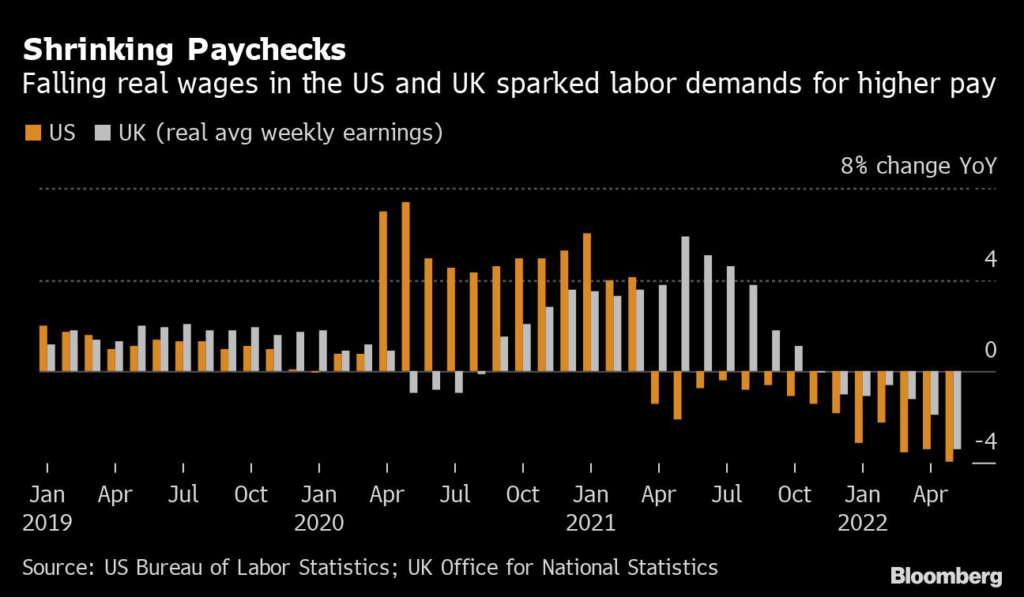
That’s because after years of stagnating wages, workers want to get paid. They’re tired of seeing their incomes evaporate as inflation surges, especially those in logistics or other front-line industries that kept economies functioning during the pandemic. Here’s an example of the pain many are feeling, showing figures on inflation-adjusted earnings receding in the US and UK:

Even the threat of  a major port strike can cause congestion, like the queue of vessels outside the port of Savannah, Georgia — as shown in the map below. Part of the reason is tied to importers rerouting cargo from Asia to avoid any potential labor unrest at the nation’s busiest trade gateways in Los Angeles. The contract for West Coast dockworkers and their employers expired last Friday, and talks are continuing.

As of early this week, there were 31 container ships anchored in the waters off Savannah, leading to waits estimated at eight to 10 days. In the New York area, the delays stretch as long as 20 days for vessels waiting at anchor.

Perhaps the most visible signs of worker discontent appears at airports in the US and Europe, where the passenger carriers are canceling thousands of flights because of shortages of grounds crews, flight attendants and pilots. The return of a healthy summer travel season was supposed to hasten the shift back to normal, but the recovery is hitting some turbulence.

That instability may ripple to the market for air cargo, which tightened considerably over the past two years because so many grounded flights cut capacity in the cargo holds below the passenger cabins. As the Drewry Air Freight index shows, rates have come down some from their peaks, but they’re still more than double pre-pandemic levels. Next thing to watch: how air-freight rates fare when Europe’s temporary rules allowing goods to ride in vacant passenger cabins expire later this month. 

Plus, any strike on the US West Coast could boost demand to move goods by plane and send air cargo rates skyward again.

For More on Labor Strife: 

  • West Coast Dockworkers Extend Talks Past Contract Expiration
  • Summer Travel Chaos Hits Europe Hardest as Delays Escalate
  • UK Train Drivers Would Make Threatened Strikes National: Union
  • Tussle Over $5 Billion in Wages Is New Risk to India Coal Supply

More stories like this are available on bloomberg.com

©2022 Bloomberg L.P.

Revolut Partnering With Stripe for Payments in Europe

(Bloomberg) — Finance app Revolut Ltd. is teaming up with Stripe Inc. to support payments in the UK and Europe.

Revolut will facilitate payments through Stripe’s existing infrastructure, according to a statement on Wednesday. The London-based firm could use the platform in more regions in future as it looks to expand in markets including Latin America, India and the Philippines.

“We’re thrilled to be powering Revolut as it builds, scales, and helps people around the world get more from their money,” said Eileen O’Mara, EMEA revenue and growth lead at Stripe.

Both Stripe and Revolut have grown from startups to sprawling fintech operations in a bid to challenge established banks and payment providers. San Francisco-based Stripe, whose software is used by millions of businesses to send and receive payments, has recently partnered with international transfer company Wise Plc and buy-now-pay-later provider Klarna Bank AB. 

Revolut currently offers payment services to retail and business users in about 30 currencies. In June, the firm teamed up with open banking platform Tink to let users incorporate their bank accounts into the app.  

More stories like this are available on bloomberg.com

©2022 Bloomberg L.P.

Crypto Broker Voyager Seeks Bankruptcy as Mogul’s Lifeline Fails

(Bloomberg) — The cryptocurrency sector’s troubles deepened Wednesday as broker Voyager Digital Ltd. filed for Chapter 11 bankruptcy protection.

The firm and two affiliates, Voyager Digital LLC and Voyager Digital Holdings, took the step in the Southern District of New York, a filing showed.

“We strongly believe in the future of the industry but the prolonged volatility in the crypto markets, and the default of Three Arrows Capital, require us to take this decisive action,” chief executive officer Stephen Ehrlich said on Twitter. 

Voyager Digital late last week temporarily suspended trading, deposits and withdrawal amid challenging market conditions. About $2 trillion in market value has been wiped from the crypto sector since a peak last year, amid a global wave of monetary tightening that drained liquidity and blew up leveraged bets.

Trading, deposits, withdrawals and loyalty rewards on the Voyager platform remain temporarily suspended, Ehrlich added.

Sam Bankman-Fried, co-founder of crypto exchange FTX US, had acted as a sort of lender of last resort for Voyager by providing credit lines via Alameda Research. Voyager’s filing lists $75 million of unsecured loans from Alameda, making the firm the biggest single creditor.

Three Arrows Fallout

New-York based Voyager is the latest in the digital-asset sector to hit trouble. Hedge fund Three Arrows Capital, to which Voyager had lent hundreds of millions of dollars, was ordered into liquidation last month after failing to repay creditors. 

Voyager offered crypto trading, staking — a way of earning rewards for holding certain cryptocurrencies — and yield products. Firms offering high-yield products including Celsius Network, Babel Finance and Vauld have suspended withdrawals as liquidity dried up.

Last month, Voyager issued a notice of default to Three Arrows Capital on a loan worth roughly $675 million. It’s actively pursuing recovery from the troubled crypto hedge fund, including through the court-ordered liquidation process in the British Virgin Islands.

Crypto markets weakened slightly after the latest filing. Bitcoin slipped about 2.4% to $19,950 as of 1:31 p.m. in Singapore.

(Updates with more context from the third paragraph on Voyager’s travails.)

More stories like this are available on bloomberg.com

©2022 Bloomberg L.P.

Alibaba Earnings Turnaround Hopes Revived After Shares Rise 60%

(Bloomberg) — Some of Wall Street’s biggest brokerages have reiterated their bullish calls for Alibaba Group Holding Ltd., suggesting more gains may be in store after the e-commerce giant surged from a mid-March low.

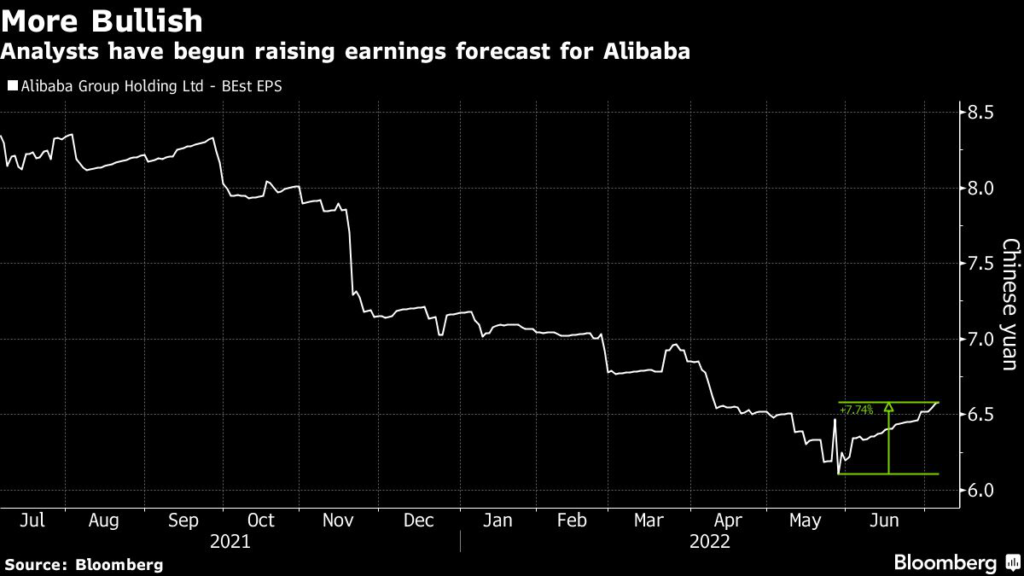
The consensus estimate for the retailer’s earnings per share for the next 12 months has climbed more than 7% from a three-year low in late May, according to data compiled by Bloomberg. More than 10 brokerages, including Citigroup Inc. and Goldman Sachs Group Inc., have reinforced their buy calls over the past week.

Speculation that a crackdown on the tech sector may be drawing to a close is buoying bets on Alibaba, which has seen its shares in Hong Kong soar more than 60% from the record low reached in mid-March. The Hang Seng Tech Index has gained nearly 38% during that time.

“We expect Alibaba’s market share loss to gradually stabilize, and remain constructive on the company’s ability to expand its total addressable market,” Goldman analysts including Ronald Keung wrote in a note on Sunday. 

Alibaba Profit Seen Better Than Expected on Cost-Cutting Effort

Alibaba outlined its business strategies to merchants and analysts in a meeting last Thursday, according to Goldman. Jefferies Financial Group Inc. said in a note the company addressed some “pain points” for its merchants and highlighted its efforts to support consumers in Shanghai during Covid lockdowns.

The company’s revenue for the March quarter beat analysts’ projections, thanks to cost-control measures and growth in new business initiatives. The retailer has faced fierce competition from rivals JD.com Inc. and Pinduoduo Inc., as well as the negative impact of slower demand due to the pandemic.

Still, investors remain cautious over the broader Chinese economy, which is facing renewed risks following rising infections in Shanghai and subsequent mass testing given the nation’s strict adherence to its Covid Zero policy.

More stories like this are available on bloomberg.com

©2022 Bloomberg L.P.

Ukraine Latest: Russia May Dodge Deep Fall; US and China to Talk

(Bloomberg) — Russia appears on track for a much shallower recession than many forecasters initially expected due to rising oil production that has blunted the impact of US and European sanctions over its war in Ukraine.

US Secretary of State Antony Blinken plans a candid discussion about the war with his Chinese counterpart during an upcoming summit in Bali. A top Biden administration official earlier urged Beijing to stop spreading Russian “lies” about the Kremlin’s invasion of its neighbor.

Blinken has no plans to meet Russian Foreign Minister Sergei Lavrov during the Group of 20 ministerial gathering in Bali this week. President Joe Biden has called for Russia to be removed from the G-20 over the invasion and diplomats have previously walked out of a Lavrov speech in protest of the Kremlin’s war.

(See RSAN on the Bloomberg Terminal for the Russian Sanctions Dashboard.)

Key Developments

  • Russia’s War-Weary Tech Talent Floods Into Neighboring Georgia
  • Russia Dodges Worst Recession Fears as Oil Eases Sanctions Pain
  • Natural Gas Soars 700%, Becoming Driving Force in New Cold War
  • Turkey Renews Threat to Veto Sweden and Finland’s NATO Bids
  • Blinken Plans ‘Candid Exchange’ With China’s Wang on Ukraine War
  • Biden Receives Plea from WNBA Star Griner on Release From Russia

On the Ground

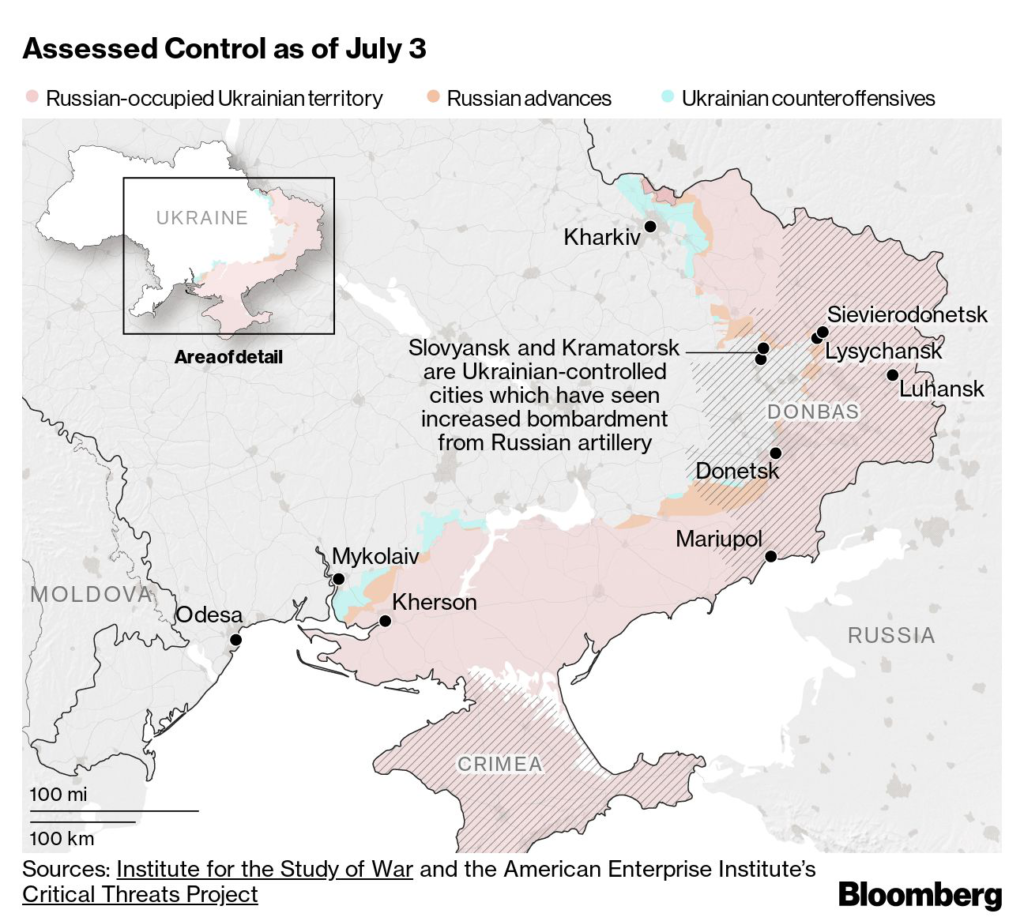
With Lysychansk under its control, Russia is switching its focus farther west into Donetsk, intensifying shelling of the region, according to Ukrainian officials. Fighting continues on the Bakhmut axis, which has emerged as a new flashpoint. Ukrainian forces repelled a Russian assault close to Slovyansk, the Ukrainian General Staff said, with the city’s mayor urging residents to evacuate as the front line moves closer. Russia fired seven missiles further west toward Dnipropetrovsk overnight, six of which were shot down by Ukrainian forces, Valentyn Reznichenko, the head of the regional government, said on his Telegram account.

(All times CET)

Russia Dodges Worst Recession Fears (6:00 a.m.)

Economists from JPMorgan Chase & Co., Citigroup Inc. and other big banks are slashing their outlooks for the drop in output this year to as little as 3.5%, dismissing fears in the first months after Putin’s invasion that it could be the deepest in a generation. 

The improving outlook is adding to Kremlin confidence that it can weather the sanctions onslaught from the US and its allies even as leaders in those countries face increasing pressure from surging energy and food prices — trends the war has worsened. 

Officials in Moscow, some of whom saw a contraction of as much as 12%, are now preparing to improve forecasts to less than half that. To be sure, Russia’s economy is still facing the sharpest contraction since at least 2009. 

Russia’s War-Weary Tech Talent Floods Into Georgia (6:00 a.m.)

Georgia’s government estimates that 80,000 Russians, Belarusians and Ukrainians now reside in this small Caucasus nation of 4 million. Of those, 20,000-25,000 work in IT and software, and about 30,000 are Russian citizens who arrived since the war began. Many came recently from Belarus and Ukraine, too.

As IT specialists, they see little future in Russia as the security services tighten control of the internet, international sanctions squeeze the economy and foreign companies exit. The exodus comes as Russian tech companies including internet giant Yandex NV struggle amid deepening censorship, shortages of key equipment, and a backlash in foreign markets.

Read more: Russia’s War-Weary Tech Talent Floods Into Neighboring Georgia

China to Strengthen Coordination With Russia (5:34 a.m.)

Chinese Deputy Foreign Minister Ma Zhaoxu said while meeting Russian Ambassador Andrey Denisov that Beijing is willing to strengthen strategic coordination and cooperation in various sectors.

China will deepen cooperation with its long-time partner Russia at the UN, G-20, Shanghai Cooperative Organization and BRICS in an effort to build a “more fair and reasonable” global governance system, Ma said, according to a statement from China’s Foreign Ministry. 

Biden warned Chinese President Xi Jinping in a March telephone call of “consequences” should Beijing provide support for Putin’s war, according to the White House readout of the chat. 

Blinken Plans ‘Candid Exchange’ With China’s Wang (1:55 a.m.)

Blinken leaves for Bali on Wednesday to attend the G20 foreign ministers meeting that’s set to be dominated by the fallout from Russia’s invasion. He will have discussions with Chinese counterpart Wang Yi, a top US administration official said. 

“This will be another opportunity, I think, to have a candid exchange on that, and to convey our expectations about what we would expect China to do, and not to do, in the context of Ukraine,” Assistant Secretary of State for East Asian and Pacific Affairs Daniel Kritenbrink told reporters in Washington. 

Nicholas Burns, the US ambassador to China, this week called on Beijing to stop spreading Russia’s “lies,” in an unusually direct and public rebuke. While China has said it doesn’t support the war and urged talks to end the fighting, top officials and state media have repeatedly blamed the US for provoking Russia by allowing the North Atlantic Treaty Organization’s expansion. 

Read more: Blinken Plans ‘Candid Exchange’ With China’s Wang on Ukraine War

Blinken Isn’t Expected to Meet Lavrov at G20 (12:40 a.m.)

Blinken isn’t expected to meet Lavrov at the G20 event, according to State Department spokesman Ned Price. He told reporters “the secretary will be a full and active participant” at the gathering in Indonesia despite Russia’s presence.

The US government is committed to a successful meeting, Price said, but “it cannot be business as usual with Russia.” He predicted that G20 members would “express no shortage of condemnation for the actions on the part of the Russian Federation” in the Ukraine invasion.

Donetsk Regional Governor Urges Locals to Evacuate (9:10 p.m.)

Regional Governor Pavlo Kyrylenko urged people who remain in the eastern Ukrainian towns of Kramatorsk and Slovyansk to evacuate as Russian attacks intensify. Kyrylenko said in a nationally televised address that the Russian army was firing randomly, targeting local residents and seeking to spread panic.

“People get killed every day in Donetsk region since the beginning of the large-scale invasion,” he said. Kyrylenko hopes as many as 350,000 people remaining in Donetsk province will evacuate.

Kaliningrad Governor Hopes EU Is About to Ease Restrictions (7:30 p.m.)

The governor of Kaliningrad said he’s hopeful the European Union may ease limitations this week on the transit of goods to Russia’s Baltic exclave.

“We’re getting signals through various channels that they’re likely to take this decision this week,” Anton Alikhanov told Rossiya 24 state channel, Interfax reported.

Russia has warned that it will retaliate against EU member state Lithuania for blocking rail transport of goods such as steel in accordance with the bloc’s sanctions measures.

Ruble Falls as Investors Rush to Safety of US Dollar (5:49 p.m.)

The Russian currency plummeted the most in four months, pulling back from a rally that’s confounded traders and politicians alike since the early days of Putin’s war.

The currency dropped as much as 11% to 62.30 per dollar amid broad strength in the greenback that also saw the euro plunge to a two-decade low. The decline follows Russia’s relaxation of capital controls and its canceling a rule forcing the conversion of export revenues to rubles.

Germany Faces Limited Options If Nord Stream Flows Don’t Return (3:55 p.m.)

A key pipeline delivering Russia’s natural gas to Europe may not return to full capacity after planned maintenance this month, Goldman Sachs Group Inc. said, echoing the concerns of German officials.

Nord Stream 1 is set to shut for work on July 11-21, tightening a market that’s seen prices soar in recent weeks. With Moscow having already slashed flows through the pipe to 40% of capacity, any move to withhold supplies for longer would severely hurt Europe’s efforts to refill stockpiles for winter.

“While we initially assumed a full restoration of NS1 flows following its upcoming maintenance event, we no longer see this as the most probable scenario,” Goldman analysts said in a note. 

Bulgaria Seeks Options to Help Process Ukrainian Grain (3:46 p.m.)

Bulgaria’s state-owned Varna port may hold talks with operators of private port terminals to help find storage and process grain loads from Ukraine, the Transport Ministry said.

The ministry is planning to seek financial aid from the European Commission to build additional grain silos, as existing storage capacity at all terminals in Varna is 150,000 tons.

Turkey Renews Threat to Block NATO Expansion (11:32 a.m.)

Turkey is threatening to veto NATO membership for Sweden and Finland, even as the military alliance formally paved the way for the two Nordic countries to join.

Turkey won’t ratify membership in the North Atlantic Treaty Organization for the applicants if they don’t fulfill their promises to combat terrorism and extradite suspects under a memorandum of understanding reached at an alliance summit in Madrid last week, Foreign Minister Mevlut Cavusoglu said Monday. 

“They have to comply with this document. If they don’t then we won’t allow them to join NATO,” Cavusoglu told NTV television. 

UniCredit Mulls a Russia Exit It Can Reverse  (10:38 a.m.)

UniCredit SpA is considering selling its Russian unit through a structure that would let the bank repurchase the subsidiary if the geopolitical situation stabilizes, according to people familiar with the matter.

Italy’s second-largest lender is looking at several possible deal arrangements, including one that would give it the option of buying back the unit depending on market and political conditions, said the people, who asked not be identified because the matter isn’t public.

Romania’s TTS Opens Danube Route for Ukraine Grain (9:33 a.m.)

Transport Trade Services SA, Romania’s largest logistics company on the Danube, has opened a new water-only transport route to help increase grain exports from Ukraine amid a surge global food prices. 

Romania has already facilitated the export of more than 1 million tons of grain from Ukraine since the Russian invasion in February. The new route “ensures a significant increase of the Ukrainian freight flows, eliminating from the supply chain the berths and storage spaces in the Constanta port,” TTS said in an e-mailed statement. The port, on the Black Sea, has been overwhelmed by a jump in traffic. 

Ukraine to Bring Outspoken Berlin Envoy Home: Bild (9:17 a.m.)

Ukraine’s ambassador to Germany, Andriy Melnyk, is poised to return to Kyiv after eight years in Berlin, according to Bild Zeitung, which cited unidentified sources in the Ukrainian capital. Melnyk has been strident in his criticism of Germany and accused Chancellor Olaf Scholz of taking too long to send heavy weaponry to Ukraine. 

13,000 of Musk’s Starlink Internet Devices in Ukraine (8:22 a.m.)

Elon Musk’s satellite Internet service Starlink has been vital in keeping parts of Ukraine affected by the Russian invasion connected, the country’s minister for digital transformation, Mykhailo Fedorov, said in an interview with Bloomberg TV.

More than 13,000 Starlink devices are operating in Ukraine, including on the front line, and government officials are in daily contact with Musk’s representatives, Fedorov said.

Russian Imports Steady After Initial Sanctions Shock (7:56 a.m.)

Russian imports picked up a bit in May, even from some countries that have joined the US and its allies in imposing sanctions over the Kremlin’s invasion of Ukraine, as the economy showed signs of stabilizing.

Trade flows into Russia remain far below pre-invasion levels, but imports for the five major trading partners were down 29% in May on the year, compared with a 43% drop in April. Bloomberg calculated the figures based on reports from those countries, which account for about half of Russian imports. Russia stopped releasing detailed trade data after the invasion.

Turkey, which hasn’t joined the sanctions, saw exports to Russia jump to the highest since December.

Russian Tycoon Agrees to Nornickel-Rusal Merger Talks (7:25 a.m.)

Billionaire Vladimir Potanin, the biggest investor in MMC Norilsk Nickel PJSC, said he’s ready to discuss merging the mining giant with United Co Rusal International PJSC as sanctions against Russia weigh on both companies.


More stories like this are available on bloomberg.com

©2022 Bloomberg L.P.

Close Bitnami banner
Bitnami