Bloomberg

Used Car Startup Kavak to Invest $180 Million in New Global Push

(Bloomberg) — Mexican used car startup Kavak is branching out into three more Latin American countries and launching its first foothold outside the region in Turkey as it seeks to prove it can expand its “super app” online business model across emerging markets.   

Currently Latin America’s most valuable startup, Kavak is planing to invest $120 million in Colombia, Chile and Peru and at least $60 million in Turkey after setting up initial operations late last year, said founder and Chief Executive Officer Carlos Garcia Ottati in an interview. However, Kavak is also cutting costs across Mexico, Brazil and Argentina as the economic environment worsens, he said.

“We’re confident the expansion is something the company needs to do, but we’re doing it conservatively,” Garcia Ottati said, speaking at the firm’s Mexico City headquarters. The company’s five years of experience and proven technology would allow it to become profitable more quickly in the new territories with smaller investments, he said. “We’re going to get to a bigger scale, faster.”

Kavak, which offers clients used cars through brick-and-mortar “hubs” and online, was valued at $8.7 billion in a private fund raising last September. But like other technology startups around the world, the company has found itself under increasing pressure to turn a profit as investors recoil from risky ventures. Phoenix-based online used car dealer Carvana Co. has tumbled more than 90% from its peak in August amid doubts that it can make its business model profitable. 

Garcia Ottati said Kavak was solving a different set of problems in emerging markets, where around 90% of deals take place between individuals, by providing a “super app” that aimed to build lifetime customers who look to Kavak for swapping cars, financing, insurance, warranties and even paying parking tickets.

“We’re solving fraud, we’re solving access to financing, and we’re using technology to grow this,” he said. Turkey had already shown promising growth that could end up justifying more investment, he said. “I think this is going to be probably one of our fastest growing profitable markets if we continue in the current direction,” he said.

More stories like this are available on bloomberg.com

©2022 Bloomberg L.P.

Chinese Chipmakers Surge After US Pushes for More Industry Curbs

(Bloomberg) — Washington’s latest move to restrain Beijing from fostering its chipmaking industry is powering China’s semiconductor stocks as the US restrictions could fire up support for homegrown technology.

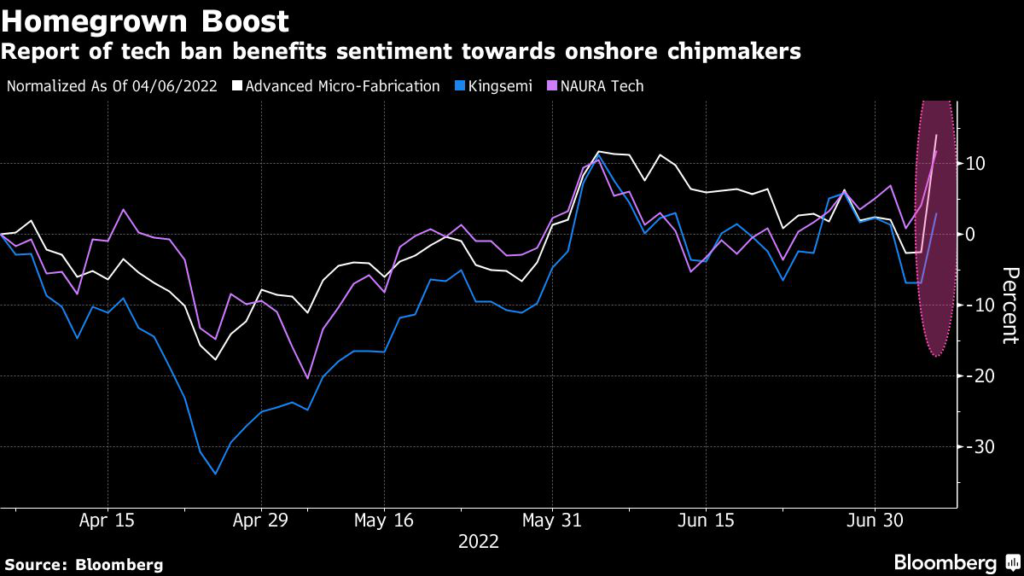
China chipmakers were one of the few bright spots in the markets Wednesday after Bloomberg News reported that the US is pushing the Netherlands to ban ASML Holding NV from selling to China technology essential in making a large chunk of the world’s chips. That, as well as a better-than expected earnings, has spurred a rally in chip stocks in China, with investors seeing US restrictions accelerating sales for domestic companies as tech firms seek onshore substitutes.

Chinese semiconductor manufacturers Piotech Inc. and Kingsemi Co. surged at least 10% in trading in Shanghai, while Advanced Micro-Fabrication Equipment Inc. and NAURA Technology Group Co. led the gains on the benchmark CSI 300 Index. Gains by Bestechnic Shanghai Co. and Verisilicon Microelectronics Shanghai Co. helped send the tech-heavy Star 50 gauge up as much as 2.3%.

China’s chip industry is growing faster than anywhere else in the world, after US sanctions on local champions from Huawei Technologies Co. to Hangzhou Hikvision Digital Technology Co. spurred appetite for home-grown components. The latest envisioned curbs underscore how tensions between Washington and Beijing are transforming the $550 billion semiconductor industry — a sector that plays a role in everything from defense to AI and autonomous cars.

Read more: US Sanctions Help China Supercharge Its Chipmaking Industry

“The logic behind China semiconductor stocks has been that of homegrown products replacing imported machinery and chips,” said Shi Junbo, fund manager at Hangzhou XiYan Asset Management Co. “Even though the technology might not be as advanced, they will have to do, as the US in effect forces domestic manufacturers to have a larger market share.”

The sector-wide gain has also been bolstered by Advanced Micro-Fabrication’s preliminary earnings. The firm sees profits after non-recurring items rising by as much as 630% in the first half, after new orders rose 62% to 3.1 billion yuan, according to a filing late Tuesday. 

The earnings are a beat, and show a significant improvement in margins from the first quarter, CICC analysts including Li Xuelai, wrote in a note, expecting “net-profit growth to accelerate from here, with new products to help the firm open up its market potential.”

The market was “pessimistic” about semiconductor earnings for the first half due to the impact of lockdowns and dampened consumer electronics demand, Shi said. “But now it looks less gloomy after nearly a month of market-lagging performance.”

More stories like this are available on bloomberg.com

©2022 Bloomberg L.P.

Voyager Digital Holdings Files for Chapter 11 Bankruptcy

(Bloomberg) — Voyager Digital Holdings filed for Chapter 11 bankruptcy in the Southern District of New York, according to a filing.

Its estimated liabilities and assets are each in the range of $1 billion to $10 billion, the filing showed. 

Crypto broker Voyager Digital Ltd., which owns 100% of Voyager Digital Holdings, late last week temporarily suspended trading, deposits and withdrawals due to difficult market conditions, amid a deepening meltdown in the beleaguered crypto sector.

Digital-asset markets appeared to take the filing in their stride. Bitcoin was little changed at about $20,260 as of 12:16 p.m. in Singapore.

More stories like this are available on bloomberg.com

©2022 Bloomberg L.P.

Russia’s Brain Drain Is Officially Underway

(Bloomberg) — Dmitry Klimenko is putting the final touches to a new nightclub in Tbilisi’s central Vake Park, aimed at drawing some of the tens of thousands of disoriented fellow Russians, Belarusians and Ukrainians who fled to Georgia in recent months.

A veteran of seven nightclubs he opened in his home town of Novosibirsk over the years, Klimenko left Russia on March 7, as President Vladimir Putin’s invasion of Ukraine darkened the political climate at home.

“It’s what I know how to do,” said Klimenko, as first one and then a second pair of curious Russians stopped by to look at “The Balance,” his latest venture. “When I asked around people said: ‘Do it! We are lost here’.”

Georgia’s government estimates that 80,000 Russians, Belarusians and Ukrainians now reside in this small Caucasus nation of 4 million. Of those, 20,000-25,000 work in IT and software, and about 30,000 are Russian citizens who arrived since the war began. Many came recently from Belarus and Ukraine, too.

As IT specialists, they see little future in Russia as the security services tighten control of the internet, international sanctions squeeze the economy and foreign companies exit. They’ve flocked to other neighboring states such as Armenia and Kazakhstan as well as to Turkey, Dubai and Israel, while the US is seeking to lure them by waiving some visa requirements. The exodus comes as Russian tech companies including internet giant Yandex NV struggle amid deepening censorship, shortages of key equipment, and a backlash in foreign markets.

Young, educated and financially self-sustaining, the arrivals are the kinds of people that tech hubs such as Berlin, Lisbon and London spend fortunes trying to lure. Keeping them in Georgia as they serve clients around the globe from their laptops represents a huge economic opportunity for a poor country with a liberal tax and business environment.

“The whole world is competing to attract these people,” said former central bank Governor Giorgi Kadagidze, over coffee in downtown Tbilisi. He argues that Georgia should market itself aggressively as a safe haven from repressive regimes that offers a strong financial sector, beaches, mountains, a warm climate and good food. “We can be the Portugal of the East.”

And yet, Kadagidze doesn’t think that will happen, with most migrants leaving again once they can secure visas to travel onward. It doesn’t help that many ordinary Georgians, who suffered a Russian invasion of their own in 2008, are suspicious of the new arrivals.

In Kadagidze’s view, Georgia’s government lacks the will to create and publicize the environment that would entice them to stay, much as it was unable to secure the candidate status that the European Union has now awarded to Ukraine and Moldova. That failure with Brussels triggered some of the largest protest rallies Georgia has seen in its turbulent post-Soviet history.

The government came in for biting criticism from the European Parliament, which last month censured Georgia for repressing media freedoms and backsliding on judicial reform and civil liberties — including those of former President Mikheil Saakashvili, currently hospitalized while serving a jail sentence his supporters say is political.

The government’s opponents also accuse it of attempting to appease Moscow. Levan Davitashvili, minister for the economy and sustainable development, calls such criticisms unfair and politically motivated. Security services screen Russian immigrants thoroughly for agents or sanctions threats, he said, while the government has set up a task force to help companies and entrepreneurs settle and navigate procedures such as the checks needed to open a bank account.

The government is also in talks to attract several international tech firms moving staff from Russia, Davitashvili said at his office above the noisy hum of Tbilisi’s hyper-modern registration center. An astonished Klimenko, the nightclub owner, said it took him just 15 minutes to register as an entrepreneur. 

“This is very important for Georgia, to Georgia’s economy and to Georgia’s digital transformation,” Davitashvili said of the Russian influx. Other advantages, including low income taxes, a special 5% corporate tax rate to attract foreign tech companies, and a culture and language familiar to Russians, were there long before the war, he said.

As for EU candidacy status, that was a severe disappointment to the government, too, given that Georgia leads Moldova and Ukraine on most EU membership criteria, according to Davitashvili. 

Some hurdles to a Russian-driven tech boom in Georgia have little to do with government policy. For one thing, many Russians fled there because they could simply arrive without the need for a visa, but planned from the outset to move on as soon as they could secure the documents needed to do so.

Kostya Amelichev, 20, said he left Moscow on March 4 for fear of being drafted to fight and is now finishing his university degree remotely. A high frequency trading startup he brought to Tbilisi with fellow exiles — 10 of his university class are now in Tbilisi — pays the bills. But he expects to move on once he has his degree.

Web developer Vladislav Miedziyanski, 25, continued working for the Swedish company that employed him in Moscow, but says he can’t be sure if he’ll still be in Tbilisi in three years’ time. For now, he said, he’s just happy to be paying taxes to the Georgian government, rather than the “genocidal” regime in his home country.

Miedziyanski had found his way to Ploho (Bad), one of several Russian speaking bars popping up around Tbilisi. “You don’t even need a license to sell alcohol here,” said 24-year-old co-owner Dariya Zheniskhan, from Kazakhstan. Opened in October, the small bar’s walls and ceiling are covered in anti-Putin graffiti.

Some may yet opt to return to Russia. One senior executive at a major Russian tech firm said some workers were already coming back as they felt the initial fallout from the war was subsiding. And not everyone in Georgia is greeting the immigrants with open arms. 

“It’s really a problem, because we don’t know what these people did in their country,” said Mikheil Ambukadze, a 30-year-old Georgian IT worker, as he waited for a free terminal at the registration center. Several others interviewed said the same.

Rents in the capital have soared —  up 101% in May compared with a year earlier, according to research by Georgia’s TBC Bank — with Russians taking the blame, even if low base effects played a big role. Zurab Eristavi, managing partner of high end property company Rentals, said he received 500 Russian enquiries within a month of the war, but responded to just one —  a returning Georgian.

It’s too early to know what long term impact the Russian immigration will have on Georgia, according to Koba Gvenetadze, Georgia’s current central bank governor.

There are indications of a short term boost. Remittances from Russia rose tenfold in May; deposits to bank accounts held by Russian citizens were up by $25 million between the end of February and the end of May; and deposits to all bank accounts as a whole in the country rose $192 million — likely the result of money spent by arriving migrants — according to Gvenetadze.

The net effect has been to strengthen Georgia’s currency and current account balance. But if returning ethnic Georgians will likely stay for the long term, “the rest of the immigrants will probably leave at some stage,” the central banker said. “The question is when, and we don’t know.”


More stories like this are available on bloomberg.com

©2022 Bloomberg L.P.

Utility Giant Tokyo Electric Mulls Joining Toshiba Bid

(Bloomberg) — Japan’s top utility company Tokyo Electric Power Co. is mulling joining a partnership between state-backed investment fund Japan Investment Corp. and a local private equity firm in bidding to take over Toshiba Corp., according to people familiar with the matter. 

The largest power utility in Japan, known as Tepco, is looking to secure Toshiba’s nuclear business through a joint takeover offer, the people said. Foreign funds have also approached JIC to join the bid, according to people familiar with the matter. 

JIC and Japan Industrial Partners Inc. are partnering up because they don’t have enough funds on their own, they said. While foreign funds have approached JIC for potential joint offers, it’s too early to tell who JIC-JIP group will partner with or whether they will proceed with their own bid, the people said. 

JIC and JIP declined to comment. Tepco spokesman said it wasn’t among companies that have submitted proposals to Toshiba, without elaborating on the potential JIC and JIP partnership. Toshiba spokeswoman Midori Hara declined to provide details of proposals and potential partners for the company. The company said last month it received eight offers to buy out the conglomerate and two proposals for capital and business alliances.

Tepco’s net income plummeted by 97% from a year earlier to about 5.6 billion yen ($41 million) for the financial year ended March 31. Its shares fell as much as 9.5% on Wednesday in their biggest decline since Sept. 30. The stock was still up about 105% this year. Toshiba shares dropped as much as 1.8% on Wednesday.

Profit Taking

“There’s a positive and a negative side to the report, but given how Tepco shares have been surging, investors are taking it as an opportunity to take profit,” said Shoichi Arisawa, an analyst at Iwai Cosmo Securities Co. “It depends on how much money Tepco is willing to put in. This company doesn’t have much money to begin with. Investors could be seeing it as the company getting involved in unnecessary matter.”

Bain Capital, CVC Capital Partners and JIC are among potential bidders for Toshiba, Bloomberg News has reported. Foreign investors have been watching developments at Toshiba to gauge shareholder influence and regulators’ acceptance of foreign private equity firms in Japan. 

Any sale of Toshiba, which owns key nuclear technologies, would require approval from the Japanese government. Toshiba is categorized as a company of interest to national security under the Foreign Exchange and Foreign Trade Act for is nuclear expertise.

Toshiba is deeply involved in the effort to clean up Tepco’s wrecked Fukushima Dai-Ichi nuclear power plant, developing technology to remove debris and treat radioactive water. The nuclear power plant suffered from a meltdown back in 2011 amid the destructive earthquake and tsunamis on March 11.

(Adds analyst comment in sixth paragraph.)

More stories like this are available on bloomberg.com

©2022 Bloomberg L.P.

China’s Housing Pain Set to Continue After Sales Bottom

(Bloomberg) — China’s real estate slump is probably past its worst — but the market remains a long way from a full recovery.

Industry executives and economists foresee sales remaining depressed due a weak job market, a prolonged cash crunch and low confidence on housing prices. It could hit growth in the world’s second-largest economy, where real estate and related industries account for about 20% of gross domestic product. 

Sales at China’s largest housing developers fell 43% in June from a year earlier, according to China Real Estate Information Corp., less than the previous month’s 59% decline. Weekly sales data from CRIC show that some major cities, including Shenzhen and Guangzhou in southern China, generated year-on-year growth at the end of June.

The market has “bottomed out” but a recovery will be slow, Yu Liang head of China’s second-largest builder China Vanke Co., said last week. He attributed the recovery partly to seasonal factors — property developers usually rush sales in June to polish interim results. 

China’s land transactions increased in June compared with the previous month. Sales of land through auctions from 300 cities rose by 45% to 120 million square meters in June, China Securities Journal reported. Fewer under-subscriptions were reported from the first two rounds of auctions held by core cities, an indication that the housing market is recovering.

The easing of Covid restrictions has helped. CRIC data show home sales by top developers were up 61% in June from May. Still, that was less than half the pace of increase following the lifting of 2020’s lockdowns. 

Such data suggest “a mild recovery, rather than the V-shaped rebound in 2020,” Barclays’ Hong Kong-based credit analyst Wilson Ho wrote in a Monday note. Sales in smaller cities are weaker compared with larger ones, he added. That’s prompted developers in some rural areas to accept garlic, wheat and even watermelon as housing deposits in recent months. 

Housing sales have fallen year-on-year for 11 successive months, according to official data, making this the longest slump since China created a private property market in the late 1990s. Some economists expect sales to turn positive in the final quarter of the year, partly because performance late last year was so weak. 

That said, the sector still faces significant challenges. Luxury builder Shimao Group Holdings Ltd.’s default on a $1 billion offshore bond this week highlighted the severity of the spreading liquidity crisis. It could also leave millions of square feet of apartments unfinished — underscoring a risk that has deterred homebuyers. Developers’ completion for property projects slumped further in May, according to official data. 

Chinese builders have been driving record offshore bond defaults this year, and the risks are now spilling into the onshore market. The nation’s economic recovery remains uncertain due to risks from lockdowns.

“The road to the property sector recovery will likely be quite bumpy as Beijing remains determined to eliminate the highly infectious omicron variant,” economists at Nomura Holdings Inc. wrote in a note.

China still has some options to boost the market — mortgage rates remain higher than levels seen after previous downturns. But officials have indicated they will stick to their policy of not using real estate for economic stimulus.

For the full year, Moody’s Corp. and S&P Global Inc. both predict a drop of 15% or more.

“Limiting the drop of real estate industry to between 10% and 20% would be difficult,” Feng Jun, a former housing ministry official who is now head of the state-backed China Real Estate Association, warned during a June 29 conference in Beijing. 

(Updates with June landsales figures in fifth paragraph)

More stories like this are available on bloomberg.com

©2022 Bloomberg L.P.

HKEX CEO Sees China Giants Moving to Primary H.K. Listing

(Bloomberg) — Hong Kong is likely to see more dual-traded companies shift toward primary listings in the financial hub as they seek inclusion in trading links with mainland China, according to the city’s exchange chief.

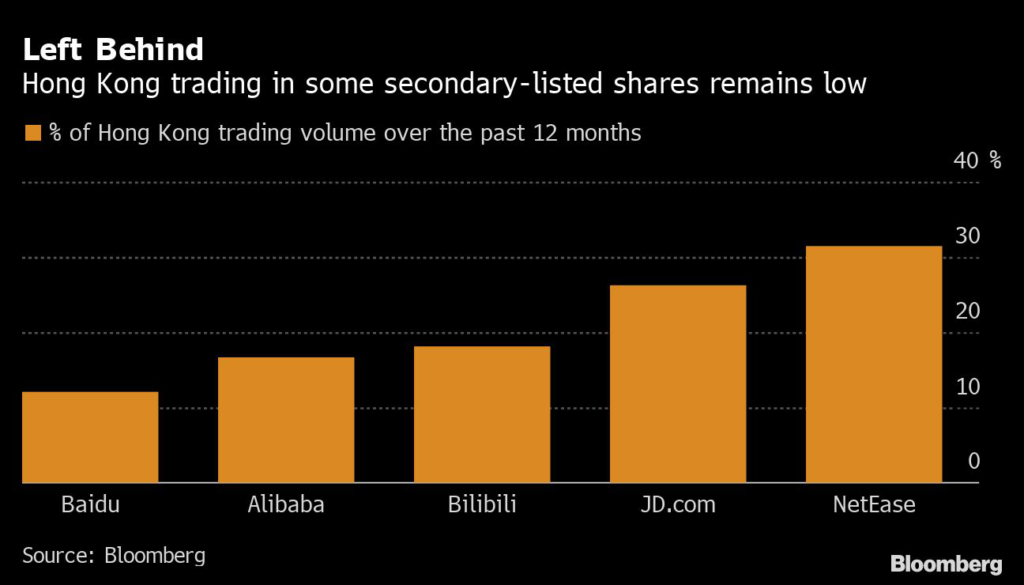
In a wide-ranging interview that also covered topics including Hong Kong’s quarantine policy and China’s support for the city’s global role, Hong Kong Exchanges and Clearing Ltd. Chief Executive Officer Nicolas Aguzin said more companies with secondary shares in Hong Kong are considering primary listings while others may be forced to do so by market rules as more of their trading volume migrates to the city. The most prominent dual-listed company currently excluded from the Stock Connect with China is e-commerce giant Alibaba Group Holding Ltd.

“What we’ve seen for example in Alibaba and in a few others, is that over time, a lot of the trading is coming to our part of the world,” Aguzin said. “When it’s over 55% trading in our market, at that point they don’t have an option. But they can decide to do it anytime.”

Aguzin didn’t indicate whether Alibaba has held talks with HKEX about a potential primary listing. Alibaba didn’t immediately respond to a request seeking comment. Shares of the Chinese tech giant gained as much as 3.3% in early Wednesday trade to the highest since February. 

The prospect of Stock Connect inclusion for companies like Alibaba has been subject of intense speculation among traders in Hong Kong, which currently excludes companies with both secondary listings and weighted voting rights from its mainland trading links.

While some market participants had hoped the exchange would relax the rules that bar such companies, a primary listing is emerging as an alternative path. Bilibili Inc. last week won shareholder approval to convert its secondary Hong Kong listing status to dual-primary while Zai Lab Ltd. completed the procedure in June.

Unlike companies with a primary listing in Hong Kong, firms with a secondary listing in the city are exempted from certain listing rules and don’t have to disclose things such as financial guarantees provided to affiliates and stock pledges made by the controlling shareholder.

Under current rules, a company will be required to convert its listing status to primary if 55% or more of the trading volume takes place on the Hong Kong bourse over the past fiscal year. Still, most secondary-listed firms, including Alibaba, are far from reaching that threshold, according to data compiled by Bloomberg. 

“I am seeing quite a clear trend that homecoming issuers are gravitating towards a dual primary listing as opposed to a secondary,” said HKEX Head of Listing Bonnie Chan during the interview. Companies seeking to convert can also discuss with HKEX on continuing exemption for some time to help with smooth transition, she said.

Aguzin also expressed confidence that more connectivity with the mainland will boost trading volume and lift the exchange’s prospects. HKEX shares have lost 18% since he took over in May 2021.

Here are some of the other topics Aguzin discussed. His comments have been lightly edited and condensed.

Hong Kong’s role:

From the overall China point of view, having the possibility of having a place that can be international and competitive, it’s very important and a great advantage. That’s why my view is that, is this going to be another city of mainland? Why? Who benefit from that? The logical conclusion is that there is a lot of value in being the most international city of China, the most Chinese city outside of the mainland. 

There’s not a change in terms of making sure that this is an international financial center. That’s very high on the agenda. I feel very encouraged by being able to operate this as an international exchange. I don’t feel any constraints from any side.  

Quarantine policy:

My expectation is as we start coming out of this situation, the amount of quarantine will probably be condensed. Hopefully very soon we will have no quarantine. I look forward to the day that we can travel back and forth. I used to travel for one day just to New York and come back. Now it’s unthinkable. 

Learning from crypto:

Whenever you do a transaction, it takes 48 hours to settle, and it’s touched by on average 10 to 12 people. There are so many people getting a little cut of everything. You look at some of the crypto exchanges — I don’t want to be a crypto exchange right now. But there are things to learn from everyone: the ease of use, how you can trade 24 hours a day, peer-to-peer without intermediary, automatic settlement at anytime, a really efficient way of operating.  

(Updates with Alibaba share price in the fourth paragraph.)

More stories like this are available on bloomberg.com

©2022 Bloomberg L.P.

Ukraine Latest: US Plans Frank Talks With China on Russia’s War

(Bloomberg) — US Secretary of State Antony Blinken plans a candid discussion about the war in Ukraine with his Chinese counterpart during an upcoming summit in Bali. A top Biden administration official earlier urged Beijing to stop spreading Russian “lies” about the Kremlin’s invasion of its neighbor.

Blinken has no plans to meet Russian Foreign Minister Sergei Lavrov during the Group of 20 ministerial gathering in Bali this week. President Joe Biden has called for Russia to be removed from the G20 over the invasion and diplomats have previously walked out of a Lavrov speech in protest of the Kremlin’s war.

NATO formally signed off on plans to bring Sweden and Finland into the defense alliance, moving a step closer to bolstering its eastern front against Russia. 

(See RSAN on the Bloomberg Terminal for the Russian Sanctions Dashboard.)

Key Developments

  • Natural Gas Soars 700%, Becoming Driving Force in New Cold War
  • Turkey Renews Threat to Veto Sweden and Finland’s NATO Bids
  • Blinken Plans ‘Candid Exchange’ With China’s Wang on Ukraine War
  • UniCredit Mulls a Russia Exit That It Can Reverse After War
  • Ukraine Estimates Immediate Funding Needs of Up to $65 Billion
  • Biden Receives Plea from WNBA Star Griner on Release From Russia

On the Ground

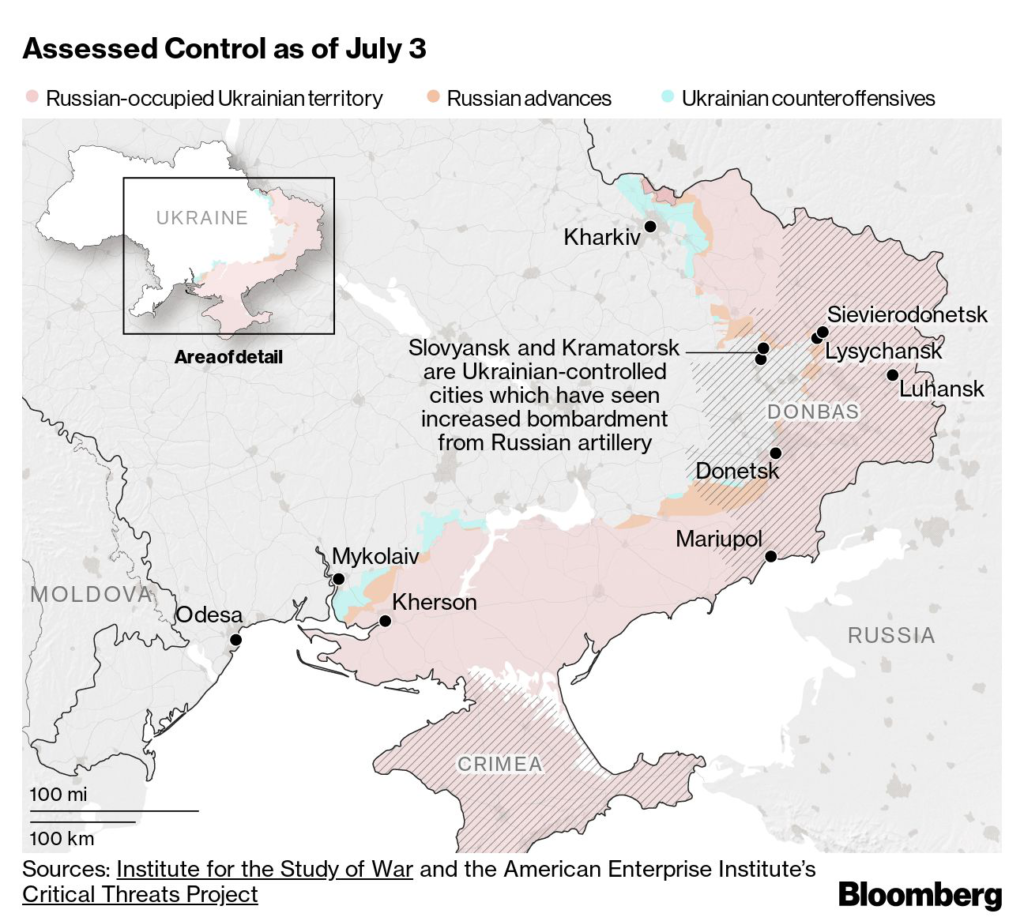
With Lysychansk under its control, Russia is switching its focus farther west into Donetsk, intensifying shelling of the region, according to Ukrainian officials. Fighting continues on the Bakhmut axis, which has emerged as a new flashpoint. Ukrainian forces repelled a Russian assault close to Slovyansk, the Ukrainian General Staff said, with the city’s mayor urging residents to evacuate as the front line moves closer. Russia fired seven missiles further west toward Dnipropetrovsk overnight, six of which were shot down by Ukrainian forces, Valentyn Reznichenko, the head of the regional government, said on his Telegram account.

(All times CET)

Blinken Plans ‘Candid Exchange’ With China’s Wang (1:55 a.m.)

Blinken leaves for Bali on Wednesday to attend the G20 foreign ministers meeting that’s set to be dominated by the fallout from Russia’s invasion. He will have discussions with Chinese counterpart Wang Yi, a top US administration official said. 

“This will be another opportunity, I think, to have a candid exchange on that, and to convey our expectations about what we would expect China to do, and not to do, in the context of Ukraine,” Assistant Secretary of State for East Asian and Pacific Affairs Daniel Kritenbrink told reporters in Washington. 

Nicholas Burns, the US ambassador to China, this week called on Beijing to stop spreading Russia’s “lies,” in an unusually direct and public rebuke. While China has said it doesn’t support the war and urged talks to end the fighting, top officials and state media have repeatedly blamed the US for provoking Russia by allowing the North Atlantic Treaty Organization’s expansion. 

Read more: Blinken Plans ‘Candid Exchange’ With China’s Wang on Ukraine War

Blinken Isn’t Expected to Meet Lavrov at G20 (12:40 a.m.)

Blinken isn’t expected to meet Lavrov at the G20 event, according to State Department spokesman Ned Price. He told reporters “the secretary will be a full and active participant” at the gathering in Indonesia despite Russia’s presence.

The US government is committed to a successful meeting, Price said, but “it cannot be business as usual with Russia.” He predicted that G20 members would “express no shortage of condemnation for the actions on the part of the Russian Federation” in the Ukraine invasion.

Donetsk Regional Governor Urges Locals to Evacuate (9:10 p.m.)

Regional Governor Pavlo Kyrylenko urged people who remain in the eastern Ukrainian towns of Kramatorsk and Slovyansk to evacuate as Russian attacks intensify. Kyrylenko said in a nationally televised address that the Russian army was firing randomly, targeting local residents and seeking to spread panic.

“People get killed every day in Donetsk region since the beginning of the large-scale invasion,” he said. Kyrylenko hopes as many as 350,000 people remaining in Donetsk province will evacuate.

Kaliningrad Governor Hopes EU Is About to Ease Restrictions (7:30 p.m.)

The governor of Kaliningrad said he’s hopeful the European Union may ease limitations this week on the transit of goods to Russia’s Baltic exclave.

“We’re getting signals through various channels that they’re likely to take this decision this week,” Anton Alikhanov told Rossiya 24 state channel, Interfax reported.

Russia has warned that it will retaliate against EU member state Lithuania for blocking rail transport of goods such as steel in accordance with the bloc’s sanctions measures.

Ruble Falls as Investors Rush to Safety of US Dollar (5:49 p.m.)

The Russian currency plummeted the most in four months, pulling back from a rally that’s confounded traders and politicians alike since the early days of President Vladimir Putin’s war on Ukraine. 

The currency dropped as much as 11% to 62.30 per dollar amid broad strength in the greenback that also saw the euro plunge to a two-decade low. The decline follows Russia’s relaxation of capital controls and its canceling a rule forcing the conversion of export revenues to rubles.

Germany Faces Limited Options If Nord Stream Flows Don’t Return (3:55 p.m.)

A key pipeline delivering Russia’s natural gas to Europe may not return to full capacity after planned maintenance this month, Goldman Sachs Group Inc. said, echoing the concerns of German officials.

Nord Stream 1 is set to shut for work on July 11-21, tightening a market that’s seen prices soar in recent weeks. With Moscow having already slashed flows through the pipe to 40% of capacity, any move to withhold supplies for longer would severely hurt Europe’s efforts to refill stockpiles for winter.

“While we initially assumed a full restoration of NS1 flows following its upcoming maintenance event, we no longer see this as the most probable scenario,” Goldman analysts said in a note. 

Bulgaria Seeks Options to Help Process Ukrainian Grain (3:46 p.m.)

Bulgaria’s state-owned Varna port may hold talks with operators of private port terminals to help find storage and process grain loads from Ukraine, the Transport Ministry said.

The ministry is planning to seek financial aid from the European Commission to build additional grain silos, as existing storage capacity at all terminals in Varna is 150,000 tons.

Turkey Renews Threat to Block NATO Expansion (11:32 a.m.)

Turkey is threatening to veto NATO membership for Sweden and Finland, even as the military alliance formally paved the way for the two Nordic countries to join.

Turkey won’t ratify membership in the North Atlantic Treaty Organization for the applicants if they don’t fulfill their promises to combat terrorism and extradite suspects under a memorandum of understanding reached at an alliance summit in Madrid last week, Foreign Minister Mevlut Cavusoglu said Monday. 

“They have to comply with this document. If they don’t then we won’t allow them to join NATO,” Cavusoglu told NTV television. 

UniCredit Mulls a Russia Exit It Can Reverse  (10:38 a.m.)

UniCredit SpA is considering selling its Russian unit through a structure that would let the bank repurchase the subsidiary if the geopolitical situation stabilizes, according to people familiar with the matter.

Italy’s second-largest lender is looking at several possible deal arrangements, including one that would give it the option of buying back the unit depending on market and political conditions, said the people, who asked not be identified because the matter isn’t public.

Romania’s TTS Opens Danube Route for Ukraine Grain (9:33 a.m.)

Transport Trade Services SA, Romania’s largest logistics company on the Danube, has opened a new water-only transport route to help increase grain exports from Ukraine amid a surge global food prices. 

Romania has already facilitated the export of more than 1 million tons of grain from Ukraine since the Russian invasion in February. The new route “ensures a significant increase of the Ukrainian freight flows, eliminating from the supply chain the berths and storage spaces in the Constanta port,” TTS said in an e-mailed statement. The port, on the Black Sea, has been overwhelmed by a jump in traffic. 

Ukraine to Bring Outspoken Berlin Envoy Home: Bild (9:17 a.m.)

Ukraine’s ambassador to Germany, Andriy Melnyk, is poised to return to Kyiv after eight years in Berlin, according to Bild Zeitung, which cited unidentified sources in the Ukrainian capital. Melnyk has been strident in his criticism of Germany and accused Chancellor Olaf Scholz of taking too long to send heavy weaponry to Ukraine. 

13,000 of Musk’s Starlink Internet Devices in Ukraine (8:22 a.m.)

Elon Musk’s satellite Internet service Starlink has been vital in keeping parts of Ukraine affected by the Russian invasion connected, the country’s minister for digital transformation, Mykhailo Fedorov, said in an interview with Bloomberg TV.

More than 13,000 Starlink devices are operating in Ukraine, including on the front line, and government officials are in daily contact with Musk’s representatives, Fedorov said.

Russian Imports Steady After Initial Sanctions Shock (7:56 a.m.)

Russian imports picked up a bit in May, even from some countries that have joined the US and its allies in imposing sanctions over the Kremlin’s invasion of Ukraine, as the economy showed signs of stabilizing.

Trade flows into Russia remain far below pre-invasion levels, but imports for the five major trading partners were down 29% in May on the year, compared with a 43% drop in April. Bloomberg calculated the figures based on reports from those countries, which account for about half of Russian imports. Russia stopped releasing detailed trade data after the invasion.

Turkey, which hasn’t joined the sanctions, saw exports to Russia jump to the highest since December.

Russian Tycoon Agrees to Nornickel-Rusal Merger Talks (7:25 a.m.)

Billionaire Vladimir Potanin, the biggest investor in MMC Norilsk Nickel PJSC, said he’s ready to discuss merging the mining giant with United Co Rusal International PJSC as sanctions against Russia weigh on both companies.

Potanin has headed Nornickel since striking a 2012 shareholder accord with aluminum producer Rusal, the company’s second-largest investor. A merger would create a “national champion,” the tycoon said in an interview with Russia’s RBC TV channel on Tuesday. Rusal shares jumped as much as 12% in Hong Kong.

Russia Wants to Send Zaporizhzhia Grain to Mideast (5:20 a.m.)

Ukraine’s Russian-occupied Zaporizhzhia region has reached agreements to export grain abroad, mainly to Middle Eastern countries, the head of local occupation authorities Yevgeny Balitsky said, according to Tass. 

Among the buyers he named are Iraq and Saudi Arabia, both US allies. One of the largest contracts of 150,000 tons of grain is with Iran.


More stories like this are available on bloomberg.com

©2022 Bloomberg L.P.

TikTok’s US Data Admission Stokes Fresh Concerns With Republican FCC Member

(Bloomberg) — TikTok’s admission that some China-based workers have access to data on US users provided fresh ammunition to a Republican member of the Federal Communications Commission who is trying to get the video-sharing service dropped from major app stores. 

“There is apparently a tremendous amount of information that was flowing back to Beijing,” Commissioner Brendan Carr said on Bloomberg TV Tuesday. “I don’t have a lot of trust left in TikTok.”

TikTok has been questioned by US officials over whether private data on Americans may have been handed over to the authoritarian regime in China. The app, owned by ByteDance Ltd., said in a letter last week that certain China-based employees can access information from US users, but denied information goes to the Chinese Communist Party.

“For two years, we’ve talked openly about our work to limit access to user data across regions, and in our letter to senators last week we were clear about our progress in limiting access even further through our work with Oracle,” a TikTok spokesperson said in a statement. “As we’ve said repeatedly, TikTok has never shared U.S. user data with the Chinese government, nor would we if asked.”

In a June 24 letter, Carr asked Apple Inc. and Google to remove the popular app from their stores. The companies declined to comment. The FCC, where Carr serves as a minority member, doesn’t regulate app stores.

“TikTok certainly isn’t what it appears to be,” Carr said. “It really does operate as a sophisticated surveillance tool.”

The Commerce Department, under an order from President Joe Biden last year, has been looking into TikTok, and that review continues. 

Former President Donald Trump tried to ban the app over what he claimed were security risks. The action was challenged in court and Biden revoked Trump’s ban in June 2021.

In the US, TikTok has been installed 321.6 million times, according to researcher Sensor Tower.

Late Tuesday, two US Senate Intelligence Committee members, Chairman Mark Warner, a Virginia Democrat, and Vice Chairman Marco Rubio, a Florida Republican, called for the Federal Trade Commission to investigate TikTok and its parent.

(Updates with TikTok’s statement from the fourth paragraph)

More stories like this are available on bloomberg.com

©2022 Bloomberg L.P.

‘Minions’ Pulls in Families, Sets July Fourth Box-Office Record

(Bloomberg) — “Minions: The Rise of Gru,” a sequel to the 2015 animated hit from Universal Pictures, smashed expectations and recorded the best-ever box office performance for a film opening near the Fourth of July, showing families are ready to return to movie theaters despite Covid-19.

  • “Minions” set a record for the four-day weekend, generating $123.1 million in domestic ticket sales, Comscore Inc. said Tuesday. That beat the performance of the 2011 film “Transformers: Dark of the Moon,” which made $115.9 million over four days when it premiered close to the US holiday.

Key Insights

  • “Minions: The Rise of Gru,” tells the origin story of Gru, the fictional supervillian voiced by Steve Carell. In this film, he’s an 11-year-old boy plotting to take over the world from his basement. It had a 73% critical approval rating on Rotten Tomatoes, better than the 55% rating of the first “Minions” film. Both movies are spinoffs of Universal’s 2010 film “Despicable Me.”
  • The movie’s performance helped quash concerns that parents worried about Covid-19 aren’t ready to bring their kids back to theaters. Walt Disney Co.’s “Lightyear” did far worse than expected when it debuted in mid-June, and ticket sales have plunged since. It landed in sixth place with $7.6 million over the extended weekend, Comscore said.
  • “Minions” took its place atop the box office from the Warner Bros. biopic “Elvis.” That movie fell to third place and made $22.7 million over four days, Comscore said. “Top Gun: Maverick,” which premiered in May, is still recording strong ticket sales, taking in $32.3 million from Friday to Monday.
  • Disney will likely regain the box office crown next weekend, however. It plans to release the Marvel film “Thor: Love and Thunder,” which could be one of the biggest-selling films of 2022.

Get More

  • See the schedule for upcoming releases.
  • See Boxoffice Pro’s long-range forecast.

More stories like this are available on bloomberg.com

©2022 Bloomberg L.P.
Close Bitnami banner
Bitnami