Bloomberg

Japan’s No. 2 Mobile Carrier Falls After Massive Outage

(Bloomberg) — Japan’s second-largest mobile carrier by subscribers fell in Tokyo trading after a nationwide disruption of its services over the weekend. As many as 39 million mobile lines were affected, preventing users from making calls or using data services, until the network was almost fully restored Monday afternoon.

KDDI Corp., in an unusually large swing for a typically stable stock, dropped as much as 3.9%, its biggest intraday fall since March 30. Shares pared their losses by the close, falling 1.7%, but still trailed the Topix index’s 1.3% gain.

The network disruption began early Saturday and impacted KDDI users nationwide as well as other platforms using the carrier’s network, such as weather services, parcel deliveries and ATMs. Rakuten Mobile, operated by e-commerce company Rakuten Group Inc., said its users were also affected. Voice and data transmission have been almost fully restored as of 4 p.m. local time, KDDI said.

“We deeply regret what happened, as a telecommunications company that should provide a stable service and support social infrastructure,” KDDI President Makoto Takahashi said at a news briefing Sunday, according to local broadcaster NHK. “We’re doing our best on recovery efforts.” 

This isn’t the first time Japan has suffered significant mobile network problems. NTT Docomo Inc. reported an outage in October that disrupted phone and data communications services nationwide. The government told NTT Docomo in November to improve operations following the incident. 

The incident is “very regrettable,” Yasushi Kaneko, minister in charge of Japan’s communications, said at a press conference Sunday. KDDI should take drastic measures to prevent any recurrence, he said. The ministry is considering issuing administrative guidance, the Asahi newspaper reported, without attribution. 

“This will have a negative impact on share prices in the short term,” Mitsubishi UFJ Morgan Stanley analyst Hideaki Tanaka wrote in a report after the KDDI disruption. “But this is a risk that all major carriers have. I don’t think this will cause major changes to the number of subscribers.”

(Updates first and third paragraphs to say service has been almost fully restored.)

More stories like this are available on bloomberg.com

©2022 Bloomberg L.P.

Top Thai Mobile Operator Buys Internet Firm to Expand

(Bloomberg) — Advanced Info Service Pcl, Thailand’s biggest mobile phone operator, plans to expand its network by acquiring Triple T Broadband Pcl and an infrastructure fund for a total of 32.4 billion baht ($908 million).

The Bangkok-based company will buy internet provider Triple T from Jasmine International Pcl for 19.5 billion baht, Chief Financial Officer Tee Seeumpornroj said in an exchange filing. It will also acquire 1.52 billion units, or a 19% stake, in Jasmine Broadband Internet Infrastructure Fund for 12.9 billion baht. At 8.5 baht a unit, that is a 7.6% discount to the fund’s latest unit price of 9.2 baht. 

“This acquisition will enhance consumer access to broader and better quality of service by improving broadband inclusion in new areas targeting the upcountry and non-city areas,” Tee said. “This aligns with our business direction to grow the broadband business and effectively develop the nation’s fiber infrastructure.”

Shares of Advanced Info rose as much as 2.8% Monday, the biggest gain since June 24. Jasmine International, a technology company that is expanding into Bitcoin mining, dropped as much as 7.2%, while Jasmine Broadband slid 7.4% before paring the loss to 3.2%. 

“Advanced Info is the biggest beneficiary from this deal as the acquisition cost is much lower than we previously expected,” said Wasu Mattanapotchanart, an analyst at Maybank Securities (Thailand) Pcl. “The cheap price and additional subscribers will benefit Advanced Info’s operations and outlook significantly. In contrast, Jasmine has a negative outlook from this deal because it is selling almost all of its businesses at a cheap price.”

Advanced Info, whose major shareholders include Singapore Telecommunications Ltd., said it will finance the acquisitions with borrowings, given its “sufficient debt headroom.” The company pledged to maintain a dividend payout of at least 70% of its net income.

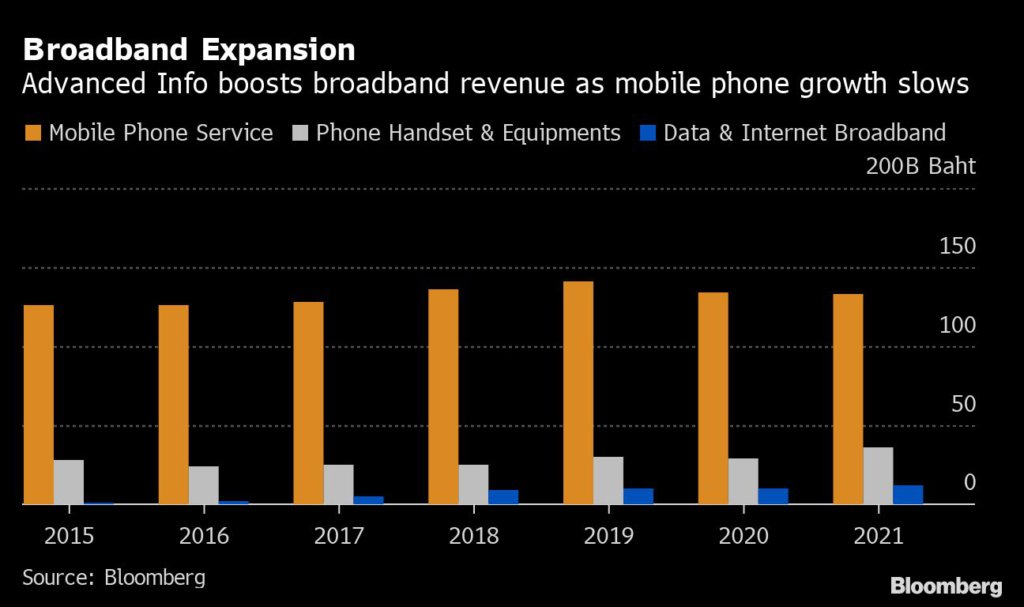
The company entered the broadband business in 2015 to tap rising demand for high-speed internet in Thailand. Its broadband service subscribers rose to 1.87 million as of March 31 from 1.77 million at the end of 2021, the company said in May, while its mobile phone business had 44.6 million customers. 

The move comes as Telenor ASA bids to merge its Thai telecommunications unit with True Corp. and potentially topple Advanced Info as the country’s biggest mobile operator. Advanced Info’s backers include Thai billionaire Sarath Ratanavadi, while True is backed by billionaire Dhanin Chearavanont’s Charoen Pokphand Group and China Mobile Ltd.

Advanced Info will request regulatory approvals before entering a formal contract and expects to complete the acquisitions in the first quarter of 2023, it said in a separate statement.

(Corrects reference to Temasek as a major shareholder in sixth paragraph.)

More stories like this are available on bloomberg.com

©2022 Bloomberg L.P.

Rakuten Seeks Approval to List Finance Unit in Tokyo

(Bloomberg) — Rakuten Group Inc. has applied to list its banking arm on the Tokyo Stock Exchange, as the Japanese online retailer seeks to accelerate an expansion into fintech.

The listing of Rakuten Bank Ltd. should help grow an ecosystem that already encompasses online commerce, payments and a mobile carrier, the parent said in a statement Monday.

Hiroshi Mikitani, the company’s chief executive officer and founder, has been expanding Rakuten’s businesses while facing competition from Amazon.com Inc. in its core e-commerce operation. The US online retailer has invested heavily in Japan as one of its key overseas markets.

More stories like this are available on bloomberg.com

©2022 Bloomberg L.P.

Hackers Claim Theft of Police Info in China’s Largest Data Leak

(Bloomberg) — Unknown hackers claimed to have stolen data on as many as a billion Chinese residents after breaching a Shanghai police database, in what industry experts are calling the largest cybersecurity breach in the country’s history.

The person or group claiming the attack has offered to sell more than 23 terabytes of stolen data from the database, including names, addresses, birthplaces, national IDs, phone numbers and criminal case information, according to an anonymous post on an online cybercrime forum last week. The unidentified hacker was asking for 10 bitcoin, worth around $200,000.

The scale of the alleged leak has sent shockwaves through the Chinese security community, triggering speculation about the credibility of the claim and how it could have taken place. Zhao Changpeng, founder and Chief Executive Officer of cryptocurrency exchange Binance, tweeted on Monday the company had detected the breach of a billion resident records “from one Asian country,” without specifying which, and had since increased verification procedures for potentially affected users.

Shanghai authorities have not publicly responded to the purported hack. Representatives for the city’s police and Cyberspace Administration of China, the country’s internet overseer, did not immediately respond to faxed requests for comment.

Read more: Chinese Firm That Accused NSA of Hacking Has Global Ambitions

The US and other nations have repeatedly identified China as one of the world’s biggest sources of cybercriminals, which they say infiltrate systems on behalf of domestic agencies in search of valuable data or intellectual property.

Domestic breaches are however rarely disclosed because of a lack of transparent reporting mechanisms. In 2016, personal information on dozens of Communist Party officials and industry figures from Jack Ma to Wang Jianlin was said to have been exposed on Twitter, in one of the country’s biggest online leaks of sensitive information at the time. In 2020, the Twitter-like service Weibo Corp. said hackers claimed to have stolen account information for more than 538 million of its users, though sensitive data such as passwords was not leaked. And this year, tens of thousands of seemingly hacked files from China’s remote Xinjiang region provided fresh evidence of the abuse of mostly Muslim ethnic Uyghurs, according to a rights group.

The latest alleged incident again underscored the challenges facing Beijing as it collects data on hundreds of millions of people while tightening policing of sensitive online content. Under Chinese law, the exposure of personal information can result in jail terms.

It’s unclear how the alleged cyberattackers in this month’s breach gained access to Shanghai police servers. One popular theory circulated online among cybersecurity experts was that the breach involved a third-party cloud infrastructure partner. Alibaba Group Holding Ltd., Tencent Holdings Ltd. and Huawei Technologies Co. are among the country’s biggest external cloud services.

More stories like this are available on bloomberg.com

©2022 Bloomberg L.P.

Chinese Beauty App Meitu Slides as Crypto Bets Steepen Losses

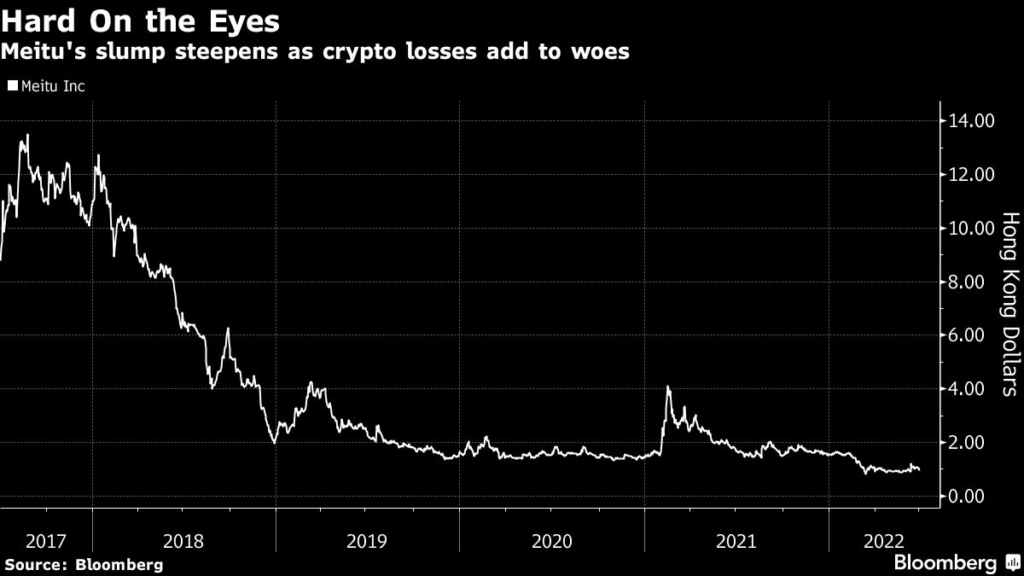
(Bloomberg) — Shares of Meitu Inc. extended their decline into a fourth day after the beauty-app developer disclosed that it expects first-half losses to widen due to soured cryptocurrency bets. 

The Xiamen, Fujian-based firm’s stock tumbled as much as 8.7% in Hong Kong, the most in over two weeks, after saying it expects impairment from Bitcoin and Ether holdings to triple from a year ago. The loss was disclosed in an exchange filing Sunday, and the company is expected to publish first-half results in August. 

The photo touch-up app maker was the first major firm in China to invest in cryptocurrencies, announcing in March 2021 that it made initial trades worth $40 million. Investments in Bitcoin and Ether grew to about $100 million in the following months as the company said that the assets could help diversify its portfolio.

Crypto’s stellar rise in recent years hit an abrupt pause this year after a hawkish Federal Reserve and increased regulatory scrutiny sent prices tumbling. Ethereum’s Ether has plunged over 70% so far this year after surging 400% in 2021, while Bitcoin is down nearly 60%.

Meitu has seen increased competition from firms including ByteDance Ltd. and Xiaomi Corp. in recent years. Total monthly active users for Meitu slipped 12% in 2021, and the firm now trades just over 10% of its debut price. It has yet to turn a profit after its notable initial public offering nearly six years ago. Shares are down nearly 40% this year. 

Losses for the first half are expected to reach as much as 349.9 million yuan ($52 million), compared with the $45.6 million crypto impairment, which the firm cites as the primary reason for the worsening earnings.

More stories like this are available on bloomberg.com

©2022 Bloomberg L.P.

Tether Fails to Calm Jittery Nerves as Short Sellers Circle

(Bloomberg) — Repeated assurances by the backers of Tether, the biggest stablecoin, that the token is backed by ample reserves and working smoothly haven’t been enough to reassure markets. 

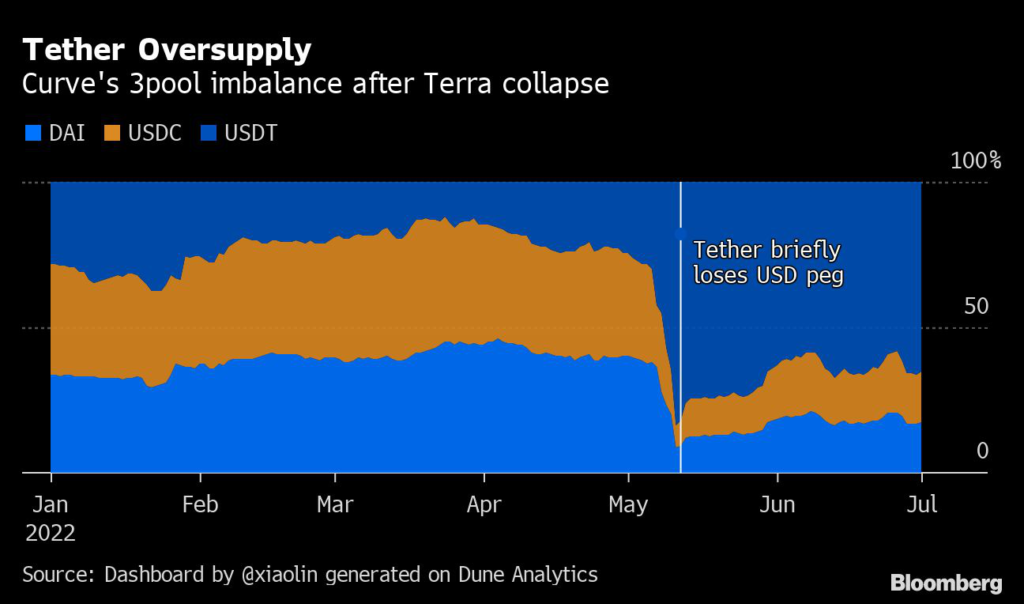
A so-called liquidity pool that allows traders to swap between the three biggest stablecoins still shows an elevated supply of Tether, with the token accounting for 65% of the total as of Friday. That’s an indication that investors remain cautious about holding Tether, said Edul Patel, chief executive of crypto investment platform Mudrex. 

Crypto investors have soured on Tether since the collapse of the TerraUSD stablecoin in early May led to increased scrutiny of the assets it claims to be backed by. Short sellers have boosted bets against Tether in the past month, the Wall Street Journal reported on Monday, citing Leon Marshall, Genesis Global Trading Inc.’s head of institutional sales. 

Tether’s market value dropped by about $600 million this week, bringing declines since just before TerraUSD’s implosion to roughly $17 billion, CoinGecko data show.

“USDT is the most widely held and most accessible stablecoin in the world, so it isn’t a surprise that more people hold USDT and have it available to swap for other assets that they want to use for other purposes,” a Tether spokesperson said in an emailed response to questions from Bloomberg. USDT is the ticker for Tether’s main dollar-based stablecoin. 

On Curve’s 3pool, where traders can swap between Tether, USDC and DAI, Tether’s share of supply stood at 29.9% on May 6, just before TerraUSD started deviating from its peg. That portion jumped as high as 82% on May 12 as the TerraUSD crisis worsened, briefly knocking Tether from its own peg. 

While Tether’s share of supply has since declined, it remains far above pre-TerraUSD crisis levels. And it has reversed some of the decrease after the Journal report.  

The 3pool platform handled about $117 million in trading volume on Friday. 

Holding the Peg

Tether has hewed close to its dollar peg since that brief May decoupling and continues to be widely used despite all the questions swirling around it. Over the weekend, for instance, the cost of buying the token with Argentine pesos surged after the nation’s Economy Minister Martin Guzman resigned.

Tether relies on a reserve of dollars and dollar-equivalent assets to maintain its one-to-one peg with the currency, though the quality of this stockpile has repeatedly been called into question. 

Tether files quarterly attestations from a Cayman Islands accounting firm on its holdings, which show that it’s been steadily decreasing its exposure to assets like commercial paper in favor of more liquid instruments like Treasury bills.

Bloomberg reported in February that Fir Tree Capital Management was making a substantial short wager on Tether, predicting it could pay off within a year. 

Read more: Shorting Tether Renews Debate Around Most Traded Cryptocurrency

Tether Chief Technology Officer Paolo Ardoino has repeatedly taken to Twitter to reassure markets since TerraUSD cratered. In a 12-part tweet this week, just after the Journal story was published, he said Tether has “never failed a redemption” and has cut its commercial paper holdings by roughly $45 billion, adding: “Tether portfolio is stronger than ever.” 

(Updates with more context on Tether’s usage in the ninth paragraph.)

More stories like this are available on bloomberg.com

©2022 Bloomberg L.P.

KKR-Led £15 Billion Bid for UK Power Networks Fails, FT Says

(Bloomberg) — A £15 billion ($18 billion) takeover approach led by KKR & Co. for the UK’s largest electricity distribution business collapsed, the Financial Times reported.

CK Infrastructure Holdings, which jointly owns UK Power Networks Holdings Ltd., tried to increase the sale price before an agreement was due to be signed last month, the newspaper said, citing two people close to the deal who it did not identify. 

The bidder group, which also includes Macquarie Group Ltd., APG, China Investment Corp., Ontario Teachers’ Pension Plan Board and PSP Investments, had been in advanced talks over an agreement, people familiar with the issue told Bloomberg News in March. 

CK Infrastructure, KKR and Macquarie did not immediately respond to emailed requests for comment.

Read more: Macquarie, KKR Near $20 Billion Deal for CKI U.K. Power Unit

UK Power Networks is owned by Hong Kong tycoon Victor Li’s CK Infrastructure and fellow group companies Power Assets Holdings Ltd. and CK Asset Holdings Ltd. The company controls and maintains electricity cables across London and other regions of England, serving about 8.3 million homes. 

(Updates with details throughout.)

More stories like this are available on bloomberg.com

©2022 Bloomberg L.P.

Supersized Outflows From Emerging Asia Have Room to Rise

(Bloomberg) — Some of Asia’s biggest stock and bond markets outside China are seeing greater outflows than in previous market crises, and the process may just be getting underway.

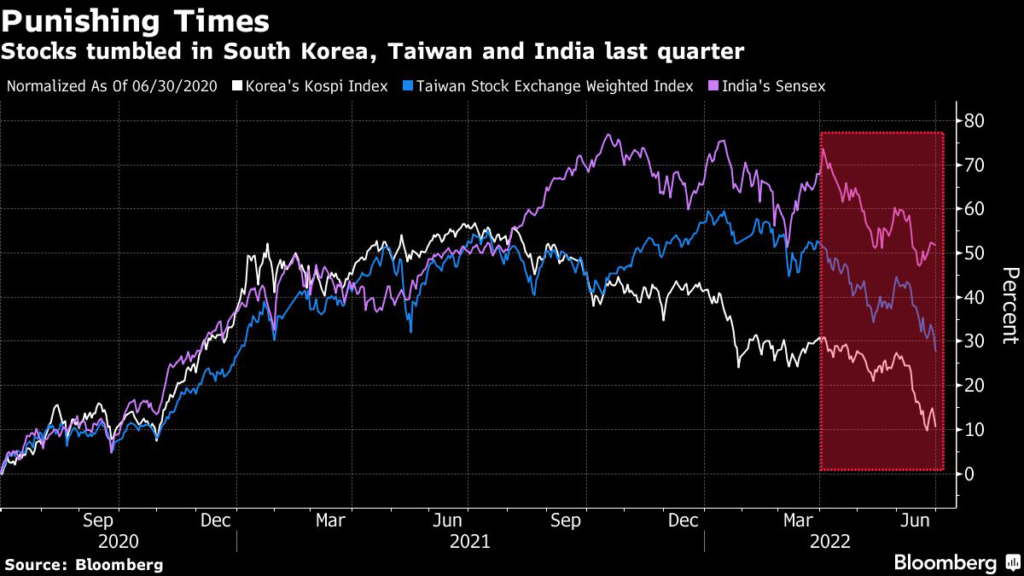
Global funds offloaded a net $40 billion of equities across seven regional markets last quarter, exceeding any three-month period characterized by systemic stresses since 2007. The steepest selling was in tech-heavy Taiwan and South Korea and energy-importing India, while foreign investors also made supersized outflows from Indonesian bonds. 

Money managers are pulling out of higher-risk markets as rampant inflation and aggressive central bank interest-rate hikes sap the outlook for global growth. Fears of a US recession and supply-chain disruptions in Europe and China in a global economy still recovering from Covid-19 lockdowns are providing additional reasons to sell.

“We would expect investors to remain cautious toward export-oriented economies and markets with high valuation under the current backdrop,” said Pruksa Iamthongthong, senior investment director for Asia equities at abrdn plc in Singapore. “We expect the outlook to remain uncertain for the technology sector globally on rising recession risks.”

The total amount of equity outflows for the quarter is an aggregate of those from India, Indonesia, Korea, Malaysia, the Philippines, Taiwan and Thailand. The sum for the past three months was then compared with three previous episodes: the global financial crisis of 2008, the 2013 taper tantrum, and the peak of the Federal Reserve’s last rate-hike cycle in 2018.

Foreigners withdrew a net $17 billion from Taiwan stocks, easily surpassing the outflows seen in any of the three previous periods. Indian shares saw $15 billion of sales, and Korea reported $9.6 billion, also exceeding the earlier periods. 

Hawkish Fed

The Fed’s aggressive tightening, which is pushing up US yields, is expected to keep drawing money away from the region. Swaps are pricing in a further 150 basis points of rate hikes from the US central bank this year.

“The reason foreign investors are selling shares in those markets is not because something has gone wrong in them, instead, it’s because the Federal Reserve and other central banks are tightening their monetary policy,” said Mark Matthews, head of research for Asia Pacific at Bank Julius Baer in Singapore.

One of the main themes thrown up by the data is selling of technology shares, which account for more than half of Taiwan’s equity benchmark and about a third of Korea’s. Tech stocks have slumped around the world this year due to concern over slowing global growth, and their lofty valuations following gains they made during the Covid pandemic.

The weakening yen is also hurting the economy and equities in Taiwan and Korea given the two countries have similar export products to Japan, said Calvin Zhang, a fund manager at Federated Hermes in Pepper Pike, Ohio. This is leading to the fear that they will lose market share, he said.

Indian stocks meanwhile have come under pressure as the economy has suffered from surging oil prices, while the central bank has been rapidly raising interest rates to try and bring inflation under control.

Benchmark stock indexes in Taiwan, Korea and India all fell in intraday trade Monday, extending this year’s declines.

There were bright spots too. Indonesia and Thailand saw inflows into their equity markets last quarter, while outflows in two other near neighbors Malaysia and the Philippines were relatively small. 

Part of that may be down to the more dovish approach of central banks in Southeast Asia, which are seeking to slow-walk increases in borrowing costs as they nurture fragile post-Covid recoveries.

Bond Outflows

Bond markets were more mixed with Indonesia seeing outflows of about $3.1 billion, while Korea and Thailand saw money coming in.

Indonesian debt fell from favor as its high-beta bonds were sold more heavily than its regional peers amid fears of a global recession.

Moderate bond outflows from emerging Asia “should persist in the second half alongside the narrowing trend of Asia-US policy rate differentials and subdued outlook for Asian growth,” said Duncan Tan, a rates strategist at DBS Group Holdings Ltd. in Singapore.

The outlook for dollar-denominated corporate bonds in the region is also challenging given that spreads offered over Treasuries are becoming less attractive compared with their US peers. Yield premiums on investment-grade Asian bonds fell below those of US debt in late June for the first time in more than two years.

“Diminishing relative value versus the US will slow down fund inflows from developed markets or even lead to outflows,” said Joyce Liang, head of Asia Pacific credit research at BofA Securities in Hong Kong. “Risks are to the downside for spreads.”

(Updates to add Monday’s stock performance in 12th paragraph.)

More stories like this are available on bloomberg.com

©2022 Bloomberg L.P.

China’s New Covid Flareup Threatens Crucial Yangtze Delta Region

(Bloomberg) — China is racing to quash a new virus flareup that risks spilling over into one of its most economically significant regions, raising the specter of disruptions that could roil global supply chains for solar panels, medicines and semiconductor chips.

Infections have surged in Si county in the eastern province of Anhui, with officials reporting 287 cases for Sunday and nearly 1,000 since late last week. Authorities locked down Si and a neighboring county late last week to try and stop the virus from spreading to nearby Jiangsu, the second biggest contributor to China’s economic output and a globally important manufacturing hub for the solar sector.

But cases there are already increasing. The city of Wuxi, a biotech hub, reported 35 infections and suspended dine-in services at restaurants and closed entertainment venues. Zhejiang province and Shanghai have also reported Covid-positive patients, fueling concerns about the broader impact across the Yangtze River Delta region that accounts for a quarter of China’s economy.

Read more: Xi Warns Against ‘Herd Immunity,’ Vows to Stick With Covid Zero

The fresh outbreaks will be a major test for President Xi Jinping’s virus strategy. He last week reaffirmed China would stick to Covid Zero — which relies on lockdowns and frequent mass testing to stamp out infections — and said the country would rather endure some temporary impact on economic development than let the virus hurt people’s safety and health. 

China is only starting to show signs of a nascent recovery from its most recent run of outbreaks, including the bruising two-month lockdown of Shanghai that caused massive manufacturing disruptions and snarled global supply chains.

While the epicenter of the latest outbreak is so far only one small county, and authorities haven’t imposed lockdowns in any of the major regional hubs, any escalation in restrictions has the potential to ripple worldwide. 

Read more: From Sneakers to Teslas, China Lockdowns Upend Supply Chains

More than one-third of global solar panel manufacturing capacity is located in Jiangsu province, according to BloombergNEF data, and it’s also the leading producer of solar cells and wafers. The Yangtze River Delta is also a key maker of components for the iPhone and Mac laptops, semiconductor chips, as well as home to drugmakers and e-commerce operations. Some manufacturers still aren’t back to normal after earlier outbreaks.

China reported 380 cases for Sunday, bringing nationwide infections to a level last seen in late May, when Shanghai was on the verge of lifting its lockdown. 

The financial hub, which neighbors Jiangsu, reported three local cases Sunday. One was found outside government quarantine after six days of the city reporting no community infections. Zhao Dandan, a vice director at Shanghai’s municipal health commission, cautioned in a briefing Sunday that the city still faces risks of a rebound in Covid cases. Beijing reported no new cases.

Elsewhere, Ningde city in Fujian province found 10 new Covid cases and implemented control measures. The city is the headquarters of Contemporary Amperex Technology Co., the largest maker of batteries for electric cars.

Macau, which reported its first two Covid deaths of the pandemic Sunday, wouldn’t rule out locking down the entire city if its virus-control measures fail to curb transmission, Secretary for Social Affairs and Culture Ao Ieong U said at a Sunday briefing. The city has announced it will conduct three more rounds of mass testing this week, with 650 workers from mainland China having arrived to provide support. 

In Hong Kong, new Chief Executive John Lee said there is no immediate need for a universal compulsory Covid testing campaign in the city, but stressed a need to reduce daily infections, which have risen to the highest since April.

More stories like this are available on bloomberg.com

©2022 Bloomberg L.P.
Geely Chairman Eyes Phone-Making by Acquiring Meizu Tech

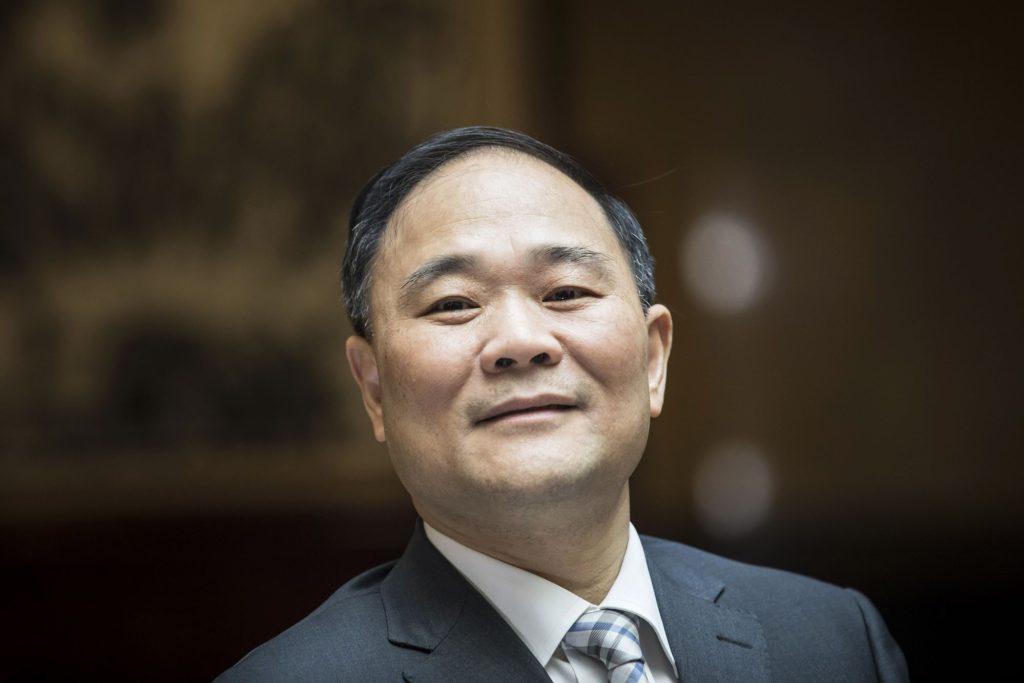
(Bloomberg) — Li Shufu, founder and chairman of carmaker Zhejiang Geely Holding Group Co., is expanding his manufacturing empire to include smartphones and consumer electronics by acquiring a majority of shares in Android device maker Meizu Technology Co.

Founded nearly 20 years ago, Meizu was one of the pioneers of China’s fast-follower cadre of phone makers who built up their market by closely imitating the look and feel of Apple Inc.’s iPhone. Hubei Xingji Shidai Technology Co., a mobile device company founded by Li in 2021, has signed an agreement to acquire 79.09% of Meizu, according to a company statement released by Xingji Technology.

Meizu will continue to operate as an independent brand, while Xingji is developing “a portfolio of next-generation smartphones, mobile devices, and wearable smart devices that will utilise XR technologies.” Extended reality (XR) tech is a broad umbrella term for augmented and virtual reality applications, services and devices.

Under the agreement, the two companies will “collaborate to integrate mobile technologies” and provide users with “bundled cross-platform services,” the statement said.

The main entity under Li’s empire, Geely Automobile, is accelerating its shift toward a more electrified, intelligent, and upscale product portfolio to capitalize on growing demand from Chinese car buyers. It launched a dedicated electric-car brand, Zeekr, in 2021 as a combination of the characteristics of a tech company with Geely’s carmaking expertise, Geely President An Conghui said in an interview with Bloomberg Television last year.

Zeekr is aimed to steal an edge on tech giants like Apple and Xiaomi Corp., which appear poised to start treating cars as a piece of hardware that’s constantly improved with software upgrades, An added. The acquisition of Meizu seems to bring Li’s competition with those leaders in the smartphone space to their market before they have entered his. 

“The ever-increasing integration of consumer electronics into our daily lives is driving demand for interoperability across multiple platforms,” Li said. “Future development will be driven by integrated relationships across multiple devices and platforms that deliver an immersive experience for end users.”

More stories like this are available on bloomberg.com

©2022 Bloomberg L.P.
Close Bitnami banner
Bitnami