

Bloomberg

What It’s Like Trying to Live Waste-Free in China

(Bloomberg) — For the past six years, Yu Yuan has been doing everything she can to live a life that produces no non-degradable waste. She takes her own coffee mug and chopsticks to cafes and restaurants, she buys second-hand clothes and she never orders food deliveries. During the day, she runs a shop in an old Beijing alley that sells housewares. None are single-use plastic and customers don’t get a bag.

“It’s not easy, but it’s not impossible, because every Chinese person used to have a low-carbon lifestyle when the country was less developed,” said Yu, 30. “I will find ways to make it happen.”

China set a goal two years ago to reach peak emissions before 2030 and zero them out by 2060, and one of the 10 key missions of the government’s official roadmap to meet those targets is a “green lifestyle for all people.” Designed to raise people’s awareness of their personal carbon footprints, it encourages the promotion of low-emission products, better labeling and more climate education. In practice, though, it’s not easy for Chinese consumers to make informed choices about what they buy, because the country lags behind places like Europe in requiring and policing product information.

“China should build a legal system to promote green-product certification and make sure the system has strong legal support,” said Wang Jianming, a professor at Zhejiang University of Finance and Economics. 

  • Want to lead a more climate-conscious life? Bloomberg Green wants to answer your questions. Take our brief survey and tell us what you’d like to know.

Take shopping for example. The sector in China has moved online fast, making low-carbon purchases harder. Last year, the online share of retail sales was projected to be more than half the total in the country, up from just 20% in 2016. In the US it’s about 15% and even less in Western Europe. All those delivered goods generated 9.4 million tons of packaging in China in 2018, according to Greenpeace, and the amount could rise by 2025 to 41 million tons, equivalent to Japan’s total annual waste.

Every year, China’s leading e-commerce platforms, including Taobao.com and JD.com, promote their green efforts, exhorting sellers to use more recyclable packaging and less plastic tape. Yet the pace of expansion of the industry is overwhelming and while there’s no penalty for over-packing, sellers risk losing money if poorly protected goods are damaged during transit.

On Meituan and Ele.me, China’s biggest online food ordering platforms, customers now can book a “green order” by opting for no disposable cutlery. Yet even this small concession sometimes fails, with some restaurants just adding the plastic utensils anyway.

Ellery Li, a project advisor at Beijing-based China Youth Climate Action Network, says this is one example of where individual action can bring change.

“It’s a common debate — how much do personal choices really make a difference on climate,” said Li. “Yes, changing grand settings like the energy infrastructure is most important, but individual-level actions and awareness are also a kind of voting that can push companies to change.”

He said since the food-ordering apps added the ability for customers to complain if restaurants put cutlery in green orders, he has noticed more outlets are paying attention.

Unfortunately for environmentally conscious consumers in China, it’s not easy to find information about the carbon footprint of most products. China launched a green product verification system in 2016, but it only covers 19 categories so far. The standards are unclear and oversight is poor, making it hard for customers to check whether the companies’ emissions claims are true.

In a 2021 survey in China, 72% of respondents said they try to buy from environmentally friendly companies, but 41% found the lack of available green options the biggest barrier. Another poll showed that about two thirds of people found it hard to tell if a product is really as low-carbon as companies claim. 

Online markets are making efforts to change. Alibaba’s Tmall.com in April added a green label for some energy-efficient home appliances, providing information on emissions for some air conditioners, washing machines and other products, with the promise to add more. Alibaba, which has promised to cut 1.5 gigatons of emissions by 2035 from its entire supply chain, said digital platforms can play “a pivotal role in transitioning to the low-carbon circular economy.”

But for individuals like Yu, the changes are too slow. She feels her best option is simply to buy less. Her wardrobe now has no more than 50 items. She stopped buying bottled water six years ago. She estimates she produced less than 0.5kg of non-degradable waste in the past six months. 

Yu’s shop, The Bulk House, attracts a mix of customers, from young hipsters to older shoppers who lives as much as an hour away. At the entrance, Yu posted her story together with six hand-written cards that repeat the maxim of Franco-American environmental activist Bea Johnson: “Refuse, Reduce, Reuse, Repair, Recycle, Rot.”

 “There are many temptations for people to buy more, so my lifestyle is a bit like swimming against the tide,” said Yu. “But I am ok with that. Progress can only happen if everyone does a bit.” 

More stories like this are available on bloomberg.com

©2022 Bloomberg L.P.

Trump Social Media Company Receives Grand Jury Subpoena

(Bloomberg) — A federal grand jury is seeking information from Trump Media & Technology Group about its planned merger with Digital World Acquisition Corp., according to a filing from the blank-check firm.

Digital World said that it found out Thursday that the panel in the Southern District of New York had demanded TMTG turn over documents related to the planned combination. The Securities and Exchange Commission issued a subpoena for similar information earlier in the week, the special purpose acquisition company said in a Friday filing. 

The blank-check company said that the grand jury is also seeking information from certain current and former TMTG personnel — adding to the scrutiny facing those involved in the high-profile bid to take the former president’s social-media company public. Digital World said in a filing dated late last week that the firm and its board members had been subpoenaed. 

“TMTG is expanding and enhancing Truth Social, with a major update to the platform scheduled for next week,” Trump Media said in a statement Friday. “TMTG will continue cooperating fully with inquiries into our planned merger and will comply with subpoenas we’ve recently received, none of which were directed at the company’s chairman or CEO.”

Representatives for Digital World didn’t immediately respond to requests for comment.

From the start, the planned tie-up has been a lightning rod. Senator Elizabeth Warren, a Massachusetts Democrat, has called on the SEC to investigate parties to the deal over reports that they may have skirted securities rules by holding undisclosed conversations. 

Digital World said the subpoenas and probes by the SEC and Justice Department “could materially delay, materially impede, or prevent the consummation of the business combination.”

(Updates with Trump Media statement in fourth paragraph.)

More stories like this are available on bloomberg.com

©2022 Bloomberg L.P.
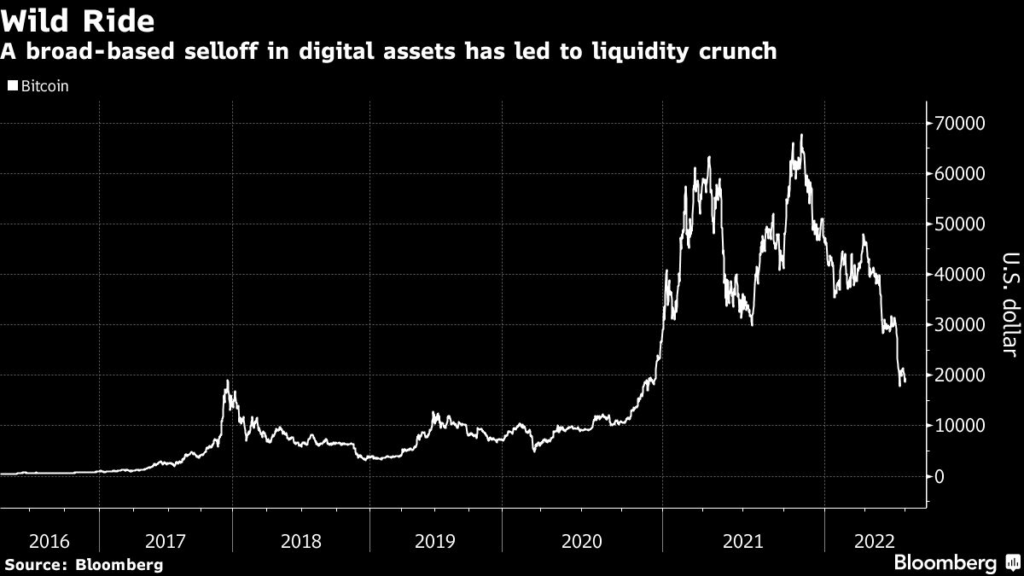
Crypto’s Brutal Week Ends With a Trading Halt and a Bailout

(Bloomberg) — The meltdown in cryptocurrency markets deepened this week, as major players contended with liquidations, withdrawal freezes, trading halts — and, at least in one case, a bailout.    

Crypto broker Voyager Digital Ltd. on Friday announced a suspension of trading, deposits and withdrawals, while BlockFi, a major digital-asset lender, won the backing of exchange FTX US with the potential to be acquired. Both companies were upended by the woes of Three Arrows Capital Ltd., the beleaguered crypto hedge fund that was ordered for liquidation by a British Virgin Islands court this week and filed for Chapter 15 bankruptcy protection in New York. 

Meanwhile, crypto markets slumped, adding to a decline that has wiped away some $2 trillion of market value and left market participants uneasy heading into the long Fourth of July weekend.

“I had begun to think that dominoes had stopped falling in mid-June,” said Aaron Brown, a crypto investor and Bloomberg Opinion contributor. “I suspect by Tuesday morning there will be more bad news, although I make no specific predictions.” 

Much of the industry’s recent liquidity issues stem from the troubles at Three Arrows, which suffered from large losses after making big bullish bets on everything from Bitcoin to Luna, part of the Terra ecosystem whose implosion in May sparked a major market spasm. Founded in 2012 by Zhu Su and Kyle Davies, former Credit Suisse traders, Three Arrows has become emblematic of the industry’s excesses during last year’s bull run, when it built up leverage that proved destructive when the market turned.  

The fuller extent of their impact on the industry is starting to emerge: Blockchain.com and Deribit, a crypto derivatives exchange, this week confirmed that they are among creditors that sought for the liquidation of Three Arrows. A spokesperson with Blockchain.com said it is also cooperating with ongoing investigations into activities by Three Arrows, which has been reprimanded by Singapore’s central bank over false information. 

“Crypto is a nascent industry, but intense competition developed amongst service providers vying for the business of a small set of entirely new counterparties,” said Alex Felix, Managing Partner at CoinFund. 

Kyle Samani, co-founder and managing partner at Multicoin Capital, said there is a need for appropriate regulations and transparency, and that an industry coalition should come together to protect retail customers.

Voyager’s chief executive officer Stephen Ehrlich said it needs additional time to explore strategic alternatives, something that Celsius Network, which has also halted withdrawals, has also been pursuing. Sam Bankman-Fried, who has acted as a lender of last resort for the industry, earlier turned down a bailout request by Celsius, according to a person familiar with the matter.

“This was a tremendously difficult decision, but we believe it is the right one given current market conditions,” said Ehrlich in a statement. 

Voyager plunged as much as 43% in US trading following Friday’s news, making it one of the worst-performing crypto stocks. Based in New York, Voyager offers crypto trading, staking — a way of earning rewards for holding certain cryptocurrencies — and yield products.

Last month, Voyager issued a notice of default to Three Arrows on a loan worth roughly $675 million. It’s actively pursuing recovery from the crypto hedge fund, including through the court-ordered liquidation process in the British Virgin Islands. It has received a credit line from Alameda Research, Bankman-Fried’s trading firm.

Bankman-Fried, for his part, is already eyeing more acquisitions as he solidifies his outsize influence in the industry. The battled crypto-mining industry might be his next target, he said. 

(Adds commentary throughout)

More stories like this are available on bloomberg.com

©2022 Bloomberg L.P.

Startups to Face ‘Hard Times’ After Market’s Plunge, Gao Says

(Bloomberg) — Investors should brace for a historic drop in the stock market to start filtering through to startups over the next few quarters, said Sapphire Ventures partner Cathy Gao.

“We are going to be in for some hard times ahead — I don’t know if it’s going to be one quarter, two quarters, three quarters or more,” Gao said in an interview Friday with Bloomberg Television. “My message to everyone is this is an opportunity to look inwards, get your house in shape and be ready for the future.”

The S&P 500 posted its worst first half in 52 years, driven by high inflation and growing recession fears. Private-market firms were spared the pain of the rout, but that’s about to change starting with “very late-stage companies,” Gao said, citing the fintech business Klarna Bank AB and Instacart Inc., a grocery-delivery startup, as examples.

After that, the affected businesses will range from second-funding-round startups to ones preparing for an initial public offering, she said. Those are the types of companies that Gao specializes in.

Sapphire, whose investments have included Fitbit and 23andMe, has more than $10 billion under management. 

“My stage is a little bit frozen right now because, on one hand, a lot of companies raised a lot of money in 2021 — they might have 30 months of runway,” Gao said. “On the other hand, investors don’t know where the valuation is going to settle quite just yet.” 

There’s an opportunity for companies to reassess “what they are actually worth and prepare themselves for future rounds they may have to raise,” she said.

More stories like this are available on bloomberg.com

©2022 Bloomberg L.P.

Google to Delete User Data on Trips to Abortion Clinics

(Bloomberg) — Alphabet Inc.’s Google said it will automatically delete records of user visits to sensitive locations, including abortion clinics, responding to growing concerns that the data could be used to prosecute those seeking reproductive care and other personal services.

The internet search and advertising leader said the Location History feature on its services is turned off by default, but even if active, the company’s policy starting in the coming weeks will be to rapidly delete records of visits to places that many people would prefer to keep private.

“Some of the places people visit — including medical facilities like counseling centers, domestic violence shelters, abortion clinics, fertility centers, addiction treatment facilities, weight loss clinics, cosmetic surgery clinics, and others — can be particularly personal,” Google said in a post Friday on its website. “If our systems identify that someone has visited one of these places, we will delete these entries from Location History soon after they visit.”

Google also said it will roll out updates that enable users of its Fitbit wearable devices who track their periods in the app to delete multiple logs at once.

Though Google made no explicit reference to it, the policy change is a clear response to last week’s US Supreme Court ruling overturning Roe v. Wade, a decision that is expected to lead to abortion becoming illegal in about half of the nation’s states. Legal and privacy experts widely anticipate that the criminalization of seeking, obtaining or aiding in abortion care will lead law enforcement and courts to demand search, location, email and cloud data from Google and other technology giants. The biggest companies have so far declined to detail how they will handle those requests.

Google declined to comment further than what’s in the blog post, though the company sought to underscore its policy of fighting government requests that it deems improper.

“We remain committed to protecting our users against improper government demands for data, and we will continue to oppose demands that are overly broad or otherwise legally objectionable,” the company said. 

(Updates with details on Roe v. Wade ruling in fifth paragraph.)

More stories like this are available on bloomberg.com

©2022 Bloomberg L.P.

Crypto Hedge Fund Three Arrows Files For Chapter 15 Bankruptcy

(Bloomberg) — Crypto hedge fund Three Arrows Capital has filed for Chapter 15 bankruptcy, a move that protects its US assets while a liquidation is carried out in the British Virgin Islands.

Representatives for Three Arrows filed the bankruptcy petition in New York on Friday, court papers show. Chapter 15 bankruptcy filings stop creditors from seizing a company’s assets in the US. 

A British Virgin Islands court ordered the liquidation of Three Arrows Capital earlier this week. The fund, founded by former Credit Suisse traders Zhu Su and Kyle Davies, managed an estimated $10 billion of assets as recently as March, according to blockchain analytics firm Nansen.

The law firm Latham & Watkins is representing Three Arrows in the US bankruptcy. 

The case is Three Arrows Capital Ltd and Russell Crumpler, 22-10920, U.S. Bankruptcy Court for the Southern District of New York (Manhattan).

More stories like this are available on bloomberg.com

©2022 Bloomberg L.P.
Tesla Braces for Delivery Slump on China Plant Shutdown

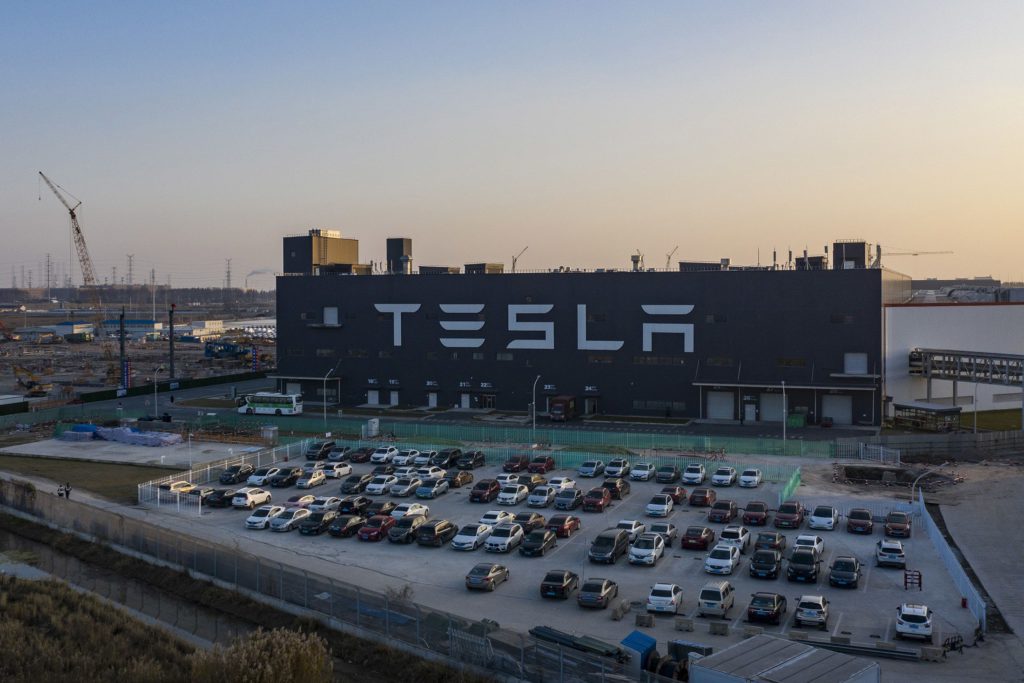
(Bloomberg) — Tesla Inc. is expected to announce quarterly production and delivery figures this weekend that will likely be among the worst of the year — and break its multi-quarter streak of record-setting results — due largely to an extended shutdown of its factory in Shanghai. 

The electric vehicle maker may have delivered more than 261,000 vehicles globally during the three months ended in June, according to 9 analysts surveyed by Bloomberg, ending a two-year stretch of consecutive quarterly gains. Tesla handed over more than 310,000 vehicles in the first three months of the year, more than any previous quarter.

“We cut our second-quarter deliveries estimate by 65,000 to 245,000 units, reflecting a prolonged Covid 19-related shutdown and logistical challenges in the Shanghai factory,” wrote Emmanuel Rosner of Deutsche Bank in a research note to clients. “Recall that during the first-quarter call, CEO Elon Musk had provided directional guidance of sequentially flat deliveries for the quarter but the situation in China worsened subsequently, only improving in early June.”

Shares of Tesla rose 1.2% to close trading Friday at $681.79, but the stock is down about 35% so far this year. 

Read more: Tesla’s $350 Billion First-Half Wipeout Opens Door for the Brave

Deliveries are one of the most closely watched metrics at Tesla. They underpin the Austin, Texas-based company’s financial results and are widely seen as a broad barometer of consumer demand for EVs amid a wider shift away from the internal combustion engine. Many large automakers will announce US sales results Friday but Tesla, which reports global totals, hasn’t specified a release date. 

Dan Levy, an analyst with Credit Suisse, reduced his delivery estimate for the period to 242,000 units. “In aggregate, we believe the Shanghai shutdown accounted for about 90,000 units of lost production in the second quarter,” Levy wrote in a note to clients.

Tesla makes the Model S, X, 3 and Y vehicles at its plant in Fremont, California. It also produces Models 3 and Y at a factory near Shanghai. The company has begun delivering the first Model Ys from its new plant near Berlin and held a “Cyber Rodeo” event for 15,000 people in April to celebrate a new factory in Austin.

‘Money Furnaces’

However, both Berlin and Austin have been slow to ramp up production, with Musk warning in a late May interview that both plants are “gigantic money furnaces.”

Analysts and investors are also worried that the price hikes automakers are imposing to combat soaring raw material costs will weigh on demand. Tesla had boosted its sticker prices by as much as $6,000 a car earlier this month, according to Electrek.

A stronger-than-expected delivery number could provide a boost to Tesla’s stock, which is down more than 35% this year amid wider market concerns about rising energy costs, inflation and a potential recession. Musk shares many of those concerns and is in the process of laying off 10% of Tesla’s salaried work force while pushing others to return to the office. 

Earlier this week, Tesla laid off roughly 200 people on its Autopilot team, mostly hourly employees who worked as data annotation specialists. 

(Updates Bloomberg estimate in second paragraph.)

More stories like this are available on bloomberg.com

©2022 Bloomberg L.P.
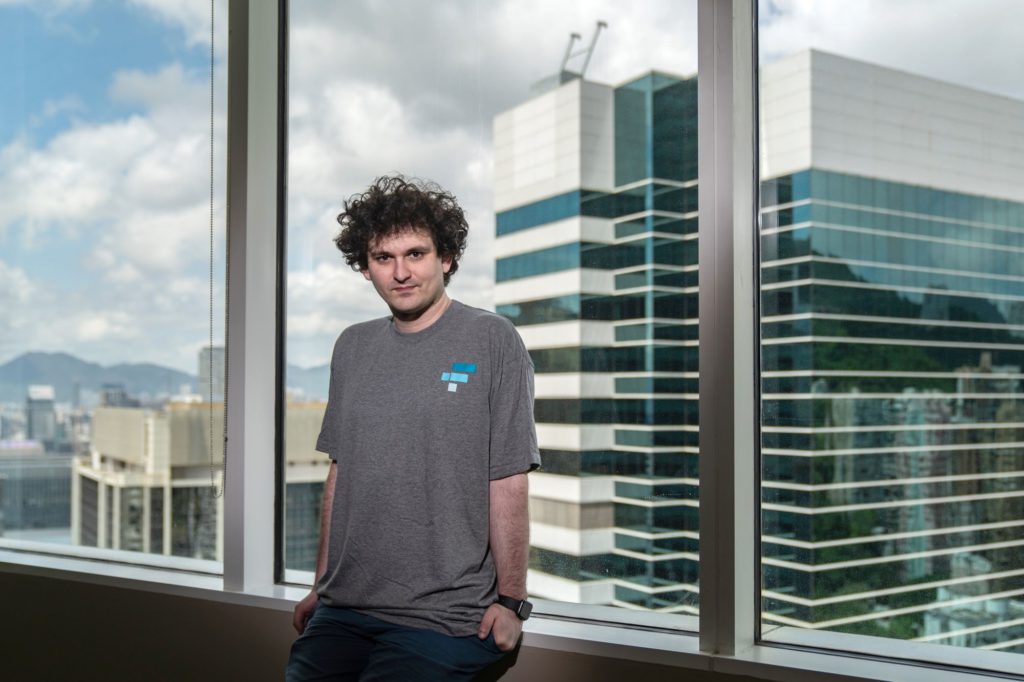
Crypto Billionaire Sam Bankman-Fried Inks BlockFi Deal, Eyes Distressed Miners Next

(Bloomberg) — Sam Bankman-Fried, the co-founder of crypto exchange FTX US who just signed a deal with BlockFi Inc., said he’s open to exploring acquisitions in the battered crypto-mining industry next. 

The move comes at a time when Bitcoin-mining companies are facing growing distress. The crypto billionaire is considering acquiring troubled crypto firms to stem potential credit contagion amid the prolonged bear market.  

“When we think about the mining industry, they do play a little bit of role in the possible contagion spread, to the extent that there are miners that were collateralizing borrows with their mining rigs,” Bankman-Fried said Friday in an interview. “There might come along a really compelling opportunity for us — I definitely don’t want to discount that possibility.”

Bankman-Fried has acted as a lender of last resort during the recent crypto meltdown, with his trading firm, Alameda Research, providing credit lines to Voyager Digital Ltd. He stopped short when it came to Celsius Network, turning down a bailout request by the lender, according to a person familiar with the matter who asked not to be identified because the information is private.

While crypto mining wouldn’t fit into FTX’s core strategy, Bankman-Fried has been looking into whether there are “underwater miners” that could have some balance-sheet impact on crypto-lending firms, he said. On Friday, his exchange signed an agreement to inject capital into BlockFi with an option to purchase the crypto lender for as much as $240 million.

The bear market has made it difficult for crypto miners to raise capital and pay down debt stemming from their aggressive expansion over the last two years. As much as $4 billion of loans backed by crypto-mining equipment are coming under distress as some of the most-popular machines’ value has dropped by about 50% since last November, when crypto markets peaked.  

As a result, merger-and-acquisition opportunities could arise. Marathon Digital Holdings Inc. Chief Executive officer Fred Thiel said in April that his company was open to the possibility of a sale at the right price. 

Shares of top mining companies have dropped by more than 75% this year along with the decline in Bitcoin’s price. High energy costs and limited infrastructure capacity have also contributed to the price slump in the mining stocks.

More stories like this are available on bloomberg.com

©2022 Bloomberg L.P.
Chipmakers’ Struggles Have Wall Street Worried About a Recession

(Bloomberg) — Semiconductor stocks took a beating Friday after a grim profit warning from Micron Technology Inc. sparked fresh worries about Corporate America’s earnings power with the US potentially heading for a recession. 

Despite the broader stock market rally, the Philadelphia Stock Exchange Semiconductor Index dropped 3.8% after Micron, the largest maker of memory semiconductors in the US, flagged that demand was cooling for chips used in computers and smartphones. The index — which is home to chip giants Advanced Micro Devices Inc. and Nvidia Corp., as well as Micron — is down 38% in 2022.

Read: Micron’s Warning on Cooling Demand Weighs on Global Chip Stocks

Historically, semiconductor stocks have been a key barometer for the broader stock market and economy. Chips are used in a broad range of industries that are important for growth: appliances, data centers, gaming and artificial intelligence. If conditions are weak for chips, it raises questions about demand in other corners of the economy, which is a troubling harbinger for the stock market, according to Matt Maley, senior strategist at Miller Tabak + Co. 

“We had nowhere near enough chips, and now the demand is falling,” Maley said. “What signal does it send? It highlights a growing concern that the slowdown we’re going through will turn into a recession.”

The global semiconductor shortage, driven by factors on the demand and supply sides of the economy, has eased somewhat, but there is still limited production for certain chips used in cars and home appliances. Troubling reports from semiconductor companies ahead of their second-quarter earnings are spurring fears that demand will exceed supply for even longer. 

“What this weakness indicates is that the economy is slowing, and there’s potential for a recession,” said Tim Ghriskey, senior portfolio strategist at Ingalls & Snyder. “Semis are a red flag because they’re really in everything. They’re so integral to everything that’s sold today. They’re the most rudimentary equipment, so this is a major negative for the economy.”

Worst Over?

Even so, signs are emerging that companies may be able to combat ongoing supply-chain woes. On Friday, General Motors Co. said it expects second-quarter sales and profit to take a hit due to chip-supply snags, but the company reinforced that it can make up for delayed production later this year and reaffirmed its full-year earnings guidance. With shares of the automaker jumping as much as 3.5% on Friday, it may signal that the worst is over for semiconductor producers. 

Read: GM Sees Profit Dipping on Inventory Woes, Reaffirms Outlook 

In fact, stock market valuations for chip stocks like Micron appear “incredibly cheap,” according to Siddharth Singhai, chief investment officer of IronHold Capital, a value-based hedge fund.

“Things are getting sold irrationally due to passive investing and the fact that rates are high and inflation is high,” Singhai said. “It’s all driven by fear rather than a real understanding of fundamentals.”

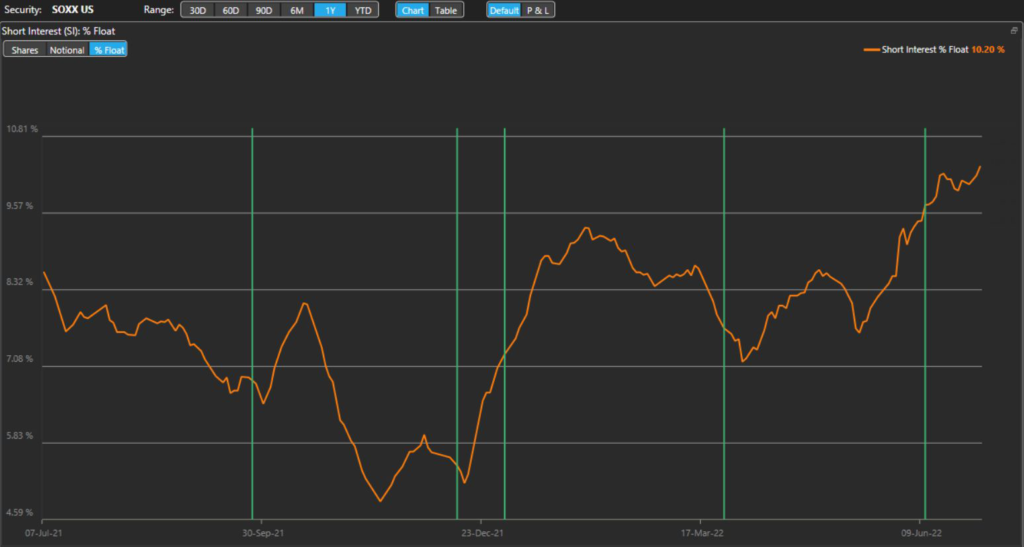
That said, betting against chipmakers was a winning bet last quarter as the market weakened and stocks tanked. And bears are raising their bets that the rout has further to go. Short interest in the $6.2 billion iShares Semiconductor exchange-traded fund, ticker SOXX, jumped to 10% of the free float in late June, the highest level since December 2020, data compiled by S3 Partners show. The ETF is down around 4% on Friday and has lost 38% this year.

So looking ahead, the risk for chipmakers and the rest of Corporate America remains a recession in the US. 

“Supply will start to come back at some point,” Ghriskey said. “But if the economy is weak, there will be a follow-on demand issue, so investors and companies could get hit twice.”

(Updates index prices through Friday’s close)

More stories like this are available on bloomberg.com

©2022 Bloomberg L.P.
Wave of SPAC Deals Canceled in Latest Blow to Stumbling Industry

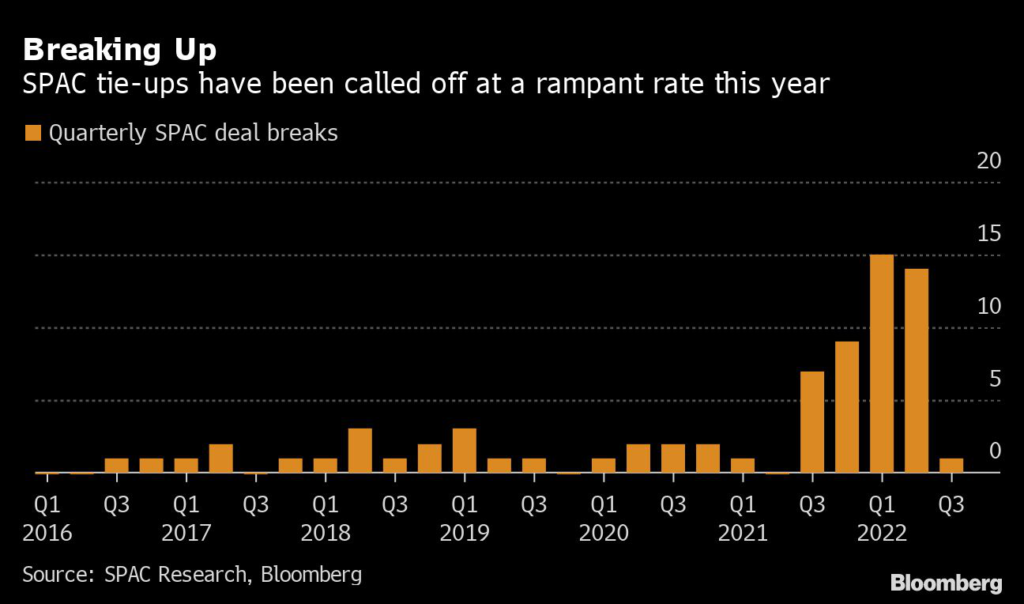
(Bloomberg) — A flurry of blank check mergers were called off over the past 24 hours as target firms and SPAC sponsors deal with market turmoil that has shaken the industry and capital markets.

At least four special-purpose acquisition company tie-ups have been called off since the end of Thursday’s trading, bringing the year’s total to 30 breakups. The malaise is expected to keep Panera Brands, the owner of Panera Bread and Einstein Bros. Bagels, and online brokerage eToro private.

With just over half the year gone, SPACs and the companies that went public by merging with them have fizzled amid one of the stock market’s worst routs in decades that has been particularly cruel to riskier stocks. The De-SPAC Index, a basket of companies that completed their tie-ups, has crashed 67% and more than 700 SPACs are either on the hunt for deals or racing the clock to close ahead of deadlines.

Panera’s canceled deal leaves restaurateur Danny Meyer’s USHG Acquisition Corp. with about eight months to find and close a merger before a deadline. The broken deal between Betsy Cohen’s FinTech Acquisition Corp. V and eToro, according to the Information, would give the SPAC until December to merge with a partner and mark the second canned SPAC tie-up for one of the industry’s most well-known sponsors.

SPACs are known as blank checks because they raise money through a public offering with the goal of buying a private business. They have limited time to complete a deal, typically about two years. If they don’t meet that deadline, the company must return the cash to shareholders, though they can buy a short extension by giving holders more cash.

Industry uncertainty and a backlog of deal-needy SPACs have driven at least eight sponsors to close shop and return cash to investors this year. The glut of teams on the hunt and unpredictability hanging over the equity markets have pushed dealmakers to withdraw and quietly abandon planned SPACs that would have raised roughly $30 billion so far this year, according to data compiled by Bloomberg.

(Updates share performance in third paragraph.)

More stories like this are available on bloomberg.com

©2022 Bloomberg L.P.

Close Bitnami banner
Bitnami
