
Bloomberg

Semiconductor Funding Bill Is Likely to Survive McConnell Threat

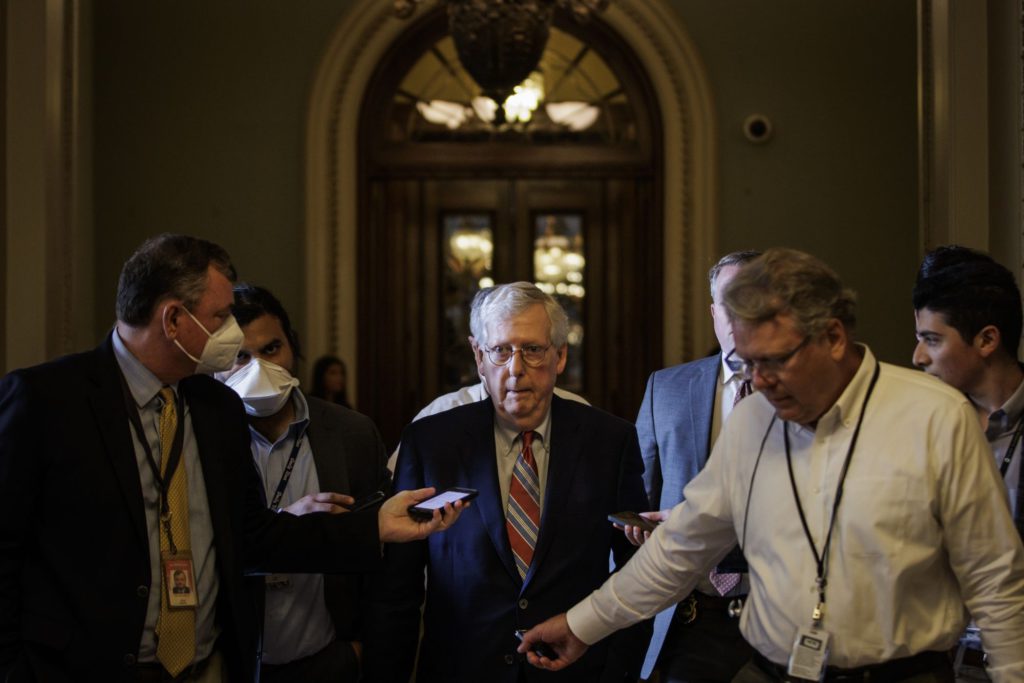
(Bloomberg) — A $52 billion package of incentives and subsidies to bolster US semiconductor manufacturing is far from dead, despite Senate Republican leader Mitch McConnell’s threat to scuttle the legislation containing it in order to stall passage of President Joe Biden’s economic plan.

Democrats have multiple paths to get the chips money, which has broad bipartisan support, through Congress.

McConnell stunned Democrats on Thursday by tweeting he would stand in the way of the wider China competition legislation of which the semiconductor provision is a part so long as Democrats plan to use the partisan budget process to ram through a separate package of tax increases on the wealthy and corporations, incentives for green energy, and prescription drug price limits.

While the ploy is aimed at stopping the budget package, it comes as Republicans have also been pushing Democrats to abandon plans to add big-ticket spending items to the China bill, which has been the subject of closed door talks for months.

Commerce Secretary Gina Raimondo, in an interview with the Washington Post, called McConnell’s threat a mere “bump in the road” designed to increase his leverage in negotiations.

“The only entity in the world that benefits from this bill not passing is China,” she said in the interview.

Supply Chains

Enactment of the semiconductor incentives is a top priority for the Biden administration as well as manufacturers such as Intel Corp. and companies that are heavy users of chips.  While the global semiconductor shortage has eased somewhat, there is still limited production for certain chips used in cars and home appliances. The wrangling over the bill comes as semiconductor stocks took a beating, driven by concerns arose about demand cooling for chips as the US economy faces recession fears.

McConnell made his threat as Senate Majority Leader Charles Schumer and Senator Joe Manchin of West Virginia, a key Democratic vote, were nearing a deal on the specifics of a $1 trillion budget and tax package. Republicans have largely rallied behind their Senate leader, including those who supported the competition and chips bill.

The McConnell move is not without political and procedural risks. Democrats, including House Speaker Nancy Pelosi’s spokesman Henry Connelly, attempted to frame the effort as being soft on China while standing in the way of prescription drug cuts. That message could blunt efforts of Republicans to present themselves in the midterms as both tough on Beijing and fighting to lower spiraling costs. 

Democrats could ignore McConnell’s threats, pass their economic package with a simple majority in August and then hold a potentially painful vote on a completed China bill just before the elections to hammer the issue home. 

At that point, with no chance to stall the economic plan, some Senate Republicans could peel off and vote for the bill. Eighteen Republicans, including McConnell, voted for the legislation when it passed the Senate in March.

In a second scenario, if Schumer and Manchin’s talks fall apart as Build Back Better talks did in December, then all sides simply let the China bill move forward. 

Given this real possibility, Republican and Democratic staff are continuing to work on the details of the House and Senate China bills to try to make progress on a unified bill that could pass both chambers. 

The biggest differences remaining on the competition bill revolve around trade policy, according to people familiar with the situation. Democrats are trying to add payments to workers displaced by trade deals under a program called Trade Adjustment Assistance.

There is also controversy over restrictions on investments by Americans and American companies in China, and a research and development tax provision. Democrats are widely seen walking away from an attempt to add immigration visa expansion and climate provisions to the bill after earlier dropping a marijuana banking provision. 

In a third scenario, Democrats can under Senate rules add the $52 billion chips bill to the budget bill if Schumer and Manchin agree to do so. Other aspects of the China legislation can be tweaked from so-called authorizations to appropriations to make them comply with Senate budget rules.   

Provisions related to Taiwan policy, outward-bound US investment, research security and federal procurement may not be allowed in the budget package, however. 

Finally, Democrats have a Senate-passed version of the China bill sitting in the House. They could simply pass it and send it to Biden without adding more spending.

McConnell Tactics

McConnell’s gambit of holding a bipartisan China competition package hostage while Democrats try and jam through a scaled-back economic plan isn’t the first time he’s used the lure of a bipartisan deal as leverage to try and slow or kill Biden’s larger agenda.

A year ago, McConnell insisted that Democrats separate the bipartisan infrastructure plan from the larger Democratic “Build Back Better” effort. 

That increased tensions and confusion in the Democratic caucus. House liberals eventually caved on their insistence of simultaneously passing the infrastructure package alongside a massive Democratic plan, while negotiations with Manchin dragged on. Ultimately Democratic divisions, rather than any McConnell ploy, led to the collapse of the $2.2 trillion Build Back Better plan, but McConnell exacerbated Democratic infighting. 

More stories like this are available on bloomberg.com

©2022 Bloomberg L.P.
FTX US Signs Option to Buy BlockFi in Crypto Sector Shakeup

(Bloomberg) — FTX US, the crypto exchange co-founded by billionaire Sam Bankman-Fried, signed an agreement to inject capital into BlockFi Inc. with an option to purchase the crypto lender, a transaction born out of a market selloff that may spur further industry consolidation. 

The deal includes a $400 million revolving credit facility, which is subordinate to all client funds, BlockFi said. It also gives FTX US an option to buy BlockFi for as much as $240 million, based on performance triggers. Together with other potential consideration, the deal represents a total value of as much as $680 million, Jersey City, New Jersey-based BlockFi said in an emailed statement Friday.  

“I think there are synergies between the businesses,” Bankman-Fried said when asked about the deal talks in an interview with Bloomberg News prior to the BlockFi announcement. “There are a lot of ways that our products can work together and can mesh together in a way that’s better than either would be independently.” BlockFi has a loyal customer base, a real business model and strong leadership, he added, while FTX has been focusing on back-end efforts such as matching engines. 

The deal represents a discount to BlockFi’s $3 billion valuation as of March 2021. In early June, it sought to raise money at a reduced valuation of about $1 billion. Crypto lenders are hard hit by the recent wave of liquidations sparked in part by the May collapse of the Terra stablecoin and more recent troubles at Three Arrows Capital Ltd. Celsius Network and Babel Finance both froze withdrawals in recent weeks, and on Friday Voyager Digital Ltd. joined them in doing the same.

BlockFi Cheif Executive Officer Zac Prince said the company had about $80 million in losses from bad debt of Three Arrows. 

“We have no further exposure and the limited losses we did experience will be absorbed by BlockFi with no impact to client funds,” Prince said in a tweet Friday. The losses will be part of Three Arrows’ ongoing bankruptcy case, he added. 

The deal solidifies Bankman-Fried’s outsize influence in the industry. He has acted as a lender of last resort during the recent markets meltdown, with his trading firm, Alameda Research, providing credit lines to Voyager Digital. He stopped short when it came to Celsius, turning down a bailout request by the lender, according to a person familiar with the matter who declined to be named because the issue was private. Celsius said June 30 it continues to explore options, including strategic transactions and a restructuring of its debt.

Buying BlockFi will give FTX another foothold to expand in the US market. FTX US, the American entity of FTX, recently launched equities trading, an attempt to capture a broader group of retail investors. FTX is also exploring whether it might be able to acquire Robinhood Markets Inc., in which Bankman-Fried already bought a 7.6% stake, Bloomberg News has reported. Bankman-Fried said there’s no active M&A conversations with Robinhood.

“This is a reputable enough brand that if you think you could fix by coming in and stepping in and helping out,” Chris McCann, partner at Race Capital, an investor in FTX, said.“It’s an incredible deal.”

(Adds context, quotes.)

More stories like this are available on bloomberg.com

©2022 Bloomberg L.P.
Car Sales in the US Slow on Rising Sticker Prices and Scant Supplies

(Bloomberg) — US auto sales slumped in the second quarter as chip shortages continued to choke car supplies and rising sticker prices put new vehicles out of reach for a wider swath of prospective buyers. 

The declines affected most automakers, including General Motors Co., but were steepest among Asian brands such as Honda Motor Co. and Nissan Motor Co. 

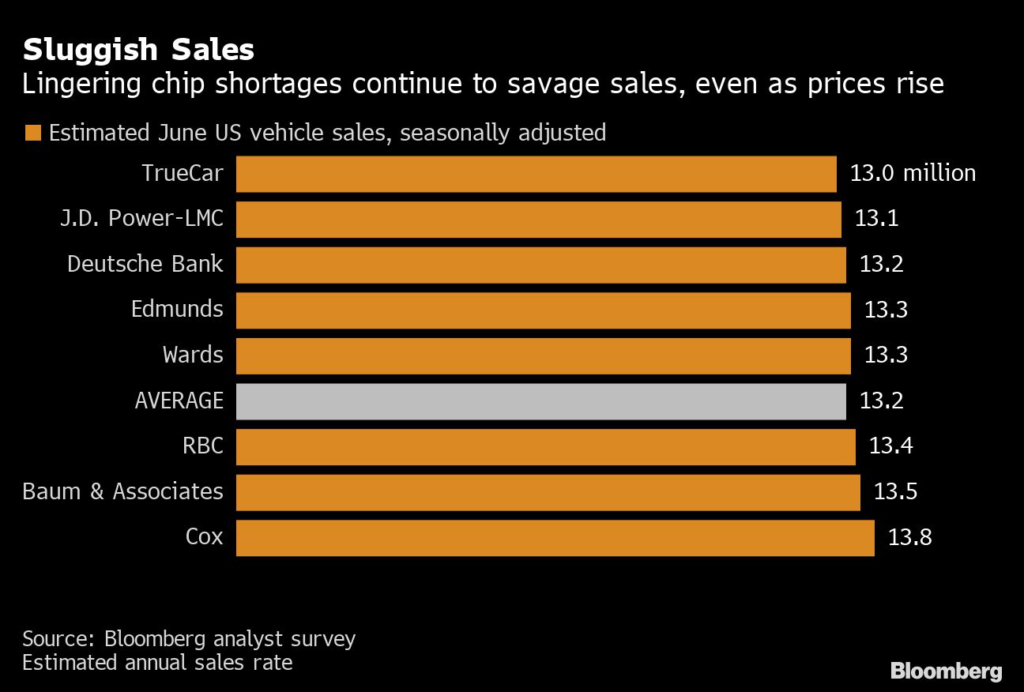
Some carmakers are optimistic a global chip shortage is easing while others doubt the crisis will abate anytime soon. The supply-chain stress points to the lowest production levels in a decade, with the annualized selling rate slipping to 13.2 million in June, according to the average forecast of six market researchers surveyed by Bloomberg. Prior to the pandemic, annual US auto sales topped 17 million vehicles for five consecutive years from 2015 to 2019.

General Motors said Friday second-quarter sales and profit will take a hit from 95,000 vehicles it can’t sell because it’s waiting on chips to complete them.

Inventory shortages drove the average price of a new vehicle to nearly $47,000 in May, up more than 13% from a year ago, according to automotive researcher Edmunds.com. Dealers can charge more and negotiate less, padding profits for them and the car manufacturers.

With interest rates rising, it’s also becoming harder to spread the pain of higher pricing with long-term financing. The average monthly payment on a new car loan was almost $700 in June, up 13% from a year ago, researcher J.D. Power reports. 

Despite the sales slow-down, GM wrested back the crown as the second-quarter leader from Toyota Motor Corp., which had bested its Detroit-based rival the two previous quarters. Others reporting deliveries on Friday, included Stellantis NV and Hyundai Motor Co. 

Ford Motor Co. reports on July 5 and Tesla Inc., which provides global numbers, has not specified a release date. 

Read more: Tesla Braces for Delivery Slump on China Plant Shutdown

GM In Line

General Motors sold 582,401 vehicles from April through June, a 15.4% drop from a year ago that’s roughly in line with the 15.8% decline forecast by researcher Cox Automotive. The Silverado pickup and Chevy Equinox SUV were it’s top sellers; light-duty Silverado deliveries plunged 25% from a year ago, while the Equinox managed a 9.4% gain to 60,642.

Despite the quarterly drop, GM said it gained share in the lucrative pickup truck market, and noted fleet sales were up 29% thanks to a rebounding economy and more activity in the travel and leisure sector. It delivered 272 electric Hummers, its flagship EV model, and 7,300 EVs in total after resuming production of the Chevy Bolt EV models and delivering its first electric commercial vans. 

Toyota Tumbles

Toyota’s second-quarter sales fell 23% to 531,105 units as supply chain issues caused production problems. The automaker had just 17 days supply in June, less than half the 41 days worth of vehicles that GM and Ford were carrying at that time, according to Cox Automotive.

Japan’s largest automaker managed to limit the drop in sales for its top-seller, the RAV4 compact SUV, to just 7% over the three-month period. But other big volume vehicles such as its Highlander mid-sized SUV and Camry mid-sized sedan saw double-digit declines. 

Jack Hollis, executive vice president of sales at Toyota’s North American operations, said the chip crisis won’t even start to get better until summer of 2023, because even though suppliers are running their factories at full blast, there’s so much unmet demand it’s hard to catch up.

“There’s pent up demand that’s significantly more than people are calculating,” Hollis said in an interview Friday. “We’re all waiting to be able to have the microchips catch up to the speed at which the demand is, and that’s going to be a long time.”

Stellantis Stumbles

Deliveries at Stellantis, which owns the Jeep and Ram brands, sank 16% in the second quarter to 408,521 vehicles, slightly worse than the 15% drop forecast by Cox. Sales of the Ram pickup slid 28% to 117,867 but it remained Stellantis’ best seller, followed by the all-new Grand Cherokee SUV, sales of which rose 12%. 

Pacifica minivan sales more than doubled in the quarter and the Dodge Charger muscle car was up 3%. Key Jeep models– the iconic Wrangler and Gladiator pickup — fell 22% and 30%, respectively.

Nissan’s Nosedive

Nissan Motor Co. had a rough second quarter in the US as sales fell 39% to 172,612 vehicles. Deliveries of its Altima sedan rose, but chip shortages hurt production of most other vehicles. Its perennial best seller, the Nissan Rogue crossover SUV, fell by 56% in the quarter.

Judy Wheeler, Nissan’s top U.S. sales executive, said China’s two-month pandemic lockdown this spring upset production plans just as the automaker was getting used to operating with leaner inventory.

“We had been managing it so well going into it, and that kind of took us by surprise,” she said in an interview. “It will get better as the year progresses, but we’re at a low point and that’s reflected in the numbers.” 

Hyundai Cheap Chic

Hyundai’s namesake brand sold 63,091 vehicles in June and 184,191 in the quarter, marking a 23% quarterly drop from a year ago and a 16% decline for the first half of 2022. Deliveries of its Palisade mid-sized SUV notched a 15% jump in June, with the Korean brand’s Santa Fe compact SUV and Elantra sedan also seeing gains.

Randy Parker, Hyundai’s head of U.S. sales, said vehicle inventories will get better as the year progresses. The automaker expects to produce 30% more vehicles than last year, in line with internal targets, he said. It’s discontinuing its Accent sedan and making the Venue, a compact crossover, its entry-level vehicle to cater to Americans’ taste for sport utes.

Hyundai’s head of US operations, Jose Munoz, said earlier this week that the company’s strategy is to keep its models affordable, even as average industry car prices surge. 

Honda’s ‘Severe’ Quarter

Honda Motor Co. said US sales fell 51% amid what the company called, “severe second-quarter supply issues.” The company’s namesake brand had 50,000 vehicles in pre-order in the first half, indicating customer demand remains strong.

More stories like this are available on bloomberg.com

©2022 Bloomberg L.P.

Crypto Broker Voyager Digital Suspends Trading, Withdrawals

(Bloomberg) — Crypto broker Voyager Digital Ltd. is temporarily suspending trading, deposits and withdrawals due to difficult market conditions, amid a deepening meltdown in beleaguered cryptocurrency markets. 

The suspension, which started at 2 p.m. in New York, also applies to its loyalty rewards program, Voyager said in a statement Friday. 

“This was a tremendously difficult decision, but we believe it is the right one given current market conditions,” said Stephen Ehrlich, chief executive officer of Voyager. “This decision gives us additional time to continue exploring strategic alternatives with various interested parties while preserving the value of the Voyager platform.” 

New York-based Voyager, which offers crypto trading, staking — a way of earning rewards for holding certain cryptocurrencies — and yield products, is among the companies that have taken a hit amid the fallout from Three Arrows Capital Ltd.’s liquidity problems. It earlier received a credit line from Alameda Research, Sam Bankman-Fried’s trading firm.

Voyager plunged as much as 43% in US trading following the news, making it one of the worst-performing crypto stocks. Shares of the firm’s main listing in Canada were not trading due to the Canada Day holiday on Friday.

Last month, Voyager issued a notice of default to Three Arrows Capital on a loan worth roughly $675 million. It’s actively pursuing recovery from the troubled crypto hedge fund, including through the court-ordered liquidation process in the British Virgin Islands.

It has engaged Moelis & Co. and the Consello Group as financial advisers, and Kirkland & Ellis LLP as legal adviser.

More stories like this are available on bloomberg.com

©2022 Bloomberg L.P.
Klarna Discussing Valuation Cut to $6 Billion From $45.6 Billion

(Bloomberg) — Klarna Bank AB is in talks to raise new equity at a valuation as low as $6 billion, a fraction of the $45.6 billion it commanded last summer as it became Europe’s most valuable startup, according to people with knowledge of the matter.

The buy-now, pay-later giant is in talks with investors about the new funding round, said some of the people, asking not to be identified discussing a private matter. The $6 billion figure is drastically lower than the $15 billion mark reported as being negotiated last month. 

Employees may be granted new equity options at the lower valuation, as the majority of existing options bear no value. Klarna’s valuation discussions remain in flux and it’s possible the level could land closer to $10 billion, some of the people said.

A Klarna representative declined to comment, saying the company doesn’t discuss fundraising or valuation speculation. The Wall Street Journal earlier on Friday reported that venture capital firm and backer Sequoia may lead a roughly $650 million round valuing Klarna at as low as $6.5 billion.

The Swedish lender, which offers buy-now, pay-later credit to more than 147 million global active users, posted an operating loss of 2.54 billion krona ($245 million) in the first quarter, and 6.58 billion krona last year. It has 400,000 retail partners, including Nike Inc., Ikea, Sephora and Expedia Group Inc, its website shows. 

Led by Chief Executive Officer Sebastian Siemiatkowski, Klarna’s backers include Dragoneer, Permira, SoftBank Group Corp.’s Vision Fund 2 and Silver Lake. The lender, which is regulated by the Swedish Financial Supervisory Authority, recently cut staff in an effort to curb costs. 

A new valuation for Klarna would align with a correction in public markets just as a cocktail of inflation, higher rates and looming recession pressures its business model. Shares of rival Affirm Holdings Ltd. have tumbled 75% in the past 12 months as investor sentiment on the buy-now, pay-later model has turned negative.

More stories like this are available on bloomberg.com

©2022 Bloomberg L.P.
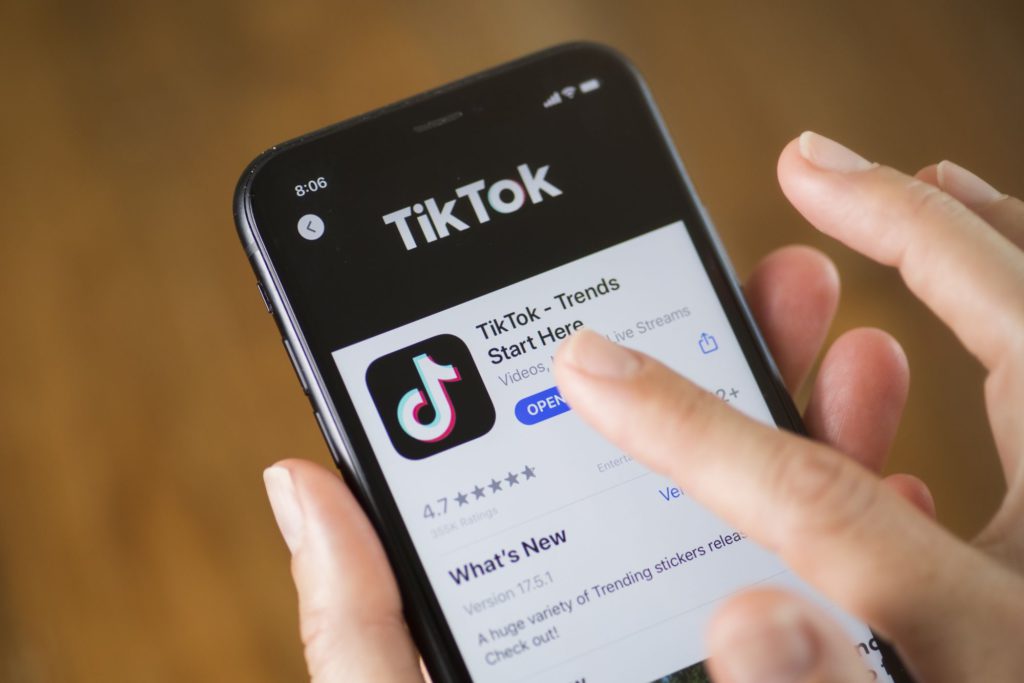
TikTok Confirms Some China-Based Employees Can Access US User Data

(Bloomberg) — TikTok, the viral video-sharing app owned by China’s ByteDance Ltd., said certain employees outside the US can access information from American users, stoking further criticism from lawmakers who have raised alarms about the social network’s data-sharing practices.

The company’s admission came in a letter to nine US senators who accused TikTok and its parent of monitoring US citizens and demanded answers on what’s becoming a familiar line of questioning for the company: Do China-based employees have access to US users’ data? What role do those employees play in shaping TikTok’s algorithm? Is any of that information shared with the Chinese government?

Currently, China-based employees who clear a number of internal security protocols can access certain information on TikTok’s US users, including public videos and comments, TikTok Chief Executive Officer Shou Zi Chew said in the June 30 letter obtained by Bloomberg News. None of that information is shared with the Chinese government, and it is subject to “robust cybersecurity controls,” he said.

The social network said it’s working with the US government on strengthening data security around that information — particularly anything defined as “protected” by the Committee on Foreign Investment in the US, or CFIUS. This new effort, called “Project Texas,” includes physically storing US information in data centers on US servers owned by software giant Oracle Corp. TikTok is also shifting its platform to Oracle’s cloud infrastructure, which means the app and the algorithm will be accessed and deployed for US users from domestic data centers.

“TikTok’s response confirms our fears about the CCP’s influence in the company were well founded,” Republican Senator Marsha Blackburn of Tennessee told Bloomberg on Friday. “The Chinese-run company should have come clean from the start, but it attempted to shroud its work in secrecy. Americans need to know if they are on TikTok, Communist China has their information.” 

Several senators, all Republicans, in a June 27 letter cited a report in BuzzFeed News that said TikTok’s US consumer data was accessed by company engineers in China. The lawmakers said in the letter that TikTok and its parent “are using their access to a treasure trove of US consumer data to surveil Americans.” The New York Times reported earlier on TikTok’s response.

More stories like this are available on bloomberg.com

©2022 Bloomberg L.P.
Meta to Shut Down Novi Service in September in Crypto Winter

(Bloomberg) — The remainder of the cryptocurrency project that Meta Platforms Inc.’s Founder Mark Zuckerberg took a beating over from Congress is officially shutting down.

Meta’s Novi pilot — a money-transfer service using the company’s own cryptocurrency digital wallet — will end on Sept. 1, the service said on its website, a link to which it texted to its users.

Both the Novi app and Novi on WhatsApp will no longer be available, the company said on the Website. Starting July 21, users will no longer be able to add money to their accounts, Novi said, advising users to withdraw their balance “as soon as possible.” Users won’t be able to access their transaction history or other data after the pilot ends.

The company does plan to use Novi’s technology in future products, such as in its metaverse project, a company spokesperson said in an email.

“We are already leveraging the years spent on building capabilities for Meta overall on blockchain and introducing new products, such as digital collectibles,” Meta said in the statement. “You can expect to see more from us in the web3 space because we are very optimistic about the value these technologies can bring to people and businesses in the metaverse.”

Meta launched Novi pilot in October of last year amid scaled back ambitions to dominate the crypto remittances space. Instead of a new Diem token Meta once backed, Novi ended up using Paxos Trust Co.’s USDP stablecoin to allow wallet users from parts of the U.S. and Guatemala to conduct transactions. Coinbase Global Inc. was safeguarding the funds. 

When he testified before Congress in 2019, Zuckerberg tried to lay to rest any concerns that his company would support launching Diem — then called Libra — without regulatory approval.

Meta’s ambitions for Diem, an association it was a part of to bring cheap and fast payments via crypto to the world, have been scaled back over the past few years amid regulatory scrutiny. David Marcus, who headed Novi wallet effort, left last year. Diem’s assets were sold in January.

While scaling back this effort, Meta has been expanding its test to support nonfungible tokens — typically art like cute monkeys or penguins — on its sites.

The unwinding of Meta’s ambitions for Novi is happening in deepening downturn in crypto markets and liquidity woes at key companies like Celsius Network and Three Arrows Capital.

More stories like this are available on bloomberg.com

©2022 Bloomberg L.P.
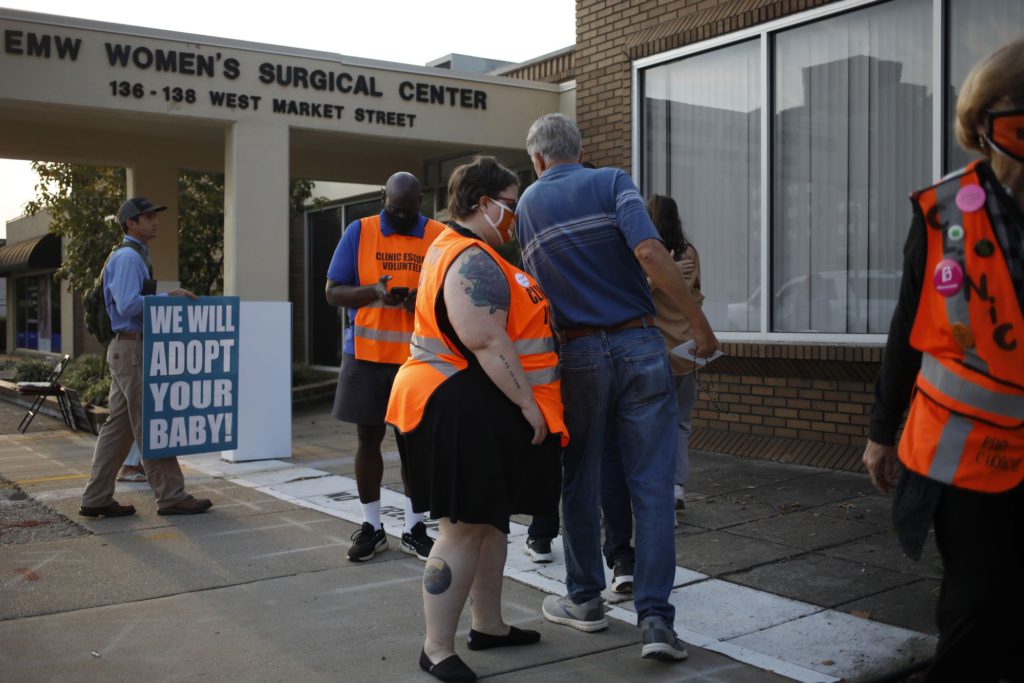
Slack, Away Heads Aim to Raise $2 Million for Abortion Funds

(Bloomberg) — The heads of Slack Technologies Inc. and luggage start-up brand Away are joining major companies in supporting abortion-related causes. 

Jen Rubio, co-founder and chief executive of JRSK Inc. — which operates as Away — said she and husband Stewart Butterfield, who leads Slack, will match up to $1 million in donations to the National Network of Abortion Fund. The fundraiser, which kicked off on June 29, will be carried out through the couple’s David C. Butterfield and Alfonso D. Rubio Memorial Foundation.

Donations would be split between abortion funds in states with trigger laws, as well as those in areas with protections that may be receiving an influx of out-of-state patients, Rubio explained in a tweet earlier this week. In a subsequent Instagram story, she said the drive raised $430,000 within its first 24 hours.


“Money alone won’t solve this issue, but there is an urgent need to support the organizations and individuals working tirelessly on behalf of our rights,” Rubio wrote in an emailed response to Bloomberg queries.  

Rubio and Butterfield join other prominent figures and companies in raising money for abortion-related groups in the past week, since the US Supreme Court struck down a law that provided federal protection for the right to terminate pregnancies.

Entertainment company LiveNation previously said it would match singer-songwriter Lizzo’s $500,000 donation to Planned Parenthood and other abortion access groups including abortion funds. Meanwhile, Jefferies Financial Group’s Chief Executive Officer Rich Handler and President Brian Friedman said in a statement released this week that they would personally donate a combined $1 million to yet-to-be-determined organizations that “champion women’s rights.”

Debasri Ghosh, the managing director of the NNAF, previously told the New York Times that the organization received around $3 million in donations in the hours after court’s decision. 

Non-profits that help coordinate and cover treatment and travel costs for people seeking an abortion have been bracing for an increase in requests for help. Rising costs pose an added challenge, with the Women’s Reproductive Rights Assistance Project, a national fund, noting the cost of abortion care has doubled from around $500 per person in recent months.

A recent report by the National Committee for Responsible Philanthropy found that 63% of donations made to abortion funds come from the individual level.

“There will be a significant amount of people who will require assistance outside of any employer health coverage,” Rubio told Bloomberg. “For those countless individuals, I hope that fundraising efforts such as these can serve to lessen the burden forced upon them.”

More stories like this are available on bloomberg.com

©2022 Bloomberg L.P.
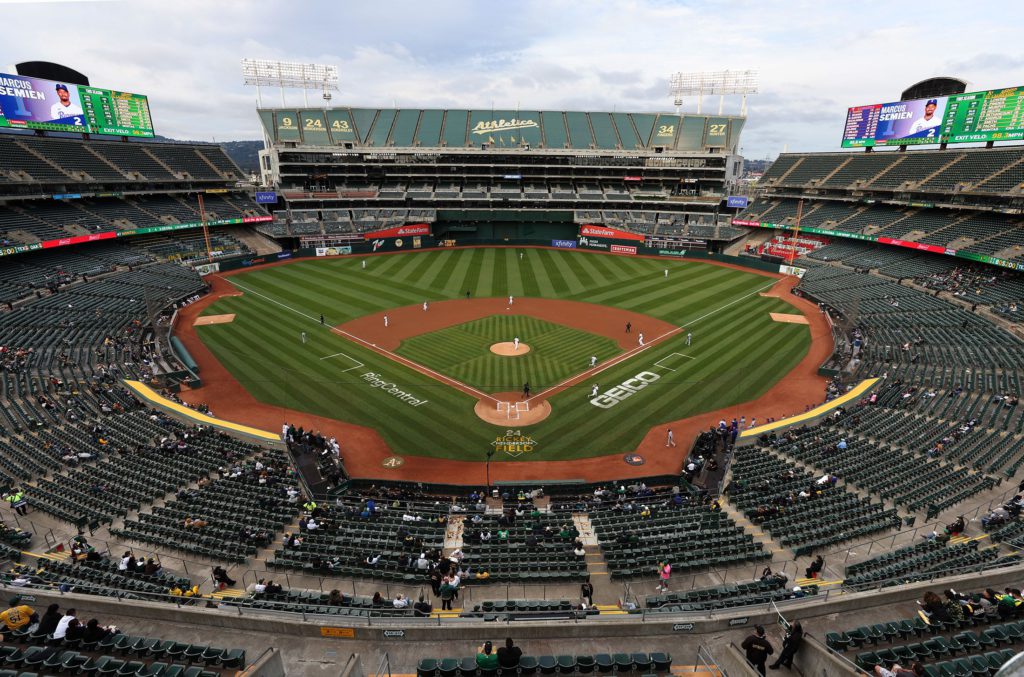
Oakland A’s Win Key Approval for Waterfront Stadium at Port Site

(Bloomberg) — The Oakland Athletics are one step closer to building a $12 billion ballpark and real estate development at the Port of Oakland after a state agency decided that a 55-acre terminal is no longer needed for maritime operations.

The baseball team is seeking to move to Howard Terminal, which has been without a tenant since SSA Marine Inc. relocated to newer facilities in 2014, and has threatened to move to Las Vegas if the project isn’t approved. The plan has generated opposition from the shipping industry, which argued it will cause major impacts to both the surrounding community and port operations.

The San Francisco Bay Conservation and Development Commission voted 23-2 Thursday to allow Howard Terminal to be used for purposes other than port activities, a major step that allows the city and the team to have more detailed discussions on the project. The A’s still need approval from stakeholders including the port, the city and various state agencies, the port said in a statement.

A’s President Dave Kaval said on Twitter that the vote is a “huge win” for the project. Oakland Mayor Libby Schaaf, a supporter of the plan, said she will work closely with the community “to bring this bold vision into a beautiful reality.” 

Although Howard Terminal is no longer used to unload ships, the terminal now serves as a truck parking lot, as well as a pop-up container yard and a training site for dockworkers. For the industry, allowing it to be used for anything other than maritime operations would deal another blow to already-stretched supply chains.

Read more: Oakland A’s Clash With Shipping Industry Over Waterfront Stadium

Oakland is the third-busiest port in California, but container-cargo volume has hardly budged, rising less than 0.5% since 2005. After ranking as the fourth-busiest hub in the US just a few years ago, today the port’s traffic barely cracks the top 10.

The A’s, who currently play at the 1960s-era Oakland Coliseum, want to build a 35,000-seat baseball stadium, 3,000 housing units, 1.7 million square feet of office and retail space and a 400-room hotel, among other amenities, at the waterfront.

More stories like this are available on bloomberg.com

©2022 Bloomberg L.P.

Big Ten Is Likely to See Bigger TV Deal With Addition of USC and UCLA

(Bloomberg) — The decision by UCLA and USC to join the Big Ten further consolidates power within two college conferences and escalates the rivalry between their two biggest media partners, Fox and ESPN.

The Big Ten said Thursday that the schools, which have large fan bases and famous histories in football and basketball, will join the conference in 2024.

Their arrival will benefit Fox Corp., which owns 61% of the Big Ten Network through a joint venture and just renewed its deal with the conference.

Meanwhile, two other college sports powerhouses — the University of Texas and the University of Oklahoma — have said they will leave the Big 12 and move to the Southeastern Conference, home of Louisiana State University and University of Alabama, in 2025.

Those moves will be a boost to Walt Disney Co.’s ESPN, which majority owns the SEC Network that airs the conference’s games. ESPN also agreed to pay $300 million per season to air SEC football starting in 2024, snatching away rights from Paramount Global’s CBS. 

“These two major college sports broadcasters have communicated which horses within the Power 5 they’ll be favoring,” said William Mao, a senior vice president of global media consulting at Octagon, referring to the five most popular of the college sports conferences.

The news that UCLA and USC will join the Big Ten came as the conference was in the middle of negotiations for a new television deal for some of its games. Fox and ESPN currently hold the national rights to broadcast Big Ten games, paying $430 million a year combined under a contract that ends next year. 

ESPN, CBS, Comcast Corp.’s NBC, Amazon.com Inc. and Apple Inc. have all expressed interest in bidding on the remaining games, according to Sports Business Journal, which reported that the conference’s total haul from media rights was likely to top $1 billion a year, even before the two Los Angeles universities were added.

Big Ten football games from schools like University of Michigan and Ohio State University routinely draw large television audiences. The addition of two more high-profile universities from the nation’s second-largest media market will add to what’s expected to be a windfall of TV dollars.

“The Big Ten was already looking at a substantial increase in media rights,” said Lee Berke, a media consultant. “Those dollars are going to be boosted because of the addition of USC and UCLA.”

The moves allow USC and UCLA teams to be seen by more fans on the East Coast. In a statement, UCLA cited “better television time slots for our road games” as a reason for joining the Big Ten.

“If your games aren’t on in Eastern time zone you’re at a disadvantage because people don’t see you at the time slots that are most visible,” Berke said. 

For broadcasters, USC and UCLA also brings the added benefit of creating an additional window of football games that start later on Saturdays.

“You can have games at noon, afternoon and late night,” Mao said. “It creates more opportunity for more Big Ten games on linear broadcast.”

The moves are a blow to the Pac-12 Conference, which is losing the two schools. The conference said in a statement that it was “extremely surprised and disappointed” that UCLA and USC are leaving. The Pac-12 must not only reckon with the loss of two popular schools, but also figure out a way to keep others from defecting, Berke said.

“This puts a tremendous amount of pressure on the Pac-12 to come up with replacements for those schools and hang onto the schools they still have,” Berke said. “The Pac-12 is vulnerable and will have to move very quickly to shore up its media rights and shore up its conference.”

More stories like this are available on bloomberg.com

©2022 Bloomberg L.P.

Close Bitnami banner
Bitnami
