
Bloomberg

Singapore Ups Scrutiny of Three Arrows as Liquidation Looms

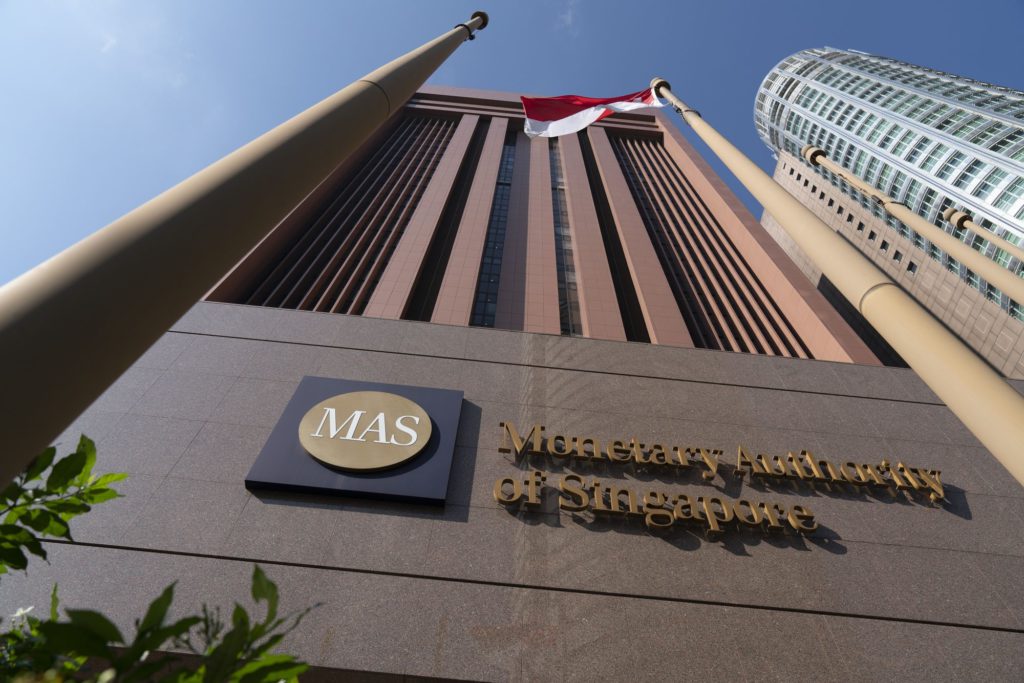
(Bloomberg) — The Monetary Authority of Singapore is intensifying scrutiny of Three Arrows Capital as the crypto hedge fund faces liquidation after failing to repay creditors. 

The regulator is assessing if there were more breaches by the firm of its rules in light of “recent developments which call into question the solvency of the fund managed” by Three Arrows, it said Thursday. MAS reprimanded Three Arrows for providing false information and exceeding the limit on assets under management between July 2020 to September 2020, and between November 2020 to August 2021. 

The fund that bet big on everything from Bitcoin to the ill-fated Luna tokens is becoming the latest casualty of a $2 trillion digital-asset market wipeout that left it with huge unpaid debt on its borrowings. It also prompted a court in the British Virgin Islands to order liquidation against Three Arrows this week.

“The timing of the MAS’ enforcement notice may have been prompted and accelerated by the insolvency of the 3AC fund that was announced,” said Hagen Rooke, a partner at law firm Reed Smith LLP in Singapore.

The breaches by Three Arrows and potential fallout from the incident may sit awkwardly with Singapore, which has set out ambitions to be a key hub for businesses related to cryptocurrency. Still, it has been wary about the risks. Its central bank has been tightening crypto regulations, conservative in giving out licenses for crypto service providers and has repeatedly warned retail investors to stay away from the volatile asset class. 

Three Arrows’ chief executive and co-founder Su Zhu and Solitaire LLP, a law firm representing the firm, didn’t respond to messages seeking comment.

‘More to Come’

The MAS usually issues a reprimand before the failure of a financial institution’s internal compliance and or its control systems result in serious lapses which may warrant harsher enforcement actions, according to the regulator’s enforcement guidelines on its website. 

“The fact that MAS is reviewing if there were further breaches by TAC of MAS’ regulations means we still cannot reach firm conclusions about the lessons of this story,” said Chris Holland, a partner at Singapore advisory firm Holland & Marie. 

If the Singapore regulator discovers that Three Arrows was not honest in its communications on additional occasions, the penalties could be severe, said Holland. “There may be more fallout to come.”

This week’s liquidation petition against Three Arrows was filed by creditors including Blockchain.com and Deribit. The court in the British Virgin Islands has appointed two partners at consulting and advisory firm Teneo to handle the process.  

Breaches

Among its breaches, Three Arrows failed to inform the regulator within the required timeline of changes in the directorships and shareholdings of its directors, Su Zhu and Kyle Davies, according to the MAS, which has been investigating these violations since June 2021. 

Three Arrows was incorporated as a company in Singapore in January 2013. The registered fund management company has lodged to cease operations in the city-state, pending regulatory submission, according to a notice on the MAS website. 

MAS’s chief fintech officer Sopnendu Mohanty said in a recent interview with the Financial Times that the regulator will be “brutal and unrelentingly hard” on any bad behavior in the crypto market.

The hedge fund’s downfall has been emblematic of the contagion that started with the collapse of TerraUSD stable coin in May, that spilled over across the crypto complex — affecting lenders like Celsius Network and Babel Finance, as well as crypto brokers including Voyager Digital.

Concerns around Three Arrows surfaced after an ominous tweet last month by Su Zhu saying they were “working this out” without providing further details. 

(Updates with details in seventh and tenth paragraphs)

More stories like this are available on bloomberg.com

©2022 Bloomberg L.P.

Summer Pool Party Off Limits for German Delivery App Drivers

(Bloomberg) — German food delivery website Lieferando.de is holding a summer party this week for employees with food, drinks and an “exclusive pool.” Delivery drivers aren’t invited. 

The invitation for a “Day Club Party” on Friday in Berlin’s hipster Friedrichshain district concludes with a caveat, in bold, that says “drivers and contingent workers” are excluded. 

A representative for Lieferando, which is owned by Just Eat Takeaway.com NV, said that it was impossible to invite everyone and kept the after-work party to colleagues working in the same office buildings. The logistics arm organizes regular events for drivers, such as barbecue evenings, the spokesperson said. 

The party is fueling anger from the excluded workers, some of whom have called for a protest outside the event. Lieferando’s parent company, Just Eat, also faced criticism after budgeting 15 million euros ($16 million) for a ski trip in April. 

“They shamelessly celebrate an all-inclusive pool party while we can’t even pay our rent!” the group, called the Lieferando Workers Collective, said in a Tweet ahead of the event. “We’ll come anyway!”

Read More: Pressure Builds on Just Eat’s Board After $16 Million Ski Trip

Relationships between delivery companies’ head offices and their drivers are increasingly fraught, with the people who take food and groceries to app customers demanding to be paid better and treated more like full-time workers at startups around the world. The European Union proposed rules in December that would give so-called gig-economy workers the same rights as an employee, regardless of what they’re called in their contract. 

Read More: Food Delivery Firms Slump After EU Proposes New Employee Rules

In Berlin, workers at Gorillas Technologies GmbH formed a collective last year after complaining about the quality of their equipment and not being paid on time. Riders at Flink SE are now also preparing to hold an assembly on July 22, in the first steps to create a works council. 

One of the organizers, Robert Snyder, said riders are concerned about receiving fewer working hours. By campaigning to set up a workers council, Flink riders in Berlin are hoping to make sure that riders get payment for the amount of hours they are contracted to work. 

“Sometimes you’d get more hours, sometimes you’d get less, but if you kept track of it, you were steadily getting less,” Snyder said. “Some people couldn’t pay their rent. This is people’s jobs.” 

A spokesman for Flink said that it’s “constantly improving its processes to empower our hub workers and riders to manage their work” and that it would acknowledge the formation of a workers collective from employees “who want to have a healthy work environment.” 

(Adds additional comment from the company in the third paragraph. An earlier version corrected the full name of Flink SE)

More stories like this are available on bloomberg.com

©2022 Bloomberg L.P.
Bond Investors Reluctant to Dive in After Europe’s Historic Loss

(Bloomberg) — After a bruising first half of record-shattering losses, European bond market investors broadly agree that the worst may be over. Few, however, say now’s a good time to jump back in.

Concerns over inflation and the region’s growth prospects are muddying the picture, giving many pause. While Invesco says it’s time to start edging back into the market, Carmignac reckons it’s too soon. AllianceBernstein is hesitant, even with rates looking much more appealing after years of wafer-thin returns. 

“Yields are now back to levels where people will start allocating to fixed income again,” said Vivek Bommi, head of European fixed income at AllianceBernstein, which manages assets of $735 billion. But the firm is awaiting further inflation data before it starts buying in size. “A better entry point will be later in the year,” he added. 

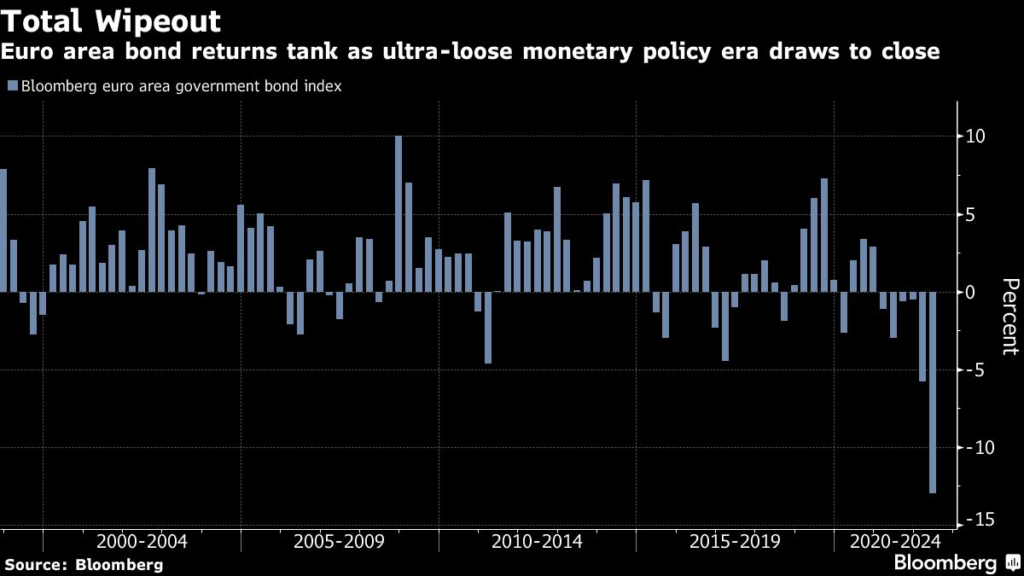
The caution is not surprising after the first-half rout left investors in European bonds nursing losses of 13%, by far the worst start to a year on record, according to a Bloomberg index tracking euro area government bonds. More than 870 billion euros ($911 billion) were wiped off the value of the index this year. 

The outlook is murkier in Europe than in other regions partly because the European Central Bank has yet to raise rates to tackle record inflation, while several countries are well into their hiking cycles. A lack of clarity on the scale of the rate increases is likely to continue to weigh on the region’s bonds, which plummeted after the ECB signaled plans to pivot away from its long-standing ultra-loose monetary policy. Volatility, as measured by swaptions, also surged and is close to its highest since the global financial crisis. 

The market will “struggle to find an equilibrium” until the ECB starts to deliver hikes and there’s “more clarity around terminal rate expectations,” said Steve Ryder, a sovereign portfolio manager at Aviva Investors.

While euro area bond yields have eased since ECB President Christine Lagarde quelled a nascent Italian bond crisis in June with a pledge to counter market speculation, many investors are reluctant to start buying in case policy makers take a tougher stance than expected to tackle the inflation shock that’s engulfing the region.

Some, like Carmignac fund manager Guillaume Rigeade, see yields continuing to rise — although not to the same extent as before. Rigeade sees further increases in inflation through the fall, after readings for France and Spain this week hit new highs and a miss in Germany was attributed to government intervention. 

“We think it’s extremely optimistic to think that the ECB can kill inflation in a year,” he said. Rigeade reckons the drop in inflation expectations, as measured by breakevens and forwards, is premature and has positioned his fund to take advantage of that.

Twists and Turns

That said, the year’s brutal bond-market selloff has been fizzling amid expectations of a looming slowdown in the economy. Ten-year German rates for example have dropped below 1.4% after surging to 1.9% in mid-June, the highest since 2014. Yields on equivalent Italian notes have also subsided after soaring past 4%, easing once the ECB promised a new tool to mitigate undue panic in government bond markets.

Further details on that instrument, still scarce for now, are expected alongside the ECB’s July 21 policy decision when it’s all but certain to raise rates by a quarter-point to minus 0.25%, the first increase in more than a decade. But some are worried the tool won’t be enough to prevent the widening of Italy’s spread over German debt again.

READ MORE: Investors Are Clinging to the Prospect of Another ECB Rescue

“We are not convinced that its plans for a new tool will be sufficient to contain a widening of spreads, given the weaker fundamentals affecting credit broadly,” Societe Generale strategists wrote in a recent note. They see Italian bonds trading as much as 300 basis points over German equivalents by year-end, compared to about 190 basis points currently. 

Borrowing costs of core countries could also come under renewed pressure. In a bear case scenario, where Brent prices rise to $150 a barrel, 10-year German yields could hit 2.75% by year-end, more than double current levels, according to Morgan Stanley strategists. That contrasts to their base case of about 2%.

Indeed, facing persistent uncertainty over the inflation outlook and the ECB’s response, the next few months are set to remain tricky for investors. Aviva’s Ryder is ready to go overweight government bonds — but just not yet. He did, however, sound a note of optimism. 

“After unprecedented losses in the first and second quarters, we do believe the bulk of the negative returns are behind us,” he said. 

More stories like this are available on bloomberg.com

©2022 Bloomberg L.P.
Bitcoin Swings Buffet Traders After Token Suffers Worst Month

(Bloomberg) — Bitcoin, fresh off its biggest-ever monthly decline, whipsawed traders with wild swings on Friday as digital assets struggle to regain their footing.   

The largest token rallied as much as 11.3% in Asia on Friday, briefly closing in on the $21,000 level. Bitcoin then quickly gave up most of those gains as global equity markets sank, trading at $19,410 at 7 a.m. in London. June’s 41% drop was the steepest in Bloomberg data going back to 2010. 

Bitcoin’s gyrations underscore the uncertainty looming over cryptocurrencies as investors struggle to assess how far central banks will go to tame rampant inflation. Adding to the confusion, major crypto players ranging from hedge fund Three Arrows Capital to lender Celsius Network have been thrown into disarray by the market selloff, raising the prospect of further contagion.   

Bitcoin “could be vulnerable to one more ugly plunge that could have many traders fearing a fall towards the $10,000 area” if the turmoil on Wall Street continues in the third quarter, Edward Moya, senior market analyst at Oanda Corp., wrote in a note. The token last traded atg those levels in mid-2020. 

Such risks aren’t deterring El Salvador, whose President Nayib Bukele said on Twitter that the nation had again bought the dip, this time adding 80 Bitcoins at a price of $19,000 each.

Earlier this week, Michael Saylor’s Bitcoin-backed tech firm MicroStrategy Inc. said in a filing it had purchased another 480 coins worth about $10 million at the height of the crypto swoon.

Bitcoin has been gyrating around the $20,000 mark after crashing below $18,000 on June 18. The lack of direction is reminiscent of how the coin traded in the wake of the TerraUSD stablecoin collapse in early May, when it clung close to $30,000 for weeks before plunging again. 

More stories like this are available on bloomberg.com

©2022 Bloomberg L.P.
Taiwan Stock Benchmark Falls Over 20% From Peak Into Bear Market

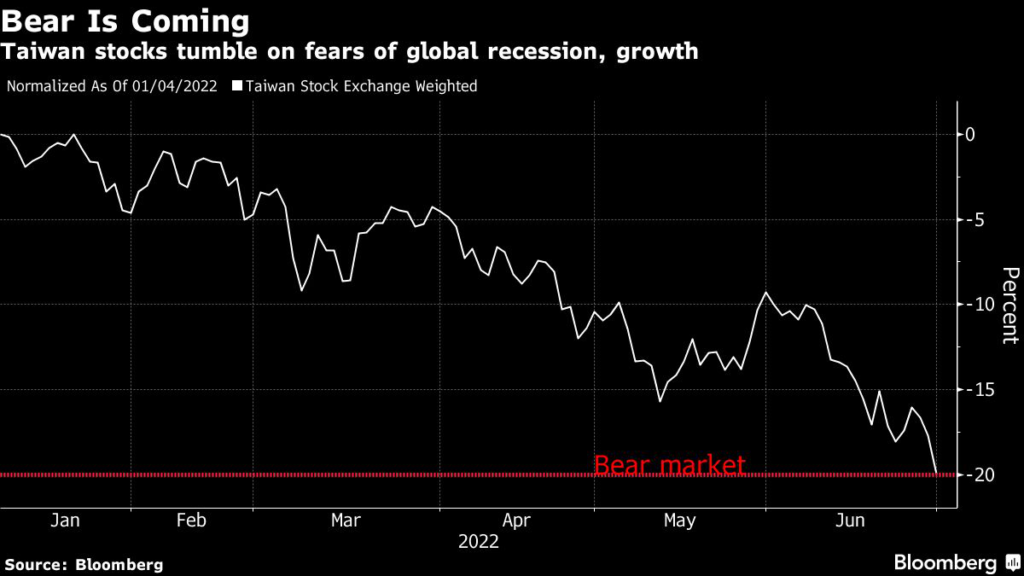
(Bloomberg) — Taiwan’s stock market slid again on Friday, taking its decline from a January high to over 20% and entered a bear market.

The Taiex gauge closed 3.3% lower in Taipei. Taiwan Semiconductor Manufacturing Co., which accounts for more than a quarter of the index’s weighting, declined 4.7% at close amid broad weakness in the chip sector following Micron Technology Inc.’s disappointing forecasts.

Tech-heavy equity markets in Taiwan and Korea were among the worst performers in Asia last quarter, both down over 15% amid rate hikes by global central banks. Foreign investors net sold more than $16 billion of Taiwan stocks during the three-month period, the most among emerging Asian markets outside of China. 


“Taiwan stocks declined due to several negatives including global inflation concerns, growth slowdown fears, and rate hikes, which lead to global funds returning to the US from emerging markets,” said Li Fang-kuo, chairman of President Capital Management. “The downward trend of Taiwan stocks will continue, so investors should avoid catching the falling knife.”

The Taiex index dropped 6.3% this week, the biggest weekly decline in 13 months. 

Investor sentiment soured on tech stocks globally due to fears of a global recession and a cautious outlook for the semiconductor sector. The Taiwan Stock Exchange said in a statement on Thursday that it will adopt stabilizing measures if needed when there are “irrational” declines in the stock market. 

Separately, Taiwan’s deputy finance minister said the National Financial Stabilization Fund will continue to monitor the stock market to see if it needs to step in. 

SinoPac Securities Investment Service Corp in a note said that a cancellation of tariffs on Chinese goods by the Biden administration, if it happens by July 6, will boost markets.

(Updates prices throughout.)

More stories like this are available on bloomberg.com

©2022 Bloomberg L.P.
Gold Keeps Its Shine for Investors as Other Precious Metals Fade

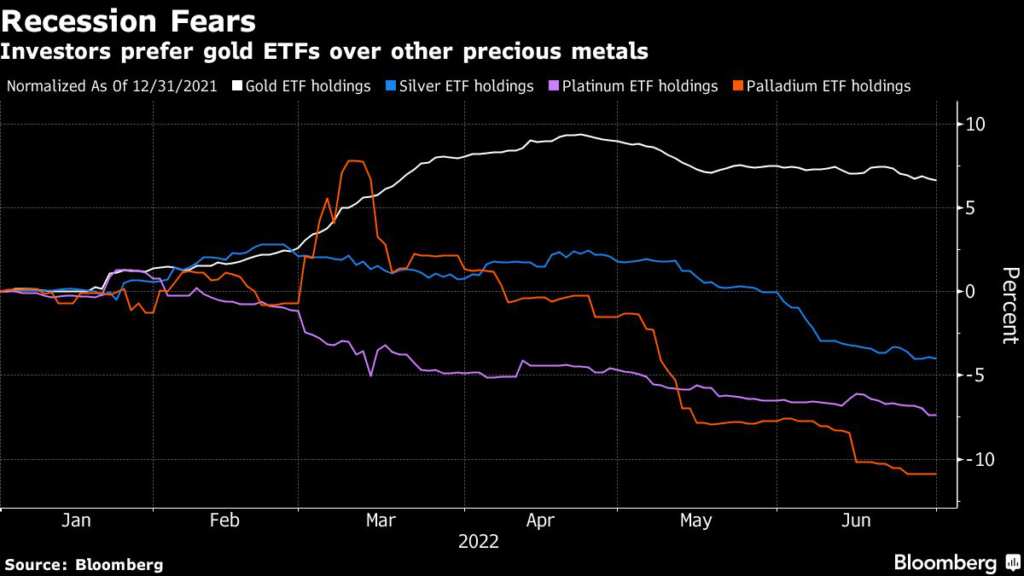
(Bloomberg) — Investors cut holdings in exchange-traded funds for silver, platinum and palladium in the second quarter on fears that a potential recession will reduce industrial demand, but gold assets held up because of its role as a haven, and that may persist.

Gold-backed ETFs shrank by just over 1% in the three months through June, or 43 tons, after an 8% surge in the first quarter helped by Russia’s invasion of Ukraine, according to data compiled by Bloomberg. By contrast, silver holdings contracted almost 5%, and the outflow in tonnage terms was the biggest since 2011. 

The amount in gold ETFs is the lowest since March, while assets in the other three precious metals are around the smallest since 2020.

Gold has held up well relative to silver and platinum. One ounce of gold now buys 90 ounces of silver, the most in almost two years. 

The resilience of gold offers yet more evidence to support its role as a component in portfolio asset allocation, in contrast to silver, platinum and palladium, which have more industrial uses and are therefore more exposed to economic downturns, according to Chad Hitzeman, senior business development manager at ETF Securities. 

“Where broader markets remain negative, pressured by inflation and central bank hawkishness in taming prices, we see investors holding fast to gold ETFs as a risk-off haven,” said Hitzeman, whose company offers several precious metals products to investors. 

Giovanni Staunovo, a strategist at UBS Group AG’s wealth management unit, shared this sentiment. “If market recession fears are increasing, you prefer to hold exposure to gold and not to the white metals, which have a high industrial usage,” he said.

Cloudy Outlook

Central banks are hiking borrowing costs in a bid to curb the highest inflation in years, weighing on non-interest bearing precious metals. The monetary tightening has spurred rising angst over a possible recession, particularly in the US, with Federal Reserve Chair Jerome Powell calling his commitment to cooling prices “unconditional.” 

But as an economic slowdown becomes more likely, so does the outlook darken for precious metals with more industrial uses. Silver is used in solar panels and electronics, while platinum and palladium can be found in catalytic converters for vehicles.

Demand for the platinum-group metals, or PGMs, has already suffered as a semiconductor shortage crimps auto production, while car sales in China have slumped due to Covid-19 lockdowns and as economic worries weigh on consumer sentiment. 

“The market focus has shifted from potential supply losses to a potential demand slowdown,” said Suki Cooper, an analyst at Standard Chartered Plc. “We do expect auto production to start to recover toward the end of the year as chip shortages ease, but before then ETF flows are likely to continue to be a drag on the market across silver and the PGMs.”

More stories like this are available on bloomberg.com

©2022 Bloomberg L.P.

Bitcoin Pares Jump Amid Dip Buying in Hope of Better Second Half

(Bloomberg) — Bitcoin dip buyers are hoping things won’t get much worse for cryptocurrencies in the remainder of this year judging by the latest surge in the virtual coin.

The largest digital token rallied as much as 11.3% in Asia on Friday, briefly closing in on the $21,000 level. The climb cooled to 5% as of 1 p.m. in Tokyo, leaving Bitcoin at about $19,660.

Some optimism was also evident for coins such as Ether, Solana and Avalanche, but the crypto universe was off session highs as a bout of risk aversion swept across global markets.

Bitcoin has been gyrating around the $20,000 mark after a 57% slide this year. The retreat has become emblematic of depressed investor spirits as liquidity evaporates amid tightening monetary policy to fight inflation.

Outrageous crypto swings have sometimes buffeted traditional assets this year. This time around, the latest jump higher failed to alleviate the gloom enveloping US equity futures and Asian stocks, which remained in the red.

Bitcoin “could be vulnerable to one more ugly plunge that could have many traders fearing a fall towards the $10,000 area” if the turmoil on Wall Street continues in the third quarter, Edward Moya, senior market analyst at Oanda Corp., wrote in a note.

Such risks aren’t deterring El Salvador: its President Nayib Bukele said on Twitter that the nation had again bought the dip, this time 80 Bitcoins at a price of $19,000 each

Earlier this week, Michael Saylor’s Bitcoin-backed tech firm MicroStrategy Inc. said in a filing it had purchased another 480 coins worth about $10 million at the height of the crypto swoon.

(Updates with El Salvador buying the dip in the seventh paragraph.)

More stories like this are available on bloomberg.com

©2022 Bloomberg L.P.

Taiwan Stock Benchmark Falls 20% From Peak, Set for Bear Market

(Bloomberg) — Taiwan’s stock market slid again on Friday, taking its decline from a January high to over 20% and is on track to enter a bear market.

The Taiex gauge dropped as much as 2.7% in Taipei. Taiwan Semiconductor Manufacturing Co., which accounts for more than a quarter of the index’s weighting, declined as much as 4.5% amid broad weakness in the chip sector following Micron Technology Inc.’s disappointing forecasts.

Tech-heavy equity markets in Taiwan and Korea were among the worst performers in Asia last quarter, both down over 15% amid rate hikes by global central banks. Foreign investors net sold more than $16 billion of Taiwan stocks during the three-month period, the most among emerging Asian markets outside of China. 


“Taiwan stocks declined due to several negatives including global inflation concerns, growth slowdown fears, and rate hikes, which lead to global funds returning to the US from emerging markets,” said Li Fang-kuo, chairman of President Capital Management. “The downward trend of Taiwan stocks will continue, so investors should avoid catching the falling knife.”

Investor sentiment soured on tech stocks globally due to fears of a global recession and a cautious outlook for the semiconductor sector. The Taiwan Stock Exchange said in a statement on Thursday that it will adopt stabilizing measures if needed when there are “irrational” declines in the stock market. 

Separately, Taiwan’s deputy finance minister said the National Financial Stabilization Fund will continue to monitor the stock market to see if it needs to step in. 

SinoPac Securities Investment Service Corp in a note said that a cancellation of tariffs on Chinese goods by the Biden administration, if it happens by July 6, will boost markets.


(Updates prices.)

More stories like this are available on bloomberg.com

©2022 Bloomberg L.P.

Google Makes Deal With Developers in Latest App Store Shift

(Bloomberg) — Google reached an agreement with US developers that will let consumers subscribe to services outside the company’s Play Store, marking the latest shift for an app-store economy that it dominates alongside Apple Inc.

The Alphabet Inc. division also plans to provide $90 million to support developers who earned $2 million or less annually through the company’s app store from 2016 to 2021. Google will continue to charge a 15% fee on the first $1 million in annual revenue earned from the Play Store by US developers, the company said Thursday in a statement.

The pact mirrors a settlement made by Apple last year with small developers, who had pushed for changes to how app stores work. As with the Google settlement, Apple developers were allowed to advertise lower pricing outside of its App Store directly to consumers via email or other communications. Apple also agreed to support developers using a pool of $100 million — a slightly larger amount than Google is offering. 

Due to a separate settlement with the Japanese Fair Trade Commission, Apple also now allows third-party subscription services to bill customers outside of the App Store, bypassing the tech giant’s 15%-to-30% fee.

Both companies have faced intense legal and polical scrutiny over the commissions and billing restrictions that are applied to paid services in their app stores. Congress is weighing a bill to force the tech companies to change their software business models. Last July, three dozen states sued Google in part over its app-store policies.

Match Group Inc., which runs dating services such as Tinder, sued Google in May over its Play Store policies, saying the search giant was acting as a monopolist with its billing rules. Within weeks, Match said Google had made changes to the policies, spurring the dating site to withdraw its legal effort to gain a temporary restraining order. Google also announced in March that it would begin a test to let some apps bill users directly as an alternative to paying through Google.

Read more: Match says Google is making concessions on app-store payments

In the deal announced Thursday, Google said it was revising its policies to let developers contact customers outside the Play Store, including “about subscription offers or lower-cost offerings on a rival app store or the developer’s website.”

The Mountain View, California-based company also said it would publish annual transparency reports about activity on its app store, including statistics such as apps removed and account terminations.

Apple, located in Cupertino, California, has agreed to publish similar annual transparency reports about app removals.

(Updates with Apple agreement starting in third paragraph.)

More stories like this are available on bloomberg.com

©2022 Bloomberg L.P.

Blackstone Weighs US Listing of $2 Billion Tech Firm IBS

(Bloomberg) — IBS Software Services Pvt., backed by Blackstone Inc., is considering a US initial public offering that could value the company at more than $2 billion, according to people familiar with the development, defying concerns about heightened market volatility.

The company is working with Goldman Sachs Group Inc. and JPMorgan Chase & Co. for the planned first-time share sale, the people said. IBS Software has filed confidentially for the US IPO, which could happen as soon as this year, they added. The company is considering seeking at least $500 million in the offering, the people said, who asked not to be identified as the information is private.

Considerations are at an early stage and details of the IPO including size and timeline could still change, said the people. Representatives for Blackstone, Goldman Sachs and JPMorgan declined to comment. A spokesperson for IBS Software said the company is focused on taking advantage of the recovery in travel, and that it is a strong IPO candidate in the right market environment.

IBS Software provides software solutions to airlines, logistics and hospitality companies, according to its website. The Thiruvananthapuram, Kerala-based company has a global presence with offices in Australia, Canada, Dubai, Japan, South Korea, the UK and the US. It counts American Airlines Group Inc., Cathay Pacific Airways Ltd. and Etihad Airways PJSC among its customers, the site shows.

Blackstone announced in 2015 it would buy a minority stake in IBS Software for $170 million.

(Updates with customers in fourth paragraph.)

More stories like this are available on bloomberg.com

©2022 Bloomberg L.P.

Close Bitnami banner
Bitnami