

Bloomberg

Bollywood Is Threatened by India’s Other Movie-Making Powerhouse

(Bloomberg) — Bollywood has a serious rival now in India. It’s bigger, louder and is making more money than its prolific, glitzy Hindi-language cousin known for its signature dance moves and opulent wedding scenes.

A new genre of films from southern India — epic, big-budget, over-the-top action flicks, some of them served with a dollop of toxic masculinity and gory violence — are increasingly dominating the country’s $24 billion media and entertainment market, and in some cases, making their mark beyond India. Though shot in regional languages like Telugu and Kannada, they are drawing millions of viewers to theaters screening dubbed versions and to streaming platforms carrying subtitles.

At the vanguard of the movement is “RRR,” a story of two Indian freedom fighters battling British colonialists in the 1920s. It has raked in as much as $150 million worldwide, according to The Numbers website, since its release in March, while Rolling Stone magazine and some other US publications have featured glowing reviews of the movie. The “K.G.F.” and “Pushpa” action franchises garnered about $200 million in total, local media reported, following on from the wild success of a two-part mythical fantasy “Baahubali” in 2015 and 2017, which collected about a combined $290 million.

The numbers represent a high-water mark for India’s movie industry that’s long been struggling to match the size of China or the US, despite being home to a population of almost 1.4 billion. Consultancy Ormax Media estimates that the Telugu-language film industry — known as Tollywood — earned about $212 million last year, eclipsing the $197 million made by Bollywood, which has long been based in India’s business center, Mumbai.


The success, indicative of a power shift toward the country’s south, comes at a time when Bollywood is reeling from a string of flops, as its increasingly westernized content limits its appeal to a mostly urban audience.

The movie makers in southern India “have figured out content that transcends regardless of language,” said Karan Bedi, chief executive officer of Indian streaming platform MX Player. “If you look at the couple of films that have gone ballistic, it’s all that superhero formula.”

And, the run of hits are also good news for streaming giants such as Netflix Inc., Amazon.com Inc. and Walt Disney Co. who are courting these film makers for local content to boost users in the vast but price-sensitive market. India’s media and entertainment industry is set to grow 17% this year to $24 billion and then to $30 billion by 2024, according to a March report by EY and the Federation of Indian Chambers of Commerce & Industry. 

India’s more affluent south is home to a passionate movie-going audience and thousands of cinema screens. The region is also reputed for churning out hundreds of films a year considered kitsch even by Bollywood standards, often featuring larger-than-life heroes and heroines. Some of those stars have become successful political leaders.  

SS Rajamouli, 49, the maverick redefining Indian entertainment with the new genre, shot “RRR” on a budget of $72 million, something unprecedented in India. Many of these pictures are grandiose with no dearth of histrionics. They are also enhanced by special effects. In a signature fight scene in “RRR,” the hero grabs a heavy motorcycle and uses it as a club to thrash the bad guys.


In a review of “RRR,” Rolling Stone wrote, “if ever a movie deserved to be seen with a crowd and on the largest screen imaginable, it’s this one,” but also warned it runs the risk of being “one long, context-less adrenaline rush.” 

In a recent interview, Rajamouli said he pushes the finances of his projects and often overshoots budgets. Before the meeting, he was watching a YouTube reel of the “Top 5 Most Awesome Cinema Game Trailers” — a nod to the bombastic style that propelled him to the top. 

“Obviously the film has to be a success,” the director said in his office in the southern city of Hyderabad, home to Tollywood.  “Otherwise everyone is going to be in big trouble.”

Little known outside India, Rajamouli has filmed only in Telugu, the fourth-most spoken tongue in the country, throughout his two-decade directorial career. He also made the “Baahubali” franchise, for which he spent 600 days shooting on a gigantic custom-built set at the world’s largest studio complex, the Ramoji Film City — a sprawling 2,000-acre site and theme park on the edge of Hyderabad.

His vision has always been “bigger, bigger and better,” Rajamouli said, reeling off Hollywood inspirations ranging from “Brave Heart,” “Spiderman” and “Superman,” along with the 1957 Telugu fantasy epic “Mayabazar.” 

Streaming with subtitles has changed the game for some of the regional movies, said Anupama Chopra, a film critic and director of the MAMI Mumbai Film Festival. 

“That also kind of enabled the stars, especially of Telugu cinema, to find an audience that was outside of their specific region,” she said. “Now suddenly everybody’s woken up.”

That success has also been aided by a two-decade trend in which Bollywood’s Hindi-language productions became “extremely westernized,” according to Chopra, focusing more on educated, urbanized Indian audiences at the expense of 70% of the population that lives outside cities.

“Meanwhile, Telugu cinema has never stopped catering to the larger audience,” she said, characterizing the films as “extremely male centric,” where mythical heroes fight in slow-motion sequences and female characters “are kind of relegated to the sidelines.”

Chopra is also among critics asking makers to tone down the testosterone a notch. Many are warning that these hits, with their hyper-masculine protagonists, can stoke casual sexism and gender violence in India — a country already deemed notoriously unsafe for women.

The Telugu-language “Pushpa,” the Kannada-language “K.G.F.” series and to a lesser extent, “RRR” — come loaded with toxic masculinity and misogyny. Violence is glorified. Attempts portrayed by male characters to court women on screen could often be construed as stalking or kidnapping in most other cultures.

Rajamouli has dismissed criticisms surrounding the male-centric content, saying his focus is on story-telling and emotions and not gender.

Despite the high volume of movies produced each year, Indian films haven’t yet managed to earn the kind of global crossover appeal South Korean content has, with award-winning titles such as “Parasite” or Netflix’s “Squid Game.”

In India, “that’s not happened yet,” said Rajamouli, adding he isn’t planning to change his style to appeal to a wider global audience. “But the doors are open. Finding your kind of audiences in the rest of the world has definitely become much easier” than it was about 10 years ago, he said.

Box-office collections in India are also smaller compared to China or the US. Total ticket sales reached only $470 million last year, slashed to a third due to the pandemic, versus China’s 47 billion yuan ($7 billion) and $4.5 billion for Hollywood.

But huge silver-screen domestic successes in India are unlikely to gain widespread traction with foreign audiences, according to Chopra, who sees the most likely candidates to come from smaller and digitally streamed productions.

“The mainstream, traditional Indian film — which is the song-and-dance, fantasy, color, drama, violence — I think that’s a tough sell as a crossover,” she said. “It’s a very, very unique taste. I don’t know that western audiences really buy into that, they always see it as kitsch.” 


More stories like this are available on bloomberg.com

©2022 Bloomberg L.P.

Crypto Lender BlockFi, in Talks With FTX, Also Gets Ledn Offer

(Bloomberg) — Troubled crypto lender BlockFi Inc., already in talks with industry giant FTX, has been approached about a deal with another party that includes rival Ledn, according to three people with knowledge of the matter. 

FTX, the crypto exchange founded by Sam Bankman-Fried, is negotiating a potential acquisition of BlockFi, Bloomberg reported earlier. But the price FTX is seeking — CNBC reported it was roughly $25 million — is a deep discount from BlockFi’s $3 billion valuation in March 2021. Unlike the bid from FTX, Ledn’s proposal involves fresh funding rather than a full acquisition and has been submitted to a BlockFi board member, according to one of the people, all of whom declined to be identified because the talks are confidential. 

Ledn would lead a funding round of up to $400 million and provide a $50 million equity contribution that would give Ledn a significant portion of the company, two of the people said. Other investors would include ParaFi Capital, they said. A spokesperson at Parafi, an investor in both BlockFi and Ledn, declined to comment.

“Given its operational strength, Ledn is currently evaluating a number of opportunities to broaden its leadership in digital asset lending and beyond,” Ledn Chief Executive Officer Adam Reeds said in a statement provided by Ledn when asked for comment on a potential BlockFi deal. “At the moment, we cannot share any additional details.”

BlockFi, when asked about the proposal from Ledn, said in a statement that it does not comment on market rumors. 

Canada-based Ledn lets users earn yields of up to 7.5% annually on lending out their Bitcoin and USDC stablecoins, as well as borrow funds. It also lets users swap Bitcoin for USDC. Unlike some rivals, Ledn doesn’t invest in decentralized finance apps to generate yields. Its investors include Coinbase Ventures, which is also an investor in BlockFi, Susquehanna Private Equity Investments and Valor Capital Group.

BlockFi is among those affected by a liquidity crunch in the industry and the troubles at Three Arrows Capital. It had acknowledged that it liquidated a large client that failed to meet its obligations on an overcollateralized margin loan, without naming the client. Earlier this month, FTX agreed to provide a $250 million revolving credit facility to BlockFi.

More stories like this are available on bloomberg.com

©2022 Bloomberg L.P.
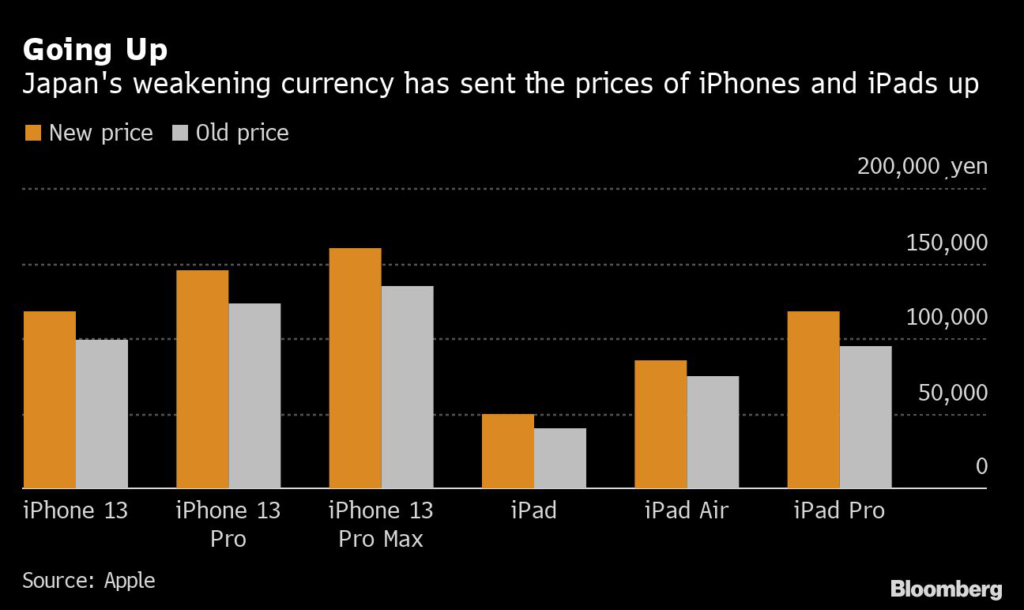
Apple Hikes iPhone and iPad Prices in Japan After Yen Tanks

(Bloomberg) — Apple Inc. raised the prices of its iPhones and iPads in Japan in an uncommon move to account for the yen’s precipitous drop in value this year.

The Cupertino, California-based tech giant added as much as 25% to the cost of its mobile gadgets in the country, taking the iPhone 13’s starting price up to 117,800 yen ($868). It increased the prices of its iPad and iPad Air by 10,000 yen each, according to checks with Apple’s local website.

Apple joins a growing list of retail brands from Asahi Group Holdings Ltd. to Lawson Inc. that are hiking consumer prices in Japan to contend with soaring production costs, compounded by a weakening local currency. Apple’s move may presage hikes from other makers of consumer electronics.

Apple already raised prices of its MacBook computers by more than 10% in June, though that change was accompanied by the launch of new models. It’s making steeper increases with its mobile devices and doing so at a time when no new releases are expected for several months. Company representatives didn’t immediately respond to a request for comment.

Yen Hits Fresh 24-Year Low as Investors Embrace Riskier Assets

With wage growth still anemic, retailers in Japan have long been reluctant to raise sticker prices for fear of scaring off customers accustomed to years of deflation. Now that’s starting to change, with everything from the price of beer and soy sauce, to fried chicken nuggets and burgers, starting to climb as businesses pass on costs to shoppers. The yen broke through its 24-year low against the dollar last month as risk assets rebounded, heaping more pressure on retailers.

The Nikkei first reported on Apple’s price hikes.

More stories like this are available on bloomberg.com

©2022 Bloomberg L.P.

Oracle Quietly Adds Abortion Travel Reimbursement Benefits

(Bloomberg) — Oracle Corp., one of the largest US tech employers, has strengthened worker benefits for abortion access while remaining publicly silent on the issue.

The company has updated its health benefits policy to include a lifetime maximum reimbursement of $10,000 for travel and lodging for “legal abortions,” according to documents reviewed by Bloomberg. The change to the 2022 health benefits plan is effective Friday. 

After the Supreme Court’s June 24 decision overturning Roe v. Wade, some tech companies, including Amazon.com Inc. and Apple Inc., announced benefits such as paying for employees’ travel expenses for abortions. The benefits are aimed at helping workers located in states where abortions are banned or are likely to be restricted. Oracle, which in December 2020 moved its headquarters to Austin, Texas, from Redwood City, California, hasn’t said anything publicly about the ruling. 

Oracle also hasn’t made any companywide employee communications related to abortion access in the week since the court’s decision, according to workers who asked not to be named because the information is private. The company circulated an internal email this week about changes in health benefits, including extended parental leave. But the memo didn’t mention the new coverage for abortion travel, according to a manager who described its contents to Bloomberg.

The company didn’t immediately return messages asking for comment on the policy.

Oracle, the second-largest software company by revenue, employed 143,000 people as of the end of May, about one-third of whom are in the US at locations including Seattle, Denver, Orlando, Florida, and the former headquarters in the San Francisco Bay area, according to company filings and its website.

While software peers like Salesforce Inc. are reliable supporters of liberal causes, Oracle has long aligned itself with conservative politics. Billionaire co-founder and Chairman Larry Ellison has donated to Republicans including former President Donald Trump. Chief Executive Officer Safra Catz advised Trump during his transition after the 2016 presidential election and was viewed as a potential Cabinet appointee.

The abortion issue is particularly relevant in Texas, where Attorney General Ken Paxton has said state law banned abortions in light of the court’s decision. Paxton also said his office is considering penalizing companies that aid their employees in getting abortions. 

Hewlett Packard Enterprise Co., another software maker that moved its headquarters to Texas from Silicon Valley in 2020, announced earlier that it would cover costs associated with out-of-state abortion travel for any Texas-based employees.

More stories like this are available on bloomberg.com

©2022 Bloomberg L.P.

Micron’s Dim Outlook Suggests Tech Spending Is on the Wane

(Bloomberg) — Micron Technology Inc. gave a surprisingly downbeat forecast for the current quarter after demand for phones and computers weakened, but vowed to move aggressively to stave off a chip glut. 

The company — the largest US maker of memory semiconductors — warned that sales will be about $7.2 billion in its fiscal fourth quarter, far below the analyst estimate of $9.14 billion. Excluding certain items, profit will be about $1.63 a share, the company said, compared with the $2.57 predicted by analysts.

The outlook overshadowed generally positive results from last quarter and renewed concerns about a slowdown in two key markets for Micron’s memory chips: computers and smartphones. Consumers and businesses have been reining in spending amid fears that the major world economies are headed for recession.

“The world is in a rapidly changing and uncertain environment, and consumer spending is certainly being reallocated away from electronic devices,” Chief Executive Officer Sanjay Mehrotra said in an interview. “Look at us: We just delivered a record quarter, and we’re so quick to take action to adjust our total supply to meet demand. This has never happened in this industry this fast.” 

Micron’s shares fell more than 8% in extended trading following the report, before recovering somewhat to a decline of about 3%. They had already lost 41% this year through the close, part of a rout for semiconductor stocks that had rallied over the last five years.


Mehrotra and his executives told analysts on a conference call that they are cutting spending on new plants and equipment to slow increases in factory output. For their part, the company’s customers — electronic device makers — are scaling back orders to reduce their inventory. 

Similar actions in the past have typically taken two quarters to be completed and Micron is projecting a rebound in orders “sometime in fiscal year 2023,” Mehrotra said. That period begins in September for the chipmaker. 

During the call, Micron executives emphasized that the company is rapidly taking action to make sure the slump in demand doesn’t fuel an industry glut. By burning through existing stockpiles, slowing production increases and walking away from orders when customers demand steep price cuts, Micron can moderate the impact on its earnings, Mehrotra said in the interview. 

The action plan helped reassure investors, who are wary of the memory-chip industry slipping into another boom-and-bust cycle. Micron and its rivals have a history of overproducing chips during good times, leading to painful downturns where the companies have to burn through cash reserves. 

In the three months ended June 2, Micron’s revenue grew 16% to $8.64 billion, its smallest increase in more than a year. Net income was $2.63 billion, or $2.34 a share. Profit and sales were roughly in line with analysts’ predictions.

“The long-term trends absolutely bode well for memory and storage,” Micron’s CEO said. “The industry will have cycles, but across the cycles the fundamentals of the industry will keep strengthening.”

Micron’s memory chips perform a crucial role in electronic devices — one that’s grown as the amount of data generated has accelerated. And Mehrotra has argued that more money will flow to its category of chips as that trend continues. 

The US company competes with South Korea’s Samsung Electronics Co. and SK Hynix Inc., as well as Japan’s Kioxia Holdings Corp., in a market that has historically been perilous and unpredictable. Many of their products are sold as interchangeable commodities, which can suffer rapid price fluctuations — sometimes trading for less than they cost to produce.

There are two main types of memory chips. The DRAM variety holds information temporarily, helping processors crunch data. Nand flash memory, meanwhile, acts as permanent storage in phones and computers. Micron, based in Boise, Idaho, is a smaller contender to Samsung in both types of chips, with the South Korean company dominating the industry. 

(Updates with additional CEO comments starting in fourth paragraph.)

More stories like this are available on bloomberg.com

©2022 Bloomberg L.P.
McConnell Threatens China Bill Over Biden Tax, Climate Plan

(Bloomberg) — Senate GOP leader Mitch McConnell said he will block bipartisan legislation to boost US competition with China and provide subsidies for domestic semiconductor manufacturing as long as Democrats pursue a go-it-alone economic package.

McConnell made the threat as Senate Majority Leader Chuck Schumer is negotiating a scaled-back version of President Joe Biden’s economic plan with West Virginia Democratic Senator Joe Manchin. That plan includes prescription drug price cuts, tax hikes on the wealthy and corporations, and energy and climate provisions.

The China bill, which provides more than $50 billion to subsidize US semiconductor chip manufacturing, has been stalled as the House and Senate try to resolve differences in their approaches. 

“Let me be perfectly clear: there will be no bipartisan USICA as long as Democrats are pursuing a partisan reconciliation bill,” McConnell said in his tweet, using an acronym for the proposed legislation.

Democrats reacted angrily to McConnell’s threat.

“Senate Republicans are literally choosing to help China out compete the U.S. in order to protect big drug companies,” White House Press Secretary Karine Jean-Pierre said in a statement that echoed those of Democratic congressional leaders. “This takes loyalty to special interests over working Americans to a new and shocking height. We are not going to back down in the face of this outrageous threat.”

McConnell has the power to block the bipartisan competition bill in the 50-50 Senate using the chamber’s filibuster rule, which requires 60 votes to advance most legislation outside the budget process.

Democrats have been striving to pass the economic package, which under special budget rules needs only a simple majority vote, before the scheduled August congressional recess. With their razor-thin majority in peril in the November midterm election, they want to promote the legislation as an inflation-fighting measure.

So far Senate Democrats are in basic agreement on prescription drug provisions in the package that would cap out of pocket costs for seniors and allow Medicare to negotiate drug prices, saving the government hundreds of billions of dollars. Some tax provisions are being pared back to make them ore business friendly.

Schumer and Democrats had hoped to have the China competition bill finished by the end of July. The long-stalled legislation was already at risk of collapsing in Congress, with Republicans growing skeptical of the measure as midterm elections near and Democrats focused on other issues, including the gun safety bill that was signed into law.

The bill would provide billions of dollars to boost research and development with an eye toward creating new technologies to help the US stay ahead of a rising China. A key provision of the bill would provide $52 billion in grants and other incentives for domestic semiconductor manufacturing.

The House and Senate are negotiating to reconcile their differing versions of the legislation but have hung up on key points, including trade provisions and whether to include tax credits for chipmakers.

To thwart McConnell, Democrats could attempt to shoehorn the chips funding and other parts of the China bill into their budget bill, although they would drive up the cost. But under the budget rules they are using regulatory and foreign policy aspects of the China bill would likely not be allowed in.

The delays in passing the bill could have significant economic consequences. Intel Corp. has warned that the timing and size of its planned new facility in Ohio will depend on whether Congress passes the bill with funding soon.

“A robust U.S. semiconductor industry is critical for our national and economic security,” William Moss, a spokesman for Intel, said in an emailed statement Thursday. “The rest of the world is moving fast and Congress should put aside politics and act now to pass this critical legislation and ensure the U.S. is not left behind.”

Schumer had led the bipartisan push for the competition legislation, working last year with Republican Senator Todd Young to pass the Senate’s version.

A Schumer spokesman, Justin Goodman, accused McConnell of “holding American jobs in key US industries hostage to help China and protect his friends in big pharma.”

(Updates with Intel statement)

More stories like this are available on bloomberg.com

©2022 Bloomberg L.P.

Blockchain.com Cooperating With Investigations Into Three Arrows

(Bloomberg) — Blockchain.com, a creditor of Three Arrows Capital, said it is cooperating with ongoing investigations into the troubled crypto hedge fund.  

Blockchain.com and Deribit, a crypto derivatives exchange, confirmed that they are among creditors that sought for the liquidation of Three Arrows at a court in the British Virgin Islands, according to a court filing and representatives at the two companies. The court made the liquidation order on Monday and has appointed two partners at consulting and advisory firm Teneo to handle the process, a person familiar with the matter has told Bloomberg News. 

“We believe Three Arrows Capital defrauded the crypto industry and intend to hold them accountable to the fullest extent of the law,” a spokesperson at Blockchain.com said in an emailed statement. “We have filed for the immediate liquidation of all global assets of Three Arrows.” 

Three Arrows was reprimanded Thursday by the Monetary Authority of Singapore for providing false information and exceeding the maximum amount of money it was allowed to manage. The central bank said it has been investigating these actions since June 2021 in a statement.

The liquidation order brings down the curtain on one of crypto’s most famous hedge funds, founded in 2012 by Su Zhu and Kyle Davies, former Credit Suisse Group AG traders. Three Arrows’ assets under management were estimated to be about $10 billion in March, according to blockchain analytics firm Nansen. Davies told the Wall Street Journal earlier this month that it had roughly $3 billion in assets under management in April before crypto markets crashed. 

Nichol Yeo, a partner at law firm Solitaire LLP, told the Wall Street Journal that Three Arrows is considering options as it seeks legal advice in the British Virgin Islands. Yeo didn’t respond to a request for comment from Bloomberg News. 

Blockchain.com, a London-based crypto wallet provider and exchange valued at $14 billion in March, said it remains liquid and solvent with a strong financial position, and customers won’t be affected.

Deribit, whose parent company counts Three Arrows as a shareholder, has said on Twitter it remains financially healthy despite having a net debt that it considered potentially distressed. Three Arrows’ woes have hit firms such as crypto broker Voyager Digital Ltd., which has issued a notice of default to the fund.

More stories like this are available on bloomberg.com

©2022 Bloomberg L.P.

RadioShack Is Tweeting Profanities But It Isn’t the Same One You Grew Up With

(Bloomberg) — Although RadioShack’s Twitter cover photo has “The Shack Is Back” emblazoned across it, @RadioShack on the social network is anything but the 100-year-old electronics retailer that generations of hobbyists frequented before the company filed for Chapter 11 in 2015, and again in 2017.

Acquired in 2020 by Retail Ecommerce Ventures, RadioShack has been reborn as a cryptocurrency company trying to putting itself on the map with shocking tweets, some now deleted. 

With nearly a quarter-million likes, a purported intern for the company defended a deleted tweet that gave offensive marital advice: “I wanted to take a sec to reflect on my post. Ik your expecting me to say, in my wildest dreams I never thought that tweet would go viral and to apologize,” the person wrote, using an abbreviation for “I know.” The intern went on to insist the account hadn’t been hacked, said no one was fired for the earlier tweet and urged readers to “buckle up,” appending another expletive.

RadioShack’s parent is a Beverly Hills, California-based startup that specializes in turning struggling brick-and-mortar companies into e-commerce-only websites. Founded in 2019 by internet marketer Tai Lopez and Zoosk Inc. dating app co-founder Alex Mehr, the company boasts a portfolio of legacy brands that also includes Pier 1, Dressbarn, Modell’s Sporting Goods, Linens ’N Things and Stein Mart. It most recently acquired British luxury label Ralph & Russo and once considered buying the Blockbuster brand for $1.8 million.

But not all brands of dead retailers have met the same dubious fate.

Luxury clothiers Barneys New York and Brooks Brothers were recently acquired by Authentic Brands Group Inc., which also specializes in bringing new life to distressed brands. Barneys went on to live inside Saks Fifth Avenue stores, and Brooks Brothers was transitioned to a more casual line during the pandemic.

More stories like this are available on bloomberg.com

©2022 Bloomberg L.P.

EU Reaches Provisional Deal on Landmark Crypto Rules

(Bloomberg) — The European Union late Thursday reached a provisional agreement on its landmark Markets in Cryptoassets (MiCA) directive, bringing years of debate on how to regulate the digital-asset industry to an informal close.

The key legislation will regulate the crypto sector with common rules across all 27 member states, marking the first time globally that lawmakers have attempted to supervise the sector on such a scale.

The European Parliament, Council and Commission approved new provisions on the supervision of cryptoasset service providers (CASPs), consumer protection and environmental safeguards for cryptoassets, including cryptocurrencies like Bitcoin and Ether. The European Securities and Markets Authority, or ESMA, will be responsible for oversight of the industry, while a new legal framework will seek to regulate public offers of cryptoassets to protect market integrity.

Nonfungible tokens that are offered to the public at a fixed price, such as for tickets to an event or as an item inside a video game, will be exempt from the new rules — though the Parliament said these could be introduced under MiCA’s scope at a later date. NFTs were a prominent point of disagreement among member states in discussions before Thursday’s final round, according to people familiar with the talks. 

Money laundering concerns were also addressed, with ESMA to be put in charge of a public register where all non-compliant crypto providers who offer services without authorization will be listed.

Other sticking points were whether cryptoasset service providers (CASPs) should be required to be based in the EU and how to address the environmental impact of cryptoassets, the people said, asking not to be identified discussing confidential information. 

Stefan Berger, the European Parliament’s representative on MiCA, said in a statement that the approved directive included an agreement that cryptoasset providers should disclose the energy consumption and environmental impact of the assets they choose to list, using the bloc’s regulatory technical standards as a basis. 

First presented in 2020, MiCA went through several iterations before it reached this point, with some proving more controversial than others. An earlier draft of the legislation included a clause that sought to effectively ban Bitcoin and other cryptocurrencies created using the energy-intensive proof-of-work mining process, but it was later scrapped following major industry backlash.

Ernest Urtasun, shadow representative on MiCA and a member of Parliament for the Greens, said the final version of the directive mandated co-legislators to take into account the environmental impact of cryptoassets in a future review. 

“We wanted more ambition,” Urtasun said in a statement after talks had concluded. “However, we see the compromise as a first step that will lead to fundamental changes to the sector in the next review.”

Several countries including Lithuania, Ireland and Hungary had opposed the inclusion of NFTs under MiCA in earlier discussions held on Wednesday, the people said, though some were willing to accept NFTs should they be allowed to add in a review clause. The Parliament and Council also reached a provisional agreement late Wednesday to force CASPs to provide identifying information on all digital asset transactions, under the so-called transfer of funds regulation.

Embrace From Industry

The crypto industry has broadly embraced MiCA’s proposed regulations, having voiced a need for boundaries within which they could safely operate their businesses. 

“Europe’s upcoming cryptoassets policy framework will be to crypto what GDPR was to privacy,” said Dante Disparte, chief strategy officer at stablecoin issuer Circle Internet Financial, in comments made before the MiCA agreement. “Namely, a harmonized, comprehensive framework, across an entire region, that gives market participants regulatory clarity — something they have long asked for — and crypto end-users key projections and market-wide assurances — something they need.”

The provisional agreement reached by the political negotiating teams will now move to be approved by the Economic and Monetary Affairs Committee, followed by a plenary vote. The Council must also approve the deal before it can come into force.

(Updates with context from the European Parliament, in third paragraph and throughout)

More stories like this are available on bloomberg.com

©2022 Bloomberg L.P.

‘Baller Ape Club’ NFT Promoter Charged in Alleged Rug-Pull Scam

(Bloomberg) — The Justice Department announced criminal charges against a person involved in promoting “Baller Ape Club” non-fungible tokens and five other people involved in crypto fraud schemes that together raised more than a $130 million from investors.

Le Anh Tuan was accused of conspiring to steal $2.6 million from investors in the largest NFT scheme ever charged, the department said in a Thursday statement. Tuan was allegedly part of the Baller Ape Club, which purported to sell NFTs in the form of various cartoon figures. Shortly after the first NFTs were publicly sold, Tuan and other unnamed conspirators engaged in a so-called “rug pull,” shutting down the project and disappearing with investors’ money. 

The Justice Department also announced separate charges against three individuals who allegedly raised more than $100 million in a global crypto Ponzi scheme. Emerson Pires and Flavio Goncalves, both of Brazil, are accused of founding a fraudulent crypto investment platform called EmpiresX with Florida resident Joshua David Nicholas acting as “head trader.” 

Lawyers for Tuan, Pires, Goncalves and Nicholas could not immediately be identified.

Two other cases were also announced against a fraudulent investment fund that traded on cryptocurrency exchanges and a fake initial coin offering.

“The Department of Justice and our partners are dedicated to using every available tool to protect consumers and investors from fraud and manipulation,” Kenneth Polite, head of the department’s criminal division, said in a statement. “These indictments reflect our deep commitment to prosecuting individuals involved in cryptocurrency fraud and market manipulation.

More stories like this are available on bloomberg.com

©2022 Bloomberg L.P.

Close Bitnami banner
Bitnami
