Bloomberg

Musk’s SpaceX Can Serve Planes, Cars With Broadband, FCC Says

(Bloomberg) — Elon Musk’s SpaceX won permission from US regulators to offers its Starlink broadband-from-space service to users in vehicles, vessels and aircraft.

The Federal Communications Commission announced the decision in an order published Thursday, which said it also granted permission for the service to mobile customers of Kepler Communications Inc.

Space Exploration Technologies Corp., the formal name of Musk’s closely held company, has launched about 2,500 first-generation satellites in its Starlink fleet and serves almost 500,000 subscribers worldwide.

Customers get Starlink signals from space through small dishes that can be mounted on their homes or businesses. It’s designed to serve remote and rural areas. SpaceX said its mobile gear would be much the same, although it would include extra sensors and mountings for use with trucks, recreational vehicles, boats and aircraft.

The FCC said it received requests to deny or defer the new SpaceX service from Viasat Inc., Dish Network Corp. and RS Access LLC. Viasat has objected to SpaceX’s Starlink, saying it raises the risk of in-space collisions, while Dish and billionaire Michael Dell’s RS Access are embroiled in a dispute with SpaceX over airwaves use.


More stories like this are available on bloomberg.com

©2022 Bloomberg L.P.

Amazon, Disney, AT&T Gave to Abortion Foes Like DeSantis While Vowing to Help Employees

(Bloomberg) — Three corporate giants that pledged to pay for employees to travel for reproductive medical care also contributed to the campaigns of anti-abortion governors.

Amazon.com Inc., AT&T Inc., and Walt Disney Co. have said that they will help cover travel costs for employees who need care that isn’t available where they live. At the same time, state campaign-finance records show that the companies or company affiliates have financially supported leaders who are trying to reduce access to abortions. 

Governors Bill Lee of Tennessee, Greg Abbott of Texas, Glenn Youngkin of Virginia and Ron DeSantis of Florida — Republicans seeking to limit abortion rights — each received contributions from at least one of the companies or associated political action committees before the court’s decision. Aside from Youngkin, who took office in January, each are facing re-election fights this year.

Last week, the US Supreme Court overturned the 1973 Roe v. Wade decision, leaving the availability of reproductive health care including abortion, miscarriage management and treatment for ectopic pregnancies subject to differing state laws. More than half of US states have banned or are expected to ban or severely limit abortion. 

Read more: Big companies decide to cover abortion travel after justices void longstanding protections

It’s common for companies, their workers or other entities with ties to businesses to give money to politicians on both sides of the aisle. Whether giving behavior might change because of new abortion laws, which have the potential to add costs and create medical-privacy and other workplace challenges, is unclear. 

“In most cases, the companies’ support for the politicians is not because of the abortion issue,” said Jane Sumner, an assistant professor of political science at the University of Minnesota, Twin Cities, who studies the relationship between public opinion and the role of corporations in politics. Companies give money to maintain positive relationships with politicians “in case they ever need it,” she said. 

Still, companies could face pressure, including from within, to change their strategies. At Amazon, nearly 1,800 employees had signed a petition as of Thursday calling on the company to take “immediate and decisive action against the threat to our basic human rights with the overturning of Roe v. Wade,” according to internal documents reviewed by Bloomberg.

The employees suggest Amazon not “aid or abet anti-abortion causes,” including through donations to public figures. Amazon managers on Wednesday shut down a conversation on the matter on an internal message board dedicated to diversity and inclusion, by saying “we will pass on the feedback shared here to leaders for their consideration.”

Spokespersons for Amazon, AT&T and Disney didn’t respond to multiple requests for comment on their contributions to candidates.

Shifting States

Amazon told staff on May 2 that it would pay as much as $4,000 to cover travel costs to obtain an abortion or other care. A leaked draft of the Supreme Court decision was published later that day. But Amazon also backed the campaigns of top officials in states where abortions could become more difficult or impossible to obtain.

That includes Virginia, where several years ago, after a noisy nationwide search for a location, Amazon decided to build its so-called HQ2 in the Washington, D.C., suburb of Arlington. The company has said it expects to bring more than 25,000 jobs to the region. 

Abortion is currently legal in Virginia through the second trimester of pregnancy in all situations, and allowed in the third trimester if multiple physicians affirm that continuing a pregnancy would lead to the death of the mother or “substantially and irremediably” harm her. After the Supreme Court ruling, Youngkin said he planned to seek a ban on abortion in the state after 15 weeks of pregnancy.

Through subsidiary Amazon Services LLC, the tech giant gave $125,000 in 2021 to Youngkin’s campaign, according to state records and company disclosures. It also gave $20,000 to Youngkin’s Democratic rival, Terry McAuliffe.

Other states where Amazon has a large presence are also expected to bar abortions. In Tennessee, Lee signed a 6-week abortion ban that has limited exceptions in July 2020. The measure was blocked by a federal court, but went into effect Tuesday after the reversal of Roe. A trigger law banning nearly all abortions is set to take effect later this year. 

Amazon gave $25,400 to Lee’s campaign, and $23,500 to the state senate campaign of Lieutenant Governor Randy McNally, from 2019 to 2021, according to state records and company disclosures. 

The company created more than 31,000 jobs in Tennessee by the end of 2021, according to its website. 

Contribution Calculus

Like Amazon, AT&T said it would pay for employees to travel for care that they can’t receive in the state where they live, though it didn’t specifically mention abortion. The Dallas-based company has backed Republicans who supported abortion bans, including in Florida and Texas, according to state records and reports by Insider and Popular Information.

Between 2020 and 2022, an AT&T Texas PAC sent $165,000 to a political action committee aligned with Governor Abbott, and $70,000 to a committee aligned with Lieutenant Governor Dan Patrick. State campaign finance records don’t show any contributions from AT&T, or affiliated groups, to Beto O’Rourke, Abbott’s Democratic challenger.

Abbott signed a ban on abortions after six weeks last year. When the Supreme Court overturned Roe last week, that law was briefly supplanted by a 19th-century law banning abortions entirely. A judge blocked that pre-Roe law on Tuesday, but only for some clinics. Currently, those Texas clinics can provide abortions up to six weeks of pregnancy. 

Read more: Florida judge says new 15-week abortion limit violates state law

In Florida, AT&T contributed $80,000 to Friends of Ron DeSantis, a political action committee aligned with the Republican governor and potential 2024 presidential candidate, in 2020 and 2021, according to state records.

AT&T’s website states that the company, when making decisions about political contributions, takes into account human rights and the economic empowerment of women. 

“Contributions made by the company or its employee PACs to an individual or political organization do not mean the company or its employee PACs support or agree with every position taken by contribution recipients on every issue,” the website states.

In April, DeSantis signed a law prohibiting abortions after 15 weeks of pregnancy. After the Supreme Court’s decision, he tweeted that “the prayer of millions have been answered” and that the state “will continue to defend its recently-enacted pro-life reforms.” A state court blocked the abortion law on Thursday.

Reassessing Approach

Disney is based in California, but it is one of Florida’s largest landowners, and its theme parks anchor the Sunshine State’s economically crucial tourism industry. Last week, the company said it would cover costs for employees who need to travel to get an abortion.

There has been increasing acrimony between Disney and DeSantis. The governor signed legislation in March that forbids “classroom instruction by school personnel or third parties on sexual orientation or gender identity” in kindergarten through third grade, or “in a manner that is not age-appropriate.” Opponents said the law is discriminatory and Disney employees pushed the company to oppose it.

Yet a Disney subsidiary has also been a significant donor to DeSantis’s campaign. Disney Worldwide Services Inc., which does electrical repair for company operations, contributed at least $100,000 to Friends of Ron DeSantis from 2019 to 2021, state records show.  

At the company’s annual shareholder meeting in March, Chief Executive Officer Bob Chapek said Disney was “reassessing our approach to advocacy, including political giving in Florida and beyond.” 

A few days later, the company told employees it was pausing political contributions in the state. In response, DeSantis signed a law setting up a process to revoke the special tax status Disney enjoys at its Disney World theme park near Orlando.

More stories like this are available on bloomberg.com

©2022 Bloomberg L.P.

NYC to Offer Pfizer’s Covid Drug at Mobile Test-to-Treat Sites

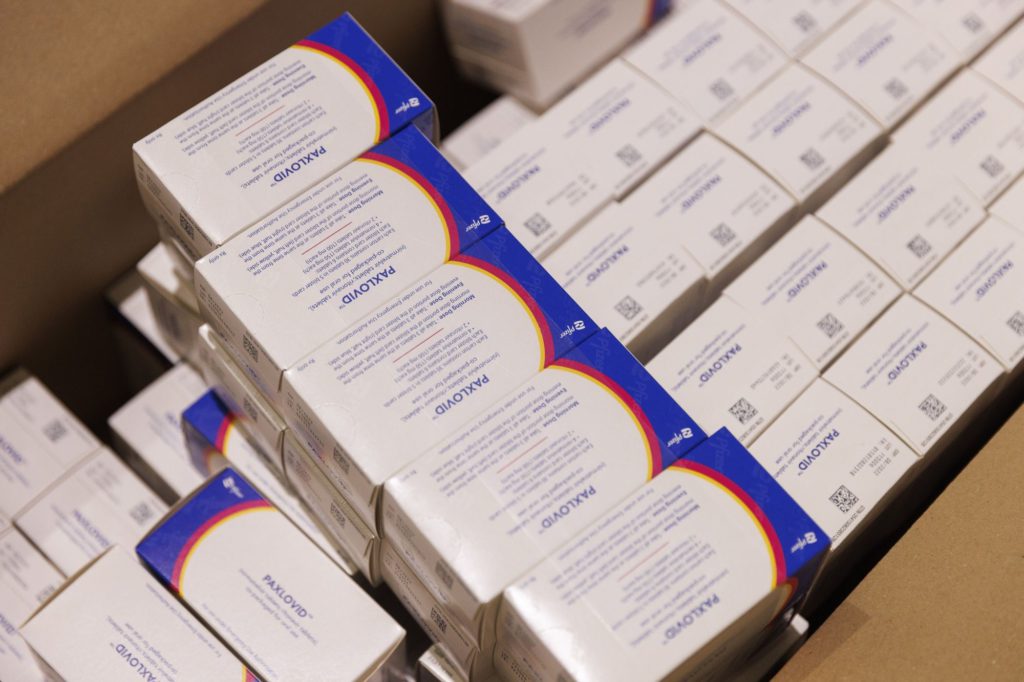
(Bloomberg) — New York City will start offering Pfizer Inc.’s Covid antiviral Paxlovid at “first of its kind” mobile test-to-treat sites across the city, providing immediate treatment for those who test positive for the virus.

Initially, mobile sites will be stationed outside of pharmacies in Inwood, South Ozone Park and the East Bronx, and will expand to 30 locations by the end of July, Manhattan’s Borough President Mark Levine said on Twitter Thursday. People who test positive for Covid and qualify for Paxlovid will be able to get a prescription on-the-spot, which they can take to a nearby pharmacy to pick up the drug. By the end of the summer, officials plan to bypass pharmacies entirely, offering Paxlovid directly through the mobile sites.

The new initiative aims to address some of the equity issues in who is getting Paxlovid and will help bolster access for people most at-risk of developing severe disease, New York City Mayor Eric Adams said during a press conference. Adams was joined by Ashish Jha, the White House Covid response coordinator, in Inwood to announce the mobile testing sites earlier. 

“We were the epicenter of the Covid pandemic at the start, but we’re leading the way in prevention and mitigation,” Adams said during the press conference. “What we’re doing here other cities can look at to make a determination of how they want to address Covid.”

Jha touted the country’s progress in reducing Covid deaths, despite there still being more than 100,000 infections each day — a number that’s likely an undercount due to at-home testing. Over the last two months, Jha said, there’s been a huge increase in the use of Paxlovid which has played a key role in keeping hospitalizations and deaths low. However, he said the use of Paxlovid lags in communities of color and neighborhoods of “high social vulnerability.”  

“This will become a national model,” Jha said. “Once New York begins to do this on a regular basis, it makes it easier for folks like me to talk to mayors and governors across the country.”

Earlier on Thursday, Pfizer asked US regulators for full approval of Paxlovid for people at high risk of developing severe disease, bringing the drugmaker one step closer to securing a formal clearance that would allow it to sell and market the antiviral outside of the public health emergency.  

More stories like this are available on bloomberg.com

©2022 Bloomberg L.P.
Michael Burry Thinks We May Be About Halfway Through Market Fall

(Bloomberg) — Michael Burry, the founder of Scion Asset Management who was made famous by Christian Bale in the movie “The Big Short,” said on Twitter that the first half declines in equity markets this year were “multiple compression” and following this will be earnings compression.

Burry recently warned that the Federal Reserve may need to reverse itself on rates and QT.

The famous investor’s warning comes as the S&P 500 suffered its worst first half since Richard Nixon’s presidency.

More stories like this are available on bloomberg.com

©2022 Bloomberg L.P.
Bears Picked Right Stocks to Short With Declines Twice the S&P’s

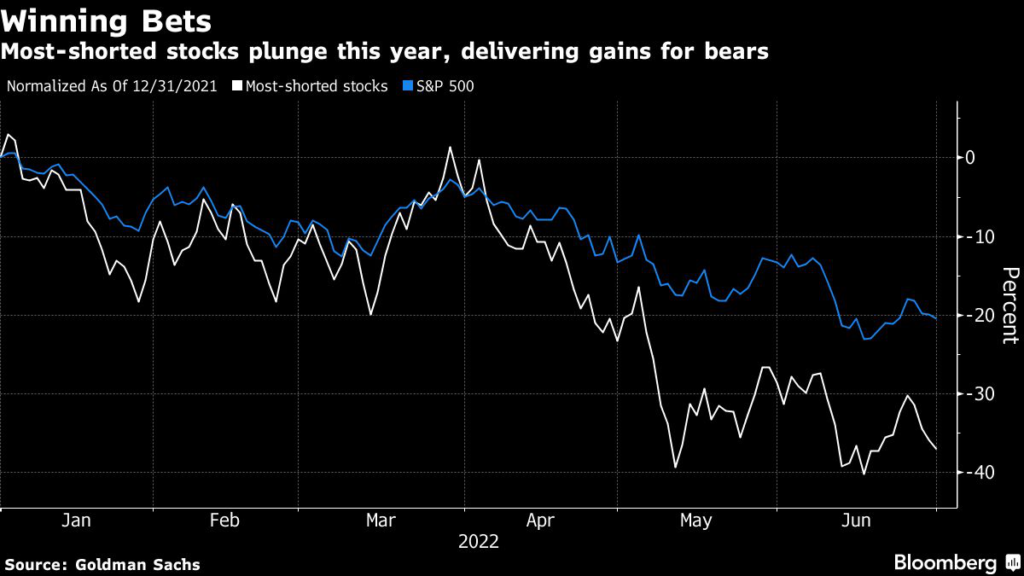
(Bloomberg) — To state the obvious, it has been a good time to be short the market. But the success of bearish traders in 2022 goes beyond luck.

With the S&P 500 down about 20% over the six months, baskets tuned to the favorite bets of those speculating on declines are showing bigger losses. An index of most-shorted stocks kept by Goldman Sachs Group Inc., for instance, is down 37%, suggesting the pessimists have done a particularly good job trawling for companies most exposed to the downdraft.

From Bed Bath & Beyond Inc. to Nikola Corp. and Beyond Meat Inc., profitless companies that once had no problem flying high are suddenly crashing down as the Federal Reserve embarks on the most aggressive monetary tightening in decades. Those three stocks are each down at least 50%, representing a boon to short sellers. 

“A lot of high-flying stocks were bid up to silly levels,” said Michael Purves, founder of Tallbacken Capital Advisors. “They were the first to provide good shorting opportunities.”

Redemption has been a long time coming in a corner of Wall Street that has been suffocated by years of mind-numbing gains in equities. The $1 trillion long-short hedge fund industry, which suffered money withdrawals for six full years in a row, saw inflows in the first quarter, data compiled by HFR show. 

Across the market, short sellers now sit on an unrealized gain of roughly $300 billion year-to-date, according to an estimate from S3 Partners, a data-analytics firm. 

“While the market has trended downward and shorts were making money on the downside, they were actively shorting to the tune of around $144 billion in 2022,” said Ihor Dusaniwsky, head of predictive analytics at S3. “Consumer discretionary and technology are the most profitable sectors to short.” 

Before this year bears had been almost driven to extinction during relentless equity gains. Now, with the Fed pledging to fight red-hot inflation and ceding its role as bulls’ ally, short sellers are getting their moment to shine. 

The windfall from betting against stocks has bolstered performance for hedge funds that usually take both bullish and bearish positions on equities. Those tracked by HFR is about 5 percentage points ahead of the S&P 500 this year through May. 

It’s a stunning reversal of fate from the previous 13 years, when hedge funds trailed the market every year. 

It’s “vindication of sorts,” said Matthew Tuttle, chief executive officer at Tuttle Capital Management LLC. “Obviously in an environment with the Fed pumping liquidity into the market it is hard to make money on the short side.” 

“These days it is a lot easier,” he added. “Unfortunately for the shorts, markets don’t go down forever so they need to enjoy it while it lasts.”

More stories like this are available on bloomberg.com

©2022 Bloomberg L.P.
Verizon, Kellogg, Kraft Heinz Will Cover Abortion Travel

(Bloomberg) — Verizon Communications Inc., Kellogg Co. and Kraft Heinz Co. said their employee health programs cover travel expenses for out-of-state medical procedures such as abortions.

The companies disclosed details about their policies in response to questions following the Supreme Court decision last week to overturn Roe v. Wade. 

Worker benefits at Verizon include health-care coverage for travel outside the state if services aren’t available within an employee’s state of residence. Those benefits were in place before the court decision, a Verizon spokesman said Thursday.

Verizon has about 120,000 employees in nearly every state in the US. The company joins mobile peers AT&T Inc. and T-Mobile US Inc. in disclosing travel-reimbursement policies following the landmark ruling.

Kellogg’s health coverage has also included abortions “for years,” the company said Thursday. It added that it’s “committed to ensuring our employees have equal access to quality health care regardless of where they live.” Workers and family members enrolled in the benefits program have coverage for travel reimbursement for eligible medical procedures not available in their home state, spokesperson Kris Bahner said.

Kraft Heinz’s health-care plan already included abortion procedures, a spokesperson said Thursday, and now includes travel for the procedures as well. These benefits are available to full-time employees working thirty hours a week or more.

(Updates with statement from Kraft Heinz in sixth paragraph.)

More stories like this are available on bloomberg.com

©2022 Bloomberg L.P.
Apple Ex-Corporate Law Chief Admits Years of Insider Trading

(Bloomberg) — The Apple Inc. lawyer who was once responsible for enforcing the company’s insider trading policy admitted he used his access to draft SEC filings to personally profit. 

Gene Levoff, Apple’s former director of corporate law, pleaded guilty on Thursday to six counts of securities fraud between 2011 and 2016. Levoff, 48, was co-chairman of the company’s disclosure committee, which allowed him to see Apple’s revenue and earnings statements before they were filed with the Securities and Exchange Commission. 

Levoff on several occasions made trades within quarterly blackout periods, even after telling other employees that they were prohibited from trading in Apple stock, according to federal prosecutors in New Jersey. He used the information to make $227,000 in profit and and to avoid losses of $377,000, according to the government. 

“Gene Levoff betrayed the trust of one of the world’s largest tech companies for his own financial gain,” New Jersey US Attorney Vikas Khanna said in a statement. “Despite being responsible for enforcing Apple’s own ban on insider trading, Levoff used his position of trust to commit insider trading in order to line his own pockets.”

Levoff’s lawyer, Kevin Marino, didn’t immediately respond to a request for comment.

Stanford Law Grad

US District Judge William J. Martini in Newark, New Jersey set Levoff’s sentencing for Nov. 10. The charges each carry a maximum sentence of 20 years in prison, though he is unlikely to get that much time.

The Stanford Law School graduate, who joined Apple in 2008, was first charged in 2019. Apple fired him in September 2018 after placing him on leave two months earlier, according to a filing in a related lawsuit by the SEC. Over his decade-long career at Apple, he was one of the company’s most senior legal executives, reporting directly to the general counsel.

Levoff last year tried to have the case thrown out as unconstitutional, arguing that no statute specifically bars insider trading. Prosecutors called his argument a bogus “Hail Mary,” and it was rejected by the judge.

The case is US v. Levoff, 19-cr-00780, U.S. District Court, District of New Jersey (Newark).

(Updates with background on case.)

More stories like this are available on bloomberg.com

©2022 Bloomberg L.P.
Kenya’s Ruto Pledges Food Security Drive, Rejects War Excuse

(Bloomberg) — Kenya’s Deputy President William Ruto dismissed comments by his boss that Russia’s invasion of Ukraine is partly to blame for higher living costs, vowing to boost farming if he wins the presidency in August.

Ruto pledged to invest at least 500 billion shillings ($4.2 billion) in agriculture and small businesses over five years. That investment would include providing animal feed and seeds to boost yields. Farming stood out in Ruto’s manifesto as a significant part of his so-called Bottom-Up economic model — where he seeks to channel government resources to sectors that can create the most jobs.

The answer to addressing the “cost of living is increasing agricultural productivity, period. This whole story about Ukraine and all this is a lost cause,” Ruto said at a rally at the Kasarani Stadium in the capital, Nairobi.

The country with East Africa’s largest economy will hold a general election on Aug. 9 to vote for a new president, governors and lawmakers. Ruto’s main rival, former Prime Minister Raila Odinga, is slightly ahead in the most-recent opinion polls.

Ruto’s remarks on Russia’s invasion of Ukraine come weeks after President Uhuru Kenyatta blamed the rising cost of living on factors including those he said are out of his control like the war — prices of everything from gasoline to fertilizer, corn and milk have surged. Kenyatta fell out with his deputy and is backing Odinga to replace him.

“If we had not withdrawn the fertilizer subsidy” and “stuck to the plan on food security,” Ruto said, “we wouldn’t be in the crisis we are in today.”

Ruto, 55, pledged to also boost investment in housing, health care, manufacturing, services and information and communication technology. He spent almost two hours explaining a plan he said followed town-hall meetings in the country’s 47 counties and consultations with groups of farmers, women, health care workers, youths and business people.

Ruto said his administration will ramp up the production of key commodities, including milk, edible oils and rice. To do this, he plans to provide capital at competitive rates to farmers. If voted in, he said his government will expand Kenya’s agricultural extension services.

Whoever wins the election will have the task of steering an economy projected to slow this year, a growing debt burden, inflation that’s breached the upper limit of the central bank’s target range and high unemployment. Odinga vowed to tackle the load of commercial loans under a plan that involves potentially restructuring public debt, a declaration that contributed to the price of the country’s eurobonds plunging this week. 

Ruto also said that the country is “in a debt hole” and debt-servicing costs are the single largest expenditure item in the recurrent budget. “If you find yourself in a hole stop digging,” Ruto said without giving details on how he will address government liabilities.

Odinga leads Ruto 39% to 35% among likely voters, Nairobi-based pollster Tifa Research said in May, the first time the opposition leader edged ahead of the deputy president.

Other manifesto highlights:

  • The deputy president pledged to provide 50 billion shillings each year as credit to small businesses at competitive rates.
  • Ruto promised to allocate half of his cabinet ministerial positions to women to promote gender parity across the government.
  • His government will increase the supply of new housing to 250,000 units per year. He pledged to grow the number of mortgages to 1 million from 30,000 currently.
  • He pledged to reform the health care system to deliver universal coverage.
  • Ruto plans to direct 40 billion shillings to ensure broadband connectivity throughout the country in five years. He also plans to commit about 2.5 billion shillings each year to back technology startups.
  • He will seek 200 billion shillings by securitization of a fuel levy, and spend it on completing roads under construction and upgrading others in rural and urban areas.

“This plan is rigorously appraised and finance-able within the resources constraint that we face,” Ruto said. 

More stories like this are available on bloomberg.com

©2022 Bloomberg L.P.
From Suncor to Shopify, Canada Stocks Whipsaw on Recession Fears

(Bloomberg) — This was supposed to be a blowout year for Canadian equities, benefiting from soaring commodity prices and a forceful post-pandemic rebound in consumer spending. Instead, the country’s benchmark index is slumping amid the global stock selloff, though not as badly as its US counterpart.

The S&P/TSX Composite Index declined 11% in the first half of 2022 as recession fears weighed on the value-heavy market, outperforming the S&P 500 Index, which fell 21%. Underscoring the market effects of inflation, Suncor Energy, one of Canada’s largest energy companies, soared 43%, while Shopify Inc. plunged, losing more than C$170 billion in market capitalization.

Here’s a look at some of the standout stock movers of the first half:

Once Canada’s most valuable publicly traded company, Shopify has sunk 77% this year amid a broad selloff in technology stocks and slowing e-commerce traffic. The tumble makes the beleaguered stock and the S&P/TSX Information Technology Sector Index the market’s worst performers. Even Shopify’s 10-for-1 stock split on Wednesday wasn’t enough to drum up investor interest, with the share price falling on the news.

Soaring oil prices boosted energy stocks, which are up 24% this year. Oil and gas stocks may have more room to run. Earnings in the sector are expected to skyrocket, with the blended forward 12-month average earnings per share expected to jump 59%, compared with 30% for the S&P/TSX and 20% for the S&P 500, according to Bloomberg data.

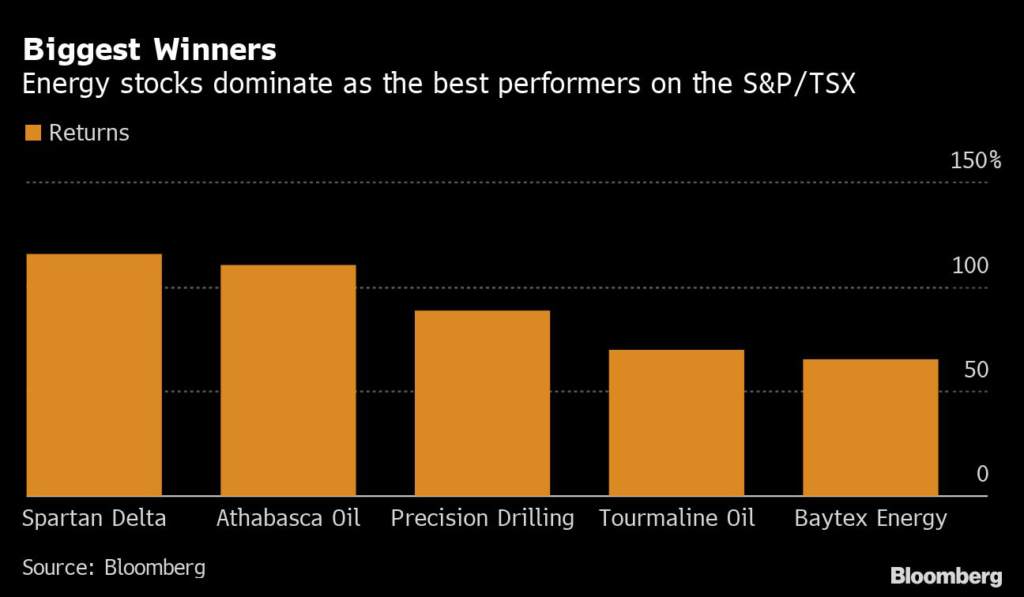
Nine of the top 10 performers on the S&P/TSX are energy stocks, with Spartan Delta Corp. and Athabasca Oil Corp. leading gains with 109% and 107% increases respectively.

Meanwhile, financial stocks have spiraled as rising interest rates and record inflation spook investors. Banks and insurers, which make up nearly one-third of the broader market, have weighed on the benchmark. 

Canada’s largest lenders were down 20% last week from their record high in February and have continued to hover near that territory. If a recession ravages markets, heavyweight financials could take another chunk out of the index. Canadian Imperial Bank of Commerce, Bank of Nova Scotia and Toronto Dominion Bank led the losses, all falling more than 12% in the first half.

The Canadian market started off the year strong, climbing as investors pivoted away from growth stocks toward value. As recession fears set in, the benchmark has descended further into the red while maintaining its outperformance over US equities. 

The S&P/TSX has handily beat the S&P 500 Index this year, and many market strategists expect the index to end the year by outperforming its US counterpart for the first time since 2016 — so long as the economy avoids a downturn into a recession and oil demand remains high.

(Updates closing share prices and Shopify market cap.)

More stories like this are available on bloomberg.com

©2022 Bloomberg L.P.
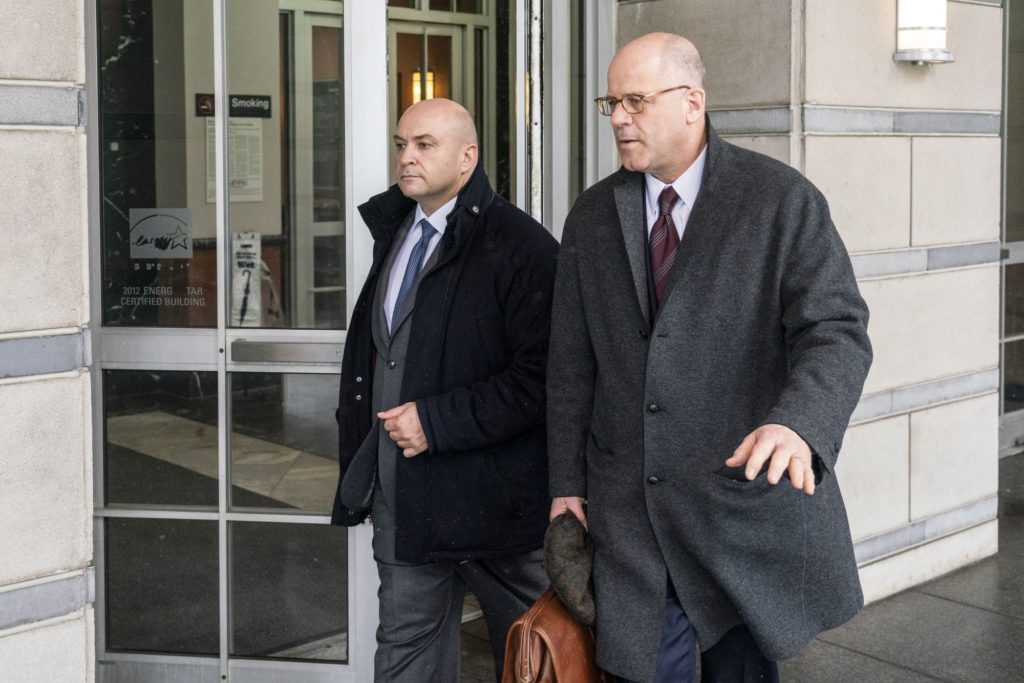
JPMorgan’s Michele Warns on Recession as Brutal First Half Draws to End

(Bloomberg) — Bob Michele kicked off his Wall Street career during the stagflation crisis of the early 1980s.

More than four decades later, JPMorgan Asset Management’s chief investment officer says the economic outlook today looks even worse — with a US recession now looking more likely than a soft landing. 

Central banks are a long way from reversing the most flagrant excesses of the easy-money era while inflation looks ever-more entrenched, per Michele. 

His pessimism is reflected in an historically bad first half of a year that’s just drawn to a close. Stocks and bonds around the world combined have fallen by the most on record, according to Bloomberg data going back to 1990, with $8 trillion wiped off the S&P 500 alone.

“This current period is no doubt the most challenging in my career,” Michele said in an interview. “You are stuck with a lot of liquidity in the system and rates that look ridiculously low relative to the levels of growth and inflation that we are seeing and where employment is.”

With books now closed, the Nasdaq 100 has fallen nearly 30% in the first half while the MSCI World Index has shed more than 20%.

There have been few safe spaces while sanguine predictions heading into the year have misfired. The 10-year yield, a key benchmark for mortgages, corporate debt and the valuation of equities, has more than doubled this year from 1.5% to a recent high of around 3.5%, a level last seen in 2011. In December, economists saw the US 10-year Treasury yield hitting 2% by the end of 2022.

“What surprised markets was inflation and it has been the driver year to date,” said Erin Browne, a fund manager at Pacific Investment Management Co. 

What’s more, the slump in cryptocurrencies, like Bitcoin to Ethereum, has wiped out trillions in value combined from once high-flying digital tokens — an asset class almost absent in past crises. 

“Many people have been caught up in the crypto craze,” Mark Mobius, partner and co-founder of Mobius Capital Partners, said in an interview. “This is creating a real problem in the financial market because it’s having a very big impact on sentiment. It’s a very unusual and challenging situation.”

Read more: Nearly All of Wall Street – and the Fed – Botched Calls for 2022

Commodities were the only outperformers as the Russia-Ukraine war hit supply. 

The question now is whether dip buyers will be rewarded as valuations plunge — or if a brewing economic downturn and supply-side-driven price pressures will intensify the cross-asset selloff. 

Stock strategists are still seemingly bullish. Oppenheimer’s John Stoltzfus sees the S&P 500 ending 2022 at 5,330, requiring a roughly 40% rally in the next six months. A handful of others, including JPMorgan and Credit Suisse Group AG, have targets that require the index to rebound at least 30% to be met. Wall Street strategists, on average, see the S&P 500 gaining more than 20% in the latest Bloomberg survey.

Nonetheless there’s likely to be less lasting damage inflicted by any inflation-driven recession than in 2008’s credit crisis, which sparked a profit decline of 57%, Morgan Stanley Wealth Management’s chief investment officer Lisa Shalett wrote in a note this week.  

But if Michele is right about the dim prospects for a soft landing, risk assets like stocks and credit could do even worse.

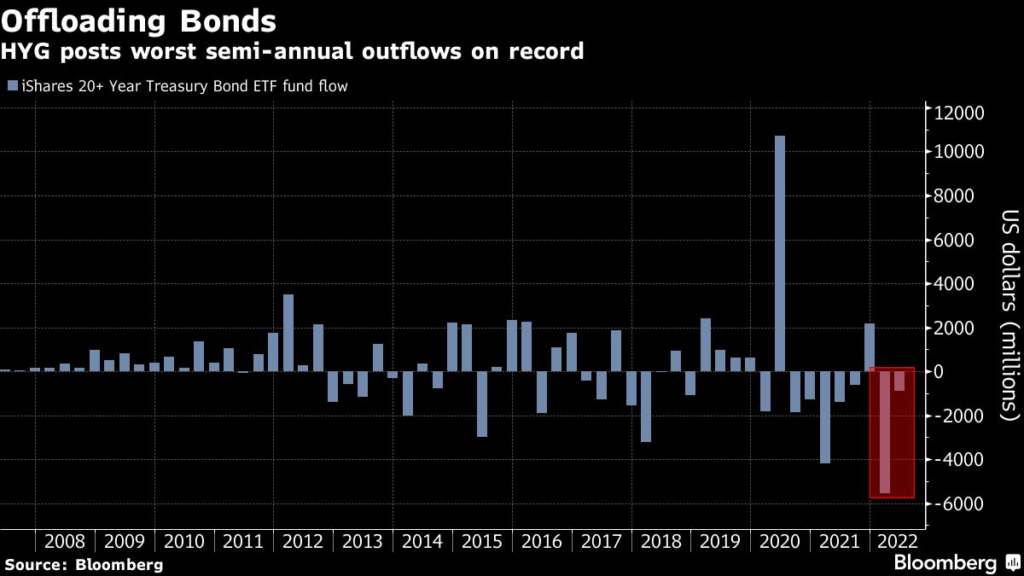
Investors have already yanked more than $6.7 billion from the iShares iBoxx High Yield Corporate Bond ETF over the last six months, the biggest semi-annual outflows since its 2007 inception, according to Bloomberg data. 

The bond market in particular is struggling to decide what to worry about more: high inflation, or emerging recession fears. US Treasuries have rallied in recent days amid recession fears, bringing down 10-year yields to near 3%.  

Michele, who’s endured every rout from Black Monday and the dot-com crash to the 2008 crisis, remains skeptical of the signals in fixed income that price pressures are ebbing. Unlike some peers, he’s staying short on duration in his bond portfolios and isn’t ready to give up his guard on inflation.

“We had gone through recessions, deep and shallow, and we recovered. What we are learning is that high inflation expectations when they are entrenched can become destructive,” he said. “And the central banks now have to scramble to try to get that out of system while trying to engineer a soft landing. Stagflation and recession look more likely to us than soft-landing.”

More stories like this are available on bloomberg.com

©2022 Bloomberg L.P.

Close Bitnami banner
Bitnami