
Bloomberg

Technology Stocks Head for Historic Wipeout as US Economy Cools

(Bloomberg) — Skeptics have long made a sport of predicting that the decade-long rally in technology stocks was destined to reverse. At the halfway point of 2022, it seems like this is the year when they will be proven right.

The Nasdaq 100 Index has tumbled by almost a third this year, including a 1.3% drop on Thursday, erasing some $5.4 trillion in value in a selloff that has left few stocks unscathed. The benchmark, which gets half its value from tech, ended down 9% for the month of June, and sank more than 20% over the second quarter. It is on track for its biggest calendar-year decline ever.

And it’s hard to make a convincing case for a market recovery in the second half: Investors are pricing in further interest rate increases from the Federal Reserve as the central bank tries to combat inflation, sparking concern that the global economy will tip into recession. Analysts are beginning to cut earnings estimates for technology companies as a result.  

“The issue is that we haven’t really seen inflation like this in decades,” said Michael Nell, a senior investment analyst and portfolio manager at UBS Asset Management. “Since 2009 or so we’ve had very low rates that contributed to the years of strength we saw. However, those low rates weren’t going to last forever.”

Here’s a look at the first half of the year for tech:

From Feast to Famine

Some of the biggest winners of the pandemic years morphed into the worst performers in 2022, among them streaming giant Netflix Inc., telemedicine company Teledoc Health Inc., and companies such as Zoom Video Communications Inc. and DocuSign Inc. that benefited from the rise of remote work.

Read more: Netflix Bulls Dwindle as Year’s Collapse Nears 70%

See also: Meta Plunge Lures Value Buyers as Growth Funds Flee

A Whole New World

At this rate, the Nasdaq 100 would finish the year down 50%, the biggest annual collapse in the almost four decades that Bloomberg has tracked the benchmark. The last time the index fell in a calendar year was 2018, when it dipped 1%, and its last notable decline was in 2008. It had bigger peak-to-trough plunges in the wake of the late 1990s internet bubble — an 83% wipeout — and in the 2007-2008 crisis, when it dropped by more than half. 

Selling this year has raged across industries, with long-time market leaders collapsing. Apple Inc., Microsoft Corp. and Alphabet Inc. have all lost more than 20%, Nvidia Corp. is down almost 50%, and Meta Platforms Inc. has lost more than half its value. Indexes of semiconductor and software stocks have both fallen by about a third.

Amazon.com Inc. is off 36% for the year, with basically all of that coming in the second quarter of 2022. The roughly 35% drop over the three-month stretch represents its biggest one-quarter percentage drop since 2001.

Shrinking Values

This year’s successive selloffs have cut some of the biggest technology companies down to size. The Nasdaq 100 now has 21 members with market values of $100 billion or more, down from 33 at the end of last year.

Finding Safety in Value

The oldest of old tech has been a pocket of strength in the market. International Business Machines Corp. has returned 8.2% this year including dividends. Of course, the strength comes after an extended stretch of massive underperformance. IBM has returned 20% over the past five years versus a gain of more than 150% for the S&P 500 tech index.

IBM’s year-to-date advance reflects investors’ shift into cheaper, dividend-paying stocks and out of highly valued growth stocks that have led the market for years. IBM trades at less than 14 times estimated earnings, a discount to the market, and yields 4.7% annually in dividends, the highest among tech companies in the S&P 500. 

“Quality and value is probably the best place to be in the short term,” said Michael Arone, chief investment strategist at State Street Global Advisors’ U.S. SPDR business. “A lot of the names we’ve seen outperform this year have low variance in their earnings, good cash flow, they pay dividends, and they’re relatively stable businesses.”

‘Light at the End of the Tunnel’

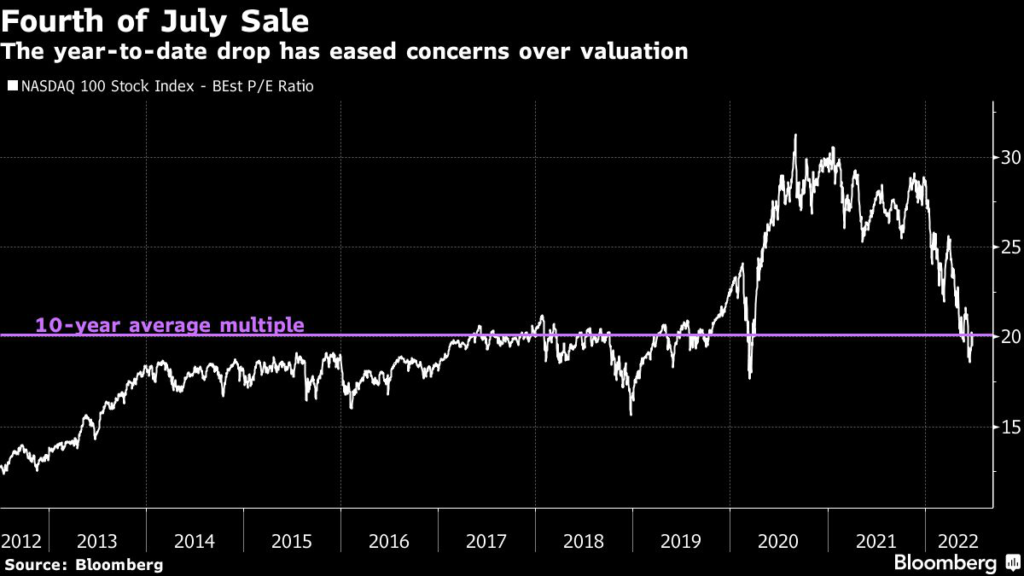
Bulls hold out hope that this year’s market plunge will bottom out as investors embrace the technology industry’s long-term growth potential and cheaper valuations. The Nasdaq 100 is now trading at about 19.2 times estimated earnings, well below a 2020 peak above 31, and under its 10-year average of about 20.1.

Nell, of UBS Asset Management, is among those keeping the faith.

“We expect tech will eventually resume its leadership position,” he said in a phone interview. “There are always ups and downs, but the long-term trend is one of tech outperformance. We see light at the end of the tunnel we’re in.”

Top Tech Stories

  • Samsung Electronics Co. kicked off mass production of 3-nanometer chips that are more powerful and efficient than predecessors, beating rival Taiwan Semiconductor Manufacturing Co. to a key milestone in the race to build the most advanced chips in the world.
  • The turmoil in the cryptocurrency industry has ravaged portfolios and left large and small investors struggling to adapt. It’s also taken a toll on a corner of the tech world that once benefited from crypto’s rise: Nvidia Corp. graphics cards.
  • Venture firm IDG Capital is poised to raise about $900 million for a new fund focusing on investment in China, a rare feat amid skepticism about the political and market risks of Asia’s largest economy.
  • A co-founder of SenseTime Group Inc. lost almost half of his fortune after shares of the artificial intelligence giant plummeted 47% on Thursday.

(Updates with close of trading.)

More stories like this are available on bloomberg.com

©2022 Bloomberg L.P.
Investors Lose $1.8 Trillion With Consumer Stocks Mired in Record Rout

(Bloomberg) — Investors in consumer stocks are nursing their wounds after witnessing a wipeout of $1.8 trillion in market value in the first half of the year as soaring inflation and swollen inventories crimp corporate profits.

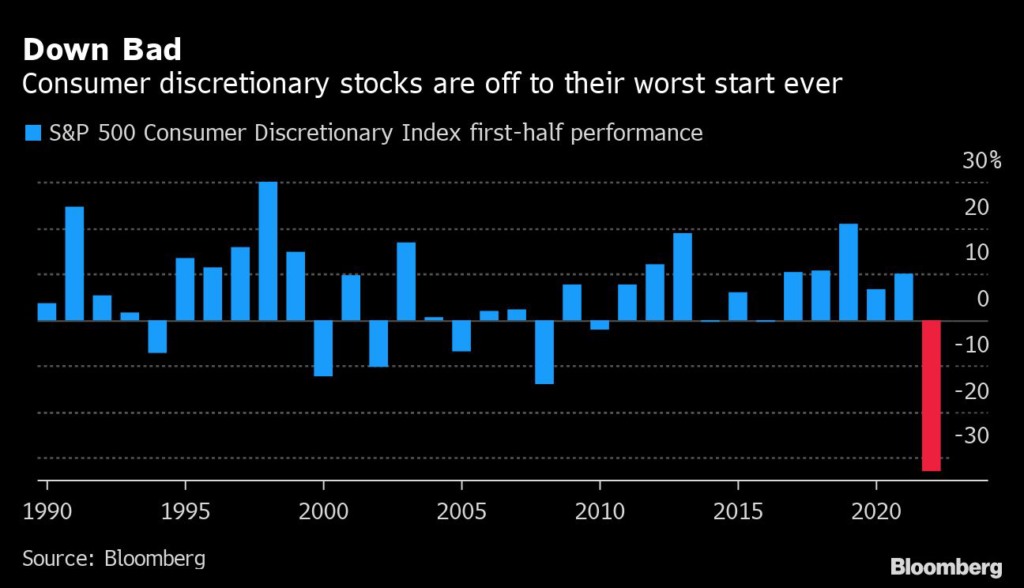
The S&P 500 Consumer Discretionary Index slumped 33% in its worst first half of the year on record in a market strained by rising costs and surging interest rates. The group is the biggest loser on the S&P 500 Index as recession concerns weigh on shoppers’ spending decisions. Adding to that wall of worry, US consumer spending fell in May for the first time this year, signaling a cooling economy that’s on weaker footing.

“As consumers continue to pull in their horns, I think that these stocks can go lower,” said Matt Maley, chief market strategist for Miller Tabak + Co.

The rout this year was laid bare in the quarterly earnings season when companies from Walmart Inc. to Target Corp. cut their annual profit forecasts. This week, RH became the latest retailer to temper investors’ expectations for the year, while Bed Bath & Beyond Inc. released a lackluster earnings report showing quarterly sales fell even more than anticipated. 

Part of the problem is that stores are awash in products that consumers don’t want. At the same time, companies are grappling with surging fuel and labor expenses, and the challenge to pass on those costs to consumers.

Etsy Inc. is the biggest decliner in the consumer discretionary index so far in 2022, plunging 67% as the boost in online sales from the Covid-19 pandemic fades. Other top decliners include Bath & Body Works Inc., Caesars Entertainment Inc. and Carnival Corp. 

The only stocks in the 58-member index that notched gains for the first half of the year are Dollar Tree Inc., Dollar General Corp. and AutoZone Inc. They are up about 11%, 4% and 3% this year, respectively.

The pair of deep-discount retailers reported stronger-than-expected quarterly results last month, with consumers beginning to trade down to less expensive products. Meanwhile, AutoZone has advanced as analysts from Morgan Stanley and Goldman Sachs Group Inc. upgraded their recommendations on the shares, touting the largely non-discretionary nature of auto-part sales. 

In Sea of Red, Three Consumer Stocks Are Glowing Green: Chart

Despite being the worst performing group on the S&P 500, consumer discretionary stocks still aren’t cheap, trading at around 20 times projected earnings, while the benchmark has an earnings multiple of 16.

“The derating in consumer discretionary has been major, but I still don’t think it’s trading at a reasonable enough valuation to make it worth dipping your toe into that pool just yet,” Jonathan Mackay, Schroders investment strategist, said earlier this week.

(Updates share-price moves and charts throughout)

More stories like this are available on bloomberg.com

©2022 Bloomberg L.P.
FTX Nears Deal to Buy Lender BlockFi in Likely Fire Sale

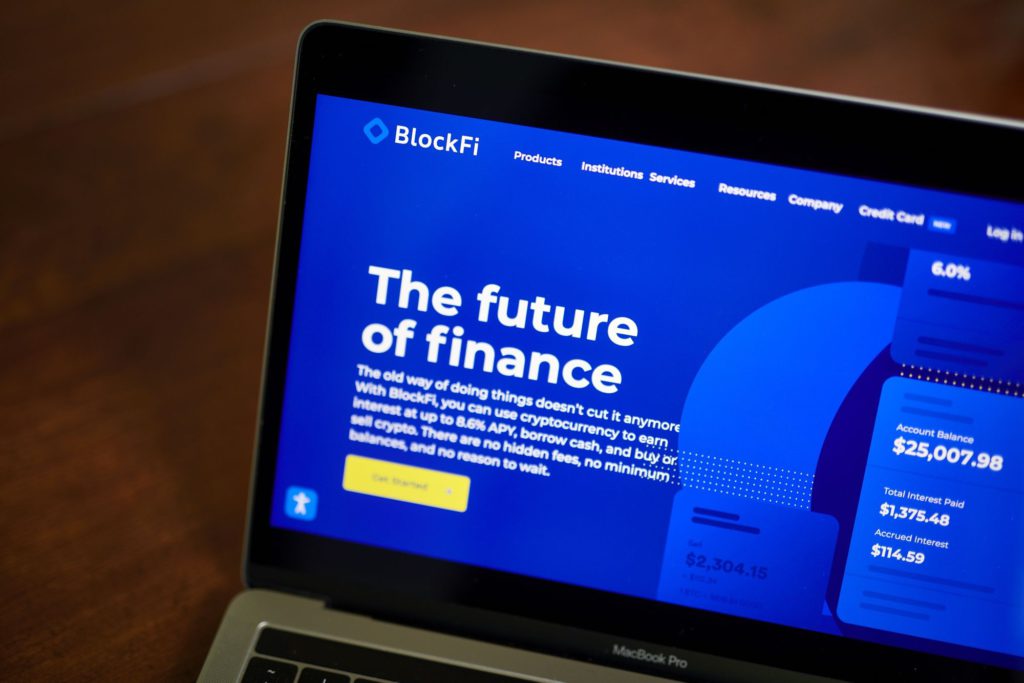
(Bloomberg) — FTX, the digital-asset exchange co-founded by Sam Bankman-Fried, is nearing an agreement to buy BlockFi Inc. after extending a credit line to the beleaguered crypto lending platform, according to people familiar with the matter.  

CNBC reported earlier that FTX is paying roughly $25 million and that a term sheet is almost complete, citing unnamed sources. Zac Prince, chief executive officer of BlockFi, responded in a tweet, saying “I can 100% confirm that we aren’t being sold for $25M.” Prince didn’t comment in the tweet whether BlockFi was in acquisition talks.

That price tag would represent a deep discount from BlockFi’s $3 billion valuation in March 2021. In early June, it sought to raise money at a reduced valuation of about $1 billion. BlockFi is among those affected by a liquidity crunch in the industry and the troubles at Three Arrows Capital. It had acknowledged that it liquidated a large client that failed to meet its obligations on an overcollateralized margin loan, without naming the client. 

Earlier this month, FTX agreed to provide a $250 million revolving credit facility to BlockFi. Bankman-Fried has been acting as a lender of last resort for some troubled crypto companies and has also provided credit lines to Voyager Digital Ltd., which is exposed to bad debt by Three Arrows. 

Based in Jersey City, New Jersey, BlockFi recently cut headcount by 20%, and its executive team, including founders Prince and Flori Marquez, took a pay cut due to market conditions. 

A FTX spokesperson said it will not be commenting on the matter. A spokesperson at BlockFi referred to Prince’s tweet when asked about the deal talks. 

Elsewhere, rival crypto lender Celsius Network, which halted user withdrawals more than two weeks ago amid liquidity issues, said it’s exploring options such as “strategic transactions as well as a restructuring of our liabilities.” The lender didn’t elaborate in a blog post Thursday. 

An infusion from FTX appears unlikely. Celsius approached Bankman-Fried, and asked for a bailout but was rejected, according to a person familiar with the matter. Celsius didn’t immediately return a request for comment.          

(Includes information on Celsius in the last two paragraphs.)

More stories like this are available on bloomberg.com

©2022 Bloomberg L.P.

Apple’s Ex-Corporate Law Chief Admits Years of Inside Trades

(Bloomberg) — The Apple Inc. lawyer who was once responsible for enforcing the company’s insider trading policy pleaded guilty to illegally trading for years on confidential revenue and earnings filings.

Gene Levoff, Apple’s former director of corporate law, on Thursday admitted he regularly traded on inside information between 2011 and 2016. Levoff, 48, of San Carlos, California, pleaded guilty to six counts of securities fraud in a videoconference before US District Judge William J. Martini in Newark, New Jersey. He was initially charged in February 2019.

The Stanford Law School graduate, who joined Apple in 2008, is scheduled to be sentenced on Nov. 10. The securities fraud counts to which Levoff pleaded guilty each carry a maximum sentence of 20 years in prison, though he is unlikely to get that much time.

“Gene Levoff betrayed the trust of one of the world’s largest tech companies for his own financial gain,” New Jersey US Attorney Vikas Khanna said in a statement. “Despite being responsible for enforcing Apple’s own ban on insider trading, Levoff used his position of trust to commit insider trading in order to line his own pockets.”

Levoff’s lawyer, Kevin Marino, didn’t immediately respond to a request for comment.

Draft SEC Filings

Prosecutors said Levoff was co-chairman of Apple’s disclosure committee, which allowed him to see draft filings before they were released to the US Securities and Exchange Commission. He used the information to make $227,000 in profit and and to avoid losses of $377,000, according to the government.

Levoff on several occasions made trades within quarterly blackout periods, even after telling others employees that they were prohibited from trading in Apple stock, according to prosecutors.

Apple fired Levoff in September 2018 after placing him on leave two months earlier, according to a filing in a related lawsuit by the U.S. Securities and Exchange Commission. Over his decade-long career at Apple, he was one of the most senior legal executives, reporting directly to the company’s general counsel.

The case is US v. Levoff, 19-cr-00780, U.S. District Court, District of New Jersey (Newark).

More stories like this are available on bloomberg.com

©2022 Bloomberg L.P.
FTX Nears Deal to Buy Crypto Lender BlockFi in Likely Fire Sale

(Bloomberg) — FTX, the digital-asset exchange co-founded by Sam Bankman-Fried, is nearing an agreement to buy BlockFi Inc. after extending a credit line to the beleaguered crypto lending platform, according to people familiar with the matter.  

CNBC reported earlier that FTX is paying roughly $25 million and that a term sheet is almost complete, citing unnamed sources. Zac Prince, chief executive officer of BlockFi, responded in a tweet, saying “I can 100% confirm that we aren’t being sold for $25M.” Prince didn’t comment in the tweet whether BlockFi was in acquisition talks.

That price tag would represent a deep discount from BlockFi’s $3 billion valuation in March 2021. In early June, it sought to raise money at a reduced valuation of about $1 billion. BlockFi is among those affected by a liquidity crunch in the industry and the troubles at Three Arrows Capital. It had acknowledged that it liquidated a large client that failed to meet its obligations on an overcollateralized margin loan, without naming the client. 

Earlier this month, FTX agreed to provide a $250 million revolving credit facility to BlockFi. Bankman-Fried has been acting as a lender of last resort for some troubled crypto companies and has also provided credit lines to Voyager Digital Ltd., which is exposed to bad debt by Three Arrows. 

Based in Jersey City, New Jersey, BlockFi recently cut headcount by 20%, and its executive team, including founders Prince and Flori Marquez, took a pay cut due to market conditions. 

A FTX spokesperson said it will not be commenting on the matter. A spokesperson at BlockFi referred to Prince’s tweet when asked about the deal talks. 

More stories like this are available on bloomberg.com

©2022 Bloomberg L.P.
Celsius Says Its Exploring Strategic Transactions, Restructuring

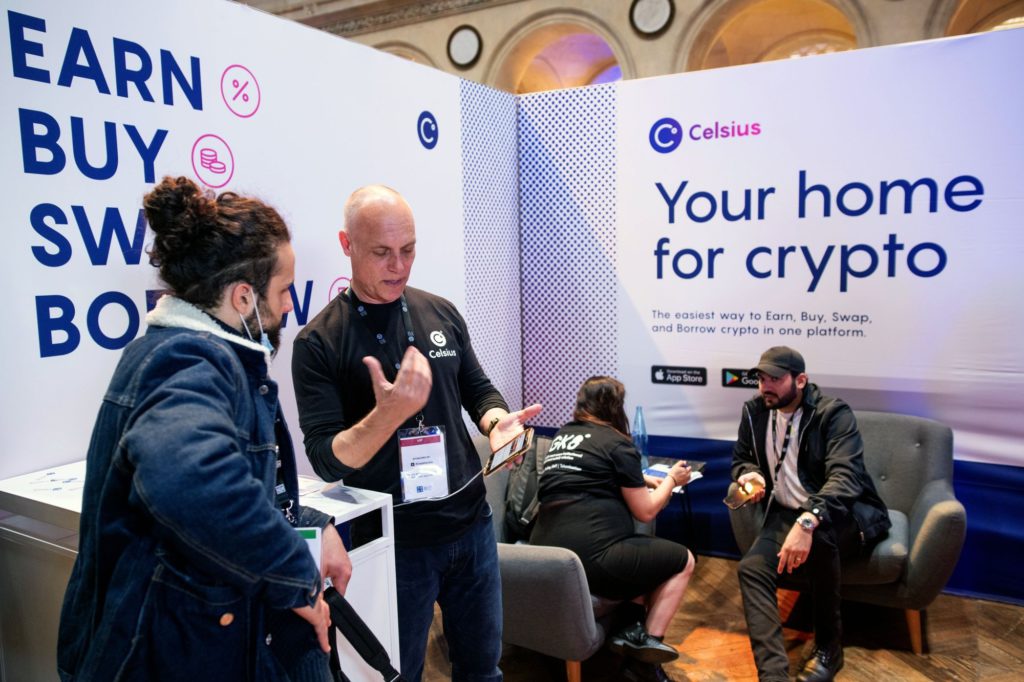
(Bloomberg) — Crypto lender Celsius Network, which halted user withdrawals more than two weeks ago amid liquidity issues, said it’s exploring options such as “strategic transactions as well as a restructuring of our liabilities.”

The lender didn’t elaborate in a blog post Thursday. Celsius, which let users lend out their coins for up to more than 18% annualized rate, grew to more than 1.7 million users and at one point had more than $20 billion in assets before its fall from grace. On June 12, Celsius halted withdrawals and other functions citing “extreme market conditions.” The company made several risky bets that didn’t pay off, as coin markets tanked. Celsius is one of a number of crypto firms battling liquidity issues that include crypto lenders Babel and BlockFi and hedge fund Three Arrows Capital.

Celsius last provided an update to users on June 19.

An infusion from FTX, one the largest crypto exchanges, appears unlikely. Celsius approached FTX head Sam Bankman-Fried, and asked for a bailout but was rejected, according to a person familiar with the matter. Celsius and FTX didn’t immediately return requests for comment. 

(An earlier updated corrected to billions in the second paragraph.)

More stories like this are available on bloomberg.com

©2022 Bloomberg L.P.
Microsoft Targets Carbon Removal With Climate Research Effort

(Bloomberg) — Microsoft Corp. has launched a climate research effort in a bid to build a network of participants to tackle some key problems affecting the environment. 

The Microsoft Climate Research Initiative will at first focus on carbon reduction and removal, carbon accounting and environmental resilience, the Redmond, Washington-based company said in a blog post Wednesday. An initial round of nine projects includes work on reducing emissions from cement and monitoring carbon dioxide in the atmosphere.

The projects, all collaborations between company experts and academics, were “curated intentionally where we have opportunity to drive high impact with the use of computational tools as well as specific domain expertise,” a company spokesperson said in an email. The results of these collaborations will be freely available to the public.

One project is examining ways to reduce the environmental impact of cement. The concrete industry accounts for 5-8% of global carbon dioxide emissions, the bulk of which can be attributed to cement, said Eleftheria Roumeli of the University of Washington, one of the researchers. 

“The overarching goal of this exciting new chapter would be to reduce the carbon footprint of cement and minimize the experiment we need to do to deliver sustainable solutions” by taking advantage of machine learning, she said.

Most of the projects are new, though some of the people involved were already engaged in research at the tech giant. Roumeli, for example, was already working with Microsoft’s Bichlien Nguyen to examine the environmental footprint of sustainable materials, green cements and biodegradable plastics from biological matter as part of the company’s Project Zerix, which is trying to create more sustainable materials for the IT industry. Microsoft has pledged to be carbon negative by 2030.

More stories like this are available on bloomberg.com

©2022 Bloomberg L.P.
Bitcoin Miner Loses Bid to Renew Power-Plant Permit in N.Y.

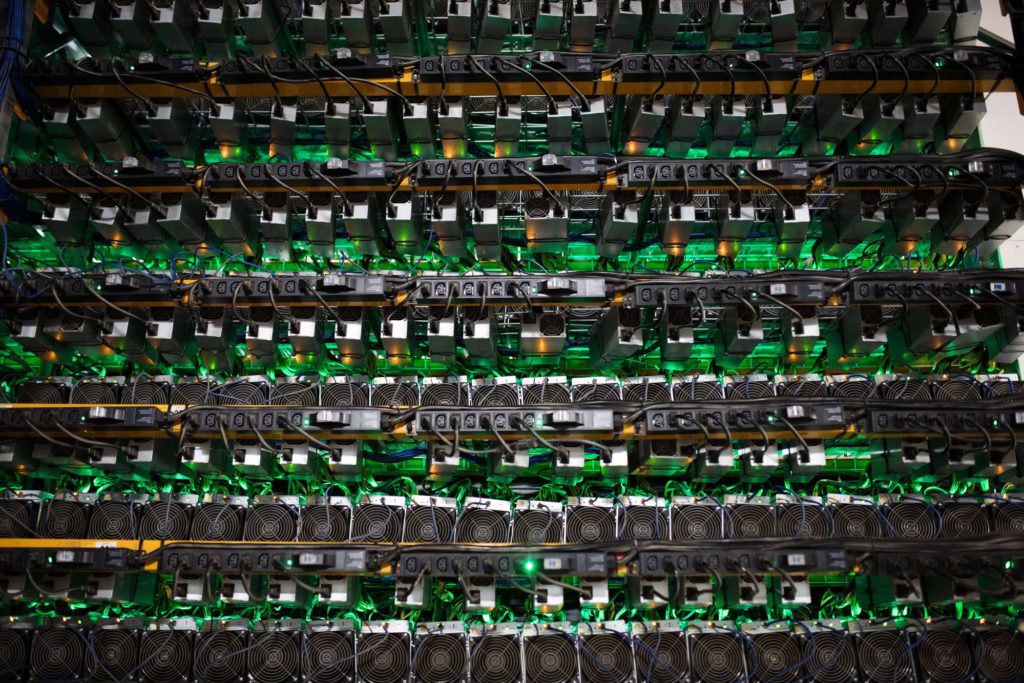
(Bloomberg) — New York State rejected the renewal permit for a power plant used by Greenidge Generation Holdings Inc. for Bitcoin mining, a decision that comes after about six months of delays.

The Department of Environmental Conservation said it denied the application because of statewide limits on greenhouse gas emissions.

The ruling comes amid a heated debate between environmental groups and cryptocurrency miners about Bitcoin mining, which uses energy-intensive computers to process records of transactions and earn rewards in the virtual currency. It has become one of the most lucrative businesses and has expanded rapidly in the US. 

Still, New York is putting forward restrictive measures on crypto mining facilities. The state Senate recently passed a bill that bars miners from using fossil-fuel sources to power their operations.

The bill is set to be delivered to Governor Kathy Hochul, who will decide whether it should become law. Hochul didn’t respond to a request for comment on the legislation.

This is the first time Greenidge’s permits to operate the natural-gas fired facility in upstate Dresden have come up for renewal. The state agency delayed decisions in January and again in March. 

In its notice, the regulator said Greenidge hasn’t identified adequate mitigation measures or alternatives, and the mining operation’s inconsistency with emission limits isn’t justified.

Greenidge has said its operations are carbon neutral. Still, environmental advocates have criticized the mine, and politicians such as US Senator Elizabeth Warren have questioned the entire industry about its impact on the climate.

“Governor Hochul and the DEC stood with science and the people, and sent a message to outside speculators: New York’s former fossil fuel-burning plants are not yours to reopen as gas-guzzling Bitcoin mining cancers on our communities,” said Yvonne Taylor, vice president of Seneca Lake Guardian, a nonprofit group advocating for environmental protection. 

More stories like this are available on bloomberg.com

©2022 Bloomberg L.P.

‘Cryptoqueen’ Ignatova to Be Added to FBI’s Most-Wanted List

(Bloomberg) — Ruja Ignatova, the woman also known as ‘Cryptoqueen,’ is being added to the FBI’s list of Ten Most Wanted fugitives for allegedly swindling millions of investors to send her at least $4 billion in the OneCoin cryptocurrency company she founded. 

US authorities on Thursday said Ignatova was the mastermind behind OneCoin, which they called one of the largest pyramid schemes in history. While Ignatova claimed OneCoin was backed by a blockchain, it was nonexistent, said Michael Driscoll, head of the Federal Bureau of Investigation’s New York office. 

“Ignatova had a sterling resume, she reportedly studied law at Oxford and worked at McKinsey, but she now sits side by side on the top 10 list of cartel leaders, kidnappers and murderers,” Damian Williams, the US Attorney for the Southern District of New York said at a news conference Thursday.

The US unsealed an indictment against her in 2019, charging her with wire fraud, conspiracy to launder money and securities fraud. The FBI is offering a $100,000 reward for information leading to her arrest. Her exploits became the subject of a successful BBC podcast “The Missing Cryptoqueen.”

Inside the Biggest Bitcoin Hack in History

No Real Value

OneCoin generated 3.4 billion euros ($3.78 billion) in revenue from the fourth quarter of 2014 to the third quarter of 2016, but had no real value and couldn’t be used to buy anything, according to prosecutors. It operated as a multilevel marketing network that paid commissions to its more than 3 million members worldwide for recruiting others to buy OneCoin packages, prosecutors said.  

A German citizen who lived in Bulgaria, Ignatova created OneCoin in 2014 and led the organization, according to Driscoll. It operated around the world, including in the US, and at one point claimed to have at least three million investors.

Ignatova filled auditoriums across the globe urging investors to join “the financial revolution” and promising them that OneCoin “would transform the life of the unbanked people,” Williams said. Instead she was “just capitalizing on the frenzied speculation in the early days of cryptocurrency.” 

After she grew suspicious that the US was watching her, Ignatova got on a flight to Greece and then vanished, Driscoll said, noting she has ties to Russia, Greece and is believed to have traveled to other Eastern European countries and the United Arab Emirates.

Brother Arrested

Ignatova’s brother, Konstantin Ignatov, was arrested in March 2019 in Los Angeles. He later pleaded guilty to fraud and money laundering charges and testified for prosecutors against Mark S. Scott, a lawyer who was found guilty of helping launder almost $400 million from OneCoin. Scott is challenging the verdict, saying there is evidence Konstantin Ignatov lied on the stand.

Another man, David Pike, pleaded guilty in October to conspiracy for bank fraud for helping Scott launder money. He was sentenced to two years probation in March.

Europol placed her on its most-wanted list last month, and offered a 5,000-euro ($5,200) award for information that leads to her capture.  

The case is US v Scott, 17-cr-630, US District Court, Southern District of New York (Manhattan).

(Updates with prosecutor’s comments beginning in third paragraph)

More stories like this are available on bloomberg.com

©2022 Bloomberg L.P.

Harvard Affirmative Action, Gay Rights Cases Are Next Up at Supreme Court

(Bloomberg) — The US Supreme Court reshaped the legal landscape in dramatic ways in the past few months, and it may just be getting started.

When its next nine-month term begins in October, the nation’s highest court is scheduled to hear arguments on the use of race in college admissions, on the intersection of free speech and gay rights and on a challenge to an environmental permitting law. 

In the blockbuster court year that ended Thursday, conservative justices used their 6-3 majority to strike down federal abortion rights, remove some limits on gun permits, curb federal regulatory power and blur the line between church and state.

“Last term saw the fewest decisions from argued cases since the Civil War, and this term isn’t on track for many more,” Shay Dvoretzky, head of the Supreme Court and Appellate Litigation Group at Skadden Arps Slate Meagher & Flom LLP, said in an emailed statement. “So it’s noteworthy that these controversial issues have made the cut, suggesting eagerness among some members of the court to revisit or remake precedent in significant ways.”

The upcoming cases come for an institution that is facing waning approval and internal strife that has spilled into public view. The court is still conducting an investigation into who leaked a draft opinion of the abortion ruling in May, and justices have had to get added security as protesters picket outside some of their homes. 

Read More: Abortion, Gun Rulings Show Supreme Court Ready to ‘Jolt’ System

The court, which will include a Black woman for the first time, will consist of four members who’ve joined in the past five years. The new justices have shown they are not afraid to upend precedent — long a key feature of American law and known as “stare decisis.” Chief Justice John Roberts warned his five fellow conservatives who voted to overturn the landmark 1973 Roe v. Wade ruling that such a drastic reversal could cause a “serious jolt to the legal system.”

Some liberal scholars say upcoming decisions by the court could impact underrepresented groups.

“You have a court who is looking to push the needle and looking to move the law to the right in very stark ways,” said David Gans, a civil rights lawyer at the progressive Constitutional Accountability Center.

But others argue that the court has taken a more moderate approach.

“We have not seen the kind of radical revolution that some people are claiming occurred,” said Ilya Somin, a law professor at George Mason University. 

With the exception of the abortion case, other decisions by the Supreme Court have been much more incremental, Somin said. For example, when the court struck down a New York law that required citizens to show a special need to carry a handgun in public, it made clear that a wide range of regulations would still be permitted, he said.

The 2022-2023 court term includes several cases that will test the court’s commitment to precedent. Among the cases to watch:

Race-Based Admissions

For years, universities have been able to take race into account in their admissions process, which the Supreme Court affirmed in a 2003 decision. But the current court agreed to take up challenges to admission policies at Harvard College and the University of North Carolina. 

A special interest group called Students for Fair Admissions accused Harvard of favoring Black and Hispanic applicants over Asian Americans. Lawrence Bacow, Harvard’s president, has said eliminating race as a factor would make it more challenging for the school to create a diverse student body. In the North Carolina case, the Supreme Court took the rare step of intervening before a trial judge’s decision made it to the appellate level. 

“The cases may offer additional insight into where the court is on stare decisis,” said Greg Garre, a partner at law firm Latham & Watkins and a former solicitor general who successfully argued a 2016 case before the court upholding the race-conscious admissions program at the University of Texas.

Gay Rights

The court will hear an appeal from a website designer who said she refused to start creating pages for same-sex weddings because doing so would be at odds with her faith. The case bears similarities to a 2018 decision in which the justices sided with a Colorado baker who refused to make cakes for gay weddings, although the court avoided a ruling that would allow business owners to turn away customers on religious grounds. 

Lorie Smith, a Colorado resident, is challenging a state law that prohibits businesses from discriminating on a variety of factors, including sexual orientation. Smith, who lost the case on appeal, argued that the law infringed on her right of free speech because it required her to communicate messages that were at odds with her faith, and because it kept her from posting a statement that explained her beliefs.

While Smith has invoked her religious rights, the justices have indicated that their focus on her case will be free speech.

Environment

The first case that will be argued on Oct. 3 involves a couple that has put up a 15-year fight to build a house on property that federal regulators say is protected wetlands. A ruling in their favor could let developers build more houses without having to get federal permits and give companies more flexibility on where they can dispose of pollutants. 

A 2006 ruling by the court left ambiguity around when the Clean Water Act should be applied to wetlands. At the time, four justices, led by Antonin Scalia, concluded that the law covered wetlands only if they have a continuous surface connection to a river, lake or other major waterway. Justice Anthony Kennedy offered up a different standard that applied to wetlands with a “significant nexus” to one of those large bodies of water. The couple is asking for the Supreme Court to adopt Scalia’s definition, after a federal appeals court judge last year ruled that the Clean Water Act governed their property.

More stories like this are available on bloomberg.com

©2022 Bloomberg L.P.

Close Bitnami banner
Bitnami