Bloomberg

Bank of America’s Crypto Users Shrunk by 50% in Bear Market

(Bloomberg) — The number of active cryptocurrency users at Bank of America has declined by more than half amid the prolonged rout in the digital-asset market.

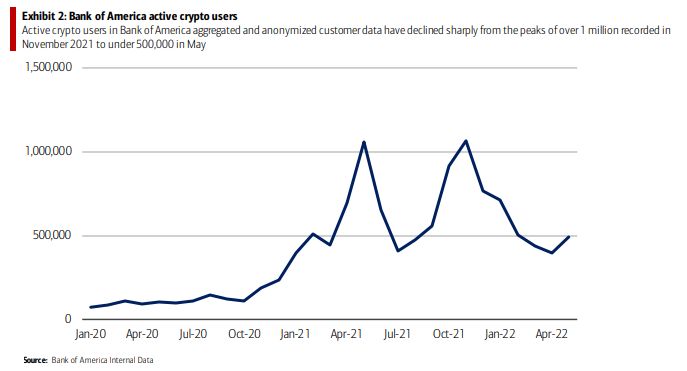
The bank’s crypto users shrunk to below 500,000 in May from more than 1 million in November 2021, when Bitcoin and some other tokens hit all-time highs. Since then, crypto prices have cratered, with sentiment among fans also souring. Bitcoin has tumbled nearly 60% this year and is trading just above $19,000. The bank said there has been “a grave decline” in prices.

“Crypto markets have been rocked by sharp declines in the prices of digital currencies and the collapse of certain stablecoins,” a Bank of America Institute team that includes David Tinsley wrote in a report. 

The bank looked at anonymized internal customer data that showed the number of clients who had made investments in crypto assets by sending or receiving a payment to or from a digital-asset platform, though the data doesn’t show what specific transactions were made. While Bank of America’s data doesn’t offer a comprehensive view of all crypto users, it can be reflective of broader trends in the space.

Cryptocurrencies, like other riskier assets, have suffered in a tighter monetary-policy environment, where the Federal Reserve and other central banks are raising interest rates to slow down growth and dampen rising prices. The market capitalization of cryptocurrencies has dropped to less than $1 trillion, from a peak of about $3 trillion in November 2021.

Amid these conditions, sentiment toward digital assets has also fallen. Between April and June, Bank of America saw a rise to 30% from 21% in those saying they haven’t invested in the space and have no plans to do so.

Still, the wider effects of the crypto-market slump might not be detrimental to the broader economy. Crypto assets comprise less than 1% of overall US household financial assets, Bank of America said, suggesting that “relatively few people view crypto assets as a reliable long-term investment.”

More stories like this are available on bloomberg.com

©2022 Bloomberg L.P.

BT Workers Decide Whether to Stage Biggest National Walkout Since 1987

(Bloomberg) — Tens of thousands of BT Group Plc’s unionized workers voted in favor of the company’s first national walkout in more than three decades. 

The collapse of pay rise negotiations in April led the UK’s Communication Workers Union to ballot more than 40,000 members on whether to take industrial action, the results of which were announced in London on Thursday. 

CWU General Secretary Dave Ward said the decision was “achieved despite a real culture of fear that has been imposed in the last couple of years by the BT management,” and that the union expects BT “to come to the table with a significantly improved offer” to avoid strike action.

The labor group wants to pressure BT Chief Executive Officer Philip Jansen back to negotiations. In April, the company increased wages for 58,000 of its workers, but the CEO said in a strained internal call last week that it couldn’t afford to pay any more. Angry staff complained that Jansen saw his remuneration jump 32% to £3.5 million due to share awards. 

“BT Group awarded its highest pay rise for frontline colleagues in more than 20 years — an average 5% increase and up to 8% for those on the lowest salaries,” a BT spokesperson said in a statement. “The result of the CWU’s ballot is a disappointment.” 

Any strike wouldn’t take place until after July 14 and its length would depend on whether management came back to negotiations, a CWU spokesman said. If it goes ahead, it’ll be the first BT-wide strike since 1987. But it would also follow rafts of similar recent action by rail workers and legal professionals over pay and conditions in the UK as the cost of living surges.

Read more: Trial Lawyers Walk Out Across UK Over Government Funding

It would be likely to affect BT broadband and telephone installations, including signing up new customers. Internet outages could be prolonged because engineers aren’t around to fix them, which could affect millions working remotely as well as harm a long effort by BT to improve its customer service ratings.

At an investor briefing on Tuesday, BT Chief Technical Officer Howard Watson said the company has a “robust plan in place” for strike disruption, so networks can continue working without manual intervention. 

BT is not alone in its tension with workers. Its biggest rival Liberty Global Plc and Telefonica SA-owned Virgin Media O2 face complaints from the CWU. On a May earnings call, Liberty CEO Mike Fries told investors the increases were “not nearly at inflation levels” two weeks after he received a package worth $62 million.

A spokesman for Virgin Media O2 declined to comment.

Prospect, a union that represents other BT staff including managers, also “did not accept BT’s pay offer” imposed instead of continuing negotiations, and has been consulting members on how to respond. It’s focused on “getting BT back to the table,” a spokeswoman said by email. 

(Updates with additional context from 6th paragraph onward.)

More stories like this are available on bloomberg.com

©2022 Bloomberg L.P.

Summer Pool Party Off Limits for German Delivery App’s Drivers

(Bloomberg) — German food delivery website Lieferando.de is holding a summer party this week for employees with food, drinks and an “exclusive pool.” Delivery drivers aren’t invited. 

The invitation for a “Day Club Party” on Friday in Berlin’s hipster Friedrichshain district concludes with a caveat, in bold, that says “drivers and contingent workers” are excluded. 

A representative for Lieferando, which is owned by Just Eat Takeaway.com NV, said that it was impossible to invite everyone and that the logistics arm organizes regular events for drivers, such as barbecue evenings. 

The party is fueling anger from the excluded workers, some of whom have called for a protest outside the event. Lieferando’s parent company, Just Eat, also faced criticism after budgeting 15 million euros ($16 million) for a ski trip in April. 

“They shamelessly celebrate an all-inclusive pool party while we can’t even pay our rent!” the group, called the Lieferando Workers Collective, said in a Tweet ahead of the event. “We’ll come anyway!”

Read More: Pressure Builds on Just Eat’s Board After $16 Million Ski Trip

Relationships between delivery companies’ head offices and their drivers are increasingly fraught, with the people who take food and groceries to app customers demanding to be paid better and treated more like full-time workers at startups around the world. The European Union proposed rules in December that would give so-called gig-economy workers the same rights as an employee, regardless of what they’re called in their contract. 

Read More: Food Delivery Firms Slump After EU Proposes New Employee Rules

In Berlin, workers at Gorillas Technologies GmbH formed a collective last year after complaining about the quality of their equipment and not being paid on time. Riders at Flink GmbH are now also preparing to hold an assembly on July 22, in the first steps to create a works council. 

One of the organizers, Robert Snyder, said riders are concerned about receiving fewer working hours. By campaigning to set up a workers council, Flink riders in Berlin are hoping to make sure that riders get payment for the amount of hours they are contracted to work. 

“Sometimes you’d get more hours, sometimes you’d get less, but if you kept track of it, you were steadily getting less,” Snyder said. “Some people couldn’t pay their rent. This is people’s jobs.” 

A spokesman for Flink said that it’s “constantly improving its processes to empower our hub workers and riders to manage their work” and that it would acknowledge the formation of a workers collective from employees “who want to have a healthy work environment.” 

More stories like this are available on bloomberg.com

©2022 Bloomberg L.P.

Grayscale Suing SEC After Its Spot Bitcoin ETF Is Rejected

(Bloomberg) — Grayscale Investments said it had sued the US Securities and Exchange Commission after the agency rejected a bid to convert its Bitcoin trust into an exchange-traded fund. 

Chief Executive Officer Michael Sonnenshein tweeted late Wednesday that Grayscale was suing the regulator and the company said it had filed a lawsuit in US Court of Appeals for the D.C. Circuit.

The SEC on Wednesday denied the company’s application to convert its Grayscale Bitcoin Trust into the first ETF based on the world’s biggest cryptocurrency. The regulator found that the plan by NYSE Arca to list the product didn’t do enough to prevent fraud and manipulation. 

“We remain laser-focused on the conversion to an ETF,” Sonnenshein said in a Bloomberg Television interview Thursday. “After receiving the SEC’s denial, our attorneys filed a petition for review with the appellate court. we’ve been guided to believe it could be, call it 9 to 12 months on that decision. It could be a little bit longer, it could be a little bit shorter.” 

The SEC declined to comment. 

Grayscale, which filed its plan in October, had been hinting for months that it would sue if the application was rejected. 

Flipping GBTC into an ETF would have solved a persistent issue for Grayscale: the trust’s deep discount to its underlying holdings. Unlike an ETF, GBTC shares can’t be created and redeemed to keep pace with shifting demand. That’s effectively turned GBTC into a closed-end fund, with GBTC’s price trading 28% below its net-asset value. 

In a May meeting with US regulators, Grayscale argued that converting into an ETF would unlock as much as $8 billion in value for investors. 

In a statement, Donald Verrilli, a law partner at Munger, Tolles & Olson representing Grayscale, said that in rejecting the application the SEC was “failing to apply consistent treatment to similar investment vehicles” in violation of federal law. 

“We are deeply disappointed by and vehemently disagree with the SEC’s decision to continue to deny spot Bitcoin ETFs from coming to the U.S. market,” Sonnenshein, Grayscale’s CEO, said in the statement.

Bitcoin is on pace for its biggest quarterly decline in more than a decade. The largest cryptocurrency by market value fell about 5.6% to $19.057 as of 12:12 p.m. in New York, and is down 58% since March, the biggest drop since the third quarter of 2011, when the digital asset was still in its infancy.  

(Updates with Sonnenshein’s comments in the fourth paragraph.)

More stories like this are available on bloomberg.com

©2022 Bloomberg L.P.

Zoom Bets on Corporate Customers to Stem Post-Pandemic Crash

(Bloomberg) — Zoom Video Communications Inc. is navigating life after the pandemic by acting like the past two years never happened.

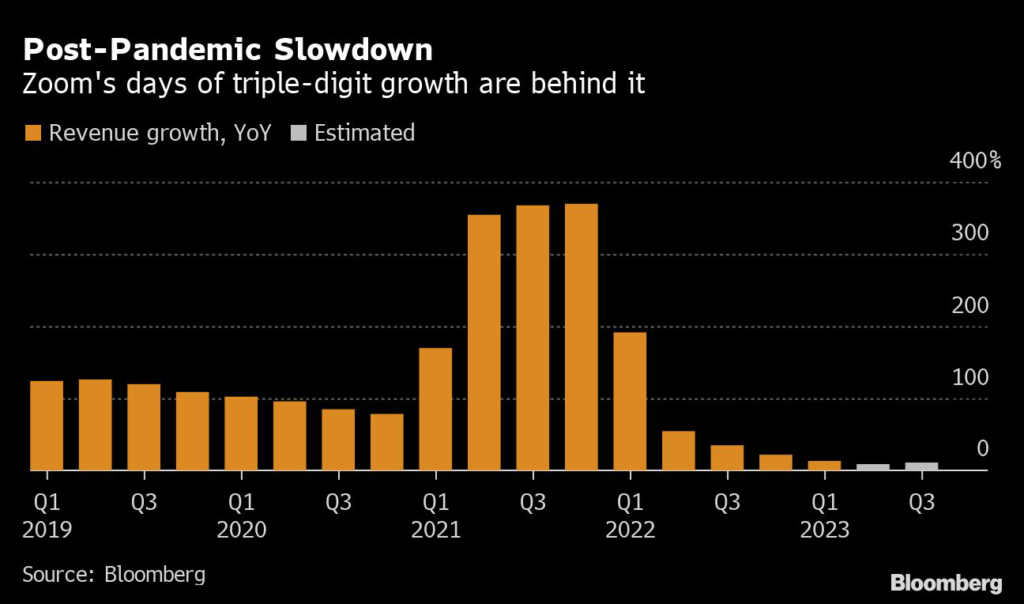
As the world shut down in 2020, its corporate videoconferencing app became a household name, delivering quarter after quarter of triple-digit growth in part by attracting millions of regular people and small businesses. Zoom seemed destined to become a consumer tech titan.

But while executives waxed poetic about facilitating graduation parties and family dinners, they never intended to become a destination for everyday people and weren’t able to sustain the momentum. Besides, corporate customers have deeper pockets and don’t drive bad press by Zoom-bombing each other or fumbling privacy settings.

“When the pandemic crisis hit us, we were not ready,” founder and Chief Executive Officer Eric Yuan said in a March interview, comparing the experience to leaping from a high school basketball team to the NBA. After two years of trying to monetize demand from consumers, many of whom were sticking with free 40-minute calls, Yuan is ready to return Zoom to its roots: a provider of business software. Investors aren’t convinced he can make it work.

Quarterly revenue surged 54% to $1 billion last July, but growth shriveled to 12% in the period that ended in April. And Microsoft Corp., the world’s biggest software maker, is Zoom’s chief competitor. The stock, which jumped sixfold to a high of $568.34 in October 2020, is now hovering near pre-pandemic levels and dipped as much as 6.3% to $104.78 Thursday in New York, the biggest intraday decline in two weeks. 

The question is whether focusing on the corporate market can revive growth, particularly as a rough economic environment could spur cost-cutting, said Matthew Niknam, an analyst at Deutsche Bank. “The bear case is that anybody who needs Zoom has it already,” he said.

That’s certainly true for everyday users and small businesses, which make up about half of Zoom’s sales — a level that’s now expected to remain stagnant. “You’re not going to sell a lot more product to the consumers,” said Meta Marshall, an analyst at Morgan Stanley. 

But Yuan is confident in his strategy. Ever the basketball fan, he said true success takes time, citing the careers of National Basketball Association stars LeBron James and the late Kobe Bryant as players who didn’t win their first championships until years after they started in the league.

Part of Zoom’s plan is selling more videoconference licenses. But more important is expanding its line of corporate collaboration tools to include phones, persistent chat a la Salesforce Inc.’s Slack, customer contact centers, digital whiteboards and even physical conference room setups. Earlier this month, the company unveiled a new service bundle — Zoom One — to highlight its expanded tools and strategy.

“We are not just the meeting company that everyone knows us for,” Chief Financial Officer Kelly Steckelberg said in an interview, adding that enterprise customers are fueling almost all projected growth. Zoom’s reputation for easy-to-use software has driven success of its other services, Steckelberg said, and its top non-video product, Zoom Phone, has sold 3 million user licenses. 

Indeed, public recognition of Zoom after the pandemic is “truly astonishing” and should help drive future business, said Vanitha Swaminathan, director of the University of Pittsburgh’s Katz Center for Branding. “The fact that people say ‘I will Zoom with you’ is evidence the brand has become deeply embedded,” she said.

Artificial intelligence capacity will be a key differentiator for Zoom’s new services, Yuan said. Earlier this year, the company unveiled a tool for salespeople that mines video calls for sentiment data to help close deals, although Microsoft has announced a similar feature. Zoom has also spoken about delving further into emotional analysis, a controversial science that has drawn ire from bias-concerned activists.

Customer contact-center services are another area of enthusiastic investment, despite competition from companies such as ServiceNow Inc., Twilio Inc., and Genesys Cloud Services Inc. After Zoom’s all-stock $14.7 billion deal for Five9 Inc. fell through last year due to slipping share prices, it purchased a smaller startup, Solvvy, to bolster conversational AI capabilities. Though the products are outside of Zoom’s main collaboration portfolio, many of the company’s customers still use on-premise contact centers, which makes it a good expansion target, Yuan said.

Zoom isn’t the only pandemic darling going through an identity crisis. Companies such as Shopify Inc., Peloton Interactive Inc. and Netflix Inc. that were on top of the locked-down world have been battered by tumbling shares and had to adjust their strategy, prices and expectations.

One issue confronting these stay-at-home stocks is what happens as offices fill up. Zoom isn’t worried — Steckelberg said that even financial firms that have returned to the office five days a week aren’t canceling licenses and many new services are catered for the office.

Read more about the challenges Zoom faces as executives choose to revive business travel

As for the dour economic sentiment, Steckelberg won’t say there’s been no impact, but enterprise demand remains strong, and Zoom doesn’t plan to eliminate jobs. 

But if a recession hits, corporations may cut redundant software products. The average enterprise has four paid videoconferencing services, according to research firm IDC. Steckelberg said that Microsoft Teams — Zoom’s biggest competitor — is often seen as free because it’s bundled with other services, but adds that Zoom is priced competitively and many customers are willing to pay more.

An October survey of corporate chief information officers from Morgan Stanley found that Teams has slightly surpassed Zoom as the primary videoconferencing system used by companies. IDC estimates that Zoom’s market share is about equal with Teams while Cisco System Inc.’s Webex, the other top competitor, has slipped.

Customers deserting Webex is one of the main sources of new corporate business, said Tyler Radke, an analyst at Citigroup Inc. Earlier in the pandemic, most of these businesses were signing up for Zoom. Today, it seems like they’re almost entirely opting for Microsoft Teams, he said.

For its part, Cisco said it leads the enterprise segment in revenue, citing a report by Synergy Research Group. Jeetu Patel, Cisco’s executive vice president for collaboration and security, said that Zoom hasn’t sustained its pandemic-era advantage, and that Webex sees Teams as the real competition. “It’s like a basketball game — things can change in a matter of seconds.” 

While Microsoft’s ascendancy is a concern, videoconferencing is ultimately large enough to support multiple providers, and Zoom’s name recognition should provide a buffer, said Marshall, of Morgan Stanley. “CIOs often say they’re still maintaining both systems.”

Yuan said competition is a motivator, citing Zoom’s moves to hire more than 4,000 new employees, improve internal processes and lay out a clear formula for growth. He added that after two years of reacting to nonstop demands, there is finally time to focus on the company’s long-term plan. 

How does Yuan describe the mindset for the future? “Work harder and evolve to make sure you’re a very good NBA-level player — that’s exactly what we’re doing.”

(Updates with shares in the fifth paragraph.)

More stories like this are available on bloomberg.com

©2022 Bloomberg L.P.

Morrison-Led Group Agrees to Buy FiberLight for About $1 Billion

(Bloomberg) — A consortium led by HRL Morrison & Co. said it agreed to acquire US fiber infrastructure provider FiberLight, marking the firm’s first North American digital-infrastructure bet.

Superannuation fund Australian Retirement Trust and a client of UBS Asset Management are part of the consortium that agreed to buy FiberLight from Thermo Companies, the companies said in a statement Thursday. California State Teachers’ Retirement System is the UBS client, and the transaction values FiberLight at about $1 billion including debt, according to people with knowledge of the matter, who asked to not be identified because the financial details are private. 

Morrison plans to accelerate the expansion of Atlanta, Georgia-based FiberLight’s network, which currently comprises 18,000 route miles of fiber infrastructure, which services states including Texas, Virginia and Florida. 

“The US needs to build significantly more fiber to service areas which do not have high-speed access,” Perry Offutt, Morrison’s head of North America, said in an interview, adding that FiberLight has opportunities to grow organically or through acquisitions. “We can consolidate a pretty fragmented industry,” Offutt added.

Morrison is an ideal partner given a “shared belief that fiber infrastructure is the key to bridging the digital divide and rapid expansion required to meet the extraordinary long-term demand,” FiberLight Chief Executive Officer Christopher Rabii said in an emailed statement. 

Representatives for Morrison and UBS Asset Management declined to comment on the financial details of the deal. A Calstrs representative didn’t immediately respond to a request for comment and a Thermo representative wasn’t immediately available to comment.

Morrison, which opened a New York office last year and had over $17 billion in assets under management as of March 31, has made two other North American bets: Longroad Energy and Clearvision Ventures. Outside the region, the firm is a long-time digital infrastructure investor, having backed companies including Fore Freedom, Canberra Data Centre, Vodafone New Zealand and Amplitel Towers. Earlier this year, the firm teamed up with Brookfield Infrastructure Partners to acquire Australian fiber company Uniti Group Ltd. 

Digital infrastructure has been an area of focus for many investment firms, pension funds and sovereign wealth funds, in part due to the perceived stability of cash flows amid buoyant demand. 

More stories like this are available on bloomberg.com

©2022 Bloomberg L.P.
Twitter Hires New Partnerships Boss From NBCUniversal

(Bloomberg) — Twitter Inc. has hired Maggie McLean Suniewick from NBCUniversal Media to be the company’s new vice president of partnerships, overseeing the teams in charge of global alliances, business development and developer relations.

Suniewick was most recently president of distribution and business development for NBCU’s digital properties. She is credited with leading a number of the company’s digital investments, including those in Snap Inc. and Vox Media Inc., according to a statement from Twitter.

The new hire comes at a tumultuous time for Twitter, which is in the process of completing a $44 billion takeover deal with billionaire Elon Musk. Musk has pledged to deliver significant changes once he takes Twitter private, including adjusting its moderation policies and expanding the social service’s reach to wider audiences. Twitter has implemented a number of cost-cutting measures in recent weeks, but it has said it will make exceptions to its pause in hiring for business-critical roles. 

“There’s so much more we can do to improve the timeline with incredible content, to drive usage of our developer platform, and to deepen our work with technology, media, sports and entertainment partners,” said Chief Financial Officer Ned Segal. Suniewick will report to Segal in her new role.

More stories like this are available on bloomberg.com

©2022 Bloomberg L.P.
Crypto Exchange CoinFlex Won’t Resume Withdrawals as Planned

(Bloomberg) — Cryptocurrency exchange CoinFlex won’t resume withdrawals Thursday as it had planned as it continues to raise funds to make up for the shortfall of $47 million triggered by a client’s default.

In an effort to resume withdrawals, CoinFlex issued a new token that will offer a 20% annual return. CoinFlex Chief Executive Officer Mark Lamb declined to share how much money has been raised.

CoinFlex is aiming to reopen withdrawals “as soon as possible, upon a successful raise,” Lamb said in a message to Bloomberg News, without providing a specific date. “One distressed debt fund has committed and we’re talking to several others. Our confidence has grown since Monday, as the industry of traditional finance buyers for these products has reached out in full force.” 

CoinFlex paused withdrawals on June 23 after a counterparty, which it later named as longtime crypto investor Roger Ver, experienced liquidity issues and failed to repay $47 million of stablecoin in a margin call. 

Ver, an investor in CoinFlex who earned the nickname “Bitcoin Jesus,” denied the claim, saying he does not owe money to CoinFlex. Their dispute played out on social media, the latest in a series of mini-crises that have rocked crypto markets in recent weeks. 

Founded in 2019, CoinFlex is a smaller crypto exchange focusing on derivatives trading, with less than $200 million in total value locked, according to its website. 

More stories like this are available on bloomberg.com

©2022 Bloomberg L.P.
A $12 Billion South African Fixed-Income Manager Plans Startup Fund

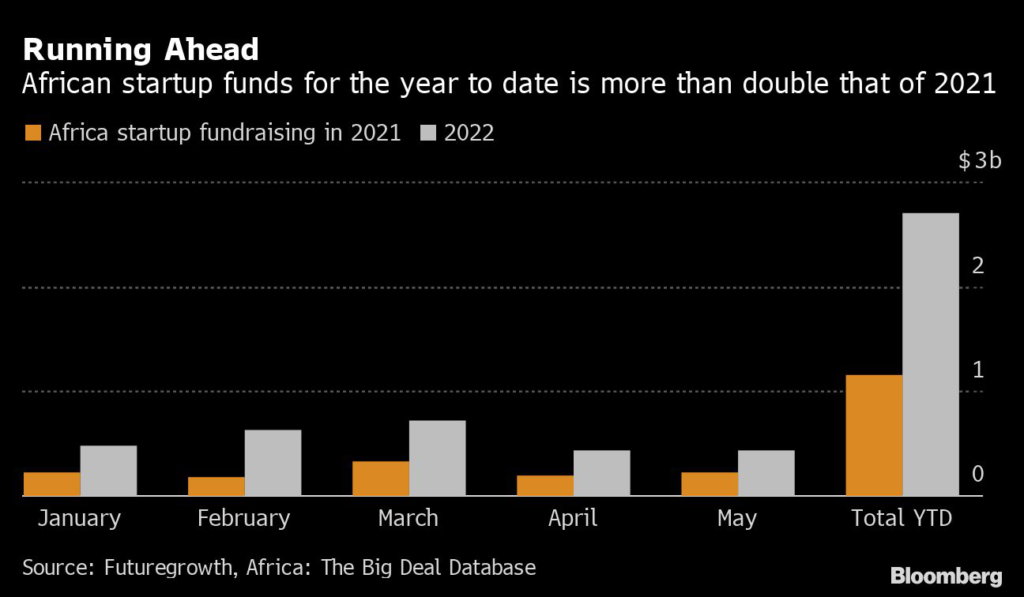
(Bloomberg) — Futuregrowth Asset Management Ltd., a South African fixed-income money manager with 193 billion rand ($11.9 billion) of assets, is raising a fund to invest in startups with a strong developmental impact.

The company aims to raise as much as 600 million rand for the Futuregrowth High Growth Development Equity Fund — a closed-ended, limited-life fund — by the end of the year, according to a statement from Futuregrowth. For the money manager’s Cape Town-based Chief Investment Officer Andrew Canter, South Africa’s second-largest city offers ample opportunities for investment.

“There are some real hives of activity going on out there,” Canter said in an interview in Bloomberg’s Cape Town office, adding that he has seen lot of business action while cycling 30 kilometers (18.6 miles) to work and back. Futuregrowth has invested in companies such as financier of small firms, Retail Capital, which Canter has observed while on his ride to work.  

Futuregrowth joins investors such as Naspers Ltd. in backing startups, which are seeing a revival in Africa’s most-industrialized economy. Early-stage firms attracted more than 12 billion rand in venture capital last year, a ninefold increase since 2016. To tap the opportunity, Naspers set up Naspers Foundry, which invests in early-stage firms.

Futuregrowth, backed by Old Mutual Ltd., has a 16-year-old Development Equity Fund with 3.4 billion rand under management that has included about 10 early-stage investments and “can see it works,” Canter said. The fund that’s being launched has a broad mandate that covers infrastructure, social services, clean power, agriculture and regional development.

The specialist money manager gained attention in 2016, during a period of alleged rife corruption under former President Jacob Zuma, when it stopped lending money to about 20 of South Africa’s largest state companies, known as SOEs, because of concerns over how they were being run. Futuregrowth lifted the restriction after it recognized adequate oversight and governance.  

The country has moved on and is on the right path now, Canter, who grew up in the US and moved to South Africa three decades ago, said. He expects his nascent startup fund to grow.

“Don’t promise the earth, do what you can do, deliver it,” he said. “That’s why my infrastructure fund has been going since 1995 — just keep doing it properly in a sustainable, appropriate way. It’s not a get-rich quick scheme, it’s a sustainable business.”

Futuregrowth’s DEF has investments in companies including Yoco, which provides handheld card payment systems, and participated in a Series B funding round for South African fintech startup Ozow, joining Tencent Holdings Ltd., and agricultural technology firm Inseco, where it led a funding round. It recently sold one of its first early-stage investments, CashConnect, generating a 48% internal rate of return.

The High Growth fund will have a four- to five-year draw period and five- to six-year payback period, according to the company. 

“What’s exciting for the rest of my career is establishing this early stage fund and doing those deals, dealing with those entrepreneurs is much more inspiring than dealing with malfunctioning SOEs,” Canter said.

More stories like this are available on bloomberg.com

©2022 Bloomberg L.P.

Bitcoin Set for Biggest Quarterly Drop in More Than a Decade

(Bloomberg) —

Bitcoin is on track for its worst quarter in more than a decade, as hawkish central banks and a string of high-profile crypto blowups hammer sentiment.  

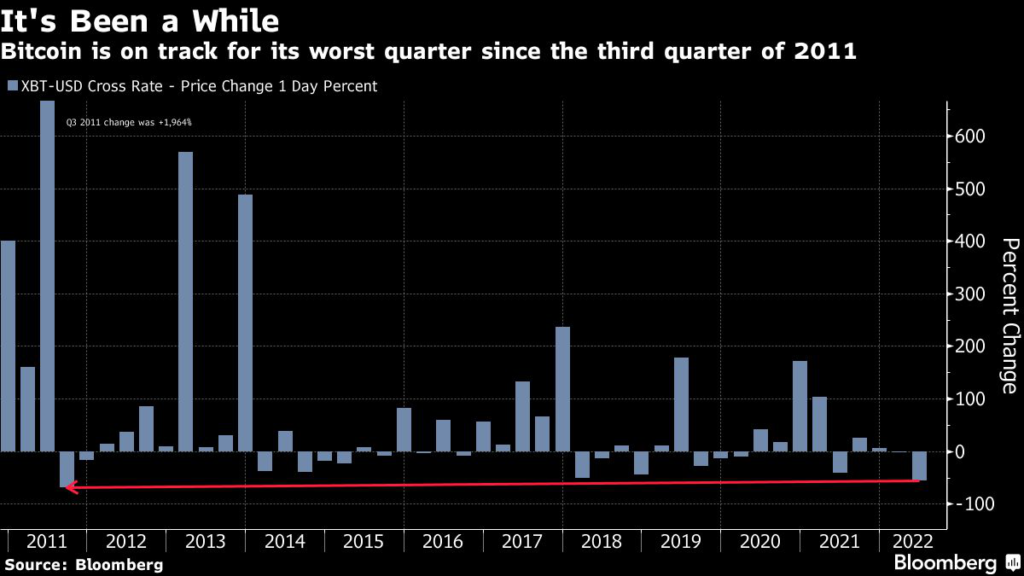
The 58% plunge in the biggest cryptocurrency is the largest since the third quarter of 2011, when Bitcoin was still in its infancy, data compiled by Bloomberg show. The decade in between those hallmarks featured several booms and busts, with the market value of all tokens swelling to a peak of $3 trillion last November as they gained more widespread adoption and ultra-low interest rates spurred risk taking. The current bear market, however, stands out for the amount of crypto leverage that’s been unwound — and for the regulatory scrutiny being heaped on an asset class many central banks now consider a threat to financial stability. 

Read more: Crypto’s $2 Trillion Shakeout Portends Lehman Moment

That total market figure now stands at around $900 billion, pummeled by a quarter in which the burgeoning Terra crypto ecosystem collapsed close to zero, and a mounting liquidity crunch caused several prominent companies to border on insolvency. Even some of crypto’s best funded companies announced swaths of layoffs, while Bitcoin’s current trading levels have seen it floating back and forth over the $20,000 mark for a number of weeks. 

Prices were tumbling again on Thursday, with the world’s largest token by market value sliding more than 6% to breach $19,000 for the second time in a fortnight. More volatile altcoins did worse, with Avalanche and Polygon each falling more than 10%. 

While perhaps not directly correlated to falling prices, the mood around Bitcoin was worsened by the Securities and Exchange Commission’s rejection of a bid to turn one of the world’s largest Bitcoin funds, Grayscale’s Bitcoin Trust (GBTC), into an exchange-traded product late on Wednesday. Another knock came in the form of a report that Genesis Trading, a sister company to Grayscale, may be facing a loss in the region of hundreds of millions of dollars from its exposure to struggling crypto lenders.

The recent drumbeat of bad news signals a broad rebuke to crypto’s love of unbridled speculation and free-wheeling innovation, which has now cost investors dearly. Its obsession with leverage laid at the heart of that mindset, as lenders and hedge funds alike parlayed their customers’ assets into even riskier bets that quickly buckled as prices dropped.


Read more: Crypto Hedge Fund Three Arrows Set for Liquidation 

Yet for all the gloom, some analysts are pointing to signs that the bottom may be near. The deleveraging that accelerated the rout in past months may not have much further to run, JPMorgan Chase & Co. strategists including Nikolaos Panigirtzoglou said in a note published Wednesday. They also pointed to venture capital funding that “continued at a healthy pace in May and June.”

“Bitcoin has had good success over the last dozen years at making cyclical lows every 90 weeks,” said Fundstrat technical strategist Mark Newton. “Lows should be right around the corner according to this cycle composite, and one should be on alert in the month of July, looking to buy weakness for a healthy rebound, just as sentiment seems to be reaching a bearish tipping point.”

(Updates with context, from third paragraph onward.)

More stories like this are available on bloomberg.com

©2022 Bloomberg L.P.
Close Bitnami banner
Bitnami