
Bloomberg

Nvidia Game Card Prices Fall Along With Crypto Mining Demand

(Bloomberg) — The turmoil in the cryptocurrency industry has ravaged portfolios and left large and small investors struggling to adapt. It’s also taken a toll on a corner of the tech world that once benefited from crypto’s rise: Nvidia Corp. graphics cards. 

Long popular with computer gaming nerds, these cards enjoyed a second life during the crypto boom as an essential component of the systems that generate digital coins. Even as Nvidia tried to limit its exposure to the industry, the crypto rally had helped send prices of the company’s products soaring on secondary markets like EBay. 

Now that’s changed. With the value of currencies plummeting, miners see less of a need for expensive computer hardware. Their interest is expected to dwindle further as the popular Ethereum blockchain network shifts to a new method called “proof of stake” that won’t require the same heavy-duty computer processing.

By one estimate, more than a third of the consumer graphics-card market could vanish as crypto enthusiasts abandon the technology. And the products are piling up on EBay’s site and other marketplaces. Though Nvidia’s suggested retail price for the cards hasn’t changed, they’re selling for 50% less on secondary markets than they did in recent months.

“People don’t want to buy GPUs knowing it’s potentially going to be obsolete in two quarters,” said Tristan Gerra, an analyst at Robert W. Baird & Co. “We believe that crypto-related purchases have steadily declined.”

A graphics card is a component that fits into a personal computer and converts code into images that can be displayed on a monitor. It’s outfitted with chips known as graphics processing units, or GPUs, which can improve how a PC renders a game. 

Crypto miners discovered that gaming gear designed to play Assassin’s Creed or Red Dead Redemption in high resolution could also be harnessed to create new crypto tokens, and that set off a stampede to acquire the equipment.

An Nvidia graphics card with a list price of $1,499 was fetching twice that amount from frenzied buyers. Pierre Ferragu, an analyst at New Street Research, reports that $3 billion worth of graphics cards were bought by miners since the beginning of 2021 and “they are now flushing into the secondhand market.” 

The question is how this turnabout will affect Nvidia, which is the biggest provider of GPUs and the most valuable chipmaker in the US. The company has acknowledged that the crypto slowdown has affected demand for some products, and it’s not alone in facing a potential hangover. Advanced Micro Devices Inc., best known for its personal-computer processors, also sells GPUs.

“The reduced pace of increase in Ethereum network cash rate likely reflects lower mining activity on GPUs,” Nvidia Chief Financial Officer Colette Kress said during the company’s quarterly conference call last month. “We expect a diminishing contribution going forward.”

The Santa Clara, California-based company declined to comment further. The shares were down about 4% Thursday morning in New York.

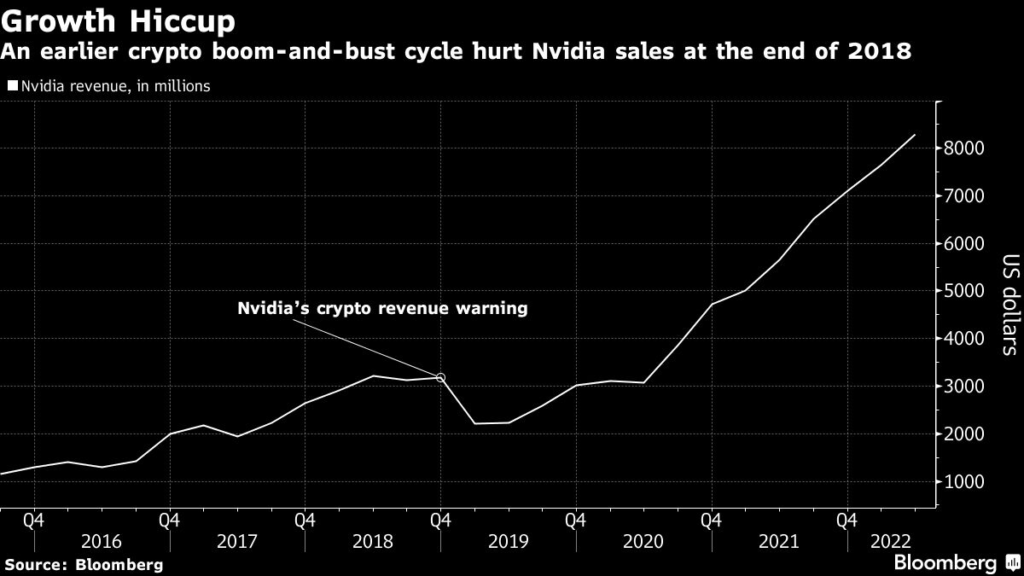
Nvidia has already spent years struggling with how to handle the crypto industry. Though demand from miners has helped fuel sales, the vagaries of the market suddenly made results harder to predict. That came to a head in late 2018 when the company blamed a crypto retreat for a weak forecast. Nvidia warned that revenue would be hundreds of millions of dollars lower than Wall Street projected, sending its shares down 20% in just two days.

The company didn’t want a repeat of that scenario, so it made its gamer GPUs — sold under the GeForce brand — less effective at mining. It also released a card designed for the crypto market that can’t be used for gaming. The product lacks the hardware needed to connect to monitors.

Even so, the Securities and Exchange Commission criticized Nvidia for not making its revenue sources clear enough to investors in previous quarters. In May, the agency fined the company $5.5 million for failing to adequately disclose the impact of crypto mining on its GPU sales. 

Meanwhile, sales of Nvidia’s new more-targeted crypto products have declined. In February, Nvidia said it had sold just $24 million of them in the fourth quarter, less about 1% of its total gaming-related sales in the period.

That suggests Nvidia’s days as a crypto supplier are already waning. Chief Executive Officer Jensen Huang has said that demand remains strong from gamers, as well as from data-center customers, which use its chips to power artificial intelligence. Nvidia’s total revenue has grown more than 50% in each of the past two years.

“The underlying dynamics of the gaming industry is really solid,” Huang said during the company’s latest quarterly conference call last month. 

That still leaves the company with the aftereffects of the crypto boom. Baird’s Gerra estimates that as much as 35% of consumer graphics cards were bought by miners during the run-up. And many of them are hitting secondary markets — and potentially eating into Nvidia’s sales. 

In the past two months, the price of Nvidia’s GeForce 3080 model fell from $1,100 in late April to $793 on EBay, according to data from MarkSight. That’s good news for gamers, who can now get their hands on the hardware without paying a massive premium or waiting in long lines outside electronics stores.

“With less crypto demand, speculators have also withdrawn from the market,” industry researcher Jon Peddie said.

And the mining market is unlikely to stage a comeback soon. Instead of using computers to generate Ethereum tokens, the technology is shifting to a bidding process. New allotments will be given to those who put up some of their existing holdings as collateral.

On the plus side, the loss of crypto customers will make it easier to gauge demand from Nvidia’s traditional buyers, Baird’s Gerra said.

“Once that’s gone, it’s a black hole that’s gone away,” he said.

(Updates with shares in 11th paragraph.)

More stories like this are available on bloomberg.com

©2022 Bloomberg L.P.
Dealmakers Buckle Up as Records Give Way to Ruptures in M&A

(Bloomberg) — Six months on from their busiest-ever year, dealmakers are facing the reality that a slowdown in mergers and acquisitions may be more than a temporary blip.

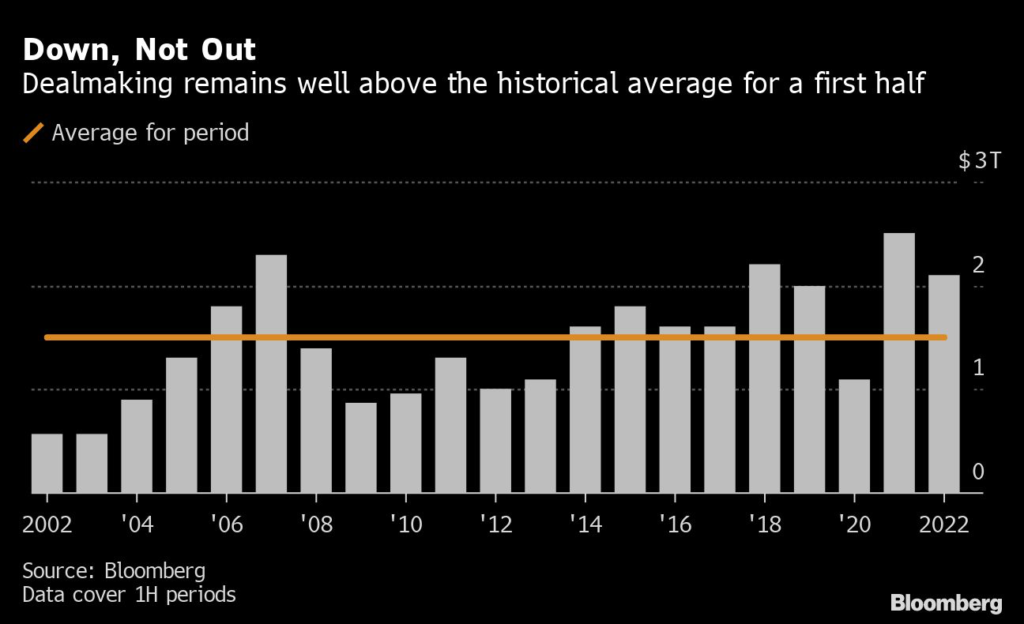
Global M&A values have fallen 17% year-on-year to $2.1 trillion, according to data compiled by Bloomberg. Rampant inflation, hawkish central banks, war in Ukraine and squeezed supply chains have combined to quickly cool the record levels of buying seen in 2021. 

Banks are also starting to pull back on lending for big-ticket transactions, choking off financing for private equity firms that fueled the boom. Deals are down across all major regions and most sectors, with an increasing number stalling altogether.

While bankers are keen to point out that activity remains comfortably above historical averages, M&A tends to trail capital markets by a few months — and major equity indexes have been flashing red for a while, with share sales now at a near two-decade low. The hype around special purpose acquisition companies, or SPACs, has also disappeared, blocking another avenue to mergers. 

“We know the M&A cycle is always late,” said Oliver Lutkens, co-head of advisory for Europe, the Middle East and Africa at BNP Paribas SA. “Buyers and sellers usually do robust M&A until the economy really turns, because they want to get deals done before it’s too late.”

The pursuit of large, strategic acquisitions is unlikely to be a priority for many company boards in the coming months as they focus on preparing their businesses for the impact of a possible recession. The rising cost of goods that’s hit levels of consumer spending around the world, and a need for certainty on central banks’ response to it, continue to weigh on stock prices and sentiment. 

“There is volatility going into the second half,” said Michael Santini, executive chairman of global banking at UBS Group AG. “We are likely setting up for a more active M&A and IPO market in 2023, given the Fed interest-rate hiking cycle could be done as we exit 2022, and we’ll have more visibility on the economic outlook.”

Alongside corporates, private equity buying is also coming off the boil. Buyout firms, whose spending had been trending up year-on-year as recently as May, are all of a sudden finding it harder to secure the leveraged loans required to get big deals done. Walgreens Boots Alliance Inc. this week abandoned a £5 billion ($6.1 billion)-plus sale of the Boots drugstore chain, and Reckitt Benckiser Group Plc is considering shelving a $7 billion sale of its baby formula business. In both cases, private equity suitors had trouble meeting sellers’ high price expectations amid tightening credit markets.

Certain pockets of private capital do continue to place bets, including infrastructure funds chasing assets that promise strong and stable returns amid the volatility. This year, Blackstone Inc. has teamed up with Italy’s billionaire Benetton family on a bid to take highway operator Atlantia SpA private, National Grid has agreed to sell 60% of its £9.6 billion gas transmission business, and bid groups are battling it out for a stake in Deutsche Telekom AG’s 20 billion-euro ($21 billion) towers unit.

“Private equity firms are still finding pockets of private capital and aren’t only relying on very conducive financing markets to pull deals off,” said Lutkens. 

As it did throughout the Covid-19 pandemic, the technology sector is still proving fertile ground for dealmaking and has already delivered the year’s two biggest transactions: Microsoft Corp.’s $69 billion purchase of video games maker Activision Blizzard Inc., and semiconductor company Broadcom Inc.’s roughly $61 billion acquisition of cloud-computing provider VMware Inc.

“Corporates are still sitting on record levels of cash so they will be in a position to act on strategic opportunities at more attractive valuations,” said Sameer Singh, co-head of North America M&A at Citigroup Inc. “It is a moment of opportunity for them relative to private equity, given near-term volatility in the financing markets.”

Both the Microsoft and Broadcom transactions helped mark the return of $50 billion-plus megadeals that were notably absent from the record-breaking run of 2021. Also this year, Indian lender HDFC Bank Ltd. announced a $60 billion all-stock merger with the nation’s biggest mortgage financier.

“Some forward-leaning management teams will still pursue deals to move their strategy forward during a recession,” said UBS’s Santini.

To be sure, the stresses in global markets present their own impetus for pursuing M&A for some companies. The need to quickly adapt to changing consumer habits, relocate supply chains or hasten the transition to cleaner forms of energy will all provide rationale for divestments, acquisitions and corporate rejigging.

“Everyone is looking at a new world, thinking about challenges like inflation, energy supply, Ukraine and an economic slowdown,” said Lutkens at BNP Paribas. “They haven’t put their pens down. The priorities are shifting and they’re pivoting to different types of transactions.”

In recent months, autos group Renault SA has outlined a plan to carve out separate electric-vehicle and combustion-engine businesses, drugmaker GSK Plc has moved ahead with a spinoff of its consumer health-care arm and foods giant Kellogg Co. has said it will split into three companies.

Other businesses are staying on the sidelines of dealmaking altogether, focusing instead on rainy-day planning or digesting acquisitions made in recent years, according to Eric M. Swedenburg, a Simpson Thacher & Bartlett partner who is co-head of the firm’s M&A practice. 

“It’s a pretty mixed feeling out there. The market is getting more tepid,” he said. “The deal market hasn’t shut down, it’s just more measured.”

(Updates with additional comments from lawyer in penultimate paragraph.)

More stories like this are available on bloomberg.com

©2022 Bloomberg L.P.

New York Fines Wegmans $400,000 After Exposing Customer Data

(Bloomberg) — Wegmans has been fined $400,000 for exposing the personal information of over three million consumers nationwide.

New York Attorney General Letitia James announced the fine on the grocery store chain and is requiring the company to upgrade its data security practices.

“Wegmans is paying the price for recklessly handling and exposing millions of consumers’ personal information on the internet. In the 21st century, there’s no excuse for companies to have poor cybersecurity systems and practices that hurt consumers,” James said in a statement.

Compromised data included names, addresses, mailing addresses and additional data derived from drivers license numbers of customers.

The breach was noticed in April 2021 when a researcher informed the company that data hosted Microsoft Azure was left unsecured and open to public access.

More stories like this are available on bloomberg.com

©2022 Bloomberg L.P.
Rising Prices, Scare Supplies Drag Down Car Sales in US

(Bloomberg) — When Jeannine Anckaitis started shopping for a car for her daughter Amanda’s 16th birthday, she was hit with waves of sticker shock. 

First her hopes of spending about $18,000 on a used car were dashed when she discovered it would cost thousands more due to scant supplies on lots. At new car dealers, too, she learned she would have to pay thousands over the manufacturer’s suggested retail price.

So she waited, hoping prices would come down. They didn’t. Now Anckaitis is “biting the bullet” and paying $24,000 for a gray Hyundai Elantra — $1,000 over MSRP.

“We didn’t pick the color, we didn’t pick the options,” said Anckaitis, who runs a nonprofit in suburban Philadelphia. “It’s shocking that we are willing to pay a thousand over sticker. But we’ve already dragged our feet for so many months and it doesn’t seem like it’s getting better.”

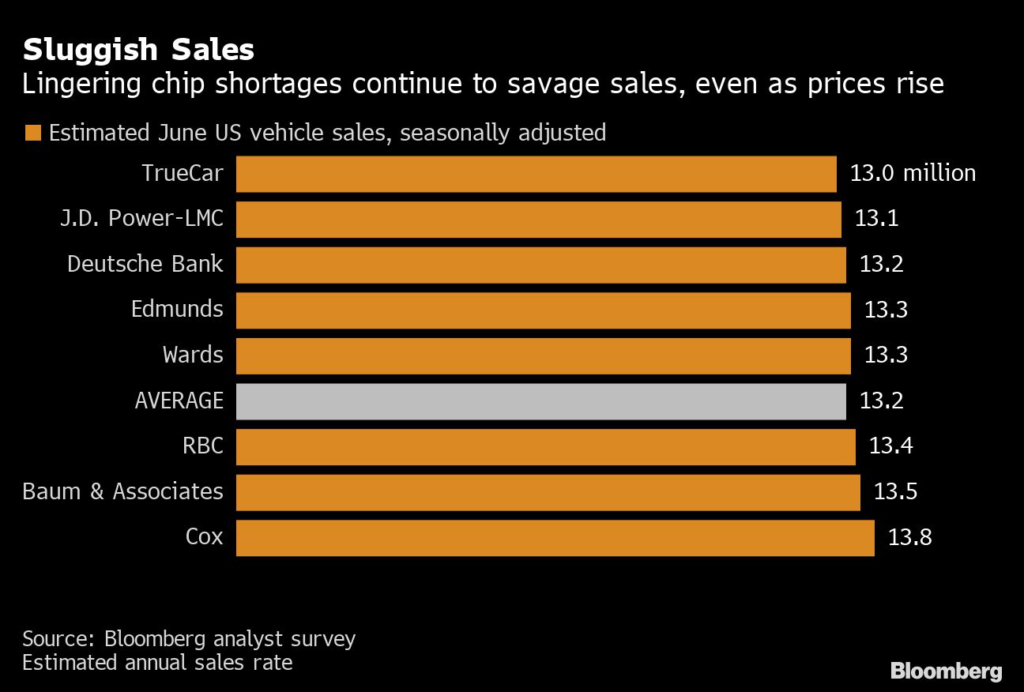
Runaway car prices have padded the profits of automakers and their dealers, allowing them to thrive even as a lingering semiconductor shortage continues to weigh on sales, which analysts forecast will be down more than 20% on average in the second quarter compared with a year ago. 

Many of the largest car companies, including General Motors Co. and Toyota Motor Corp., will report quarterly US sales numbers on Friday.

Car buyers, buffeted by $5 gas and the highest inflation rate in 40 years, increasingly are finding it hard to stomach the sticker shock as the average price of a new vehicle approaches $47,000, according to automotive researcher Edmunds.com. That’s up more than 13% from this time last year and a jump of 35% from five years ago, when a new set of wheels went for $34,651 on average.

Car Shopping Fatigue

“Because prices are high and everything else is so expensive, we’re inevitably going to see demand start to soften,” said Jessica Caldwell, Edmunds executive director of insights. “There is less consumer traffic than normal and inquiries from people interested in buying cars are lower.”

A lack of inventory due to the chip shortage has been a major reason for the cratering car market this year. The annual selling rate is expected to decline to 13.2 million vehicles in June from 15.4 million a year earlier, according to the average forecast of eight market researchers. Prior to the pandemic, annual US auto sales topped 17 million vehicles for five consecutive years from 2015 to 2019.

Affordability is becoming another road block to sales. The average monthly payment on a new car loan is almost $700, up 13% from a year ago, researcher J.D. Power reports. That could lead to fewer sales for automakers even after inventories return to normal.

“The new vehicle market is shrinking the pool of households who can buy vehicles,” said Jonathan Smoke, chief economist for Cox Automotive. “It’s permanently changing the retail landscape and what it means to be an entry level buyer.”

Bottom Line Salve 

Among automakers, the short supply of cars has gone from vice to virtue in a cooling economy, as executives see it as salvation for their bottom lines.

“While the economy may slow, the imbalance is so great that if you can build it, it will sell,” Bob Carter, Toyota’s top US sales executive, said in an interview. “I don’t see a problem until 2023, when the supply chain catches up.”

Over at Ford Motor Co., the finance staff is planning for everything from a mild to a severe recession, Chief Financial Officer John Lawler told analysts at the Deutsche Bank Auto Conference on June 15. But with a paucity of models and the consumer demand that has built up during the pandemic, Ford sees high prices holding up — and propping up profits. 

“It’s a completely different environment heading into what could be a potential recession than anything I’ve seen,” said Lawler, a 32-year veteran at Ford. “This is going to unfold for us as a company and for the industry a bit differently than it has in the past.”

But rising interest rates could give pause to car buyers who have seemed nonplussed by rising prices. After the Fed hiked rates the most in 28 years on June 15, the average percentage rate on car loan rose to 5.1%, the highest since the start of the pandemic, according to Edmunds. The days of the 0% financing deals that fueled auto sales in the last decade appear to be in the rearview mirror.

“Even though prices are rising, consumers are still in the mindset of, ‘Can I find one?’ not ‘Where can I get the best deal?’,” said Mark Wakefield, head of the automotive practice at consultant AlixPartners. “The biggest negative is really the loan rate, where that’s been increasing sharply in 2022 and is expected to really crimp into affordability.”

Inevitable Crisis

It may take some time for the impact of the emerging affordability crisis to take hold, Wakefield said. But if prices and interest rates continue on their upward trajectory, it’s inevitable.

More prospective buyers may decide to wait for better pricing and selection, said Smoke, the Cox economist. “The spillover of the tight supply leading to record high prices, record low incentives, and now compounded by higher interest rates, is reducing some of that incremental demand.”

Automakers that are chasing ever higher prices and wealthier customers do so at their peril, said Jose Munoz, global chief operating officer of Hyundai Motor Co., the company building the Elantra sedan Anckaitis is purchasing for her daughter.

“It’s easy to take advantage of the wave of the trends to compete in the high end, but you need to be always mindful of the cost,” Munoz said in an interview. “If you’re not able to be affordable, then you are not competitive.”

More stories like this are available on bloomberg.com

©2022 Bloomberg L.P.

Universal Music Wants to Take Frank Zappa Into the Metaverse

(Bloomberg) — Universal Music Group said it’s planning to launch Frank Zappa NFTs and Web3 projects, after buying the late musician’s estate and likeness from his family for an undisclosed sum.

Zappa, who passed away of prostate cancer in 1993, released over 60 albums over his four-decade career. The eccentric American musician and guitarist was known for his free speech activism and anti-establishment criticism. He also served as a one-time cultural ambassador to Czechoslovakia in 1990. 

Universal said it plans to draw new fans to Zappa’s work with cross-platform deals, including “merchandise, feature films, interactive experiences, as well as non-fungible tokens and other next-generation Web3 projects.” 

The estate, bought from the Zappa Trust, includes his name, likeness, complete recordings, film archive, publishing catalog, and his “vault” of complete work. The Trust is comprised of his family, Moon, Dweezil, Ahmet and Diva Zappa. 

Zappa was posthumously inducted into the Rock and Roll Hall of Fame in 1995 and awarded the Recording Academy’s Lifetime Achievement Grammy Award in 1997. 

More stories like this are available on bloomberg.com

©2022 Bloomberg L.P.
BMO and Jefferies Sign On to Platform Bringing AI Auctions to Stocks

(Bloomberg) — A new trading platform operated by OneChronos Markets LLC will let institutional investors bid for equities in an automated auction, an effort to disrupt the ages-old system for buying and selling stocks.

OneChronos started this month with Bank of Montreal, Jefferies Financial Group Inc. and more than a dozen other broker-dealers signed on. The New York-based firm’s technology enables potential buyers to dictate what they think the value of a portfolio or large quantity of stocks is at a given time, known as an “expressive” bid.

“Our system gives investors a greater level of control and detail over how their orders are executed,” co-founder Richard Suth said in an interview. The goal, he said, is to slow down the process and let investors have more say over how trades are executed. 

The firm’s software uses artificial intelligence to allow participants to input what they determine is the value of large order, or a collection of stocks, which is fed into a matching engine on a randomized basis. OneChronos then pairs orders from the buy and sell sides through periodic auctions. If values match from both parties, then the trade happens.

Among the early adopters of OneChronos is Bank of Montreal’s electronic trading group.

“Because we can express, under the terms and conditions we really want to trade, it can help us save our clients money and lowers implementation costs,” said Eric Stockland, who oversees institutional electronic quantitative strategy at the Canadian bank.

OneChronos runs roughly 10 auctions per second across all US stocks, said Suth, who spent more than a decade trading equities at Goldman Sachs Group Inc. All matches are made within what’s known as the national best bid and offer, the standard quote that reports the highest asking price and lowest offered price in a security, sourced from all available exchanges or trading venues. If a trade is filled through OneChronos, the fill-size and price is then printed to the public tape. 

“We are not trying to take market share from existing players,” said Kelly Littlepage, co-founder and chief executive officer of OneChronos. “We are trying to unlock economic value for investors through mutually beneficial trades that otherwise would have gone unrealized.”

The new platform needs sufficient liquidity from institutional investors to source and execute the best possible trades. The more participants OneChronos has, increasing the overall pool of liquidity, the better the outcome, its executives said.

The field of alternative-trading systems is crowded with new entrants fighting for orders. Many like OneChronos are looking for an edge to attract investors and broker-dealer clients. Last year, Blue Ocean Technologies LLC started its own ATS that lets investors buy and sell equities outside of traditional US market hours.

OneChronos has raised over $20 million from Y Combinator, BoxGroup, Green Visor Capital and other investors, and the firm’s valuation is roughly $250 million valuation after a financing round this month, according to Littlepage. The company’s third co-founder, Stephen Johnson, is a former senior manager Accenture Plc. Bernard Dan, former CEO of Sun Trading and CBOT will lead the ATS, with a focus on the operations and growth of the platform. Jesse Greif, OneChronos’s chief operating officer, also worked at Goldman Sachs, where he was head of electronic principal liquidity solutions and quant-strategies sales.

More stories like this are available on bloomberg.com

©2022 Bloomberg L.P.

‘Stick a Fork in Them’: Bed Bath & Beyond’s Recovery Hopes Fade

(Bloomberg) — Mark Tritton was supposed to be the savior for Bed Bath & Beyond Inc. — a hotshot executive from Target Corp. who knew how to charm customers with in-house brands and train stores on handling online and in-person orders.

But the chief executive officer never saw the fruits of his labor, and the home-goods retailer watched its sales melt away during the pandemic even as customers snapped up the same wares at nimbler competitors. One last dismal quarterly report was all it took, and Tritton was unceremoniously dumped on Wednesday.

Behind the scenes, activist shareholder Ryan Cohen, whose Reddit-reading fans had followed him into the stock, had grown fed up with Tritton’s performance and pushed the board to fire him, according to a person familiar with Cohen’s thinking. Cohen continues to believe the better-performing Buybuy Baby unit is a great asset and sees Tritton’s departure as a chance to undo a series of missteps over the last three years. The challenge, with the stock down more than 80% in the past 12 months and bond yields rising, is persuading other investors that Bed Bath & Beyond still has time to recover.

“They’re done. I mean, stick a fork in them,” said Anthony Chukumba, managing director at Loop Capital Markets, which has a sell rating on Bed Bath & Beyond shares. 

The shares fell another 3.5% on Thursday at 9:36 a.m. New York time. That’s bad news for Cohen’s RC Ventures. The firm is Bed Bath & Beyond’s fourth-largest holder, with a 9.7% stake as of Feb. 24, according to data compiled by Bloomberg.

Sue Gove, a board member who was appointed interim CEO to replace Tritton, told analysts on an earnings call that the company is aware of interest in the baby-products business and continues to evaluate its options.

Cohen’s Role

The person familiar with Cohen’s thinking said he believes the company needs to narrow its focus, reduce spending and get back to catering to customers’ core demands and focus on national brands — rather than pushing expensive private labels. Cohen thinks Tritton was the wrong CEO with the wrong strategy, the person said.

In a tweet Wednesday, Cohen criticized executives who make too much money, something that he previously had lamented about Tritton’s arrangement. 

Tritton, now 58, was a superstar at Target when Bed Bath & Beyond hired him in late 2019 after settling with a trio of activist investors who criticized it for failing to adapt quickly to online shopping. He had been the architect of Target developing more than 30 new private brands in areas like apparel and home decor, which seemed to fit well with Bed Bath & Beyond’s goal of taking back market share from the likes of Amazon.com Inc., Wayfair Inc. and TJX Cos.’ HomeGoods.

His task was straightforward: reverse a deep sales slump. But despite the pandemic driving a surge in demand for spruced-up living spaces, Bed Bath & Beyond has reported declining year-over-year sales in every quarter but one since the end of 2018. Profitability has also suffered. In the past three quarterly losses, analysts didn’t foresee two of them and the most recent one was twice as steep as they had expected.

Long Odds

The odds are even longer now as Bed Bath & Beyond attempts to return to profitability while contending with rapidly changing consumer habits and the highest US inflation in 40 years.

Like other retailers, Bed Bath & Beyond is also suffering from a glut of unwanted stuff. Most of that is private-label products, executives said on the earnings call. The company will need to mark down items to clear out excess inventory, which will put pressure on profit margins.

Under Tritton’s leadership, Bed Bath & Beyond cleaned up aisles, but it also scaled back discounts, a move that may have deterred foot traffic, said Morningstar analyst Jaime Katz.

“Cleaning up the store to make the selection process easier for consumers was great, but now you have to stay ahead of companies like Wayfair on digital channels,” said Katz, who has a buy rating on the shares.

Making matters worse, Bed Bath & Beyond weakened its once-strong balance sheet with a $1 billion accelerated share-buyback program, even as the foundations of its business operations were crumbling, Loop Capital’s Chukumba said.

“If you’re struggling and you’re trying to turn the business around, you’ve got to pull back as much as you possibly can. You want to preserve liquidity,” he said. “They did the exact opposite.”

Credit Fears

Bond traders are also worried. The retailer’s debt has sold off in recent months. The bond closest to maturity — due in 2024 — traded for about 54 cents on the dollar Thursday to yield more than 37%, according to Trace data. A longer-dated note maturing in 2044 dropped to just 26.5 cents on the dollar.

The company had about $108 million in cash and equivalents at the end of May, down from $1.1 billion a year ago. Its total liquidity, including availability under its revolving credit facility, was about $900 million.

The board said it hired Berkeley Research Group, a retail advisory firm, to focus on cash, inventory and balance sheet optimization. The company also tapped search firm Russell Reynolds to help find its next CEO.

Katz said it’s going to be tough to recruit someone in light of the company’s floundering performance.

“Who’s going to want to run this?”

(Updates with shares in fifth paragraph, bond trading in 17th.)

More stories like this are available on bloomberg.com

©2022 Bloomberg L.P.

Zilingo’s Ousted CEO Ankiti Bose Resigns From Startup’s Board

(Bloomberg) — Zilingo Pte’s former Chief Executive Officer Ankiti Bose said she stepped down from her post as director due to lack of access to information.

Bose said the board failed to show her investigation reports on the company or her alleged misconduct, even though she was a director and large shareholder of Zilingo, according to a statement posted on her Instagram account. 

“Given the current circumstances, and due to the opacity of information to me as a board member and a shareholder, I have resigned forthwith from all directorships I hold with Zilingo’s holding company and any of its subsidiaries,” Bose said. 

Her resignation comes as Zilingo’s board of directors weigh options for the embattled startup including liquidation and a management buyout. On June 20, the board members met to hear the alternatives, including a presentation from its financial adviser Deloitte LLP to sell off the company’s assets, Bloomberg News reported. Co-founder and director Dhruv Kapoor made the pitch for a buyout, a surprise, last-minute development the previous day. 

Bose, who co-founded the Singapore-based fashion e-commerce startup with Kapoor in 2015, endorsed his preliminary proposal minutes after it was sent out to existing shareholders. In her email, as seen by Bloomberg News, Bose urged investors to see beyond their “personal differences” and support the initiative.

Read more: Zilingo Founders Make Surprise Buyout Offer for Startup

Allegations of financial irregularities in March prompted an investigation into Zilingo, valued at $970 million in 2019, and led to the dismissal of Bose as CEO in May. Her ouster plunged the once high-flying startup into crisis and sent shockwaves through Southeast Asia and India’s technology industry. 

More stories like this are available on bloomberg.com

©2022 Bloomberg L.P.

Scholz Indicates German Government Ready to Support Uniper

(Bloomberg) — Chancellor Olaf Scholz said the German government is ready to help companies in need, providing a positive backdrop to talks to bail out embattled energy giant Uniper SE. 

“I can assure you that Germany has a practice of doing all that is necessary to help companies which are in trouble because of external shocks,” Scholz said on Thursday, citing programs implemented during the coronavirus pandemic.

Uniper, the largest buyer of Russian gas in Germany, late Wednesday said it’s discussing a possible increase in state-backed loans or even equity investments to secure liquidity. The Economy Ministry confirmed on Thursday that talks to provide “stabilization measures” are ongoing, because of a sharp rise in gas prices and Russia’s moves to slash deliveries. 

Supportive feedback from Germany is all the more important with Uniper facing slim chances of securing funding from Finland, the home country of its parent company Fortum Oyj. The Finnish government is focused on the state-controlled utility, rather than its German unit, according to a person familiar with the matter who isn’t authorized to discuss a sensitive issue publicly.

At a press conference after a meeting of NATO leaders in Madrid, Scholz was asked whether his government is prepared to help Uniper. The chancellor cited various programs during the pandemic as an example for possible support for energy companies in the current gas crisis. 

He declined to comment on Uniper specifically, saying that decisions would be made on a case-by-case basis.

More stories like this are available on bloomberg.com

©2022 Bloomberg L.P.
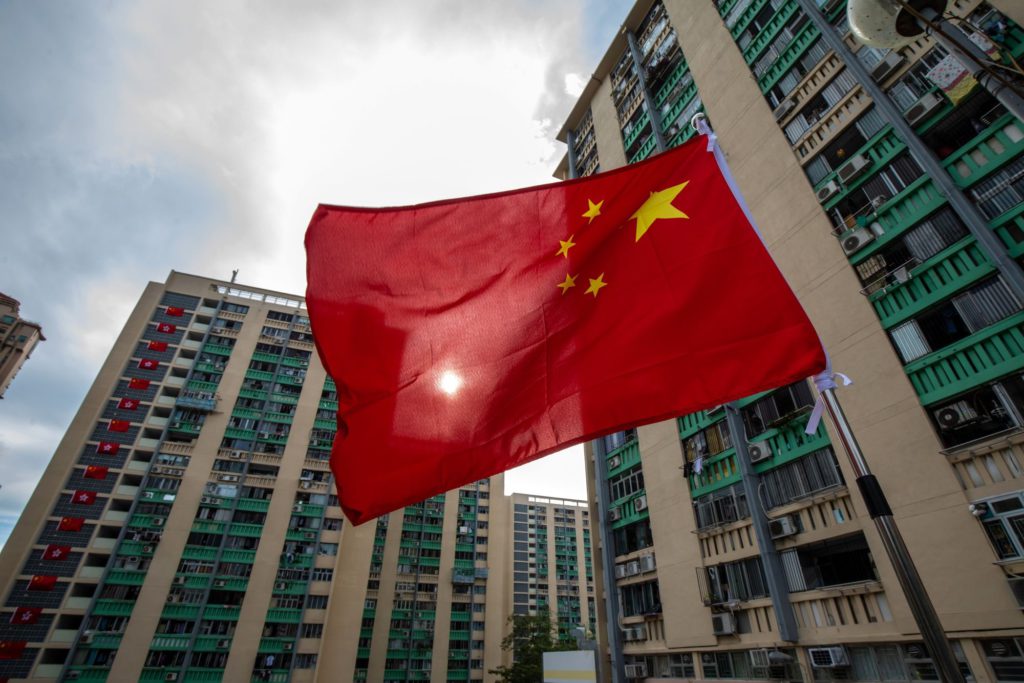
China’s Home Sales Slump Eases in June After Support Measures

(Bloomberg) — China’s home sales slump eased for the first time this year as stepped-up supportive measures by local governments started to attract more buyers. 

The 100 biggest real estate developers saw new-home sales slide 43% in June from a year earlier to 733 billion yuan ($109 billion), according to preliminary data from China Real Estate Information Corp. Compared with last month’s, however, their sales climbed 61.2%. 

China’s debt-saddled private developers face growing risks from a liquidity crunch with homebuyers’ shattered confidence. The 100 developers’ sales slumped 50.3% in the first half of 2022, the data shows. 

Signs of improvement in the housing market have emerged after local governments eased buying curbs, cut mortgage rates and partially relaxed ownership rules. The chairman of one of China’s biggest property companies said earlier this week that the home market has bottomed out, adding that the recovery will be a slow process. 

Some residential builders have resorted to gimmicks such as accepting wheat and garlic as payment to entice farmers as buyers. 

The pace of the housing-market recovery is crucial for some embattled developers. Chinese builders have been driving record offshore bond defaults this year. The risks are now spilling into the onshore market.  

China’s fourth-largest developer Sunac dodged a local-bond payment miss Wednesday after receiving approval to tweak an installment plan.

More stories like this are available on bloomberg.com

©2022 Bloomberg L.P.

Close Bitnami banner
Bitnami
