

Bloomberg

Walgreens Abandons Boots Sale as Debt-Market Chaos Spooks Buyers

(Bloomberg) — Walgreens Boots Alliance Inc. abandoned the sale of its Boots drugstore chain that was expected to bring more than $6 billion after failing to secure the desired valuation for the UK business amid a turbulent credit market.

The American health-care group had been in talks with a consortium between Reliance Industries Ltd. and Apollo Global Management Inc. over the sale of Britain’s biggest pharmacy chain. The two parties couldn’t reach an agreement on value, which prompted Walgreens to pull the sale, people familiar with the matter said. Reliance had committed financing for the deal, Bloomberg News reported earlier in June.

As a result of “market instability severely impacting financing availability, no third party has been able to make an offer that adequately reflects the high potential value of Boots,” Walgreens said Tuesday in a statement. 

Walgreens had been exploring the Boots sale amid increased focus on its North American business, where it had begun adding primary-care centers to its US locations and launched an initiative to enroll patients in clinical trials. Walgreens Chief Executive Officer Rosalind Brewer left open the possibility of other moves for the UK pharmacy chain in Tuesday’s statement. 

“The board and I remain confident that Boots and No7 Beauty Company hold strong fundamental value,” she said. “Longer term, we will stay open to all opportunities to maximize shareholder value for these businesses and across our company.”

Walgreens shares rose 0.2% in New York trading at 10:15 a.m. They have lost 19% since the year started.

Litmus Test

The proposed Boots sale was considered a litmus test for dealmaking in the UK with credit markets becoming increasingly fragile. The plans ran aground after financing conditions that supported a series of debt-fueled takeovers of British companies last year have mostly come to an end. Banks have been cutting their exposure to leveraged loans for risk of being saddled with debt they can’t then sell on to investors.

That’s cast a shadow over at least $25 billion of transactions in Europe. Banks have run into problems offloading £6.6 billion of debt tied to Clayton Dubilier & Rice’s take-private of UK supermarket chain Wm Morrison Supermarkets Plc. 

The focus is now on how the financing will come together for deals including the possible £5 billion sale of UK gas station operator Motor Fuel Group Ltd. Meanwhile, Reckitt Benckiser Group Plc has been struggling to attract bidders for its $7 billion infant nutrition unit.

Despite being the front-runner to buy Boots, the Reliance-led consortium was offering less than the £7 billion Walgreens had initially sought. Their main competitor in the bidding was a consortium of Britain’s billionaire Issa brothers and TDR Capital, although the race between the two lost steam as financing markets became weighed down by concerns around inflation and the war in Ukraine.

Boots has a sprawling web of more than 2,000 UK stores, and many of them need to be renovated and adapted to changing consumer trends. Boots has also been slow to catch up with online shopping, just one of the areas where investment is needed. There are also billions in pension guarantees that would have to be taken on by a purchaser. 

(Updates with US focus, shares starting in third paragraph.)

More stories like this are available on bloomberg.com

©2022 Bloomberg L.P.
Auto Sales Expected to Fall 17% This Year Amid Supply-Chain Woes

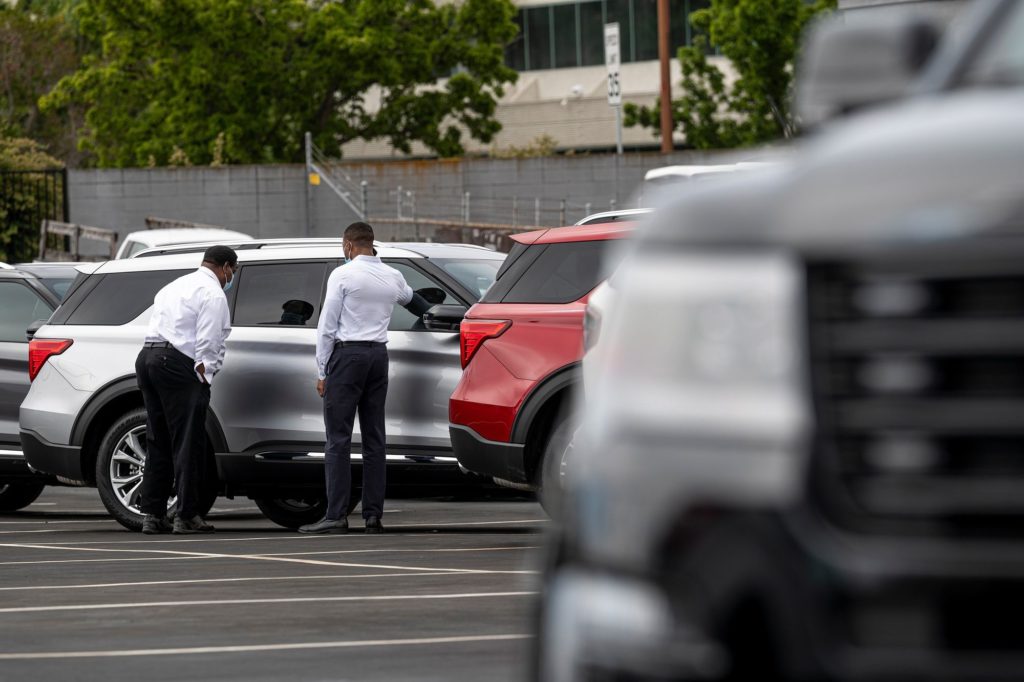
(Bloomberg) — Vehicle sales in the US are expected to fall 17.3% this year to the lowest level in a decade as semiconductor shortages and other supply-chain problems continue to hamper production.

Researcher Cox Automotive lowered its forecast to 14.4 million vehicles, citing production constraints. Despite the lower forecast, Cox believes lower auto sales belie the state of the economy because the job market and consumer demand remain strong. 

“We don’t think a recession is inevitable,” said Cox Chief Economist Jonathan Smoke. “We still have pent-up demand in retail. There are people who can’t get what they want.” 

New-vehicle inventory has risen so far this year but remains at about 25 days worth of stock. Before the Covid-19 pandemic, dealers were carrying on average close to 70 days of supply.

The only caveat, Smoke said, is that inflation fears and falling consumer confidence could slow the economy.

“The consumer is close to thinking we’re in a recession and behaving like that,” he said. “We’re on that thin line.”

More stories like this are available on bloomberg.com

©2022 Bloomberg L.P.
The Number of Netflix Bulls Is Dwindling 

(Bloomberg) — Even in a year that has seen widespread selling of technology stocks and long-time market leaders fall into bear territory, the woes of Netflix Inc. stand alone.

The video-streaming company has plummeted 69% this year, abandoned by both investors and analysts as back-to-back disappointing quarterly reports raised concerns about user trends in an industry that’s becoming more competitive and losing its pandemic-related tailwinds. The drop is the most of any Nasdaq 100 or S&P 500 component, and much worse than the former index’s 26% decline.

Shares of Netflix gained 0.6% in early trading on Tuesday.

The growth outlook has weakened to the point that Netflix has cut hundreds of jobs and changed its tune on two longstanding principles: it is cracking down on password sharing, and will introduce an ad-based subscriber tier to the platform. That’s on top of a backdrop where high inflation has pushed the Federal Reserve to hike rates sharply, sparking recession fuels and fueling a rotation out of tech.

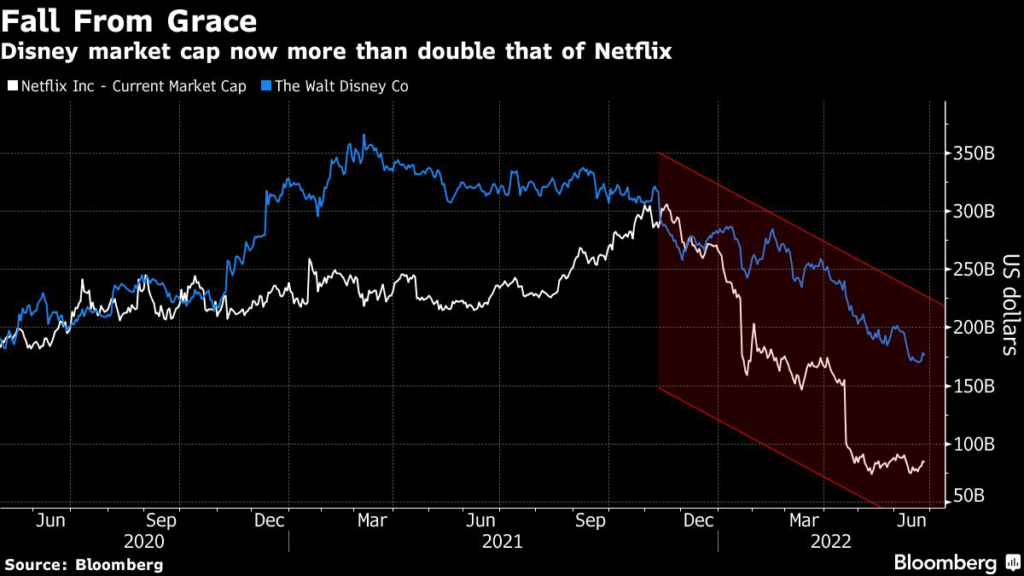
The scale of the challenges suggest it will be tough for Netflix to regain a valuation that exceeded that of Walt Disney Co.’s as recently as December. Now, “The Lion King” parent is worth more than twice the home of “Tiger King.”

“We’ve seen a lot more competition, and the cost for Netflix to continue competing has gone up, which hurts the expectation that earnings were going to grow at aggressive rates for a long time,” said Jeremiah Buckley, who oversees nearly $48 billion as a portfolio manager at Janus Henderson Investors.

Estimates for Netflix are moving in the wrong direction. The consensus for this year’s revenue now stands at $32.4 billion, which although representing year-on-year growth of 9.2%, is down from the $34.1 billion that was expected at the beginning of the year, according to data compiled by Bloomberg. The consensus for adjusted earnings has declined about 16% over the same period.

The weakening growth outlook has led Wall Street to turn sour. At the start of the year, more than 70% of analysts had Netflix as a buy. Now, just about 30% do, with Goldman Sachs Group Inc. and Benchmark Co. among the firms downgrading their opinions this month. The consensus rating — a proxy for the ratio of buy, hold, and sell recommendations — is at 3.35 out of 5, the lowest since 2014.

Yet the stock is getting ever cheaper. Netflix now trades at around 16 times estimated earnings, near the lowest since 2008, and a fraction of a 10-year average exceeding 80. Its drop this year has been steep enough that the shares have joined the Russell 1000 Value Index following a re-balancing.

David Katz, chief investment officer at Matrix Asset Advisors, said investors “can at least make a case for Netflix” at current levels, although he remains skeptical about its prospects, given the competitive backdrop.

“That’s why we’re not prepared to buy Netflix yet, even though that’s also considered a value name now,” Katz said. “It is statistically cheap, but we have more questions than answers.”

Tech Chart of the Day

The Philadelphia Stock Exchange Semiconductor Index has fallen 31% this year, with every component down at least 14%. Some of the worst-performing stocks in the gauge include Marvell Technology Inc., Nvidia Inc. and Advanced Micro Devices Inc. While demand has remained strong for chipmakers, the industry has been plagued by constant supply constraints.

Top Tech Stories

  • Netflix is looking to Asia after its shock first-quarter slowdown, seeking to both maintain growth in the one region where it’s still adding subscribers and replicate its success there in other parts of the world.
  • Chinese technology stocks fell as a plan by Tencent Holdings Ltd.’s major backer to further cut its stake in the company fueled concerns more investors may look to take profits following a strong rally.
  • Toshiba Corp. shareholders elected representatives of two vocal activist hedge funds to the board in a contentious meeting, bringing the scandal-tainted industrial giant a step closer to possible privatization.
  • Online education provider Byju’s, India’s most valuable startup, is pushing back payments for an approximately $1 billion acquisition struck last year, according to people familiar with the matter.
  • GlobalWafers Co. plans to build a $5 billion semiconductor silicon-wafer facility that will be the biggest of its kind on American soil, as the country contends with the fallout from a global shortage of chips.
  • Siemens AG will buy US firm Brightly Software for $1.58 billion to add digital services for buildings and infrastructure as the German company continues its transformation into a software provider.

(Updates with market open.)

More stories like this are available on bloomberg.com

©2022 Bloomberg L.P.

ETFs Offering Way to Bet on Overnight Equity Gains Set to Launch

(Bloomberg) — A pair of exchange-traded funds that seek to capitalize on the tendency for US stocks to log the bulk of their gains when the cash market is shut are set to launch Tuesday. 

The NightShares 500 ETF (ticker NSPY) and the NightShares 2000 (NIWM), the debut products of AlphaTrAI Funds, will use futures and total return swaps to capture the difference in returns notched during US market hours and those after regular daytime trading ends. 

In other words, owning these large and small-cap-focused funds essentially gives investors the ability to buy stocks at the close and offload them at the next day’s open. Each ETF carries a 0.55% management fee. 

“Your risk-adjusted return improves a lot when you isolate the night portion,” Max Gokhman, chief investment officer for AlphaTrAI Funds, which is based in the San Francisco area, said in an interview. “So this leads to some really clear use-cases for why someone would buy this product.”

New ETFs Aim to Capture Those Overnight Returns in Stock Market

The overnight phenomenon has been an obsession among traders who have noticed that those hours tend to deliver better returns than just owning stocks during the span when the US market is open. 

To be sure, the effect isn’t always prevalent, and there are stretches when the opposite can be true. But it has been pronounced in recent months and has been evident in the cryptocurrency market as well. 

For instance, the S&P 500 Index has lost roughly 18% this year, though the night effect shows it losing 10%, according to AlphaTrAI. Buying and holding the Russell 2000 overnight translates to losses of 7% versus its 9:30 a.m.-4 p.m. decline of 21% year to date. 

Theories abound as to why there’s a difference, including that news continues to flow even after stock trading ceases for the US day. Gokhman also says many companies tend to post earnings results while markets are closed, which tends to swing prices. 

“Earnings announcements tend to be a positive overnight effect,” he said. “That answers part of the return story.” 

Staying Power

Policy developments also occur while US traders are sleeping. These, and other explanations, are all structural in nature, he added, meaning that the phenomenon has staying power. 

Gokhman cited several potential uses for his firm’s products. For one, they allow traders to increase equity exposure. They could also be a trading tool for those — especially retail investors operating from their homes or phones — who want to transact in the market overnight in addition to buying and selling stocks during the day. And investors looking to speculate around a specific announcement could use the funds to do so. 

“With yields continuing to rise to new heights, bonds are failing investors seeking safety and diversification,” Gokhman said. “Conversely, adding exposure to the overnight effect gives equity exposure, but only to the better-behaved after-hours portion of stock markets. This may let investors sleep a bit more soundly through the turbulent times we’re going through.”

More stories like this are available on bloomberg.com

©2022 Bloomberg L.P.
Uber, Lyft Drivers Switch to Teslas as High Gas Prices Squeeze Profit

(Bloomberg) — Some Uber and Lyft drivers are finding that renting or buying a Tesla, the luxury electric car, is a more profitable option now amid soaring gas prices that have upended the economics of gig work.  

Last summer, Heidi Barnes, 34, thought about upgrading her beloved 2009 Toyota Camry, which she nicknamed “The Beast,” for a sleek Tesla Inc. Model 3 sedan. The Lancaster, California-based driver never imagined that the high-end vehicle would become less of a splurge and more like a last resort until the average price for a gallon of gas in the US surpassed $4 for the first time in March. Almost overnight, a full tank went from costing Barnes roughly $60 to a day to more than $100, making it harder to make a decent profit from ferrying passengers around Los Angeles County. “It was a huge push to get in a Tesla sooner rather than later,” Barnes said.

Barnes opted to rent a standard Tesla Model 3 for a month through Hertz, which has a deal with Uber Technologies Inc. offering drivers a weekly rate of $344 that includes insurance, basic maintenance, and unlimited miles. Even after accounting for the cost to charge the car, Barnes was paying roughly $450 a week for “the car of her dreams,” less than the nearly $600 required to fuel her Camry. In her first week, Barnes’ earnings covered the cost of the rental for the month.

Her new ride is also a hit with passengers. “They’re a lot more generous,” Barnes said. “Usually I’m lucky to get $1 to $3 tips but it’s now $10 or $15, sometimes consecutively.” In total, she netted over $2,600 during her 25-day rental, more than double the $800 to $1,000 she typically made from driving the “Beast,” according to screenshots of earnings she provided to Bloomberg. 

This month, the national average for a gallon of gas topped $5, an all-time high since the American Automobile Association began collecting pricing data in 2000.  As prices continue to climb, the difference between gasoline-powered cars versus electric is only becoming more stark.

For drivers who have seen their take-home pay whittled down, the switch isn’t just skimming a few dollars from expenses, it’s a lucrative earnings opportunity. According to Gridwise, an app that helps gig workers manage their trips, the number of ride-share and delivery drivers who opted to hop behind the wheel of a Tesla jumped 186% in May compared with last June.The Tesla trend also comes at a time when Uber and Lyft Inc. are on the hook to show progress toward achieving their goal of switching entirely to EVs in Europe and North America by 2030.

Uber offers an additional $1 per ride to drivers who switch to an EV — which can earn them up to $4,000 a year under the company’s Green Future program. Last month the San Francisco-based company revamped its driver app with an “EV hub” that features a charging map and made rides in EVs a premium option for passengers. Lyft, meanwhile, offers no financial incentives for drivers to switch to EVs.

Since launching its partnership with Hertz in November, Uber has seen more than 15,000 drivers rent a Tesla. “Participation has been really compelling,” Adam Gromis, Uber’s public policy manager for sustainability, said in an interview. “Drivers are smart and they know how to maximize their take-home pay.” Uber has about 1 million Uber drivers in the US, according to The Rideshare Guy, a website dedicated to the ride-share industry.At Lyft, growth of electric vehicles on the platform is at record levels, a spokesman said, and there has been a 27% increase in EV use since the first quarter. While Teslas are the dominant EV used by Lyft drivers, the company is also seeing significant growth from other manufacturers, particularly Kia Corp., he said. 

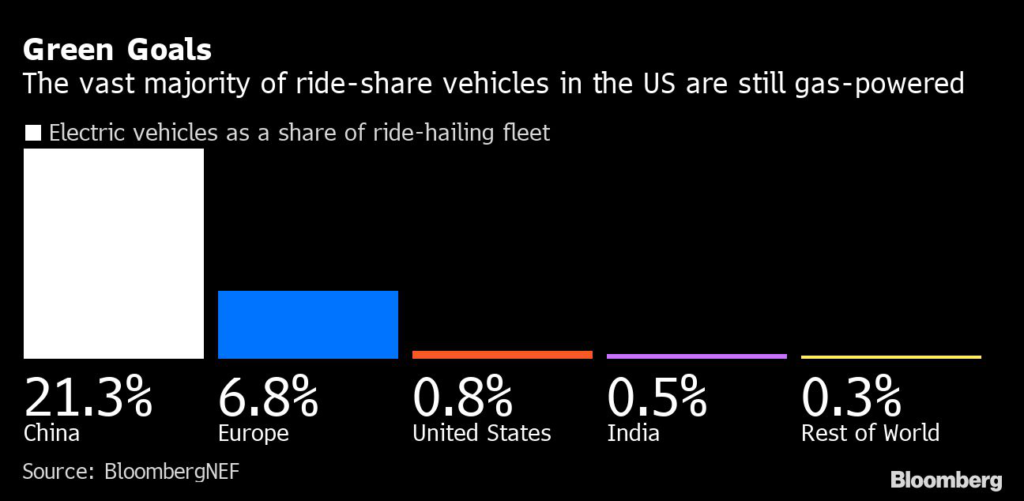
But reaching those EV goals in the US in less than a decade won’t be easy. In 2021, fewer than 1% of ride-hailing vehicles in the country were electric, according to clean-energy research firm BloombergNEF. Uber is doing better in Europe, where government incentives also help spur the switch to EVs. 

One big reason behind the reticence is that the cost of a battery-powered car is still too high relative to a driver’s wages. On average, an electric car now costs $61,000. Another hurdle is the availability of charging stations. Barnes mostly drives in Los Angeles, where Tesla Inc. superchargers are plentiful, but often crowded. Without a wait, the process takes about 45 minutes, but when every dock is taken, it can become a much longer ordeal, Barnes said. “In this job, every minute you’re not on the road picking up a passenger is money you’re leaving on the table.” 

Renting is a low-risk option for Uber and Lyft drivers like Barnes who can’t afford to purchase one outright, especially after Tesla raised prices by as much as $6,000 per car. 

READ: Soaring EV Prices Mean Fewer Middle Class Buyers Can Afford Them

But for other drivers like Luis Martinez, 34, taking out a hefty loan is a risk worth taking instead of waiting for gas prices to come down. Like Barnes, Martinez first started looking to replace his 2012 Toyota Camry Hybrid with an electric car at the beginning of March when gas prices spiked. He had his eyes set on a new Hyundai Ioniq 5, which, listed at roughly $47,000, was in his price range. But at dealerships, the car was going for as much as $62,000, well above the Manufacturer’s Suggested Retail Price and the resale market was even worse, Martinez said. 

That’s when he settled on the Tesla Model 3 Long Range. “I was throwing $800 at gas every month and I realized instead I could put that money towards a car I could actually own,” he said. With a $58,000 price tag, Martinez took out a loan. In one week, his $900 car payment is covered and he pockets about $1,000 more in take-home pay. 

Persistently high gas prices and resurgent demand for ride-hailing has created the ideal conditions for a Tesla — a car considered affordable mostly only for well-off buyers — to be within reach for Uber and Lyft drivers. But the math only makes sense if demand for rides remains elevated. In May, average transactions per customer at both Uber and Lyft increased 15% compared with last year, according to Bloomberg Second Measure, and the summer travel season typically benefits ride-hailing. 

Still, Martinez, who drives in Ventura, California, is acutely aware of the trade-off. “I’ve never taken a loan for that much before and it’s very scary. I’m more stressed because I know I have to drive a minimum to cover the car and doubt creeps in.” he said. Still, when he pulled the trigger on buying his Tesla, gas had just crossed $5. Today, it’s north of $6.30, according to AAA. “There’s a lot of anxiety but, for me, the math makes sense.”

(Updates with comment from Lyft)

More stories like this are available on bloomberg.com

©2022 Bloomberg L.P.

NBA Invests in Celebrity-Backed Kids’ Social Network Zigazoo

(Bloomberg) — The National Basketball Association is investing in Zigazoo Inc. as the kids’ social network gets more deeply involved with sports and media properties.

The funding round values the company around $100 million, according to a person familiar with the matter. Venture capital firm Liberty City Ventures led the $17 million investment, which was joined by Causeway Media Partners, Dapper Labs Inc., German media company OneFootball GmbH, Hong Kong-based Animoca Brands Corp. and social-media personalities Charli and Dixie D’Amelio. Existing investors include late-night host Jimmy Kimmel and tennis star Serena Williams’s venture fund.

Zigazoo is a TikTok-like video-sharing app for children that orchestrates challenges and activities for kids in short clips, while responses can be shared with friends in the social network. Chief Executive Officer Zak Ringelstein declined to share revenue figures but said most of its sales come from in-app purchases, with additional proceeds from partnership deals. The app now has more than 1 million users, he said.

Ringelstein said Zigazoo will use the fresh capital to develop more creator tools, create a marketplace for digital goods and expand into “emerging tech sectors” like augmented reality and the metaverse. In April, the social network started selling its first nonfungible tokens with Moonbug Entertainment, which owns kids’ shows CoComelon and Blippi. 

Sports, Shows and Music

Early partners included museums and zoos, but the app has quickly attracted interest from sports and media brands, including shows that air on Apple Inc.’s Apple TV+, Netflix Inc. and Paramount Global’s Nickelodeon. Celebrities such as LeBron James, Dolly Parton and Tiffany Haddish have appeared on Zigazoo, too, as a part of a reading series.

Prior to this financing round, the NBA worked with the app around its All-Star weekend and playoffs in pursuit of young basketball fans who could potentially become lifelong viewers. The league has been dabbling in startup investments this year. Earlier this month, it put money into Nextiles, a smart-fabric technology business.

With sports and TV on the rise, Zigazoo is now looking to music as its next frontier, and is looking to line up agreements with artists and labels.

“One of the biggest opportunities in this space is creating long-term relationships with not only kids’ music, but also with pop music,” said Ringelstein. “That’s No. 1.”

More stories like this are available on bloomberg.com

©2022 Bloomberg L.P.

The Cadillac Lyriq Electric SUV Is Not Worth Waiting For

(Bloomberg) — Park City, Utah, is pretty this time of year. Mountain sunlight drenches verdant hills strung with million-dollar ski lodges buttoned up for summer. Chestnut mares doze in pastoral repose. Shopkeeps don insta-smiles for travelers spending $40 on a bandana or squeaky dog toy.

But the 2023 Cadillac Lyriq transporting me through these bucolic environs had me in a funk. I had recently learned that the $62,990 SUV I was driving was a pre-production model—99% finished but technically not a customer-ready example of Cadillac’s first-ever fully electric vehicle. Which meant that any critique I might develop regarding it could be swatted away with an airy “It’ll be fixed by the time we get to production” comment from the folks selling it. This felt like a cop-out. Potential customers for this vehicle deserve to know what exactly they are getting into, not an approximation of something still to come.

The thing is, Cadillac is doing everything it can to get people into the Lyriq—fast. And it’s not working.

In 2020, Cadillac announced it would push ahead Lyriq production by nine months. At the time, it seemed obvious that in order to keep up appearances, parent company General Motors needed to produce an EV more easily swallowed by the general populace than the planned $200,000-plus Hummer and some (still) forthcoming electric pickups. Rival Ford started selling the Mustang Mach-E EV SUV in late 2020, and started production on the F-150 Lightning pickup truck EV this spring. 

Meanwhile, every other luxury brand from Audi and BMW to Mercedes-Benz and Porsche is already knee-deep in EVs. Audi, for instance, lists eight of them for sale on its website, with more on the way. (Hyundai, by the way, is quietly climbing the EV ranks with its affordable Ioniq 5 and Kia EV6.) So Cadillac offered a small “first round” of Lyriqs for sale in September 2021, and on May 19 opened orders for the 2023 model year version. A 2024 model-year Lyriq is currently open for “pre-order” sales, with production starting in the spring of 2023 and deliveries—with a higher MSRP—anticipated mainly in 2024.

It was unclear while I was in Utah how many of those first-round vehicles the company had delivered, or how the company selected people to purchase one in the first place. Spokespeople told me that deliveries of the 2023 models would start in a few weeks, declining to specify how many, if any, have actually sold.

Confused? Me, too. What I do know is that 2024 is nearly two years from now. So when I found myself on those mountain roads in Utah, I kept wondering: Would I, or anybody I knew, care enough about this thing to put down the refundable $100 deposit now to wait for some suburban vehicle they’d get sometime in the future?

I am no more immune to this age of instant gratification than anyone else; while the good-looking Lyriq passes the sniff test when it comes to power, range, and interior quality, it lacks the gut-check X factor that would make me want to wait.

Missing Some Luxuries

Maybe the Lyriq vehicles Cadillac sells next will have additional oomf. The one I drove lacked critical elements we have come to expect from even non-luxury vehicles: all-wheel-drive, heads-up display, and hands-free driving. At GM, hands-free is called “Super Cruise,” but in this car—as in early customer vehicles—it wasn’t functional. Customer cars will get Super Cruise as an over-the-air update later this year, a spokesperson said. The AWD system just wasn’t ready enough to put into cars, engineers told me. They already had the RWD system developed for the Hummer, so they used that one for Lyriq.

Cadillac doesn’t currently offer a company-official home-charging system; it says it will offer an Ultium-branded charger later this year. (Ultium is GM’s all-new battery system and platform. The company will spend $35 billion through 2025 to engineer it as a dedicated EV platform that can be calibrated to models across its lineup, from the Equinox to Hummer, which should help the automaker save money, according to Bloomberg Intelligence.) In the meantime, customers can buy a Clipper Creek home charging system through Cadillac to power the Lyriq. Prices on Clipper Creek’s website start around $350 and rise to more than $1,600.

The GPS and Navigation systems aren’t quite ready for prime time, either. In order to navigate a loop around the Park City area, I had to scan a QR code on my phone and then sync the phone to Bluetooth to use my own phone’s map that way. As I wound around near Wasatch Mountain State Park and circled sweeping vistas near Jordanelle State Park, I flipped through the map function on the dashboard just to see what would happen. While it did show accurate depictions of the road some of the time, most of the time I was in the car it showed a pixelated screen of gray.

All this will be ironed out by the time the next batch or so of customers take delivery, spokespeople told me. Quelle surprise.

Looks Good 

Now that the ugly stuff is out of the way, the good stuff is this: The Cadillac Lyriq looks great. Rather than following the generic rounded hump of metal mold that Alfa Romeo Stelvio and Maserati Levante followed, it is distinguishable from those—or, say, an unbadged Audi. It folds sharp lines from the front black-crystal pinstriped grille to the bright red tail lights that wrap like big Ls around the rear of the vehicle. Standard 20-inch 6-spoke alloy wheels, or optional 22-inch split-spoke alloy wheels, complete the bold stance in something far prettier than what Ford has offered in the Mach-E. I hope this can become a signature look for Cadillac.

Inside, the Lyriq offers a gaping total of 105 cubic feet of passenger volume, which bodes well for any cowboy hat-wearing individuals who will want to drive it. The quality of the components and leather trim—which Caddy says are all unique to the Lyriq, with no parts-bin sharing across GM’s less exclusive brands—equals what you’d find in other premium rides from Lexus or Lincoln. I appreciated the mix of tangible knobs and buttons paired with touch-sensitive screens; it felt modern without going overboard.

An exceptionally quiet cabin, thanks to Cadillac’s clever noise-canceling system, made it all feel even more special that day I drove in Utah. The clean lines of the dashboard match the relative simplicity of the infotainment system, though you’d often have to dig through layers of options to find the tabs for tasks such as adjusting the strength of the regenerative braking. (A shortcut is available, though I never found it.) Intricate laser etching through the wood and metal were pleasing accents to the 33-inch curved LED screen set near the middle to form the centerpiece of the cabin.

A Smooth Drive

On the road, Lyriq behaves comparably to what you might expect from the $68,000-or-so Tesla Model Y. That’s what I meant when I said it passes the sniff test. With a 340-horsepower equivalent motor and 325 pound-feet of instant torque, it glides smoothly and powerfully as it heads to a top speed of 118 mph. Zero to 60 mph takes six seconds, slower than the BMW iX and Audi e-Tron. But the steering apparatus and chassis are tight enough to keep the rig from wobbling or dawdling when you punch the gas or swerve. 

The one-pedal driving system that brakes the car the moment you lift from the gas pedal will take some adjustment, but it does serve to help the vehicle achieve 312 miles at its farthest range. You can charge up to 76 miles of range in 10 minutes on a DC fast charger. These statistics are roughly the same as those of the comparably priced EV sedans and SUVs on the market today. 

It all adds up to the Cadillac Lyriq being a capable, though not yet crave-able, SUV. Last I heard, GM said it wants to sell 400,000 EVs in North America by the end of 2023. At this rate, it’s going to have to move mountains to do it. Ski lodges included.

More stories like this are available on bloomberg.com

©2022 Bloomberg L.P.

Celebrity-Endorsed Crypto Scams Soaring in UK, Santander Says

(Bloomberg) —

Celebrity-endorsed cryptocurrency scams in the UK are on pace to almost double this year, Banco Santander SA’s local unit said.  

“Case volumes” jumped 61% in the first quarter from the prior three months, Santander said in a statement on its website on Tuesday. The average value of the scams was £11,872 ($14,540), up 65% from a year earlier. Around £2 million was lost to such schemes in the quarter, according to the bank.   

“We’re seeing a worrying rise in ‘celebrity-endorsed’ cryptocurrency scams, where familiar faces are being misused on social media in order to con people out of often life-changing sums of money,” said Chris Ainsley, Santander UK’s head of fraud risk management, said in the statement.

Crypto scams are getting increased attention as regulators and politicians grapple with how to encourage technological innovation while at the same time protecting unsuspecting consumers. Santander said it expects the number of celebrity-endorsed crypto scams to rise 87% in 2022 based on the current rate of growth. 

British billionaire Richard Branson brought attention to the issue this month, telling Bloomberg he’s stepping up efforts to stop his name from being used in fraudulent crypto schemes. Bank of England Governor Andrew Bailey in April said cryptocurrencies are the new “front line” in the types of criminal scams regulators are trying to combat. 

Read more: Branson Takes Aim at Crypto Scams That Use His Name as Lure

More stories like this are available on bloomberg.com

©2022 Bloomberg L.P.

Ambani’s Son to Lead Reliance Telecom Unit in Succession Signal

(Bloomberg) — Mukesh Ambani’s first-born will succeed him as chairman of the conglomerate’s telecom unit, kickstarting a leadership transition in one of Asia’s wealthiest families.

Akash Ambani, 30, a non-executive director at India’s No.1 wireless carrier Reliance Jio Infocomm Ltd., was appointed chairman of the board. Mukesh Ambani resigned from the board, the company said in an exchange filing Tuesday, while staying as chair of the holding firm 

This is the first instance where Mukesh Ambani has officially taken a backseat, after flagging last year that his children were taking on more responsibilities. Akash was part of teams that negotiated Meta Platforms Inc.’s investment into Jio’s parent, besides leading other key acquisitions.

“This is another clear signal that Mukesh Ambani is taking the next step of redefining his involvement with the group,” said Kavil Ramachandran, a professor and executive director at the Thomas Schmidheiny Centre for Family Enterprise at the Hyderabad-based Indian School of Business. “I hope he has taken care to make this a successful succession by strengthening the team around Akash Ambani.”

Asia’s Richest Man Looks to Walton Family Playbook on Succession

For years, Mukesh Ambani has studied the ways in which billionaire families, from the Waltons to the Kochs, passed on what they’d built to the next generation. Recently, that process has intensified — Bloomberg reported last year — with the tycoon eyeing a blueprint for the next stage of his $217 billion empire that seeks to avert the succession warfare that’s torn apart so many wealthy clans including his own.

Akash Ambani, a Brown University alumnus, has studied economics. He married his childhood sweetheart, Shloka Mehta, the daughter of a Mumbai-based diamond trader and jeweler. They had a son, Prithvi, in 2020. Akash has a twin sister Isha and younger brother, Anant.

His elevation comes at a time when the Reliance group, dominated by fossil-fuel profits, is pivoting toward consumer offerings. Jio, since its debut in 2016, has shaken up India’s telecommunications industry with free calls and cheap data, forcing a consolidation that whittled down carriers to three from about a dozen four years ago.

Mukesh Ambani will continue to be the chairman of Jio Platforms Ltd., the flagship company that owns all Jio digital services brands including Reliance Jio Infocomm.

(Updates with details throughout)

More stories like this are available on bloomberg.com

©2022 Bloomberg L.P.

Salesforce-Backed Front Valued at $1.7 Billion in Funding Round

(Bloomberg) — Customer communication software maker FrontApp Inc. is now valued at $1.7 billion after receiving $65 million in financing led by Salesforce Ventures and Battery Ventures. This new round roughly doubles the $859 million valuation that the company raised at in 2020, according to data provider PitchBook.

The San Francisco-based business has nearly 8,000 customers in over 100 countries. Its email and customer support software is used by Shopify Inc., Airbnb Inc. and Lyft Inc. 

Co-founder and Chief Executive Officer Mathilde Collin started the company in Paris, where the company retains an office. Front now has more than 250 employees, according to its website.

Sequoia Capital, an existing investor in Front, participated in the round because of the company’s strong growth and because its product is needed even more in a downturn, said Bryan Schreier, a partner at the firm. “As companies brace for more economic uncertainty, customer relationships are more important than ever,” he said.

At a time when fewer growth-stage companies are seeking financing due to a broader industry correction, Collin said that she feels it is actually a good time to raise capital because the expectations are “healthier” than the sky-high valuations companies raised funds at last year. She said she “chose not to raise” in 2021 because she was “pretty uncomfortable with how high the multiples were.” 

Collin is thinking about the long term, with the possibility that Front could seek an initial public offering someday. “I think we could go public someday for sure,” she said.

More stories like this are available on bloomberg.com

©2022 Bloomberg L.P.

Close Bitnami banner
Bitnami