
Bloomberg

Bill Gates-Led Fund Backs Startup With Cheaper Way to Move Hydrogen

(Bloomberg) —

A hydrogen molecule is tiny. So tiny, in fact, that trying to store and transport it via existing tanks and pipes can end up causing cracks in steel. If hydrogen is to become a clean fuel of the future, urgent technological solutions are needed to keep it in place and move it at will.

Enter H2SITE, a Spanish startup, that promises to do just that. It’s secured 12.5 million euros ($13.23 million) in investments from Bill Gates-led Breakthrough Energy Ventures, French utility Engie SA and Norwegian oil giant Equinor ASA.

While there are existing methods to store and transport hydrogen, they can be prohibitively expensive, especially compared to moving around its carbonaceous cousin natural gas. H2SITE says that transporting hydrogen could cost as much as three times the cost of hydrogen production. The startup offers to provide that service at a fraction of a cost, if its technology can scale.

There are two modes in which H2SITE’s technology works. First is to use existing natural-gas pipelines to move hydrogen from where it’s produced to where it is consumed. These pipes can carry about 30% hydrogen when mixed with natural gas. The idea is that diluted hydrogen will be less corrosive on existing steel infrastructure. Freshly produced hydrogen is injected into a pipeline containing natural gas, close to where hydrogen is made, and then recovered using H2SITE’s filter where it needs to be consumed.

“It’s like being able to separate a great Bordeaux wine after it’s mixed with a common wine,” said Sebastien Arbola, executive vice president at Engie.

No sieve in the world can filter out hydrogen (or separate a Bordeaux from supermarket wine). So H2SITE makes use of some clever chemistry that exploits hydrogen’s liking for certain metals such as palladium. Under the right conditions of heat and pressure, a hydrogen atom on the surface of a palladium alloy can split apart and reform when the temperature and pressure are lower. That means H2SITE can filter hydrogen at 99.9% purity from a pipe carrying between 5% and 30% hydrogen with the rest being natural gas.

That’s not all. If it’s not pipes, hydrogen (H₂) is likely to be moved around in ships — not as itself but trapped within ammonia (NH₃) or methanol (CH₃OH). That’s because ammonia can be easily turned into a liquid and methanol is already a liquid. There are currently projects being developed in countries like Australia that have plenty of space for solar and wind farms where hydrogen is produced, converted to ammonia, moved on ships, and then hydrogen is recovered by undoing the chemical reaction.

Obviously, the process of converting hydrogen to ammonia and back is highly energy intensive. Bringing down the cost of ammonia cracking will be key to making large investments to scale up hydrogen production for exports, according to Anja-Isabel Dotzenrath, executive vice president of gas and low carbon energy at BP Plc. “What we need to address is the cost of ammonia cracking,” Dotzenrath said in a recent interview about the company’s plans for a green hydrogen hub in Australia.

H2SITE’s second mode of operation causes it to become a cracker for ammonia or methanol. All that needs to be done, according to Andrés Galnares, H2SITE’s chief executive officer, is to increase the number of palladium membranes and tweak the temperature and pressure at which the reactor is run.

“It is early days” for H2SITE, said Arbola. The startup has reactors that can be used to filter out 40 kilograms of hydrogen per day, whereas its commercial units will be able to handle 200kg and 500kg respectively. Once scaled up, Galnares says that the cost of filtering the clean-burning fuel will be about $0.80 per kilogram of hydrogen.

The startup already has three sites where the technology will be tested. In the UK, ammonia made with renewable hydrogen will be converted to hydrogen. In Spain, a consortium of energy companies and research centers will test the generation, injection and transportation of hydrogen, with H2SITE providing reactors for filtering. In France, H2SITE’s reactors will generate hydrogen for vehicles.

Engie’s Arbola is clear that in building out hydrogen infrastructure or repurposing existing pipelines, it’s important to ensure that hydrogen doesn’t leak. That’s because, while hydrogen isn’t a greenhouse gas, it can extend the life of existing potent warming gases like methane or cause the production of another greenhouse gas ozone.

With natural gas prices at such highs, clean energy research group BloombergNEF finds that green hydrogen is now cheaper than natural gas in eight European countries. That means you can expect more startups with technologies that work to make the hydrogen economy a reality.

More stories like this are available on bloomberg.com

©2022 Bloomberg L.P.

Credit Suisse to Lean on Wealth Unit, Technology in Revamp

(Bloomberg) — Credit Suisse Group AG vowed to boost the business with rich clients and cut costs through simplifying technology as it seeks to emerge from two years of scandal and losses. 

The bank on Tuesday outlined plans to grow the wealth unit by focusing on priority markets such as Hong Kong and Singapore, in a presentation for an “investor deep dive” that gave more detail on how it wants to reach its targets while improving risk management.

Credit Suisse announced some 800 million Swiss francs ($836 million) in savings from centralizing technology, including 200 million francs this year and again next, with an additional 400 million francs over the medium term. The bank last year laid out a firmwide cost-savings target of more than 1 billion francs, which earlier this month it said it plans to accelerate.

Chief Executive Officer Thomas Gottstein and Chairman Axel Lehmann are trying to regain investor confidence after scandals such as the blow-up of client Archegos Capital Management eroded investor confidence, weakened key businesses and prompted an exodus of talent. The Swiss lender has changed almost its entire executive team and half of its board of directors in the past year in an effort to move past the crisis.

Credit Suisse already presented its group-wide strategy in November, consisting of shrinking the investment bank and shifting about $3 billion of capital to the wealth management unit. Gottstein confirmed that plan on Tuesday, while saying it may be slowed down after clients cut back leverage more than expected in the past quarters.

“In principle, our plan continues to be to grow our lending book in wealth management,” he told analysts. “But given what happened during the last couple of quarters, it’s clearly a slightly different basis from where to grow.”

Tuesday’s update, which didn’t include any new overarching targets, was the first time investors also heard the vision of the new global wealth head Francesco De Ferrari, who started in January. The new executives in charge of technology, compliance and risk also outlined their strategies.

The wealth unit plans to double client assets under management for private market investments and expand programs that focus on sustainability and the next generation set to inherit wealth. Credit Suisse also expects mid- to high-single-digit growth in lending to rich clients by 2024, while rising interest rates are set to add 800 million francs in income.

After its exit from Sub-Sahara markets, Credit Suisse said it may leave more regions where it doesn’t have sufficient scale, narrowing its focus to the 20 markets that drive the majority of the wealth unit’s business volume. 

The bank highlighted progress in cutting risk as predictions of a global recession mount, saying it reduced its emerging markets credit exposure by 21% and its non-investment grade portfolio by 17% in the year ended in March. The Swiss firm also said it added about 500 people in its compliance division since 2019 and will spend about 70% more on cyber security this year than it did in 2020. 

Risk chief David Wildermuth, who joined this year from Goldman Sachs Group Inc., said that he now sees room to gradually take a less conservative approach.

“We have the capacity to increase our risk,” he said. “There are good risk opportunities out there, and we are doing that bit by bit.” 

(Add CEO comment in sixth paragraph.)

More stories like this are available on bloomberg.com

©2022 Bloomberg L.P.
Ant-Backed Zomato Loses $1.1 Billion of Market Value in Two Days

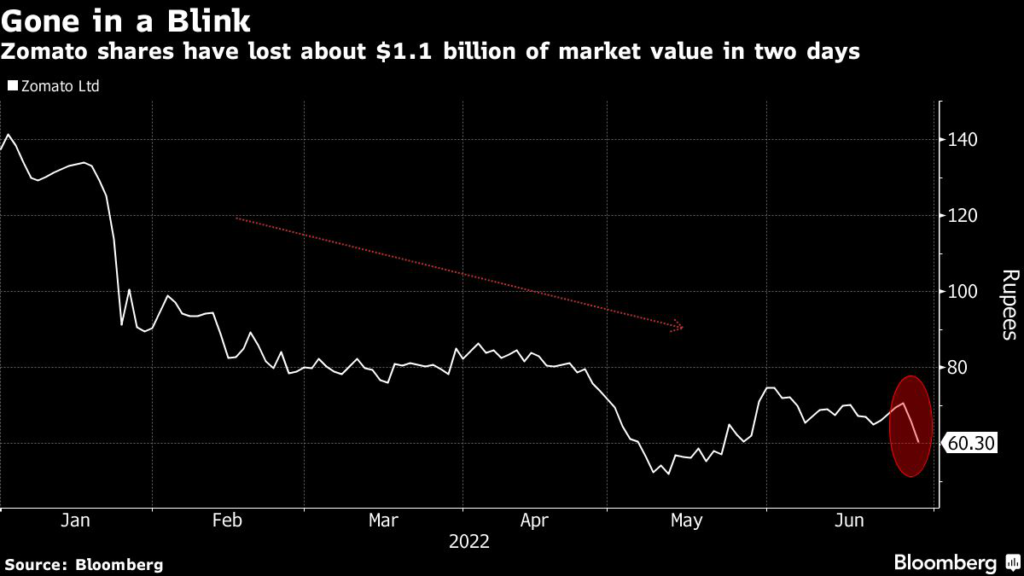
(Bloomberg) — Zomato Ltd. lost about $1.1 billion of market value in two days after the food-delivery platform announced the acquisition of loss-making quick-commerce firm Blink Commerce Pvt., a move some analysts said will weigh on future growth. 

Zomato, among the first generation of Internet unicorns to tap India’s capital market, tumbled 8.4% in Mumbai trading on Tuesday on top of a 6.6% drop on Monday. The two-day fall to 60.3 rupees put shares 21% below the initial public offering price. 

The acquisition will increase Zomato’s operating loss to fund activities of Blink and its Blinkit app, “shifting path to profitability back by another year,” Rahul Jain, an analyst at Dolat Capital Market Ltd., said in a note. 

The successful listing of Zomato last year set the tone for the IPOs of a number of Indian unicorns, including digital-payments firm Paytm’s parent One 97 Communications Ltd. However, doubts have been raised about the valuations of the so-called new-age technology firms — as well as about their business models, with many companies still making losses and turning to the inorganic route of acquisitions to expand. 

Zomato, backed by Sequoia Capital and Jack Ma’s Ant Group Co. among others, first invested in Blink in August 2021. The company said the acquisition will help it increase its hyper-local delivery fleet and reduce some costs.

The acquisition widens Zomato’s scope beyond food delivery and “highlights management’s broader ambitions of capturing a larger slice of India’s $1.3 trillion commerce market,” Swapnil Potdukhe, an analyst at JM Financial Institutional Securities Ltd., said in a note.

More stories like this are available on bloomberg.com

©2022 Bloomberg L.P.
Toshiba Adds Activist Directors in Move Toward Privatization

(Bloomberg) — Toshiba Corp. shareholders elected representatives of two vocal activist hedge funds to the board in a contentious meeting, bringing the scandal-tainted industrial giant a step closer to possible privatization.

Shareholders of the Tokyo-based company voted their support for all 13 director appointees, including Eijiro Imai of Farallon Capital and Nabeel Bhanji of Elliott Management Corp., at an annual meeting of shareholders on Tuesday. Angry investors shouted at management from the start of the meeting, disrupting executives’ presentations.

The election paves the way for a major deal that will determine Toshiba’s future. The company has said it received eight bids to privatize the company and two offers to form business alliances. The board’s first task is to narrow the list of suitors, and conduct due diligence with each, before deciding the next step for the 147-year company. Toshiba shares have gained 20% this year, partly on its plans to review privatization bids. 

Shares were little changed in Tokyo after the shareholders’ meeting.

The presence of the new directors on the board may help quiet the company’s bitter and longstanding fracas with shareholders, who have accused management of ignoring their interests. Following years of scandals and mismanagement, investors rejected key nominations at last year’s meeting and in March put the company in a state of limbo by voting against both proposals presented after months of wrangling — splitting the company or selling it off.

“We believe management and shareholders can share the same footing by welcoming Imai and Bhanji to the board,” Chief Operating Officer Goro Yanase said.

Bain Capital and CVC Capital Partners are among the candidates considering bids, along with state-backed investment fund Japan Investment Corp., Bloomberg News has reported. Foreign investors have watched developments at Toshiba to gauge shareholder influence and regulators’ acceptance of foreign private equity firms in Japan. Any sale of Toshiba, which owns key nuclear technologies, would require approval from the Japanese government.

Private Equity Giants Called Vultures Eye Breakthrough in Japan

How well the board can unite will also be critical. Toshiba external board member Mariko Watahiki earlier this month spoke out publicly against the appointments of Imai and Bhanji, saying that if they were appointed, activists would take up too much of the board. Watahiki resigned from the board after the shareholders’ meeting, Toshiba said.

Retail investors at the meeting questioned the appointments of both Imai and Bhanji as well as the need for privatization. Shareholders asked whether the activist funds’ interests were aligned with what was good for the company over the long-term. 

“Toshiba has accumulated amazing technology precisely because it is listed,” another said. “Please do not go private.” 

External board member George Zage, who chairs the appointment committee that nominated Imai and Bhanji, said that the company consulted multiple law firms to review conflicts of interest, and that the appointments were designed to address lack of trust between large shareholders and management. Chief Executive Officer Taro Shimada responded to shareholders opposing privatization by saying the company would thoroughly study all options.

The board’s first order of business, however, is finding a clear direction, said Chieko Matsuda, a professor at Tokyo Metropolitan University who specializes in corporate governance. Even after spinning out its memory chips, home appliances, PCs and TVs, the sprawling industrial conglomerate’s remaining products still span the gamut from nuclear turbines and high-speed trains to batteries, elevators, cloud computing and semiconductors. 

“It is completely unclear where Toshiba is headed, what its business will be, or how it sees its future,” she said. 

(Updates with board member resigning in the eighth paragraph)

More stories like this are available on bloomberg.com

©2022 Bloomberg L.P.

Philips Says Faulty Cleaning Worsened Apnea Device Foam Issue

(Bloomberg) — Koninklijke Philips NA said the use by customers of unauthorized cleaning products worsened damage to noise-dampening foam inside some ventilators used for treating sleep apnea, hinting that the finding will form part of its defense in looming court cases.

An investigation into faults with some of its sleep apnea machines found that customers’ use of ozone cleaning products “significantly exacerbates” foam degradation, the Amsterdam-based company said late Monday. 

“This is not the time to discuss tactics for how we will do court cases,” Chief Executive Officer Frans van Houten said in a phone interview. “But obviously this information that we publish today show a strong correlation with the use of non-authorized cleaning methods, so that will be helpful information.”

Philips initiated its first recall of potentially faulty devices last June. The company has made cumulative financial provisions of around 885 million euros ($937 million) for the recall and warned it might need to set aside more funds as user lawsuits progress.

Philips shares fell 1.9% by 11:10 a.m. in Amsterdam, bringing the decline this year to 38%. Analysts at UBS said the testing update didn’t provide the “unequivocal” positive news investors were hoping for.

Philips Sinks; UBS Says Breathing Device Update ‘Disappointing’

Consumers have accused Philips in lawsuits of violating the US Federal Food, Drug and Cosmetic Act, which requires that medical devices be safe and effective. They claim the breathing machines were defectively designed by using foam that could degrade if exposed to moisture.

In sleep apnea, breathing stops and starts, which can cause fatigue and longer-term health problems. Philips products designed to improve sleep patterns include its DreamStation CPAP machines and Trilogy ventilators.

Van Houten said Philips’ probe found that only a small percentage of units examined during the testing showed visible signs of foam degradation. The company said that 422 of the 60,847 returned or used devices that were inspected were linked to a reported foam degradation complaint. However, testing found that only 18 of these 422 machines, or 4%, actually showed visible foam degradation.

“What made these people complain about foam degradation when there was no foam degradation in the units they had?” he asked. “All of that is going to be highly relevant in subsequent litigation.”

More stories like this are available on bloomberg.com

©2022 Bloomberg L.P.
Netflix’s Plan to Fix Its Subscription Crisis Starts in Asia

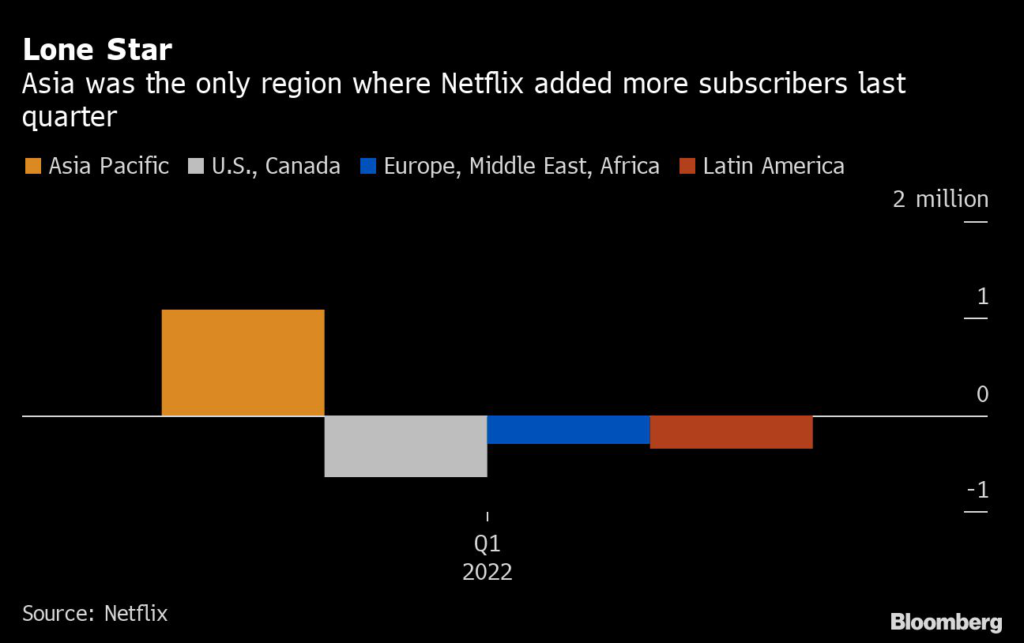
(Bloomberg) — Netflix Inc. is looking to Asia after its shock first-quarter slowdown, seeking to both maintain growth in the one region where it’s still adding subscribers and replicate its success there in other parts of the world.

Despite plans to curb overall spending, investment in Asia will keep growing, including financing for the production of local films and series, Tony Zameczkowski, vice president of business development for Asia Pacific, said in an interview. 

While Netflix will continue to offer low-price, mobile-only membership across Asia, it’s also seeking more partnerships with wireless operators and digital payment companies to reach more potential customers in a region where credit card use is less common, he said. The company’s Asia strategy is informing moves in other emerging markets, where the platform must also grow to balance out saturation in North America and Europe.

“Asia is a great proxy for other markets in the world,” said Zameczkowski. “There are similarities between emerging Asia and other emerging markets like Africa and Latin America. Learnings here can be easily replicated or leveraged by those regions.” 

The world’s biggest streaming platform is at a critical juncture. Shares surged in recent years as subscriber counts boomed, but the company reported its first loss of customers in more than a decade in April and forecasts another contraction this quarter amid fierce competition from rivals. With more than 70% of its market value wiped out since mid-November, Netflix is under pressure to renew a content pipeline that’s lost shine, while cutting costs.

Read more: Netflix Has Finally Hit a Wall. Where Does it Go From Here?

The company has already made inroads in the Asia Pacific but the broader slowdown gives added impetus to build on the success of South Korean mega-hits like “Squid Game” and “Hellbound,” which boosted subscriptions. 

Read more: Netflix Hunts for Subscribers in Asia After ‘Squid Game’ Success

The Asia Pacific region accounts for 15% of Netflix’s 221.6 million global subscribers and is forecast to be the biggest driver of further expansion. After a disappointing start to the year, analysts expect a rebound in the second half will see the company add about 6.8 million members for the whole year, with 79% coming from the Asia Pacific.

Challenges Ahead

Still, the region’s widely differing audiences, preferences and operating environments pose risks. New users in the Asia Pacific totaled 1.1 million in the first quarter, down 20% from a year earlier, and the company has faced cultural and political challenges in penetrating some markets. The series “A Suitable Boy” triggered controversy in India in 2020 over a scene showing its Hindu female protagonist kissing a Muslim man, while the company removed a show for Vietnamese audiences after the government said a map in it violated sovereignty laws.

Netflix’s customers in Asia are also some of its lowest-value ones, which means many more subscriptions are required to juice revenue. The pace of revenue growth is already the slowest since records began in 2017 after low-priced mobile-only plans were introduced across Asia and prices slashed in India. Average revenue per membership fell 5% to $9.21 per month in the Asia Pacific, compared with a 5% increase to $14.91 in the U.S. and Canada.

“It’s those $14.91 subscribers who pay the bills, and they declined last quarter,” said Michael Pachter, an analyst at Wedbush Securities. “Cheap mobile pricing drives subscribers, but they come at a huge cost.”

Netflix also faces keen competition from streaming giants such as Amazon.com Inc. and Walt Disney Co., as well as local companies that have made headway into Asian markets. In Southeast Asia, Viu, owned by billionaire Richard Li, overtook Netflix to become the region’s second-largest streamer last year due to its extensive library of Korean content and a free subscription tier.

To make up for the steep pricing discounts, Netflix must concentrate on expanding the user base, both in high-revenue countries like Japan and Korea as well as emerging markets such as Thailand and Indonesia, said Vivek Couto, executive director of Media Partners Asia.

In India, that would require adding 20 million to 30 million subscribers for revenue to be meaningful, he said. The market had about 5.5 million subscribers last year, according to estimates from the consultancy. 

This will likely be an uphill challenge. Many people in the country still prefer to watch movies at cinemas and dramas on traditional TV, with streaming services relying heavily on live programming to draw customers. Even Disney, whose Disney + Hotstar is one of the dominant players in the market, is facing a potential subscriber drain after losing the rights to stream the lucrative Indian Premier League cricket matches. 

“They are trying to create a deeper funnel of customers,” said Couto. “You can’t increase prices unless you’ve got a significant customer base.” 

Read more: Netflix’s Bet on India Has Yet to Pay Off Six Years After Launch

While major competitors have all introduced tiered pricing such as mobile-only plans, Netflix is going beyond that to attract sign-ups through innovative payment methods, like allowing users to include their subscription fees in their monthly phone bills or pay via digital wallets.

Netflix offers a wider range of payment choices in Asia than competitors, Couto said. The number of new members signing up last year using alternative payment methods more than tripled from the previous year, and these measures have been adopted in other markets after their successful launch in Asia, according to Netflix.

Asia could also be part of Netflix’s latest plan to raise revenue via introducing advertising. While Zameczkowski said it’s too early to tell in which markets the company will launch the new model, he believes it would make the platform more accessible to customers.

“Even though the company is entering a new phase of slower growth, Asia is very exciting and presents a lot of opportunities,” said Zameczkowski. “We are just getting started.”

(Updates to add comment in tenth paragraph.)

More stories like this are available on bloomberg.com

©2022 Bloomberg L.P.
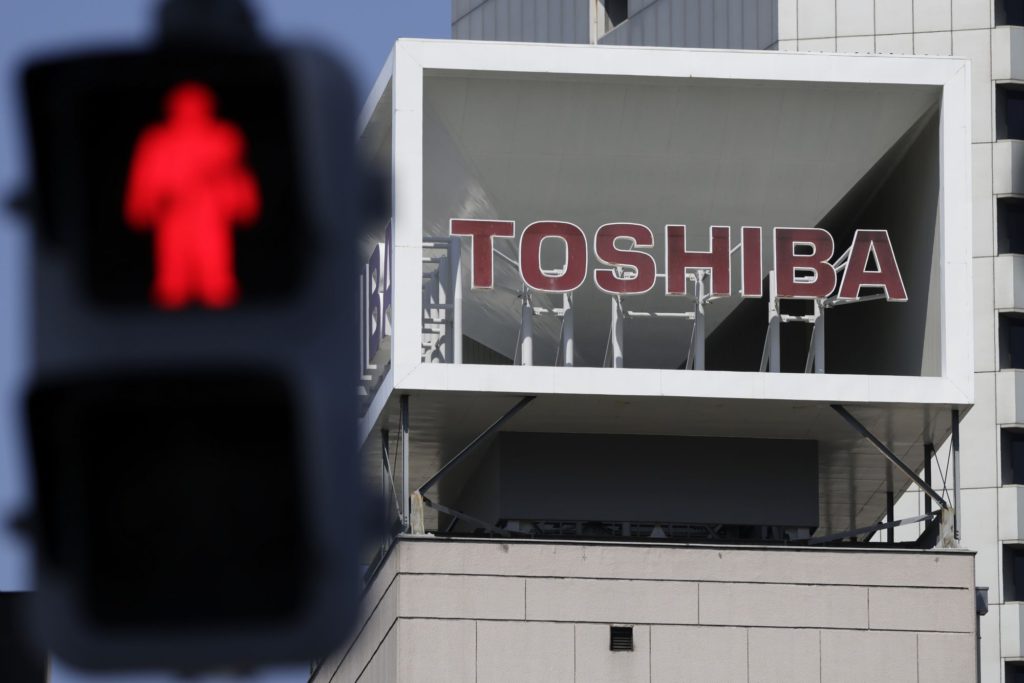
KKR Backs Out of Bidding for Toshiba, FT Says

(Bloomberg) — KKR & Co. is backing away from a potential $22 billion bidding war for Toshiba Corp., the Financial Times reported, citing people familiar with the discussions.

The private equity giant has lost enthusiasm for a takeover of the Japanese industrial icon, opting instead to acquire businesses that will get spun off during a privatization process, the newspaper said. 

KKR’s retreat could pave the way for rivals like Bain Capital to acquire the company, which is trying to leave behind years of scandal and mismanagement. Toshiba has said it’s received eight bids to privatize the company and two offers to form business alliances. KKR and Blackstone Inc. had held exploratory discussions about teaming up on a joint bid for the Japanese conglomerate, Bloomberg News reported in May.

Read more: Toshiba Adds Activist Directors in Move Toward Privatization

More stories like this are available on bloomberg.com

©2022 Bloomberg L.P.
SSE, Equinor Buy Three UK Power Plants for Low-Carbon Plan

(Bloomberg) — SSE Plc and Equinor ASA teamed up to buy three UK electricity plants from Triton Power Co., and plan to use the sites to develop low-carbon projects.

The £341 million ($419 million) deal for the stations in northern England, southwest England and Wales reflects the increasing drive among European energy companies to clean up their operations amid an accelerating shift to green power.

Triton’s portfolio includes the 1.2-gigawatt Saltend gas-fired complex in east Yorkshire, which could be a customer for Equinor’s hydrogen project in the area, the companies said Tuesday in a statement.

“Flexible energy will be absolutely essential as renewable energy scales up over the coming years, providing vital back-up,” said Catherine Raw, managing director of SSE Thermal. “We will explore every avenue to decarbonize Saltend and create new opportunities at other assets so they can play a continued role in a net-zero future.”

SSE and Equinor, which are entering the Triton Power deal as equal partners, are among companies pushing into hydrogen as demand for clean energy booms and governments plow funds into development. Clean hydrogen, produced from renewables or using carbon-capture technology, is seen as a way to cut emissions from the gas industry, as well as from energy-intensive sectors such as steel and cement.

This portfolio of assets was previously sold by Engie in 2017 for £205 million, making the new deal price 65% higher despite the assets being 5 years older, according to RBC Europe Ltd. This is because of improved profitability of gas-fired plants and the increasing need for flexible generation to back up intermittent renewables, the bank said. 

The UK government is targeting 10 gigawatts of hydrogen projects by 2030, with at least half being green hydrogen — produced using water and renewable power.

Read more: U.K. Bets Big on Nuclear, Wind in Energy Security Strategy

Equinor, whose H2H Saltend hydrogen project is expected to be key to the decarbonization of the Humber industrial area, has already joined forces with SSE on other ventures. They plan to convert two other power plants to run on hydrogen, and are studying converting one of Britain’s biggest natural gas storage sites to hold the fuel.

The Triton portfolio also includes the 140-megawatt Indian Queens power station in Cornwall and the Deeside power station, a decommissioned gas plant in north Wales, which provides a so-called inertia service to keep the grid at 50 hertz.

Initial steps to decarbonize the Saltend station are already under way, targeting lower emissions by 2027 by blending as much as 30% hydrogen with the gas supply. SSE’s thermal division and Equinor will work toward zero emissions there by 2035. 

The Triton transaction is expected to complete in September.

Although the acquisition will bring additional emissions into SSE’s greenhouse gas emissions inventory in the short term, SSE will not rebase its existing Science-Based Targets for 2030, the company said.

(Updates with RBC comment in sixth paragraph)

More stories like this are available on bloomberg.com

©2022 Bloomberg L.P.

Danske Finds Sexual Harassment Cases Among Bankers in Survey

(Bloomberg) — Danske Bank A/S said it found examples of bullying and sexual harassment after conducting the first comprehensive employee survey for its entire staff.

The survey, which included replies from 13,000 of the bank’s 22,000 employees, showed that 2.7% said they had faced bullying, discrimination or harassment, while 0.7% had experienced sexual harassment during the past 12 months, Danske said on Tuesday.

Denmark’s biggest bank is working to restore its reputation among customers and its own staff in the wake of a number of scandals, including what may be Europe’s biggest money laundering case. The Copenhagen-based lender has been a pioneer in Denmark for allowing its staff to work remotely, and has offered employees as much as 8,000 kroner ($1,100) in financial aid to set up work stations at home.

The bank said the results are in line with what other, less comprehensive, surveys for the financial sector have shown in the past and are better than results in other industries. Still, Danske said that just 30% of the incidents had been reported to the bank. The lender will use the findings to map out plans to improve working conditions, especially for women and minorities.

“Even though the survey shows that employees in our organization experience relatively fewer incidents than others overall, even one incident is one too many,” Danske’s chief people officer, Karsten Breum, said in the statement.

More stories like this are available on bloomberg.com

©2022 Bloomberg L.P.

How Correlated Is Crypto? Signs Point to Quite a Bit, Actually

  • Listen to Bloomberg Crypto on the iHeartRadio App
  • Listen to Bloomberg Crypto on Apple Podcasts
  • Listen to Bloomberg Crypto on Spotify 

(Bloomberg) — One of the features that early crypto investors would talk about is something called correlation – specifically, the lack of it. Correlation refers to the relationship between different financial assets – if the gold price goes up, and the price of oil also goes up, you could say those prices are positively correlated. For investors looking to diversify their portfolios, correlation isn’t always a good thing. What they want is something that doesn’t move in the same direction as everything else. And for a while, it looked like cryptoassets might fit the bill. 

Over the past year, as inflation rates have begun to rise- the price of crypto has fallen in line with stocks. What does this mean for crypto’s supposed independence from other markets? Bloomberg reporter Vildana Hajric joins this episode to explore these questions. 

Follow us on Twitter @crypto, and subscribe to the Bloomberg Crypto Newsletter at https://bloom.bg/cryptonewsletter

More stories like this are available on bloomberg.com

©2022 Bloomberg L.P.

Close Bitnami banner
Bitnami
