Bloomberg

Wise Shares Fall as Expansion Plans Dent Earnings Margin

(Bloomberg) — Wise Plc said revenue hit £559.9 million ($686 million) in its first set of full-year results as a listed company, up a third from the previous year.

But earnings missed estimates as the company’s investments hit margins, according to a statement Tuesday. Adjusted EBITDA was £121.4 million in the year to March 2022, up 12% but below Bloomberg-compiled analyst expectations of £129.6 million. 

The revenue figure was above the average analyst estimate of £556 million. 

The firm “will continue to invest in our infrastructure” and “expand globally,” Kristo Kaarmann, Wise co-founder and chief executive officer, said in the statement.

Analysts at Citigroup Inc. said the results were “mixed.”

Wise’s shares were down 5.8% at 9:32 a.m. in London, having earlier risen as much as 6% following the publication of the results. 

The company said its volumes grew to £76 billion in the period, which was 40% more than in the year to March 2021. It had 4.6 million active customers, an increase of 29%.

The money-transfer firm also said it expects revenue to grow by between 30% and 35% in the twelve months to March 2023, and in the medium term it expects to deliver revenue growth above 20%.  

New Hires

The London-based fintech is hiring in Europe, Singapore and in its new Austin, Texas, office, with more than 400 roles open. 

“Our teams will be hiring heavily in engineering and in product, but also we have operational teams around the world that will continue to grow,” Matt Briers, chief financial officer at Wise, said in a phone call.

Wise can send money to over 70 countries, but is only able to receive money from 45 countries, Briers said. “So there’s many markets on the horizon that we’ll expand to.”

The company is one of a string of London-listed technology firms, whose shares have slipped since their listing, dampening investor confidence in London IPOs. Wise made headlines since going public and losing about 60% of its value since then. 

Kaarmann himself is also in the spotlight. Wise said Monday that the Financial Conduct Authority has commenced an investigation into the CEO almost a year after he was fined by HMRC for deliberately defaulting on his taxes.

“The board did a review into this. We take it very seriously. We shared that with the FCA and now the FCA is running their own investigation,” Briers said.  “We continue to support Kristo.”

He also said Wise — unlike some other startups — had no plans to raise capital. 

“We don’t need to raise capital, we’re profitable,” Briers said. “We weaned ourselves off this way of growing a business.”

(Updates with details throughout.)

More stories like this are available on bloomberg.com

©2022 Bloomberg L.P.

Indonesia Will Use Covid Tracking App to Sell Cheap Cooking Oil

(Bloomberg) — Indonesia will make use of its Covid-19 tracking app to distribute cheap cooking oil as the government takes steps to ensure its subsidies reach their target.

The PeduliLindungi app, which lets people scan QR codes to verify their health and vaccination status when entering buildings, will also let Indonesians buy as much as 10 kilograms of subsidized cooking oil each day, said Rachmat Kaimuddin, acting deputy at the Coordiating Ministry for Maritime Affairs and Investment. Kaimuddin was president director of e-commerce startup PT Bukalapak.com.

“People’s IDs are verified on PeduliLindungi, so people can scan QR codes and the app will show green — meaning you can buy cooking oil — or red if you’ve met your quota,” he said on Tuesday.

Indonesia, the world’s biggest palm producer, has pushed for better distribution of cheap cooking oil to temper local prices and keep it exporting edible oils. President Joko Widodo sent the market whipsawing when he announced a ban on all cooking oil shipments in April due to a local shortage, only to revoke it weeks later.

More stories like this are available on bloomberg.com

©2022 Bloomberg L.P.

Michelin Eyes Transfer of Russian Unit to Local Management

(Bloomberg) — Michelin is planning a transfer of its Russian operations to local management by the end of the year, becoming the latest European manufacturer to pull out of the country due to the war in Ukraine.

“Michelin now confirms that it is technically impossible to resume production, due in particular to supply issues,” the company said Tuesday, adding that it values the activities at around 250 million euros ($265 million).

The French tiremaker employs around 1,000 people in Russia, most of them at its Davydovo plant outside Moscow that has a capacity to make as many as 2 million tires. Work at the factory was halted in March. 

Cie. Generale des Etablissements Michelin follows Renault SA in withdrawing from Russia after spending decades building up a local business. The French carmaker last month agreed to transfer its 2.2 billion-euro business to local state entities in what amounted to a nationalization of car plants staffed by around 45,000 people.

READ: Renault Hands Lada Maker to Russia as Price of War Mounts

Michelin said the new Russian entity would operate through a structure independent from Michelin. The firm generates around 2% of its total sales in the country and 1% of its global car tire production.

Michelin rose as much as 1.6% in Paris. The shares have lost around a quarter this year.

War Costs

The French manufacturer expects the war in Ukraine to add more than 1 billion euros in costs in 2022, mainly due to higher prices for energy, transport and raw materials. It stopped exports to Russia in March, including freezing a supply contract with flag carrier Aeroflot PJSC for airplane tires that dealt a blow the country’s aviation industry.

The company has had to find alternative sources for the 30% of carbon black, a raw material used to make tires, that was sourced from Russia for its European plants. Russian synthetic rubber also had to be replaced along with Ukrainian truck drivers, who were an important logistics link in some regions.

(Updates with shares in sixth paragraph.)

More stories like this are available on bloomberg.com

©2022 Bloomberg L.P.

Taliban Declare Online Forex Trading Illegal in Afghanistan

(Bloomberg) — Afghanistan’s central bank has banned online foreign exchange trading, declaring it “illegal” in Islam and warned that anyone engaging in it would face prosecution, a spokesman of the bank said.

“Da Afghanistan Bank considers online forex trading illegal and fraudulent, and there is no instruction in Islamic law to approve it,” Saber Mohmand said over the phone. “As a result, we have banned it.” 

Since the Taliban returned to power last year, the economic collapse of the already-fragile nation had pushed many Afghans to turn to online forex or cryptocurrency trading, partly to preserve their money and keep it out of the group’s reach.

The bank has also tweeted a video showing two men in a boxing gym discussing how online trade in foreign currencies was against their Muslim faith. It’s unclear whether the central bank will also ban cryptocurrency trade in the country.

While there is no specific data on how many people trade forex online, Mohmand said that “millions of dollars” are traded daily, mainly by the currency traders in Sara-e Shahzada, the largest foreign exchange market in capital Kabul.

The announcement comes as the Taliban are struggling to fix an economy ravaged by international sanctions since they swept into power. Their global isolation has resulted in the nation losing the international aid that had previously accounted for more than 40% of Afghanistan’s GDP. The US has also blocked the central bank’s access to $9 billion in foreign reserves.

More stories like this are available on bloomberg.com

©2022 Bloomberg L.P.

Michelin May Transfer Russian Operations to Local Management

(Bloomberg) — Michelin is considering a transfer of its Russian operations to local management by the end of the year, the latest global manufacturer to pull out of the country due to the war in Ukraine.

“Michelin now confirms that it is technically impossible to resume production, due in particular to supply issues,” the company said Tuesday. It suspended activities in the country on March 15.

The French manufacturer has stopped exports to Russia, including freezing a supply contract with flag carrier Aeroflot PJSC for airplane tires. The new Russian entity would operate through a structure independent from Michelin. 


More stories like this are available on bloomberg.com

©2022 Bloomberg L.P.

Love of Big Cars, Chip Dearth Swells Wait Times for Mahindra

(Bloomberg) — Robust consumer demand teamed with an ongoing shortage of chips has seen wait times for Mahindra & Mahindra Ltd.’s XUV700 sports utility vehicle balloon to as long as 22 months just as the carmaker unveils the latest model in its big-automobile lineup.

Outstanding customer pre-orders for the seven-seater XUV700, which the Indian automaker launched in August, are running to around 70,000, Executive Director Rajesh Jejurikar said in an interview last week. While the chip shortage has eased from a peak late last year, Mahindra is still experiencing some supply chain pain points, he said.

The Mumbai-based $15.8 billion cars-to-factory equipment conglomerate took the wraps off its Scorpio-N late Monday, an automobile it bills as the “Big Daddy of SUVs.” Mahindra is hoping consumers in India will continue their embrace of larger, gas guzzling vehicles even as Prime Minister Narendra Modi commits to making the South Asian nation a net-zero carbon emitting one by 2070.

Read more: India’s Top Carmaker Bets on Hybrids Over EVs in Clean Shift

Mahindra doesn’t have a strong electric vehicle line up — it currently sells one passenger EV, the e-Verito, though it does have a much bigger presence in the electric three-wheeler market. But Jejurikar said range anxiety and lack of charging infrastructure mean the company doesn’t see a tipping point for EVs until between 2025 to 2027.

By that stage, electric SUV sales are expected to comprise about 20% to 25% of Mahindra’s sales, he said.

Until then, a major focus for Mahindra, which also last year unveiled a new look logo, will be defending its market share in the large-format SUV segment from Tata Motors Ltd. and Hyundai Motor Co. 

Data from automotive business intelligence provider JATO Dynamics show Mahindra had a leading revenue market share of 17.8% in the fourth quarter of fiscal 2022, followed by Tata, Hyundai and Hyundai affiliate Kia. Shares in Mahindra rose to a record high Tuesday, bringing gains this year to 31.5%.

Mahindra isn’t the only carmaker to be suffering long chip-induced wait times.

Maruti Suzuki India Ltd., the automaker that sells every other car on the nation’s roads and positions itself in the smaller vehicle segment, doesn’t see the semiconductor crunch finishing even in 2023.

But “with more engineering input going into how to beat the problem, production this year will definitely be better than last year,” Chairman R.C. Bhargava said.

“At the moment we have 325,000 cars on our waiting list. It’s almost two months’ sales. We think that by this year end we’ll have the problem under more control.”

(Updates with share price in 7th paragraph.)

More stories like this are available on bloomberg.com

©2022 Bloomberg L.P.

Startup Byju’s Pushes Back Payments for $1 Billion Acquisition

(Bloomberg) — Online education provider Byju’s, India’s most valuable startup, is pushing back payments for an approximately $1 billion acquisition struck last year, according to people familiar with the matter.

Blackstone Inc. and other shareholders of test-preparation provider Aakash Educational Services were due to be paid partly in cash and partly in Byju’s stock this week, but Byju’s sought a two-month extension, said the people, who asked not to be identified discussing a private matter. Some sellers received partial payment in 2021, the people said. Blackstone, which owned 38% of Aakash, opted to defer payments due until this year, one of the people said.

The acquisition process is “fully on track and all payments are expected to be completed by the agreed upon date i.e. August 2022,” a Byju’s spokeswoman said. Blackstone didn’t respond to an email seeking comment and an Aakash representative declined to comment. The Morning Context reported earlier that the deal’s payments had been postponed.

Byju’s, one of the world’s most valuable startups with backing from Tiger Global Management and Mark Zuckerberg’s Chan Zuckerberg Initiative, has expanded its business globally through acquisitions. But the tech investing climate has changed radically in recent months as company valuations have plummeted, and the number of startup deals and total funding raised dropping to its lowest level since late 2020.

Byju’s asked to push back the Aakash deal payments until late August because regulators have yet to clear the acquisition, said one of the people, adding that it had nothing to do with cash shortages. Blackstone and Aakash’s other shareholders agreed to the extension, the person said.

Even amid a constrained financing environment, Byju’s has sought to keep expanding. The company was in discussions to acquire a US target and was likely to bid for either Chegg Inc. or 2U Inc., people familiar with the matter said in May. It has previously sewn up deals to acquire companies in India, the US and Austria.

Byju’s was also in negotiations with at least three special-purpose acquisition companies and was aiming to unveil plans to go public via a merger with one of them, people familiar said earlier this year.

The education pioneer is India’s most valuable startup, with a valuation of $22 billion, according to the market researcher CB Insights. Its backers also include Silver Lake Management, Naspers Ltd., and Mary Meeker’s Bond Capital. The edtech provider has about 115 million students using its online learning platform, with 7 million of them paying annual subscriptions.

More stories like this are available on bloomberg.com

©2022 Bloomberg L.P.

Wise Says Revenue to Grow More Than 30% as Results Top Estimates

(Bloomberg) — Wise Plc said revenue hit £559.9 million ($686 million) in its first set of full-year results as a listed company, up a third from the previous year.

The revenue figure was above the average Bloomberg-compiled analyst estimate of £556 million. The company said its volumes grew to £76 billion in the period, which was 40% more than in the year to March 2021, according to a statement Tuesday. It had 4.6 million active customers, an increase of 29%.

The money-transfer firm also said it expects revenue to grow by between 30% and 35% in the twelve months to March 2023, and in the medium term it expects to deliver revenue growth above 20%.

The firm “will continue to invest in our infrastructure” and “expand globally,” said Kristo Kaarmann, Wise co-founder and chief executive officer.

The company is one of a string of London-listed technology firms, whose shares have slipped since their listing, dampening investor confidence in London IPOs. Wise made headlines since going public for losing about 60% of its value. 

Kaarmann himself is also in the spotlight. Wise said Monday that the Financial Conduct Authority has commenced an investigation into the CEO almost a year after he was fined by HMRC for deliberately defaulting on his taxes.

More stories like this are available on bloomberg.com

©2022 Bloomberg L.P.

Crypto Data Firm Kaiko Raises $53 Million During Market Rout

(Bloomberg) — Blockchain analytics firm Kaiko raised $53 million from new and existing investors in its latest financing round, even as crypto-exposed companies struggle through a rout in digital assets.

The series B deal tripled Kaiko’s valuation from its last round in June 2021, a spokesperson for the firm said, declining to provide exact figures. The investment was led by Alibaba backer Eight Roads, alongside French venture capital firm Revaia and existing investors Alven, Point Nine, Anthemis and Underscore.

Kaiko Chief Executive Officer Ambre Soubiran, in an interview with Bloomberg, described the past two months as “a marathon,” with investors growing increasingly cautious about deploying capital to crypto-linked businesses.

“What was challenging, in all honesty, was the due diligence and closing process because we were really, really under scrutiny,” she said. “They went into many, many details to make sure that there was barely any risk in the investment.”

As a data provider for clients and partners including Deutsche Boerse, ICE Global Network, Messari and Paxos, Kaiko offers institutional investors and businesses a mix of market data in crypto and decentralized finance, pricing services, indices and industry research. 

Wary Investors

The company was founded in 2014 by Pascal Gauthier, now the CEO of cryptocurrency hardware firm Ledger, before being bought by Soubiran, a former HSBC banker.

Read More: Celsius Is Running Out of Options to Stay Solvent, Kaiko Says

Though it doesn’t have direct exposure to the whims of token pricing, Kaiko has not been immune to the industry’s troubles as $2 trillion was wiped off the market’s value. 

Several prominent crypto companies, lenders and hedge funds, once flush with cash and accolades at the peak of the market, have cut costs, laid off staff and bordered on insolvency as prices plunged and liquidity dissipated. Investors have become overly wary as a result, Soubiran said, keen to ensure their bets can withstand a potentially lengthy bear market.

“Building the narrative around the series B pitch was not the hardest part,” Soubiran said. “The hardest part was getting the whole thing across the finish line in the middle of a minus 80% downturn.”  

Controlling Costs

Soubiran said the crypto meltdown has been a boon for Kaiko’s business, as customers clamor for information about why prices are crashing. She pointed to a sharp jump in leads for new clients since the current crisis started.

Alston Zecha, a partner at Eight Roads who oversaw its investment in Kaiko, said crypto has matured a great deal in the seven years since he first presented an overview of the industry to colleagues and senior executives at Fidelity International Ltd., to which the fund is affiliated. 

“When you speak to most VCs, yes, they are potentially slowing down their pace of deployment, but they’re not saying ‘no’ for really promising companies,” Zecha said in an interview. “The phrase that VCs use is the bar is higher.”

Soubiran said she plans to take “a much closer look at our path to profitability” in the coming months, including controlling spending as much as possible. Kaiko, however, remains in the market for a chief financial officer among other senior roles, and will use the funding to expand its workforce of roughly 60 employees across offices in London, Paris, Singapore and New York.

More stories like this are available on bloomberg.com

©2022 Bloomberg L.P.

Cyber Pirates Prowling Ship Controls Threaten Another Big Shock

(Bloomberg) — In February 2019, a large container ship sailing for New York identified a cyber intrusion on board that startled the US Coast Guard. Though the malware attack never controlled the vessel’s movement, authorities concluded that weak defenses exposed critical functions to “significant vulnerabilities.”

A maritime disaster didn’t happen that day, but a warning flare rose over an emerging threat to global trade: cyber piracy able to penetrate on-board technology that’s replacing old ways of steering, propulsion, navigation and other key operations. Such leaps in hacking capabilities could do enormous economic damage, particularly now, when supply chains are already stressed from the pandemic and the war in Ukraine, experts including a top Coast Guard official said.

“We’ve been lucky so far,” said Rick Tiene, vice president with Mission Secure Inc., a cybersecurity firm in Charlottesville, Virginia. “More and more incidents are happening, and the hackers are getting a better understanding what they can do once they’ve taken over an operational technology system. In the case of maritime — whether it be the ports or the vessels themselves — there is a tremendous amount that could be done to harm both the network and physical operations.”

Rear Admiral Wayne Arguin, the Coast Guard’s assistant commandant for prevention policy, said shipping faces cyber risks similar to those in other industries — it’s just that the stakes are so much higher given that almost 80% of global trade moves on the sea. While Arguin declined to put a number on the frequency of attempted break-ins, he said “I feel very confident that every day networks are being tested, which really reinforces the need to have a plan.” 

Stress System

“A potential intentional attack could really stress the system and we’re certainly thinking about how to shore that up,” Arguin said in an interview. “When you couple that with the sensitivity of supply-chain disruptions, it does have the potential to be devastating to the marine transportation system.”

That universe includes not just ship operators but port terminals and the thousands of logistics links in global supply chains that are increasingly interconnected.

BlueVoyant, a New York-based cyber-defense platform that recently analyzed 20 well-known shipping companies, said some strides have been made since 2021, but “there are more cyber-defense actions the industry can take to make things more secure.” A wider survey into third-party cyber risks showed 93% of respondents acknowledged suffering direct breaches tied to supply-chain weaknesses, with the average number of intrusions rising to 3.7 last year from 2.7 in 2020, according to Lorri Janssen-Anessi, BlueVoyant’s director of external cyber assessments.

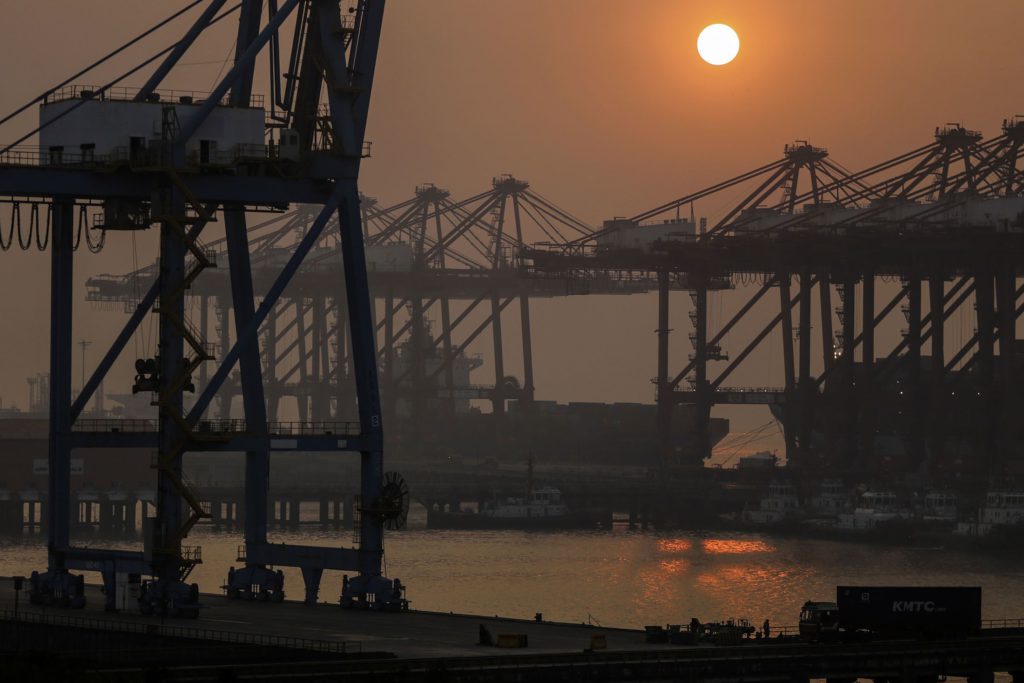
Hackers have hit major logistics operations several times already this year. Jawaharlal Nehru Port Trust, India’s busiest container port, suffered a ransomware attack in February. A targeted attack on Expeditors International of Washington Inc., a large freight-forwarding company, crippled its systems for about three weeks and led to $60 million in expenses. Blume Global Inc., a supply-chain tech company based in Pleasanton, California, said in early May that a cyber incident temporarily made its asset-management platform inaccessible.

‘Vulnerable Areas’

“You’ve picked on an industry that has a lot of vulnerable areas,” said Jennifer Bisceglie, the CEO of Arlington, Virginia-based Interos, a supply-chain risk-management company.

The ocean shipping industry is the backbone of global goods trade but when it comes to cyber vulnerabilities, its broad reach is an Achilles heel. The biggest companies are playing catch-up and, after years of struggling to make money, now have the resources to invest in upgraded ship-to-shore technology.

Hapag-Lloyd AG, Germany’s largest shipping line, announced in April that it’ll become the first carrier to equip its entire fleet of containers with real-time tracking devices. Most of the large container lines use remote sensors for functions like monitoring engine performance, maintaining cooling systems or opening a pump valve. Electronic charts and collision-avoidance mapping can be updated on shore and shared remotely. Many new ships ordered during this period of peak profitability will be fitted with more online connectivity to land-based operations.

Such advances add visibility and efficiency but they also potentially make the jobs of hackers easier, experts said.

“Ships were quickly connected to the internet using satellite communications, but without all the other security controls needed to be safe and secure at sea,”said Ken Munro, a security specialist at Pen Test Partners, a cybersecurity company with clients in the maritime industry. “So now shipping operators are frantically trying to build these controls back in, but are struggling with decades-old equipment on board that can be really hard to secure.”

To help guard against the threats, the International Maritime Organization, a United Nations agency responsible for safety and security, issued guidelines that companies were supposed to adopt starting in 2021. Some analysts said those regulations haven’t had enough of the intended effect and led to a wide range of responses.

System Patchwork

“Some were very proactive and started doing the work long before the regulations,” said Captain Rahul Khanna, the global head of marine risk consulting with Allianz Global Corporate & Specialty, a unit of the Munich-based financial services company, Allianz SE. “On the other end of the spectrum, you had people who are aware and doing just the bare minimum just to get the certificate in their files.”

Even modern ships have a patchwork of systems from different manufacturers that have taken cybersecurity in varying degrees of seriousness, said Andy Jones, the former chief information security officer at A.P. Moller-Maersk A/S, the world’s No. 2 container carrier. “Some operators have taken this seriously, but with substantial fleets and ships that are probably over 30 years old, it is a very tall order.”

Jakob Larsen, a maritime security specialist with Bimco, one of the world’s biggest associations representing shipowners, defended the industry’s position on cyber protections as “relatively strong” and on par with other sectors. Though increased digitization brings “more and more of an attack surface,” he said instances where operational controls have been hacked are rare and technically difficult to pull off.

“This idea that someone can take over the control of a ship and do all sorts of things, while it might be technically possible for a really skilled hacker who has the time to do it, in reality it’s not really something that we’re seeing,” Larsen said. “Theoretically, yes in can happen and of course we have to constantly stay updated with our defenses and pay attention to new threats.” 

‘Huge Underreporting’

Khanna said there’s a “huge underreporting” when ships get attacked and “the ones who say they haven’t been, just don’t know about it.”

Across industry and government, there’s agreement that there needs to be more information sharing. “Everybody needs to be all-in in this game and understand when there are vulnerabilities — getting that information out quickly is going to be thing that continues to help us close doors,” the Coast Guard’s Arguin said.

For some observers, a wakeup call about the stakes involved came in March 2021, when the Ever Given — one of the world’s largest container ships — ran aground and blocked traffic in the Suez Canal for almost a week. The accident, blamed partly on strong winds, cut off much of Europe’s trade with Asia and threw supply chains off kilter for several weeks.

“The Suez incident made everybody realize that global supply chains are actually quite vulnerable,” Munro said. “Not that Suez was a hack — it wasn’t — but it so easily could’ve been.”

More stories like this are available on bloomberg.com

©2022 Bloomberg L.P.

Close Bitnami banner
Bitnami