
Bloomberg

One of China’s Top Tech Investors Sees Crackdown Turning Point

(Bloomberg) — The founder of one of China’s biggest private equity investors said the nation’s tech firms are turning a corner after a recent rout wiped out nearly $2 trillion in market value at its peak. 

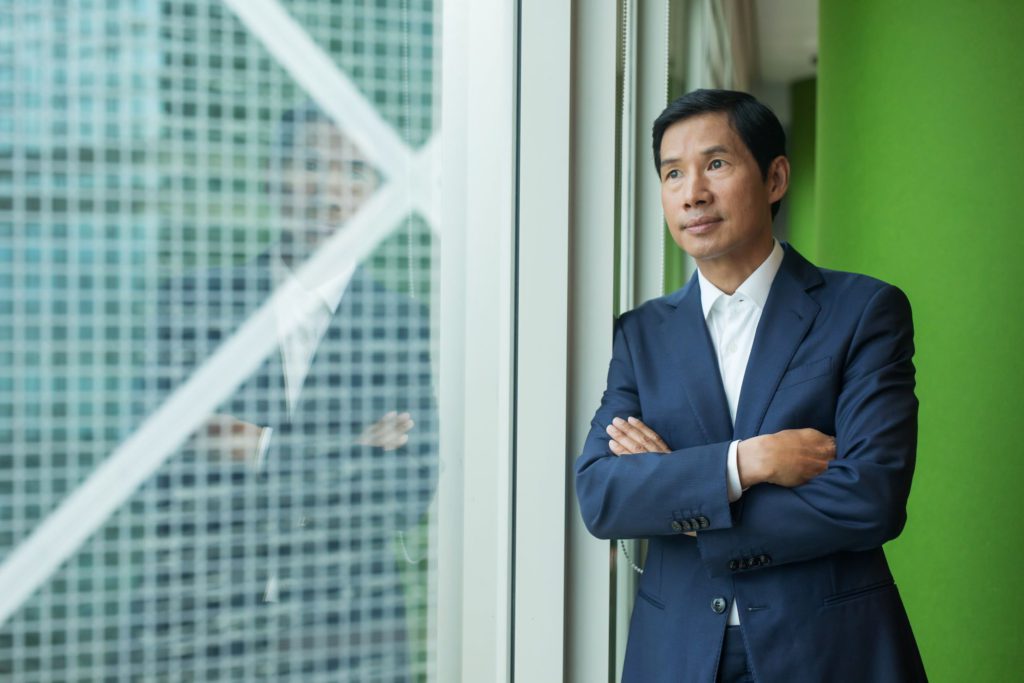
Fred Hu, the former Goldman Sachs Group Inc. rainmaker who started the $17 billion Chinese private equity firm Primavera Capital, said reassuring messages concerning regulation, resilient earnings and beaten-down valuations now make the sector interesting for investors.

“This could be the beginning of a new era for China tech,” Hu, the firm’s chairman, said in a recent interview. “There’s a lot of value to be discovered,” he said, adding that investors still need to be selective given the high risk profile of such companies.

The private equity mogul’s views are one of the strongest statements yet in support of a turnaround as global investors begin to rotate back into tech stocks. The Chinese Communist Party’s yearlong crackdown is showing signs of softening at the edges, even as industry insiders point to a more downbeat picture.

Founded in 2010, Primavera is ranked as the fourth biggest private equity firm in China according to Private Equity International. Previous investments include fast-food chain operator Yum China Holdings Inc., electric-vehicle maker XPeng Inc. and e-commerce giant Alibaba Group Holding Ltd., according to the firm’s website. 

Hu joins banks including JPMorgan Asset Management and Goldman Sachs that are betting on a recovery for the nation’s homegrown tech giants while the People’s Bank of China’s pledge to keep monetary policy supportive has attracted buyers to the stocks.

Reports on the wrapping up of a regulatory probe into Didi Global Inc. and steps toward a potential revival of Ant Group Co.’s listing have added to more optimistic sentiment. A gauge of Chinese tech stocks has surged 11% this month, poised for the most in nearly two years. 

The financier has maintained a broadly positive outlook for tech firms even as others abandoned the sector, in March calling a selloff in Chinese stocks “excessive” and saying Alibaba offers “deep value”. Primavera filed to list one of the first special purpose acquisition companies in Hong Kong earlier this year to target high-growth sectors in Greater China. 

The longtime tech advocate was an early investor in billionaire Jack Ma’s Ant Group and previously served as an independent non-executive director on the fintech firm’s board. 

While declining to comment on Ant’s IPO progress, Hu – who is also a board member of UBS Group AG, a key international lender to China’s billionaire entrepreneurs – said Hong Kong’s initial public offering pipeline remains “very robust” with high-quality companies that will continue to attract investors. 

Funds raised by the city’s IPOs slumped to just $139 million in May from $12.5 billion in November 2020, the month when Ant’s listing was pulled by regulators, according to data compiled by Bloomberg.

Talent Loss

In addition to slower dealflow, Hong Kong’s stringent quarantine rules and Beijing’s tightening grip have fueled concerns of a brain drain, especially in the financial industry which employs a plethora of expatriates. The number of new visas issued to foreign financial-service workers fell to 2,569 last year, down almost 50% from 2018. More and more bankers have decided to leave the city for opportunities in other financial centers such as New York, London and Singapore.

Still, private equity hasn’t felt the pain from the departures, Hu said, adding that he continues to see “tremendous interest” in applications for Hong Kong-based jobs at Primavera. 

Financial talent should return to the former British colony once Covid policies become normalized, Hu said. He believes the city’s incoming Chief Executive John Lee should endeavor to relax, or even eliminate many of the “unnecessary restrictions.” 

“It’s going to really harm Hong Kong’s economy, undercut our international competitiveness,” said Hu, referring to the restrictive Covid policies. “Make Hong Kong more normal, like the rest of the world.”

More stories like this are available on bloomberg.com

©2022 Bloomberg L.P.
Tencent Leads China Tech Losses as Major Backer Plans to Cut Its Stake

(Bloomberg) — Chinese technology stocks fell as a plan by Tencent Holdings Ltd.’s major backer to further cut its stake in the company fueled concerns more investors may look to take profits following a strong rally. 

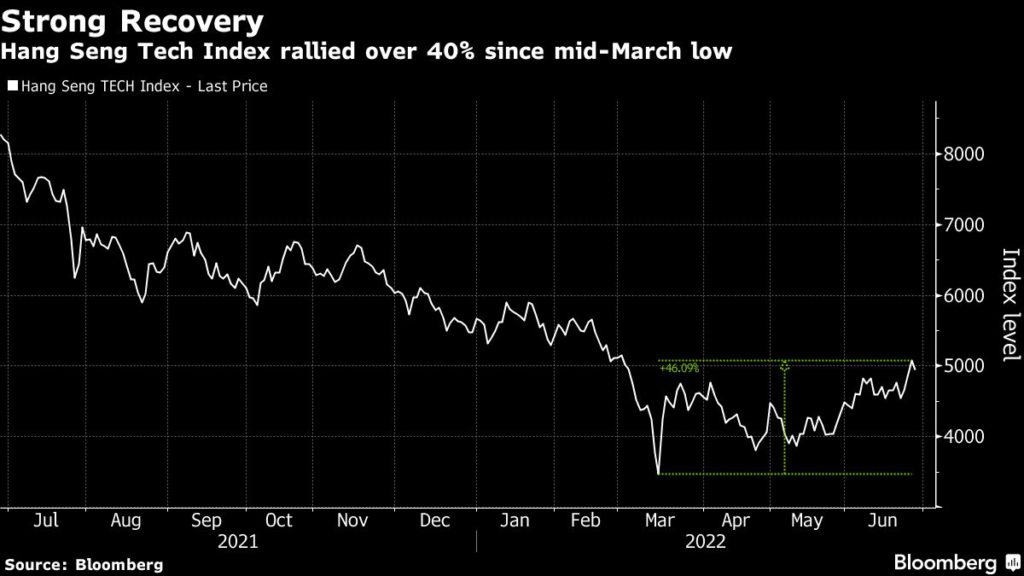
The Hang Seng Tech Index slid as much as 2.9% Tuesday, the most since June 22, before paring some losses. Tencent slumped as much as 5.8%, the most in nearly six weeks, after Prosus NV on Monday said it intends to sell more of the mobile gaming giant’s stake. JD.com Inc. — another firm in which Prosus sold stock — and Bilibili Inc., were among the other big decliners on Tuesday.

“Tencent’s big shareholder sale is definitely hurting the whole market sentiment,” said Banny Lam, head of research at CEB International Investment Corp. “The tech stocks have had a good rally, so it’s not surprising for us to see people taking profit or rotating among sectors.”

READ: Tencent Backer Prosus to Cut $134 Billion Stake to Buy Stock

Prosus, an arm of South African internet giant Naspers Ltd., sold almost $4 billion worth of stock in JD.com that it got as dividends from investee Tencent, saying on Monday that the e-commerce firm didn’t fit with its broader strategy.

The Chinese tech gauge has rebounded more than 40% from a record low in mid-March, as investors rotate back into the sector on bets that the worst of Beijing’s crackdowns — which triggered more than a year of heavy selling — is over. A growing chorus of global investors including JPMorgan Asset Management and Goldman Sachs Group Inc. have turned more sanguine on Chinese tech giants, citing attractive valuations and supportive policies.

READ: ‘Worst Over’ Call for China Tech Booms on Ant IPO Revival News

Still, industry insiders point to a more downbeat picture despite a softening regulatory stance. China’s strict adherence to Covid Zero policy and sporadic infections mean a full reopening may still be far away, and will likely continue to be a drag on the economy.

The sell-down plan by Prosus was taken to be “a sign from other investors that the rally had hit a near term peak amid an uncertain macroeconomic environment and the ongoing Covid situation,” said Justin Tang, head of Asian research at United First Partners in Singapore.

Companies including Alibaba Group Holding Ltd. and Bilibili have seen their shares approach or enter overbought zones this month, technical indicators compiled by Bloomberg show. The Hang Seng Tech Index is still up 11% in June, poised for its best month in nearly two years.

(A previous version of this story was corrected to fix the spelling of company name to Bilibili.)

More stories like this are available on bloomberg.com

©2022 Bloomberg L.P.

Sri Lanka Under Virtual Lockdown With Fuel Supplies Halted for Private Cars

(Bloomberg) — Sri Lanka abruptly restricted fuel supplies and told residents to stay home, raising the risk of more unrest as the government struggles to provide essential goods due to a crippling sovereign debt crisis that has rocked the country for months.

The island nation’s cabinet of ministers Monday decided to limit distribution of fuel to essential services until July 10, spokesman Bandula Gunawardena said in a televised statement, adding that inter provincial public transport would likely come to a halt.

“Port, health services, food transport will be provided petrol and diesel while all other sectors are requested to stay at home and provide services online in this difficult time,” Gunawardena said. “Our country is facing an unprecedented state of finance and foreign exchange crisis.”

Sri Lankan Prime Minister Ranil Wickremesinghe told lawmakers last week the economy had “completely collapsed,” saying the island nation is unable to purchase fuel as shortages of essentials and electricity worsen. His government is in talks with the International Monetary Fund as well as bilateral creditors such as India and China for fresh funds to pay for imports after it defaulted on its dollar bonds earlier this year and saw foreign reserves dwindle. 

The government had already closed public schools and asked civil servants to work from home to curtail transport, leaving many roads in and around the capital, Colombo, deserted over the past days, even as thousands of vehicles lined up in queues stretching for kilometers waiting for filling stations to be replenished.

Violent protests erupted in May after President Gotabaya Rajapaksa’s brother resigned as prime minister following clashes between government supporters and opponents. Although Rajapaksa has since shored up support in parliament and vowed to serve out the final two years in his term, tensions remain high. 

Sri Lanka plans to allow foreign companies to distribute fuel in a bid to ease crippling shortages that have paralyzed most economic activity, Energy Minister Kanchana Wijesekera said Sunday.

The governor of the Central Bank of Sri Lanka has agreed to pay outstanding dues to companies for fuel supplies “with a plan,” the president’s office said in a statement late Monday. President Rajapaksa also instructed officials to take “immediate action to import fuel using the existing funds available until then,” it said without elaborating.

The government is sending its envoys to Qatar and Russia this week to secure fresh supplies and is hoping for approval from India of a $500 million credit line for fuel imports.

The High Commissioner of Sri Lanka to New Delhi Milinda Moragoda met with India’s Minister of Petroleum & Natural Gas and Housing and Urban Affairs Hardeep Singh Puri in New Delhi on Monday to discuss the possibility of securing petrol and diesel supplies that are required by the island nation on an urgent basis.

Moragoda also briefed Puri on the “acute challenges that Sri Lanka is currently facing with regard to the supply and distribution of petroleum products and the severe hardships that the people are undergoing,” according to a Facebook post from the high commission.

(Updates with comments from president’s office in eighth paragraph)

More stories like this are available on bloomberg.com

©2022 Bloomberg L.P.

Google’s Cloud Customers Will Learn Their Gmail Carbon Footprint

(Bloomberg) — Google’s cloud-computing division is preparing to reveal the carbon footprint for its Workspace apps, including Gmail and Docs, as it builds out its suite of tools to help customers assess their impact on the environment.

The move by Alphabet Inc.-owned Google Cloud expands measures unveiled last year to help clients measure and reduce the gross carbon emissions of using Google Cloud services. Google plans to reveal the Workspace carbon data in early 2023, Justin Keeble, managing director of global sustainability at Google Cloud, said in a blog post Monday.

Mountain View, California-based Google aims to be completely decarbonized by 2030. It currently uses renewable energy sources for its operations globally and had fully offset all its emissions by 2007. Last year, it touted its efforts to help search and maps users reduce their carbon emissions by suggesting certain flights or driving routes that cause less pollution.

However cloud computing, a key area of operations for Google, is known as a particularly energy-heavy domain. Google runs data centers all over the world and has for years purchased renewable energy offsets to keep pace with usage by its server farms. It claims that its cloud, which delivers internet-based computing and storage to other companies, is the world’s cleanest.

The company also announced it will now provide scope 1 and 3 emissions associated with a customer’s use of Google Cloud. This refers respectively to emissions from sources it controls directly, and indirect emissions up and down its supply chain. 

More stories like this are available on bloomberg.com

©2022 Bloomberg L.P.

US Sails Seized Russian Yacht to California After Fiji Legal Win

(Bloomberg) — After a stopover in Hawaii, the $325 million superyacht that’s tied to Russian billionaire Suleiman Kerimov and that was seized by US authorities in Fiji has sailed into a port in Southern California.

The Amadea, a luxurious megayacht that’s nearly as long as a football field and features a helipad, docked in San Diego Monday morning local time, according to vessel data compiled by Bloomberg. It had spent a few days in Honolulu after the US hired a new crew and sailed the superyacht out of Fiji on June 7, flying the American flag after winning a legal battle.

The stop in San Diego caps a more than 13,000-nautical-mile odyssey for the vessel as it attempted to find a safe haven, with US agents from multiple government agencies pursuing it. The seizure is a huge win for the US as it looks to punish titans close to President Vladimir Putin by going after their megayachts, villas and other assets.

With the ship now in US hands, authorities from that nation will bear the responsibility for its maintenance, which the Federal Bureau of Investigation has estimated will cost between $25 million to $30 million annually, according to court documents seen by Bloomberg.

  • Follow the Amadea’s journey here.

President Joe Biden has pushed for legislation that’s been passed by lawmakers in the House of Representatives that would allow the US to seize yachts like the Amadea and other assets of sanctioned Russians, liquidate them and use those funds to benefit Ukraine. The European Union is considering similar measures.

Still, there may be risks for buyers of seized yachts, according to Benjamin Maltby, a partner who specializes in superyacht law at London-based Keystone Law.

“Buyers need to be aware that certain countries may not necessarily recognize the seizure and transfer of ownership,” said Maltby. “Clearly, the risk is higher for countries that are at odds politically with the West — and these are unlikely to be countries one would wish to cruise to — but it’s something potential buyers should keep in mind.”

Legal Fights

Some maritime analysts say the legal battles are likely far from over. In Fiji, the registered owner, Millemarin Investments Ltd., has contended the vessel isn’t owned by Kerimov as the US alleges but another Russian tycoon — Eduard Khudainatov, the former chairman and CEO of Russian oil and gas giant Rosneft Oil Co. Khudainatov doesn’t appear to be on any sanctions lists. Counsel for Millemarin didn’t respond to requests for comment, nor did Kerimov and his representatives.

Legal challenges over ownership need to be hammered out in the US courts, Fiji authorities and its courts said. Deep-pocketed tycoons have filed appeals before to fight asset seizures. The US and other governments will likely face rounds of court tussles when they move to sell the more than one dozen yachts worth over $2.25 billion that have been seized as part of the push to target oligarchs, spurred by Russia’s invasion of Ukraine in late February.

The US alleges that Khudainatov is “being used as a clean, unsanctioned owner” to conceal the Amadea’s true owner. Kerimov is a Russian gold billionaire who was first sanctioned by Washington in 2018, Bloomberg reported last month.

Shell Companies

The US says layers of offshore shell companies were created to conceal that Kerimov is actually the beneficial owner, with crew members giving code names for the sanctioned billionaire and his family members, according to a US affidavit reported earlier by Bloomberg. Kerimov, a member of Russia’s upper house of parliament, was also sanctioned by the UK and the EU in March for his close ties to Putin.

While Kerimov and his supporters will likely continue to pursue legal action to prevent the US from making good on its efforts to use asset forfeiture proceedings to enforce sanctions, many of the biggest challenges have already been overcome, Ian Ralby, chief executive of I.R. Consilium, a maritime law and security consultancy, said.

“Now that the Amadea is the continental US, dispensing of it should be able to occur in the same manner in which the US dispenses of the proceeds of crime on a regular basis,” he said. “The main challenge, if it is put up for public sale, will be finding a buyer willing to take the risk of becoming a Russian target. Then again, if you can afford that yacht, you can probably afford that risk.”

Kerimov is worth around $13.4 billion, according to the Bloomberg Billionaires Index. His family formerly held almost half of Polyus, the biggest gold producer in Russia. He beat money-laundering charges in France in 2018.

13,000 Mile Odyssey

The Amadea, which features a mosaic-tiled pool and lobster tank, has now logged more than 13,000 nautical miles since the Feb. 24 invasion of Ukraine — more than any vessel connected to sanctioned Russian tycoons, according to Spire Global Inc., a data and analytics firm that uses satellite technology to track maritime activity.

  • Want to interact with a tracker of yachts tied to sanctioned Russians? You can here.

It arrived in Fiji’s Lautoka port on April 12 after an 18-day journey that took it from the Caribbean to Mexico, data compiled by Bloomberg show. Fiji detained the superyacht the following week after the US government requested mutual legal assistance.

On May 3, Fiji’s High Court gave the green light for US and local authorities to seize the vessel, but a series of legal challenges from the registered owner ensued. The US has devoted considerable resources to obtaining the yacht, sending officials to Fiji from the US Marshals Service, the FBI and the US Coast Guard, according to court filings.

The Amadea is among more than a dozen multimillion dollar Russian tycoon-linked megayachts rounded up by Western governments.

Germany has impounded Russian billionaire Alisher Usmanov’s superyacht Dilbar, valued at as much as $750 million. Italian authorities arrested a 530 million euro ($560 million) vessel owned billionaire Andrey Melnichenko, while Spain seized Viktor Vekselberg’s $90 million Tango as well as the $600 million Crescent believed to belong to Igor Sechin, head of Moscow-based Rosneft.

The Amadea’s seizure shows Russian tycoons are running out of places to park their floating palaces. Fearful of having their yachts impounded, owners have sent them to a small number of locales still considered friendly — allowing the vessels to dock or hang around unbothered — including Dubai in the United Arab Emirates, Turkey and the Maldives.

More stories like this are available on bloomberg.com

©2022 Bloomberg L.P.
Russian Industry Faces Code Crisis as Critical Software Pulled

(Bloomberg) — Russia’s reliance on foreign software to run its factories, farms and oil fields is turning into one of the biggest headaches for domestic industry as more IT providers pull out of the market in response to President Vladimir Putin’s invasion of Ukraine. 

International sanctions and tensions over the war have forced industrial manufacturers from Siemens AG to SMS Group GmbH to wind down operations in what was once one of their biggest markets. Their computer programs might be missed more than their machines.

Sourcing software for computer-aided design and manufacturing is turning into a major issue that will be a drag on development, according to Elena Semenovskaya, a Russia-focused analyst at IDC. 

“Russian analogues in this area are much weaker and the need is high,” Semenovskaya said. “But for now the approach is to rely on piracy and outdated copies, which is a dead-end and not sustainable.”

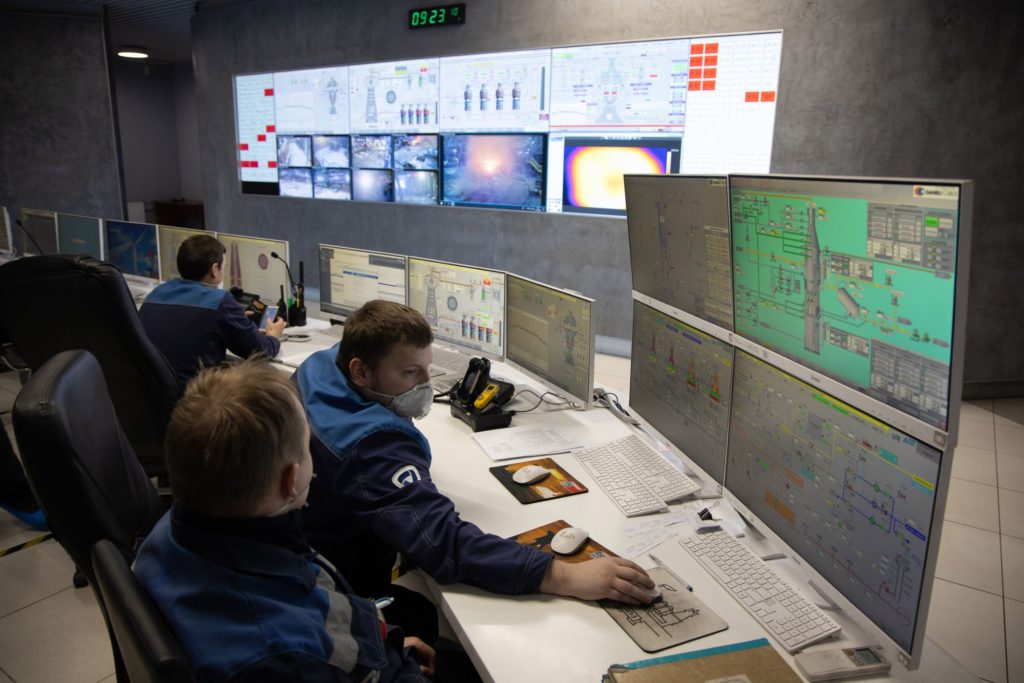
Foreign software is often baked directly into industrial machinery and controls high-precision processes. Equipment makers closely guard their intellectual property and in many cases don’t give clients access to the codes used to run their plants, Sergey Dunaev, the chief information officer of Severstal PJSC, said in an interview. 

In steelmaking, which can require accuracy within a few hundredths of a millimeter for high-value products, even small deviations can render output worthless, according to Dunaev. 

While the Russian economy, helped by high commodities prices, has fared better than most forecasts since the war began, it is facing a period of structural adjustments pushing it into recession. Steel production nationwide is down 25% to 30% since the invasion, Severstal’s owner, Alexey Mordashov, said this month. 

‘Suboptimal’ Alternatives

The Russian government has emphasized import substitution since many industries were hit by an earlier wave of US and European sanctions after the 2014 annexation of Crimea, but its ambitions failed to take into account how modern facilities rely on programming. 

The steel industry alone invested about 3.2 trillion rubles ($59 billion) in the last two decades to rebuild capacity after its post-Soviet decline, according to the Russian Steel Association. Much of that was spent on equipment supplied by foreign companies like Siemens, SMS Group and Danieli & C. Officine Meccaniche SpA to increase the sector’s efficiency.  

“All industries are facing the same problems,” Dunaev said. “Many processes in modern units are controlled by software.”

The exodus is a challenge for the nation’s oil and gas industry, where domestic software accounts for only 5% to 10% of industry-specific tools and is often “suboptimal,” according to First Deputy Energy Minister Pavel Sorokin.

The situation is made worse with the depletion of Russia’s traditional oil deposits, forcing producers to tap hard-to-recover reserves that require more complicated equipment and programs if the country wants to maintain output at current levels. 

“Super-sophisticated software for seismic, for modeling layers, drilling and hydraulic fracturing won’t be needed if we won’t have equipment for all those processes,” Sorokin said earlier this month at the St. Petersburg International Economic Forum.

Imported MES

Even local food production, where Russia made strides in domestic farming in recent years, is facing challenges. Meat processing facilities at Ros Agro Plc, one of the country’s biggest agricultural holdings, rely on imported manufacturing execution systems, or MES. 

“We are critically dependent on European companies in terms of MES, and we do not yet know what to do if something happens,” Maxim Basov, chairman of Ros Agro Plc, said at the St. Petersburg forum. 

If software crashes lead to equipment failure, plants could require replacement parts that are difficult to source and increasingly expensive, Severstal’s Dunaev said. To avoid such delays, he proposed industry players cooperate to create a database of spare components that can be shared as necessary. 

It’s not just industry that’s affected. SAP SE and Microsoft Corp. are due to stop updates and services for Russian companies in August, leaving businesses and government services that rely on their software potentially vulnerable to security breaches and viruses.

Russia’s ambitions for a 5G mobile network have also been upended by the war, raising fears the economy will lose its competitiveness as it struggles to maintain existing services while other countries upgrade their infrastructure. 

New systems won’t appear overnight. It took nearly a decade and around $100 million to create Russia’s domestic alternative to Microsoft Office, according to Dmitry Komissarov, the developer of MyOffice. 

“It is necessary to take a look at inventory and determine what solutions are missing, and then start developing them,” Komissarov said.  

More stories like this are available on bloomberg.com

©2022 Bloomberg L.P.

Taiwan’s GlobalWafers to Build $5 Billion Chip Plant in Texas

(Bloomberg) — GlobalWafers Co. plans to build a $5 billion semiconductor silicon-wafer facility that will be the biggest of its kind on American soil, as the country contends with the fallout from a global shortage of chips.

Construction of the factory that will produce 300-millimeter silicon wafers in Sherman, Texas, is expected to start later this year. Production from the first fab is anticipated as early as 2025, the Hsinchu, Taiwan-based company said in a statement.

Washington is trying to court chip investment after a semiconductor shortage disrupted supplies of everything from cars to smartphones, exposing a reliance on foreign sources. A US review of supply-chain vulnerabilities last year found that while the US maintains a healthy share of chip design and manufacturing equipment, the industry is “highly dependent” on overseas sales, notably in China. 

“This investment will represent the first new silicon wafer facility in the US in over two decades and close a critical semiconductor supply-chain gap,” GlobalWafers said.

Read more: China’s Chipmaking Power Grows Despite US Effort to Counter It

These types of wafers are the starting material for all advanced semiconductor fabrication sites and most are currently manufactured in Asia, forcing the US semiconductor industry to rely on imports.    

The investment will total $5 billion, the White House said in a statement, confirming an earlier Wall Street Journal report.

Speaking at an investment summit Monday, Commerce Secretary Gina Raimondo said the US currently produces 10% to 12% of the world’s microprocessor chips, down from nearly 40% in earlier years. “We took our eye off the ball,” the secretary said. “We stopped investing in chip manufacturing and chip R&D. And, in search of cheap labor, we watched a lot of our manufacturing leave our shores.”

The Biden administration has for months sought the passage of a bill that would appropriate $52 billion for domestic semiconductor manufacturing. The legislation would provide billions of dollars to boost research and development with an eye toward creating new technologies to help the US stay ahead of a rising China. GlobalWafers could be eligible for funding incentives if the CHIP Act passes.

Raimondo said ensuring that Congress passes the bill is “my No. 1 priority.”

GlobalWafers said its new facility could support as many as 1,500 jobs with production volumes ultimately reaching 1.2 million wafers monthly after multiple stages of equipment installation. 

More stories like this are available on bloomberg.com

©2022 Bloomberg L.P.
Love of Big Cars, Chip Dearth Pushes Out Wait Times for Mahindra

(Bloomberg) — Robust consumer demand teamed with an ongoing shortage of chips has seen wait times for Mahindra & Mahindra Ltd.’s XUV700 sports utility vehicle balloon to as long as 22 months just as the carmaker unveils the latest model in its big-automobile lineup.

Outstanding customer pre-orders for the seven-seater XUV700, which the Indian automaker launched in August, are running to around 70,000, Executive Director Rajesh Jejurikar said in an interview last week. While the chip shortage has eased from a peak late last year, Mahindra is still experiencing some supply chain pain points, he said.

The Mumbai-based $15.8 billion cars-to-factory equipment conglomerate took the wraps off its Scorpio-N late Monday, an automobile it bills as the “Big Daddy of SUVs.” Mahindra is hoping consumers in India will continue their embrace of larger, gas guzzling vehicles even as Prime Minister Narendra Modi commits to making the South Asian nation a net-zero carbon emitting one by 2070.

Read more: India’s Top Carmaker Bets on Hybrids Over EVs in Clean Shift

Mahindra doesn’t have a strong electric vehicle line up — it currently sells one passenger EV, the e-Verito, though it does have a much bigger presence in the electric three-wheeler market. But Jejurikar said range anxiety and lack of charging infrastructure mean the company doesn’t see a tipping point for EVs until between 2025 to 2027.

By that stage, electric SUV sales are expected to comprise about 20% to 25% of Mahindra’s sales, he said.

Until then, a major focus for Mahindra, which also last year unveiled a new look logo, will be defending its market share in the large-format SUV segment from Tata Motors Ltd. and Hyundai Motor Co. 

Data from automotive business intelligence provider JATO Dynamics show Mahindra had a leading revenue market share of 17.8% in the fourth quarter of fiscal 2022, followed by Tata, Hyundai and Hyundai affiliate Kia.

Mahindra isn’t the only carmaker to be suffering long chip-induced wait times.

Maruti Suzuki India Ltd., the automaker that sells every other car on the nation’s roads and positions itself in the smaller vehicle segment, doesn’t see the semiconductor crunch finishing even in 2023.

But “with more engineering input going into how to beat the problem, production this year will definitely be better than last year,” Chairman R.C. Bhargava said.

“At the moment we have 325,000 cars on our waiting list. It’s almost two months’ sales. We think that by this year end we’ll have the problem under more control.”

More stories like this are available on bloomberg.com

©2022 Bloomberg L.P.
Trump Lawyer Eastman Sues for Return of Phone Seized by FBI

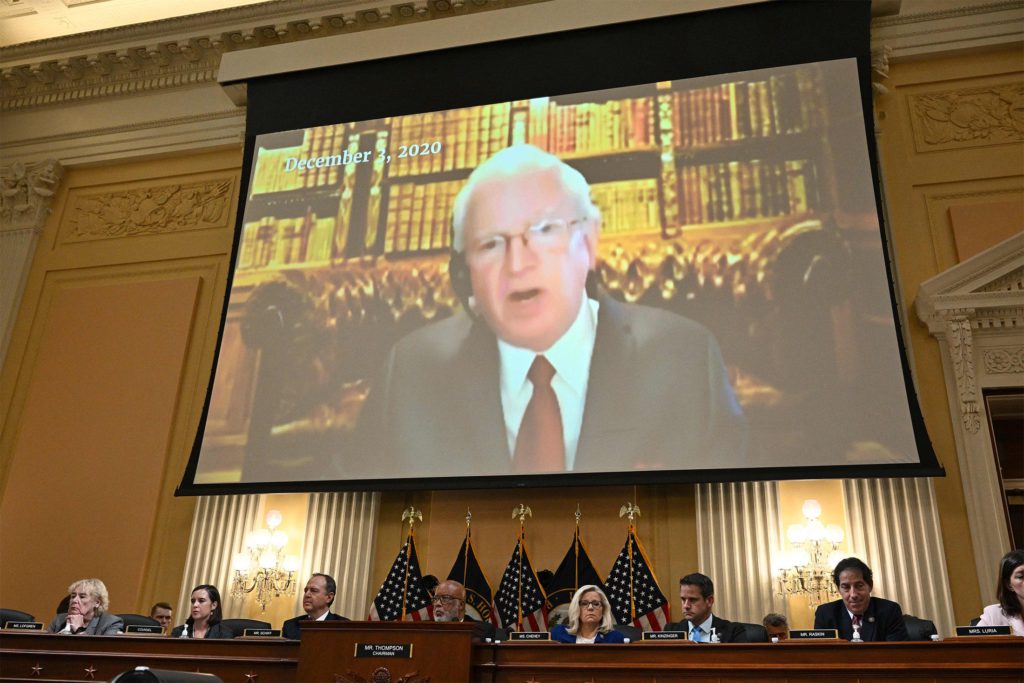
(Bloomberg) — The lawyer who helped devise Donald Trump’s elaborate plan to stay in power after losing the 2020 presidential election claims his mobile phone was seized by federal agents outside a New Mexico restaurant last week.

John Eastman, the former dean of Chapman University’s law school, filed a petition for the return of the phone on Monday in federal court in Albuquerque, claiming he was served with a search warrant, frisked and forced to unlock the phone with his biometric data as he left the restaurant on June 22.

The warrant was defective, Eastman claims, because the document “mentions no crime at all, much less any specific crime,” according to the filing.

Eastman, whose name and documents have featured heavily at the House select committee hearings on the Jan. 6 insurrection, also seeks a court order for the destruction of all copies of any information retrieved from the device.

‘Pure Insanity’: Trump Election Fraud Pursuit Detailed by Panel

The Justice Department didn’t immediately respond to a message seeking comment.

The filing is the latest twist in the select committee’s probe into Eastman, who was part of a broad effort to sway state officials to appoint fake electors for Trump and pressure then-Vice President Mike Pence to reject electors for Joe Biden. The false theory ultimately helped trigger the Capitol riot.

In his complaint, Eastman asked the court to prohibit further access to his seized iPhone Pro 12 and block sharing of any information “until he has a full and fair opportunity to assert and protect his constitutional rights and the privileged communications of his numerous clients.”

The lawyer, whose earlier lawsuit in California failed to prevent disclosure of hundreds of documents to the Jan. 6 committee, said in Monday’s filing in New Mexico that the seized phone contains many of the files that are protected by attorney-client privilege. 

According to the complaint, the agents who searched Eastman said they were from the Federal Bureau of Investigation but “appeared to be executing a warrant issued at the behest of the Department of Justice’s Office of the Inspector General.”


(Updates with Eastman seeking destruction of seized data)

More stories like this are available on bloomberg.com

©2022 Bloomberg L.P.
Record $82 Billion Dealmaking Spree Sees India Defy Global Slump

(Bloomberg) — Bankers in India recorded their best-ever quarter for mergers and acquisitions while dealmaking elsewhere slows to a crawl.

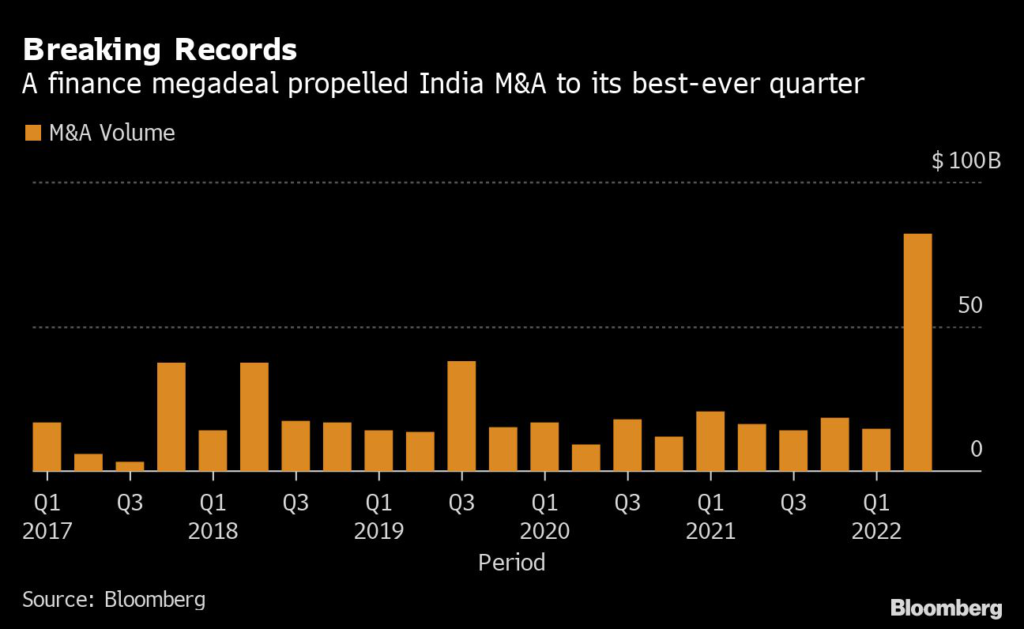
India saw $82.3 billion pending and completed M&A deals in the second quarter, the highest amount on record, according to data compiled by Bloomberg. That’s more than twice as much than the previous record of $38.1 billion in the third quarter of 2019. Globally, M&A volume in the quarter reached $827.6 billion, down 8.7% from the same period in 2021.

The surge in India was dominated by HDFC Bank Ltd.’s $60 billion all-stock purchase of Housing Development Finance Corp. in April, combining India’s most valuable bank and largest mortgage lender in the country’s biggest ever M&A transaction. The move illustrated how India’s flagship companies, facing disruptive trends such as the rise of fintech and climate change, are turning to dealmaking as a tactic to dramatically reshape themselves.

“While conglomerates will consolidate to become stronger and gain market share in their core sectors, there will be renewed or new initiatives around two big themes: ESG and digital,” according to Sonjoy Chatterjee, chairman and chief executive officer for Goldman Sachs Group Inc. in India. The second in particular is a focus for all companies, no matter the sector, he added.

“There won’t be a strategy going forward that doesn’t provide a clear path to deliver this,” Chatterjee said.

The combination of Mindtree Ltd. and Larsen & Toubro Infotech Ltd., two software firms controlled by engineering conglomerate Larsen & Toubro Ltd., in a $3.3 billion all-stock deal announced in May further illustrated how India’s largest firms are positioning themselves for a changed landscape in technology, aided by volatility in the markets.

Even without the HDFC megadeal, India’s second quarter would still rank as its fifth-best quarter on record, thanks to transactions such as billionaire Gautam Adani’s $10.5 billion deal to buy Ambuja Cements Ltd., giving his conglomerate a sizable presence in the industry.

“The appetite of strategic investors has definitely increased, with market correction resetting the valuations in India,” said Ganeshan Murugaiyan, head of corporate coverage and advisory at BNP Paribas SA in India. 

Companies in India leading the shift to renewable energy were among the biggest dealmakers. Shell Plc agreed to buy renewable power supplier Sprng Energy Pvt for $1.5 billion in April, while French oil giant TotalEnergies SE purchased a 25% stake in Adani New Industries Ltd. this month. The firm plans to invest more than $50 billion in technologies such as green hydrogen over the next decade.

Read More: Big Oil Bets That Green Hydrogen Is the Future of Energy

Large acquisitions will be challenging to put together, Murugaiyan said. “It is not that easy to get long term financing and the high-yield leverage buyout market — corporate loans — is literally shut down.” 

Like Chatterjee, Murugaiyan sees the green and digital transitions driving more transactions. His team has grown from nine bankers in 2021 to 12 this year, and he is looking to add another three.  

The next wave of deals could come in the mid-market, where a cohort of aging founders is starting to hand the reins to their offspring.

“Regularly, we find the next generation has interests in other themes, particularly tech platforms and ESG,” Chatterjee said. “Themes coming out of the pandemic have revised perspectives and choices around what the next generation want to do with their futures — in a very personal way.”

More stories like this are available on bloomberg.com

©2022 Bloomberg L.P.

Close Bitnami banner
Bitnami
