Bloomberg

Macquarie-Backed Data Center Company Aligned in Talks for $1.8 Billion Odata Deal

(Bloomberg) — Aligned, a data center operator backed by a unit of Macquarie Group Ltd., is in talks to acquire Odata, a Latin America-focused rival, according to people with knowledge of the matter.

The parties are in advanced discussions regarding a transaction that values Odata at about $1.8 billion including debt, said the people, who asked not to be identified discussing private information. An agreement hasn’t been reached yet and the terms could change or the talks could still collapse at the last minute. If they don’t, a deal could be announced as soon as next week, one of the people said.

Representatives for Aligned, Macquarie and Patria Investments Ltd., which controls Odata, didn’t immediately respond to requests for comment.

Odata, led by Chief Executive Officer Ricardo Alario, has a strategic partnership with CyrusOne, its website shows. Founded in 2015, it has taken steps to develop data center operations in Brazil, Colombia, Mexico and Chile.  

Plano, Texas-based Aligned, led by CEO Andrew Schaap, has a footprint in Chicago, Maryland, Phoenix, Dallas, northern Virginia and Salt Lake City, its website shows. It’s backed by a fund managed by Macquarie Asset Management.

Data center platforms have attracted investment from a slew of infrastructure, real estate and other firms. Last month, Partners Group acquired EdgeCore Digital Infrastructure. In May, a consortium led by DigitalBridge Group Inc. agreed to acquire Switch Inc. 

–With assistance from Cristiane Lucchesi.

More stories like this are available on bloomberg.com

©2022 Bloomberg L.P.

NYC Spars With Hosts Over New Airbnb Rental Laws

(Bloomberg) — New York City officials held a lively public debate with property owners on Monday over proposed changes to short-term rental laws that will make it much harder for hosts to list their apartments on Airbnb Inc. and other platforms. 

Mayor Eric Adams’s Office of Special Enforcement outlined coming legislation that will more strictly enforce some existing laws and also add tough new measures. Hosts will be required to register their properties with the city, including names of all permanent occupants and their relationship to the applicant, and submit a detailed diagram of the listing, designating which parts will be used for the rental and highlighting fire exits, among other requirements. Tenants who are leasing must also provide a lease, and applicants need to submit a government ID along with documents that show proof of occupancy. The measure will also prohibit Airbnb and other platforms from processing payments for listings that are not registered.

San Francisco-based Airbnb has long sparred with New York, one of its biggest domestic markets, where short-term rental rules are among the most restrictive in the country and essentially prohibit rentals of most apartments for fewer than 30 days without the owner present. City officials have argued that illegal rentals can be dangerous, take property off an already strained market and only push prices higher. Airbnb says the rentals provide people with a much-needed source of extra income in an expensive real estate landscape, a position many hosts seemed to validate.

“My social security and pension does not cover my cost of living and without this income from the short-term rental, I would not be able to pay my mortgage and I would lose my home,” said Aimee Thrasher, a Queens-based Airbnb host, at the hearing.

For weeks, hosts have been submitting comments on the Office of Special Enforcement’s site, calling the proposed rules onerous and saying they would likely force them to delist their property. Of more than 230 respondents on the site, many discussed how the short-term rental regulations on single-family homes would restrict their ability to pay mortgages and other bills. Others were in favor of the new registration system, citing apartment units that are currently being run like illegal hotels and the ability for co-op owners to place their building on a prohibited listings list. 

Some hosts were particularly disgruntled over one part of the existing legislation that prohibits a rentee from having a key to lock their room behind them.

“I have no issues with registration, just the restriction of the use of locks or separation of living spaces,” said Mike Harp, a Brooklyn-based host, speaking at the hearing.

The city has been determined for years to crack down on thousands of illegal listings across the five boroughs. New York has has close to 24,000 active short-term rentals on online platforms, including Expedia Group Inc.’s Vrbo, according to industry data provider AirDNA. 

The Office of Special Enforcement has been stepping up its regulation of short-term rentals since the city and Airbnb reached a settlement in 2020 requiring the company to share information about its listings with the city on a quarterly basis. The legislation that takes effect in January goes further. 

Over the summer, the mayor’s office sued an operator of a multimillion-dollar illegal Airbnb operation in Manhattan. The Southen District of New York also charged a Florida man self-described as the “Wolf of Airbnb” on wire fraud counts after he allegedly ran an illegal Airbnb hotel scheme and stiffed landlords on lease payments. 

“Currently as is, this is an entirely unregulated market and the consequences have been disastrous for New Yorkers,” said New York State Assembly Member Zohran Mamdani, at the hearing.

The Office of Special Enforcement will review the comments and feedback before the final law goes into effect in January. Hosts could be fined as much as $5,000 for noncompliance, and Airbnb could be on the hook for $1,500 per violation.

More stories like this are available on bloomberg.com

©2022 Bloomberg L.P.

Argentine Fintech Ualá to Start Giving Personal Loans in Mexico

(Bloomberg) — Argentina’s Ualá, the fintech company backed by George Soros, Steve Cohen and Tencent Holdings, will begin offering loans for its clients in Mexico through its alliance with Mexican bank ABC Capital.

The service will be offered through ABC and allow for loans of up to 20,000 mexican pesos ($1,011) between 12 and 36 months, according to Ualá chief executive officer Pierpaolo Barbieri. Uala announced the purchase of ABC in November 2021, with the acquisition still pending regulatory approval. 

“It’s a key milestone for what we’re building in Mexico,” Barbieri said in an interview. “It’s also one of the great benefits of having a banking license, which allows us to offer more complex products.”

Ualá plans to target both middle class clients and previously unbanked users in Mexico, coming up with its own credit score for them based on the data it gathers. Because the company is fully digital, with lower costs than brick-and-mortar banks, the partnership will be able to offer lower rates to its clients than those of existing banks, Barbieri said. 

Ualá, which provides a slew of financial services based on a prepaid card managed through a mobile app in Mexico, Argentina and Colombia, expects to invest $100 million over the next 18 months in Latin America’s second largest economy, part of its plan to spend $150 million in the region next year. 

For ABC Capital it’s also a milestone, as the bank previously only offered loans to real estate developers, said its chief executive officer Carlos Hernandez. 

In Mexico, Ualá already launched this year mobile point-of-sales (mPOS) services and a service for clients to receive remittances from abroad. Of these, mobile payment solutions are the fastest-growing service, Barbieri said. 

Ualá currently has more than 5 million clients. It was valued at $2.5 billion in its last funding round in August 2021 and also launched operations in Colombia earlier this year. The startup is also backed by Japanese conglomerate SoftBank Group Corp. 

The company is not expecting to seek a capital raise next year, and it’s not actively seeking acquisitions but is “open to opportunities,” Barbieri said. Ualá this year closed the purchase of Argentina’s Wilobank, Empretienda and Ceibo Creditos. The company is expecting to break even in its home market of Argentina in 2023.

“In three or four years, the Mexican market will be even larger than that of Argentina,” he added. 

More stories like this are available on bloomberg.com

©2022 Bloomberg L.P.

Putin Expands ‘Gay Propaganda’ Ban, Threatening LGBTQ Crackdown

(Bloomberg) — Russian President Vladimir Putin signed into law on Monday a sweeping ban on the positive portrayal of gay relationships in books, films, the media and the Internet, regardless of age.

The ban on “propaganda of non-traditional sexual relations” expands Russia’s 2013 law that prohibited the promotion of homosexuality to children. The new legislation now makes it illegal to present positive images to adults of gay relationships in media and advertising.

Vyacheslav Volodin, a Putin ally and speaker of the State Duma lower house of parliament, defended the measure as needed to fight against “sin” and “sodomy.” The United Nations High Commissioner for Human Rights, Volker Turk, urged Russia to repeal all discrimination against lesbian, gay, bisexual and transgender people, warning that the latest step “infringes even further on international human rights norms and standards.”

The new package of measures proposes fines of as much as 400,000 rubles ($6,400) for individuals who break the ban and 5 million rubles for organizations.

Information deemed to encourage children to change their gender would also be outlawed and subject to fines. 

The Kremlin has stepped up its public embrace of what it calls “traditional values” in the months since its invasion of Ukraine, a conflict it portrays as a showdown with what it describes as western attitudes alien to Russia.

The biggest threat for Russia’s LGBTQ community is that organizations defending its rights will be targeted and eventually shut down, said Igor Kochetkov, one of the founders of the Russian LGBT Network.

More stories like this are available on bloomberg.com

©2022 Bloomberg L.P.

Ex-Startup CEO Pleads Not Guilty to SXSW Sexual Assault Charge

(Bloomberg) — Brian Wong, co-founder of now-defunct mobile advertising network Kiip Inc., pleaded not guilty to sexually assaulting a woman during the 2016 South by Southwest festival.

Wearing a beige shirt and looking solemn and attentive, Wong entered his plea Monday via video link before Judge Chantal Eldridge in state court in Austin, Texas. Eldridge set an Aug. 7 trial date.

Wong was indicted by a grand jury in March 2019. A woman given the pseudonym Samantha Luu said in an affidavit that Wong raped her at his hotel after she drank half a glass of wine at a restaurant that left her feeling disoriented and impaired. 

Wong’s lawyer has called the claim “baseless” and said all contact was consensual.

Read more: Startup Wunderkind Indicted on Sexual Assault Charge in Texas

In early 2019, Kiip asked Wong, then the company’s chief executive officer, to take a leave of absence to focus on his defense. Later that year, Kiip went into foreclosure and then liquidation after the company settled a class action lawsuit claiming it had collected personal data without permission.

Over the years, Kiip had raised more than $30 million from backers including American Express Ventures and Verizon Ventures. Wong rose to prominence in part because he was just just 19 when he founded the company. He is also the author of a book offering advice on entrepreneurship called “The Cheat Code.”

More stories like this are available on bloomberg.com

©2022 Bloomberg L.P.

Stablecoin Issuer Circle’s SPAC Deal With Concord Scrapped

(Bloomberg) — Circle Internet Financial, the issuer of the world’s second largest crypto stablecoin, said its planned merger with special purpose acquisition company Concord Acquisition Corp. that was once valued at $9 billion has been scrapped. 

The pair had been in talks to take Circle public since June last year, but delays plagued the process as the broader crypto sector settled into bear market territory. An amendment to the deal in February doubled Circle’s valuation to $9 billion, when Circle’s USDC stablecoin had a market circulation of approximately $52 billion — a figure that has since dropped to around $43.4 billion, according to pricing data from CoinGecko.

Bob Diamond, chairman of Concord and former chief executive officer of Barclays PLC, said in a statement on Monday that he remained confident in blockchain’s ability to disrupt financial services, and of Circle’s future growth. He added that a “regulatory-first approach” to building trust between crypto and the financial sector “has never been more important.”

Circle CEO Jeremy Allaire said becoming a public company “remains part of Circle’s core strategy.” The firm became profitable in the most recent quarter, the statement said, with total revenue and reserve interest income of $274 million and net income of $43 million. 

Dante Disparte, the firm’s chief strategy officer, said in an interview on Monday that neither side had initiated termination of the deal, adding that Circle plans to increase spending across its business in the coming year. 

“It’s not that the deal fell apart, it’s that the timeline for which the deal had to be qualified was upon us and, for the better part of valor, it seems both organizations made a determination to not renew the deal. That is what it is,” Disparte said.

The collapse of Circle’s SPAC comes after more than year of falling crypto prices, which alongside several major hacks and company failures, have damaged the industry’s reputation. The bankruptcy of crypto exchange FTX, which is being investigated by a number of US authorities on allegations of potential mishandling of customer assets, has worsened that landscape.

Under the terms of Concord’s amended and restated certificate of incorporation, Concord has until Dec. 10 to consummate a business combination. Concord can also seek a shareholder vote to extend that date if the US Securities and Exchange Commission declares the S-4 registration statement for the business combination effective, but so far, that has yet to occur.  

Circle raised an additional $400 million in funding in April from traditional Wall Street names including BlackRock Inc., Fidelity Management and Research LLC and Marshall Wace LLP. Disparte said the firm may consider raising money again “if there are opportunistic reasons,” but that it had no plans to do so at the moment.

It joins a growing list of private firms ranging from Bitcoin miner Prime Blockchain Inc. to investing app Acorns Grow Inc. that have had mergers fall apart. At least 56 SPAC tie-ups have been called off this year, more than double the number in the five years prior, as the industry is and global markets have been rocked by volatility.

“For the argument that SPACs do not present strength necessarily, we think there’s a very deep counter narrative to the contrary,” Disparte added, citing the fact that Circle’s valuation increased when the deal was amended in February. “The desire to not extend it, I think, is more a function of just inertia around getting it authorized.”

The stablecoin issuer won’t likely be the last SPAC deal to crumble, with nearly 150 racing against deadlines to complete mergers amid the market turmoil.


SPACs are known as blank checks because they raise money in IPOs with the goal of taking an unidentified company public. They give themselves a short window, typically two years, to buy something or return the cash to investors. Management teams can get short extensions to find and close deals, but they usually have to get shareholder approval and pay them to do it.

The SPAC ecosystem has been hammered by a broader rout in more speculative assets amid concerns about increased oversight from the SEC. The De-SPAC Index is down 68% this year compared with a 15% drop in the S&P 500 Index, as the firms that have gone public through blank-check firms struggle. All told, more than one-third of the roughly 400 companies that merged with a SPAC are now trading below $2 a share.   

Concord will redeem all of its Class A common stock at about $10.17 each as of Dec. 20.  

(Updates with commentary from an interview beginning in the fifth paragraph.)

More stories like this are available on bloomberg.com

©2022 Bloomberg L.P.

Jumia Moves Top Bosses to Africa from Dubai in Profit Push

(Bloomberg) — Jumia Technologies AG is closing its office in Dubai and moving senior management to the African countries they oversee as part of a plan to cut losses and redirect the company after its founders quit last month. 

Managers will move to countries in their region, with most going to Morocco, Kenya and Ivory Coast, and the 60-person Dubai office will be disbanded, Jumia’s acting head Francis Dufay said in an interview. 

“As we are an Africa-focused company, we want our leaders to be based with customers, vendors and employees,” he said.

Dufay took over after founders Sacha Poignonnec and Jeremy Hodara left the online retailer last month. He said he’s attempting to cut costs — Dubai’s rents are rising faster than those in New York or London — and become more responsive to the young, tech-savvy population in its African markets while fending off larger competitors. 

Read More: Co-Founders Depart Africa’s Rival to Amazon as Losses Pile Up

Jumia went public in 2019 in a New York listing where it was was hailed as the Amazon of Africa. Since then, it’s been struggling with persistent losses and its shares have dropped 68%. The shares were down 1.1% as of 10:30 a.m. on Monday in New York.  

Meanwhile, Amazon.com Inc. is planning to expand its e-commerce service into some of the larger African markets as soon as next year, people familiar with the matter said. A representative for Amazon didn’t immediately respond to a request for comment.

Still, Dufay said that the company’s more than 10 years of experience operating in Africa give it an advantage over new competitors. For example, Jumia has built a logistics business from scratch to deal with the lack of formal addresses and city mapping in many of the areas where it makes deliveries. 

The company, which was one of the first African companies to achieve so-called unicorn size and has attracted investors such as French drinks maker Pernod Richard SA and US investment bank Goldman Sachs Group Inc., plans to reduce its losses over the next 12 months, Dufay said, without elaborating. Jumia previously guided that it expects an adjusted Ebitda loss of $200 million to $220 million this year. 

He said he’ll double down on Jumia’s “bread-and-butter” e-commerce categories, including fashion, beauty, consumer electronics and appliances. The company will also pause the logistics services it offers third parties in its operating countries except for Morocco, Nigeria and Ivory Coast, he said. 

“We have spread ourselves a bit too thin in the past by pushing many projects across our markets,” he said. “We are at a very interesting point in the life of the company, as the board appointed a new leadership more focused on the on-the-ground operations to drive a new plan to lead to a significant improvement on the profitability trajectory.”

(Adds Jumia share price in the fifth paragraph)

More stories like this are available on bloomberg.com

©2022 Bloomberg L.P.

Verizon’s Consumer Chief Departs After Less Than a Year

(Bloomberg) — Verizon Communications Inc. said Manon Brouillette, the executive in charge of the wireless company’s consumer business, has stepped down from the role she has held since January as subscriber growth continues to trail peers.

The division was formed in 2019 as part of a reorganization under Verizon CEO Hans Vestberg. He has assumed responsibility for leading the business after Brouillette’s departure and will be focused on aligning operational results with the “top quality network product,” the company said.

Verizon, the largest US wireless provider, has been lagging behind peers AT&T Inc. and T-Mobile USA Inc. on subscriber growth for the past two years. Brouillette was the second consumer chief during that time and had been unable to put together a compelling offer to compete with AT&T’s free phone for new and existing customers, which has driven growth there.

Brouillette’s exit is unexpected and likely signals that Verizon is losing more market share, Bloomberg Intelligence analyst John Butler wrote.

Shares of Verizon slipped 1.6% at 10:05 a.m. on Monday.

“Apparently Verizon gave Manon one year to make a splash, and it ended up being more of a kerplop,” said Tammy Parker, an analyst with GlobalData Plc.

Vestberg, speaking at an investor conference in New York, said the company started to make changes after a bad second quarter. Verizon is on track for subscriber growth this quarter and the consumer unit is now “heading in the right direction,” he said.

Vestberg said 2022 is probably the low point for consumer growth but he says the progress he’s seeing this quarter shows improvements that will carry into 2023. Verizon will be “surgical” in how it raises and lowers pricing depending on the area, he said.


(Updates with analyst and CEO comments.)

More stories like this are available on bloomberg.com

©2022 Bloomberg L.P.

Bitcoin’s Status Quo Is Making Some Long-Time Observers Nervous

(Bloomberg) — Cryptocurrencies are maintaining the status quo in the wake of the most recent market downturn and that is being viewed by some long-time observers as an ominous sign. 

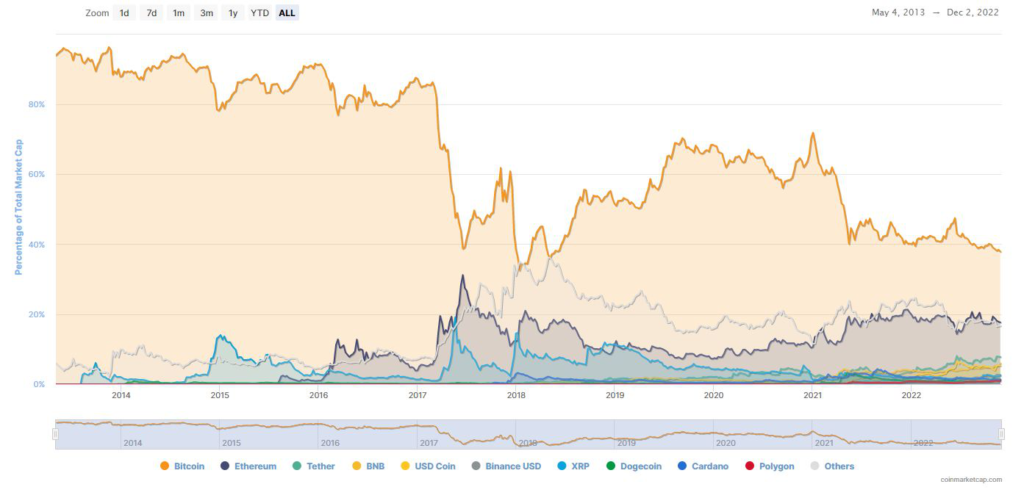
Bitcoin’s dominance in the market, currently below 40%, hasn’t wavered much amid the turmoil surrounding the implosion of Sam Bankman-Fried’s FTX exchange. In past boom and bust cycles, that percentage of market share tended to increase as investors gravitated to the original virtual currency given its stature as being the “safest” in a crowd of volatile investments. 

The idea is that the coin is the most liquid within the sector, and has the lowest volatility of the non-stablecoin large-cap tokens, said Noelle Acheson, author of the “Crypto Is Macro Now” newsletter. During the May-June stretch, for example, when a number of projects and companies folded amid market turmoil, Bitcoin’s dominance rose to around 48%, and then diminished again once risk appetite returned. But during the November tumble, that didn’t happen.

“In times of intense uncertainty and market turmoil, you normally see a rotation into the relative ‘safety’ of BTC,” Acheson said. “Part of it is that the FTX drama was for many traders and investors the final nail in the coffin and they didn’t rotate into BTC — they just left the market,” she said, adding that she’s still seeing speculation happening in some smaller coins.

While just one statistic, it points to the severity of the recent plunge in cryptocurrencies that’s happened in the wake of FTX’s bankruptcy. The exchange had once been viewed as a premium platform in the nascent space and its downfall took many by surprise, undermining confidence in the market and destroying numerous reputations as well. 

Crypto prices have plunged, with Bitcoin hovering around $17,000, down from near $69,000 just a little more than a year ago. Other tokens have fared far worse. And in the meantime, liquidity has dried up as Alameda Research, a hedge fund also founded by Bankman-Fried, also folded. 

To many market-participants, this crash feels different, partly because FTX and its subsidiaries had been so highly regarded. Some predict that it could take years for the sector to recover and that, in the meantime, institutional investors could stay away for good.

“People are feeling there’s several other shoes to drop in terms of companies. It’s just got everybody sitting on the sidelines,” said Matt Maley, chief market strategist at Miller Tabak + Co. He points to Ether, which has held up better than Bitcoin has since the Nov. 22 lows. “Ethereum has many more uses with the blockchain technology, whereas Bitcoin is basically just a cryptocurrency.”

On Twitter, where a lot of crypto discourse happens, there’s still plenty of shameless shilling happening, but to a lesser extent than before. There’s more caution, and there’s definitely a lot of fear. The Crypto Fear and Greed Index has been in “fear” territory for weeks. 

Many infamous crypto promoters, in the meantime, have removed the once-ubiquitous laser eyes that denote a spiritual alignment with the space and its virtues. Perhaps the idea is that the future’s not looking so blindingly bright anymore — at least for now. 

In the past, when speculation was running rampant and token prices were rallying, Bitcoin’s dominance had tended to wane, and during such periods, alternative coins — or alt-coins — have benefited, with weird projects and offshoots gaining notoriety. 

“If you’re bearish on the market, BTC is not proving to be defensive, and if you’re bullish on the market, BTC no longer represents any of the positive blockchain initiatives,” including stablecoins, DeFi, Web 3 and NFTs, among other things, said Jeff Dorman, chief investment officer at Arca. “It’s hard to justify owning BTC for any reason other than a true out-of-the-money call option on a collapse of the banking and fiat system, whereas other digital assets represent bets on the growth of the technology and its various use cases.”

More stories like this are available on bloomberg.com

©2022 Bloomberg L.P.

Activision’s Risk-Reward Tradeoff Defies Microsoft Deal Doubt

(Bloomberg) — For analysts following Activision Blizzard Inc., it’s almost as if the video-game company never decided to sell itself to Microsoft Corp. for $69 billion. 

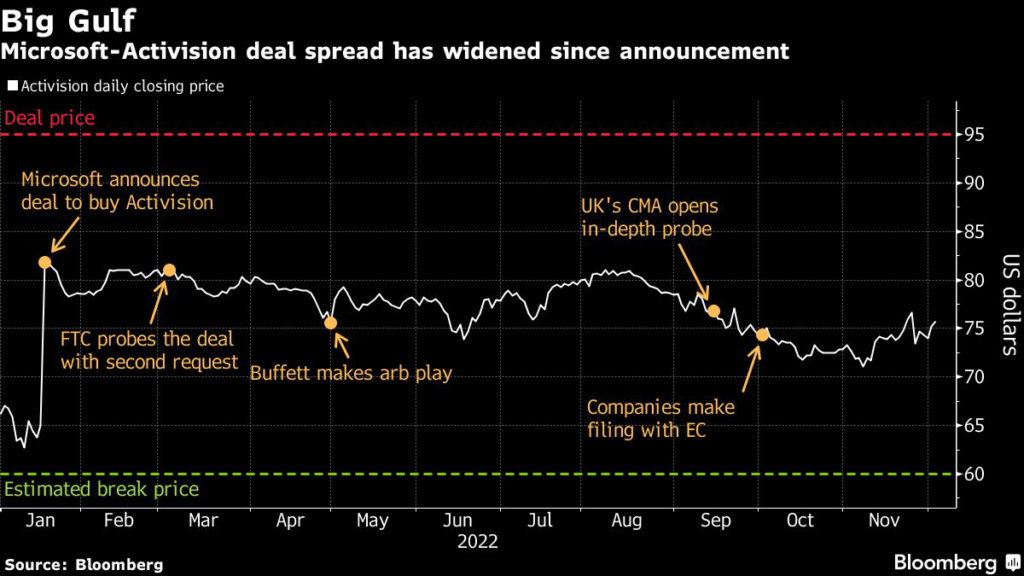
As investors increasingly doubt whether the deal will survive antitrust scrutiny, Wall Street brokerages have been growing more bullish on Activision’s standalone prospects. Their average 12-month price target for the stock is $92.17, almost identical to their $91.95 prediction on Jan. 17, the day before Microsoft shocked the market with the takeover announcement. 

Activision shares climbed 1.2% on Monday, while Microsoft edged lower 0.7%.

Should Microsoft’s $95-a-share cash offer fail, arbitragers tend to see the stock dropping back toward $60, where it traded before the bid, said Aaron Glick, a merger-arb specialist at Cowen & Co., from $75.76 Friday. Yet it might not stay there long: Analysts have been raising earnings estimates the past month, citing the outlook for its Call of Duty and World of Warcraft franchises. And the stock would jump more than 20% if the deal does go through.

“You can see why people would see this as a favorable risk/reward, with or without a deal,” said Ralph Rocco, portfolio manager at Gabelli Funds, which owns Activision shares. “We see limited fundamental downside and a decent amount of upside if the deal goes through.” 

Since the January deal announcement, Activision’s stock has weakened from the low $80s to the mid $70s. The transaction faces in-depth antitrust probes in the European Union and UK, as well as heightened scrutiny from the Federal Trade Commission in the US, which Politico reported is likely to file a lawsuit to block the sale.

Microsoft is ready to fight if the US sues to block the deal, Bloomberg News reported late Friday, citing a person familiar with the matter said. Microsoft, which has said it expects to close the transaction by June 30, declined to comment on the prospect of an FTC suit. Separately, The New York Post reported that there is a rift within the FTC over the deal that could help get it approved.

There’s not much of a takeover premium left: Over the five years before the acquisition, investors valued Activision at an average of 23 times estimated earnings, though that multiple had weakened to 16.8 right before Microsoft stepped in. Activision shares are priced now at 20 times earnings.    

The market is pricing in roughly a 35% to 40% probability of the deal closing. “If it falls apart, some event-driven traders will have to reduce or exit their positions and that selling pressure could push the stock down below investors’ fair value estimates,” said Cowen’s Glick. There’s a difference “between fair value and where something trades due to technical dislocation,” he added. 

At least six analysts upgraded the stock in November, including Wells Fargo Securities, which  wrote that the market “is undervaluing ATVI relative to both outcomes (deal or no deal).” Analyst Brian Fitzgerald cited Activision’s portfolio of intellectual property, PC player base, and growth opportunity in mobile gaming. 

The view was echoed by Truist Securities, which wrote that based on a strong release slate, Activision “should have a big 2023.”


Tech Chart of the Day

Recent gains in the Nasdaq 100 Index have led to a growing number of components trading above their 200-day moving average, a sign that the recent rally is picking up momentum. As of Friday’s close, about 55% of stocks in the benchmark are above this closely watched level, near the highest since January. To compare, fewer than 8% of components were above their 200-day at the end of September. The overall index needs to rise about 4.5% to reach its 200-day, which it hasn’t closed above since April.

Top Tech Stories

  • Elon Musk said Apple Inc. has “fully resumed” advertising on Twitter Inc., further de-escalating a brewing war between two of the world’s most influential tech companies.
  • CyberAgent Inc.’s Abema TV may have to restrict access to Japan’s World Cup game at midnight Monday local time, as runaway demand is pushing the streaming service to its limits.
  • Vodafone Group Plc Chief Executive Officer Nick Read will step down at the end of 2022 following a year when the telecommunications company’s share price sank.
  • Tesla Inc. plans to lower production at its Shanghai factory, according to people familiar with the matter, in the latest sign demand in China isn’t living up to expectations. A Tesla representative in China declined to comment.

–With assistance from Subrat Patnaik.

(Updates to market open)

More stories like this are available on bloomberg.com

©2022 Bloomberg L.P.

Close Bitnami banner
Bitnami