
Bloomberg

Big Oil Backs Israeli Startup That Sucks CO2 From the Atmosphere

(Bloomberg) — Israeli startup RepAir raised $10 million to help scale up its technology to suck planet-warming carbon dioxide out of the air. 

RepAir is one of a handful of companies looking to build technology that performs a process known as direct air capture, which takes CO2 from the air and stores it safely out of the atmosphere. It’s potentially a key tool for getting rid of excess greenhouse gas emissions that are causing global warming —  alongside the much larger effort to prevent them from ever entering the atmosphere in the first place. 

RepAir currently has a working prototype that’s about the size of a shoe box, which it operates in a laboratory near Haifa, Israel. With that proof of concept, the company plans to scale up with the money raised from investors including climate venture firm Extantia Capital and the venture arms of European oil and gas giants Shell Plc and Equinor ASA. 

“Direct air capture has to be part of the solution to the climate problem. It’s an essential element on top of shifting to renewables and eliminating emissions at the source,” said RepAir’s co-founder and Chief Executive Officer Amir Shiner. “The name of the game is to scale up as quickly and economically as possible.”

The next phase for RepAir will be to build a unit capable of capturing as much as 1 metric ton of CO2 per year out in the real world, a system about the size of a residential air conditioner. That will be up and running in about six months. Next would be to scale up to a module able to suck in about 200 tons per year, a building block to larger-scale plants that aim to operate commercially.

“It’s a very small quantity, but it’s going to be very important for us to reach that milestone and start moving faster,” Shiner said.

Carbon capture technologies that trap emissions at the smokestack have been developed for decades by the oil and gas industry. But direct air capture is a relatively nascent technology that’s being promoted as a way to remove emissions from the air more reliably than offsets based on forests, the benefits of which are hard to verify. The world’s largest direct air capture plant, built by Swiss startup Climeworks AG, started up last year in Iceland with a capacity to draw in 4,000 tons of CO2 a year. 

While RepAir, which was founded in 2020, is behind that competition, it aims to distinguish itself by limiting how much energy is needed to capture CO2. Shiner said that his machine needs about 650 kilowatt hours of power to capture a ton of CO2. That compares to roughly 2,000 kilowatt hours required by the Climeworks system, although RepAir requires power, while Climeworks uses heat for much of its energy. 

To put that in perspective, the International Energy Agency forecasts that direct air capture could be used to trap about 393 million tons of emissions by 2050 to help the world keep warming temperatures within the 1.5C limit set by the 2015 Paris Agreement. To sequester that amount of CO2, RepAir would need about 255 terawatt hours of electricity per year, which is slightly more than the total power generated in a year in Spain. Shiner ultimately plans for that power to come from renewable sources to maximize the net benefit. 

RepAir’s technology comprises two electrodes with a membrane in between. Air enters from one side of the cell as an electric current zaps the cathode, generating hydroxide ions, which bind with CO2 in the air and form bicarbonate ions. They then pass through the membrane and release pure CO2 on the other side, where it can be stored. 

While the company is currently focused on its development phase in Israel, it plans to expand next year into the US, where President Joe Biden’s climate bill,  the Inflation Reduction Act, offers as much as  $180 per ton in subsidies for projects that sequester at least 1,000 tons a year. 

More stories like this are available on bloomberg.com

©2022 Bloomberg L.P.

Coupa Investor HMI Says Co. Should Fetch $95 Per Share in Sale

(Bloomberg) — A top shareholder in Coupa Software Inc. said the software company should fetch at least $95 a share in a sale after getting interest from at least one potential buyer. 

HMI Capital Management said in a letter to the company’s board on Monday that Coupa is an excellent business with a great management team. HMI Capital, which owns a 4.8% stake in Coupa, said it would not support any transaction unless it was at the right price and followed a proper sales process. It said it may be a difficult time to realize the full value of the business in the current market. 

“Timing is everything when it comes to successful M&A, and the standalone option simply may make more sense right now than a transaction, and certainly makes more sense than a deal at the wrong price,” said RK Mahendran, HMI Capital partner, in the letter reviewed by Bloomberg News.

Vista Equity Partners is exploring a potential acquisition of Coupa, people familiar with the matter said last month. A representative for Coupa wasn’t immediately available for comment.

HMI Capital, which said it has never written a public letter to a company before, believes that Coupa is undervalued and would reject any offer that failed to capture its potential upside. Shares in the San Mateo, California-based company closed at $64.67 in New York Friday, giving it a market value of $4.9 billion.

“Our worry is that now is a difficult time to realize the full value of Coupa’s long-term potential as a market-leader, given that Coupa’s share price is currently trading at a significantly depressed level and there are near-term sector-wide challenges in the software industry,” Mahendran said.  

Coupa’s shares have fallen about 63% from a year ago amid a broader selloff in the technology sector. HMI Capital said that, based on other transactions in the sector, Coupa should yield more than $95 a share in a sale. 

Coupa provides so-called business-spend management software, which helps companies track and manage the purchasing of goods and services. Customers have included Nestle SA and Groupon Inc., according to its website. 

Last week, another Coupa shareholder, Meritage Group, said in a regulatory filing it had conveyed its own views on what it would believed would be a fair price for the company without disclosing additional details. 

“The future for Coupa is an exciting one, and any sale price or process that fails to appropriately value Coupa’s long-term potential at the expense of seeking to rush into a deal would not be tolerated by HMI,” Mahendran said. 

More stories like this are available on bloomberg.com

©2022 Bloomberg L.P.
Watch Leveraged Loans as Canary in Credit Coal Mine, Traders Say

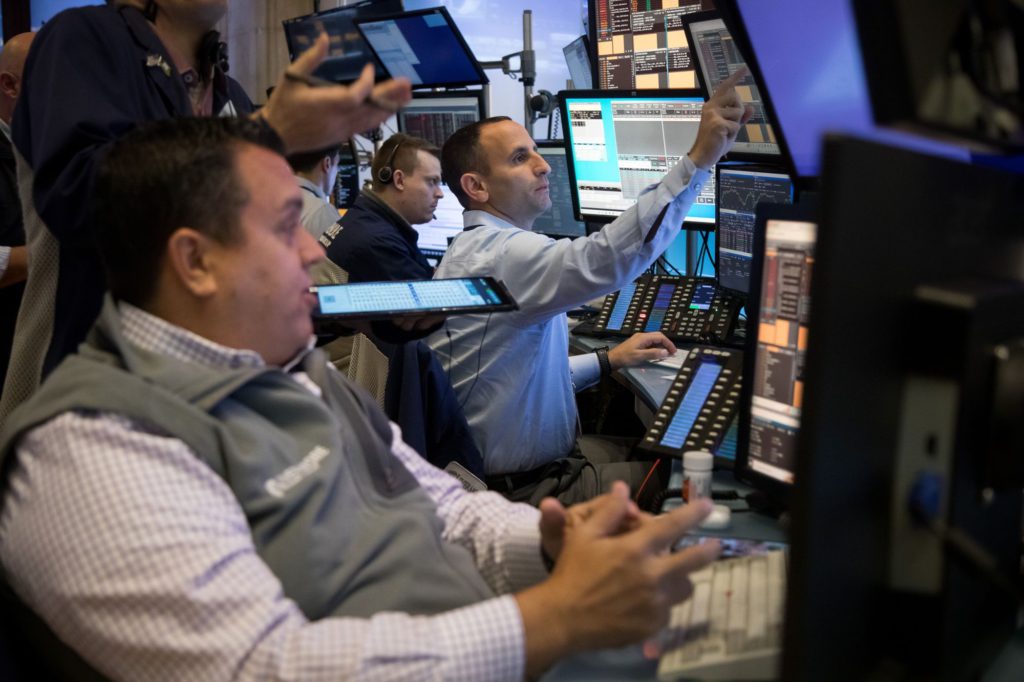
(Bloomberg) — Investors watch leveraged loans for the first signs that aggressive central-bank rate hikes are starting to hit companies hard. They also brace for more FTX-like blowouts in the private equity industry and expect investment grade to do well next year.

A majority of 291 respondents to the latest MLIV Pulse survey said leveraged loans would be the canary in the coal mine to indicate that corporate credit quality is getting worse. 

Any trouble for leveraged loans would represent a key shift in this credit cycle. For most of this year, buying loans seemed like a smart bet, because they carry floating interest rates and pay higher yields as central banks tighten the money supply. Even if loan prices fell a bit, the rising yields were enough to leave investors down just 0.9% for a year where most other markets are down double digits. And corporate balance sheets were still relatively strong, even for junk-rated companies. 

But now companies seem more likely to default, and some investors would rather cut back on credit risk. About 28% of survey respondents expect defaults to jump significantly if US rates peak at or below 5%, which is about where the market bets the Federal Reserve will stop hiking, based on Fed funds futures. Another 63% see defaults surging if rates peak above 5%. 

“While loans have performed well in an extremely challenging year, the path going forward is more problematic,” said Christian Hoffmann, a portfolio manager for Thornburg Investment Management. “As we get closer to short-term rates falling and defaults rising, the market could lose interest in the asset class.” 

Part of the problem is the same feature that made loans attractive to investors: floating rates, which are now forcing highly indebted companies to make higher interest payments. And most investors expect a stagflation or deflationary recession next year, weighing on company revenues. Many money managers would rather bet on interest rates falling by buying longer-term investment-grade company bonds. 

The US leveraged loan market is only a few decades old, so there isn’t robust data about how it performs during recessions. The debt fell precipitately in the Global Financial Crisis and again during the pandemic. In the 2001 recession, returns for the Morningstar LSTA US Leveraged Loan index, including interest payments and price movements, were more or less zero. 

But tighter credit conditions will hurt a wide array of highly indebted companies. Default rates for US leveraged loans could rise to 9% next year if the Fed stays on its aggressive monetary-policy path, according to UBS strategist Matt Mish. 

Even if many investors have bought loans this year, the debt has still faced some pressure. Prices began to dip after Russia invaded Ukraine in February, introducing fresh concerns about energy prices and global economic growth. US leveraged loans were trading at 99 cents on the dollar in January, and have since dropped to about 93 cents. 

The epic collapse of the FTX crypto empire has shone a light on aggressive risk-taking and slack due diligence in the venture-capital industry. Some 94% of MLIV Pulse respondents think that further blowups will follow the bankruptcy of FTX as years of easy credit give way to a tougher business and market environment. 

A more vulnerable credit market means that loan investors have to be particularly assiduous about doing their homework, said Frank Ossino, bank loan sector head at Newfleet Asset Management. 

“Credit selection is going to be critical,” Ossino said. “As we enter a downward cycle, risk assets will be impacted and loans – as a credit risk asset class – will naturally be a participant.” 

As leveraged loans are becoming less interesting to some investors, investment-grade bonds are poised to gain ground. More than half of respondents said they expected investment-grade credit to outperform next year, while about a fifth said they expected junk bonds to do better. Longer-term high-grade bonds generated returns of more than 9% in November, their best month since 2008.

Wall Street banks have also been talking lately about potentially high returns for investment-grade credit in 2023. Bank of America sees the debt generating total gains of close to 13% next year in the US, based on its index. 

UBS said that credit can offer once-in-a-decade returns, recommending macro trades including going long blue-chip company debt compared with leveraged loans. But timing the trades is critical, strategists led by Mish said, as recession looms and won’t reach every economy at the same time. 

Investor optimism about high-grade credit has been increasingly reflected in risk premiums. Spreads for US investment-grade debt have narrowed about 35 basis points since mid-October, according to Bloomberg index data. 

Investment-grade credit is typically far more sensitive than junk bonds to changes in benchmark yields, because high-grade debt tends to take longer to mature and pays less interest. That makes investment-grade debt a better bet when yields are falling, as they have been in recent weeks.

Investment-grade bonds in dollars have returned 8.7% since Oct. 21, compared with 5.2% for high yield. High-grade debt is still on course for — by far — its worst year on record. 

For more markets analysis, see the MLIV Blog. To subscribe and see previous MLIV Pulse stories, click here. Full survey’s results are here.

–With assistance from Airielle Lowe and Tomoko Yamazaki.

(Updates with market prices in penultimate graph.)

More stories like this are available on bloomberg.com

©2022 Bloomberg L.P.
Bitcoin’s Bearish Futures Are Signaling a Slowdown into 2023

(Bloomberg) — Bearish traders are signaling that crypto losses will continue into next year, as risk-averse firms scale back from a market roiled by the implosion of digital-assets exchange FTX. 

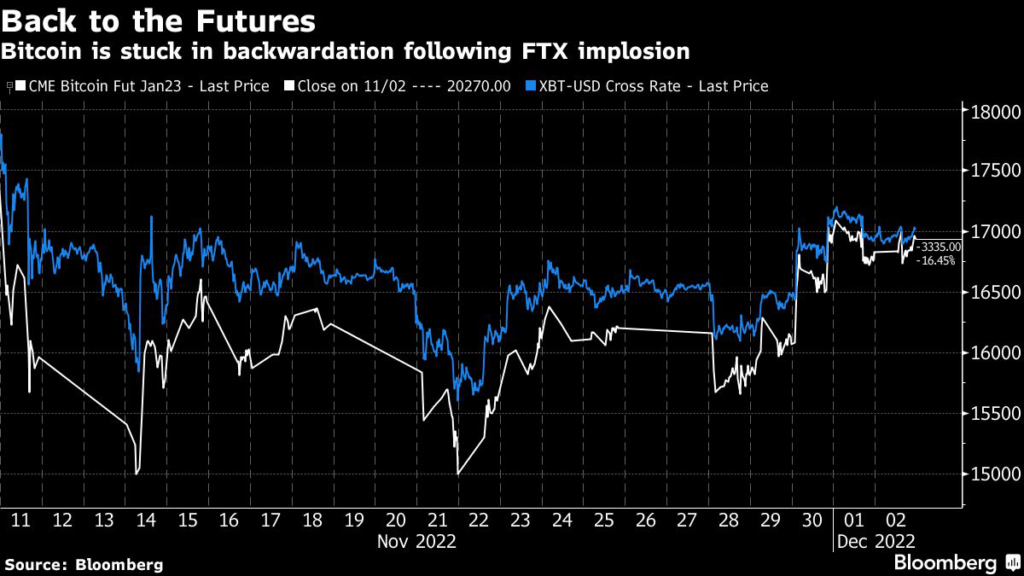
The Bitcoin futures curve is stuck in backwardation, meaning its spot price is higher than its futures price. The CME Group’s January 2023 contract has dropped to its deepest discount to spot since its launch earlier in November and is stuck trading at more than 1% below the cash price. Active Bitcoin futures on the CME group platform are all trading at a discount.

Contracts on Deribit, the most liquid crypto-native derivatives exchange, are also trading at discount with the January contract priced at $17,290 compared with Bitcoin’s cash price at around $17,300.

“It shows some strong bearishness in the market, with no expectations of good news anytime soon,” said Michael Safai, the chief executive of trading firm Dexterity Capital LLC. “Traders are gearing up for a slow and unimpressive trading period, probably into the spring.”

The dislocation between spot and futures markets emerged on November 11, the day FTX filed for bankruptcy. It’s the longest period of backwardation on the Deribit exchange since July 2021, according to its chief commercial officer Luuk Strijers.

Futures prices moved largely in tandem before FTX’s collapse and occasionally traded at a premium to spot markets. Large inflows into futures-based ETFs meant that arbitrage traders could profit from buying front-month futures in the knowledge that demand from investment vehicles would push the prices of these contracts higher. 

Bitcoin’s price has dropped 64% since the beginning of the year, according to data compiled by Bloomberg. 

In the wake of FTX’s unraveling and the disarray in its finances laid bare, trading firms have scaled down activities due to heightened concerns about counterparty risk. That’s exacerbated the dislocation between futures and cash prices as investors unwind trades. 

“A whole bunch of people are flocking to the CME to short bitcoin,” said Stephane Ouellette, chief executive of FRNT Financial Inc,. an institutional crypto platform. “People are staying away from offshore exchanges and they are looking at platforms that are going to be around when the bets expire.”

Other investment vehicles focusing on Bitcoin are also signaling more downside. Shares in the largest holder of Bitcoin assets, the Grayscale Bitcoin Trust, hit a record discount in mid-November compared with the value of assets held and they’re currently trading at a 42.6% discount to the trust’s holdings.

In another bearish signal, the ProShares Short Bitcoin ETF had its second-largest month of inflows in November since its launch with three consecutive weeks of inflows totaling $40.83 million.

To arbitrage the current discount away, trading firms would need to buy CME futures and enter into short positions in other Bitcoin markets to hedge. 

Such a strategy is extremely challenging due to the seizing up in lending and borrowing activity, according to Chris Zuehlke, partner at DRW and global head of Cumberland, a digital asset specialist. This leaves just those who hold cash Bitcoin to try and profit from the gap. 

“Those who have their own inventory can and likely be putting it to use, but it appears that isn’t enough to collapse the basis,” Zuehlke said.

More stories like this are available on bloomberg.com

©2022 Bloomberg L.P.
Vodafone CEO Nick Read Ousted After 44% Collapse in Shares

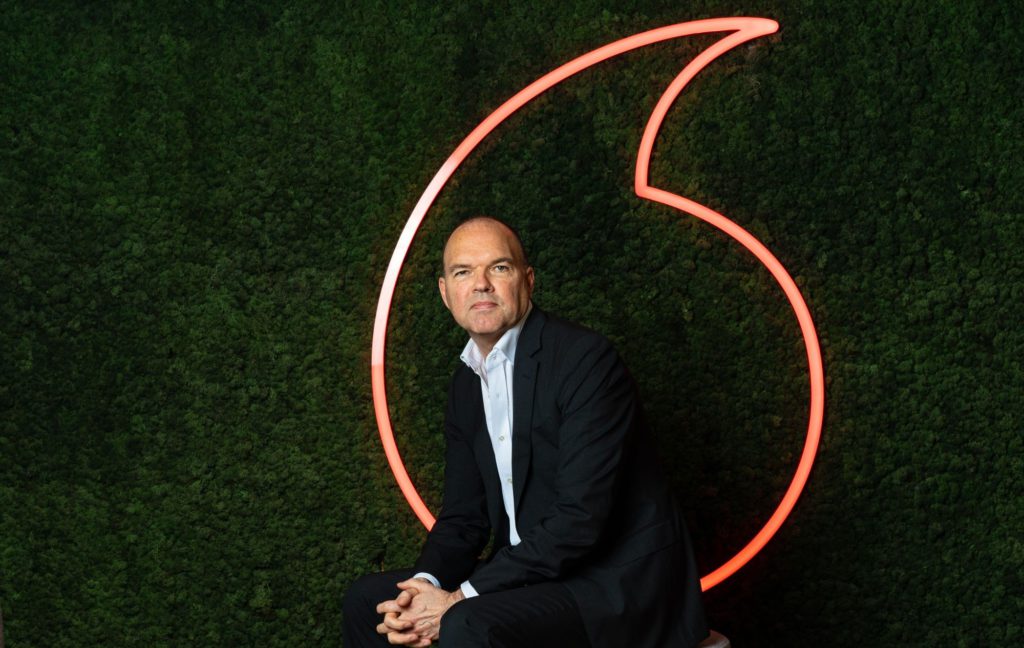
(Bloomberg) — Vodafone Group Plc Chief Executive Officer Nick Read will step down at the end of 2022, after he failed to halt a years-long slide in the telecommunication giant’s share price and mergers with major rivals failed to materialize.  

Chief Financial Officer Margherita Della Valle will do the job on an interim basis while the board, led by Chairman Jean-Francois van Boxmeer, seeks a replacement. Read, who’d been in the post for four years and at Vodafone for more than two decades, will stay on an as adviser until the end of March, the company said in a statement on Monday. 

“I agreed with the board that now is the right moment to hand over to a new leader who can build on Vodafone’s strengths and capture the significant opportunities ahead,” Read, 58, said in the statement.

Vodafone’s share price has sunk about 44% since Read took over in October 2018. In that time the Newbury, England-based mobile and broadband giant has retrenched and cut debt. Read’s biggest move may have been to spin out and list the company’s tens of thousands of mobile masts, selling a stake in Frankfurt-listed listed Vantage Towers AG to a private equity consortium in a deal that valued the business €16.2 billion ($17.1 billion) last month. 

Still, Read struggled to finalize deals that would have reduced the number of players in some of Vodafone’s biggest markets such as the UK, Italy and Spain. An approach for the Italian business was rebuffed, a key merger opportunity in Spain was missed, and talks with UK rival Three, owned by CK Hutchison Holdings Ltd., are public but have yet to conclude. 

Vodafone shares were little changed at 12:39 p.m. in London trading. The stock remains close to 25-year lows. 

Vodafone’s share price has underperformed the rest of the industry this year, even as the sector lost value as a whole, falling more than the Stoxx Europe 600 Telecommunications Price Index.

Its challenges deepened in 2022 after Russia’s invasion of Ukraine sent energy costs soaring, while interest rates also rose. Read faced pressure from investors including Europe’s largest activist fund Cevian Capital AB, which sold much of its stake earlier this year. 

More recently, a vehicle backed by French billionaire Xavier Niel bought 2.5% of Vodafone saying it saw opportunities to accelerate deals and improve profits. 

Although major issues like energy prices and coronavirus were outside of Read’s control, analysts pointed to how he’d handled others. 

In 2019, he cut the dividend six months after the company said it was affordable. Earlier this year, he missed the company’s biggest opportunity yet to merge its embattled and shrinking Spanish division. And he’s acknowledged poor performance in Vodafone’s biggest business, Germany, following an €18.4 billion deal early in Read’s tenure. The acquisition, which included some eastern European businesses, was originally struck by his predecessor, Vittorio Colao.

A new CEO will have to address the commercial issues in Germany, and cost-of-living concerns across Vodafone’s footprint, which could undermine support for “market repair,” which might include price rises or mergers, Jefferies analyst Jerry Dellis said in a note to clients. 

Dellis added that leverage remains “uncomfortably high” after the Vantage deal and that the dividend policy should be treated as under review.

Vodafone’s operations are complex and it’s never appointed a complete outsider to the top job, so Read’s successor may already have some link with the company, Berenberg analyst Carl Murdock-Smith said in a note following the announcement. 

He pointed to Informa Plc CEO Stephen Carter, who serves on Vodafone’s board and was previously head of UK telecom regulator Ofcom, and Nick Jeffery, who was previously Vodafone’s UK head and left the company last year to run US-based Frontier Communications. 

Carter and Jeffery didn’t immediately respond to requests for comment. 

Other contenders mentioned by analysts include new interim chief Della Valle, who has implemented significant cost cuts as CFO. There isn’t a clear internal successor, analysts at Bernstein said.

(Updates with context throughout)

More stories like this are available on bloomberg.com

©2022 Bloomberg L.P.

Chrono24 CEO Says Rolex Certification Move to Boost Sales

(Bloomberg) — Chrono24, the biggest online watch marketplace, said Rolex’s decision to certify its pre-owned timepieces for resale by authorized dealers will boost sales as it legitimizes the secondhand market.

“It will incentivize even more first-time buyers to try to get their hands on their first Swiss trophy timepiece,” Chrono24 Co-CEO Tim Stracke said. 

Geneva-based Rolex launched a program last week to certify pre-owned watches for resale through its dealer network. The watches must be at least three years old and will be guaranteed by Rolex for an additional two years. Rolex certified pre-owned watches will only be sold by authorized dealers, beginning with Swiss retailer Bucherer and then others next year.

E-commerce platforms like Chrono24, Richemont’s Watchfinder and major used-Rolex dealers such as Bob’s Watches in the US won’t be eligible for the program. Still, online resellers expect to get a boost from increased interest in Rolex.

Stracke said Rolex’s decision is an acknowledgment of the importance of the pre-owned watch market that is worth about $20 billion and is expected to grow to $35 billion by 2030, according to Deloitte. 

“This announcement will only fan the flames of demand for Rolex on our platform, and we’re very excited to see how Geneva’s other luxury brands will respond,” Stracke said. 

There are about 30 million used Rolex watches in circulation and the brand accounts for 40% of sales transactions on Chrono24. 

The e-commerce site’s sales volumes rose 43% in the first six months of the year. That comes even as prices for the most sought-after Rolex, Patek Philippe and Audemars Piguet watches have fallen sharply since March. 

Chrono24 has a valuation of more than $1 billion and is considering selling shares to the public in an initial public offering.  It has financial backing from LVMH-owner Bernard Arnault’s family investment company, Aglae Ventures, General Atlantic, Insight Partners and Sprints Capital.

Paul Altieri, the founder and CEO of Bob’s Watches in the US, said Rolex’s jump into the pre-owned market shows the brand wants its “fair slice” of the profits from secondhand sales. The company, which specializes in selling used Rolex, expects revenue of more than $120 million this year. 


More stories like this are available on bloomberg.com

©2022 Bloomberg L.P.

Tesla Set to Cut Shanghai Output in Sign of Sluggish Demand

(Bloomberg) — Tesla Inc. plans to lower production at its Shanghai factory, according to people familiar with the matter, in the latest sign demand in China isn’t meeting expectations.

The output cuts will take effect as soon as this week, said the people, who asked not to be identified because the information isn’t public. They estimate the move could reduce production by about 20% from full capacity, which is the rate at which the factory ran in October and November.

The decision was made after the automaker evaluated its near-term performance in the domestic market, one of the people said, adding that there’s flexibility to increase output if demand increases.

A Tesla representative in China declined to comment. The carmaker’s shares fell as much as 2.4% to $190.10 at 5:25 a.m. Monday in New York, before the start of regular trading.

The trimming marks the first time Elon Musk’s EV maker has voluntarily reduced production at its Shanghai plant, with previous reductions caused by the city’s two-month Covid lockdown or supply chain snarls. Recent price cuts and incentives such as insurance subsidies, along with shorter delivery times, suggest demand has failed to keep up with supply after an upgrade doubled the plant’s capacity to about 1 million cars a year.

Read more: Tesla Revamps China Marketing Strategy as Rivals Lure Customers

Tesla’s China deliveries were a record 100,291 in November, China’s Passenger Car Association said on Monday, as lead times for the Model 3 and Model Y — the two vehicles Tesla makes in Shanghai — shortened markedly, another sign the factory is pumping out more cars than it’s selling.

Any Model 3 and Model Y ordered in China today should be delivered within the month, Tesla’s website shows, down from as long as four weeks in October and up to 22 weeks earlier this year. The Shanghai factory mainly serves the Chinese market, although some cars are exported to Europe and other parts of Asia.

Full production capacity at the Shanghai factory is around 85,000 vehicles per month, Junheng Li, chief executive officer of equity research firm JL Warren Capital LLC, said in a Nov. 22 note. “Without more promotions, new orders from the domestic market will likely normalize to 25,000 in December,” she said, adding that increased production couldn’t all be absorbed by exports.

Tesla is facing intensifying competition from local automakers such as BYD Co. and Guangzhou Automobile Group, which are raising prices in the world’s largest EV market. BYD posted a ninth consecutive month of record sales in November, with deliveries topping 230,000, including almost 114,000 pure-electric models.

This has contributed to Tesla — which has long eschewed incentives and traditional advertising — deciding to offer extended insurance subsidies, reinstating a user-referral program and even advertising on television.

Tesla’s reliability also is back in the spotlight after two recalls in China in the past month that required both over-the-air software fixes and some vehicles to be returned for maintenance. A recent fatal crash involving a Model Y that killed two people has again sparked discussion of Tesla’s safety record.

(Updates with early trading in the fourth paragraph.)

More stories like this are available on bloomberg.com

©2022 Bloomberg L.P.
BYD Has Tesla In Its Sights After a Year of Runaway Growth

(Bloomberg) —

Covid lockdowns, supply chain woes and power shortages hampering China’s auto industry haven’t been enough to halt BYD Co.’s relentless advance to dominate the world’s biggest electric-vehicle market.

Now, it has Elon Musk’s Tesla Inc. in its sights.

The Berkshire Hathaway Inc.-backed automaker will enter 2023 on a roll, with record vehicle sales, revenue and profitability, driven by the appeal of its affordable cars in China’s mass market. It’s now making a play for cashed-up buyers in the premium end of the market with two luxury brands, pitting itself against Tesla’s pricier cars.

“The two segments BYD doesn’t have exposure to are the luxury SUV and sports car markets, which we expect BYD will expand into in 2023,” says Bridget McCarthy, head of China operations for green tech-focused US hedge fund Snow Bull Capital. “These are the two most profitable vehicle segments, so bottom-line growth in 2023 will excite investors.”

The first of the two new brands, Yangwang, will launch in the first quarter, targeting affluent professionals with promises of high performance and disruptive technologies.

More intriguingly, BYD also is touting a new brand that it says will be “grounded in highly professional and personalized identities” to cater to the “diversified demands” of customers. It’s said little more about the brand beyond that.

After ceasing production of combustion engine-only cars earlier this year, BYD “has now established itself unequivocally as the market leader in the race to electrification, and I believe it will parlay that into a multi-brand strategy,” says Bill Russo, founder and CEO of Shanghai-based advisory firm Automobility. “They’ll be a pioneer if they do.”

The new brands also happen to be the kind of EVs fit for the US, a market BYD has yet to enter with its ever-growing electric lineup.

Russo also expects the hardware-driven BYD to embrace software in a big way, as it’s an area seen as a shortcoming.

“What BYD lacks that others have is more of a digital DNA,” he says. “BYD is still a hardware company. As good as it is assembling an EV profitably at scale, it hasn’t proven itself to be a tech-driven software-defined technology company.”

The Chinese EV giant has managed to withstand most production disruptions, in part thanks to its vertically integrated supply chain. Production and deliveries hit another record in November, topping 230,000 vehicles.

The rise and rise of BYD puts it on course to match and maybe even exceed Tesla in pure EV car sales by the first quarter of next year. With critics pointing to BYD’s lower levels of revenue and profitability versus Tesla, the Shenzhen-based juggernaut may close that gap with by broadening its lineup with more top-end vehicles.

“Can the Chinese in a hypercompetitive market establish a sustainable premium price position with Chinese consumers?” asks Russo. “It hasn’t been done sustainably.”

More stories like this are available on bloomberg.com

©2022 Bloomberg L.P.

Crypto CEOs Fearing Worst Is Yet to Come Are Cutting More Jobs

(Bloomberg) — Digital assets are already a year into one of the industry’s worst slumps, but judging from recent announcements of steep headcount reductions, crypto executives seem to be bracing for more pain. 

Cryptocurrency exchanges Bybit and Swyftx over the past two days said they’re laying off 30% and 35% of their staff, respectively. The announcements came less than a week after bigger rival Kraken unveiled a similar workforce culling. 

With the implosion of Sam Bankman Fried’s FTX reverberating through the industry, Bybit Chief Executive Officer Ben Zhou and his counterpart at Swyftx, Alex Harper, offered frank assessments of the challenges facing the sector. 

In a message to employees seen by Bloomberg News, Harper cited the potential for more “black swan-type events” and said trading volumes could suffer “a potentially sharp fall” in the first half of 2023. Zhou flagged the possibility “that we are entering into an even colder winter than we had anticipated from both industry and market perspectives.”

Exchanges are at the epicenter of the industry’s crisis because trading volumes have fallen sharply as a $2 trillion drop in cryptoassets’ market value drove retail traders away. In addition, questions about whether FTX misused customer funds to prop up Bankman-Fried’s trading house Alameda Research have led to a loss of faith in centralized marketplaces. 

“As we’ve just announced to the team, Swyftx has no direct exposure to FTX, but we are not immune to the fallout it has caused in the crypto markets. As a result, we have to prepare in advance for a worst-case scenario of further significant drops in global trade volumes during H1 next year and the potential for more black swan-type events.” 

— Alex Harper, Swyftx CEO

After a year of hacks, blowups and bankruptcies, pessimism now suffuses the sector. A roughly 70% drop in the price of Bitcoin to $5,000 next year is among “surprise” scenarios markets may be “under-pricing,” Standard Chartered’s global head of research, Eric Robertsen, wrote in a note on Sunday. That’s more than 90% below the token’s peak of almost $69,000 in November 2021.


Read more: Bitcoin Sinks 70% to $5,000 in StanChart’s Potential 2023 Upsets

For all the hand-wringing among digital-asset executives, perhaps the bleakest prediction for the industry comes from one of traditional finance’s biggest names. BlackRock Inc. CEO Larry Fink, a longtime cryptocurrency skeptic, said last week that he expects most crypto companies won’t survive the havoc FTX’s fall unleashed. 

“I actually believe most of the companies are not going to be around,” Fink said at the New York Times DealBook Summit on Nov. 30. 

More stories like this are available on bloomberg.com

©2022 Bloomberg L.P.

Why Toyota’s New Prius Won’t Be Its Last

(Bloomberg) — Toyota aired a Super Bowl commercial almost 18 years ago that opened with cars in traffic, their wheels spinning but going nowhere. “It’s been a long time since transportation has truly advanced,” a narrator intoned. “We’ve been moving; we just haven’t been moving forward.”

The ad for the second-generation Prius echoes the criticism being lobbed at the manufacturer that just debuted a fifth-generation version of its flagship hybrid. Toyota has ranked last when Greenpeace scored the 10 biggest automakers’ decarbonization efforts. InfluenceMap, a think tank that evaluates corporate climate policy engagement, said last month that Toyota remains the most obstructive company in the transport sector.

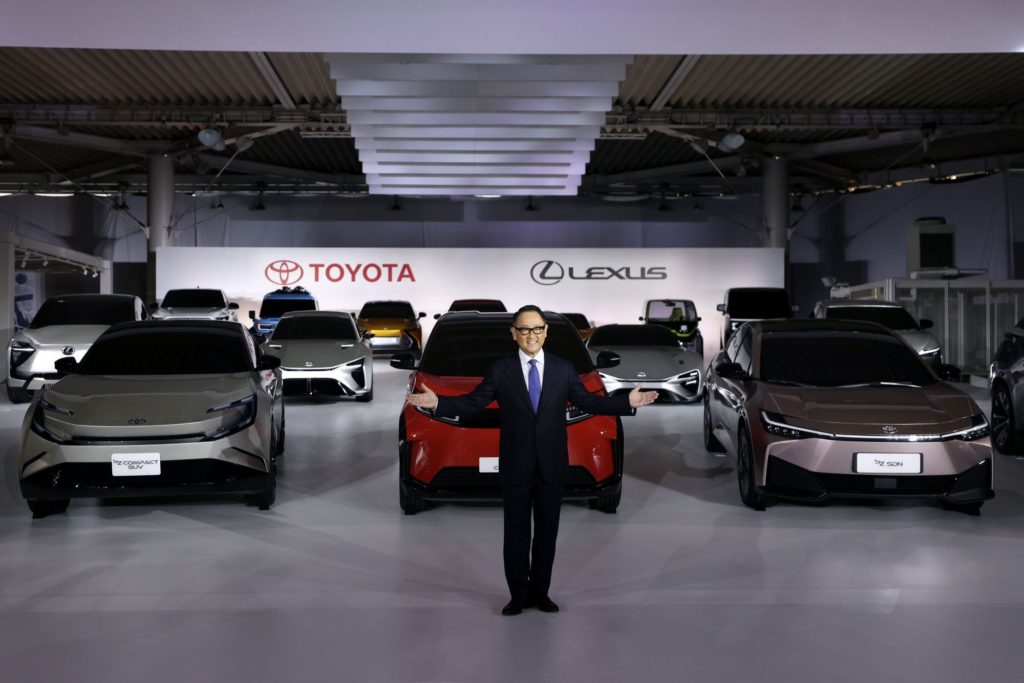
Toyota would fare better in these rankings if it were to make a no-holds-barred pivot to fully electric vehicles and embrace policies pushing in that direction. But while the company vowed a year ago to plow ¥4 trillion ($30 billion) into an effort to sell 3.5 million EVs annually by the end of the decade, the new-look Prius the company just unveiled won’t be the last iteration.

Toyota insists that building more of the hybrids it’s been selling for 25 years doesn’t mean it’s spinning its wheels or failing to move forward. Executives briefed reporters in Brussels last week on plans to reach carbon neutrality in Europe by 2040 — a decade before the company plans to reach net zero globally — and argued the tack they’re taking is the quickest way to cut back on car pollution, given the lasting shortages of what’s needed for automakers and their customers to go fully electric.

“When battery materials and renewable energy charging infrastructure are scarce — which is what they’re going to be for the next 10 to 15 years — we need to employ systems thinking,” said Gill Pratt, Toyota’s chief scientist. “Battery cells should be put where they will do the most good.”

Stay on top of the auto industry’s transformation by signing up for Bloomberg’s Hyperdrive newsletter here.

To illustrate his point, Pratt gave an estimate of the typical lifetime emissions of 100 non-electrified vehicles. He then gave a breakdown of how much the emissions rate of the fleet could be reduced assuming you only have 100 kilowatt hours of battery capacity to go around.

That happens to be the size of a Tesla Model S battery. Using the entire battery supply to fully electrify one car reduces the emissions rate of the fleet by less than 1%. Using this scarce amount of cells to replace six non-electrified cars with plug-in hybrids each using 18 kWh batteries would reduce the fleet’s emissions rate a bit more — by about 2.4%. But the winner in Pratt’s thought exercise would be to replace 90 non-electrified vehicles with hybrids using 1.1 kWh batteries, which would lower the emissions rate of the fleet by 18%.

“We can debate the lifetime average carbon emissions that I’ve assumed here for each vehicle type,” Pratt said. “The result is not going to change significantly, because the dominant factor is the different numbers of non-electrified vehicles that are displaced by the same amount of battery, not the exact lifetime emissions of each powertrain type. This is the fundamental rationale for Toyota’s diverse approach.”

Toyota is intimately familiar with battery raw material shortages — its trading arm Toyota Tsusho has invested in mining for more than a decade. Pratt pointed to the price of lithium soaring to record highs of more than $50,000 per ton, 10 times higher than just two years ago.

The automaker estimates that more than 1 billion people don’t have access to adequate electricity supply. And whereas the average battery-electric vehicle, or BEV, sells for more than $65,000 in the US, the current-generation Prius starts at just over $25,000.

“BEVs are a satisfactory answer in Europe and increasingly in the US, where infrastructure is being built out and there is enough electricity — for now,” Toyota President Akio Toyoda said in remarks shared with reporters. “They are not yet the answer everywhere, nor are they yet affordable for all.”

At a similar forum in Brussels this time last year, Toyota vowed to be ready to sell only zero-emission cars in Europe by 2035, aligning itself with the European Union’s planned phase-out of combustion engine cars. It staged the European premiere of bZ4X, the first in a series of six Toyota brand EVs it will sell in the region by 2026.

The launch of the RAV4-like SUV didn’t go according to plan — a single bZ4X was delivered to a customer in Europe before Toyota stopped sales worldwide over a hub bolt issue that could lead to wheels detaching from the vehicle. Sales will start months late in major European markets in the first quarter.

Despite the rocky start, the company’s sales units are projecting demand next year that the company won’t be able to meet with enough supply, Matt Harrison, the president of Toyota Motor Europe, said in an interview.

“We’re having to sort of manage around the world to put more capacity in place for bZ4X for beyond 2023, because we see that probably the demand is going to be higher than was expected,” he said. “We’re going to have a supply problem for bZ4X, not a demand problem.”

More stories like this are available on bloomberg.com

©2022 Bloomberg L.P.

Close Bitnami banner
Bitnami