Bloomberg

India’s JetSynthesys Is Said in Talks to Merge With BurTech SPAC

(Bloomberg) — JetSynthesys, an Indian digital entertainment and technology company, is in talks to go public through a merger with blank-check firm BurTech Acquisition Corp., according to people with knowledge of the matter.

The two companies have signed a non-binding letter of intent regarding a transaction that values the combined entity at more than $700 million, said the people, who asked not to be identified discussing private talks. BurTech may seek an additional $120 million in new financing to support the deal, one of the people said. Terms could still change and it’s possible that talks collapse.

A representative for Washington-based BurTech declined to comment, as did a JetSynthesys representative.

JetSynthesys, led by Chairman Kris Gopalakrishnan and Chief Executive Officer Rajan Navani, says its aim is “to build world class digital products and platforms with the goal of impacting the lives of 1.3 billion Indians and extending to the world.” The company’s holdings include gaming and e-sports, entertainment and wellness platforms including “Real Cricket,” meditation app ThinkRight.me and “Sachin Saga Cricket Champions,” named for former batsman Sachin Tendulkar, the company’s website shows. JetSynthesys’s minority stake in Nodwin Gaming is set to be included in the transaction, the people said. 

BurTech, led by CEO Shahal Khan, raised $287.5 million in a December 2021 initial public offering and said it would focus on finding a target in sectors such as retail, lifestyle, hospitality, technology or real estate.

Other digital media platforms have inked agreements to go public through mergers with special purpose acquisition companies, such as Grindr LLC and Trump Media & Technology Group.

More stories like this are available on bloomberg.com

©2022 Bloomberg L.P.

Frontier-Debt Buyers Look Past Default Risk in Hunger for Yield

(Bloomberg) — Signs of distress flashing in bond markets suggest the world’s poorest nations are set to see a wave of debt restructurings. But a growing cohort of investors say that’s a buying opportunity.

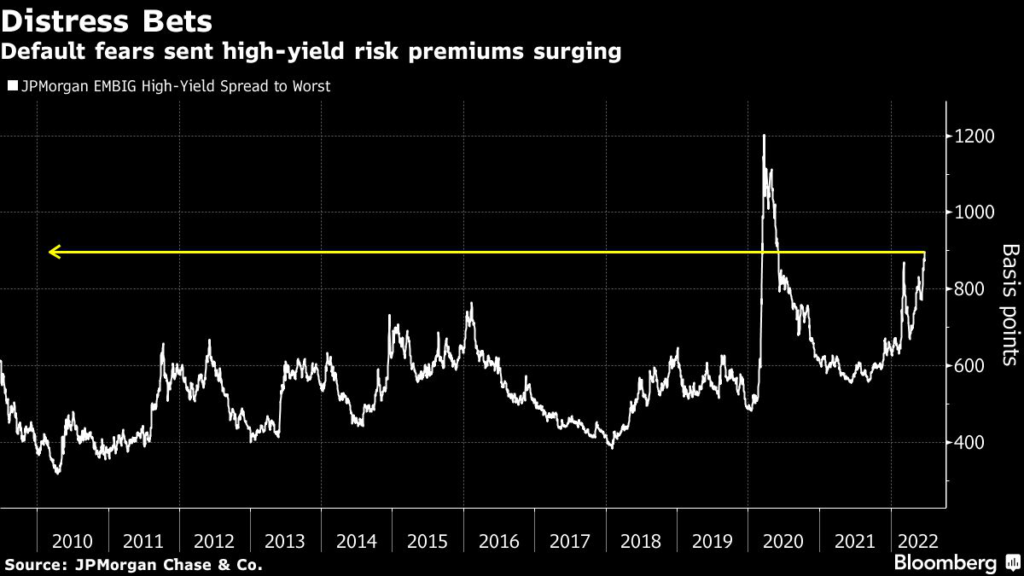
Panic selling in the aftermath of Sri Lanka’s economic collapse has sent the average yield in junk-rated emerging economies to almost 900 basis points above US Treasuries, the highest risk premium in 13 years except for the Covid-related rout in 2020, according to JPMorgan Chase & Co. data. Yet, initial fears about a widespread default Armageddon across emerging markets is easing, and money managers are looking beyond the handful of countries that may reschedule their debt.

This shift in perception means at least some smaller developing nations, called frontier markets, have been unduly punished in the recent selloff and now offer highly attractive yields. Even in the event of debt restructuring, their bonds will offer greater recovery values than current bond prices, investors including Barclays Plc and Bluebay Asset Management say. 

“The beating in the frontier space has been much more severe than the broader emerging-market space,” said Lars Jakob Krabbe, a money manager for frontier-market fixed income at Coeli Frontier Markets AB. “We are getting closer to where we see a bottom. That has to do with you having a high coupon coming to you all the time, unless credits default in a larger sense, which I doubt.”

The selloff in frontier-market debt started last year, well before the Sri Lankan crisis grabbed the world’s attention, as investors trimmed the riskiest portions of their portfolios in preparation for the Federal Reserve’s monetary tightening. The Asian island nation’s default this year sparked further losses, especially among countries seen as having similar problems to Sri Lanka — high debt, a food-and-fuel price crisis, low foreign-exchange reserves and political discontent.

As a result, the number of countries whose dollar bonds trade at least 1,000 basis points above Treasury yields — a widely accepted measure of distress — has more than doubled since the start of the year to 19. Ecuador, Kenya, Nigeria and Egypt are the latest members of this unfortunate club that also includes Pakistan, Belarus, Tajikistan and the war-torn Ukraine. 

“The risk premium embedded in the market is quite substantial,” said Anupam Damani, the head of international and emerging-market debt at Nuveen. “In some cases, these credits have been pricing in way below recovery levels. I’m not saying all of these credits will survive but some surely will. Being selective in that space clearly offers value.”

Money managers see multiple avenues through which they can profit from the idea that actual defaults will be lower than what the market pricing suggests currently. For some, the renewed strength of the dollar makes eurobonds, which typically move in tandem with the greenback, a tempting investment. For others, their high coupon rates mean attractive total returns even if bond prices prove volatile.

“In the higher-beta segment, total-return prospects justify overweights in select distressed frontier credits including Ghana, El Salvador and Zambia and in oil exporters Oman, Ecuador and Nigeria,” Barclays analysts led by Christian Keller wrote in a note.

Investors may also be overcoming their initial angst about the war in Ukraine and its impact on frontier markets through food-price shocks. 

“A lot of the distressed frontier stories were well known, and already traded with decent yields to provide ample compensation,” said Tim Ash, a senior strategist at Bluebay Asset Management. “I’m not sure the Ukraine crisis is really pushing that many new frontier credits over the edge. Most had their underlying problems already.”

Selective Bets

The most attractive frontier-market bets are located in Africa. Ghana, which was cited by money managers as most likely to run into a debt-repayment problem after Sri Lanka, is now their top pick. Barclays, Coeli and Tellimer recommend Ghanaian bonds after its 2026 security fell below 70 cents on the dollar in June, the lowest price in six years. The bond rose to 72.2 cents on Monday.

“The selloff has created buying opportunities in Pakistan and Ghana, where bonds are now trading roughly in line with our estimated recovery values, and in Egypt and Kenya, where the rise in yields has outstripped fundamentals,” said Patrick Curran, a senior economist at Tellimer.

In Latin America, El Salvador and Ecuador are the most favored. The latter is among a clutch of oil exporters recommended by Barclays, while investors keen on El Salvador are watching the moves in Bitcoin after the country lost about half of the $100 million it spent on the cryptocurrency.

Every money manager is keen to emphasize that they aren’t making a bullish call on frontier markets at this point but only a tactical adjustment taking advantage of the market’s overblown fears of default that aren’t coming true. 

“It’s generally quite a gloomy outlook for frontiers,” said Richard Segal, a research analyst at Ambrosia Capital in London. “There will be many debt reschedulings, but we don’t expect more defaults in the near-term.” 

What to watch in emerging markets this week:

  • China’s purchasing managers’ indexes on Thursday are forecast to show the economy extending a rebound in June, buoyed by Shanghai’s reopening and the easing of virus curbs in other parts of the country, according to Bloomberg Economics
    • The official manufacturing and non-manufacturing gauges are likely to climb back into growth territory for the first time since February
    • The Caixin manufacturing PMI, which focuses more on smaller private companies and exporters, is also set to show a higher reading
    • China’s economy showed some improvement in June as Covid restrictions were eased, although the recovery remains muted, according to a Bloomberg aggregate index of eight early indicators
  • PMI numbers on Friday from South Korea, Thailand, Indonesia, Philippines, Malaysia, India, Taiwan will also be closely watched
  • Russia will publish May data on retail sales, unemployment, industrial production. The indicators will shed light on the impact of international sanctions on its economy
  • Colombia’s central bank is expected to raise its benchmark rate on Thursday
  • In Indonesia, data on Friday will probably show that inflation rose in June above the central bank’s 2%-4% target. Poland will also publish CPI numbers the same day


(Adds Ghanaian bond price in 12th paragraph)

More stories like this are available on bloomberg.com

©2022 Bloomberg L.P.

Cathie Wood’s ARKK Posts Longest Inflow Streak in Over a Year

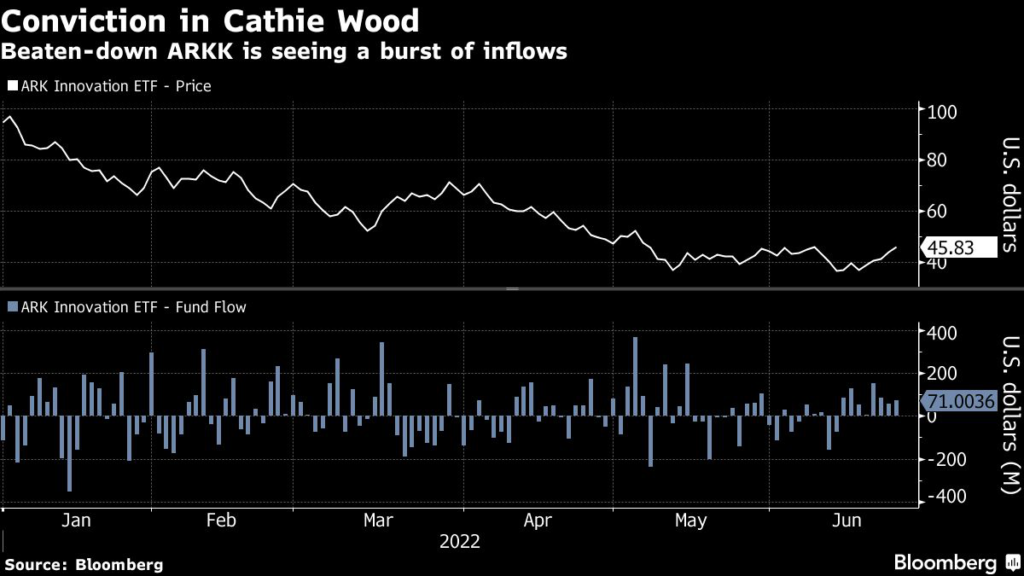
(Bloomberg) — Cathie Wood’s flagship fund has posted its longest streak of inflows in over a year as it fights back from an interest rate hike-fueled decline.

Investors have poured money into the $9.5 billion Ark Innovation ETF (ticker ARKK) for eight straight days, with the amount totaling $639 million, according to data compiled by Bloomberg. The last time there was that long a span of cash pouring in was in March 2021, about a month after the fund peaked.

While the cash intake trails the $1.4 billion the fund lured in its prior inflow streak of this length, the influx of money signals investors’ conviction in Wood. The exchange-traded fund has risen 14% in the last two weeks, but is still down more than 70% since its peak as it comes under pressure from red-hot inflation and Federal Reserve rate hikes. 


Wood has continued to double down on her innovation-themed strategy even as some of her high-profile bets like Coinbase Global Inc., the largest US cryptocurrency exchange, have suffered brutal stretches this year. 

Read more: Cathie Wood Just Keeps Buying Coinbase and Getting More Inflows

As speculative tech stocks get battered during the selloff, other ETF issuers are also seeing opportunity in the current environment and are following in Wood’s footsteps. The AOT Growth and Innovation ETF (ticker AOTG) aims to be listed soon. IndexIQ also recently launched two growth ETFs.

More stories like this are available on bloomberg.com

©2022 Bloomberg L.P.

A $2 Trillion Free-Fall Rattles Crypto to the Core

(Bloomberg) — For a generation of alienated techies, crypto’s all-for-one ethos was its biggest draw. Now panic is spreading across this universe — and that same ethos is posing what may be the biggest threat yet to its survival.

What started this year in crypto markets as a “risk-off” bout of selling fueled by a Federal Reserve suddenly determined to rein in excesses has exposed a web of interconnectedness that looks a little like the tangle of derivatives that brought down the global financial system in 2008. As Bitcoin slipped almost 70% from its record high, a panoply of altcoins also plummeted. The collapse of the Terra ecosystem — a much-hyped experiment in decentralized finance — began with its algorithmic stablecoin losing its peg to the US dollar, and ended with a bank run that made $40 billion of tokens virtually worthless. Crypto collateral that seemed valuable enough to support loans one day became deeply discounted or illiquid, putting the fates of a previously invincible hedge fund and several high-profile lenders in doubt.

The seeds that spawned the meltdown — greed, overuse of leverage, a dogmatic belief in “number go up” — aren’t anything new. They’ve been present when virtually every other asset bubble popped. In crypto, though, and particularly at this exact moment, they are landing in a new and still largely unregulated industry all at once, with boundaries blurred and failsafes weakened by a conviction that everyone involved could get rich together. 

 Crypto has gone through several major drops in its history — known by its cognoscenti as “crypto winters” and to the rest of finance as a bear market — but the market’s expansion and increasing adoption from Main Street to Wall Street means more is at stake now. Kim Kardashian hawking a cryptocurrency that tanked shortly afterward is one thing, but Fidelity’s plans to offer Bitcoin in 401(k)s could impact an entire generation. Its growth has also made this year’s turbulence reverberate that much more: After crypto’s last two-year hibernation ended in 2020, the sector spiked to around $3 trillion in total assets last November, before plunging to less than $1 trillion. “It’s got a different flavor this time,” Jason Urban, co-head of trading at Galaxy Digital Holdings Ltd., said in an interview. Galaxy, the $2 billion digital-asset brokerage founded by billionaire Mike Novogratz, benefited immensely from crypto’s rise — but was also one of the industry’s most prominent investors in the Terra experiment. “Truthfully, it’s being a victim of your own success.” Read more: Novogratz Breaks Silence, Calls Luna ‘Big Idea That Failed’

If Terra was this crypto winter’s Bear Stearns, many fear that the Lehman Brothers moment is just around the corner. Just as the inability of lenders to meet margin calls was an early warning sign in the 2008 financial crisis, crypto this month has had its equivalent: Celsius Network, Babel Finance and Three Arrows Capital all revealed major troubles as digital-asset prices plunged, triggering a liquidity crunch that ultimately stems from the industry’s interdependence.

“In 2022, the downturn looks far more like a traditional financial de-leveraging,” said Lex Sokolin, global fintech co-head at ConsenSys. “All the words that people use, like ‘a run on the bank’ or ‘insolvent,’ are the same that you would apply to a functioning but overheated traditional financial sector. Consumer confidence and perception of bad actors definitely played a role in both cases, but what is happening now is about money moving out of deployed, functional systems due to over-leverage and poor risk-taking.” 

In bullish periods, leverage is a way for investors to make bigger profits with less cash, but when the market tanks, those positions quickly unwind. And because it’s crypto, such bets usually involve more than one kind of asset — making contagion across the market even more likely to occur. 

Crypto loans — particularly those in decentralized-finance apps that dispense with intermediaries like banks — often require borrowers to put up more collateral than the loan is worth, given the risk of accepting such assets. But when market prices sour, loans that were once over-collateralized become suddenly at risk of liquidation — a process that often happens automatically in DeFi and has been exacerbated by the rise of traders and bots hunting for ways to make a quick buck.

Subscribe to the Bloomberg Crypto newsletter

John Griffin, a finance professor at University of Texas at Austin, said the rise of crypto prices last year was likely fueled by leveraged speculation, perhaps more so than in the previous crypto winter. An environment of rock-bottom rates and ultra-accommodative monetary policy helped set the stage.

“With interest rates rising as well as lack of trust in leveraged platforms, this de-leveraging cycle has the effect of unwinding these prices much more rapidly than they rose,” he said. Though traditional markets often rely on a slow and steady amount of leverage to grow, that effect is seemingly amplified in crypto because of how speculation concentrates in the sector. Regulators are circling the sector, watching for signs of instability that might threaten their infant plans to rein in crypto. Even rules that were announced in spring have had to change in the wake of Terra’s collapse, with some jurisdictions preparing rules to ease the systemic impact of failed stablecoin systems. Any further crypto failures could ultimately pave the way for tougher rules, making a market rebound any time soon less likely.

On Monday, Bitcoin slumped along with much of the rest of the crypto market, declining about 3.5% to $20,650 as of 10:30 a.m. in New York. The world’s largest token is down about 35% this month alone.   

“There may be some bear rallies, but I don’t see a catalyst to reverse the cycle anytime soon,” Griffin said. “When the Nasdaq bubble burst, our research found that the smart investors got out first and sold as prices went down, whereas individuals bought all the way down and continually lost money. I hope history doesn’t repeat itself, but it often does.”

Now back around $1 trillion, the crypto market is only marginally above the approximately $830 billion mark it reached in early 2018 before the last winter set in, spurring a downdraft that sent the market to as low as about $100 billion at its depths, according to CoinMarketCap data. Then, digital assets were the playground of dedicated retail investors and a select number of crypto-focused funds. This time around, the sector has built a broader appeal to both mom and pop investors and hedge fund titans alike, causing regulators to frequently intervene with statements warning consumers of the risk of trading such assets. As one infamous (now banned) advert on London’s transport network read in late 2020: “If you’re seeing Bitcoin on a bus, it’s time to buy.”

Unlike crypto’s early believers, mass adoption means most investors now view crypto as just another asset class and treat it in much the same way as the rest of their portfolio. That makes crypto prices more correlated to everything else, like technology stocks.

Unfortunately, that doesn’t make most crypto bets any less complex to understand. Though most of the financial world is taking a beating in 2022, the recent crypto market crash was amplified by its experimental and speculative nature, wiping out small-town traders who stuck their life savings in untested projects like Terra with little recourse. And the sector’s hype machine is blaring louder than ever, utilizing tools like Twitter and Reddit that have been strengthened by new generations of crypto acolytes. Exchanges have also done their part, with FTX, Binance and Crypto.com all spending on marketing and high-profile sponsorships.

Sina Meier, managing director at crypto fund manager 21Shares AG, said that extreme level of risk demonstrates exactly why crypto isn’t for everyone. “Some people should definitely stay away,” she said during a panel discussion earlier this month at Bloomberg’s Future of Finance conference in Zurich. Many retail investors “are lost, they just follow what they read in the newspapers. That’s a mistake.”

Before the previous crypto winter, many startups had used initial coin offerings, or ICOs, to raise capital by issuing their own tokens to investors. They suffered when coin prices came crashing down because they had kept most of their value in that same pool of assets, plus Ether, and it worsened when regulators started to crack down on ICOs as akin to offering unregistered securities to investors. 

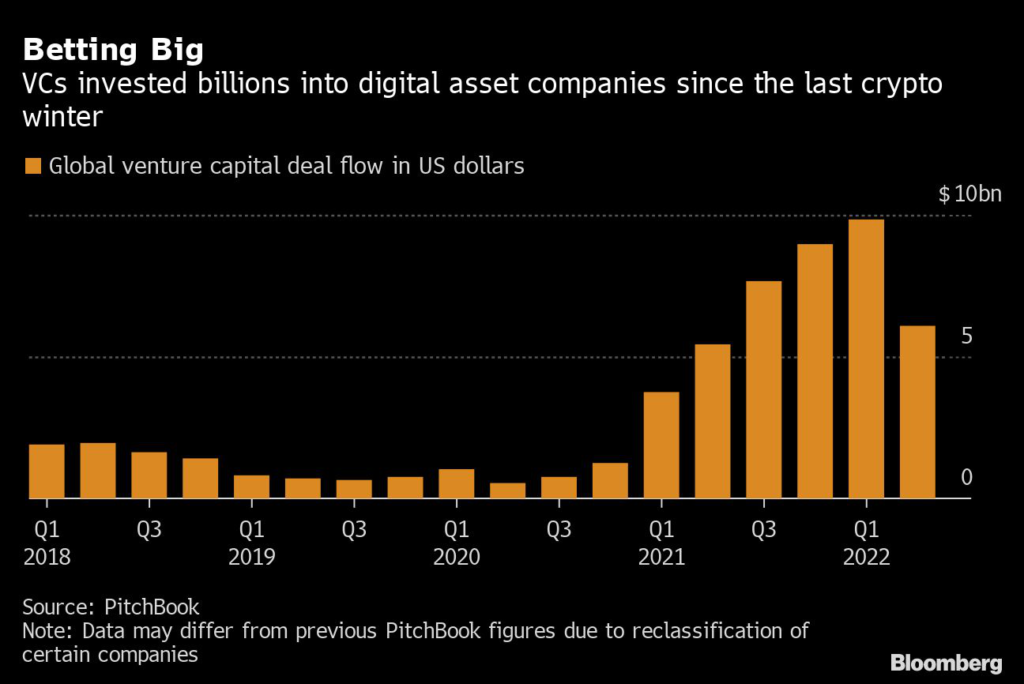
This time around, the funding landscape is vastly different. Many startups born out of the last freeze, such as nonfungible-token and gaming platform Dapper Labs, have sought out venture capital funding as a more traditional route to raising cash. Behemoths like Andreessen Horowitz and Sequoia Capital collectively plugged almost $43 billion into the sector since late 2020 when the last bull market began, according to data from PitchBook.This means that instead of relying on crypto wealth, some of its biggest players actually have vast reserves of hard currency stored to get them through the blizzard as they work on growing new blockchains or building decentralized media platforms. On the other hand, the recent end to the bull market means they’ve been spending that cash much faster than it’s been coming in. 

This month Coinbase Global Inc., Crypto.com, Gemini Trust and BlockFi Inc. are among the crypto companies to have announced swaths of layoffs, citing the general macroeconomic downturn for derailing their previously ever-expanding plans. Coinbase, which had hired about 1,200 people this year alone, is now laying off about as many employees in an 18% cut to its workforce.

But thanks to the heights crypto reached in the last boom, there’s still a great amount of earmarked funding sloshing around Silicon Valley’s coffers compared to previous seasons. Andreessen alum Katie Haun debuted her $1.5 billion crypto fund in March, while Coinbase co-founder Matt Huang launched a $2.5 billion vehicle in November. And while VCs might be more careful now about where they put their cash, it’s still got to be spent somewhere.

“None of these companies become mature for many years,” said Alston Zecha, partner at Eight Roads. “We’ve been spoiled over the last couple of years of seeing businesses get these amazing up-rounds after six or nine months. As the tide goes out, there’s going to be a lot of people who are found to be naked.”

More stories like this are available on bloomberg.com

©2022 Bloomberg L.P.

Meta Plunge Lures Value Buyers as Growth Funds Flee

(Bloomberg) — For years, investors valued Facebook’s parent company as if its growth would never falter. Now that it has, fund managers who buy cheap, out-of-favor stocks are finally getting a chance to own shares of Meta Platforms Inc. 

Stock pickers at value firms Dodge & Cox, First Eagle Investment Management and Artisan Partners bought millions of Meta shares this year. Index-tracking investors now will be buying too: After FTSE Russell’s annual overhaul of its equity benchmarks, Meta on Monday joined other former growth darlings Netflix Inc. and PayPal Holdings Inc. in the firm’s value indexes, which serve as the basis for billions of dollars of passive portfolios.

Meta began to attract bargain hunters after the company announced in February that Facebook’s user growth had stalled, sending the shares plunging. The stock last week reached its cheapest level ever, relative to earnings. For investors who believe the problems at Facebook are temporary, that’s a buying opportunity.  

“We own Meta and are very upbeat about it here,” said David Katz, chief investment officer at value firm Matrix Asset Advisors. “You want to find dynamic growth companies at value prices. Meta has a good outlook, but it is being priced as though it’s in a secular decline.”

Value funds look for stocks that are cheap relative to earnings or book value, often because of business setbacks that at least temporarily derail sales growth or profitability. Until recently Meta didn’t fit the bill: The stock traded for an average of 38 times estimated earnings in the first five years after its 2012 initial public offering as more people flocked to Facebook, Instagram and WhatsApp.

Shares of the company, which changed its name from Facebook to Meta in October, surged more than 780% from the IPO through the end of last year, handily beating the S&P 500 and the Nasdaq 100. Revenue rose 23-fold in that time. 

However, with user growth stalling, the company has lost half its value this year, trading now at 12 times earnings versus a multiple of 20 for the Nasdaq 100 and 16 for the S&P 500. 

Meta “is a deep value stock,” said Alex Umansky, a global equities portfolio manager at growth investor Baron Capital.

The company is getting hit on many fronts, including a “massive brain drain,” regulatory crackdowns and, most crucially, slowing user growth, because everyone who wants to be on Facebook, WhatsApp or Instagram already is, said Umansky, whose fund owned the stock from its 2012 debut until the end of last year. 

Brokerages estimate that the social media giant, which makes nearly all of its revenue from digital ads, will increase its revenue by 6.8% this year, the slowest pace ever, in part because of a slowing economy. They see growth picking up to around 15% in each of the next two years.

To be sure, the Facebook parent still has the best gross profit margin among megacap peers Apple Inc., Amazon.com Inc., Netflix and Alphabet Inc. If investors become more confident that growth will pick up again, and award the company the same valuation as the Nasdaq 100 based on estimated earnings for the next four quarters, the stock would trade at about $277, or 63% above Friday’s closing price of about $170.

“We’re with the market in being cautious in the short term but are extremely optimistic in the long run,” said Global X research analyst Tejas Dessai.

Tech Chart of the Day

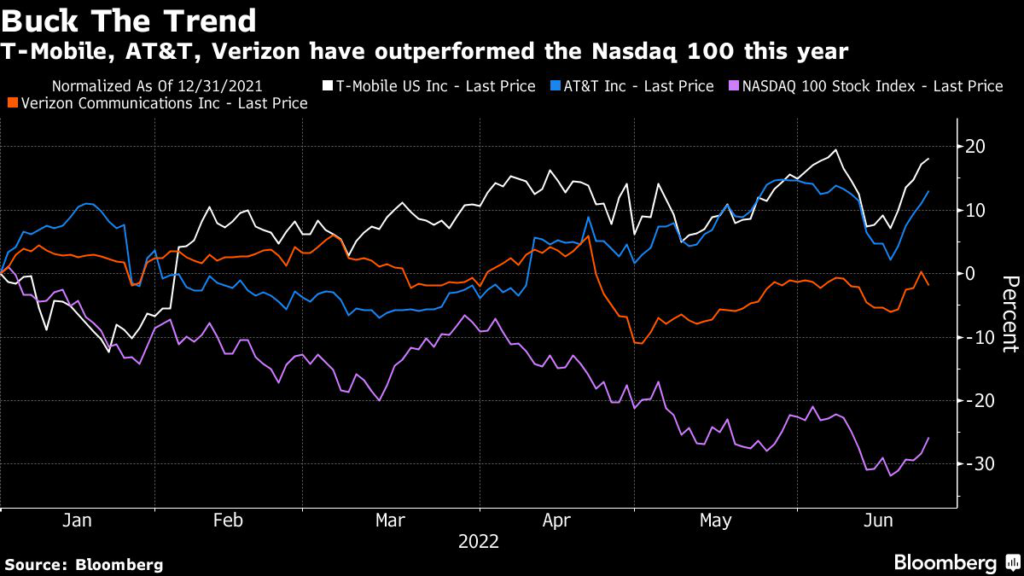
Telecommunications companies T-Mobile US Inc., AT&T Inc. and Verizon Communications Inc. have waded through multiple selloffs this year that have pounded the stock prices of technology companies big and small alike. Shares of T-Mobile are up 18%, AT&T has gained 13% and Verizon is down 2% this year. Meanwhile, the tech-heavy Nasdaq 100 index, which rallied to recoup some of its losses last week, is still down 26% for the year.  

Top Tech Stories

  • Prosus NV is planning to sell more of its $134 billion stake in Chinese internet giant Tencent Holdings Ltd. to finance a buyback program, reversing a pledge to hold onto the full shareholding.
  • Toshiba Corp. is expected to appoint representatives of its two most vocal activist shareholders to the board Tuesday, taking a step forward in corporate governance but potentially widening rifts between directors.
  • Apple Inc. is about to embark on one of the most ambitious periods of new products in its history—with the deluge coming between the fall of 2022 and first half of 2023. The new products will include four iPhone 14 models, three Apple Watch variations, several Macs with M2 and M3 chips, the company’s first mixed-reality headset, low-end and high-end iPads, updated AirPods Pro earbuds, a fresh HomePod and an upgraded Apple TV.
  • Taiwan’s industrial sector, including the world’s largest contract chipmaker, will be hit with the island’s first power price increase in four years as the state-owned utility grapples with soaring fuel costs.
  • Pakistani ride-sharing and delivery startup Bykea raised $10 million from its existing backers to tap rising demand for online services in the South Asian country.

(Updates stock move throughout.)

More stories like this are available on bloomberg.com

©2022 Bloomberg L.P.

Coinbase Slumps as Goldman Cuts to Sell After 75% Drop This Year

(Bloomberg) — Goldman Sachs Group Inc. analysts downgraded Coinbase Global Inc. to a sell rating as the crypto winter continues to take its toll on the struggling digital currency exchange.

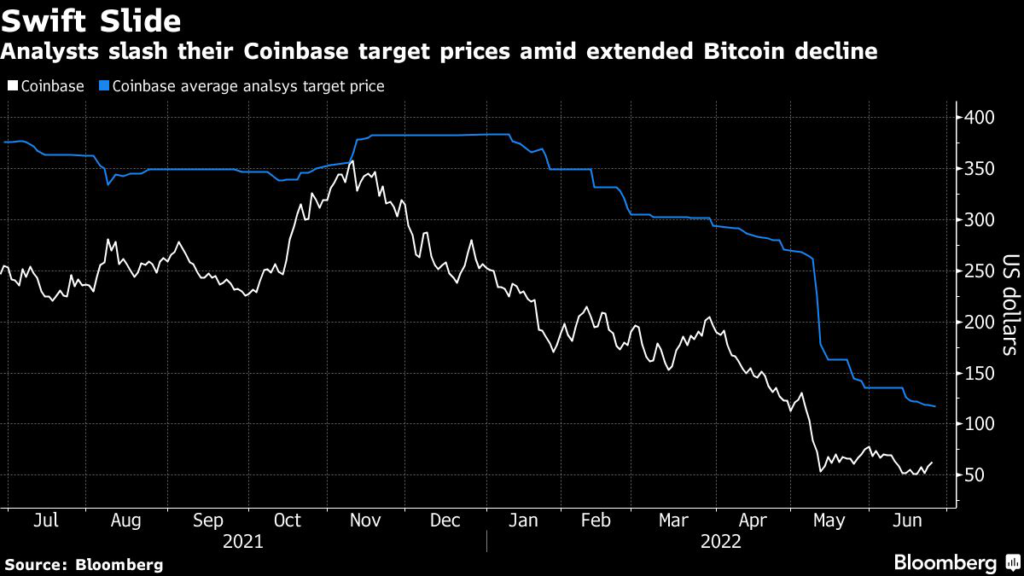
Shares of the firm slumped as much as 8.3% to $57.50 at the trading open on Monday, putting them on track to extend their 75% decline this year with Bitcoin now at less than half its value from just six months ago. Goldman analyst William Nance cited the “continued downdraft in crypto prices” and the broader drop in activity levels across the industry.

“We believe Coinbase will need to make substantial reductions in its cost base in order to stem the resulting cash burn as retail trading activity dries up,” Nance wrote in a note on Monday.

Coinbase quickly became the equities market poster child for the boom in digital currency prices last year with the largest US cryptocurrency exchange seeing its value surge above $75 billion as Bitcoin hit a record high. Since then, the company has been dogged by a laundry list of issues including declining revenues and trading volumes as the broader crypto market endures one of its worst selloffs in history. 

As of Friday’s close, the company is valued at less than $14 billion. Coinbase has 20 buy ratings, 6 holds and 5 sell recommendations, according to data compiled by Bloomberg. The average analyst share-price target sits at about $117, its lowest level on record.

Read more: Crypto Stocks Show Why They’re Among the Riskiest of Risk Assets

Increased competition from other firms has also weighed on the stock. Earlier this month, Binance.US revealed that it would be offering zero-fee trading for Bitcoin and said it had plans to also eliminate fees on other tokens in the future. Coinbase also announced this month that it would be laying off 18% of its workforce as it attempts to reel in operating expenses that ballooned to a record $1.7 billion in the first quarter.

“Coinbase faces a difficult choice between shareholder dilution and significant reductions in effective employee compensation, which could impact talent retention,” Nance said.

(Updates stock move in second paragraph.)

More stories like this are available on bloomberg.com

©2022 Bloomberg L.P.

Crypto Broker Voyager Issues Notice of Default to Three Arrows

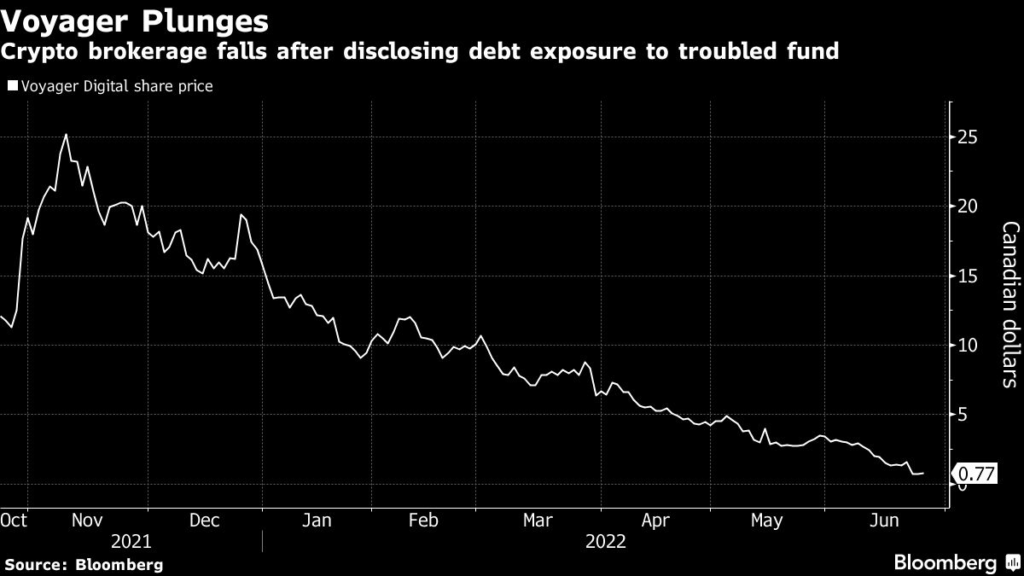
(Bloomberg) — Crypto broker Voyager Digital Ltd. said it has issued a notice of default to Three Arrows Capital, the troubled crypto hedge fund, on a loan worth roughly $675 million based on Bitcoin’s price on Monday.

Three Arrows has failed to make the required payments on its loan of 15,250 Bitcoin and $350 million USDC stablecoin, Voyager said in a statement. The company intends to pursue recovery and is in talks on legal remedies as it weighs options to meet customer demands. It has hired Moelis & Company as its financial adviser in the process.

New York-based Voyager, which offers crypto trading, staking — a way of earning rewards for holding certain cryptocurrencies — and yield products, is among the companies that have taken a hit in the fallout from Three Arrows Capital’s liquidity problems. Earlier this month, Voyager secured credit lines from the investment arm of Alameda Research LLC, the trading firm founded by Sam Bankman-Fried as concerns about Three Arrows and the crypto sector rattled the market.

Voyager said it has accessed $75 million of the credit line from Alameda and it may further dip into the funds as needed to facilitate customer orders and withdrawals. 

“We are working diligently and expeditiously to strengthen our balance sheet and pursuing options so we can continue to meet customer liquidity demands,” said Stephen Ehrlich, Voyager’s chief executive said in the statement.  

Three Arrows’ law firm, Solitaire LLP, didn’t immediately respond to a request for comment while Voyager declined to comment further.

Shares of Voyager, listed on the Toronto Stock Exchange, are down 95% this year. 

More stories like this are available on bloomberg.com

©2022 Bloomberg L.P.

Anti-Abortion Centers Find Pregnant Teens Online, Then Save Their Data

(Bloomberg) — When Lisa suspected she was pregnant, she did what other teenagers might: She Googled her options to terminate. One of the first links that popped up in the search engine was a clinic in Volusia, Florida, where the 19-year-old lived. The offer of a free pregnancy test tempted Lisa into booking an appointment and she drove there with her boyfriend, parking across the street. It was a small town, and she did not want to be recognized.

The consultation room was filled with posters depicting fetuses with speech bubbles, as if they were asking to be born. Lisa sobbed as one of the women running the clinic confirmed she was pregnant; they had refused to let her take a test home. Lisa needed to return for an ultrasound in four weeks to be certain, and then they could discuss options. But until then, they told her, she absolutely should not go to an abortion clinic. “Maybe you’ll miscarry and then you won’t have any problems,” the woman suggested.

As Lisa started to realize it wasn’t a medical facility, she became terrified for her privacy. “This information can’t go anywhere, right?” she begged a receptionist on her way out the door. “No one is gonna know that I was here?” 

The answer wasn’t reassuring. “I remember her saying: ‘Well, honey, this is what happens when you have sex.’”

Lisa, who asked not to be identified by her real name, did manage to get an abortion from a different provider. But she also ended up in a database. The center continued to call her every few weeks to ask for an update on the baby and offer parenting classes. And as women like Lisa around the country are led unsuspectingly into anti-abortion centers, known as “crisis pregnancy centers,” academics and advocates for reproductive rights are concerned about what happens to this potentially incriminating data — especially after abortion becomes illegal in many states following Friday’s Roe v. Wade ruling.

Meanwhile, the crisis pregnancy nonprofits are sharpening their digital skills, investing their donations and state funding into outreach on social media, targeting teens and young adults. The centers have poured money into advertising on search and social media products such as TikTok, Instagram and Snapchat. And some of them have begun using these platforms to spread not merely marketing messages but also what physicians and other health care professionals say is harmful misinformation.

On Snapchat, for instance, the centers appear to have been using the app to gain exposure to teenagers and women in their early 20s, Snapchat’s core audience. When searching in California, each of the nine businesses listed on Snap Maps under “pregnancy tests” are anti-abortion clinics. That’s also true for all all but one of the 10 listed when searching for “pregnancy.” Eleven of the 24 locations listed under “abortion” on Snap Maps in the same location were anti-abortion clinics. Three offered the so-called abortion reversal pill, which is considered dangerous by the American College of Obstetricians and Gynecologists, due to risk of hemorrhaging.

Snapchat removed dozens of anti-abortion clinics from its Snap Map feature after Bloomberg News raised questions.

The crisis pregnancy centers, which often also offer services such as adoption planning, have long tried to be listed alongside legitimate reproductive health providers in order to reach an audience. Google, for instance, now requires providers to note whether businesses are accredited to perform abortions or not, but the deceptive centers still remain en masse in states where women may no longer be able to find legitimate treatment.

Choose Life Marketing, a digital marketing company that works with anti-abortion clinics in the US and Ireland, said in training material posted to its website that Snapchat is a great place to advertise to the younger generation. It gives tips on how to include imagery with young people wearing baggy clothing or hairstyles that reflect Gen Z. 

“Like Facebook and Instagram, it would accelerate the word of mouth that has brought clients through your doors for many years,” the Choose Life Marketing site said. Snapchat advertisements in particular “were effective at getting clients to directly respond to the ad and call pregnancy centers for appointments.”

Anti-abortion organizations have gotten more savvy about tracking their visitors and collecting information that isn’t protected by medical privacy laws. Tara Murtha, communications director at Women’s Law Project, said that if women in states where abortions are restricted visit a center and then fail to have a baby, there’s a record that could be passed into the hands of “overzealous prosecutors,” examples of which have almost tripled in the last 12 years.

“There’s going to be policing and surveillance of pregnant people and, if there’s an adverse outcome other than a full term, healthy baby, that could invite investigation into what that person might have done to cause that,” Murtha said.

Heartbeat International, an Ohio-based organization that runs thousands of anti-abortion clinics around the country and globally, offers a software called Next Level Center Management Solution. It costs $100 a month to hold more than 20,000 names of women who visit a center. It helps centers keep in touch over emails and phone calls, or track donations to the center. It offers integration with QuickBooks, accounting software from Intuit, which did not comment. 

“The data your organization collects needs to work not just for you, but for the rest of the pregnancy help movement,” the website states. “As big data revolutionizes industries around the globe, now is the time to do the same for life-affirming work of pregnancy help. As we pool together what we’ve learned separately, we can begin to wield game-changing predictive and prescriptive analytics that lead to stronger outcomes.”

The National Institute of Family and Life Advocates, a charity that provides training and legal advice to more than 1,000 anti-abortion clinics across the US, was listed as a Choose Life Marketing partner on the advertising firm’s website, according to a screenshot that Jack Dobkin, a researcher at rights nonprofit Equity Forward, sent to Bloomberg News. The site removed the reference after Dobkin published a report revealing the link in April. Choose Life Marketing and NIFLA did not respond to a request for comment. 

“Their goal is to collect and store ultrasound photos, income, history of possible abuse in relationships, history of addictions, history of drug use, your STI history, your medical history,” Murtha said. “And in many cases this is shared in a national database.”

Anti-abortion clinics often use medical misinformation to draw women in, Dobkin said. One of the clinics appearing on Snap Map claimed, inaccurately, that it was “vital for you to have an ultrasound before you have an abortion,” a common tactic used to try to persuade women to abandon plans to terminate a pregnancy.

Anti-abortion centers used graphic descriptions to suggest abortions were unsafe and several overstated the risks of the procedure. They included graphic descriptions of “scraping,” and claimed that many women bleed to death after a surgical abortion. Abortions are overwhelmingly consided safe by medical professionals: A study published in the Lancet last November found that 99% of patients who took the first abortion pill, and 94% of those who took both, experienced a successful abortion with no medical complications.

Another center claimed that abortion clinics were overrun and local wait times were so long it that it would be in the patient’s best interest to schedule a same-day appointment at its office instead. There are roughly three times as many anti-abortion centers as there are abortion clinics in the US, allowing these clinics to capitalize on hurdles created by legal restrictions at the state level. This could narrow the amount of time a woman has to plan a safe abortion.

A Snap Inc. spokeswoman said it had no control over the websites that listings on Snapchat sent users to, but said the company felt a “deep responsibility to ensure content on its platform is accurate” and that it encouraged users to report concerning content. Snap allows abortion-related advertising but not medical misinformation or disinformation, she said.

Some of the anti-abortion clinics that appeared under “abortion” on Snap Map offered the so-called abortion reversal pill. A “reversal” is a dangerous yet increasingly common scenario where a woman takes a high dose of the hormone progesterone after taking the first of two abortion pills.

Despite social media companies’ attempts to remove medical misinformation, abortion reversal advertising has continued. Facebook said it would remove abortion reversal advertising in September 2021 but it has published 19 reversal campaigns worth $65,591 in revenue between September 2021 and May 2022, according to research that the Center for Countering Digital Hate shared with Bloomberg News. 

Since 2020, Facebook has taken in $202,258 in advertising revenue for reversal ads, which have been seen 23 million times. Two additional advertisement campaigns for reversal procedures appeared on Facebook on May 16, but Bloomberg News was unable to see how many times they had been viewed or the advertising revenue they generated in Facebook’s advertising library. Facebook did not comment but a spokesman said that it had removed one of the advertisements for violating its policy against promoting prescription medication. 

Research suggests that most women who visit these clinics with the intention of getting an abortion will go on to do so. Still, many of the women who visit are not even pregnant and want to use the free services the clinics offer, which come with tie-ins like signing up to a program and handing over personal information. This has led academics and researchers to believe they have an alternative primary goal than just convincing pregnant women not to have an abortion.

“They receive funding under their alternative to abortion programs, but according to their own data, they are not successful at that,” said Murtha. “So what are they successful at? Siphoning public money into the anti-abortion industry.” In 2021, 13 states had state-backed funding for anti-abortion clinics for offering maternal services, according to Equity Forward. 

Elisa Wells, a co-founder and co-director of the abortion-pill advocacy group Plan C, said anti-abortion clinics are stealing her businesses’ text to appear higher in Google searches and confuse patients. Following an interview with Wells, a search for a “Plan C” on Google surfaced an ad that looked like it came from the organization, but was the work of a Memphis-based anti-abortion group that alleged there were risks involved with taking the abortion pill.

“The fact that these algorithms and holds or blockages of ads are making it harder to find that information is really something that’s concerning to us,” Wells said.

Google said that it now requires clinics that do not offer abortions to make that clear and that it was “exploring ways to make these disclosures more visible.”

To counter the increased spending by anti-abortion activists, abortion provider Planned Parenthood is putting more money into social media, too. It spent an estimated $178,000 on Snap advertising this year in comparison with $86,000 in 2021, a company spokesperson said, and nearly $2 million on advertising across Facebook and Instagram since May 3, a day after the draft of the proposal to overturn Roe v. Wade was leaked. That accounts for around 20% of Planned Parenthood’s overall spending on the platform since 2018, when Facebook’s owner Meta Platforms Inc. began publishing political advertising figures.  

“There is overwhelming support for abortion access in this country, but our reproductive rights are under attack like never before from politicians who want to control our bodies and our futures,” said Sam Lau, Senior Director of Advocacy Communications at Planned Parenthood. “That’s why we’re leveraging the power of digital platforms and running ads.”

More stories like this are available on bloomberg.com

©2022 Bloomberg L.P.

China Stocks Approach Bull Market as Investors Catch Up on Gains

(Bloomberg) — Chinese stocks extended gains into a fifth week, bringing them close to a bull market, as investors turned increasingly upbeat amid eased pandemic curbs in Shanghai. Tech shares also rallied in Hong Kong to the highest in nearly four months.

The recent rebound in Chinese equities, which started in April while stocks elsewhere were still selling off, is gaining momentum thanks to an improving economic outlook as well as persistent monetary and fiscal stimulus. President Xi Jinping’s planned visit to Hong Kong is boosting stocks that would benefit from easing pandemic restrictions such as Macau casinos.

The benchmark CSI 300 Index gained 1.1%, adding 4% in three sessions, led by consumer shares, as Shanghai’s leader declared victory in defending the financial hub against Covid and will this week allow residents to dine in restaurants in some areas deemed lower risk.

Drinks maker Eastroc Beverage Group Co. and food supplier Yihai Kerry Arawana Holdings Co. advanced at least 7.5%. The CSI 300 has now rebounded more than 17% from its April low. 

Adding to a growing number of market participants turning more positive on Chinese shares, abrdn plc’s regional Chairman Hugh Young said they look to be the best home for fresh money in Asia amid a tough investment environment.

“We are inclined to put more money into China again, depends on the portfolio,” Young said in an interview on Monday, adding that the firm underweights the country’s shares in portfolios. “It’s very hard to be super bullish about anything at the moment” but valuations in China are reasonable and the investing landscape could improve.

Christian Nolting, Deutsche Bank AG’s private bank global chief investment officer, said last week he was considering turning overweight on Chinese stocks and Morgan Stanley, Bank of America and Jefferies Financial Group all ramped up bullish commentary this month.

Redmond Wong, a market strategist at Saxo Capital Markets, said there was “a fear-of-missing-out sentiment out there.”

Hong Kong’s Hang Seng Tech Index, which tracks Chinese tech stocks listed in the city, jumped nearly 5%, making for a gain of 11% in three days and now up 46% from their March 15 low. BYD Electronic International Co. and Xiaomi Corp., both added at least 12%. Alibaba Group Holding Ltd. advanced roughly 4%.

US-listed Chinese internet stocks also gained in premarket trading, with JD.com Inc. leading the pack after tech investor Prosus N.V. disposed of its stake in the e-commerce firm. The Nasdaq Golden Dragon China Index is on track to rise for a third day and has surged 58% from its March low.

Overseas investors purchased 7.3 billion yuan ($1.1 billion) of onshore stocks via the Hong Kong trading link Monday for a third straight session of inflows, while turnover in Chinese equities topped the 1 trillion yuan mark for the 14th session this month. Quarter-end rebalancing may also have played a role in the recent buying into Chinese stocks.

“When we think about valuation and we think about where the direction of the economy goes next in an area like China, that is one of the areas where from a longer term perspective we see some opportunities,” Meera Pandit, JPMorgan Asset Management vice president and global market strategist said on Bloomberg Radio.

(Adds trading of US-listed Chinese stocks in tenth paragraph.)

More stories like this are available on bloomberg.com

©2022 Bloomberg L.P.

Venture Funding Set to Hit Lowest Level Since 2020

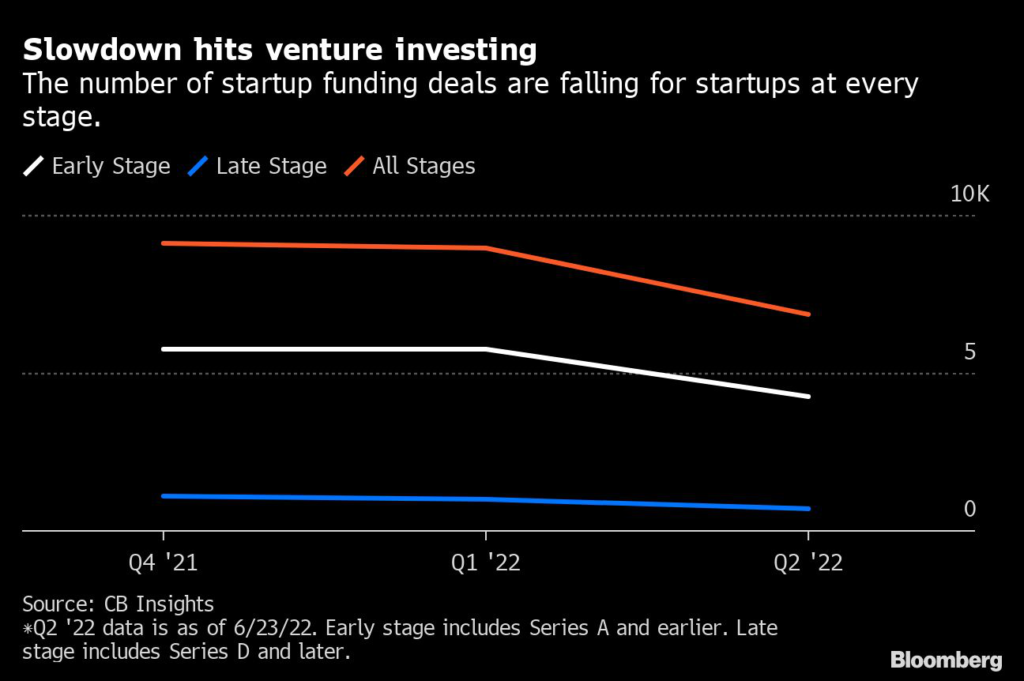
(Bloomberg) — Venture capital-backed startups raised far fewer rounds of funding during the past three months than they did during the more ebullient days of late last year and early this year, according to new data from analytics firm CB Insights.

Deal activity across the globe dropped 23% between the first quarter and second quarter of this year, the firm found, using data for the second quarter through June 23. That’s a stark contrast to the previous quarter, where the deal count dropped only 1.4%—and an indication that the roiling of the crypto and public markets are affecting private companies.

Investors are not just writing fewer checks but also smaller ones. The total funding amount going to startups for the current quarter to date dropped 27% compared to the first quarter. Those numbers are likely to change before the second quarter is officially over in a week, but the drop appears to be more severe than the 19% CB Insights had predicted just a month ago. Late-stage companies are getting squeezed particularly hard: Funding in Series D rounds or beyond dropped 43%. 

In May, venture firms such as Sequoia Capital and Lightspeed Venture Partners warned their portfolio companies that they should prepare for a significant throttling of the money that, for a decade, had flowed at increasing volumes. Sequoia’s investors argued that a drawn-out recession lies ahead and called it a “crucible moment”—a prediction reminiscent to the firm’s “RIP Good Times” memo in 2008. Sequoia told founders to “do the cut exercise,” meaning to look at their spending and find places where they could lower expenses on short notice if needed.

The tech investing climate has changed radically in recent months. After a short period of uncertainty at the beginning of the Covid-19 pandemic, startup investing activity shot upward, fueled by a newly remote world that needed to connect digitally rather than in person. That frenzy led to unprecedented levels of money flowing into startups in 2021. By early 2022, so many companies were raising at valuations of $1 billion or more that a new “unicorn” company was minted about twice a day. Over the past three months, however, the number of deals and the total funding raised have dropped to their lowest levels since late 2020.

More stories like this are available on bloomberg.com

©2022 Bloomberg L.P.
Close Bitnami banner
Bitnami