Bloomberg

Ecuador to Stop Pumping Oil in 48 Hours, Energy Ministry Warns

(Bloomberg) — Ecuador’s oil production is likely to halt completely within 48 hours if road blocks and vandalizing of oil wells continue, the Energy Ministry said in an emailed statement.

Anti-government protests launched June 13 risk shutting down the former OPEC member’s oil industry “due to the acts of vandalism, takeover of wells and closing of roads, supplies and diesel necessary to maintain operations has not been possible.”

As of Sunday, production has dropped more than 50% below the average 520,000 barrels a day Ecuador extracted from its Amazon territory before the protests began. A total 1,176 oil wells have been forced to stop pumping.

Led by umbrella indigenous organization CONAIE, demonstrators are demanding higher fuel subsidies, a moratorium on new oil and mining projects, and a slowdown of moves to privatize state assets amid broader criticism of conservative President Guillermo Lasso’s plan to overhaul the economy with support from the International Monetary Fund.

Ecuador had preventively already declared force majeure on oil contracts to avoid penalties from being unable to ship scheduled deliveries. It’s the second force majeure since Dec. 12 after erosion threatened to snap its two oil pipelines. Oil production dipped to a low of 101,700 barrels during that event, the lowest since at least January 2010. 

The problems with production have cut into the financial windfall the current high oil prices are providing the administration with. 

Despite domestic and international calls on Sunday, including from Pope Francis, for the government to negotiate with indigenous leaders, CONAIE President Leonidas Iza has refused offers to discuss the organization’s demands. 

Later Sunday, lawmakers are scheduled to vote on an opposition attempt to impeach Lasso. According to statements from several political parties, this is likely to fail.

More stories like this are available on bloomberg.com

©2022 Bloomberg L.P.

How US Companies Are Supporting Workers on Abortion

(Bloomberg) — The US Supreme Court’s ruling overturning the constitutional right to abortion quickly drew responses from the corporate world, with dozens of major employers committing to cover travel expenses for employees in states where the medical procedure will be banned.

Others had already announced the coverage policy when a draft of the decision leaked earlier this year. 

Read More: Big employers to cover abortion travel after Roe is overturned

Twenty-six states either will or are likely to ban almost all abortions, according to the Guttmacher Institute, a research organization that backs abortion rights. Thirteen have so-called trigger laws designed to automatically outlaw abortion if Roe is overturned. Such laws have already taken effect in Missouri and Texas.

That may put further pressure on companies to find ways for their employees to receive the reproductive care services they’ve been entitled to for half a century.

Here’s how some of the nation’s biggest corporations are currently helping workers:

Activision Blizzard

The video game publisher expanded medical travel benefits in June to cover reproductive health, gender-affirming treatment, transplant care and other services not available in the home state of a covered employee or dependent.

Advanced Micro Devices

The chipmaker said all employees and dependents participating in the company’s US health-care plans “will receive travel and lodging reimbursement for covered medical services not able to be performed in their state of residence.”

Alaska Airlines

The airline told employees June 24 it will reimburse travel for “certain medical procedures and treatments if they are not available where you live.” 

Alnylam

The biotech company is working with its insurer to add a transportation benefit for covered individuals who need to travel outside their home state, according to an internal memo on June 24 from Kelley Boucher, chief human resources officer. In the meantime, the company will cover all travel expenses outside the plan.

Amalgamated Bank 

The Amalgamated Financial Corp.-owned bank on May 3, announced a new initiative in which it would reimburse employees and dependents for travel-related costs should they need to leave their home state for reproductive health care, as well as up to five days of childcare expenses incurred during the travel time. In a statement, Chief Executive Officer Priscilla Sims Brown said the policy would help employees “make personal and confidential decisions.”

Amazon

Amazon on May 2 told employees in the US that it would cover up to $4,000 in travel expenses related to medical procedures including abortion services. The policy is retroactive to Jan. 1 for employees and their dependents covered by two company-offered health plans, Reuters reported, and covers services rendered if care is not possible to be offered virtually or available within 100 miles of an employee’s home. Such a distance is typically referred to as an abortion desert; as of 2017, there were 27 cities with populations over 100,000 that qualified for such a title.

American Express

American Express said its US health plans already cover abortions and provide for travel expenses if needed, according to an emailed statement.

Apple

The company has said it will cover the cost of abortions and travel for treatment for its retail workers.

AT&T

The telecommunications company, one of the largest employers in Texas, said it is reimbursing travel expenses for medical procedures after the state banned abortions on June 24. The policy applies to medical services that employees can’t access within 100 miles of where they live, Dallas-based AT&T said in a statement that didn’t specifically mention abortion. “The health of our employees and their families is important to our company,” the telecommunications provider said.

Atlassian

“Starting today, US employees living in states that have restricted or banned abortions will be offered reimbursement for travel and accommodations for themselves and a companion should they seek care outside their state,” the Australian software company said June 24. Atlassian has offices in Texas and Virginia.

Bank of America

Bank of America, in a memo to employees, said it’s expanding the list of medical treatments eligible for travel expense reimbursement to services including reproductive health care. 

“This step is fully consistent with our long-term, well-established approach to ensuring our benefits programs align and respond to the broad-ranging health-care needs of our employees and their families,” Charlotte, North Carolina-based Bank of America said in the memo.

Biogen

A spokesperson for the biotech firm said June 24 the company would be enhancing its health benefit to include a reimbursement for travel expenses for US employees to access health-care services not available within a 100 mile radius. That would include access to abortion, according to the Cambridge, Massachusetts-based company.

Bloomberg 

Bloomberg LP, the parent of Bloomberg News, covers out-of-state travel for medical services, including abortion, for which there is no licensed provider in employees’ state of residence. The reimbursements apply to all employees and their dependents covered under the company’s medical plan.

Cigna

The company will reimburse employees who need to travel for abortion care, a company spokesperson said in an email. The Bloomfield, Connecticut-based health conglomerate has employees in every state and already covers travel for some medical needs. 

Citigroup

The New-York-based bank, which is headed by its first female chief executive officer, Jane Fraser, and has some 8,500 employees in Texas alone, pledged to cover travel costs for employees seeking abortions. A source said the costs covered could include airfares and lodging if necessary.

CVS Health

The pharmacy chain will continue to make out-of-state care accessible for employees, spokesman Mike DeAngelis said on June 24. The coverage includes abortion and other services, he said. 

Deutsche Bank

The German financial firm will begin to cover travel costs for US staff seeking abortions up to a defined distance, including across state borders, according to a person familiar with the matter, who asked not to be identified discussing private information. 

Dick’s Sporting Goods

Employees who live in states that restrict access to abortion can be reimbursed up to $4,000 in travel expenses to go to the nearest place they can get care, CEO Lauren Hobart and Executive Chairman Ed Stack said in a joint letter to staff on June 24. The benefit includes spouses and dependents on the company’s medical plan, along with one person traveling in support.

Discord

A Discord spokesperson said the company would cover up to $5,000 annually in reimbursements for employees and dependents. The Dobbs ruling “has taken away the ability for millions of people, including members of our team, to access critical health services,” the spokesperson said.

Disney

Walt Disney Co., which has been mired in disputes with conservative leaders over its support for LGBTQ people, said on June 24 it will cover the cost of travel for employees who can’t access family planning services such as abortion.

EBay

Employees and covered beneficiaries can be reimbursed for travel in the US for treatment that’s locally unavailable and can’t be handled through telehealth, effective June 8, the company said on June 24.

Electronic Arts

EA, the video game publisher behind Fifa 22, Apex Legends and The Sims, published a statement to employees, telling them that their health and well-being are a top priority. Working through the company’s health-care provider, Cigna, EA said it will “soon offer expanded travel health benefits, for eligible US employees and their eligible dependents. Our aim is to provide the support and services that empower you and your eligible dependents to get the care needed to be the best, most authentic version of yourself at work and in other areas of your life.”

EA already had a location change policy in place for employees who want to consider moving to a different location.

Estee Lauder

In preparation for the Supreme Court ruling, the cosmetics company told employees in mid-June that travel and lodging would now be covered for reproductive health care in the US when not available locally, according to a spokesperson. The coverage will go into effect Aug. 1 and includes employees and their dependents enrolled in the company’s health plan.

Expedia

The travel booking company’s benefits plan includes travel for health care not provided in an employee’s state, a spokesperson said June 24.

Foot Locker

US employees covered by the company’s health plan can be reimbursed for travel for medical procedures, including family planning, according to an internal memo seen by Bloomberg. 

Gilead Sciences

The biopharmaceutical company ensured that its medical plan covers travel and lodging for workers who need to travel out of state in the US for care related to women’s reproductive health. In addition, the Gilead Foundation is donating $1.5 million to organizations focused on reproductive health services and doubling any contributions by workers up to $15,000.

Goldman Sachs

New York-based Goldman said in a memo to its employees that it will extend its “health-care travel reimbursement policies to include all medical procedures, treatments and evaluations, including abortion services and gender-affirming care where a provider is not available in proximity to where our people live.”

Google

Google is allowing its employees to apply for relocation “without justification” in light of the Supreme Court ruling overturning Roe v. Wade, according to a memo seen by Bloomberg News from Google’s Chief People Officer Fiona Cicconi. Managers will be made aware of the situation, she said.

Cicconi added in her note that Google’s US benefits plan and health insurance covers out-of-state medical procedures that are not available where an employee lives and works.

Gucci 

The Kering-owned fashion house said in a statement that it would reimburse travel expenses for US employees “who need access to health care not available in their home state.” The statement also said that the company “remains steadfast in its belief that access to reproductive health care is a fundamental human right.” 

HP

In a statement to the Los Angeles Times, the company said its employee health plan covers some abortion-related costs, including care and some lodging should employees need to travel out of state. 

Intel

The top maker of personal-computer processors said it “respects the rights and privacy of our employees to choose what best meets their health needs” and that it will continue to provide resources “for those who need to travel for safe, timely health care.”

JPMorgan Chase

The biggest US bank plans to pay for employees to travel to another state if needed to obtain a legal abortion. The benefit will go into effect July 1, according to a frequently-asked-questions page linked to a memo to all US employees in June. 

Kroger

The supermarket company offers travel benefits up to $4,000 for access to medical treatments including abortion and fertility, for people who are insured on company plans. The company clarified the coverage for employees on June 14, according to a statement on June 24.

Levi’s

The jeans maker said any employee who opts into their health-care plans will be eligible for reimbursement of travel costs for abortions, including part-time workers.Live Nation Entertainment

The concert promoter said it would cover travel expenses for employees “who need access to women’s healthcare services outside their home state.” The company said it would also provide bail expenses for staff arrested for protesting peacefully. 

Lyft and Uber

Describing the Texas abortion law as an “attack on women’s access to health care,” Lyft Inc. Chief Executive Officer Logan Green said last week that the ride-hailing company is working with health providers to cover the cost of rides for women in Texas and Oklahoma—which outlawed abortion last month—who seek out of state care. Both Lyft and Uber have also pledged to pay legal fees for any of their drivers sued under anti-abortion laws for helping women seek out the procedure.

Macy’s

The department store-chain said it will expand its current medical coverage options and paid time off benefits to provide travel reimbursement “for colleagues to receive the medical care needed,” according to a post on the company’s LinkedIn.

Mastercard

The credit card company will as of June 1 reimburse employees who need to travel outside of their home state to receive an abortion, per a memo to staff on May 18. The update follows existing policies to cover out-of-state travel for organ transplants and other surgery, as well as policies that cover other aspects of reproductive health-care and family planning, such as vasectomies and birth control.

Match

The Dallas-based parent company of dating apps including Tinder and OkCupid set up a fund to support staff after Texas’s near-total abortion ban came into effect in late 2021. Chief Executive Officer Shar Dubey described the ban as “so regressive to the cause of women’s rights that I felt compelled to speak publicly about my personal views.” The fund aims to cover the costs for employees and dependents who need to seek care outside of Texas. Rival dating app Bumble has set up a similar fund.

Meta Platforms

A spokesperson for the parent of Facebook and Instagram said June 24 the company was working to cover travel-related costs for employees who cannot access reproductive health-care and other services in their home state. “We intend to offer travel expense reimbursements, to the extent permitted by law,” the spokesperson said. Some anti-abortion laws in states like Oklahoma and Texas include bounty clauses that target people who assist someone receive abortion care, whether or not they knew their actions did so.

Microsoft 

The technology company on May 9 said that it would expand its health-care reimbursement program to include travel if an employee could not access health care because it was not available nearby. The company said the move would “support employees and their enrolled dependents in accessing critical health care — which already includes services like abortion and gender-affirming care — regardless of where they live across the US.”

Netflix

The streaming video provider said June 24 it offers financial support for employees that need to access health-care outside their home state, mostly through their insurance plans.

Nike

The maker of sneakers and athletic gear covers travel and lodging for “situations where services are not available close to home,” according to a June 24 statement.

OpenSea

The company, which runs the largest marketplace for nonfungible tokens, told US employees it will cover travel expenses for them or their dependents to receive “critical health care.” OpenSea also created a channel on its official Slack network called #roe-discussion to encourage employees coping with the news to support one another, according to a staff memo seen by Bloomberg.

Patagonia

The outdoors outfitter covers the cost of medical insurance for all workers, including part-time employees. The plans include abortion care and travel, lodging and food where that care is restricted, the company said June 24. In addition, the company is offering training and bail for people who peacefully protest for reproductive justice. 

PayPal

In a memo to employees seen by Bloomberg, Chief Human Resources Officer Kausik Rajgopal said the company would reimburse employees who live in states that restrict their access to reproductive health care such as abortion services, and need to travel to obtain treatment. “As a PayPal community, we’ll continue to work to provide equitable access to health care benefits for our employees,” Rajgopal said.

Pinterest

The company has expanded its coverage benefits to include abortion-related travel costs, LeMia Jenkins, chief communications officer, said on June 24. “We believe access to health care is a fundamental right,” she said, adding that the company also reimburses travel if employees or their dependents need to travel to receive gender-affirming care.

REI

The outdoor gear co-op said it would provide travel and lodging reimbursement to employees who live in restricted states and have to travel more than 100 miles for reproductive care. CEO Eric Artz told staff in a memo that REI is “committed to protecting your right to choose and access a safe and legal abortion.”

Rivian Automotive

The carmaker said it would provide up to $5,000 in travel expenses for employees and covered dependents “to protect our employees’ access to reproductive care,” according to an internal memo seen by Bloomberg. 

Robinhood

The maker of a popular stock-trading app said it will cover travel expenses of as much as $5,000 for employees or their dependents to secure reproductive care.

Salesforce

Chief Executive Officer Marc Benioff told employees in September that the company would help any employees living in Texas to relocate out of the state if they wished to move in response to strict abortion laws.

Snap

Snapchat parent company Snap Inc. told employees on June 24 that it would reimburse them up to $10,000 for travel and lodging costs related to medical procedures that are banned in their state of residence, including abortions. The coverage extends to employee family members that are covered by company-provided insurance. “Our goal is to ensure that all Snap team members are able to get access to the medical care they need, and when they need it,” a spokesperson said in a statement.

Starbucks

The company on May 16 said that it would reimburse travel expenses for employees and their dependents should they need to travel more than 100 miles to receive an abortion or access gender-affirming care.  A date for implementation wasn’t immediately noted; the memo from Partner Resources executive-vice president Sara Kelly said it would be “coming soon.”

“Regardless of what the Supreme Court ends up deciding, we will always ensure our partners have access to quality health care,” Kelly said in a statement.

T-Mobile US

The wireless carrier expanded its health coverage for those needing to travel for health care in May, after a draft of the court’s majority opinion was leaked to the press. 

Tesla 

The Austin, Texas-based carmaker in its 2021 global impact report said its expanded  health-care policies included covering travel and hotel costs for employees who had to travel out-of-state for health care. 

TikTok

The short-form video platform on June 24 said it would update its employee benefits to reflect the needs of employees post-Roe. “We are committed to ensuring our employees have access to a wide range of medical benefits, including family and reproductive care, no matter where they live,” a spokesperson said. “We are finalizing updates to our benefits to continue to provide our employees access to the medical benefits they need.”

WPP

The advertising company expanded its employee benefits to cover travel for US-based employees’ health-care needs including abortion, per an internal memo. “We don’t know the full details or impact of these potential changes in reproductive rights yet, but we do know we want our people to have the same health coverage regardless of where they live,” Chief Executive Officer Mark Read wrote.

WW International

The weight-loss company will support travel needed to access reproductive care, Chief Executive Officer Sima Sistani said in a video message on Instagram. “But even that feels problematic, because we are contributing to the inequities in our country — contributing to the inequities in the access to health care,’’ she said. “Access to health care for our bodies should be a right and when the private sector needs to step up to make up the gap of public policy, that’s a problem.’’

Yelp

With more than 4,000 workers in the US, Yelp will next month roll out a new travel benefit which “allows our US employees and their dependents to have equitable access to reproductive care, regardless of where they live.” A person familiar with the matter said the benefit, announced before the draft ruling was leaked, would be offered through the company’s insurance provider.

Zillow

The real estate service updated its plan earlier in June to reimburse up to $7,500 each time that “significant travel is necessary to access health care, including reproductive services or gender-affirming care,” the company said June 24. “Our health benefits cover a wide range of reproductive health care services — including abortion, whether patient-elected, medically necessary, or both.”

Zoom 

The videoconferencing company’s US benefits already included reproductive care coverage and coverage of travel more than 100 miles from home for medical services, according to an internal memo on June 24 from Matthew Saxon, Zoom’s chief people officer.

(Updates to add items on more companies.)

More stories like this are available on bloomberg.com

©2022 Bloomberg L.P.

Chinese Firms Are Dominating Key Parts of Hong Kong’s Economy

(Bloomberg) — Half way to the point when Hong Kong will officially be enveloped by China, Beijing is not just calling the shots politically, but in vast swathes of the city’s $344 billion economy.

From the stock exchange to brokerages, construction projects to the retail sector, Chinese state-controlled firms are increasingly dominating, taking market share away from the local tycoons and British trading houses that thrived under the final decades of UK rule.

Those behind the growing Chinese influence view Hong Kong’s economy as stagnant, slow to embrace the technology-driven, new economy industries that have been catalysts for growth on the mainland. Chinese enterprises have been handed more political power in the city, including a recent revamp of the electoral system that reduced the influence of local businesspeople and added greater representation for state-backed companies.

“Hong Kong has come to a crucial crossroads,” said Simon Lee, a Hong Kong lawmaker and Greater Bay Area chief strategist for China Resources Group, a state-owned conglomerate. “With all these challenges, we need to make sure different voices are included in our policy making and mainland Chinese enterprises need to take greater responsibility in our society, economy and politics.”

While the mainland economy now faces its own host of challenges, and substantial political resistance to Beijing’s overpowering influence remains — especially among local youth who don’t identify as Chinese — the mainland-ization of Hong Kong’s business life increasingly looks irreversible.

We take a look at how it’s playing out, sector by sector:

Finance

Back in 1997, local brokers such as Peregrine and Somerley Capital, along with foreign banks including Morgan Stanley ruled the city’s finance industry. Fast forward to this year, and China International Capital Corp., China Merchants Bank Co. and Citic Securities Co. dominate listings. Almost 100 local brokers have closed over the past four years, battered by competition. 

But more worrying for Hong Kong’s status as a gateway to China is that Chinese firms are choosing to raise capital at home, rather than in the city. Shanghai and Shenzhen have seen $37 billion in initial public offerings this year, compared with just $2.4 billion in Hong Kong.  

In 1993, Tsingtao Brewery Co. became the first Chinese company to list in Hong Kong, and by 1999 that number had grown to 44, according to the Hong Kong Exchanges & Clearing Ltd. Now the city’s exchange hosts 1,370 mainland firms, accounting for almost 80% of the market’s value. 

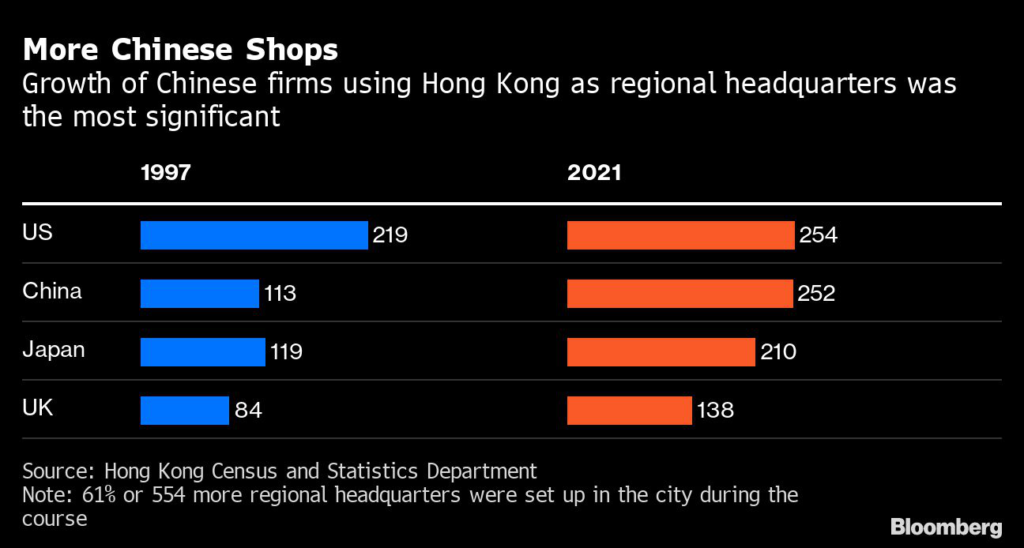
Chinese firms are catching up to foreign firms in terms of placing their regional headquarters in Hong Kong, more than doubling since 1997. Foreign businesses have also been clamoring for the city to relax its strict quarantine rules imposed over the past three years. In March, a survey by the European Chamber of Commerce showed a quarter of European companies in Hong Kong plan to fully relocate operations out of the city.     

Telecommunications

China Mobile Ltd., the mainland’s largest mobile operator, has become a dominant force in Hong Kong since it entered the market in 2006 after acquiring the fourth-largest wireless carrier. Today, the company has the biggest share of commercial mobile airwaves, beating three other competitors controlled by CK Hutchison Holdings Ltd., billionaire Richard Li and Sun Hung Kai Properties Ltd.’s Kwok family. China Mobile is leading in the next generation 5G, holding the largest share of the spectrum along with Li’s HKT Trust & HKT Ltd.

Infrastructure

Hong Kong’s skyline is being increasingly defined by mainland companies, as those firms -– mainly state-owned construction behemoths — grabbed more and bigger public infrastructure contracts. Last year, mainland firms won 48% of government infrastructure contracts worth more than HK$500 million ($64 million), up from just 8% in 2018, a Bloomberg News analysis of public tendering records found. 

Their dominance was even more pronounced for the largest projects. For example, they took 68% of the HK$53 billion construction of the local part of the Hong Kong-Zhuhai-Macao Bridge, including a 12-kilometer (7.46 mile) highway and building an artificial island off the city’s airport. All of Hong Kong’s makeshift hospitals and most of its quarantine facilities for Covid-19 control were also built by state-owned construction companies.

Chinese developers also aggressively snapped land in the middle of the last decade, although the buying spree has lost some of its steam in recent years amid pressure from Beijing to deleverage. One of the biggest buyers was HNA Group Co., which acquired several residential sites in the Kai Tak area in record-breaking deals, only to dispose of them due to debt issues.

On the construction side, state-owned firms such as China State Construction International Holdings Ltd. and China Communications Construction Co. expanded their market share in Hong Kong thanks to their massive capital. This allowed them to offer attractively low prices to the government on builds, said Derrick Pang, chief executive officer of Asia Allied Infrastructure Holdings Ltd., a local construction firm. Homegrown developers often need to rely on bank loans, making them less competitive. And losing past projects also means local companies now lack a good track record, putting them at even more of a disadvantage, Pang said. 

“If we don’t have more Hong Kong companies rising to the top, what happens is they will gradually disappear,” Pang said. “Whether this happens in five years, 10 years or 20 years — it’s just a matter of time. And it will be a similar story in other Hong Kong sectors, not just the construction industry.”

Mainland firms have also been buying up prime office space. In 2017, they occupied almost half of the Central business district’s office space, according to Jones Lang LaSalle Inc. But there has been a slide in demand in recent years, leaving large chunks of empty office space as foreign firms also cut back amid sky-high rents and the chilling effect of the city’s strict pandemic measures. 

Retail

For decades, Hong Kong’s retail scene had been ruled by homegrown tycoons. The two dominant supermarket chains are owned by CK Hutchison, the flagship of billionaire Li Ka-shing’s empire, as well as Jardine Matheson Holdings Ltd. Their growth has stagnated in recent years as groups backed by mainland Chinese capital are catching up. 

Jardine’s Wellcome supermarket has grown just 2% since 2017 while CK Hutchison’s ParknShop has shrunk 17%. U Select, owned by China Resources, expanded 39%, according to data from Euromonitor International and Bloomberg News. Qiandama, a mainland grocery chain backed by JD.com Inc., entered Hong Kong in mid-2018 and has since opened 50 shops. 

China Resources is also Hong Kong’s largest food distributor and sole importer of fresh pork, beef and poultry from the mainland. The city relies on the mainland for more than 90% of its fresh pork supply.

Beijing has been open about its desire to increase its influence in Hong Kong, especially after the unrest in 2019 strained its trust with the local tycoons. Mainland Chinese enterprises should provide for Hong Kong’s livelihood and promote its integration into the nation’s overall development, Yin Zonghua, deputy director of China’s liaison office in Hong Kong, said at an event in December 2021. 

Still, there’s one crucial part of the city that is becoming less Chinese: the public. 

A survey released last week showed only 29% of residents identified as broadly “Chinese,” down from above 40% just after the handover, according to a poll by the Hong Kong Public Opinion Research Institute. Some 70% identified as Hong Kongers, up from about 60% 25 years ago. 

But the survey showed some good news for officials eager to tie Hong Kong closer to the mainland, the residents identifying as “Chinese” has rebounded from a low in 2020. 

More stories like this are available on bloomberg.com

©2022 Bloomberg L.P.

Crypto Stocks Show Why They’re Among the Riskiest of Risk Assets

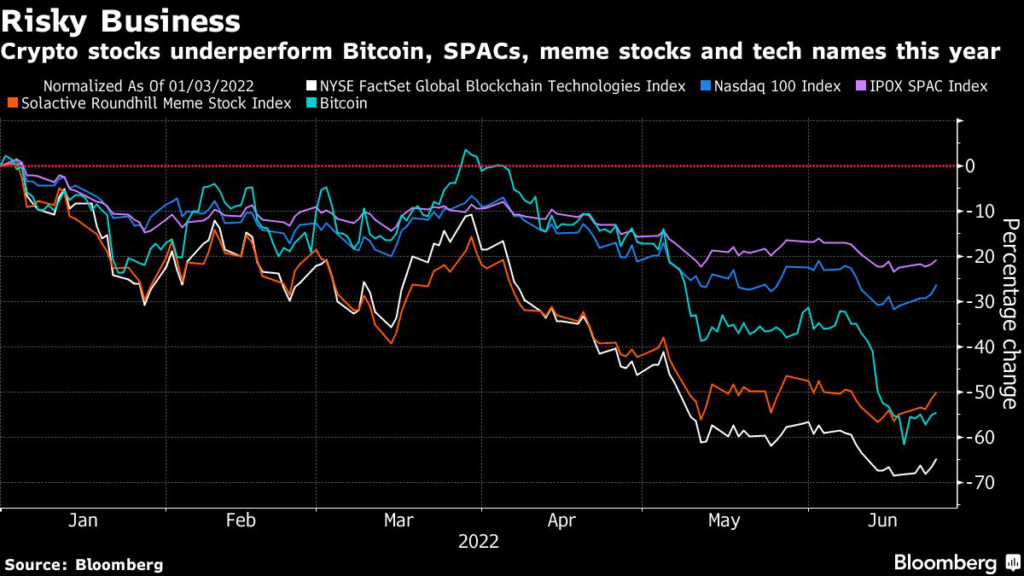
(Bloomberg) — Crypto curious stock investors are taking little comfort in the rebound in the shares of companies linked to the digital-asset world in the past week, with the sector underperforming just about every other risky corner of the financial markets this year by a wide margin. 

Coinbase Global Inc., touted last year as one of the best ways to gain exposure to crypto when it was first listed on Nasdaq, has tumbled 75% since December. MicroStategy Inc. is down 62%, or more than Bitcoin, for which the software company has been seen a proxy for since Chief Executive Michael Saylor loaded up its balance sheet with the coins. Digital token mining leaders Marathon Digital Holdings Inc. and Riot Blockchain Inc. are down similar amounts, while smaller rivals such as Stronghold Digital Mining Inc. having plunged even more. 

As the second-quarter winds down, cryptocurrency-related stocks are being lumped in with the digital tokens as one of the world’s riskiest asset classes. The NYSE FactSet Global Blockchain Technologies Index has fallen 65% this year, underperforming not only Bitcoin, but also an index that tracks highly volatile so-called meme stocks as well as a gauge of special purpose acquisition vehicle names.

Crypto stocks are “essentially a leveraged bet on one of the riskiest risk assets that there is,” said Steve Sosnick, chief strategist at Interactive Brokers LLC. He added that there are only a few other bets that he’d considered a higher risk for investors including certain meme and penny stocks.

While outsized drawdowns by Bitcoin are nothing new across its roughly 12-year history, the most recent selloff has been particularly brutal given the scope of the losses seen across the broader crypto industry. In less than six months, the crypto market has seen more than $1 trillion in value erased, with an index of the 100 largest digital assets sinking about 59% and on pace for its worst year since the prior bear market in 2018.

The selloff in crypto names, which started in early November after Bitcoin hit an all-time high of almost $69,000, has accelerated this year as investors globally began to rotate out of riskier assets classes amid fears that a batch of aggressive rate hikes by the Federal Reserve aimed at cooling inflation would plunge the US economy into a recession. Further adding to the pain for investors was the May implosion of the Terra/Luna ecosystem which set off a series of liquidations across the industry and sparked a rash of panic selling. 

Despite the risks and deeply depressed share prices, Wall Street analysts have largely remained optimistic on the vast majority of crypto-exposed stocks. 

Coinbase, which has lost more than $60 billion in value since hitting a record high in November, currently has 20 buy recommendations, according to data compiled by Bloomberg. Thats the exact same number it had back in early January, when the stock was worth more than triple its current value. 

“While we are not at all dismissive of the impact of the current crypto market downturn, we also believe any notion that Coinbase would be unable to survive this latest challenge is misguided in light of the facts on the ground,” according to BTIG analyst Mark Palmer who this week cut his price target on the stock to $290, down from a Street-high $380. It closed Friday at $62.71, after rebounding 22% this week.

Other crypto stocks have seen similarly bullish dedication from the analyst community. Bitcoin miners Riot Blockchain and Marathon Digital each have at least 75% buy-equivalent ratings and sport average 12-month price targets that are roughly 379% and 293% respectively above their current share prices.

They’re not alone either. Among the 33 stocks that make up the NYSE FactSet Global Blockchain Technologies Index, the average projected return over the next year is nearly 200%, over five times higher than the average across the Nasdaq 100 Index.

To be sure, the largely positive long-term outlook for the cryptocurrency market doesn’t come without caveats. 

“We remain skeptical that crypto prices are fully out of the woods,” said Compass Point analyst Chris Allen. “We could see more downside to come given the uncertainty of Celsius/3AC insolvency situation and the pending asset sales that will likely result.”

One particularly troubling sign for investors looking to buy the dip in crypto stocks, despite the already historically deep selloff by some names, stocks like Voyager Digital Ltd. have proved that there is always room to fall further.

Shares of the cryptocurrency brokerage firm sank by 53% on Wednesday, the most since 2001, after it said it may issue a notice of default to hedge fund Three Arrows Capital Ltd. over its failure to repay a loan worth roughly $660 million. Before that plunge, the stock had already lost roughly 90% of its value this year.

“Given the size of the exposure, and given the uncertainty with respect to Voyager’s collecting on any of these balances, we believe it is difficult to arrive at a reasonable estimate of Voyager’s equity value per share,” KBW analyst Kyle Voigt wrote in a note after removing his outperform rating on the stock. 

More stories like this are available on bloomberg.com

©2022 Bloomberg L.P.
Draymond Green, Podcast Star, Turns an Unsparing Mic on Himself

(Bloomberg) — The morning after the Golden State Warriors lost the opening game of the 2022 NBA Finals, Draymond Green sat down at his apartment in downtown San Francisco to tape an episode of his podcast. Many athletes might have wanted to put such a forgettable night behind them. The Golden State Warriors had blown a lead at home and wasted 34 points by their star player Stephen Curry. But Green, one of the most outspoken players in the league, had hundreds of thousands of fans waiting to hear his thoughts.

Over the next 30 minutes, Green praised Curry’s play, criticized his own performance and questioned how their team had allowed the Boston Celtics to score so many points.

“I failed him because I didn’t play well,” Green said. “When he comes out guns blazing, I have to make sure I do my part.”

As the series progressed, Green’s real-time commentary from inside the locker room turned his podcast into the single biggest media story of the NBA finals. Along the way, Celtics’ coaches listened to Green’s podcast for insight into the Warriors’ tactics. TV analysts referenced it during broadcasts. Former players blamed it for Green’s poor play at times, and after the Warriors won the finals in six games, Green’s teammates joined the show.

All told, Green’s rapid bouts of self-assessment offered basketball fans something new — unprecedented access to the thoughts of a key player as he battled his way through a championship series.

“As I got deeper into the playoffs, everyone is waiting to hear what Dray has to say on the podcast,” Green said in an interview with Bloomberg this past week. “They started to look for my analysis after games.”

Since debuting last November, the show’s audience has ballooned. The morning after the Warriors won the title, the show ranked as the 11th most popular podcast on Apple according to Chartable, its highest ranking to date. For several months this year, it has been one of the 100 most popular podcasts in the world.  A video of Green’s episode on the heels of game six has since racked up more than a million views on YouTube.

Green has always enjoyed talking into a microphone but in the past often grew frustrated trying to condense his thoughts into brief clips for TV. A podcast, on the other hand, allows him to speak at length and share his knowledge of the sport.

His first stab at podcasting wasn’t so successful. In 2017, he co-hosted a show called “Dray Day” alongside Bay Area sports journalist Marcus Thompson II. But Green didn’t commit himself to the project. They would upload an episode and then not tape again for a couple weeks or more. After three months, the feed went dark.

Green told his representatives that he remained interested in doing a show if the right opportunity came along. Meanwhile, he was proving himself as a particularly adept commentator during regular appearances on TNT, which airs weekly games and the award-winning studio show “Inside the NBA.”

“Audiences crave immediate reaction.”

Executives at The Volume, a podcast network founded by sports broadcasting giant Colin Cowherd, approached Green last year and offered to make whatever show he wanted to do. “So many people have an opinion, and the minute it’s wrong they go hide. Or they are terrified by the reaction,” Cowherd said. “He leans into it.”

What Green wanted to do was an in-season show, accompanied by a co-host. Others, like JJ Redick, a former NBA player turned podcaster, and CJ McCollum, a current NBA player-podcaster, were making good use of the co-host format. Initially, Green delayed his podcast’s debut while searching for someone to join him on the air. But as the season picked up, Green and his producer, Jackson Safon, decided to start taping on their own. Within a few episodes, they’d decided Green was doing just fine as a solo act. 

Still, it took a few months to find the right rhythm. They started by posting once a week, and early episodes combined Green’s commentary on recent games and league developments with long-form interviews. Guests included current and former players such as Gary Payton, Joel Embiid and Bradley Beal.

By February, episodes were generating about 500,000 downloads a month, Green said. That’s good for a new show, but not in the upper echelon of podcasts. The Volume offered Green data on its performance and counseled him on when to post new episodes. 

“He’s very coachable, and he wants to be pushed,” Cowherd said. “You don’t get a lot of that from people with a net worth of more than $100 million.”

As the season progressed, Green grew more comfortable. He swore less and adopted a more personal, diaristic approach. During the opening rounds of the playoffs, he started taping reflections on games the morning after he played. During the finals, he would tape an episode in his hotel room the night after the game. The episodes got shorter, more focused and more in the moment, redefining what an athlete can do while still playing an integral role on a team.

“Audiences crave immediate reaction,” said Logan Swaim, the head of programming at The Volume. “If you can get it from the athlete themselves, that’s lightning in a bottle.”

Now that the season is over, Green will have to adjust the format again. He will likely revert to doing more interviews. Green views his podcast as a safe space for fellow athletes. That doesn’t mean they will be free from criticism. Green has no filter when it comes to his play or that of his opponents. But he is hosting them as a peer and typically lends a sympathetic ear. As one of the leading competitors in the NBA—and a former defensive player of the year—Green has been able to book guests that most podcasts can’t.

While Green didn’t ask the Warriors for permission to do the show, he has prevailed upon many of his teammates to appear on it, including Curry and Andre Iguodala.

The podcast is just one part of what Green hopes is a budding media empire. He previously starred in an Amazon documentary called “The Sessions,” in which he talks to self-help guru Deepak Chopra and wellness expert Devi Brown. Earlier this year, he signed on as a regular contributor to “Inside the NBA.” Sports media experts have speculated Green could one day replace Charles Barkley in the studio. Though, for his part, Green said he isn’t retiring from basketball anytime soon.

Green is one of many professional athletes building media businesses, including Curry, LeBron James and Peyton Manning. Their success has led to some concern among journalists about the future of independent sports media. While the podcast hasn’t stopped Green from showing up at post-game press conference or speaking with the media, it has inspired podcast networks to think if there are athletes from other sports that could replicate his success. Both Cowherd and Stephen A. Smith, one of the biggest stars at ESPN, have acknowledged that Green brings something to the table they may not. 

“I’ve never been afraid of these athletes replacing me,” Cowherd said. “I want to be in business with them.”

More stories like this are available on bloomberg.com

©2022 Bloomberg L.P.
Indonesia Says Foxconn May Invest in Projects for New Capital

(Bloomberg) — Indonesia said Foxconn Technology Group is considering investing in the country’s new capital, a move that would bolster the $34 billion construction project.

The Taiwanese company is looking at setting up an electric bus system and an Internet of Things network at Nusantara, as Indonesia’s new capital will be called, Investment Minister Bahlil Lahadalia said in a statement on Sunday.

Young Liu, the chairman of Hon Hai Precision Industry Co., Foxconn’s flagship unit, met with Indonesian President Joko Widodo on Saturday to discuss the company’s plan to invest $8 billion to build a manufacturing plant with electric-scooter startup Gogoro Inc. The factory, set to be built in Central Java province, will produce batteries and other electric vehicle-related products.

Liu told Jokowi, as the president is known, that Hon Hai is happy to help Indonesia set up talent training institutions, and it will provide EV technologies and products to local partners and work with them to build an EV ecosystem, according to a company statement on Saturday. They also talked about batteries and renewable energy and exchanged ideas about the electric mobility industry, the statement said.

Indonesia is seeking to capitalize on its large reserves of nickel, a key component in batteries, to develop an EV industry. 

The government is also planning to relocate its capital from Jakarta on Java island to Borneo island, where it plans to build a “green” city that will rely mostly on public transport and use renewable energy entirely. 

More stories like this are available on bloomberg.com

©2022 Bloomberg L.P.
Ad Execs Return to Cannes Party With Recession Fears in Backdrop

(Bloomberg) —

Take it from Joao Paulo, who manages the infamous Gutter Bar where many an evening ends at the advertising industry’s annual confab on the French Riviera: Cannes is back.

“It’s much more busy than two years ago,” Paulo said, with 2,000 or so people stopping by each night and some staying until 6 a.m. “They’re more excited than usual.”

The flowing rose at the bar matched the broader — at least outward — tone of the Cannes Lions Festival. After a two-year hiatus, executives were happy to mingle on the sunny La Croisette boulevard and beaches this week. However, an undercurrent of anxiety over the economic outlook edged into conversation. 

After a sharp pullback in ad spending at the start of the pandemic, brands ramped up their efforts to reach consumers as economies reopened. Now though, worsening inflation and fears of an imminent recession are leading some companies to cut back their budgets again.

“We’re not naive about what would happen if the economy does move into a recession,” WPP Plc Chief Executive Officer Mark Read said in a cabana-side interview at his firm’s beach setup. “We’re operating against a backdrop of what I would describe as — we haven’t seen anything yet, but — headwinds in the economy over the next year.” 

GroupM, the ad-buying arm of WPP, cut its estimate for advertising growth in 2022 in a mid-year update. However, the report noted that many sectors are still seeing significant growth.

“The likelihood is it’s going to be a tough ‘22,” said Martin Sorrell, founder of digital marketing services business S4 Capital Plc.

But the more cautious forecast wasn’t emphasized at panels and over-the-top beach displays. 

Meta Platforms Inc. had special rooms for visitors to record reels for Instagram and a demonstration space to try virtual reality technology. Spotify Technology SA brought in top musical talent like rapper Post Malone and pop artist Dua Lipa. 

“It’s unbelievably exciting to be back in Cannes, and I think there’s a real feeling of gratitude for the industry to be able to get together,” said Nicola Mendelsohn, vice president of Meta’s Global Business Group. There’s also “a real desire, more than I’ve seen in in a long time, about learning.”

Reddit Inc. sought to showcase a friendlier side with an “explorers club” themed house that served rose and pastries on its observation deck. TikTok had a relatively subdued presence despite its outsized influence, renting out a cabana sandwiched between T-Mobile and Roku.

One topic of fascination during the week was Netflix Inc.’s plans to begin selling advertising, and which companies the streaming giant might partner with to build out their offering. While Netflix co-CEO Ted Sarandos said in an on-stage interview that the firm was discussing partnerships, he warned it was still early in the process.

“This could be the last hurrah for a while,” said Richard Raddon, co-CEO of advertising technology company Zefr, in an interview on one of the yachts parked in the Bay of Cannes. “There is this weird feeling of a little bit like what’s going to happen with the world.”

More stories like this are available on bloomberg.com

©2022 Bloomberg L.P.

Crypto Exchanges Hunker Down as Everything Goes Wrong in India

(Bloomberg) — India’s largest digital assets exchanges are bracing for a drawn-out crypto winter — one with some unwelcome local twists. 

With token prices plummeting, customers unable to transfer money to their accounts and a dreaded transaction tax on cryptocurrencies just around the corner, exchanges like Binance-backed WazirX have put expansion plans on the back burner. 

“We have cut down all our non-critical costs,” said Rajagopalan Menon, WazirX’s vice president. “We are hiring only critical hires, we aren’t spending money at all. It’s literally crypto winter here,” he said, using industry jargon for an extended bear market. 

WazirX isn’t alone. Rival exchanges Unocoin and BuyUcoin are also responding to vanishing trading volumes in a market that just last year ranked second in the world for crypto adoption. 

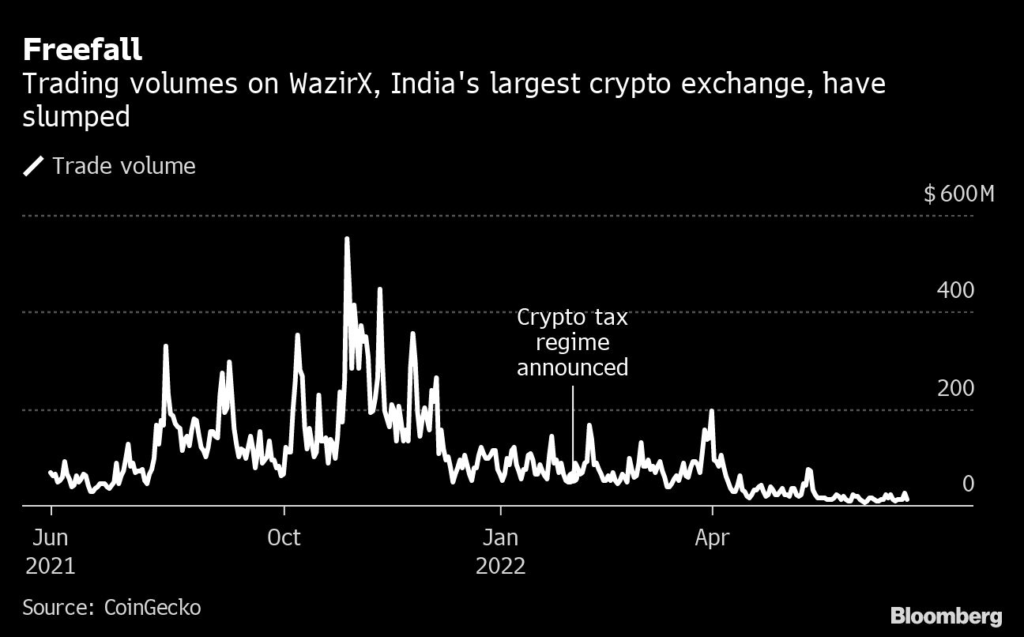
That a crypto marketplace should be in cost-cutting mode is hardly a surprise — Coinbase Global Inc. and Crypto.com have announced layoffs in the last two weeks alone — but Indian exchanges face the added burden of a new tax system that executives fear will wipe out what little trading is left. WazirX’s daily volume has slumped about 95% since October, data from CoinGecko shows. 

On July 1, a tax deductible at source of 1% on all digital-asset transfers above a certain size takes effect despite industry warnings that it will sap liquidity. That’s on top of an existing 30% rate on income from such assets plus a proposed value-added tax increase that’s making its way through the bureaucracy. 

The government also doesn’t permit offsetting of trading losses on cryptocurrencies, treating them differently from stocks and bonds. 

Adding to the pain, crypto exchanges have been largely cut off from the regular banking system since mid-April. That’s when India’s ubiquitous United Payments Interface was made unavailable to them without explanation, prompting some banks and payment gateways to also cut off service, which in turn meant traders couldn’t top up their accounts with cash. 

It’s a remarkable turnaround from last year, when India was one of the world’s hottest crypto markets. The country’s cryptocurrency market expanded more than 600% in the 12 months through June 2021, according to researcher Chainalysis, which used a metric that estimates the total amount of crypto received in a country. 

Crypto exchanges took out full-page ads in newspapers and signed up Bollywood stars to promote their offerings to one of the world’s youngest populations. Coinbase-backed CoinDCX became the official title sponsor of a cricket series between India and Sri Lanka.

“Last year that was the golden age,” said Menon. “We went from six programmers to 50 in seven months.” WazirX has only added “a few developers and some critical senior people” since that hiring spurt, he said. 

Influencer Spending

Not everyone is hitting the brakes. CoinDCX, which raised $135 million in April from funds including Pantera Capital, isn’t planning to cut costs, Vinay Tiwari, its senior vice president for finance, said in an interview. 

That makes it an outlier among exchanges. 

BuyUcoin, a small bourse with 45 employees, is only hiring developers and engineers, Chief Executive Officer Shivam Thakral said. It’s also cutting spending on things like partnerships with social media influencers and eschewing mass advertising, according to Thakral. BuyUcoin’s trading volume has fallen about 80% since peaking last year, he said.  

“All companies are being cautious when it comes to expenses now, same with us as well,” Sathvik Vishwanath, CEO of crypto exchange Unocoin, told Bloomberg. “We continue to hire for key positions but are not hiring for redundancy.”  

Vishwanath said he’ll assess the impact of the transaction tax, known by the acronym TDS, before making any major decisions on strategy. The industry body he’s a member of unsuccessfully lobbied the government for a reduction in the TDS, he said.  

With no immediate relief in sight, existing employees at WazirX may have to shoulder more work. 

“If someone leaves the company, earlier replacement was near instant,” Menon said. “Now, we are checking if someone can double up for that position.”

More stories like this are available on bloomberg.com

©2022 Bloomberg L.P.

Washington to Block Anti-Abortion States From Accessing ID Data

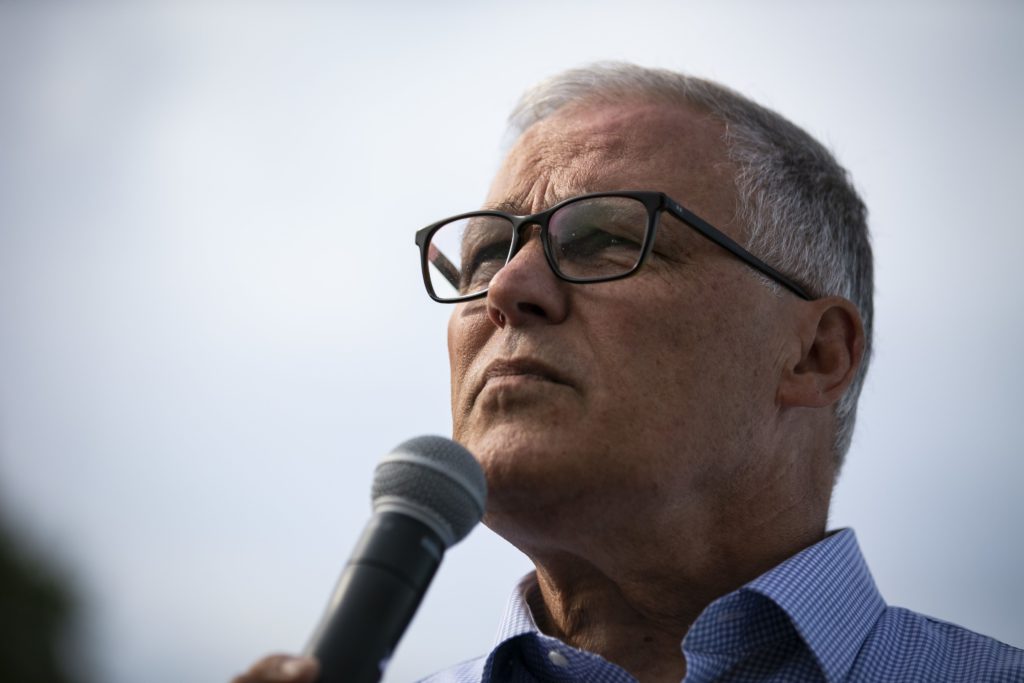
(Bloomberg) — Washington Governor Jay Inslee pledged to block hardline anti-abortion jurisdictions such as Texas from learning who travels to the state for the procedure, the latest escalation in the US divide over reproductive rights.

Inslee, the longest-serving active US governor, said he will work to “plug any gaps” in privacy laws so women can obtain abortions without fear of their information being shared. The three-term Democrat singled out Texas, Missouri and neighboring Idaho as states hostile to abortion in remarks Saturday on the steps of the capital building in Olympia.

Inslee’s vow came a day after the US Supreme Court’s momentous decision to overturn the landmark abortion-rights case Roe V. Wade that underpinned American reproductive rights for almost half a century. 

The governor also plans to direct state police to refuse to cooperate with law enforcement from other states seeking to enforce anti-abortion laws, and said he’ll push for legislation to impose similar bans on other police agencies within the state. Inslee said his goal is to make Washington a “sanctuary” for abortion rights.

“We are not going to allow that data to get back to Texas or Missouri or Idaho,” Inslee said.


More stories like this are available on bloomberg.com

©2022 Bloomberg L.P.

US Layoffs, Hiring Freezes Are Tip of Labor Market Slowdown

(Bloomberg) — Sign up for the New Economy Daily newsletter, follow us @economics and subscribe to our podcast.

The US labor market is stronger today than many thought possible. But cracks are emerging, signaling that it’s not going to last. 

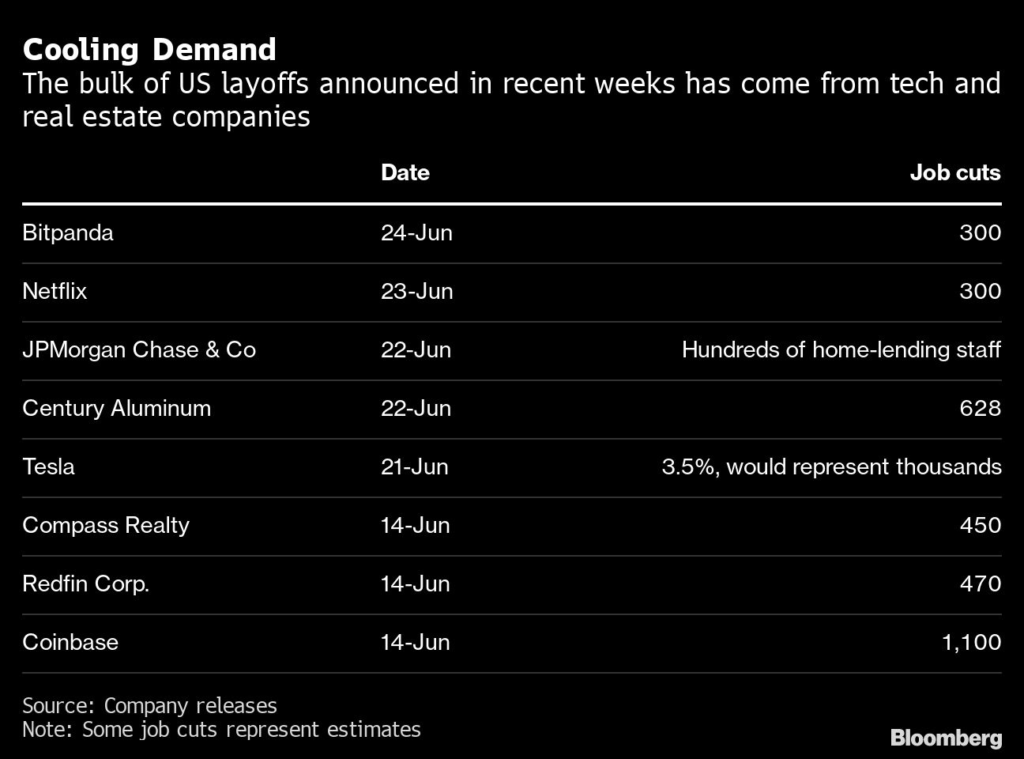
In the past few weeks, companies have announced tens of thousands of job cuts and plans to freeze hiring. The bulk has come from technology, cryptocurrency and real estate firms big and small, which have laid off at least 37,000 workers since May, according to tech job-listings website TrueUp. Brokerages and banks including JPMorgan Chase & Co. are reducing headcount as the housing market cools.

The combination of slowing consumer demand, 40-year high inflation and the Federal Reserve’s interest-rate hikes is seeping into other sectors, too. The country’s second-largest aluminum producer, Century Aluminum Co., said it was laying off about 600 workers.

Economic data suggest more is on the way. Manufacturing overtime hours have declined for three months in a row, the longest downward streak since 2015. The four-week average of jobless claims, which is less volatile than the weekly figures, climbed to the highest level since January as more people filed for benefits. And wage growth across the country is cooling.

“The anecdotal evidence is piling up. Workers are definitely losing some of their bargaining power,” said Bob Schwartz, senior economist at Oxford Economics. “We are at a tipping point and what the Fed is doing is going to accelerate the process.” 

The question for economists is not whether the labor market will slow down, but how quickly.

In its bid to tamp down on inflation, the Fed hiked rates by 75 basis points at its June meeting — the most since 1994 — and Chairman Jerome Powell is eyeing at least a 50-basis points increase at the next meeting.

That’s prompted growing recession calls from economists as consumer and corporate lending demand weakens. Powell himself acknowledged this week that a recession is possible, though not inevitable.

So far, firings have largely been constrained to interest-rate sensitive industries such as real estate. During the pandemic, low rates and trillions of dollars in fiscal stimulus propelled home sales to the highest in more than a decade. Now, mortgage rates have soared to the highest since 2008, deterring would-be buyers. Lenders and agencies suddenly find they don’t need all those employees.

Tech firms are also contending with higher borrowing costs. Many of the companies that are now cutting jobs said they hired too many workers during the pandemic to meet the sudden influx of demand when the economy began to reopen. And crypto companies like Coinbase Global Inc., which is cutting more than 1,000 staff, have been hit by a severe rout this month following explosive growth last year.

Hiring Freeze

Cost-cutting measures are spreading to other sectors. 

One nonfinancial-service firm told the Richmond Fed that its plans for hiring and spending are on hold because clients are capping or cutting budgets. Another services company told the Kansas City Fed it too instituted a hiring freeze after sales dropped, adding it’s looking to cut costs. 

The Fed’s interest rate hikes are engineered to slow down demand, and that includes demand for workers: The central bank forecasts an increase in the unemployment rate to 4.1% by 2024. That’s optimistic when compared to recent Wall Street estimates: Nomura Holdings Inc. sees the rate jumping to 5.9% by the end of that year. That would be about the level of June 2021.

For now the labor market remains tight. The jobless rate, at 3.6% in May, is historically low, and payrolls rose by a healthy 390,000 that month. Wage growth is historically high, when excluding inflation. While new job postings declined slightly in recent weeks, they remain 54% higher than before the pandemic, according to data from jobs website Indeed.

But traditional indicators tend to lag. For instance job openings tracked by the government in April fell by the most since the pandemic first hit the US. But May numbers won’t be released until July.  

“The labor market is currently strong — but it’s deteriorating and it’s going to deteriorate pretty quickly,” said Troy Ludtka, senior US economist at Natixis North America LLC. Ludtka forecasts the unemployment rate to hit at least 5% by the start of 2023. 

“The tightness that we’re seeing now is in response to the massive burst of growth we saw a year ago,” he said. “Now, the economy is slowing, which means the labor market is going to slow.”

More stories like this are available on bloomberg.com

©2022 Bloomberg L.P.
Close Bitnami banner
Bitnami