Bloomberg

Amazon’s Alexa Impersonates Grandma, Creeping Out Internet

(Bloomberg) — “Creepy.” “Morbid.” “Monstrosity.”

Those were just some of the reactions that poured in over social media when Amazon.com Inc.’s Alexa digital assistant impersonated a grandmother reading an excerpt from “The Wonderful Wizard of Oz.”

It all started innocently enough, with Alexa chief scientist Rohit Prasad trying to demonstrate the digital assistant’s humanlike mien during a company presentation Wednesday. Prasad said he’d been surprised by the companionable relationship users develop with Alexa and wanted to explore that. Human characteristics like “empathy and affect” are key for building trust with people, he added.

“These attributes have become more important in these times of the ongoing pandemic, when so many of us have lost someone we love,” he said. “While AI can’t eliminate that pain of loss, it can definitely make their memories last.”

The presentation left the impression that Amazon was pitching the service as a tool for digitally raising the dead. Prasad walked that back a bit in a subsequent interview on the sidelines of Amazon’s re:MARS technology conference in Las Vegas, saying the service wasn’t primarily designed to simulate the voice of dead people.

“It’s not about people who aren’t with you anymore,” he said. “But it’s about, your grandma, if you want your kid to listen to grandma’s voice you can do that, if she is not available. Personally I would want that.”

As the presentation ricocheted around the web, the creep factor dominated the discourse. But more serious concerns emerged, as well. One was the potential for deploying the technology to create deepfakes — in this case using a legitimate recording to mimic people saying something they haven’t actually vocalized.

Siwei Lyu, a University of Buffalo professor of computer science and engineering whose research involves deepfakes and digital media forensics, said he was concerned about the development. 

“There are certainly benefits of voice conversion technologies to be developed by Amazon, but we should be aware of the potential misuses,” he said. “For instance, a predator can masquerade as a family member or a friend in a phone call to lure unaware victims, and a falsified audio recording of a high-level executive commenting on her company’s financial situation could send the stock market awry.”

While Amazon didn’t say when the new Alexa feature would be rolled out, similar technology could eventually make such mischief a lot easier. Prasad said Amazon had learned to simulate a voice based on less than a minute of that person’s speech. Pulling that off previously required hours in a studio. 

(Updates with professor’s comments starting in eighth paragraph.)

More stories like this are available on bloomberg.com

©2022 Bloomberg L.P.

Airbnb Is Giving Away $10 Million to Build the ‘Craziest Places on Earth’

(Bloomberg) — Airbnb Inc. has launched a $10 million fund to inspire the creation of the wackiest and most unique property destinations on the planet. 

The vacation-rental site will offer 100 people $100,000 to create unforgettable stays, like a “livable donut in the desert,” according to the application form. Designs must possess a wow factor, consider the environment, and be completable by August 2023. A panel of judges, including American designer Iris Apfel and Sydney-based architect Koichi Takada, will evaluate submissions and select the projects.

In May, Airbnb redesigned its website to help visitors discover off-the-beaten-path locations. The OMG! Fund is designed to highlight more one-of-a-kind destination homes like the Big Idaho Potato Hotel in Boise, Idaho, which looks like a giant spud from the outside and features cozy accommodations including a fireplace and antler-carved chandelier. The Deluxe Covered Wagon farm stay near Las Vegas offers horse rides, cattle drives, and rodeos. 

Airbnb, along with its rivals Expedia Group Inc. and Booking Holdings Inc., have said they expect this summer to be one of the best the industry has ever seen, despite higher gas prices and flight cancellations. Focusing on unique properties helps the company distinguish its offerings, as debates rage over the merits of staying at an Airbnb versus a hotel room. The San Francisco-based company said nights booked at unique properties increased globally by more than 49% from 2019 to 2021.

More stories like this are available on bloomberg.com

©2022 Bloomberg L.P.

US Senators Ask GitHub Users for Input on Crypto Legislation

(Bloomberg) — Two US senators are seeking feedback on a new bipartisan crypto legislation, and they are using Microsoft-owned GitHub to reach the masses. 

Wyoming Republican Cynthia Lummis and New York Democrat Kirsten Gillibrand, posted the legislation on GitHub, a software development and version control platform, on Tuesday. As of Thursday 9:24 a.m. New York time there were no comments. The duo introduced the bill, which aims to regulate digital assets, on June 7.

“From the get go, we wanted input from the people who live and work in this space every day. No one knows more about digital assets than the ones who mine, stake, and trade them,” Lummis said in an email to Bloomberg on June 22. “After talking to some of these folks, they suggested that GitHub was the place to solicit that feedback.”

The bipartisan bill, titled Lummis-Gillibrand Responsible Financial Innovation Act (S. 4356), calls for a set of standards to determine if a digital asset is a commodity or security and other stablecoin provisions. The legislation also wants to task the Commodity Futures Trading Commission with more authority to regulate coins. 

“Digital assets, blockchain technology and cryptocurrencies have experienced tremendous growth in the past few years and offer substantial potential benefits if harnessed correctly,” Gillibrand said in a June 7 press release. “It is critical that the United States play a leading role in developing policy to regulate new financial products, while also encouraging innovation and protecting consumers.”

Several Senate committees would have to consider the bill for it to move through Congress.

“We’re going to collect the comments then take a look at the suggestions and piece together how they could fit into the broader legislation,” Lummis said via email. “I anticipate that we will incorporate some of this feedback into the bill.” 

GitHub allows users to collaborate on software projects by letting them code separately on one project. More than 83 million developers utilize the platform, according to the company’s website.

(Corrects sixth paragraph, earlier version inaccurately said the legislation will be considered at an upcoming Senate committee hearing.)

More stories like this are available on bloomberg.com

©2022 Bloomberg L.P.

Ukraine Latest: EU Leaders Grant ‘Candidate’ Status to Ukraine

(Bloomberg) — European Union leaders granted Ukraine candidate status that moves it closer to the war-torn nation’s long-sought goal of joining the Western bloc. The US is prepared to provide an additional $450 million in military aid to Ukraine, the Associated Press reported. 

The Kremlin said a peace deal with Ukraine isn’t possible until Kyiv accepts all its demands — leaving conditions at a stalemate as Russia’s invasion nears the four-month mark. European Union leaders granted Ukraine candidate status in a highly symbolic first step toward full EU membership. 

German Economy Minister Robert Habeck triggered the second stage of the country’s three-phase gas-emergency plan on Thursday and warned of the potential for Lehman-like contagion. 

(See RSAN on the Bloomberg Terminal for the Russian Sanctions Dashboard.)

Key Developments

  • Germany Warns of Lehman-Like Contagion From Russian Gas Cuts 
  • Russia Faces Fresh Bond Deadline With Possible Default Days Away
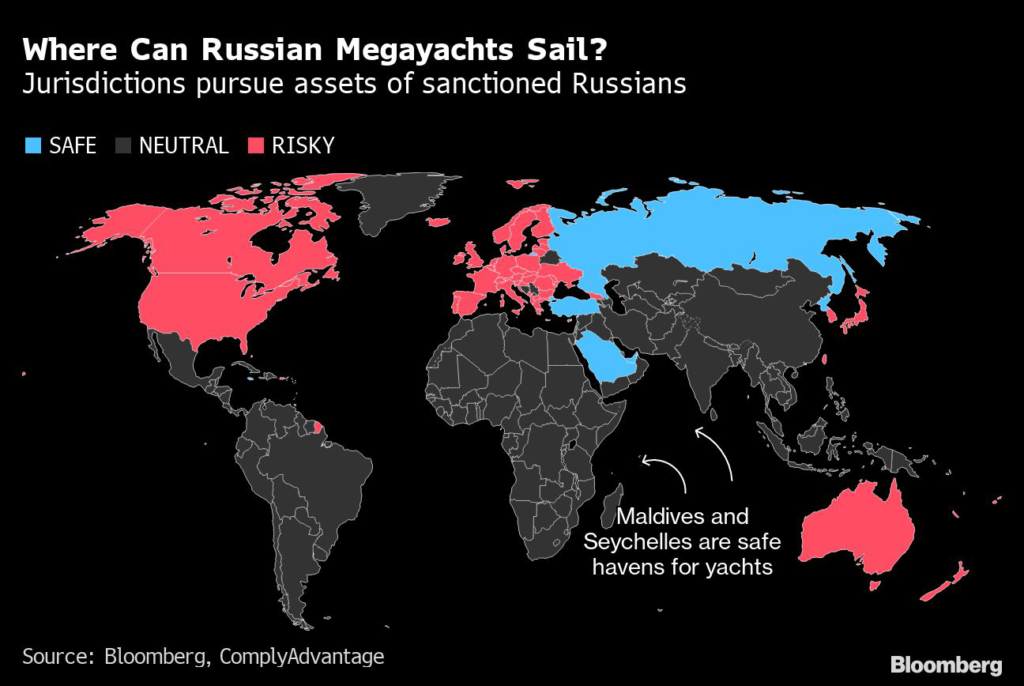
  • Megayachts Running Low on Safe Harbors as Russia Sanctions Bite
  • Europe Industries Cut Gas Use as Continent Saves Fuel for Winter
  • Cold Winter Could Push Europe Toward Gas Supply Shortages
  • Ukraine Wins Symbolic Step on Long Path to EU Membership

On the Ground

Ukrainian air defense downed two cruise missiles targeting Odesa on Thursday, the city council said on Telegram. Three cruise missiles launched from occupied Kherson targeted the city of Mykolayiv, hitting industrial and social infrastructure and injuring one person.“Heavy explosions” were heard in the southern seaport, its mayor said. A day earlier Mykolayiv faced a large-scale rocket attack. “A threat of artillery shelling has been announced in the city,” the mayor wrote on his Telegram account, urging residents to go to shelters “immediately.” Russian troops seized two more villages south of Lysychansk, in Luhansk, a stronghold Kyiv relies on in its defense in that area. 

(All times CET)

Leaders Hail Move on Ukraine’s EU Candidacy as Historic (9:40 p.m.)

Leaders including Ukraine’s Volodymyr Zelenskiy and France’s Emmanuel Macron applauded the decision by EU heads to grant Kyiv candidate status on the path to membership of the bloc.

Zelenskiy hailed the move as “a unique and historical moment.” Macron said the decision mirrors the EU’s response since Russia invaded Ukraine, “which means reacting in a fast, historic and united way through sanctions, macroeconomic, military and financial support.”

Ursula von der Leyen, head of the European Commission, said she was convinced Ukraine would move ahead as swiftly as possible with reform needed to join the EU. Kyiv, which applied for membership shortly after the Russian invasion in February, will have to meet conditions in the future on issues related to the rule of law, justice and anti-corruption.

Lithuania Says EU to Clarify Kaliningrad Advice (9:30 p.m.)

The EU is “is working on a document” that will clarify the bloc’s guidance on how to handle Russian goods transiting to the exclave of Kaliningrad without violating sanctions, according to Lithuania’s leader.

“I don’t know if they’ll publish it tonight, but this may also happen sometime early next week,” Lithuanian President Gitanas Nauseda told reporters. “This will answer all the questions that may occur to people today.”

EU Grants Ukraine Candidate Status for Membership (8:26 p.m.)

European Union government leaders holding a two-day summit in Brussels approved a recommendation from the European Commission to grant candidate status to Ukraine, according to Luxembourg Prime Minister Xavier Bettel. Kyiv, which applied for membership shortly after the Russian invasion in February, will have to meet conditions on issues related to the rule of law, justice and anti-corruption.

President Volodymyr Zelenskiy has spent the past few months pressing for recognition that the country is on a path to a closer relationship with Europe as he seeks moral support in countering Russian aggression. But the membership process can last more than a decade.

US Senate Panel Backs Measure Calling Russia Terror Sponsor (7:04 p.m)

The US Senate’s Foreign Relations Committee advanced a measure Thursday that would direct the secretary of state to designate Russia as a state sponsor of terrorism for its invasion of Ukraine, putting it in the same category as Iran, Syria, North Korea and Cuba. Both chambers of Congress would have to pass the measure for it to be sent to President Joe Biden’s desk to be signed into law.

Earlier in the day, Senator Jim Risch, the top Republican on the committee, told an audience that included Ukrainian Ambassador to the US Oksana Markarova that Russia’s actions make it a “bully” and a state sponsor of terrorism because it invaded a country that was smaller in size, population and military capability.

Ukraine Takes Russia to Human Rights Court Over War Crimes (6:58 p.m.)

Ukraine is seeking $80 billion in compensation from Russia over war crimes inflicted during its invasion of the country, kick-starting its legal battle at Europe’s human rights court. 

The country’s justice ministry filed the first round of submissions against Russia at the European Court of Human Rights in Strasbourg, according to a Thursday statement from its lawyers, Quinn Emanuel Urquhart & Sullivan. 

“Russia has caused – and is continuing to cause – loss of life, injury and trauma, population displacement and damage to property on a scale not seen in the continent of Europe since the Second World War,” the law firm said.  

Envoy Presses Canada to Hold on to Gazprom Turbine (6:51 p.m.)

Ukraine’s ambassador to Canada encouraged Prime Minister Justin Trudeau’s government to keep a gas turbine sent to the country for repairs and not return it to Europe where it would be used on the Nord Stream pipeline. The turbine was sent to Canada, where it was manufactured, for repairs just before sanctions were imposed on Russia over its invasion of Ukraine.

Ambassador Yulia Kovaliv said that Russian energy giant Gazprom is holding Europe hostage by blaming the missing turbine for a reduction in gas flows. She argued that the company could deliver additional gas to Europe through Ukrainian infrastructure.

“Instead of blackmailing, instead of threatening European consumers, there is a way to deliver this gas to the market,” Kovaliv said in an interview. “It’s quite obvious that Russia and Gazprom are playing another game. And we do call everybody and the Canadian government to understand it.”

US to Provide $450 Million More in Military Aid, AP Says (6:43 p.m.)

The US will send an additional $450 million in military aid to Ukraine, including some additional medium-range rocket systems, according to unidentified American officials cited by the AP.

The new package is expected to include a number of High Mobility Artillery Rocket Systems, or HIMARS, adding to the four that have already arrived.

Germany Warns of Lehman-Like Contagion From Russian Gas Cuts (5:37 a.m.)

Germany warned that Russia’s moves to slash Europe’s natural gas supplies risked sparking a collapse in energy markets, drawing a parallel to the role of Lehman Brothers in triggering the global financial crisis.

With energy suppliers piling up losses by being forced to cover volumes at high prices, there’s a danger of a spillover effect for local utilities and their customers, including consumers and businesses, Economy Minister Robert Habeck said after raising the country’s gas risk level to the second-highest “alarm” phase.

Europe’s largest economy faces the unprecedented prospect of businesses and consumers running out of power. 

Lithuania Accuses Moscow of Propaganda Battle (3:55 p.m.)

Lithuania accused Moscow of waging a propaganda battle and taking a threatening stance in a standoff over Vilnius restricting the transit of sanctioned goods to the Russia’s exclave of Kaliningrad.

Food Crisis Could Last Two Years, Western Officials Say (4:08 p.m.)

Even if Russia’s war on Ukraine ended tomorrow, the current food crisis could last another two years or more, Western officials said in a briefing. It’s possible an agreement on shipping grain from Ukraine’s ports could be reached within the next month, though if that happens, it will still take time to de-mine ports and get them back up and running. 

Officials are working with the UN Food and Agriculture Organization and the International Grains Council to look at having an investigation into allegations that Russia is stealing grain from occupied areas of Ukraine, though they said it’s hard to track because reports are coming from the country’s east, where there’s no international presence.

Italy Won’t Trigger Emergency Gas Alert Yet (3:29 p.m.)

Italy is “much better off than other countries” on gas reserves and sees no need to copy Germany’s move to increase the alert on supplies, Energy Minister Roberto Cingolani told reporters in remarks quoted by Radiocor. 

His comments follow Germany’s decision to raise the country’s gas risk level to the second-highest “alarm” phase. Still, Italy’s approach could shift, Cingolani said, adding, “The impact of the war is unpredictable, what Russia is doing is unpredictable.”

Italy’s gas storage is 55% full, he said. Italy has mandates from energy companies including Snam Spa to stock up as soon as possible to reach a 85% to 90% level by the end of the year. Most EU members have more gas in storage now than is normal at this time of year, Josep Borrell, the EU’s foreign policy chief, said in Brussels.  

US Long-Range Rocket Launchers Arrive in Ukraine (2:47 p.m.) 

US high mobility artillery rocket systems, or HIMARS, have arrived in Ukraine, Defense Minister Oleksii Reznikov said in a tweet. 

The delivery is part of an effort to provide heavy weapons to Ukraine to counter Russia’s firepower. President Joe Biden promised the HIMARS as part of an announcement of new military aid this month. 

HIMARS have a “recognized and proven range up to 300 kilometers” (186 miles) according to their manufacturer, Lockheed Martin. 

Zelenskiy Calls on Israel to Do More (13:30 p.m.)

The Ukrainian president said he regretted Israel’s reluctance to join sanctions against Russia in a video address to The Hebrew University of Jerusalem community. While thanking Israel for medical aid, Zelenskiy said there was a lack of support to help Ukraine defend itself. Israel has significant ties with both Russia and Ukraine, and its government has been adopting a neutral stance since Putin’s invasion.

Kremlin Says Peace Possible if Kyiv Accepts Demands (12:40 p.m.)

Russia is ready to agree to a peace deal with Ukraine if it accepts all of Moscow’s demands, President Vladimir Putin’s spokesman said. “As far as the peace plan is concerned, it’s only possible after Ukraine fulfills all the conditions of the Russian side,” Dmitry Peskov told reporters on a conference call on Thursday, Interfax reported.

Negotiations between Russia and Ukraine on a cease-fire and peace deal have been effectively frozen since April. In addition to demanding that Kyiv give up its ambitions to join NATO and declare its neutrality, Russia wants to keep territory it’s captured since its February invasion of the neighboring state.

EU Council President Expects Ukraine Candidacy Status (9:50 a.m.)

Charles Michel is “confident” that European leaders will grant Ukraine and Moldova EU candidacy status today. “This is a decisive moment for the European Union,” the president of the European Council told reporters in Brussels before the start of a two-day summit. “Today’s decisions will impact our future, our stability, security and prosperity.”

Europe’s Offshore Wind Industry in Major Ramp-Up (9:44 a.m.) 

Dutch power grid operator TenneT Holding BV has launched a tender to build the infrastructure that will speed the construction of North Sea wind farms as Europe looks to cut its dependence on Russian energy imports.

The company plans to enter agreements worth as much as 30 billion euros ($31.7 billion), a sign that Europe is following through on plans to rapidly ramp up renewable power. 

Europe’s Top Economies Slow Significantly (9:40 a.m.)

Growth in Germany and France slowed sharply as manufacturers suffered from a dearth of demand, increasingly strained supply chains and surging prices.

Reports on Thursday signaled that, for now, economic activity is still being supported to some extent by workloads built up earlier in the year. But the range of challenges confronting the world economy has led to worries that a recession is on the horizon.

European stocks fell on Thursday, with miners and energy firms leading the decliners in the Stoxx Europe 600 Index. 

Germany’s a Step Closer to Gas Rationing (9:35 a.m.) 

German Economy Minister Robert Habeck will trigger the second stage of the country’s three-phase gas-emergency plan later on Thursday, moving Europe’s biggest economy to the “alarm” level following steep cuts in supplies from Russia, according to a person familiar with the plan.

The heightened alert gives the government the option of enacting legislation to allow energy companies to pass on cost increases to homes and businesses, while some coal-fired power plants could also be reactivated to help minimize gas consumption. The third and highest “emergency” level would involve state control over distribution. 

Ukraine’s EU Membership Timeline Depends on War, Reform (9:00 a.m.)

Kyiv sees “positive trends” for Ukraine to get EU candidate status, Zelenskiy’s deputy chief of staff, Ihor Zhovkva, said in an interview on Bloomberg Television as the bloc’s summit kicks off. 

“Ukraine should become a candidate country for EU membership and then move further on the path to the integration with the European Union,” Zhovkva said. He warned that negotiations might be tough and difficult. While much depends on the course of the war, the pace of reforms will also be critical, he said. 

Zhovkva said Moscow would need to withdraw its troops to the lines of Feb. 23 to resume diplomatic talks. There are no talks planned between Ukraine’s Zelenskiy and Russian President Vladimir Putin.

Russia Faces Fresh Bond Deadline (6:00 a.m.)

Another pressing Russian bond deadline looms Sunday night on previously missed payments from late May. Those funds — about $100 million of bond coupons — are stuck due to international sanctions and the grace period to find a solution expires at the end of June 26. At that point, Russia will effectively be in default, unless it somehow gets payments through to sufficient holders of the debt.

Billions of dollars of energy revenue pour into Kremlin coffers each week but the country has failed to meet the deadlines because mounting sanctions are cutting off avenues to transfer the cash.

Read more: Russia Faces Fresh Bond Deadline With Possible Default Days Away

Megayachts Running Low on Safe Harbors (1:00 a.m.)

Russian tycoons are running out of places to park their floating palaces, four months after their country’s invasion of Ukraine. The US and Europe are going after their superyachts, villas and other assets because of their ties to Russian President Vladimir Putin. Already, more than a dozen boats worth more than $2.25 billion have been seized by the US, EU nations and willing allies — such as Fiji.

Fearful of having their yachts seized, owners have sent them to a small number of locales still considered friendly — allowing the vessels to dock or hang around unbothered — including Dubai in the United Arab Emirates, Turkey and the Maldives, according to Spire Global Inc., a data and analytics firm that uses satellite technology to track maritime activity. 

Read more: Megayachts Running Low on Safe Harbors as Russia Sanctions Bite


More stories like this are available on bloomberg.com

©2022 Bloomberg L.P.

Intel Warns US Lawmakers Factory Plans Hinge on Stalled Chip Bill

(Bloomberg) — Intel Corp. Chief Executive Officer Pat Gelsinger said US politicians are reaching the last moment to pass a bill aimed at revitalizing the country’s chip industry, putting the company’s domestic expansion plans in doubt.

“It’s time to get all the chaff out of the way, get to the core issues, get decisions made over the next two weeks,” Gelsinger said in an interview Thursday. “I think both sides of the aisle now — both bipartisan and bicameral — feel the urgency of getting this done before the August recess.”

Gelsinger was on Capitol Hill to press members of both parties to pass something before the midterm elections in November. Shortly before sitting down for an interview with Senator Rob Portman and Representative Ro Khanna, his company announced that the “scope and scale” of its investment in the US will depend on whether the funding gets passed.

Intel has vowed to build one of the world’s largest chipmaking hubs in Ohio — spending up to $20 billion — with multiple fabrication sites, or fabs. But Intel canceled a planned groundbreaking for the complex Thursday and warned it may have to lower its ambitions without help from the legislation, known as the CHIPS Act.

“We’re going slow and small or we’re going to go big and bold based on the CHIPS Act,” Gelsinger said. “We’re committed to go build two fabs there. I don’t want a two-fab site there. I want an eight or 10 fab site there. I want this to become a tech hub that is the largest manufacturing location and one of the great tech hubs of the world. That is our objective.”

During the interview, Gelsinger had to pause to take a call from a senior White House official who was concerned about Intel scaling back its plans. The urgency of the call underscores the stakes for an administration looking for a legislative win ahead of a midterm election that is expected to wipe out Democratic control of Congress.

“My view is we have to compromise,” said Khanna, a Democrat from California. Congress needs to send the CHIPS Act to the president’s desk, he said. “It’s been way too long. I’ve been advocating that within my caucus and will continue that.”

Portman, an Ohio Republican whose state stands to gain from Intel’s investment, also sees the August recess as the “drop dead” moment to get the legislation done. “We should push against this deadline to get as many decisions made as we possibly can,” he said.

More stories like this are available on bloomberg.com

©2022 Bloomberg L.P.

Crypto Exchange Uniswap Overtakes Ethereum in User Fees

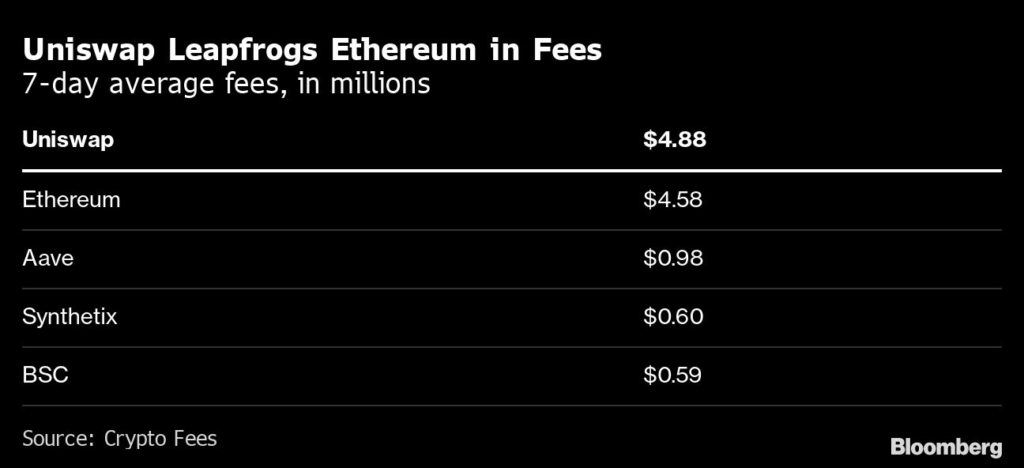
(Bloomberg) — In a surprise twist, Uniswap — the world’s biggest decentralized crypto exchange — is now generating more in user fees than Ethereum, the blockchain where it got its start. 

Over the last seven days, Uniswap’s average total user fees have grown to about $4.1 million, surpassing Ethereum’s $3.9 million, according to data tracker Crypto Fees. Ethereum has usually been the bigger money-maker, hosting thousands of projects — including Uniswap — that pay so-called gas fees to conduct transactions on its blockchain. To put this in perspective, on Jan. 1, Ethereum earned nearly 10 times more fees than Uniswap, data from Crypto Fees shows.

“When combined with heightened volatility over the last few weeks, Uniswap volumes and therefore fees have increased heavily as trading has picked up everywhere,” said Katie Talati, director of research at Arca, a crypto and blockchain-focused asset manager. The firm does not disclose whether it owns Uniswap’s Uni token. 

The uptick in trading comes in the midst of a crypto bear market, where coin prices have been swinging wildly in recent weeks. Ether plunged 66% and Bitcoin dropped about 50% between June 7-18, following a solvency crisis at crypto lender Celsius Network and liquidity troubles at hedge fund Three Arrows Capital, plus the related fallout for other crypto funds and apps. 

“Meanwhile, usage on Ethereum has dropped massively,” said Talati, noting that many applications and users are migrating to so-called Layer 2 blockchains, which are built to ease congestion on Ethereum and also have lower transaction fees. During the sale of Otherside nonfungible tokens on May 1, users wound up paying more for Ethereum gas fees than for actual NFTs. 

Layer 2 chains like Polygon and Arbitrum — which already host Uniswap and a growing number of apps — can provide some relief for users frustrated with Ethereum’s price spikes during high demand periods. 

Since hitting a peak last year, the number of transactions on Ethereum has been trending downward, according to analytics platform Etherscan. This is partially due to traders moving away from financial apps hosted on the network amid the broader crypto rout.

“I wouldn’t be surprised to continue to see this dynamic play out, especially as more Ethereum usage moves to Layer 2,” said Henry Elder, head of decentralized finance at Wave Financial, an investment and asset management firm focused on digital assets and blockchain technology. “I think the dynamic flips back to high Ethereum revenues once we move back into a bull market, though.”

In the case of Uniswap, fees usually go to liquidity providers, or users who provide tokens in various trading pools, whereas Ethereum fees go to miners whose computers help order transactions on the chain. 

But this clear distinction is likely to blur later this year, when Ethereum is upgraded to a proof-of-stake protocol that gets rid of miners altogether and orders transactions via coins that users deposit in locked wallets. Until Ethereum undergoes yet another software upgrade, possibly next year, depositors cannot take their locked Ether out. This means that in the meantime, becoming a liquidity provider on Uniswap may be more appealing for some risk-takers than becoming a staker on Ethereum.

More stories like this are available on bloomberg.com

©2022 Bloomberg L.P.

GM’s Cruise Plots Quick Expansion After Debuting Robotaxi Fares

(Bloomberg) — General Motors Co.’s Cruise LLC plans to expand its robotaxi business to all of San Francisco this year and move into other cities beginning in 2023, a growth push that comes on the heels of its first self-driving vehicle rides to carry paying customers.

The company started charging fares Wednesday night for rides covering one-third of the city between 10 p.m. and 6 a.m.

It marked a significant milestone, both for Cruise and driverless technology. Few companies have been able to get cars on public roads without a safety driver, and even fewer are charging for it. GM’s plan is to expand the business in the next several years en route to a target of $50 billion a year in revenue by the end of the decade.

Read more: GM-Backed Cruise Sees Big Profits From Its $50 Billion Push

“It’s a Wright Brothers moment,” Cruise Chief Operating Officer Gil West said in an interview. “If you fast forward to next year and beyond, it’s rapid scaling of the business.”

The company aims to grow its fleet from about 100 cars currently to thousands of robotaxis in the next year or two, he said. Cruise also intends to next expand operations in San Francisco to 24 hours a day and eventually enter new cities across the state. It’s starting to run pilots in Tokyo with Honda, which owns a small stake in the company, and has announced plans to start service in Dubai next year. 

Cruise will explore possibilities in the US Sun Belt, said people familiar with the matter who asked not to be identified. States like Arizona, Texas and Florida have weather that is easier for autonomous cars to drive in and a more relaxed regulatory environment.

The expansion plans come weeks after Cruise was granted permission by the California Public Utilities Commission to charge fares.

Few Charging Fares

Besides Cruise, Alphabet Inc.’s Waymo is one of the few companies charging for rides, with operations in Chandler, Arizona. AV startup Motional also gets paid for trips in Las Vegas, said Sam Abuelsamid, principal research analyst with Guidehouse Insights.

Cruise aims to reach $50 billion in revenue by 2030 and challenge Uber Technologies Inc. and Lyft Inc. in the ride-hailing business. GM, which owns 80% of Cruise, believes it can be a big contributor to the automaker, helping the parent double revenue by the end of the decade.

The robotaxi company expects to make tens of thousands of dollars per car per year, West said.

The vehicles have cameras in them to alert Cruise staff if a car needs to come in for cleaning between rides. They get a deeper cleaning after running for the night, said West, who was formerly chief operating officer at Delta Air Lines Inc.

He said Cruise expects its average fare to be just under $5 a mile, which is a bit lower than Uber and Lyft charge in San Francisco. There is a $5 base fare for all rides, so longer routes have a lower per-mile cost.

More stories like this are available on bloomberg.com

©2022 Bloomberg L.P.

Amazon’s Alexa Impersonates Grandma, Creeping Out the Internet

(Bloomberg) — “Creepy.” “Morbid.” “Monstrosity.”

Those were just some of the reactions that poured in over social media when Amazon.com Inc.’s Alexa digital assistant impersonated a grandmother reading an excerpt from “The Wonderful Wizard of Oz.”

It all started innocently enough, with Alexa chief scientist Rohit Prasad trying to demonstrate the digital assistant’s humanlike mein during a company presentation Wednesday. Prasad said he’d been surprised by the companionable relationship users develop with Alexa and wanted to explore that. Human characteristics like “empathy and affect” are key for building trust with people, he added.

“These attributes have become more important in these times of the ongoing pandemic, when so many of us have lost someone we love,” he said. “While AI can’t eliminate that pain of loss, it can definitely make their memories last.”

The presentation left the impression that Amazon was pitching the service as a tool for digitally raising the dead. Prasad walked that back a bit in a subsequent interview on the sidelines of Amazon’s re:MARS technology conference in Las Vegas, saying the service wasn’t primarily designed to simulate the voice of dead people.

“It’s not about people who aren’t with you anymore,” he said. “But it’s about, your grandma, if you want your kid to listen to grandma’s voice you can do that, if she is not available. Personally I would want that.”

As the presentation ricocheted around the web, the creep factor dominated the discourse. But more serious concerns emerged, as well. One was the potential for deploying the technology to create deep fakes — in this case using a legitimate recording to mimic people saying something they haven’t actually vocalized. 

While Amazon didn’t say when the new Alexa feature would be rolled out, similar technology could eventually make such mischief a lot easier. Prasad said Amazon had learned to simulate a voice based on less than a minute of that person’s speech. Pulling that off previously required hours in a studio. 

More stories like this are available on bloomberg.com

©2022 Bloomberg L.P.
Distressed Crypto Broker Voyager Sets Limits on Withdrawals

(Bloomberg) — Crypto brokerage firm Voyager Digital Ltd. is limiting customer withdrawals from its platform to $10,000 and to 20 transactions during a 24-hour period. 

The New York-based firm, which secured $485 million in loans in the past week from Alameda Research to shore up protection for customer assets, announced the limits on its website. The firm secured the funding after disclosing its exposure to the troubled crypto hedge fund Three Arrows Capital Ltd.

Voyager is among the crypto platforms that have faced liquidity issues in the wake of this year’s collapse in the prices of cryptocurrencies. Celsius Network and Bable Finance both recently froze withdrawals.     


More stories like this are available on bloomberg.com

©2022 Bloomberg L.P.

Pink Floyd Is Seeking $500 Million for Music Catalog Including ‘The Wall’

(Bloomberg) — Members of the rock band Pink Floyd are seeking at least $500 million in a deal for their music catalog, according to people familiar with the talks, which would be one of the largest sales in music history.

The group known for hits such as “Money” and “Comfortably Numb” is selling its recording and songwriting catalog, as well as the power to create merchandise based on the band, said the people, who asked not to be identified because the talks are confidential. Patrick McKenna, who is representing the band in the process, didn’t respond to an email seeking comment.

McKenna has winnowed the list of potential buyers to four, said the people. The names include Warner Music Group Corp., Sony Music Entertainment and BMG. Sony and Warner already distribute some of Pink Floyd’s music.

Read more: Rock Stars Are Making Fortunes Cashing In on Their Old Songs

The British rock band released some of the most popular records ever, including “Dark Side of the Moon” and “The Wall,” two albums that defined music in the 1970s. The group has sold 75 million records in the US, the 10th most of any artist, according to the Recording Industry Association of America.

Many famous musicians have cashed in on a frothy market for song catalogs in recent years, capitalizing on interest from both music companies and financial firms. Bob Dylan sold his recordings to Sony Music in a deal estimated to be worth more than $150 million, and his song catalog to Universal Music in a deal for between $200 million and $300 million.

Investors are starting to grow wary of shelling out for music portfolios due to rising interest rates and uncertainty about the economy. But demand has held steady at the very top of the market.

Getting all of the members of Pink Floyd to agree on anything has been a challenge for decades. The band formed in 1965 under the direction of then lead singer Syd Barrett, who left three years later. Singer and bassist Roger Waters left the band in 1985 and later sued his fellow band mates over their use of the name. Waters and the rest of the crew have squabbled over the years as the band, led by guitarist David Gilmour, continued to release records. 

That is a big reason they chose McKenna, who runs the UK-based advisory group Ingenious Media, to guide them through the process.

More stories like this are available on bloomberg.com

©2022 Bloomberg L.P.
Close Bitnami banner
Bitnami