
Bloomberg

MicroStrategy Bulls Unfazed by Double Dose of Pain

(Bloomberg) — Shares of MicroStrategy Inc. have been hit hard this year as its once-winning approach of being a tech company that also holds billions of dollars in Bitcoin sends investors rushing for the exit. Analysts are holding fast in their bullishness.

Three of the four brokerages that follow the software company recommend buying the shares, with an average price target that’s more than triple where the stock closed Wednesday, according to data compiled by Bloomberg.

Under Chief Executive Officer Michael Saylor, MicroStrategy has spent about $4 billion on tokens as of March 31. While that was a hot strategy in the pandemic-fueled market boom — when tech stocks and Bitcoin surged to record heights — MicroStrategy is now mired in the historic selloff that’s hitting both areas, slumping 69% this year. That’s deeper than the Nasdaq 100 Index’s 29% decline and Bitcoin’s 55% drop.  

“MicroStrategy provides equity investors in particular with not only exposure to Bitcoin, which currently they don’t have many efficient ways to access,” said Mark Palmer, an analyst at BTIG with a buy rating. The company also offers an operating business that generates cash with which to buy more Bitcoin, he said. 

This isn’t MicroStrategy’s first rollercoaster ride. Its shares soared more than 3,400% during the dotcom bubble and subsequently wiped out all those gains during the collapse. The Covid-19 pandemic, which saw the rise of the retail trader, evoked memories of a similar rally thanks to Bitcoin’s surge: At one point, its shares were up more than 1,200%.

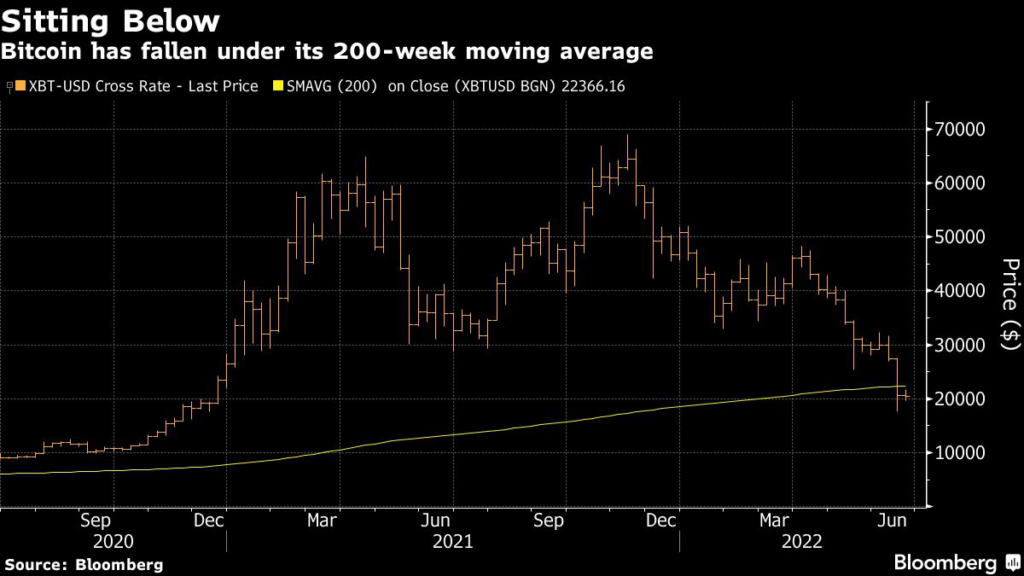
Now, they are on pace for their worst year since 2000, fueled by the crypto rout and bear-market plunge in tech. The Federal Reserve triggered the decline in both by aggressively raising interest rates to cool inflation, fueling concern that the economy is headed for a recession. Just last week, the world’s largest cryptocurrency plunged below $20,000 for the first time since late 2020.

The crypto crash generated losses for Saylor of about $3.5 billion, according to the Bloomberg Billionaires Index. His 2.36 million MicroStrategy shares and options peaked in February 2021, when they were worth nearly $3 billion. They’ve since plunged 86% to $355 million. Meanwhile, the Bitcoins he said in October 2020 that he owned are worth $350 million, down 71% from their $1.22 billion peak.

Palmer’s share-price target of $950 is the highest among analysts covering the stock, more than five times MicroStrategy’s closing price of $170.91. He also estimates that Bitcoin will more than quadruple from its current level to hit $95,000 by 2023.

Brent Thill of Jefferies is the only non-bull on MicroStrategy, rating the stock hold with a $180 price target. Management needs to focus on the core software business, which declined 3% in the first quarter, Thill wrote in a June 16 note. 

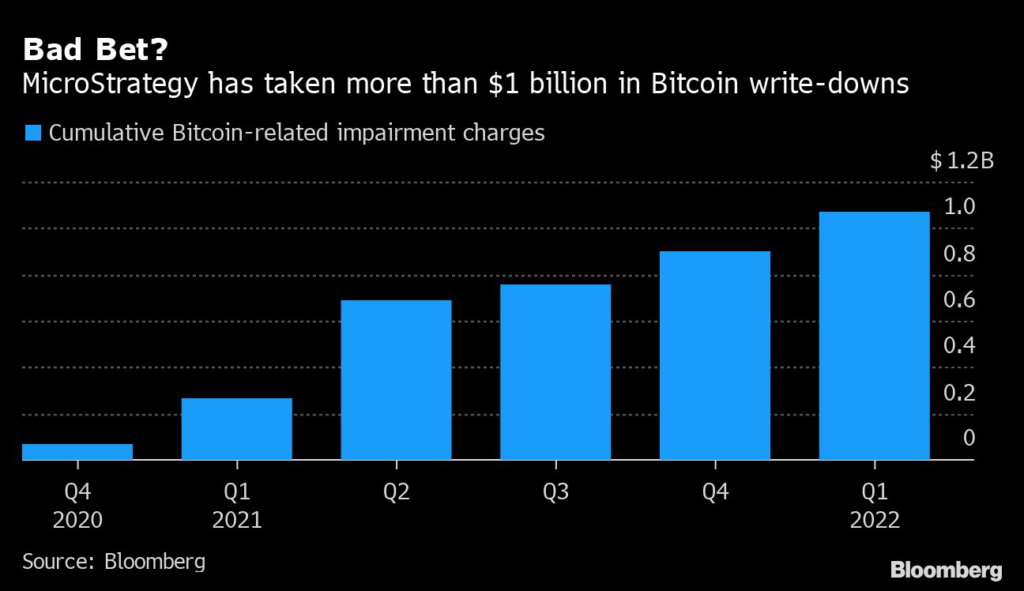
Still, it’s hard to ignore the potential multibillion-dollar writedowns that the company could be facing. Total impairment charges on MicroStrategy’s Bitcoin holdings already reached roughly $1 billion at the end of the last quarter. The company has also come under scrutiny due to the possibility that it could face a margin call on a $205 million loan it took out this year to buy more Bitcoin. 

Saylor, however, told investors this month not to worry about a potential margin call, saying the company has ample collateral to pledge if necessary.

Tech Chart of the Day

Apple Inc. and Saudi Aramco have been tightly contesting the title of the world’s most valuable company as major forces shake up the global economy. In May, the crude producer overtook the iPhone maker, helped by the surge in oil prices while concerns around rising inflation triggered multiple routs in technology stocks. Apple shares were trading higher on Thursday, putting the stock on course for its best week in June. 

Top Tech Stories

  • Uber Technologies Inc. explored options for its Indian ride-hailing business, including a sale, but suspended discussions after tech startup valuations cratered, people familiar with the matter said.
  • Elon Musk said Tesla Inc.’s new plants in Germany and Texas are losing “billions of dollars” as the electric-vehicle maker tries to ramp up production.
  • SumUp has achieved an 8 billion euro ($8.4 billion) valuation in its latest funding round, raising 590 million euros in a deal split between debt and equity in a bid to develop new products and gain clients.
  • Toshiba Corp. shares jumped Thursday after Reuters reported bidders are considering offering up to 7,000 yen per share to take the company private, which would value the deal at about $22 billion.
  • JPMorgan Asset Management is doubling down on China tech stocks after enduring a tumultuous selloff, betting that an easing of regulatory crackdowns and attractive valuations will pay off well.
  • Meta Platforms Inc. Chief Executive Officer Mark Zuckerberg said he expects people will eventually spend “hundreds of dollars” each buying digital goods in the metaverse, including things like clothes for their virtual avatars.
  • SoftBank Group Corp. founder Masayoshi Son is used to praise and encouragement from shareholders. But the company’s loss of $34 billion in market value over the last year is a test for even his most faithful admirers when they gather for the annual shareholders’ meeting on Friday.


(Adds stock move in last paragragh.)

More stories like this are available on bloomberg.com

©2022 Bloomberg L.P.

Uber Is Said to Have Explored Sale of India Ride-Hailing Arm

(Bloomberg) — Uber Technologies Inc. explored options for its Indian ride-hailing business, including a sale, but suspended discussions after tech startup valuations cratered, people familiar with the matter said.

The US company began weighing alternatives and reached out to several interested parties after recognizing it had limited potential for profitable expansion in the country, the people said, asking not to be named as the information isn’t public. It pondered a stock swap with local companies or even a pullout, before a global equity market rout upended plans, the people added. A stock deal was favored in exploratory talks as that would allow Uber to retain a foothold in India, the people said. An outreach came as recently as this year, one of the people said. 

Uber disputed the idea it had considered retreating from India. 

“Bloomberg’s reporting is categorically false. We have never explored exiting India — not even for a minute,” company spokesperson Ruchica Tomar said in an emailed statement. Uber remains committed to India and continues to hire people “aggressively.”  

Read more: Ride-Hailing Firm Ola Said to Pick Banks for $1 Billion IPO

“There is zero truth to this story — wasn’t explored, wasn’t considered, discussions didn’t happen, at any level,” Uber’s Chief Executive Officer Dara Khosrowshahi tweeted after publication. 

Uber and its local-rival Ola had been struggling to eke out a profit in a rapidly growing but price-sensitive market, where constant driver attrition was pressuring margins. A sale to a local operator could have mirrored similar deals it struck with Didi Global Inc. in China and Grab Holdings Ltd. in Southeast Asia, where Uber ceded the markets but kept an equity stake in the dominant local player to tap future growth. The maneuvers ended costly turf wars waged with driver incentives and cash subsidies.

Uber, whose shares have gyrated wildly since its 2019 IPO, has hived off money-losing businesses to achieve its goal of being consistently profitable. In May, it delivered a positive outlook for earnings, signaling the company plans to capitalize on robust ride demand without compromising profits by focusing on product changes, rather than incentives, to address a driver shortage.

India and Japan are the sole major remaining Asian markets for Uber, which has scaled back sharply since the tumultuous days of former chief Travis Kalanick. The San Franciso-based company started services in India in 2013 and now offers ride-hailing in almost 100 cities across the country, its website showed.

Conversations around an India deal had been preliminary and the company could decide not to revisit those options, the people said.

Uber also sold its food-delivery business in India to local rival Zomato Ltd. in 2020 in return for a stake in the local startup. The US giant now competes mainly with Ola, which had selected bankers to prepare for an initial public offering in Mumbai, Bloomberg News reported last year. Uber announced in May that it would add 500 tech workers this year to its Bangalore and Hyderabad engineering centers.

The Gig Economy’s Political Reckoning Has Arrived: QuickTake

(Updates with reaction from Uber’s CEO in fifth paragraph.)

More stories like this are available on bloomberg.com

©2022 Bloomberg L.P.
Ukraine Latest: Kyiv Says US Precision Rocket Launchers Arrive

(Bloomberg) — The Kremlin said a peace deal with Ukraine isn’t possible until Kyiv accepts all its demands — leaving conditions at a stalemate as Russia’s invasion nears the four-month mark. Precision artillery systems have arrived in Ukraine from the US.

The timeline for Ukraine to achieve EU membership will hinge on the country’s ability to enact reforms, as well as the course of the war, a top aide to President Volodymyr Zelenskiy said. A formal move by European Union leaders to grant candidate status to Kyiv after intense lobbying is expected to come at the bloc’s summit in Brussels starting Thursday. 

German Economy Minister Robert Habeck will trigger the second stage of the country’s three-phase gas-emergency plan later on Thursday, according to a person familiar with the plan.  

(See RSAN on the Bloomberg Terminal for the Russian Sanctions Dashboard.)

Key Developments

  • Spain’s Big Defense Push Hinges on Creating a National Champion
  • Germany a Step Closer to Gas Rationing With Heightened Alert
  • Russia Faces Fresh Bond Deadline With Possible Default Days Away
  • Megayachts Running Low on Safe Harbors as Russia Sanctions Bite
  • Europe Industries Cut Gas Use as Continent Saves Fuel for Winter
  • Cold Winter Could Push Europe Toward Gas Supply Shortages

On the Ground

Ukrainian air defense downed two cruise missiles targeting Odesa on Thursday, the city council said on Telegram. Three cruise missiles launched from occupied Kherson targeted the city of Mykolayiv, hitting industrial and social infrastructure and injuring one person.“Heavy explosions” were heard in the southern seaport, its mayor said. A day earlier Mykolayiv faced a large-scale rocket attack. “A threat of artillery shelling has been announced in the city,” the mayor wrote on his Telegram account, urging residents to go to shelters “immediately.” Russian troops seized two more villages south of Lysychansk, in Luhansk, a stronghold Kyiv relies on in its defense in that area. 

(All times CET)

US Long-Range Rocket Launchers Arrive in Ukraine (2:47 p.m.) 

US high mobility artillery rocket systems, or HIMARS, have arrived in Ukraine, Defense Minister Oleksii Reznikov said in a tweet. 

The delivery is part of an effort to provide heavy weapons to Ukraine to counter Russia’s firepower. President Joe Biden promised the HIMARS as part of an announcement of new military aid this month. 

HIMARS have a “recognized and proven range up to 300 kilometers” (186 miles) according to their manufacturer, Lockheed Martin. 

Zelenskiy Calls on Israel to Do More (13:30 p.m.)

The Ukrainian president said he regretted Israel’s reluctance to join sanctions against Russia in a video address to The Hebrew University of Jerusalem community. While thanking Israel for medical aid, Zelenskiy said there was a lack of support to help Ukraine defend itself. Israel has significant ties with both Russia and Ukraine, and its government has been adopting a neutral stance since Putin’s invasion.

Kremlin Says Peace Possible if Kyiv Accepts Demands (12:40 p.m.)

Russia is ready to agree to a peace deal with Ukraine if it accepts all of Moscow’s demands, President Vladimir Putin’s spokesman said. “As far as the peace plan is concerned, it’s only possible after Ukraine fulfills all the conditions of the Russian side,” Dmitry Peskov told reporters on a conference call on Thursday, Interfax reported.

Negotiations between Russia and Ukraine on a cease-fire and peace deal have been effectively frozen since April. In addition to demanding that Kyiv give up its ambitions to join NATO and declare its neutrality, Russia wants to keep territory it’s captured since its February invasion of the neighboring state.

EU Council President Expects Ukraine Candidacy Status (9:50 a.m.)

Charles Michel is “confident” that European leaders will grant Ukraine and Moldova EU candidacy status today. “This is a decisive moment for the European Union,” the president of the European Council told reporters in Brussels before the start of a two-day summit. “Today’s decisions will impact our future, our stability, security and prosperity.”

Europe’s Offshore Wind Industry in Major Ramp-Up (9:44 a.m.) 

Dutch power grid operator TenneT Holding BV has launched a tender to build the infrastructure that will speed the construction of North Sea wind farms as Europe looks to cut its dependence on Russian energy imports.

The company plans to enter agreements worth as much as 30 billion euros ($31.7 billion), a sign that Europe is following through on plans to rapidly ramp up renewable power. 

Europe’s Top Economies Slow Significantly (9:40 a.m.)

Growth in Germany and France slowed sharply as manufacturers suffered from a dearth of demand, increasingly strained supply chains and surging prices.

Reports on Thursday signaled that, for now, economic activity is still being supported to some extent by workloads built up earlier in the year. But the range of challenges confronting the world economy has led to worries that a recession is on the horizon.

European stocks fell on Thursday, with miners and energy firms leading the decliners in the Stoxx Europe 600 Index. 

Germany’s a Step Closer to Gas Rationing (9:35 a.m.) 

German Economy Minister Robert Habeck will trigger the second stage of the country’s three-phase gas-emergency plan later on Thursday, moving Europe’s biggest economy to the “alarm” level following steep cuts in supplies from Russia, according to a person familiar with the plan.

The heightened alert gives the government the option of enacting legislation to allow energy companies to pass on cost increases to homes and businesses, while some coal-fired power plants could also be reactivated to help minimize gas consumption. The third and highest “emergency” level would involve state control over distribution. 

Ukraine’s EU Membership Timeline Depends on War, Reform (9:00 a.m.)

Kyiv sees “positive trends” for Ukraine to get EU candidate status, Zelenskiy’s deputy chief of staff, Ihor Zhovkva, said in an interview on Bloomberg Television as the bloc’s summit kicks off. 

“Ukraine should become a candidate country for EU membership and then move further on the path to the integration with the European Union,” Zhovkva said. He warned that negotiations might be tough and difficult. While much depends on the course of the war, the pace of reforms will also be critical, he said. 

Zhovkva said Moscow would need to withdraw its troops to the lines of Feb. 23 to resume diplomatic talks. There are no talks planned between Ukraine’s Zelenskiy and Russian President Vladimir Putin.

Russia Faces Fresh Bond Deadline (6:00 a.m.)

Another pressing Russian bond deadline looms Sunday night on previously missed payments from late May. Those funds — about $100 million of bond coupons — are stuck due to international sanctions and the grace period to find a solution expires at the end of June 26. At that point, Russia will effectively be in default, unless it somehow gets payments through to sufficient holders of the debt.

Billions of dollars of energy revenue pour into Kremlin coffers each week but the country has failed to meet the deadlines because mounting sanctions are cutting off avenues to transfer the cash.

Read more: Russia Faces Fresh Bond Deadline With Possible Default Days Away

Megayachts Running Low on Safe Harbors (1:00 a.m.)

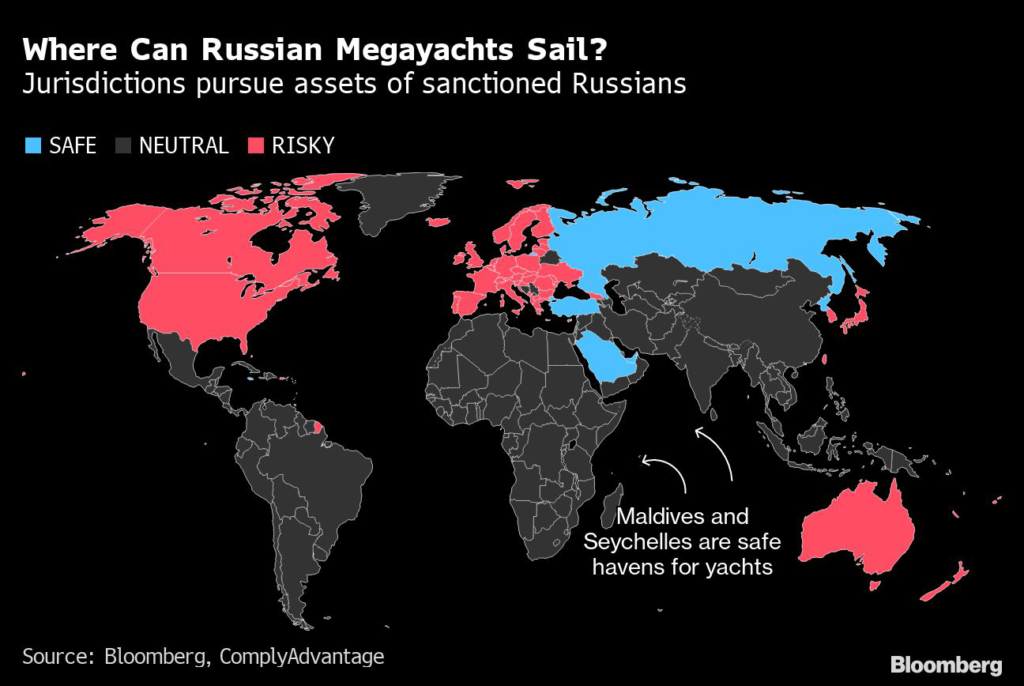
Russian tycoons are running out of places to park their floating palaces, four months after their country’s invasion of Ukraine. The US and Europe are going after their superyachts, villas and other assets because of their ties to Russian President Vladimir Putin. Already, more than a dozen boats worth more than $2.25 billion have been seized by the US, EU nations and willing allies — such as Fiji.

Fearful of having their yachts seized, owners have sent them to a small number of locales still considered friendly — allowing the vessels to dock or hang around unbothered — including Dubai in the United Arab Emirates, Turkey and the Maldives, according to Spire Global Inc., a data and analytics firm that uses satellite technology to track maritime activity. 

Read more: Megayachts Running Low on Safe Harbors as Russia Sanctions Bite

Von der Leyen Praises Ukraine Before Council Decision (5:15 p.m.)

Ukraine implemented about 70% of EU rules, norms and standards, European Commission Ursula von der Leyen said in a speech in the European Parliament. She praised the “immense progress that Ukraine’s democracy has achieved,” but emphasized that more work is needed to fight corruption and loosen the grip of oligarchs on the Ukrainian economy. 

Expressing her support for Kyiv’s EU candidacy status, von der Leyen said that “it is now up to the European Council to decide, and live up to the historic responsibility we are confronted with.”  

Germany Plans Conference to Set Up Ukraine Marshall Plan (4:20 p.m.)

Chancellor Olaf Scholz said Germany and the EU will jointly host an international conference with donors and experts later this year to discuss a multibillion-euro reconstruction plan for Ukraine.

“We have to agree on this — also with the advice of experts and scientists — how such a Marshall Plan for Ukraine can look like, how we coordinate it internationally, how we will decide together on which investments help Ukraine to move forward the most quickly on its European path,” Scholz told lawmakers in Berlin.  


More stories like this are available on bloomberg.com

©2022 Bloomberg L.P.
JPMorgan Says Retail Investors Are Finally Bailing on Stocks

(Bloomberg) — Some of the last bulls at the party are finally yielding to the bear market, bailing from stocks at the fastest rate in nearly two years.

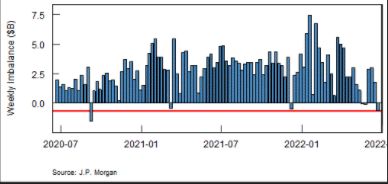
Retail investors, who’d almost always bought the dip since the pandemic crash, exited shares in the past week, with sales reaching the heaviest since September 2020, according to an estimate by JPMorgan Chase & Co. based on public data on exchanges.

The exodus marks a notable shift for small-time traders who mostly hung on during the $15 trillion selloff this year. Sentiment is finally cratering with losses piling up in their favorite stocks as well as cryptocurrencies, says JPMorgan strategist Peng Cheng. 

“There’s been a trend of weakening demand,” Cheng said in an interview. “It’s fair to say that retail has capitulated.”

The disaffection is welcome news to market watchers who focus on signs of cathartic selling that they say would indicate the downdraft has reached its bottom. From hedge funds to quant traders, professional investors have slashed their equity exposure to multiyear lows. Now, the day-trader army is joining the crowd of bears after spending many months clashing with the pros.  

Not that gambler spirits have been snuffed out entirely among the retail crowd, many of whom cut their investing teeth during Covid lockdowns, armed with government stimulus checks. On Wednesday, they piled into shares of Revlon Inc., a cosmetics maker that this month filed for bankruptcy, sparking a 34% surge in the stock. 

But broadly speaking, the once-euphoric buying is cooling. Retail demand tracked by JPMorgan has been below one-year average for the last eight weeks. In the options market, bearish puts are in vogue, a departure from last year, when bullish calls were sought frenetically for quick profits. 

It’s not hard to see why amateurs are finally giving up. With the S&P 500 dropping as much as 23% from its peak and the Nasdaq 100 down more than 30%, the gains that newbie traders once took pride in are quickly evaporating. As of June 13, all their trading profits made during the meme-stock era had been wiped out, JPMorgan estimated. 

“They were a significant driver of the inflated valuations we saw in tech and crypto,” said Michael Wang, chief executive officer at Prometheus Alternative Investments. “The reality is retail tends to buy the most at the top and the least at the bottom. We’ve seen this before in pretty much every market cycle, including the dot-com crash.”

More stories like this are available on bloomberg.com

©2022 Bloomberg L.P.

Tesla and Volkswagen Square Off in Duel For Electric-Car Dominance

(Bloomberg) —

McDonalds versus Burger King. Apple versus Microsoft. Coca-Cola versus Pepsi. The business world is riddled with rivalries. A new one may be taking shape as Volkswagen tries to unseat Tesla as the leading maker of electric cars.

VW is in a “good second position” behind Tesla on EVs and making progress on battery production, charging infrastructure and software, Chief Executive Officer Herbert Diess said Wednesday at a tech conference in Berlin. “We think we can close the gap a little bit in the next months,” he said. Europe’s biggest automaker could overtake its US rival as soon as 2024, Bloomberg Intelligence analysts predicted last week.

Elon Musk disputed this Tuesday during the Qatar Economic Forum, telling Bloomberg News Editor-in-Chief John Micklethwait that he “would not agree” with the forecast. He instead praised Chinese carmakers before saying that at Tesla, “we don’t really think about other competitors.”

I’m not so sure about that. Many of Tesla’s competitors long laughed it off as an upstart on feeble financial footing before their electric about-faces, so it must feel good to still be miles ahead when it comes to selling battery-powered cars. But Musk himself has acknowledged VW is rapidly electrifying, and has praised Diess for doing so. He’s clearly paying close attention.

Tesla delivered more than 936,000 EVs worldwide last year, while VW sold some 453,000 fully electric cars. Musk has christened new factories this year in Austin, Texas, and near Berlin — the latter is basically in VW’s backyard — and Tesla is on track to produce more than 1.5 million vehicles this year, Musk said in April.

Still, the Germans are pushing hard to catch up. VW has earmarked some €52 billion ($55 billion) through 2026 to develop and produce electric cars. This includes setting up a new €2 billion EV factory in Germany and plans to build up six battery factories across Europe, several of which will involve partnerships. It’s also making a bold move to gain market share in the US, where it’s reviving the defunct brand Scout with rugged electric SUV and pickup models.

  • Do you own an electric car? US residents, Bloomberg Green wants to learn more about your experience with EVs. Take our brief survey.

It’s noteworthy that Tesla’s Austin and Berlin plants have been experiencing teething problems, losing “billions of dollars” as they try to ramp up, Musk said in a May 31 video interview released Wednesday. During the Qatar event, Musk detailed his decision to cut costs by dismissing about 10% of Tesla’s salaried employees over the next three months, or about 3.5% of its global workforce. VW and Tesla have also suffered from Covid-related lockdowns at their factories in China, but recent remarks from Musk and Diess suggest the situation is improving.

Tesla still trumps VW on Wall Street. Even after the recent rout, the US carmaker is valued at around $734 billion — more than eight times VW’s market capitalization. The Germans do have an ace up their sleeve making slick sports cars.

VW is sticking to plans to list its Porsche unit in the fourth quarter, CFO Arno Antlitz told my colleague Elisabeth Behrmann on Wednesday at a Bloomberg-organized finance conference in Frankfurt. The Porsche listing is poised to be one of Germany’s biggest-ever IPOs and could value the business at as much as €90 billion. Porsche is a highly profitable brand and is far along in its electric transformation, with its Taycan EV already outselling the legendary 911.

It’s a bold move charging ahead with the share sale given that IPOs globally have slowed dramatically this year. Investors are shying away from risks because of the war in Ukraine, rising interest rates and runaway inflation. Swiss firm ABB on Monday postponed the $750 million listing of its EV charging business until the market improves.

Antlitz pitched Porsche as a safe haven for investors eager to sidestep the drop in tech and EV stocks, arguing the brand has proven resilient in the face of disruptions.

“There’s still capital out there and there’s a lot of skepticism about investing capital in technology companies, in new ventures,” he said. Porsche, on the other hand, “is very solid.”

Like getting this newsletter? Subscribe to Bloomberg.com for unlimited access to trusted, data-driven journalism and subscriber-only insights.

More stories like this are available on bloomberg.com

©2022 Bloomberg L.P.
World’s Dirtiest Oil and Gas Fields Are in Russia, Turkmenistan and Texas

(Bloomberg) — Oil and natural gas fields in Russia, Turkmenistan and Texas are the most climate-damaging on Earth, according to a first-of-its kind analysis that looks at greenhouse-gas emissions across entire supply chains and finds they vary widely. The dirtiest fields emit more than 10 times as much carbon dioxide equivalent as the least emissions-intensive sites, it finds.

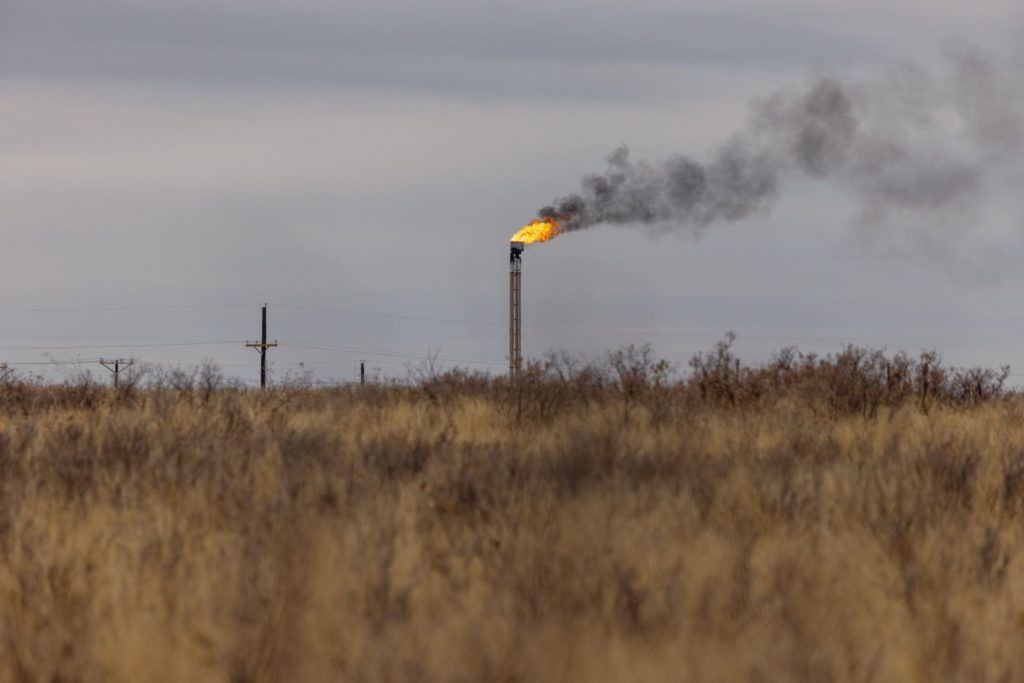
Released Thursday by the nonprofit Rocky Mountain Institute, the Oil Climate Index plus Gas (OCI+) web tool ranks 135 global oil- and gas-producing resources — which together account for half of the world’s supplies of those commodities — based on a full life-cycle analysis of their 2020 emissions. Russia’s Astrakhanskoye natural gas field has the biggest footprint across its supply chain because of prolific leaks on pipelines and other infrastructure “downstream,” according to the analysis. Turkmenistan’s South Caspian basin and the Permian Basin in West Texas rank second and third; the majority of their emissions arise “upstream,” during production. 

Created by researchers at RMI, Stanford University, the University of Calgary and Koomey Analytics, the OCI+ tool and an accompanying report conclude that significant fossil-fuel emissions occur not just at the point of combustion, but directly at the wellhead and during processing, refining, and transportation. RMI estimates that the US Environmental Protection Agency’s greenhouse gas reporting program undercounts oil and gas industry emissions by a factor of two. The project received funding from the philanthropic organization of Michael Bloomberg, the founder and majority owner of Bloomberg LP, which owns Bloomberg News. 

  • Do you own an electric car? US residents, Bloomberg Green wants to learn more about your experience with EVs. Take our brief survey.

Methane, a greenhouse gas that is the primary component of natural gas and a powerful global-warming agent, accounts for more than half of operational emissions at sites worldwide. Curbing the flaring and venting of the gas and ensuring that oil-field equipment is working properly can help significantly reduce upstream emissions, the report says, calling methane reductions “the highest priority for the oil and gas sector.” 

The initiative draws on years of research by academics and nonprofit institutions, public data and satellite images. It boils down to the questions, “Who has the worst barrel, and who are the suckers buying the bad stuff?” said Deborah Gordon, senior principal of climate intelligence at RMI, the research lead. That’s where the spotlight needs to be to combat climate change, she said. 

Oil and gas prices have surged after demand rebounded from the Covid-19 pandemic and due to dislocations caused by Russia’s war on Ukraine. Despite growth in renewable power generation, global reliance on fossil fuels is poised to grow before tapering amid a transition to alternatives like wind and solar. Yet the urgency to cut emissions has grown. A United Nations-backed panel of scientists recently warned that emissions must be significantly reduced by 2030 to help avoid the catastrophic impacts that would result from warming exceeding the Paris Agreement targets of 1.5° and 2° Celsius. 

The report recommends buying fuel locally as much as possible to save on transport-related emissions, but according to the OCI+ analysis, Europe might actually avoid some emissions by buying gas from the US that is super-chilled into liquid and shipped across the ocean rather than from Russia. Sourcing gas from Russia is “horrid” because of leaks, Gordon said: On the OCI+ digital emissions map, Russia’s pipeline system jumps out in bright yellow and orange due to concentrated methane emissions. (New York City and Boston, which have aging pipe infrastructure, show up as smaller, less intense hot spots, while Russia’s liquefied natural gas export terminal in Siberia is a blip.) 

For decades, policies have targeted reducing emissions from cars and power plants, which puts the responsibility on the consumer with little transparency on emissions from producers themselves, Gordon said. “Conventional wisdom is that the consumer is responsible for 86% of the emissions from the barrel.” But the research shows that’s not the case for the most polluting oil and gas fields, she said. 

The researchers also estimated a price for carbon, and OCI+ shows how accounting for life-cycle emissions would tack on more than $50 per barrel for the highest-emitting sites. If a fee reflecting the social cost to carbon were imposed today, the production-weighted average cost for the 135 fields would be $7 per barrel of oil equivalent, less than $1 for refiners and $4 for shippers, according to the analysis. The values are based on a cost of $56 per metric ton that was modeled by the US government. (Carbon fees can be adjusted in OCI+ to account for different scenarios.) 

Aging oil and gas fields become more GHG-intensive as more energy and water are needed to extract the fuel from underground. The average emissions of a typical large oil field will double over 25 years, according to past research. Two prime candidates for decommissioning are the Minas field in Indonesia and Wilmington in California, since they already require large injections, Gordon said. 

The web tool also breaks out the share of sites’ emissions from flaring, or burning off excess natural gas. This practice is notoriously common in the Permian Basin, where oil is the most profitable fuel and natural gas is a nuisance byproduct. 

“The Permian looks terrible,” Gordon said, but “if Texas cleans up its act and really focuses on not leaking methane and not flaring its gas, it will be there right at the top” of the lowest-emitting areas. 

More stories like this are available on bloomberg.com

©2022 Bloomberg L.P.

Swedish Startup Paves Way to Driverless Pod Tests on US Roads

(Bloomberg) — Electric truckmaker Einride AB has received approvals to test its driverless vehicle on public roads in the US, paving the way for the company to conduct a pilot with partner GE Appliances. 

The approval from the National Highway Traffic Safety Administration marks “the first time a purpose-built autonomous, electric truck without a driver on board receives public road permission,” Einride said Thursday.

The Swedish company’s driverless Einride Pod will be remotely monitored by a human operator, while transporting goods on public roads with mixed traffic. Initially it’s just one cabless pod on the streets as well as tests with teams at various warehouses for loading and unloading.

Einride and GE Appliances, a Haier company, partnered in October last year to implement Einride’s electric and cabless pods on a GEA campus in Louisville, Kentucky. The first tests took place on predetermined routes and a controlled environment.

“We believe that the technology needed for mass adoption of autonomy is here and ready now,” Einride Chief Executive Officer Robert Falck said in an email. “This NHTSA approval is a critical step to make sure the mass adoption of autonomous and electric, specifically for the US, is in the near future.”

The public road pilot will take place in the third quarter of 2022.

More stories like this are available on bloomberg.com

©2022 Bloomberg L.P.

CLO Trading Startup Is Now Allowing Investors to Cut Out Banks

(Bloomberg) — An online platform is now allowing money managers to trade collateralized loan obligations directly with one another, without banks standing in between. 

KopenTech, a firm that provides CLO refinancing, data analytics, and electronic trading services, has launched direct trading among investors, according to a statement seen by Bloomberg. The platform saw its first trade between two investors last Thursday, Jill Scalisi, chief engagement officer, said in an interview. 

The roughly $1 trillion CLO market, where leveraged loans are bundled into bonds, has for years remained largely manual. To sell a CLO, investors often solicit bids through multiple banks, which act as broker-dealers and try to find buyers for the debt. This process is often tracked manually and arranged through a combination of instant message chats, emails, or phone calls. 

“CLO trading has been done the same way for the last 20 years, and client-to-client trading has never happened before,” Scalisi said. “Now we are using technology to bring the CLO market into the 2.0 space.”

KopenTech’s KTX DirectBidding, a new feature on its trading platform, will likely compete with Octaura Holdings, an upcoming electronic trading platform for syndicated loans and CLOs recently formed by a group of seven banks, such as Citigroup Inc. and Bank of America Corp, along with Moody’s Corp.’s Moody’s Analytics. Octaura plans to debut the venue for loans first with the one for CLOs to follow, and ultimately hopes to expand to other credit market products, Bloomberg reported last week.

Investors have already been able to use the KopenTech platform to sell CLOs, with 15 broker-dealers on the platform participating in transactions. Now, investors have the ability to allow the potentially more than 150 other institutional buyside accounts on KopenTech to bid directly on the sale, Scalisi said. 

The process is anonymous and can be completed in under two hours, and the seller can choose the time-frame, Scalisi said. If the transaction ends up being between two investors, then a subsidiary of KopenTech that is a broker-dealer acts as the settlement agent, instead of a bank doing so. 

In early 2020, KopenTech launched an online auction process to allow some CLOs to cheaply refinance their obligations. While CLOs must have a provision in their documentation known as an applicable margin reset to use that auction process, the new DirectBidding feature does not need any special provisions in documentation, Scalisi said. 

The bidders also receive automated feedback on where their bid stands compared to others — for example, if their bid is the highest, or if it’s not even in the top three, Scalisi said.

Signing up for the platform is free, and traders pay fees on individual transactions. Scalisi declined to discuss the fees, but said that she expects them to be cheaper than current market standards. 

More stories like this are available on bloomberg.com

©2022 Bloomberg L.P.
JPMorgan China Fund Ramps Up Bets on Tech as Bullish Calls Grow

(Bloomberg) — JPMorgan Asset Management is doubling down on China tech stocks after enduring a tumultuous selloff, betting that an easing of regulatory crackdowns and attractive valuations will pay off well.  

Rebecca Jiang, who co-manages three China equity funds with almost $20 billion of assets, said she is becoming more optimistic on the sector as regulatory hurdles are being cleared, while macro policies offer support. The flagship China fund has snapped up shares of Alibaba Group Holding Ltd. and JD.com Inc. this year, according to filings as of end-May. 

“A clearer and more defined regulatory framework around these internet businesses is a definite positive,” Jiang said in an interview in Hong Kong this week. “The worst is over,” she said, adding that the firm has held on to most of its China tech holdings during a yearlong rout as the sector provides “critical value” to customers.  

Her views echo a growing trend in China’s market, where investors have been rotating back into tech stocks after a year of heavy selling that wiped out almost $2 trillion at the height of the rout. And with Chinese authorities going full throttle in their efforts to revive the economy, the nation’s stocks have attracted buyers even as major indexes around the world tumbled into bear markets.

In what’s been a regular occurrence this month, stocks in China and Hong Kong were once again the top performers in Asia on Thursday. Chinese stocks were also higher in premarket trading in US, with electric vehicle companies such as Li Auto Inc. and XPeng Inc. leading the gains.

China’s benchmark CSI 300 Index has advanced more than 7% in the past month, during which the MSCI gauge of global shares has fallen more than 5%. The Hang Seng index of Chinese tech shares, meanwhile, has surged more than 11% as authorities signaled a more lenient stance toward the sector. 

The outperformance in Chinese stocks is driven by loose monetary and fiscal policy settings, even as global central banks led by the Federal Reserve rush to raise interest rates to curb red-hot inflation. China’s policy determination was highlighted again as President Xi Jinping, in a keynote speech to a virtual BRICS Business Forum on Wednesday, pledged to meet economic targets for the year.

From strategists at Morgan Stanley to Jefferies Financial Group, the drumbeat of bullish China rhetoric has been growing louder by the day, with Deutsche Bank AG saying Wednesday that it expects to upgrade its view on the market in the coming months. More fiscal stimulus is likely before Xi secures a third term later this year, according to money managers at the German lender’s private banking unit.


To be sure, betting on big tech has entailed losses. Jiang’s China fund lost 20% last year, sliding down the ranking after finishing in the top 5% among its peers in 2020. While still down about 20% this year, its more recent returns have started to turn positive.  

READ: China Bulls Have Got It Wrong as Covid Zero Stays, Lombard Says

“Growth strategies have experienced a difficult period,” said Jiang. “But the regulatory headwinds and tightening could be a blessing in disguise for a lot of these internet companies. I think this helped investors to identify and appreciate their real values.”

Going forward, Jiang said she’s looking at opportunities in other beaten-down sectors such as property, as well as policy beneficiaries including infrastructure and new energy. 

Regulations on the property sector can “accelerate market consolidation and market share gains, particularly for the leading state-owned developers that are more conservatively run,” she said, adding that the fund has been increasing allocation in the sector. 

The gradual easing of Covid restrictions, coupled with continued monetary and fiscal support, means Chinese stocks will continue to outperform global peers for the rest of the year, according to Jiang. 

“Both from a global asset allocation perspective or on a standalone basis, the Chinese assets, equities we are talking here are looking attractive, particularly from the level it has fallen.”

(Updates with US premarket trading in fifth paragraph.)

More stories like this are available on bloomberg.com

©2022 Bloomberg L.P.

Bitcoin Advances as Concerns Over Deleveraging ‘Cascades’ Ease

(Bloomberg) — Bitcoin climbed as some executives and investors expressed optimism that the selling pressure that drove the largest token to an 18-month low over the weekend is abating.  

The largest cryptocurrency rose as much as 4.7% to $20,786, while Ether climbed as much as 6.4%. Bitcoin is now up 16% over the past few days, while many altcoins have seen far bigger gains. The crypto advance came even as European stocks were trading mixed. 

With several crypto lenders and at least one hedge fund struggling to meet their financial obligations, concerns had mounted that the wave of liquidations that sank cryptocurrencies last week would worsen. Binance Chief Executive Officer Changpeng Zhao on Wednesday offered a more upbeat assessment, saying the “cascades” of deleveraging are getting smaller. 

Crypto markets are struggling to consolidate after declining precipitously in recent months as the Federal Reserve hiked interest rates to fight inflation. The collapse of the Terra/Luna ecosystem and continued concern about hedge fund Three Arrows Capital Ltd. have further rattled investors. 

“Turbulence has returned to the cryptocurrency space as high inflation threatens the valuations of all risk assets, including equities,” Bitfinex analysts wrote in a note Wednesday. “As central banks continue to reverse previously accommodative policies, we can expect more volatility in the Bitcoin price.”

Options ‘Witching’

Attention is now turning to Friday’s weekly options expiry, the current quarter’s last which also coincides with futures expiries “to produce the final ‘witching’ in the first half of 2022,” according to Genesis Global Trading. 

“Options open interest on Deribit indicates over $2 billion in notional for Bitcoin and $1 billion for Ether options, making this the largest on-exchange expiry on the horizon by a wide margin (~39% and ~33% of total open interest on the exchange for BTC and ETH options respectively),” Ainsley To, Gordon Grant and Noelle Acheson of Genesis wrote in a note Wednesday.

The Bitcoin options expiring on Friday are mostly puts for strikes around current price levels, with notional open interest concentrated around the $20,000 strike, Genesis said. For Ether, there is comparable concentration around the $1,000 strike — mostly in puts, the firm added. 

The upcoming expiration may potentially influence price action, particularly if Bitcoin and Ether are right around the levels with a high concentration of options.

“Both Bitcoin and Ether saw lows under $20,000 and $1,000 respectively over the weekend,” the Genesis report noted. “Though they have since recovered above those levels, the options market will be one to watch should prices remain close to these thresholds going into Friday.”

More stories like this are available on bloomberg.com

©2022 Bloomberg L.P.

Close Bitnami banner
Bitnami