
Bloomberg

Apple Says US Bill Would Make App Store Less Secure, But Its Critics Aren’t So Sure

(Bloomberg) — Apple Inc. says an antitrust bill aimed at cracking open the app-store market will make iPhones less secure — even though Congress and some large firms already have Apple-approved tools that let them bypass the App Store. 

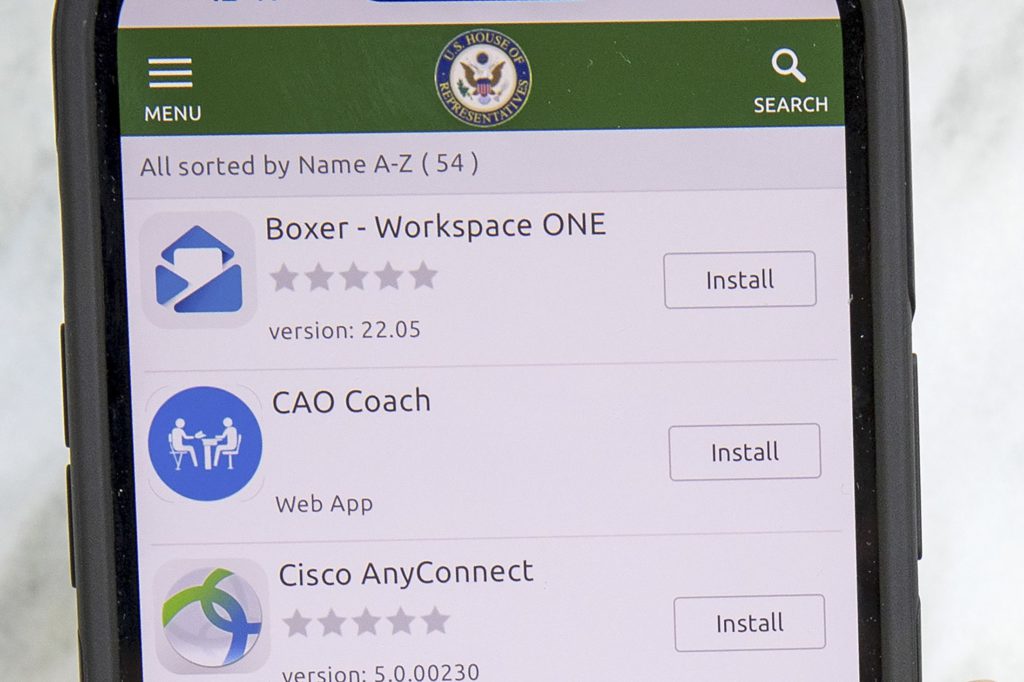
Although Apple says it’s the only company that can offer a secure App Store, the iPhone maker has long allowed members of Congress and large firms to bypass its strict controls and use alternatives to install third-party apps. The practice isn’t widely known, and is at odds with Apple’s opposition to the bill designed to break its mobile app-store duopoly with Alphabet Inc.’s Google.

Apple’s acceptance of some instances of so-called sideloading looms large as Congress nears a vote next month on the antitrust measures. While Apple maintains that outside apps would leave iPhone users vulnerable to malware and scams, antitrust advocates and cybersecurity specialists say the company’s protests appear to be more about defending its business model.

“Security is a giant red herring,” said Bruce Schneier, a fellow at the Berkman Klein Center for Internet & Society at Harvard University. “It will scare a lot of people. The goal is to protect the monopoly.”

Apple tightly controls the iPhone, requiring all mobile app downloads take place within its App Store, where it takes up to a 30 percent cut on digital sales. To get into the App Store, developers must submit apps for review by Apple’s team, which scrutinizes them to ensure compliance with the company’s rules on privacy and security. The company forbids developers from offering certain things like sexually explicit content, all-in-one cloud gaming services and cryptocurrency mining.

Earlier: Tech Giants Split in Lobbying Brawl Over the App Store’s Future

A 2020 House investigation found Apple has “monopoly power over software distribution on iOS devices” allowing it “supranormal profits.”

“Developers have no other option than to play by Apple’s rules to reach customers who own iOS devices,” the report found, just as iPhone owners “have no alternative means to install apps on their phones.”

In the wake of the House investigation, a bipartisan group of lawmakers introduced legislation aimed at opening up mobile app stores. The Open App Markets Act would require Apple and Google — whose Google Play is the most popular app store on Android mobile phones — to make it easier for users to download other app stores and switch the apps set as the defaults on phones.

“We remain concerned that this legislation threatens to break this model and undermine the privacy and security protections our users depend on,” said Fred Sainz, an Apple spokesperson. “The legislation, as originally drafted, created unintended privacy and security vulnerabilities for users. We believe the proposed remedies fall far short of the protections consumers need.”

Computers, including Apple’s Mac, have always allowed direct downloads of software. Google’s Android also lets users install apps without going through its built-in app store. Only Apple requires iPhone users to use its App Store for all mobile app downloads, said John Bergmayer, legal director for advocacy non-profit group Public Knowledge.

“Proponents of these regulations argue that no harm would be done by simply giving people a choice,” Apple’s Chief Executive Officer Tim Cook said at a privacy conference in April. “But taking away a more secure option will leave users with less choice, not more.”

But Apple sometimes makes exceptions to allow sideloading and apps that haven’t gone through its review process.

Lawmakers and staff go to a special, secured online portal to install apps, said Dan Weiser, who works for the House’s Chief Administrative Officer. That secured portal helps ensure members use licensed apps and have the most up-to-date versions, he said.

The House and Senate app catalogs, created using VMWare Inc’s cloud-based software, include popular apps like Webex and Zoom customized so members can securely participate remotely in hearings.

The catalog also contains custom apps specially designed for members of Congress, said Weiser. Those include apps to access the secured internal network for the House or Senate, email, live floor updates and calendars.

The House and Senate app catalogs were created as part of an effort to modernize the technology Congress uses, centralize its purchasing and ensure it’s secure from potential cyberattacks.

The Senate’s IT services are managed by the Sergeant at Arms, which didn’t respond to questions about its app catalog. But Senate aides and a contract solicitation published by the Sergeant at Arms’ office confirmed the chamber uses the same system. 

Apple acknowledged during a federal antitrust trial last year that it has long allowed some companies to bypass the App Store. Craig Federighi, a top Apple executive and engineer, testified that large organizations can get permission to distribute apps directly to their employees in lieu of going through Apple’s App Store and review process. This allows them to create apps specific to the company, he said, citing a 3D-modeling app that animation studio Pixar created for its designers as an example.

“These aren’t apps they want to sell to the general public,” Federighi said. “They want to provide it just to their employees. The Enterprise program is meant to give them the ability to do that.”

Those custom apps aren’t reviewed by Apple, he said. The arrangement, called the Apple Enterprise Program, has been around since 2008. 

The onus is on the company to make sure the apps are safe and secure enough to be downloaded and used by employees, he said. Apple trusts that companies wouldn’t want to harm their own employees by installing malware or other malicious apps onto corporate-owned devices, Federighi said.

Apple declined to respond to questions about how many companies in the U.S. use the program today, but said that “most” corporate clients now use Apple Business Manager — a more tightly controlled program introduced in 2019 where custom apps go through a limited review by Apple. The company also offers a service called TestFlight, where developers can distribute apps still in the works to a limited number users for testing. 

Apple said it has taken steps to limit “abuse” of its Enterprise program. For example, it cited a January 2019 incident where the company suspended Facebook for distributing an app to consumers through the Enterprise program that collected users’ data. Facebook later had its access restored.

Downloading software directly is less secure than downloading an app from Apple’s App Store but not the “security apocalypse” the company makes it out to be, Schneier said.

That lesser security “is what exists on everyone’s PC right now,” he said. “It is demonstrably true that Disney World is safer than a public park. That does not mean we give Disney a monopoly on all public parks in the country.”

More stories like this are available on bloomberg.com

©2022 Bloomberg L.P.
Clubhouse Tests Private Groups, Part of a Bid to Regain Relevance

(Bloomberg) — Clubhouse, the voice chat app that captured the attention of Hollywood and Silicon Valley early in the pandemic, is experimenting with a new feature that lets users join private groups. Testing of the tool has expanded in recent weeks, around the same time that Clubhouse reduced headcount and embarked on a change in strategy.

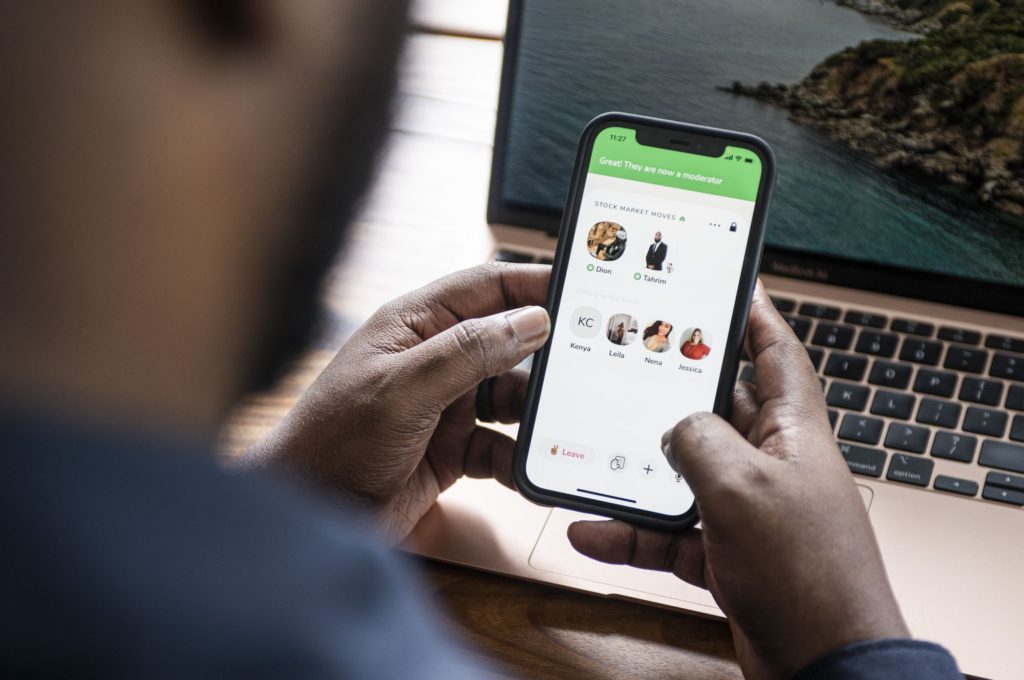
The feature, which previously went by the name Social Clubs and is now known as Houses, appeared on some users’ phones in recent weeks, said people who shared screenshots of their apps with Bloomberg. A Bloomberg reporter also used a version of the feature on the app. On Wednesday, the functionality appeared to be removed from some phones after Bloomberg requested comment from Clubhouse, but it remained active for other users.

Here’s how the Houses feature works: In addition to Clubhouse’s main “hallway” of rooms, which anyone can join as a listener, members of a House can see an additional set of active conversations not available to general users. In those rooms, all participants can unmute themselves and speak, whereas in most standard rooms, a moderator must give someone permission to talk.

With Houses, Clubhouse appears to be encouraging friendlier social interaction within private groups of users. Instead of only live, ephemeral audio rooms, members of a House can post in a written group chat, where messages stay visible for a week before disappearing. New members are encouraged to write a post introducing themselves. “Houses are private hallways where you can see more of  your favorite people and get to know friends-of-friends,” according to a description of the feature within the app.

It’s unclear how integral the feature is to what Clubhouse is billing internally as a forthcoming strategy shift. A spokeswoman for the company declined to comment. 

Clubhouse was created in 2020 and saw a sudden boom in popularity that coincided with Covid-19 lockdowns. The app lets people host casual, live audio discussions and became a home for conference-like talks and celebrity drop-ins — as well as some conversations that spun out of control and led to hateful content. Investors valued the business at $4 billion last year, but downloads soon began to flag. And it eventually found some new audiences overseas.

Clubhouse’s monthly downloads peaked in February 2021 for iOS users at 9.6 million, and hit a high in June 2021 for Android users at 6.8 million. Last month, those download rates were each less than 300,000 according to mobile app analysis firm SensorTower Inc.  

Paul Davison, the co-founder and chief executive officer, said last year that the app grew “way, way too fast” in its initial months. Davison, who has a background in creating trendy social apps, has a constant drive to experiment, as well as a belief that bringing people together with digital tools will create good in the world, former colleagues have said. He has talked in the past about Clubhouse potentially providing a platform for human gatherings of many kinds, including company all-hands meeting and political rallies.

Clubhouse is still trying to establish what exactly it’s about right now. The job cuts last month were a retreat from general interest programming, such as international, news and sports, Bloomberg reported. The latest experiment highlights the company’s interest in social networking. 

Clubhouse’s initial trendiness sparked several competitive products from established tech companies such as Twitter Inc., Spotify Technology SA, Meta Platforms Inc., and Microsoft Corp.’s LinkedIn. Meta’s product, Live Audio Rooms, is available for Facebook Groups, which allows creators to broadcast audio to a pre-existing group, similar to Clubhouse’s test feature.

More stories like this are available on bloomberg.com

©2022 Bloomberg L.P.
Ukraine Latest: Kyiv’s EU Prospects; Germany on Higher Gas Alert

(Bloomberg) — The timeline for Ukraine to achieve EU membership will hinge on the country’s ability to enact reforms, as well as the course of the war, a top aide to President Volodymyr Zelenskiy said.

A formal move by European Union leaders to grant candidate status to Kyiv after intense lobbying is expected to come at the bloc’s summit in Brussels starting Thursday. 

German Economy Minister Robert Habeck will trigger the second stage of the country’s three-phase gas-emergency plan later on Thursday, according to a person familiar with the plan.  

(See RSAN on the Bloomberg Terminal for the Russian Sanctions Dashboard.)

Key Developments

  • Spain’s Big Defense Push Hinges on Creating a National Champion
  • Germany a Step Closer to Gas Rationing With Heightened Alert
  • Russia Faces Fresh Bond Deadline With Possible Default Days Away
  • Megayachts Running Low on Safe Harbors as Russia Sanctions Bite
  • Europe Industries Cut Gas Use as Continent Saves Fuel for Winter
  • Cold Winter Could Push Europe Toward Gas Supply Shortages

On the Ground

“Heavy explosions” were heard in Ukraine’s southern seaport of Mykolayiv after the city faced a mass-scale rocket attack the previous day, its mayor Oleksandr Sienkevych said. “A threat of artillery shelling has been announced in the city,” he wrote on his Telegram-account, urging residents to go to shelters “immediately.” Russian troops seized two more villages south of Lysychansk, a stronghold Kyiv relies on in its defense in that area. 

(All times CET)

Kremlin Says Peace Possible if Kyiv Accepts Demands (12:40 p.m.)

Russia is ready to agree to a peace deal with Ukraine if it accepts all of Moscow’s demands, President Vladimir Putin’s spokesman said. “As far as the peace plan is concerned, it’s only possible after Ukraine fulfills all the conditions of the Russian side,” Dmitry Peskov told reporters on a conference call on Thursday, Interfax reported.

Negotiations between Russia and Ukraine on a cease-fire and peace deal have been effectively frozen since April. In addition to demanding that Kyiv give up its ambitions to join NATO and declare its neutrality, Russia wants to keep territory it’s captured since its February invasion of the neighboring state.

EU Council President Expects Ukraine Candidacy Status (9:50 a.m.)

Charles Michel is “confident” that European leaders will grant Ukraine and Moldova EU candidacy status today. “This is a decisive moment for the European Union,” the president of the European Council told reporters in Brussels before the start of a two-day summit. “Today’s decisions will impact our future, our stability, security and prosperity.”

Europe’s Offshore Wind Industry in Major Ramp-Up (9:44 a.m.) 

Dutch power grid operator TenneT Holding BV has launched a tender to build the infrastructure that will speed the construction of North Sea wind farms as Europe looks to cut its dependence on Russian energy imports.

The company plans to enter agreements worth as much as 30 billion euros ($31.7 billion), a sign that Europe is following through on plans to rapidly ramp up renewable power. 

Europe’s Top Economies Slow Significantly (9:40 a.m.)

Growth in Germany and France slowed sharply as manufacturers suffered from a dearth of demand, increasingly strained supply chains and surging prices.

Reports on Thursday signaled that, for now, economic activity is still being supported to some extent by workloads built up earlier in the year. But the range of challenges confronting the world economy has led to worries that a recession is on the horizon.

European stocks fell on Thursday, with miners and energy firms leading the decliners in the Stoxx Europe 600 Index. 

Germany’s a Step Closer to Gas Rationing (9:35 a.m.) 

German Economy Minister Robert Habeck will trigger the second stage of the country’s three-phase gas-emergency plan later on Thursday, moving Europe’s biggest economy to the “alarm” level following steep cuts in supplies from Russia, according to a person familiar with the plan.

The heightened alert gives the government the option of enacting legislation to allow energy companies to pass on cost increases to homes and businesses, while some coal-fired power plants could also be reactivated to help minimize gas consumption. The third and highest “emergency” level would involve state control over distribution. 

Ukraine’s EU Membership Timeline Depends on War, Reform (9:00 a.m.)

Kyiv sees “positive trends” for Ukraine to get EU candidate status, Zelenskiy’s deputy chief of staff, Ihor Zhovkva, said in an interview on Bloomberg Television as the bloc’s summit kicks off. 

“Ukraine should become a candidate country for EU membership and then move further on the path to the integration with the European Union,” Zhovkva said. He warned that negotiations might be tough and difficult. While much depends on the course of the war, the pace of reforms will also be critical, he said. 

Zhovkva said Moscow would need to withdraw its troops to the lines of Feb. 23 to resume diplomatic talks. There are no talks planned between Ukraine’s Zelenskiy and Russian President Vladimir Putin.

Russia Faces Fresh Bond Deadline (6:00 a.m.)

Another pressing Russian bond deadline looms Sunday night on previously missed payments from late May. Those funds — about $100 million of bond coupons — are stuck due to international sanctions and the grace period to find a solution expires at the end of June 26. At that point, Russia will effectively be in default, unless it somehow gets payments through to sufficient holders of the debt.

Billions of dollars of energy revenue pour into Kremlin coffers each week but the country has failed to meet the deadlines because mounting sanctions are cutting off avenues to transfer the cash.

Read more: Russia Faces Fresh Bond Deadline With Possible Default Days Away

Megayachts Running Low on Safe Harbors (1:00 a.m.)

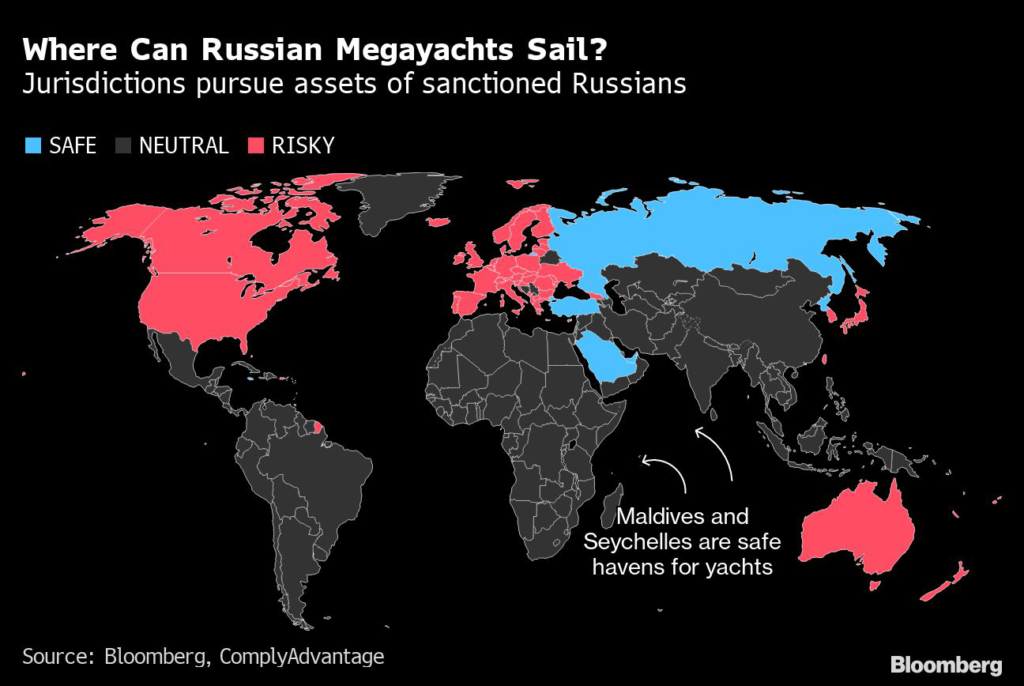
Russian tycoons are running out of places to park their floating palaces, four months after their country’s invasion of Ukraine. The US and Europe are going after their superyachts, villas and other assets because of their ties to Russian President Vladimir Putin. Already, more than a dozen boats worth more than $2.25 billion have been seized by the US, EU nations and willing allies — such as Fiji.

Fearful of having their yachts seized, owners have sent them to a small number of locales still considered friendly — allowing the vessels to dock or hang around unbothered — including Dubai in the United Arab Emirates, Turkey and the Maldives, according to Spire Global Inc., a data and analytics firm that uses satellite technology to track maritime activity. 

Read more: Megayachts Running Low on Safe Harbors as Russia Sanctions Bite

Von der Leyen Praises Ukraine Before Council Decision (5:15 p.m.)

Ukraine implemented about 70% of EU rules, norms and standards, European Commission Ursula von der Leyen said in a speech in the European Parliament. She praised the “immense progress that Ukraine’s democracy has achieved,” but emphasized that more work is needed to fight corruption and loosen the grip of oligarchs on the Ukrainian economy. 

Expressing her support for Kyiv’s EU candidacy status, von der Leyen said that “it is now up to the European Council to decide, and live up to the historic responsibility we are confronted with.”  

Germany Plans Conference to Set Up Ukraine Marshall Plan (4:20 p.m.)

Chancellor Olaf Scholz said Germany and the EU will jointly host an international conference with donors and experts later this year to discuss a multibillion-euro reconstruction plan for Ukraine.

“We have to agree on this — also with the advice of experts and scientists — how such a Marshall Plan for Ukraine can look like, how we coordinate it internationally, how we will decide together on which investments help Ukraine to move forward the most quickly on its European path,” Scholz told lawmakers in Berlin.  


More stories like this are available on bloomberg.com

©2022 Bloomberg L.P.

Klarna Hits Back at Barclays Over ‘Irresponsible’ Buy-Now-Pay-Later Research

(Bloomberg) — The head of Klarna’s UK business has criticized what he called “mind-boggling” and “irresponsible” research by Barclays Plc that called for stronger regulation of the buy-now-pay-later sector, the latest sign of the growing willingness of lenders to insert themselves into a market dominated by new entrants.

The bank published a press release Thursday with debt charity StepChange warning that 876,000 could fall into financial difficulties as a result of using BNPL products. It said retailers need to do more to examine these offerings and ensure customers understood the risks of unregulated lending.

In response, Klarna’s UK boss Alex Marsh said it was an attempt by the London-headquartered bank to push its own “high-cost” loan installment offering.  

“It is mind-boggling and frankly irresponsible in a cost of living crisis, that Barclays should use StepChange to endorse their high-cost installment credit product which charges 10.9% interest and to lobby against interest-free and manageable Buy Now Pay Later products,” Marsh said in a statement. “The conclusions in this report from Barclays are hugely patronizing to UK retailers.”

Attention to BNPL lending is heating up as more consumers turn to the unregulated form of credit. The UK government announced on Monday it’s tightening regulation of the sector amid growing concern some users don’t fully understand the product.

More stories like this are available on bloomberg.com

©2022 Bloomberg L.P.

One of World’s Biggest Cobalt Mines Is at Stake in Congo Fight

(Bloomberg) — A dispute over one of the biggest copper and cobalt mines is escalating in the Democratic Republic of Congo, threatening to disrupt exports of essential battery materials and raising questions about the project’s future.

A top executive from state mining company Gecamines said that partner CMOC Group Ltd. owes $7.6 billion in overdue payments, and even accused the Chinese metals producer and trader of posing a threat to national security. CMOC said it denies the allegations, “strongly” opposes what it views as unjustified attacks and will defend its rights and interests.

The crux of the dispute is over mineral royalties. Gecamines, which owns 20% of the Tenke Fungurume mine, accuses controlling shareholder CMOC of under-reporting mineral reserves and hiding data to avoid triggering higher payments under their agreement.

Earlier this year, a court ordered that the mine should be run by a temporary administrator while the two sides sort out their differences. However, CMOC says it’s still in charge of managing the project and insists it’s business as usual.

Now Gecamines is firing up the rhetoric, threatening last week to cancel the partnership altogether and take back the rights to the deposit. The company is owed about $5 billion in royalties and wants more than $2.5 billion in interest as well, said deputy chief executive officer Leon Mwine Kabiena.

“If we determine that it’s not working, even in marriages, there are always divorces,” Mwine said Monday in an interview at Gecamines’ headquarters in the mining hub of Lubumbashi. “It’s the biggest rip-off of the last twenty years, and Gecamines is not going to continue like this.”

The escalating fight is important because of Congo’s outsized role in supplying the world’s cobalt, a vital part of many electric-vehicle batteries. Tenke was one of the top cobalt producers last year, and is also a large supplier of copper.

The spat also takes place against the backdrop of President Felix Tshisekedi’s efforts to increase scrutiny of mining deals made under his predecessor, Joseph Kabila. Its mineral riches make Congo hard to ignore for the global mining industry, but many have steered clear because of the perceived riskiness, so the dispute will be closely watched by other international miners and potential investors.

Gecamines’ next step may be to halt Tenke’s mineral sales, Mwine said. The state-owned company has not signed its annual commercial agreement with the venture and without that Mwine says any exports are technically illegal.

CMOC says the allegations against it are groundless and that royalty payments are clearly defined in its agreement with Gecamines.

“There are people, who ignore the basic facts and act against the established agreement, trying to sabotage the amicable environment of friendly talks by telling lies, making troubles, and attacking partners,” CMOC said in an emailed response. “This is not justified. CMOC opposes it strongly. We will retain all means, including legal means, to defend our legitimate rights and interests.”

Read: Congo Miner Threatens to Seize Giant Cobalt Project From Partner

CMOC bought control of Tenke Fungurume Mining Sarl from Phoenix-based Freeport McMoRan Inc. about five years ago in a deal that ultimately cost the company more than $3 billion. CMOC announced a $2.5 billion injection into the mine last year in order to double production, raising questions from Gecamines and the government about whether it was under-reporting its reserves.

According to its 2010 amended mining convention, Tenke Fungurume Mining is supposed to pay Gecamines a royalty of $12 for every ton of proved and probable recoverable reserves of copper beyond 2.5 million tons.

Last August, Tshisekedi created a special commission coordinated by Mwine to investigate the deal, and Gecamines filed a lawsuit against the company in December. In February, the court decided in Gecamines’ favor, ordering that Tenke should be run for at least six months by the administrator, Sage Ngoie Mbayo. 

Gecamines backed Ngoie when his appointment took effect earlier this month, but he says that Congolese soldiers, who’ve been protecting the mine from artisanal miners since 2019, barred him from entering. The large military presence at the site, and the refusal to allow Ngoie entry, is a threat to national security, Mwine said.

The deputy CEO also criticized TFM’s mining practices, as well as the number of expatriate workers who he said are doing jobs that could easily be performed by locals at the mine. 

“It’s not just money that interests us,” he said. “Money is money, but it’s also the governance of the business,” he said.

More stories like this are available on bloomberg.com

©2022 Bloomberg L.P.

SoftBank Vision Fund’s 4th Japan Investment Is a Legal Tech Bet

(Bloomberg) — SoftBank Group Corp.’s Vision Fund will lead a 13.7 billion yen ($101 million) Series D fundraising into Japanese startup LegalForce Inc., in the world’s biggest tech investor’s fourth outlay in its home country.

LegalForce, which uses AI to screen contracts for loopholes and potential legal risks, said other participants in the round include new investors Sequoia Capital China and Goldman Sachs Group Inc., as well as existing backers Mitsubishi UFJ Capital and Mizuho Capital. The fundraising lifts total amount raised to 17.9 billion yen, the company said in a release on Thursday. The startup has 2,000 clients, including Japanese companies Nomura Holdings Inc. and All Nippon Airways Co. LegalForce said it will use the funds on research and development and on expanding its sales team to win new customers. 

SoftBank’s investment in LegalForce is far smaller than the billions the Vision Fund wielded in its heyday, representing founder Masayoshi Son’s new cautious approach. The company logged a record 1.7 trillion yen loss in the year ended in March as a global downturn in tech shares deflated its big bets on companies such as Chinese ride-hailing company Didi Global Inc. and South Korean e-commerce leader Coupang Inc.

Son had previously said Japanese startups grew too slowly for the Vision Fund, as most catered only to the domestic market. But it has since shifted strategy to invest smaller sums and expanded its team at home. Thursday’s investment follows SoftBank’s bets in AI Medical Service Inc., a Tokyo startup specializing in endoscopy; Aculys Pharma, which has rights to develop a treatment for narcolepsy and sleep apnea in Europe; and Soda Inc., which operates an online marketplace for sneakers.

More stories like this are available on bloomberg.com

©2022 Bloomberg L.P.

Instagram to Test AI on Faces to Verify Users Are Over 18

(Bloomberg) — Instagram, under fire from safety advocates to keep children off the app and prevent teens from seeing harmful content, is testing new ways to verify users’ age. Among them: running users’ video selfies through an artificial intelligence that can determine if they are adults.

The Meta Platforms Inc.-owned app recently started requiring users to submit their birthdate to verify that they are over 13 and eligible to use Instagram. The company has also introduced new privacy settings for 13- to 18-year-olds, including parental controls. Now, if someone tries to change their profile to say they’re an adult, Instagram has a few options beyond submitting a personal identification card.

Starting in the US, Instagram will be accepting video selfies, which Meta will submit to the identity verification company Yoti. “Yoti’s technology estimates your age based on your facial features and shares that estimate with us,” Instagram said in a statement. “Meta and Yoti then delete the image.”

Instagram is making the changes as part of a commitment to raise its standards around protecting teenagers. That promise came after a whistle-blower testified in October that Facebook had prioritized profit over the wellbeing of users, especially teens.

Yoti said it trained the AI through “anonymous images of diverse people from around the world who have transparently allowed Yoti to use their data.” It has knowledge of what under-13s look like because of images obtained with parental consent, it added.

If users don’t want to submit a video or ID, they can also ask three adult users to vouch for them. Those users will get a request to confirm the person’s age, must respond within three days and mustn’t vouch for anyone else at the same time.

More stories like this are available on bloomberg.com

©2022 Bloomberg L.P.
Toyota Halved Stake in Uber Following Self-Driving Unit Sale

(Bloomberg) — Toyota Motor Corp. sold about half of its Uber Technologies Inc. shares after the US mobility company carved out its self-driving division. 

Toyota held about 5.13 million shares of Uber in the fiscal year ended March, half the amount it reported the previous year, according to a securities filing Thursday. Toyota reported Uber holdings valued at 22.4 billion yen ($165 million), down from 61.9 billion yen a year earlier. 

Uber’s work on autonomous driving was one of Toyota’s original objectives for investing in the company, spokeswoman Shiori Hashimoto said Thursday. Toyota sold its stake in Uber following Aurora Innovation Inc.’s 2020 purchase of the ride-hailing company’s self-driving division. Toyota first took a stake in Uber in 2016 and increased it two years later.

Toyota and Uber’s “good relationship” has not changed, Toyota’s Hashimoto said, adding “we would like to continue to examine possibilities for various collaborations.”

As of the end of March, Toyota held 47.6 million shares of Aurora, worth about 32.4 billion yen. 

More stories like this are available on bloomberg.com

©2022 Bloomberg L.P.

TerraUSD and the Nats: A Cautionary Tale in Crypto Sponsorship

  • Listen to Bloomberg Crypto on the iHeartRadio App
  • Listen to Bloomberg Crypto on Apple Podcasts
  • Listen to Bloomberg Crypto on Spotify 

(Bloomberg) — The Washington Nationals baseball team didn’t have a great start to their season, and that’s not just because of their losing record. They also managed to debut a sponsorship deal with the organization behind the not-so-stable stablecoin, TerraUSD. The name of that organization, Terraform Labs, is now splashed all over billboards, uniforms, seats – everything. It might have seemed like a good play when they signed the contract, but by the time TerraUSD crashed and burned in early May, it started to look more like a strikeout. 

The Nats aren’t the only sports team to have accepted crypto sponsorship. In this episode, Bloomberg senior editor Mike Regan, joins the conversation to sort through how crypto companies are changing the sports landscape.

Follow us on Twitter @crypto, and subscribe to the Bloomberg Crypto Newsletter at https://bloom.bg/cryptonewsletter


More stories like this are available on bloomberg.com

©2022 Bloomberg L.P.
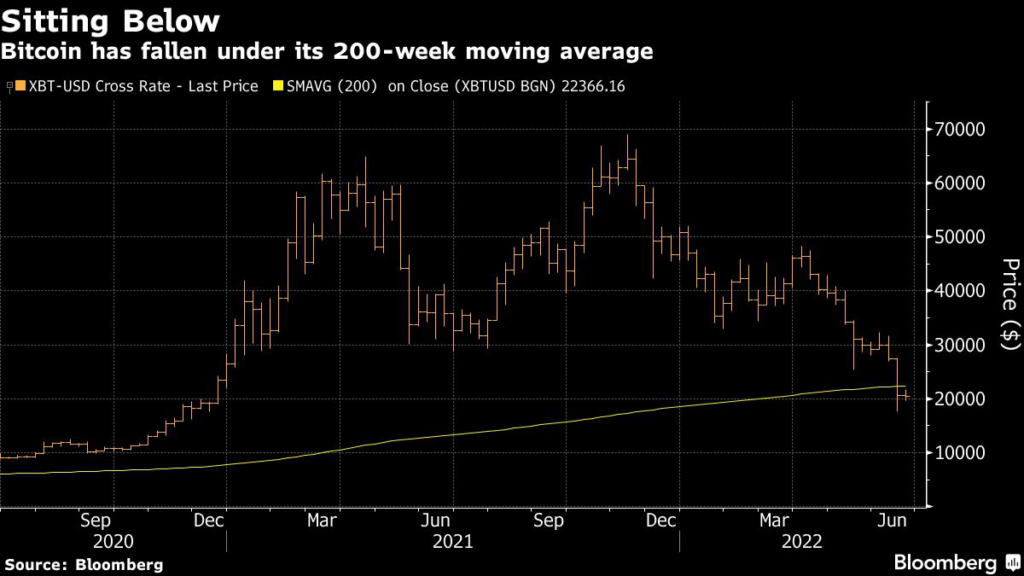
Bitcoin, Ether Gain Ground Ahead of Crypto Options ‘Witching’

(Bloomberg) — Bitcoin and Ether climbed on Thursday, as investors braced themselves for an imminent wave of option expiries. 

The largest cryptocurrency rose as much as 3.9% to $20,626, while Ether advanced as much as 5.8% to $1,108. The gains have come before Friday’s weekly options expiry, the current quarter’s last that also coincides with futures expiries “to produce the final ‘witching’ in the first half of 2022,” according to Genesis Global Trading. 

“Options open interest on Deribit indicates over $2 billion in notional for Bitcoin and $1 billion for Ether options, making this the largest on-exchange expiry on the horizon by a wide margin (~39% and ~33% of total open interest on the exchange for BTC and ETH options respectively),” Ainsley To, Gordon Grant and Noelle Acheson of Genesis wrote in a note Wednesday.

The Bitcoin options expiring on Friday are mostly puts for strikes around current price levels, with notional open interest concentrated around the $20,000 strike, Genesis said. For Ether, there is comparable concentration around the $1,000 strike — mostly in puts, the firm added. 

Crypto markets are struggling to consolidate after declining precipitously in recent months as the Federal Reserve hiked interest rates to fight inflation. The collapse of the Terra/Luna ecosystem and continued concern about hedge fund Three Arrows Capital Ltd. have further rattled investors. 

“Turbulence has returned to the cryptocurrency space as high inflation threatens the valuations of all risk assets, including equities,” Bitfinex analysts wrote in a note Wednesday. “As central banks continue to reverse previously accommodative policies, we can expect more volatility in the Bitcoin price.”

The upcoming expiration may potentially influence price action, particularly if Bitcoin and Ether are right around the levels with a high concentration of options.

“Both Bitcoin and Ether saw lows under $20,000 and $1,000 respectively over the weekend,” the Genesis report noted. “Though they have since recovered above those levels, the options market will be one to watch should prices remain close to these thresholds going into Friday.”

More stories like this are available on bloomberg.com

©2022 Bloomberg L.P.

Close Bitnami banner
Bitnami
