

Bloomberg

Vapers Who Fear Juul FDA Ban Are Rushing to Hoard E-Cigarettes

(Bloomberg) — Brand-loyal vapers are flocking to their favorite shops to stock up on Juul Labs Inc.’s e-cigarettes, amid news that the products could soon be taken off the market. 

“My husband is out on a Juul run right now. Gonna clear the shelves and hoard ’em like our incandescent bulbs!” one user wrote on Twitter following the news, first reported by the Wall Street Journal, that the US Food and Drug Administration could order the company to stop selling its e-cigarettes as soon as Wednesday.

It’s the latest hit for Juul after the FDA banned sales of customer-favorite fruity and sweet flavors on concerns the products were being marketed to minors. But the company isn’t being singled out — the FDA has generally tightened its oversight of e-cigarette companies and is reviewing thousands of applications from companies aiming to sell similar products.

Juul “just so happened to rise to the top of the stack,” said Lynn Kozlowski, a public health professor at the University of Buffalo who has led studies on nicotine addiction, vaping and cigarettes. 

Back in 2019, reports began to emerge of cases of severe lung damage in young people that were later linked to vaping or e-cigarette use. As of February 2020, the US Centers for Disease Control and Prevention recorded more than 2,800 such cases that resulted in hospitalizations and deaths. Studies revealed an association with vitamin E acetate, an additive in some THC-containing vaping products, and cases declined amid increased public awareness and efforts to better regulate the products’ safety.

People vape for a different reasons: some to kick cigarettes, other use the products socially. When flavors like mango, fruit and creme were taken off shelves in 2019, some customers turned to other products that had more of a “reward” component — better flavors, perhaps even a higher nicotine content, Kozlowski said.

Will Teasley, 20, a college senior at North Carolina A&T State University is happy the FDA is pulling Juul off the shelves, but thinks it will do little to discourage young people from vaping because there are so many other products available. Teasley first got hooked on vaping in high school — with Juul — and for the last five years he said its been nearly impossible to quit.

“Juul is the device that opens the door to cause lifelong addiction,” Teasley said. But for him, the FDA’s move comes too late: “It already got me.”

Brands like Puff Bar, VaporLax and Hyde sell more flavors and offer disposable options that consumers say makes them easier to use than a Juul, which needs to be refilled and charged. Plus, Juuls tend to be more expensive than competitors. The liquid inside Juul pods is eight times more expensive per milliliter than comparable e-liquid sold in a bottle, according to e-cigarette website vaping.com.

“You might have some people who buy up Juul and hoard it, but others will just switch to products that are still legal,” Kozlowski said. “It’s a very diverse market.”

Read More: Juul Finds Hell Hath No Fury Like an Army of Really Rich Parents

Still, some shops are readying for a potential influx of customers hoping to stock up. By mid-morning Wednesday, the Smoke Shop in Manhattan’s Kips Bay neighborhood said they were putting all their Juul supply out on shelves in preparation. 

More problems could arise for vapers if the FDA continues cracking down on vaping products, Kozlowski said. The Biden administration is showing more interest in the subject, preparing to require tobacco companies to cut nicotine levels in cigarettes to reduce smoking-related deaths. When that comes to pass, it may be safer to have an abundance of consumer-acceptable, less-harmful options available, Kozlowski said. 

“I’m worried about what this suggests for the impact of a low-nicotine cigarette policy,” he said. “We don’t know what types of patterns might develop; it’s a risk to consumers.”

More stories like this are available on bloomberg.com

©2022 Bloomberg L.P.

Bitcoin Lingers Around $20,000 Again as Risk-Off Mood Remains

(Bloomberg) — Bitcoin traded once again around the $20,000 level, underperforming stocks amid lingering concerns of a greater shakeout in the crypto market. 

The largest cryptocurrency declined as much as 4.8% to $19,832, before settling in around $20,000 as of 3:11 p.m. in New York. Ether fell by a maximum 6.1% to $1,053. Solana, Cardano, Polkadot and Dogecoin all declined. 

“Bitcoin has made ‘a bottom’ but probably not ‘the bottom’,” said Mark Newton, head of technical strategy at Fundstrat Global Advisors. “Upside targets should materialize near $23,300 with a max near $24,800 before prices pull back to likely challenge lows into the final week of June.”

Cryptocurrencies had been moving for months in the same direction as stocks as investor appetite for risk assets ebbed on growing fears about an economic downturn. Bitcoin appears to be consolidating around the $20,000 level, similar to its action around $30,000 for much of May and into June.

The move off of sub-$20,000 lows occurred as broader risk sentiment stabilized and speculative investors await their next trading prompts, Informa Global Markets wrote in a note Tuesday. 

The firm added that data from on-chain analytics firm Glassnode shows that as of June 20, 56.2% of addresses were still worth more in dollar terms than when their coins entered them, which Informa said raises questions about the severity of the current bear market. That’s compared with recent Glassnode data showing the average purchase price of all Bitcoins in circulation was around $23,430 — so, above current levels.

Still, it’s the bigger picture that’s really driving Bitcoin’s price, Informa said.

“Macroeconomic conditions need to improve and the Fed’s aggressive approach to monetary policy has to subside before crypto markets see a bottom,” the firm wrote.

More stories like this are available on bloomberg.com

©2022 Bloomberg L.P.

Crypto Fund Three Arrows’ Troubles Spill Over to Exchange

(Bloomberg) — The fallout from troubled crypto hedge fund Three Arrows Capital Ltd. has reached Voyager Digital Ltd., sending shares of the crypto exchange down 51% in Toronto trading with analysts raising the prospect of further damage. 

Voyager said it may issue a notice of default to Three Arrows for failure to repay a loan, the exchange disclosed in a statement. The broker’s exposure to Three Arrows includes 15,250 Bitcoin and $350 million of stablecoin USDC, worth roughly $660 million based on Bitcoin’s price on Wednesday in New York. 

New York-based Voyager, which offers crypto trading, staking — a way of earning rewards for holding certain cryptocurrencies — and yield products, is listed on the Toronto Stock Exchange and its shares are traded over-the-counter in the US. It had about $5.8 billion of assets on its platform as of quarter-end in March. 

To meet customer liquidity needs, Voyager has secured credit lines — $200 million in cash and USDC stablecoin plus 15,000 Bitcoin — from the investment arm of Alameda Research LLC. The funding is contingent on Voyager’s ability to secure additional sources of funding within 12 months, among other conditions. 

Its Three Arrows exposure “raises survivability questions” for Voyager, analysts at Compass Point Research & Trading LLC wrote in a research report Wednesday. “We would not be surprised to see VOYG customers pulling assets from the platform,” they said, referring to the company’s ticker.  

The pace of customer redemptions and Voyager’s ability to recoup loans to Three Arrows will likely determine its ability to continue operations, they wrote. 

Meanwhile, analysts at BTIG downgraded Voyager to neutral from a buy, and KBW Research removed its rating on Voyager, saying it was difficult to put a value on the shares given the uncertainty of collecting on its loan. 

Voyager did not mention the amount of collateral, if any, held on its loan to Three Arrows and a spokesperson did not respond when asked by Bloomberg News. Three Arrows’ law firm, Solitaire LLP, didn’t respond to a request for comment. 

A broad-based selloff in digital assets and the collapse of the TerraUSD and Luna tokens has left Three Arrows facing liquidity troubles. The fund’s co-founders told the Wall Street Journal that it’s considering options including asset sales and a bailout, and has hired legal and financial advisers after large losses. A wave of liquidations has triggered fear of contagion risks for the industry. 

Other lenders, including Genesis and BlockFi Inc., have sought to quell fear amid concerns over contagion risks from Three Arrows. On Tuesday, BlockFi said it received a $250 million credit line from FTX Trading Ltd.  

Voyager will seek to recover the debt from Three Arrows and is in discussions for legal remedies, according to the statement. It has made an initial request for a repayment of $25 million USDC by June 24, and then requested repayment of the entire balance of USDC and Bitcoin by June 27. Neither of these amounts has been repaid, and Voyager is currently unable to assess the amount it will be able to recover, the company said.

As of June 20, Voyager has about $152 million cash and owned-crypto assets on hand, as well as $20 million of cash that is solely for buying stablecoin USDC, the company said. 

Alameda, a trading outfit from FTX founder Sam Bankman-Fried, is the largest holder in Voyager with a nearly 12% stake, according to data compiled by Bloomberg. Bitcoin dropped back below $21,000 on Wednesday after staging a short-lived rally in Tuesday trading.

(Updates with analyst comments, stock price and loan details.)

More stories like this are available on bloomberg.com

©2022 Bloomberg L.P.

Meta Says UK Bill Risks Messages Being Surveilled, Censored

(Bloomberg) — Meta Platforms Inc. said UK online safety legislation “risks people’s private messages being constantly surveilled and censored” unless it’s changed, adding to a long list of complaints recently lodged against the proposed law. 

The sweeping Online Safety Bill is winding its way through Parliament and it’s intended to come into force next year. The government has estimated it will apply to more than 25,000 services. 

The bill still faces possible amendments, but a draft pushes the very biggest social media and search engines to help people avoid “legal but harmful content” on their so-called user-to-user services, Meta said. 

Read More: UK’s New Tech Enforcer Avoids Using Twitter Because of Trolls

That doesn’t distinguish between messaging and public social media, and could imply “scanning all private messaging,” WhatsApp and Facebook owner Meta argued in written evidence published Wednesday, adding to a list of concerns and proposed amendments published since the draft bill’s publication in March. 

“Tech firms have failed to tackle child abuse and end-to-end encryption could blind them to it on their sites while hampering efforts to catch the perpetrators,” a spokesman for the Department for Digital, Culture, Media and Sport said by email. “As a last resort Ofcom has the power to make private messaging apps use technology to identify child sexual abuse material – this can only be used when proportionate and with strict legal privacy safeguards in place.”

The range of submissions reflects the proposed law’s breadth and complexity. Lawmakers have received letters from Silicon Valley giants, news publishers, religious groups, broadcasters, insurers, the LEGO Group, e-cigarette manufacturer Juul Labs, dating app Bumble, animal rights advocates, and more. 

Meta has also received its own criticism around perceived censorship, misinformation, and controversies over training politicians who later used Facebook to spread propaganda. A representative for Meta declined to comment on these stories, but said they support the introduction of regulations. 

Within the submissions, Twitter Inc. said it’s concerned about issues in the bill around freedom of expression as well as the precedent that could be set by the bill’s threat of criminal sanctions. It added that exemptions around journalism should be removed due to the risk of exploitation by “bad faith actors”.

Alphabet Inc.’s Google said the bill appears to incentivize “automated general monitoring, and over-removal, of content.”

(Updates with DCMS comment)

More stories like this are available on bloomberg.com

©2022 Bloomberg L.P.
Mystery Surrounds $500 Million Outflow From Bitcoin ETF

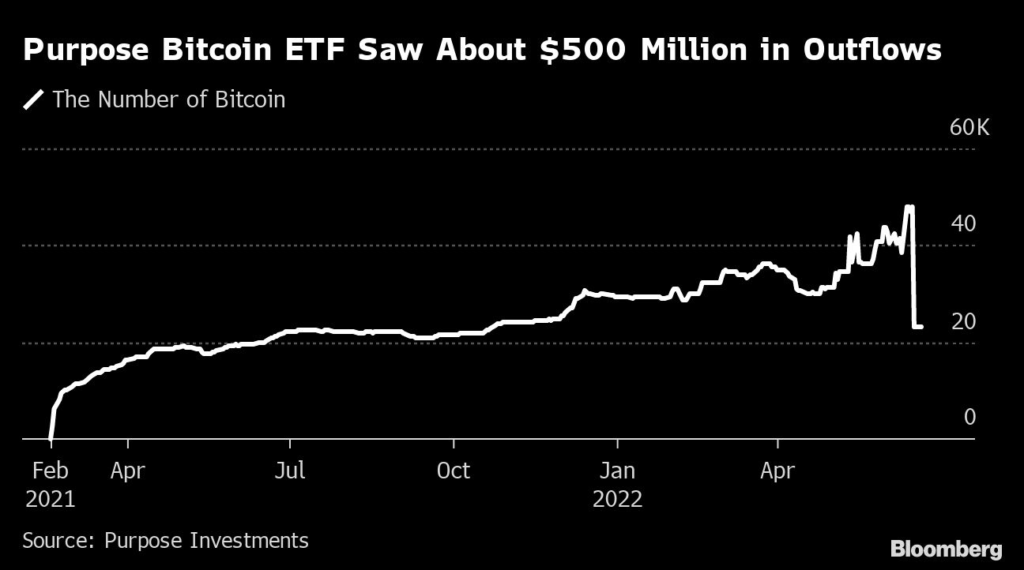
(Bloomberg) — North America’s first Bitcoin exchange-traded fund is at the center of a crypto-market guessing game after it saw record one-day outflows of $500 million last week. 

The withdrawals from the Purpose Bitcoin ETF (ticker BTCC) equaled about 24,510 Bitcoin, or around 51% of its asset under management on Friday, according to data compiled by Bloomberg and analysts. 

“Obviously, this one was more of a larger outflow in this case, and, to me, this is more of a reflection of investors’ views on the market,” said Vlad Tasevski, chief operating officer at Purpose Investments. He added that the company does not have direct visibility into who’s doing the trades given how the ETF’s structure works. “Even if we knew, typically we don’t actually comment on what our clients are doing.”

The selling came as the crypto market went through an intense selloff that carried into the weekend. Bitcoin tumbled as much as 15% to $17,599 on Saturday, the lowest level since late 2020. The largest cryptocurrency by market value is down about 70% from its record high in November. The fund debuted in February 2021.

“The enormous outflows are likely caused by a forced seller in a huge liquidation. The forced selling of the 24,000 BTC could have triggered BTC’s move down towards $17,600 this weekend,” Vetle Lunde, analyst at Arcane Crypto, wrote in a research report.   

Nate Geraci, president of The ETF Store, an advisory firm, agrees that the outflow has the appearance of being a forced sale. And it could be the case that some holder — or holders — might have needed the underlying Bitcoin quickly.

For instance, it might involve a large trader utilizing margin who is unable or unwilling to meet a margin call, he said. Or it could perhaps be a different situation in which a person or entity must meet a loan obligation where the lender has the ability to liquidate and secure the pledged collateral that backs said loan, Geraci added.

Bitcoin futures and spot ETFs have been popular among investors that are not willing to hold Bitcoin but want to gain that exposure in their portfolios. The funds have been hit hard as of late amid the slide in the price of the cryptocurrency. Bitcoin ETPs have seen net outflows of 18,315 coins as of June 21, according to Arcane Crypto.  

“This is by far the most severe redemption we’ve seen in the relatively short-lived BTC ETF history and has contributed to shrinking Purpose’s Bitcoin under management down towards lows not seen since October 2021,” Lunde said. 

Europe had several crypto-tracking products that function like an ETF before the Purpose fund was launched. The US Securities and Exchange Commission has repeatedly rejected requests for a physically-backed ETF, citing price volatility and the risk of market manipulation.  

“The recent crypto bloodbath has shown there is no shortage of leverage in the system, which works well on the way up, but not so well on the way down,” Geraci said, adding that he doesn’t view the issue as being ETF-related. “The bottom line is that forced liquidations of over-leveraged crypto traders likely triggered Bitcoin’s crash, not anything pertaining to the Bitcoin ETF structure.”   

(Adds company and analyst comment beginning in the third paragraph.)

More stories like this are available on bloomberg.com

©2022 Bloomberg L.P.

Meta Says UK Bill Risks Messages Being ‘Surveilled and Censored’

(Bloomberg) — Meta Platforms Inc. said UK online safety legislation “risks people’s private messages being constantly surveilled and censored” unless it’s changed, adding to a long list of complaints recently lodged against the proposed law. 

The sweeping Online Safety Bill is winding its way through Parliament and it’s intended to come into force next year. The government has estimated it will apply to more than 25,000 services. 

The bill still faces possible amendments, but a draft pushes the very biggest social media and search engines to help people avoid “legal but harmful content” on their so-called user-to-user services, Meta said. 

Read More: UK’s New Tech Enforcer Avoids Using Twitter Because of Trolls

That doesn’t distinguish between messaging and public social media, and could imply “scanning all private messaging,” WhatsApp and Facebook owner Meta argued in written evidence published Wednesday, adding to a list of concerns and proposed amendments published since the draft bill’s publication in March. 

The range of submissions reflects the proposed law’s breadth and complexity. Lawmakers have received letters from Silicon Valley giants, news publishers, religious groups, broadcasters, insurers, the LEGO Group, e-cigarette manufacturer Juul Labs, dating app Bumble, animal rights advocates, and more. 

Meta has also received its own criticism around perceived censorship, misinformation, and controversies over training politicians who later used Facebook to spread propaganda.

Representatives for Meta and for the Department for Digital, Culture, Media and Sport didn’t immediately respond to requests for comment. 

Within the submissions, Twitter Inc. said it’s concerned about issues in the bill around freedom of expression as well as the precedent that could be set by the bill’s threat of criminal sanctions. It added that exemptions around journalism should be removed due to the risk of exploitation by “bad faith actors”.

Alphabet Inc.’s Google said the bill appears to incentivize “automated general monitoring, and over-removal, of content.”

More stories like this are available on bloomberg.com

©2022 Bloomberg L.P.
Russian Hackers Also Focused on US and NATO Since Invasion

(Bloomberg) — Russia is expanding its espionage and influence operations against Ukraine and its allies, including malicious cyber activity that requires a coordinated, robust response, Microsoft Corp said in a report published Wednesday. 

Russia has deployed a three-pronged strategy of coordinated military, cyber and propaganda efforts since it invaded Ukraine in February, Microsoft said. The cyberattacks included “wiper” malware that Russian hackers deployed against Ukrainian computer systems, the company said, and malware masquerading as legitimate emails. 

Nearly two-thirds of Russian cyber espionage targets outside Ukraine were NATO countries, with nearly half of all campaigns directed at government agencies, according to the report. Russian hackers have most frequently tried to conduct network intrusions against US organizations, with attackers also aiming to breach entities based in Poland, Denmark, Norway, Finland, Sweden and Turkey, the company said. Cyberattacks directed at critical infrastructure accounted for about 19% of the activity. 

Of the attempted Russian hacking detected by Microsoft since the start of the war, 29% has been successful, according to the report. Roughly a quarter of the successful breaches have resulted in the theft of data, the company said. 

Data stored on-site is more vulnerable than information in the cloud, according to the report. 

“The key to a country’s digital resilience in wartime is the ability quickly to move data outside the country while still connecting to and relying on it for a government’s digital operations,” researchers wrote.

Meanwhile, Microsoft found, the spread of Russian propaganda has spiked in Ukraine, the US and elsewhere since the war began.

Pro-Russian news articles have sought to justify the initial February invasion, explain how Ukraine’s revolution led to the war and criticize the countries aligned with Ukraine.

“The escalation follows years of unsuccessful talks, broken ceasefire agreements and a standoff between Russia and the West,” according to one article cited as an example in Microsoft’s report.  

A representative for the Russian embassy in Washington didn’t immediately respond to an email seeking comment Wednesday. 

The Biden administration has repeatedly warned of cybersecurity threats against US companies and critical infrastructure since the outbreak of the war. US officials have urged companies to update their software and increase threat detection capabilities in the face of Russian aggression in cyberspace, among other recommendations.  

More stories like this are available on bloomberg.com

©2022 Bloomberg L.P.
Once-Dull Crypto Strategies Are Now Shining in the Bear Market

(Bloomberg) — As the “to the moon” refrains quiet down, crypto is seeing increased demand from hedge funds in a trading strategy that does not take directional views on the market.

There’s no question that 2022 has been a tough year for crypto: Bitcoin’s down 50%, and digital assets have shed more than $1 trillion as central banks around the world tighten monetary policy to combat inflation. But funds like Miami-based BlockTower Capital and Nickel Digital Asset Management, which utilize so-called market-neutral strategies, said they are still notching positive returns.

BlockTower Capital’s market-neutral fund, which manages more than $100 million, has about a 3% return so far this year. And London-based Nickel Digital, with $300 million in assets under management, advanced 0.49% in May when the collapse of Terra sent shock waves throughout the rest of the market and dragged a wide-encompassing index of digital assets down 25%. 

“This strategy sometimes might not look as attractive during a bull market where Bitcoin’s up 70%,” Rahul Rai, co-head of market neutral at BlockTower and former FX trader at Morgan Stanley, said in an interview. “In a bear market especially, the strategy really stands out. We’re absolutely seeing a lot of investor demand.”


The teams behind both firms include experienced traders from Wall Street, as the strategy has long been deployed in the equity market. Ken Griffin’s Citadel, for instance, booked a 7.5% return with its market-neutral strategy as US stocks posted losses of nearly 9% in April.

Nickel Digital’s CEO and founding partner Anatoly Crachilov, who left Goldman Sachs in 2019 to pursue crypto, said that with hundreds of trading venues operating 24/7 around the world, the arbitrage opportunities to trade on price differences for the same token are abundant. It’s also a strategy that dates back to the early beginnings of crypto.

In contrast to US markets, “there are more than 400 exchanges out there and every single one of them trades Bitcoin, which means now you have multiple venues and very likely prices will be asynchronized for various reasons,” he said.

Still, Crachilov expects the annualized returns from the market’s inefficiency to come down to 8-10% over time as crypto matures. His firm posted a return of around 15% in 2021.

Since last year, the market-neutral strategy has grown into one of the most popular types of trading methods, according to an April survey by accounting giant PwC. However, market-neutral funds, with an average return of 37% in 2021, underperformed other strategies — including certain long-only ones that notched average gains above 400%.

Olwyn Alexander, global asset and wealth management leader at PwC Ireland, said the relative performance of market-neutral funds would stand out in today’s environment compared with directional long-exposure funds.

“Directional strategies are obviously best during a bull market — if you bought Solana early on and sold it at the peak, you might have made 1,000%. It’s more about timing. Market-neutral strategies aren’t going to touch that,” said Michael Safai, co-founder and partner at proprietary trading firm Dexterity Capital. “We’ve been doing this for five years, and for us, it’s a long game, where we can always make money no matter what the market is doing.”

Though there are a number of different market-neutral strategies traders can deploy, “you’ve done pretty well if you’re in the neighborhood of 20-30%,” Safai said. “But you can do better than that if you’re clever.” 

Risk-Taking

Beyond taking advantage of market inefficiencies across centralized trading venues, another crypto-only market-neutral strategy can be found within decentralized finance, a fast-growing experimental sub-sector of crypto that became popular over the past two years.  

BlockTower’s Rai said his firm is actively looking for returns in DeFi, but acknowledged that DeFi faces increased criticism due to the collapse of the Terra blockchain and the billions of dollars that have been hacked in the nascent sector. 

Celsius, a crypto lending platform, paused withdrawals and other activities for its users recently, after many in the market questioned the firm’s investment in DeFi.

Rai said his firm had “no material losses” through Terra’s meltdown, since it saw the warning signs early on.

“What a savvy fund manager has to do is evaluate — given the return profile — is it worth taking on these risks? And what is the risk-adjusted return?” he said. In DeFi, “these risks are uncorrelated to the broader market. A smart contract getting hacked has no correlation to what the S&P 500 is doing or what Bitcoin is doing. It’s an idiosyncratic event.”

More stories like this are available on bloomberg.com

©2022 Bloomberg L.P.

Voyager Discloses $660 Million Exposure to Troubled Crypto Fund

(Bloomberg) — Voyager Digital Ltd. faces steep losses if the crypto broker is unable to recoup a loan it made to troubled digital asset hedge fund Three Arrows Capital Ltd. 

Voyager said it may issue a notice of default to Three Arrows for failure to repay the loan, the company disclosed in a statement. The broker’s exposure to Three Arrows includes 15,250 Bitcoin and $350 million of stablecoin USDC, worth about $660 million based on Bitcoin’s price Wednesday morning in New York. 

A broad-based selloff in digital assets and the collapse of the TerraUSD and Luna tokens has left hedge fund Three Arrows facing liquidity troubles. The fund’s co-founders told the Wall Street Journal that it has hired legal and financial advisers after the crypto rout left it with large losses. A wave of liquidations has triggered fear of contagion risks for the industry. 

Voyager will seek to recover the debt from Three Arrows and is in discussions for legal remedies, according to the statement. It has made an initial request for a repayment of $25 million USDC by June 24, and then requested repayment of the entire balance of USDC and Bitcoin by June 27. Neither of these amounts has been repaid, and Voyager is currently unable to assess the amount it will be able to recover, the company said.

Toronto-listed Voyager has secured credit lines — $200 million in cash and USDC stablecoins plus 15,000 Bitcoin — from the investment arm of Alameda Research LLC. As of June 20, Voyager has about $152 million cash and owned crypto assets on hand, as well as $20 million of cash that is solely for buying stablecoin USDC, the company said. 

Voyager declined to comment beyond its statement while Three Arrows’ law firm didn’t immediately respond to a request for comment. Voyager plunged 44% at 9:45 a.m. in Toronto trading.

Alameda, a trading outfit from FTX Trading Ltd. founder Sam Bankman-Fried, is the largest holder in Voyager with a nearly 12% stake, according to Bloomberg compiled data. Bitcoin dropped back below $21,000 on Wednesday after staging a short-lived rally in Tuesday trading.

More stories like this are available on bloomberg.com

©2022 Bloomberg L.P.

Swedish Gaming Firm Hit by War Opens New European Hubs

(Bloomberg) — With a 1,000-strong workforce split evenly across Russia and Ukraine, the outbreak of war on Feb. 24 hurt one European gaming company perhaps more than any other.

Stockholm-based G5 Entertainment AB is now conducting a major overhaul of its organizational footprint by opening offices in Georgia, Montenegro and Turkey. According to Chief Executive Officer Vlad Suglobov the aim of the changes is two-fold: to diversify its staff base and to offer safe relocation for those forced to flee their home countries. 

“We will still probably be Eastern European-focused in terms of developer talent,” Suglobov said during an interview in the Swedish capital. “That’s where the company grew out of and this is where people running the company are from.”

The Russia-born CEO, who himself is based in California, has spent the past 20 years building a company into a free-to-play gaming specialist with titles such as ‘Sherlock’ and ‘Jewels of Rome’ that also offer in-game purchases. Its shares have been traded on Nasdaq Stockholm’s main market since 2014.

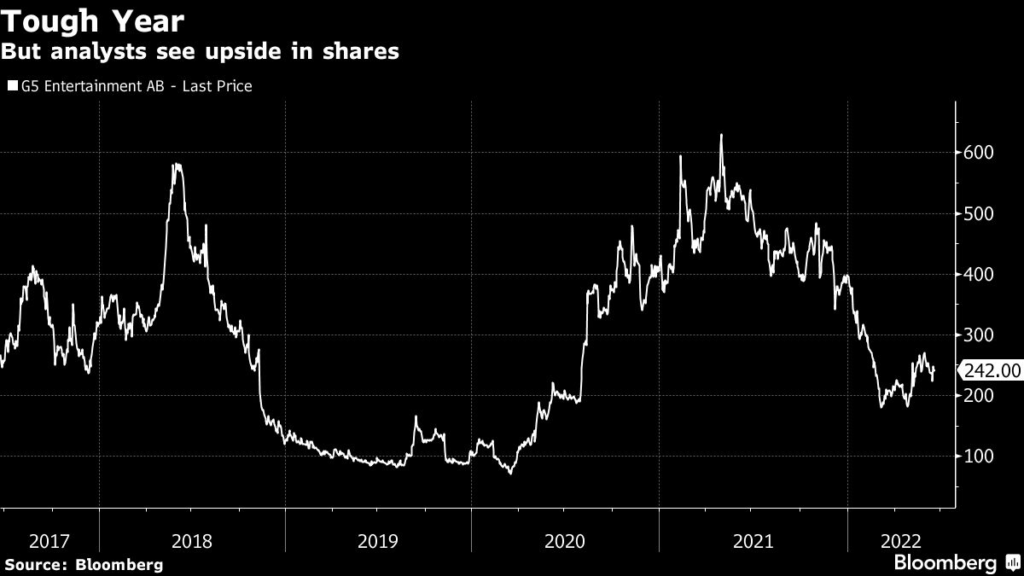
It’s a business model that has been well received by the small number of analysts who all recommend buying the stock. Last week, Kepler Cheuvreux’s Mathias Lundberg initiated coverage of G5 with a buy rating and labeled the firm “the comeback king” after a tumultuous period that has seen its shares slump 40% so far this year.

The company also benefits from an unusual gender balance when it comes to customers with significantly more women players than men, according to the CEO. 

“I have to engage my inner 55-year-old woman,” Suglobov said citing a corner of the market that is often overlooked by more established gaming companies such as Activision Blizzard Inc., whose ‘Call of Duty’ series regularly tops sales charts.

But in an increasingly crowded market place, the cost of finding new gamers may weigh on G5’s profits in the short term, according to Redeye analyst Tomas Otterbeck. In May, the Swedish company said it would boost the level of investments in this area to as much as 35% of sales from the previous guidance of 22%.

Suglobov however remains bullish on attracting customers to the company’s free games even amid the uncertainty caused by accelerating inflation. “We see that spending is pretty much proportional to the time that customers spend playing our games,” he said. “So a situation where they have difficulty affording something else is quite good for us.”

(Corrects to show Malta is not a new location for the company)

More stories like this are available on bloomberg.com

©2022 Bloomberg L.P.

Close Bitnami banner
Bitnami