
Bloomberg

Crypto Crash Survivors Could Become Tomorrow’s Amazons, BOE Says

(Bloomberg) — The survivors of the rout in cryptoassets could become the technology companies of the future rivaling Amazon.com Inc. and eBay Inc., Bank of England Deputy Governor Jon Cunliffe said.

Cunliffe compared the crash that has wiped more than $1 trillion off the value of Bitcoin and other crypto currencies this year to the dotcom collapse at the start of the millennium.

“The analogy for me is the dotcom boom, when $5 trillion was wiped off values,” Cunliffe said at the Point Zero Forum in Zurich on Wednesday. “A lot of companies went, but the technology didn’t go away. It came back 10 years later, and those that survived — the Amazons and the eBays — turned out to be the dominant players.”

He stressed that crypto technology has “huge applications and potential within the financial sector” even though the market is wobbling at the moment. 

“Whatever happens over the next few months to crypto assets, I expect crypto technology and finance to continue.” Cunliffe said. “It has the possibility of huge efficiencies and changes in market structure.”

The BOE is developing plans for its own retail central bank digital currency and will deliver a consultation paper at the end of the year.

One key issue under investigation is whether to produce a fully independent CBDC with an “on or off ramp to fiat” money or just “something that is flexible enough” to be used in private stablecoins.

Cunliffe gave an example of stablecoins that are integrated into supply chain and logistics systems to maximize efficiency. “We couldn’t provide something that does all those things,” he said.

“The question is, are you better off having private stablecoins to be more optimized in certain areas, which then link back to a central bank ledger in some way? Or should we provide the base?” Cunliffe said.

The big philosophical question regulators face is whether to allow “fully disintegrated settlement,” which would mean regulating the AI code behind the crypto technology. 

“I have the same confidence in that as a fully automated pilotless plane from London to Zurich, or a fully driverless car,” he said. “I want to know where the liability is — if the algo goes wrong and I crash.”

“My sense is that will be very difficult for the regulatory system to cross in the near future.”

More stories like this are available on bloomberg.com

©2022 Bloomberg L.P.
Hong Kong IPO Gong Is Back for First Listing Ceremony Since 2020

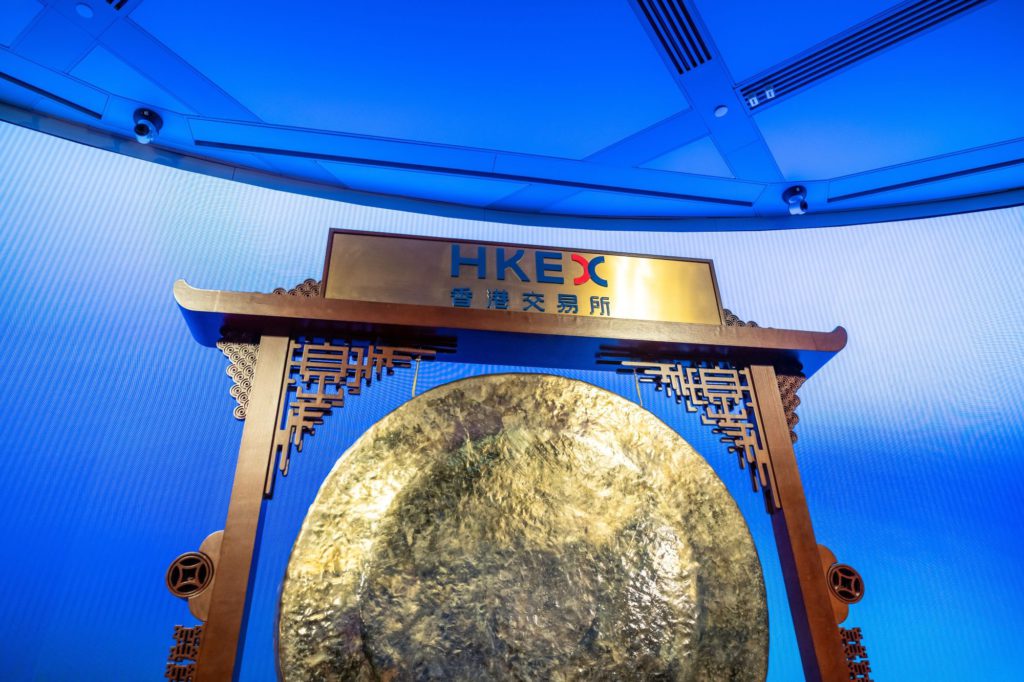
(Bloomberg) — Hong Kong is dusting off the gong for the city’s first in-person listing ceremony in two years.

Logistics startup GogoX Holdings Ltd. is hosting a ceremony at the exchange’s newly refurbished HKEX Connect Hall on Friday, according to a media invitation. Attendees are required to pre-register and to declare they’ve taken a rapid antigen test the same day showing a negative result. Everyone must wear a face mask.

The listing ceremony is another sign of normalcy that Hong Kong has been looking for after two years of stringent social distancing measures. The pandemic has reshaped dealmaking globally as meetings and due diligence go virtual because of travel restrictions. InnoCare Pharma Ltd., a Chinese biotech firm, was among the first in Hong Kong to opt for a virtual investor meeting in early 2020.

Striking a gong is a key feature of a listing ceremony in Hong Kong just like the iconic bell ringing ceremony in New York. In the Asian city, executives usually hit the gong with mallets in red cloth, a color symbolizing good fortune and joy in Chinese culture. Since the pandemic, the gong ceremony has gone virtual.

Hong Kong’s IPO market is also waiting for a big bang as inflation concerns and the war in Ukraine have slowed down activity significantly. Companies have raised about $2.4 billion through IPOs so far this year, only a fraction of the $26.2 billion raised during the same period in 2021, according to data compiled by Bloomberg.

GogoX last week held Hong Kong’s first in-person IPO press briefing in months. The startup is also among a few companies that are set to defy the slump and test the waters. Although it’s only raising about $86 million, the startup has enlisted four banks as its IPO sponsors: UBS Group AG, China International Capital Corp., Bocom International Holdings Co. and ABC International Holdings Ltd.

More stories like this are available on bloomberg.com

©2022 Bloomberg L.P.
FalconX Doubles Valuation to $8 Billion Despite Crypto Downturn

(Bloomberg) — FalconX, a digital asset trading platform and brokerage for institutional investors, has doubled its valuation to $8 billion, despite a major market downturn for crypto. 

The San Mateo, California-based startup said Wednesday that it had raised $150 million in a Series D funding from investors led by GIC and B Capital, a previous investor. Thoma Bravo, Adams Street Partners and previous investors Wellington Management and Tiger Global Management also participated. FalconX previously raised $210 million at a $3.75 billion valuation in August. 

The company’s new funding arrives as a crypto winter chills the digital asset industry. Companies like Coinbase Global Inc., Gemini Trust Co. and Crypto.com have laid off staff. The price of Bitcoin has sunk about 30% over the past month.

Venture capitalists have also pulled back from crypto, despite being some of the industry’s biggest cheerleaders. Startups at all stages have seen funding deals fall through and taken valuation hits amid crises such as the collapse of the TerraUSD stablecoin and the freezing of withdrawals at crypto lending platforms Celsius and Babel Finance. Companies like BlockFi Inc. are looking to raise funding at lower valuations than in previous rounds.

But FalconX’s new round shows that there’s still some investor appetite for crypto. The company’s valuation puts it on par with some of the biggest names in crypto. FTX US, the US branch of crypto exchange FTX, is also valued at about $8 billion, as is crypto custody firm Fireblocks Inc. Coinbase currently has a market capitalization of about $13 billion. 

FalconX Chief Executive Officer Raghu Yarlagadda said in an interview that the funding came together a few weeks ago, even as market conditions were changing. Yarlagadda declined to provide specific revenue numbers, but he said the company was profitable in the first quarter of this year and is on track to be profitable in the second quarter, despite the recent downturn. he said the company’s strategy has helped insulate it against recent volatility.

“Our ethos is to be market-risk neutral and not to bet against the customer,” Yarlagadda said.  

Even as other companies trim their headcount, FalconX is looking to build out its 200-person workforce by adding 30 to 40 people by the end of this year, Yarlagadda said. The company will also use its new funding to fuel acquisitions in the data analytics and engineering spaces in order to build out its suite of services.

“Institutions do want a one stop-shop — that insight is very, very clear,” Yarlagadda said. 

More stories like this are available on bloomberg.com

©2022 Bloomberg L.P.
Tether Plans to Launch a Stablecoin Tied to the British Pound

(Bloomberg) — Tether is releasing a crypto token tied to the value of the British pound as part of a push into new stablecoins. 

The GBPT token will be available to trade on the Ethereum blockchain from early July, according to a statement on Wednesday. The crypto platform also offers tokens pegged to the US dollar, euro, Chinese yuan and Mexican peso, having launched the latter last month.

Stablecoins are one of the most used tokens in crypto, and have been adopted by traders and investors as a store of wealth to safeguard portfolios against market volatility. The number of dollar-pegged Tethers, or USDT, in circulation has dropped significantly in recent months as price instability pushed traders to sell their tokens.

Tether has been harder hit by the crypto rout than rivals, such as Circle’s USDC, and its dollar token briefly lost its peg last month. Total USDT circulation has dropped to $67 billion, according to data from CoinGecko, compared with a peak of more than $83 billion in early May.

The new pound token comes as central banks in Europe and the UK push ahead with CBDCs, a state-issued version of a stablecoin. The Bank of England remains in discussions with market participants about whether to launch a digital sterling. The BOE has said the token wouldn’t arrive until the second half of this decade, if approved. 

UK Moves to Bolster Stablecoin Protections After Terra Collapse

The UK’s ambition of becoming a crypto hub makes it an attractive destination, said Paolo Ardoino, chief technology officer at Tether. The UK has announced plans to regulate stablecoins under existing e-money legislation, though it’s not the same as accepting them as legal tender. 

“Tether is ready and willing to work with UK regulators to make this goal a reality and looks forward to the continued adoption of Tether stablecoins,” Ardoino said.

More stories like this are available on bloomberg.com

©2022 Bloomberg L.P.

Grab Your Sunblock, Your Digital Assets, and Head to Bitcoin Beach

  • Listen to Bloomberg Crypto on the iHeartRadio App
  • Listen to Bloomberg Crypto on Apple Podcasts
  • Listen to Bloomberg Crypto on Spotify 

(Bloomberg) — El Salvador’s millennial president Nayib Bukele is no tourist when it comes to Bitcoin. Last year, under his leadership, El Salvador became the first country in the world to approve Bitcoin as a form of legal tender. That means if you want to pay for something in El Salvador, you have two currency options: Bitcoin or US dollars.

Since then, President Bukele has bought more than 2,000 Bitcoins using public funds. And whenever there’s a particularly sharp decline in the crypto market, he is fond of tweeting that he’s “buying the dip” and adding to those Bitcoin holdings. He doesn’t appear to be stressed by the market volatility, or by the drumbeat of international organizations like the IMF that have criticized his crypto decisions. He’s even created a so-called “Bitcoin beach” in the coastal town of El Zonte as a pilot project.

In this episode, Bloomberg reporter Mike McDonald joins to talk more about the sustainability of El Salvador’s Bitcoin strategy.

Follow us on Twitter @crypto, and subscribe to the Bloomberg Crypto Newsletter at https://bloom.bg/cryptonewsletter 

More stories like this are available on bloomberg.com

©2022 Bloomberg L.P.
Singapore Gives Crypto.com Nod for Digital Payment Token Permit

(Bloomberg) — Singapore will issue in-principle approvals to three more firms to provide digital payment token services in the city-state even as it maintains a stringent licensing regime for cryptocurrencies.

Crypto.com was among the companies that got the nod from the Monetary Authority of Singapore, according to a statement from the firm on Wednesday. The other two firms are Genesis and Sparrow Tech, according to a person with knowledge of the matter, confirming a Straits Times report earlier. 

The three new approvals take the number of crypto firms that have received the regulatory nod to 14, a fraction of almost 200 applicants. Singapore has been turning more cautious toward cryptocurrencies as policymakers seek to ring fence the nation from money laundering and cyber crime. Authorities have also repeatedly warned retail investors against putting their money in the market. 

“We must continue to build trust through regulatory guardrails, while encouraging innovation and realising gains,” Heng Swee Keat, Singapore’s deputy prime minister, said in a video-message at a conference in Zurich Wednesday, where he announced the central bank will issue the three new permits.  

Genesis and Sparrow Tech didn’t immediately comment in response to queries about the approvals. 

Wary about the public getting burned from trading cryptocurrencies, the Monetary Authority of Singapore has been tightening regulations including clamping down on crypto marketing and requiring the virtual asset providers to be licensed locally even if they only do business overseas. The rules have made it more challenging for firms hoping to expand their business in the Southeast Asian nation where four out of 10 own a digital asset.

Some frustration with Singapore’s tentative approach appears to be brewing. Firms have moved to rival crypto-hub Dubai which is developing into a regional base. Bybit for example has announced switching their headquarters to Dubai from Singapore while Singapore-based Crypto.com has set up a regional base in Dubai.  

Heng reiterated the stance that the highly volatile prices in the crypto market make them unsuitable for the public. Still, he also stressed the benefits of the blockchain technology underlying cryptocurrencies that could improve the efficiency and cost of cross-border transactions. 

“We are at an inflection point of a new wave of tech, even as we have yet to fully ride the existing wave,” he said.

(Updates with names of three approved firms in second paragraph and more comments from Heng in last two paragraphs)

More stories like this are available on bloomberg.com

©2022 Bloomberg L.P.
Bitcoin Sinks Again as Risk-Off Mood Returns on Recession Fears

(Bloomberg) — Bitcoin resumed a fall on Wednesday, moving in tandem with weakening stocks amid mounting concerns about a global recession. 

The largest cryptocurrency declined as much as 4.3% to $19,947, and was holding right around the key $20,000 level as of 9:08 a.m. in London. Ether fell by a maximum 5% to $1,066.02. Shiba Inu, the 14th-biggest cryptocurrency by market cap, rallied 14% in the past 24 hours though its momentum was tailing off, according to pricing from CoinGecko.

“Bitcoin has made ‘a bottom’ but probably not ‘the bottom’,” said Mark Newton, head of technical strategy at Fundstrat Global Advisors. “Upside targets should materialize near $23,300 with a max near $24,800 before prices pull back to likely challenge lows into the final week of June.”

Cryptocurrencies have been moving for months in the same direction as stocks, and Wednesday’s moves were no exception as investor appetite for risk assets ebbed on growing fears about an economic downturn. Bitcoin appears to be consolidating around the $20,000 level, similar to its action around $30,000 for much of May and into June.

The move off of sub-$20,000 lows occurred as broader risk sentiment stabilized and speculative investors await their next trading prompts, Informa Global Markets wrote in a note Tuesday. 

The firm added that data from on-chain analytics firm Glassnode shows that as of June 20, 56.2% of addresses were still worth more in dollar terms than when their coins entered them, which Informa said raises questions about the severity of the current bear market. That’s compared with recent Glassnode data showing the average purchase price of all Bitcoins in circulation was around $23,430 — so, above current levels.

Still, it’s the bigger picture that’s really driving Bitcoin’s price, Informa said.

“Macroeconomic conditions need to improve and the Fed’s aggressive approach to monetary policy has to subside before crypto markets see a bottom,” the firm wrote.

More stories like this are available on bloomberg.com

©2022 Bloomberg L.P.

Ex-Bankers’ Study-Abroad Startup Nears $1 Billion Unicorn Status

(Bloomberg) — Outleap Technologies Pvt., a startup that helps Indians study abroad, raised $75 million at a valuation of almost $1 billion as demand for overseas learning returns following the pandemic.

Owl Ventures led the round, with Steadview Capital and Paramark Ventures as well as existing investors Jungle Ventures and Sequoia Capital India participating, the company, known by its brand name Leap, said Wednesday in a statement. Its valuation has doubled since a September fundraising and is nearing $1 billion, co-founder Vaibhav Singh, 37, said in a video interview.

Students from the country of 1.4 billion people are entering overseas programs at an unprecedented rate, even after the Covid outbreak temporarily weighed on demand, Singh said. Leap offers help with preparations for exams like TOEFL and SAT, assistance with visas, loans, international bank accounts and credit cards, as well as counseling to students targeting particular countries or universities.

A record number of students from India traveled abroad to study last year, mainly to the US, Canada, the UK and Australia, Singh said. “2022 is going to break the 2021 record and we’ll keep setting new highs for many many years to come,” he said.

While education has always been a priority for Indian families, Leap is benefiting as demand for overseas study spreads beyond the country’s large cities, the co-founder said. “Education is not cyclical, motivation among families to do the best for the kids is high and 70% of our flow is from outside the 10 big Indian cities,” Singh said.

Leap was founded in 2019 by Singh and Arnav Kumar, who studied together at the Indian Institute of Technology Kharagpur and worked at Deutsche Bank AG. The company is headquartered in San Francisco and has the bulk of its operations in Bangalore and Mumbai. It helped about 60,000 students travel overseas in 2021, its first full year of operation, and plans to triple the number to 175,000 this year.

 “The demand is overwhelming,” Singh said.  “The largest edtech businesses will be built out of India as technology helps startups improve access, quality and global distribution.”

More stories like this are available on bloomberg.com

©2022 Bloomberg L.P.
Online Drug Sellers Lead China Tech Losses on Fears of Sales Ban

(Bloomberg) — Shares of China’s online drug sellers slumped in Hong Kong on Wednesday after a media report renewed concerns that Beijing may ban third-party platforms from offering medicines over the internet. 

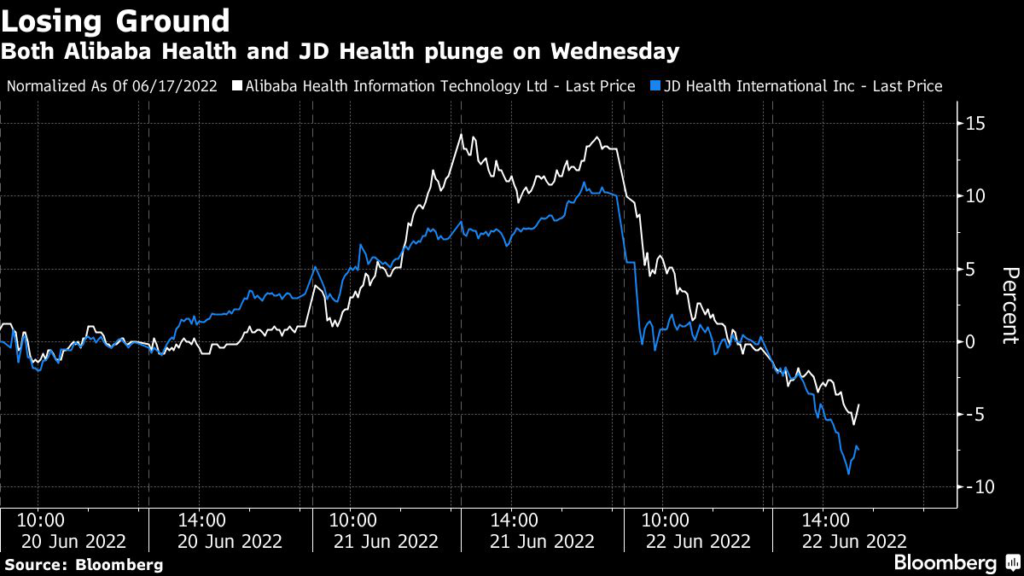
Alibaba Health Information Technology Ltd. plunged 14% and JD Health International Inc. tumbled 15%, wiping out three days of strong gains. Weakness in pharmaceutical shares and concerns of a global recession led the Hang Seng Tech Index to a decline of 4.4%.

The 21st Century Business Herald reported Tuesday, citing one unidentified source, that the regulators will clarify the definition of “third-party platform” mentioned in a May proposal that seeks to amend rules on drug supervision, including a ban of such firms to sell medicinal products.

Meanwhile, Chinese live-streaming platform operators also took a hit in afternoon trading after Beijing published new document to tighten regulation on the sector.


Live-streamers should safeguard the national interest and uphold correct political values, according to a notice released by National Radio and Television Administration. Kuaishou Technology dropped 4.1% while Bilibili Inc. lost 3.4%.

“I think any potential regulatory news can still create some volatility,” said Wenchang Ma, a portfolio manager at Ninety One Hong Kong Ltd. But in the short run, “there is going to be more focus on how the second quarter earnings is going to deliver, and then looking forward to the second half of the year as well,” she said.

Rebound at Risk

Alibaba Health and Ping An Healthcare and Technology Co. are the worst-performing stocks on Hang Seng Tech Index since mid-March when it started rebounding after dropping to its lowest since inception. 

The gauge has risen more than 30% since mid-March amid expectations the worst might be over for Chinese technology giants, which have been suffering from regulatory crackdown since late 2020.

Still, the draft policy should have “minimal operational impact on internet healthcare leaders, such as AliHealth”, Citigroup Inc. analysts including John Yung wrote in a note. Their related businesses should conform with the policy and their e-commerce platform businesses don’t directly sell drugs online, they said.

“For those online pharma names, some people are worried about rising regulatory risks today,” said Banny Lam, head of research at CEB International Investment Corp. “I think the impact should be limited since Beijing has vowed to support the platform economy.” 

(Updates with more context)

More stories like this are available on bloomberg.com

©2022 Bloomberg L.P.
Volkswagen CEO Diess Warns Car Plants Are at Risk From Energy Supply Halt

(Bloomberg) — Volkswagen AG Chief Executive Officer Herbert Diess warned that the shift away from Russian energy isn’t happening fast enough to shield the German carmaker from a sudden stop in natural-gas deliveries.

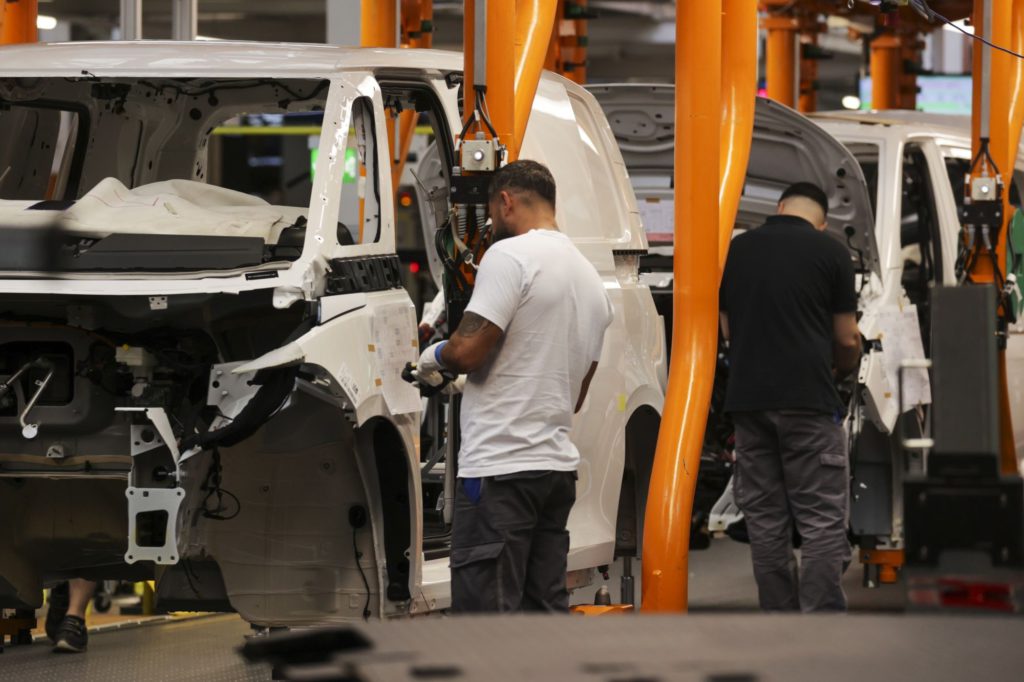
VW will keep the ability to run its power plants with coal instead of gas because of Germany’s reliance on Russian imports, Diess said in an interview for the Qatar Economic Forum in Doha. While progress has been made sourcing liquefied natural gas from the US and other nations, building up the necessary infrastructure will take time.

“It’s going probably not fast enough” to cope with a major disruption, Diess told Bloomberg Television’s Anna Edwards. “In the long run, I’m sure that we become independent from Russian gas.”

Diess has spearheaded major changes at VW to make the manufacturer more agile and challenge Tesla Inc. as the leading maker of electric vehicles. The company has introduced new battery-powered models, is moving ahead with a plan to add an EV factory close to its Wolfsburg headquarters and is building up a comprehensive battery supply chain.

Read: Germany Prepares to Trigger Second Stage of Emergency Gas Plan

While the war in Ukraine, rising interest rates and inflation all weigh on investors’ risk appetite, Diess said he’s not yet seeing demand destruction in the automotive sector. VW has EV orders lined up for “roughly one year” and is optimistic it will achieve its targets for 2022.

“We don’t see customer demand going down currently, but that might change,” he said.

EV Leader

VW could overtake Tesla as the biggest EV maker in 2024, according to Bloomberg Intelligence — a projection Elon Musk contested in his interview at the Doha event on Tuesday. Diess said VW has “the widest range of EVs in the world market.”

Still, Diess has recently fielded tough questions about issues at VW’s software unit that are delaying the release of new models. The CEO said he’s happy with the technology stack at its main VW passenger-car brand and confident that its Porsche and Audi units can iron out their challenges soon. He added that the structural overhaul at VW will require more patience.

“The build-up of software competences to a level where we are 90% self-sufficient will take decade or so,” Diess said. “We are still buying teams, companies worldwide, investing heavily in China, in the US.”

Qatar’s Ministry of Commerce and Industry, Qatar Investment Authority and Investment Promotion Agency Qatar are the underwriters of the Qatar Economic Forum, Powered by Bloomberg. Media City Qatar is the host organization.

More stories like this are available on bloomberg.com

©2022 Bloomberg L.P.

Close Bitnami banner
Bitnami
