Bloomberg

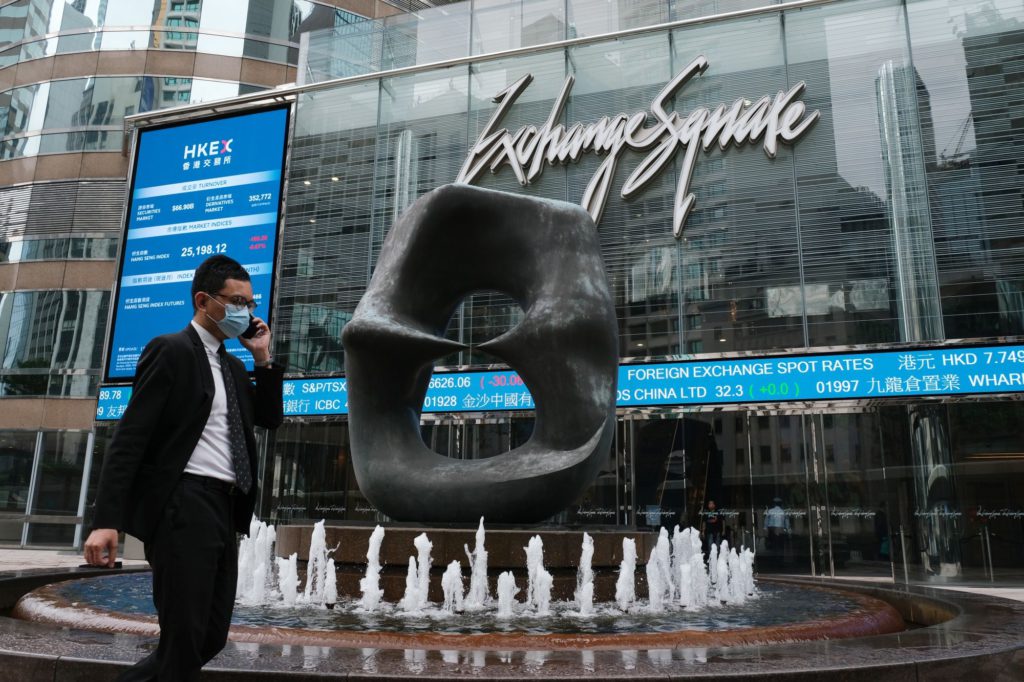
Ximalaya Pushes Back Hong Kong IPO Launch Amid Volatility

(Bloomberg) — Chinese podcasting startup Ximalaya Inc. is pushing back the launch of its planned initial public offering in Hong Kong, in an abrupt change of heart amid market volatility, people familiar with the matter said. 

The Shanghai-based company was speaking with potential cornerstone investors in recent days and was considering to start taking orders as soon as next week if talks go well, Bloomberg News reported earlier. It has now decided to hold off until September at the soonest, the people said. 

Ximalaya met with lukewarm demand during early talks with prospective investors, one of the people said, asking not to be identified because the information is private. It ultimately determined that it would be too hard to kick off the offering this month given disagreements over valuation amid the market turmoil, another person said. 

The company, which was considering seeking less than $100 million, made the final decision to hold off in the last 24 hours, the people said. Ximalaya hasn’t formally set a new timeline, and details of the offering could still change, the people said. A representative for Ximalaya declined to comment.

Hong Kong’s IPO market has seen its sharpest swing in a decade, with inflation concerns and the war in Ukraine contributing to market volatility. Companies have raised about $2.4 billion through IPOs so far this year, only a fraction of the $26.2 billion raised during the same period in 2021, according to data compiled by Bloomberg.

This month, a few companies including logistics startup GogoX Holdings Ltd. and battery material supplier Tianqi Lithium Corp. are set to defy the slump and are going ahead with their Hong Kong listing plans.

Read More: Hong Kong IPOs See Some Uptick As Semester End Nears

Ximalaya counts Tencent Holdings Ltd., Baidu Inc. and Sony Music Entertainment as backers, a preliminary prospectus shows. The app-based online audio platform launched on Tuesday the first official audiobook versions of the Harry Potter series in Chinese, according to a statement from Pottermore Publishing.

The company first filed for a Hong Kong IPO in 2021. It had previously dropped a plan to list in New York as Chinese regulators stepped up scrutiny over domestic firms flocking to US exchanges, probing them over national security concerns.

Goldman Sachs Group Inc., Morgan Stanley and China International Capital Corp. are joint sponsors of Ximalaya’s Hong Kong offering, the prospectus shows.

(Updates with Harry Potter audiobooks in seventh paragraph.)

More stories like this are available on bloomberg.com

©2022 Bloomberg L.P.

Apple Union Getting Calls From ‘All Over’ After Win in Maryland

(Bloomberg) — The labor group that helped orchestrate the first successful unionization campaign at an Apple Inc. store said it’s eager to begin negotiating with the company and looks to build on the breakthrough elsewhere. 

“The biggest thing for us to do now is to get Apple to the table and talk to them about who we are and what we want for our union members,” said David Sullivan, a general vice president at the International Association of Machinists and Aerospace Workers, which prevailed in a union vote last weekend at a store in Towson, Maryland. 

Sullivan declined to discuss specific plans for additional stores, but said the union has a “complete strategic plan” in place. “We’ve received phone calls from all over the country,” he said.

In a vote announced by the National Labor Relations Board on Saturday, employees in Towson voted to join the IAM by a roughly 2-to-1 margin. The bargaining unit, calling itself the Coalition of Organized Retail Employees, or CORE, includes about 100 workers. President Joe Biden applauded the move, saying “workers have a right to determine under what conditions they are gonna work or not work.”

The outcome represents a breakthrough for labor activists, who had struggled to make inroads at Apple. They now hope to duplicate the success of workers at Starbucks Corp., who won their first union election last year and are now pursuing votes at hundreds of stores. An Amazon.com Inc. labor group, meanwhile, had a successful vote at a warehouse in New York’s Staten Island, but then failed to win a second vote at a nearby facility. 

Just last month, a separate labor group trying to organize employees at an Apple store in Atlanta withdrew its request for an election, citing what it alleged were illegal union-busting tactics by the company. That organization, the Communications Workers of America, said it took the step “because Apple’s repeated violations of the National Labor Relations Act have made a free and fair election impossible.”

In complaints filed with the NLRB, the CWA accused Apple of violating federal labor law by forcing workers in Atlanta and New York City to attend “captive audience” meetings about unionization. Employees at the Towson store also have complained about such meetings, as well as a video message from Apple’s retail chief that cast unionizing in a negative light.

The executive, Deirdre O’Brien, told employees she was worried about “what it would mean to put another organization in the middle of our relationship.”

“We have a relationship that is based on an open and collaborative and direct engagement,” O’Brien said in the video, which Bloomberg reported last month.

Apple has boosted worker pay and benefits in the months since employees first announced organizing efforts. The company increased hourly wages for retail staff to at least $22 per hour, up from a previous $20 minimum. It also agreed to make work schedules more flexible, addressing a source of tension for employees. 

In addition, Apple doubled the number of paid sick days, increased vacation time and expanded backup care for children. 

The IAM’s Sullivan said he is confident the NLRB will certify the Towson vote. Once that happens, Apple and the union can begin negotiating a contract. The company, based in Cupertino, California, didn’t have an immediate comment.

A More Perfect Union, a social welfare nonprofit, produced a video ahead of the vote in which employees from the Towson store called Apple’s anti-union campaign “nasty.” The company’s messaging included management telling workers that the IAM once prohibited Black employees from joining its ranks, they said.

A key issue is whether Apple crossed a line by pushing back against unionization. Workers in the video complained about managers holding meetings that they described as “union busting.”

Existing precedent allows companies to hold such meetings, but the NLRB’s current general counsel, Jennifer Abruzzo, views them as inherently coercive and illegal. She is pursuing cases that could change the precedent.

Abruzzo, a former CWA attorney, also is trying to resurrect an old doctrine requiring employers to negotiate with a labor group if they have no “good faith doubt” that most employees support the union.

“Apple’s messaging didn’t work in Maryland,” the IAM’s Sullivan said. “We hope other workers across the country will see that they can stand up for themselves.”

More stories like this are available on bloomberg.com

©2022 Bloomberg L.P.

Personio Hits $8.5 Billion Valuation in Latest Fundraising Round

(Bloomberg) — Personio, one of Germany’s largest startups, raised an additional $200 million in a funding round that pushed the value of the human-resources software maker to $8.5 billion. 

Greenoaks Capital Management, a San Francisco-based venture firm that’s also backed Stripe Inc., TripActions and Robinhood Markets Inc., led the investment, which raised $470 million in total, Personio said Wednesday. 

The deal marks an increase in the Munich-based company’s $6.3 billion valuation last year. Still, Co-Founder and Chief Executive Officer Hanno Renner said investors had more questions this time about the stability of the business in light of a slowdown in the tech industry.

Market Downturn Rattles Venture Investors Despite Funding Surge

“As long as our customers employ people who need to be paid, for example, and who take vacation, our software remains in use,” Renner said. The company provides services to clients in a variety of industries and targets small and mid-sized businesses, he said.

An initial public offering is the “clearest outcome” for Personio, but the company isn’t in a rush to file, he said. 

Following the fundraising, Renner said that Personio is “focusing strongly on organic growth,” though he didn’t rule out more deals. Personio bought Berlin-based Back, which automates HR processes, last month. 

More stories like this are available on bloomberg.com

©2022 Bloomberg L.P.

BlockFi CEO Prince on Credit Pact With FTX, Crypto Plunge: Q&A

(Bloomberg) — Within the cryptocurrencies space, lenders have been under the spotlight in recent days after some disclosed signs of trouble. But one of the biggest players in the space, BlockFi Inc., says every aspect of the business is functioning.

The Jersey City, New Jersey-based company made waves on Tuesday when it disclosed that crypto powerhouse FTX agreed to provide it with a $250 million revolving credit facility. Zac Prince, co-founder and CEO of BlockFi, said the move helps to further bolster his company’s balance sheet. 

Read more: Crypto Lender BlockFi Gets $250 Million Credit Line From FTX

Bloomberg News spoke with Prince about the agreement. Though he declined to share details on the revolver, Prince said the credit facility is subordinate in priority to client funds, meaning if the company ever encountered a liquidation scenario, clients would get their funds back before any of the credit line was paid back.    

What follows is an interview with Prince, which took place on Tuesday. Some of the questions and answers have been edited for length and clarity:

Q: What can you tell me about the revolver?

A: At a high level, the best time to raise capital is when you don’t need it. Obviously markets in general are pretty volatile right now. Crypto markets, in particular, are pretty volatile right now given some of the events that have taken place over the past six weeks. While markets are volatile, this was a strategic decision on our part to further bolster our balance sheet and reinforce our commitment to serving clients and ensuring all funds are safeguarded.

Q: How come you made this move with FTX right now?

A: It was equal parts an offensive and defensive move. To the untrained eye, BlockFi might look to have a seemingly similar business model to others in the space. To the trained eye, and what we know — everybody at BlockFi, what Sam [Bankman-Fried] and the FTX team know, what a lot of people in the industry know — is that it’s night and day. We felt that it was a smart, offensive and strategic decision for BlockFi to bolster the balance sheet with a big number, and tell everybody about it.

Q: How is your relationship with your banks right now?

A: Before UST/Luna happened, we had two Bitcoin-backed credit lines open with two different banks. Before UST/Luna, we had borrowed a partial amount of those facilities. Fast-forward to today, we still have those Bitcoin-backed credit facilities with the banks, but the drawn amount right now is zero. We have great relationships with them, with all of our banking partners. Everything is working as it always has.

Q: And how is BlockFi doing?

A: In May 2022, BlockFi was cash-flow positive and had the best month ever in the company’s history. Like the broader crypto industry, and as a result of some of the recent events in the market, we’re absolutely seeing the negative implication on our platform in the very short term. We see this all the time when there’s negative news events — people get scared, they withdraw and they ultimately come back once the trust is restored or the dust is settled, depending on the event. So we definitely saw an uptick in that last week.

Q: Can you say more about the withdrawal requests?

A: For example, we processed a higher-than-usual volume of withdrawals last week, but we have since seen an 88% decrease from peak to trough in daily withdrawal requests and expect this declining trend to continue.

Q: What do you make of what’s going on with the broader market? Does it make sense that we’ve seen the selloff we’ve seen?

A: Bitcoin and the cryptocurrency space was born out of a depression, a major financial event, but this is the first time that Bitcoin and this industry have been alive where it looks like we’re facing another macroeconomic depression. I’ve worked in other parts of fintech and traditional tech, and for anything that’s new, its resiliency is always questioned the first time that it’s existing when there’s one of these major events that happen roughly every decade. We’ll see what happens with the traditional market, but people are not feeling bullish. So does it make sense that crypto is here? It’s hard to say that without the benefit of hindsight. But what I’m highly confident in is that at some point in the future — it might be six months or 18 months — we’re going to look back at some point in time over the next few months and we’ll say, ‘That was a phenomenal time to buy.’ And the reason that’s going to happen is because there’s so much long-term growth still ahead for this asset class.

More stories like this are available on bloomberg.com

©2022 Bloomberg L.P.

Meal-Kit Unicorn Daily Harvest Recalls Lentil Crumbles After Reports of Illness

(Bloomberg) — Pre-packaged meal service Daily Harvest is telling customers not to eat one of its products after reports of “gastrointestinal issues.”

While the company has been responding to reports as early as Wednesday on its Instagram account, Daily Harvest did not make a statement on the matter until Sunday. The recall statement was posted to the company’s website, where they vowed to launch “an investigation with internal and external experts throughout our supply chain and in accordance with regulatory procedures.”

“We took immediate steps to address what we heard from customers, reaching out to every person who received French Lentil + Leek Crumbles, instructing them to dispose of the product and not eat it,” the post says. 

Meal and grocery delivery is increasingly competitive, with companies from Blue Apron to Hungry Root and Instacart to FreshDirect and UberEats piling in. Founded in 2015, Daily Harvest specializes in frozen food products, including ready-to-blend smoothies, and The New York-based startup was valued at $1.1 billion in November after an investment round led by Lone Pine Capital that included Lightspeed Venture Partners. 

Consumers and influencers have flooded Redditt and Twitter, claiming the brand’s French Lentil + Leek Crumbles have sickened them and even sent them to the hospital.

In an email viewed by NBC News, the brand responded to customer complaints by offering a $10 credit for every bag purchased. “As included in our cooking instructions, lentils must be thoroughly cooked to an internal temperature of 165°F,” the email read.

More stories like this are available on bloomberg.com

©2022 Bloomberg L.P.

Crypto Bulls Charge Back, Encourage Buying in Plummet’s Wake

(Bloomberg) — Crypto bulls seem to believe that winter may have passed as several currencies rose sharply after painful weeks that made some investors question the viability of the entire industry. 

Bitcoin, the most widely held cryptocurrency, rose as much as 6.2% to once again trade above $21,000 after falling close to $17,000 over the weekend. Ether, the second-most popular token, added 6.5% at one point and hovered around $1,191. Altcoins, including XRP, Cardano, Dogecoin and Polkadot, all rallied as well.

The comeback spurred exhortations on Twitter, where much of crypto discourse happens, to buy the dip and keep the faith even amid the recent brutal selloff that’s seen billions wiped out in value. 

Many tweets played up the FOMO aspect of investing in the highly-volatile space. Tuesday’s rise is a case in point, they say, of that if you fail to buy during the big dips — you end up missing the rallies, too. 

Still, not everyone was ready to call it a bottom. Quantum Economics Founder and Chief Executive Officer Mati Greenspan, for one, remains cautious.

“I don’t know if what we’re seeing now is a dead-cat bounce, or if it turns out we have a false breakout below $20,000,” Greenspan said. “I think it’s yet to be determined.” 

Others pointed to historical precedent, arguing that most Bitcoin bear-market bottoms, though they’re volatile, tend to form quickly:

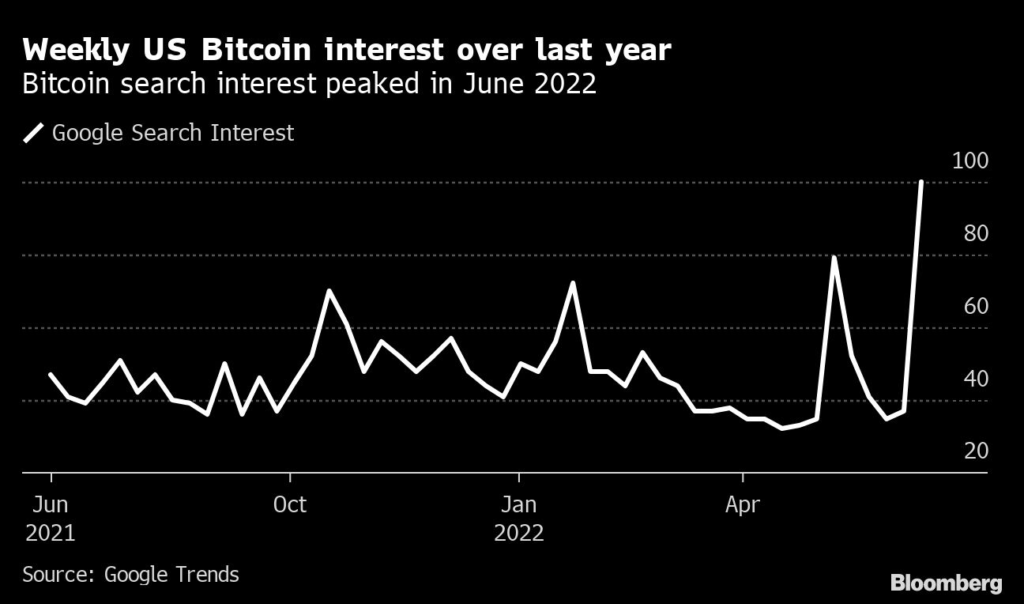
Even though crypto, has had a rough few months, and other assets, like stocks, have not been immune to market turmoil, the weekend plunge caught many investors by surprise because of the magnitude of the declines. Google Trends data indicates that weekly searches for Bitcoin reached its highest value over the last year.

The head of MicroStrategy Inc., Michael Saylor, weighed in to say that Bitcoin continues to evolve:

While others pointed out that Bitcoin at its infancy traded for a tiny fraction of where it is today:

“There has been a resurgence in extra-medium, social media bullish sentiment, however, it’s not really near the highs at this point,” Greenspan said, adding that if the $20,000 floor holds, then he would be “very bullish.”

More stories like this are available on bloomberg.com

©2022 Bloomberg L.P.

Private Equity Giants Called Vultures Eye Breakthrough in Japan

(Bloomberg) — For years, private equity giants have worked to change a damaging public perception in Japan: that they’re “vultures,” hacking companies apart and gorging on their remains.

Now, Toshiba Corp. is giving the buyout industry an $18 billion opportunity to see whether those efforts have paid off.

The troubled Japanese conglomerate is soliciting acquisition offers — and other proposals — as it seeks to end years of mismanagement. Bain Capital, Blackstone Inc. and CVC Capital Partners are among the funds considering bids, Bloomberg News has reported. A successful deal, which may be private equity’s largest ever in the country, would signal the once-criticized investors have become more accepted in Japan.

But that remains far from certain. Toshiba directors have been disagreeing publicly over the company’s future, and the Japanese government, which deems the firm’s nuclear power business critical to national security, would have to sign off. What’s less in doubt is private equity has made progress in improving its reputation in Japan.

“Things are starting to change,” said Kazuhiro Yamada, head of the Japan buyout advisory team at Carlyle Group Inc., the US investment house that manages $325 billion in assets. “Before, it was hard for private equity firms to even make an appointment,” he said. “Now, companies are increasingly approaching private equity.”

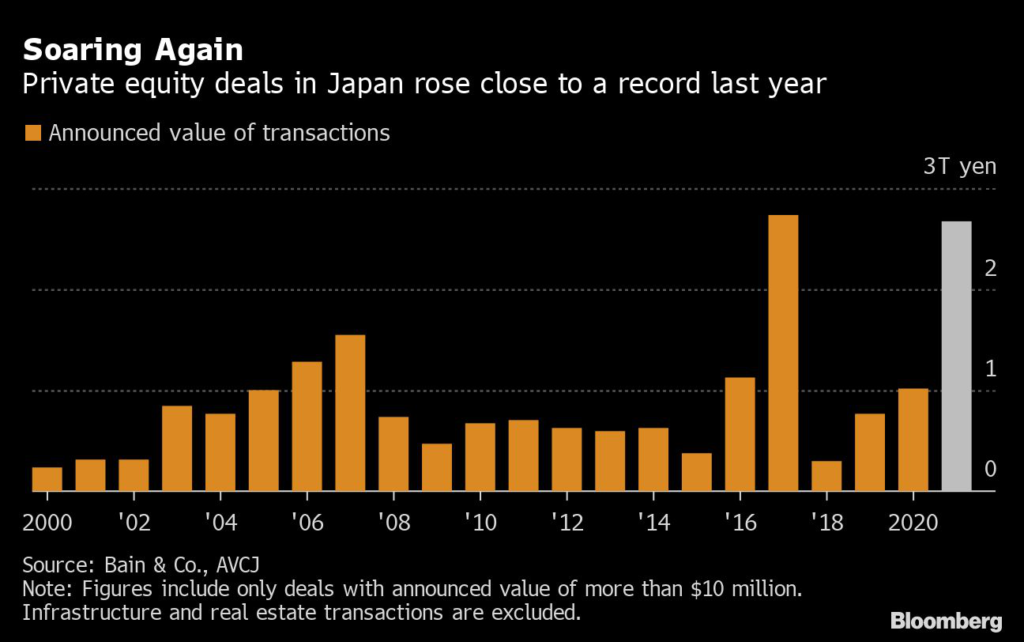
The number of deals involving private equity funds hit an all-time high of 134 in Japan last year, according to the consulting firm Bain & Co. The value of transactions more than doubled from the previous year to about 2.7 trillion yen ($20 billion), close to the record from 2017. Shiseido Co. and Hitachi Ltd., both founded more than a century ago, sold parts of their business to private equity last year.

Even the government says private equity has changed in Japan. In the first half of the 2000s, many private equity firms “sought to increase the value of companies over the short term through debt workouts,” a representative of the Ministry of Economy, Trade and Industry’s Industrial Finance Division said in emailed comments. These days, they try to raise the value of companies over the medium to long term, mainly through overseas expansion, business diversification or acquiring other companies in the same industry, the official said.

That’s a far cry from the early years of the century, when one buyout, in particular, shaped the image of private equity firms in Japan. In 2000, a consortium led by Ripplewood Holdings bought the collapsed Long-Term Credit Bank of Japan (now Shinsei Bank Ltd.) from the government for a price that was considered low. Ripplewood made a big profit when Shinsei listed in 2004. The deal angered the Japanese public, especially as the state cleaned up the bank’s bad debts.

Foreign investment funds became labeled as “hagetaka,” or vultures. A wave of overseas activist funds didn’t help perceptions in the years before the global financial crisis as they pushed Japan Inc. for higher dividends and buybacks. In 2007, the public broadcaster NHK aired a popular TV drama series called “Hagetaka” about a western investment firm taking over ailing Japanese companies and forcing them to swallow painful restructuring.

“Even my parents asked me if I’d become a vulture,” Carlyle’s Yamada recalled. 

When Carlyle bought one Japanese manufacturer, its staff looked at him, wondering “Who is this guy? Is he a foreigner?” he said.

Around that time, Japanese companies would only talk to PE firms after they’d been spurned by peers in their industry, said Tetsuro Onitsuka, head of Japan private equity for Stockholm-based buyout firm EQT AB.

But in the years after the financial crisis, the situation started to change. 

After Prime Minister Shinzo Abe came to power at the end of 2012, he started to push companies to overhaul themselves, helping to sow the seeds for an increase in mergers and acquisitions.

“People began to understand that there are many different kinds of investment funds and not all of them are hagetaka,” Onitsuka said.

A key deal that helped change perceptions was KKR & Co.’s $1.7 billion purchase of Panasonic Corp.’s health-care unit, which was announced in 2013.

“Panasonic is a very iconic company,” said Kunihiro Takahashi, head of corporate finance at Barclays Plc in Japan. “The fact that an American PE was able to buy a business from such a well-known company in Japan was very surprising.”

In 2017 came an even bigger milestone, when a consortium led by Bain Capital agreed to buy Toshiba’s crown-jewel memory-chip business for $18 billion. It was — and remains — private equity’s largest deal in Japan.

The buyout sent a “positive signal” that industries or assets deemed nationally important weren’t “off limits” to foreign investors, said Jim Verbeeten, a partner at Bain & Co. in Tokyo.

To be sure, not everyone is positive about private equity. The investors have been criticized for their tactic of leveraged buyouts, saddling companies with large debts, which can give them less room to maneuver when things go wrong. The LBO was immortalized in the book “Barbarians at the Gate” more than three decades ago about the takeover of tobacco and food conglomerate RJR Nabisco in the US. 

Still, “private equity investors provide the strategic capital which is needed for aging Japanese companies in an aging society,” said Nga Pham, a research fellow at Monash Centre for Financial Studies in Melbourne. As well as injecting funds, private equity firms offer the expertise needed to help transform companies, she said.

Despite its recent successes in Japan, a buyout of Toshiba would be the true litmus test of whether private equity has arrived. The company, which has a market value of about $17.8 billion, has received eight privatization offers and two alliance proposals as part of its process to solicit strategic options. A sharply weakening yen is helping make Japanese companies more attractive for foreign investors. But nothing is decided, Chief Executive Officer Taro Shimada told Bloomberg in an interview this month, saying staying public is still a possibility.

That’s partly because Japan’s government could nix any deal. Toshiba’s nuclear business is involved in decommissioning the wrecked Fukushima Dai-Ichi nuclear power plant, a critical operation for the country. 

The METI division said in its emailed comments that the key for private equity funds isn’t whether they’re Japanese or foreign, but whether they’re contributing to revitalizing the country’s economy. But Koichi Hagiuda, the trade minister, was more cautious about overseas ownership of Toshiba.

“If foreign investors seek a stake above certain levels, we will strictly review whether that could undermine our country’s security,” he told reporters at a press conference earlier this month.

Monash’s Pham said she doubts an international private equity firm will succeed in buying Toshiba without partnering with a domestic PE fund. State-backed investment fund Japan Investment Corp. is considering making a bid, Bloomberg reported in May.

The next step for Toshiba is to appoint a new board. One of the company’s directors publicly disagreed with its inclusion of representatives from activist investors among the nominees. Shareholders will vote on the new director slate at the annual meeting scheduled for June 28. 

Once the board is in place, the company will narrow down the list of investment proposals. In July or later, it give those selected the opportunity to do due diligence and ask them to submit binding bids.

“If a PE succeeds in buying all of Toshiba, it will arguably be one of the most significant transactions in the country,” with other similar large deals likely to follow, Takahashi of Barclays said. “A global PE taking over such an iconic company will be very significant.”

More stories like this are available on bloomberg.com

©2022 Bloomberg L.P.

Bitcoin Miner Bitfarms Sells Coins After Ending ‘Hodling’

(Bloomberg) — Crypto mining company Bitfarms Ltd. has made an about-face on its holding strategy and sold 3,000 Bitcoin for $62 million over the past week to boost its liquidity amid the record-breaking bear market. It’s one of the first self-proclaimed Bitcoin hoarding miners to turn away from accumulating mined coins. 

The Toronto-based company is the latest of the public mining companies that have had to sell their crypto assets to stay afloat. With the recent market rout, other miners may see their strategy of holding onto mined coins coming under pressure as it gets more difficult for the sector to raise capital from the stock market and repay debts. 

In April, Riot Blockchain Inc., one of the largest public miners by market cap and a long-time holder, started selling Bitcoin. Large-scale miners like Riot and Marathon Digital Holdings Inc. hold on to their mined coins and can serve as a proxy for coin prices, attracting investors who do not want to directly hold onto Bitcoin.

Bitfarms is “no longer HODLing all our daily BTC production,” said Jeff Lucas, CFO of Bitfarms. The company bought 1,000 coins five months ago at the average price of $43,200. The miner’s Bitcoin holdings are down by 47% with 3,349 coins still on its balance sheet. Bitcoin climbed above $21,600 on Tuesday as cryptocurrencies get a reprieve from the recent sell-off. 

The company is one of the largest miners by computing power in North America. “In consideration of extreme volatility in the markets, we have continued to take action to enhance liquidity and to de-leverage and strengthen our balance sheet,” Lucas said in a statement.

The company sold 1,500 coins last week and used a portion of the proceeds to reduce its Bitcoin-backed credit facility with crypto merchant bank Galaxy Digital Holdings Ltd. 

Other major public Bitcoin miners are selling large amounts of their holdings as well. Core Scientific Inc., Riot and Argo Blockchain Plc have sold 2,598 coins, 250 and 427, respectively. Mining stocks have been in a sharp decline as Bitcoin prices dropped further in the recent weeks.

Bitfarms’ move came at a time when public Bitcoin miners are selling their coins at a much faster pace. The top 28 public mining companies, which contribute about 20% of the computing power to mine Bitcoin, sold 4,271 coins in May, an 329% increase than the previous month and the miners are likely to sell even more in June, according to data from public filings compiled by research firm Arcane Crypto. 

Public mining companies may also be selling more compared to private miners since they could keep a larger share of their production during the bull market by tapping into financial markets, said Jaran Mellerud, mining analyst at Arcane Crypto said. 

The miners are some of the biggest whales, holding around 800,000 Bitcoin, according to data from Coin Metrics, of which public miners own 46,000. “If they are forced to liquidate a considerable share of these holdings, it could contribute to pushing the Bitcoin price further down.” Mellerud said.

(Updates with additional data and analysis on Bitcoin sales beginning in the seventh paragraph.)

More stories like this are available on bloomberg.com

©2022 Bloomberg L.P.
Meta Bet Scrapped at Brazil Money Manager on TikTok Competition

(Bloomberg) — One of Brazil’s oldest independent asset managers said it closed a years-old wager on Meta Platforms Inc. in the first half of 2022, citing the impact of competition from video-sharing app TikTok.

“The competition for time became fiercer given TikTok’s incredible ability to retain user attention,” IP Capital Partners wrote in a note to clients this month announcing the move. “While the short-form video format has had more success among young people, we believe it has a universal appeal and will continue to penetrate older audiences around the world.”

IP Capital Partners, which was founded in 1988, had more than 4 billion reais ($777 million) in assets as of April, according to data from Brazil’s capital-markets association Anbima. The firm didn’t disclose the size of the Meta position in the note to clients, and it didn’t immediately respond to an emailed request for comment.

The money manager, which started building a long position in Meta in 2018, estimates that the US audience spent more time watching TikTok than Reels, the short video platform of Meta unit Instagram, by a magnitude of 20 in the first three months of the year. 

While Meta has focused on boosting the adoption of Reels, the effort diverts attention from highly monetized features on its Facebook platform, such as the feed and stories, which helps explain a sharp slowdown in revenue growth last year, the fund wrote. 

Wall Street has soured on Meta this year, with the stock losing more than half its value, erasing about $500 billion in market valuation. Much of the collapse occurred in February, when the company gave a forecast that disappointed investors and warned about competition from TikTok. Last year, it announced a pivot toward the metaverse, a change in strategy that investors remain mixed on.

The Rio de Janeiro-based asset manager’s oldest fund, IP Participacoes Master FIA BDR Nivel I, had exposure to Meta through both U.S.-listed shares and the company’s Brazilian depositary receipts, data compiled by Bloomberg show. Other U.S. bets include Netflix Inc., Charter Communications Inc., Charles Schwab Corp. and Amazon.com Inc., according to the note to clients. 

More stories like this are available on bloomberg.com

©2022 Bloomberg L.P.

Biden Taps Prabhakar for Science Post, Eyeing Health Leaps

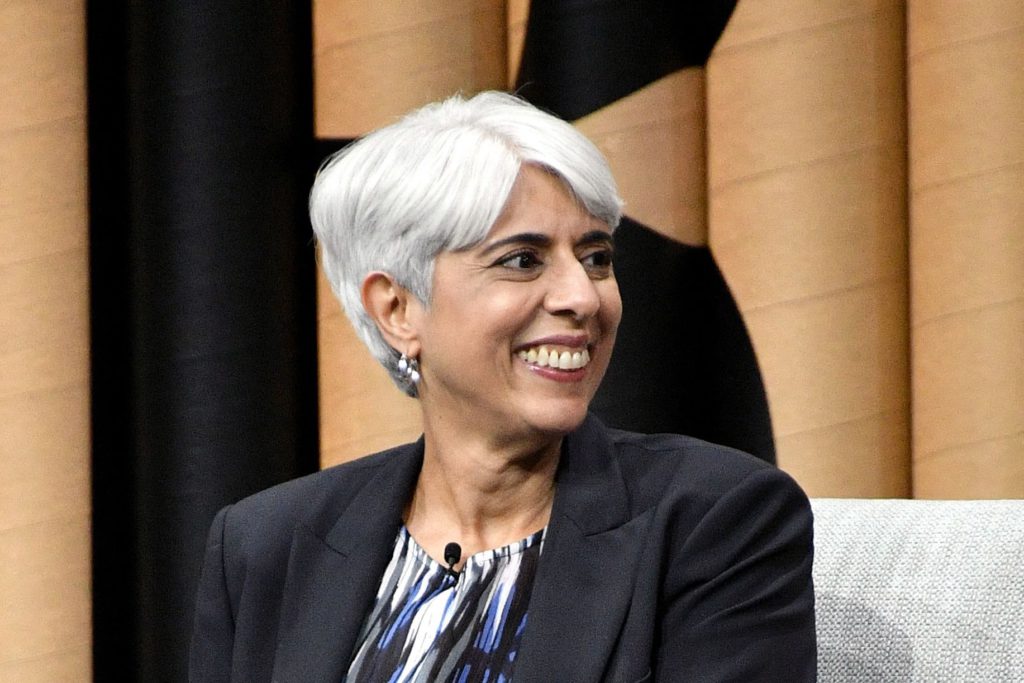
(Bloomberg) — President Joe Biden selected a former Defense Department innovation official, Arati Prabhakar, to serve as the next White House science adviser as his administration undertakes an effort to accelerate biomedical research.

She will replace Eric Lander, who resigned in February following reports he mistreated his staff.

As head of the Office of Science and Technology Policy, Prabhakar will work to “expand our possibilities, solve our toughest challenges, and make the impossible possible,” Biden said in a statement.

Prabhakar would be the first woman, person of color and immigrant confirmed by the Senate to lead the White House agency, if lawmakers approve her nomination. 

Her portfolio will include issues ranging from climate change to the physical sciences. Prabhakar, 63, also will play an essential role in Cancer Moonshot 2.0 — an initiative personally important to Biden that aims to cut the cancer death rate in half over the next 25 years.

Prabhakar will draw on her experience leading the Defense Advanced Research Projects Agency — a Pentagon entity that develops cutting-edge national security technologies, including precision-guided weapons and stealth technology — particularly as the administration stands up a new biomedical research accelerator. She led DARPA from 2012 to 2017.

The new biomedical research program — the Advanced Research Projects Agency for Health, or ARPA-H — aims to shepherd medical breakthroughs the same way DARPA paved the way for the internet and GPS. 

Prabhakar’s experience “will be invaluable as ARPA-H applies the DARPA model to drive biomedical and health breakthroughs that will address diseases affecting a significant number of Americans,” Sudip Parikh, chief executive officer of the American Association for the Advancement of Science, said in a a statement. 

Prabhakar, who served as a DARPA program manager from 1986 to 1993, said during a STAT summit last year that ARPA-H should be separate from the National Institutes of Health, which aligns with a bill (H.R. 5585) the House is expected to consider Wednesday. That position differs from plans the administration already has undertaken to house ARPA-H within the NIH.

Prabhakar clocked nearly 15 years of experience in Silicon Valley between running DARPA during President Barack Obama‘s administration and leading the National Institute of Standards and Technology from 1993 to 1997.

She’s currently chief executive of Actuate, a nonprofit that aims to apply a DARPA-like approach to issues including climate change, chronic disease and the use of machine learning without compromising privacy.

Three other women have led the OSTP on an acting basis, including its current temporary director, Alondra Nelson. Nelson is expected to return to her position as deputy director for science and society.

Lander resigned in February after a White House investigation found credible evidence he had bullied and spoken harshly to members of his staff. 

(Adds comment in eighth paragraph)

More stories like this are available on bloomberg.com

©2022 Bloomberg L.P.

Close Bitnami banner
Bitnami