Bloomberg

NFT Startup Magic Eden Valuation Surges Tenfold to $1.6 Billion

(Bloomberg) — Magic Eden, a marketplace for nonfungible tokens on the Solana blockchain, saw its valuation surge in a fresh funding round despite a slowdown in private investing and a cratering cryptocurrency market.

Investors have plowed a fresh $130 million into the startup at a $1.6 billion valuation – a roughly tenfold valuation increase since March, according to Avichal Garg, managing partner at Electric Capital and an investor in both rounds. Although that’s a startling pop even by boom-time standards, Garg said he invested because he believes the company will ultimately be worth much more.

The raise is notable at a time when other crypto startups have taken a hit during the market’s downdraft, with kingpins Coinbase Global Inc. and Crypto.com slashing their ambitions along with their workforces. This has also tempered enthusiasm for NFTs: monthly global sales have decreased about 34% between January and May, according to CryptoSlam. And Solana is down about 80% this year. 

Garg said he’s willing to look through the rout.

“I’m not too worried about overpaying because the headwinds will last 18, maybe 24 months, not six years,” Garg, whose firm co-led the round with Greylock Partners, said in an interview. “You have to be patient with crypto.”

Founded last year and based in San Francisco, Magic Eden operates an NFT marketplace similar to competitors OpenSea and AtomicMarket, earning revenue by taking a share of each transaction. Magic Eden has grown quickly, attracting users who liked Solana’s efficiency and lower cost to authenticate transactions compared to Ethereum.

Read More: Sequoia Capital Sees a Weakness in OpenSea’s NFT Dominance

Magic Eden was the ninth-largest NFT marketplace in mid-March, according to DappRadar. Now it’s second, just behind OpenSea in users and transaction volume as of Friday.

“We weren’t intending to kick off another round immediately, but we had a lot of interest,” Magic Eden Chief Executive Officer and co-founder Jack Lu said in an interview. “A lot of investors still feel we are very, very early.” 

Lu, who co-founded the startup with Zhuoxun Yin, said the company had $7.5 million in revenue in May and has been profitable from the start. Magic Eden is on an annual revenue run rate of $100 million, Garg said.

The company will use the new funds to increase headcount to 140 from its current 50 and grow in what Lu described as “a responsible way” over the next six to 12 months. During that time, it aims to expand and consolidate its collection of Magic Eden-minted NFTs with its larger marketplace, expand into gaming and build on other blockchain technologies in addition to Solana.

This could help ensure greater stability for users. The Solana blockchain’s surge in popularity has also made it unstable, leading to a wave of blackouts during the past year. 

However, building on multiple blockchains will also make it more similar to five-year-old OpenSea, which uses Solana, Ethereum, Klaytn and Polygon. Investors valued OpenSea at more than $13 billion in a funding round earlier this year. 

More stories like this are available on bloomberg.com

©2022 Bloomberg L.P.

Wall Street Gets a Short-Bitcoin Fund After 70% Crypto Collapse

(Bloomberg) —

Crypto bears who reckon the meltdown across digital currencies isn’t done yet are getting a new tool to bet on fresh declines.

The ProShares Short Bitcoin Strategy ETF (ticker BITI) launches Tuesday, becoming the first inverse exchange-traded fund in the US linked to the largest cryptocurrency. By reversing the performance of an index of Bitcoin futures, it aims to offer a relatively cheap and easy way to profit from any further losses.

BITI is arriving while the virtual-currency complex is in turmoil, with a digital-asset selloff amid soaring inflation gathering pace in the aftermath of last week’s super-sized Federal Reserve rate hike. It’s a spiral that’s seen even long-term holders start selling, and Bitcoin is down about 70% since its November peak.

That raises the risk that the new fund has missed the bulk of the drawdown. The bet by ProShares is that making it easier to short Bitcoin will encourage more investors to express their negative crypto views.

“We think there are many investors who have bearish short-term or long-term view of Bitcoin and cryptocurrencies in general who haven’t acted on their view because it was too difficult or expensive,” Michael Sapir, ProShares chief executive officer, said by phone. “Those investors will be able to gain short exposure to Bitcoin as easily as buying an ETF in traditional brokerage account.”

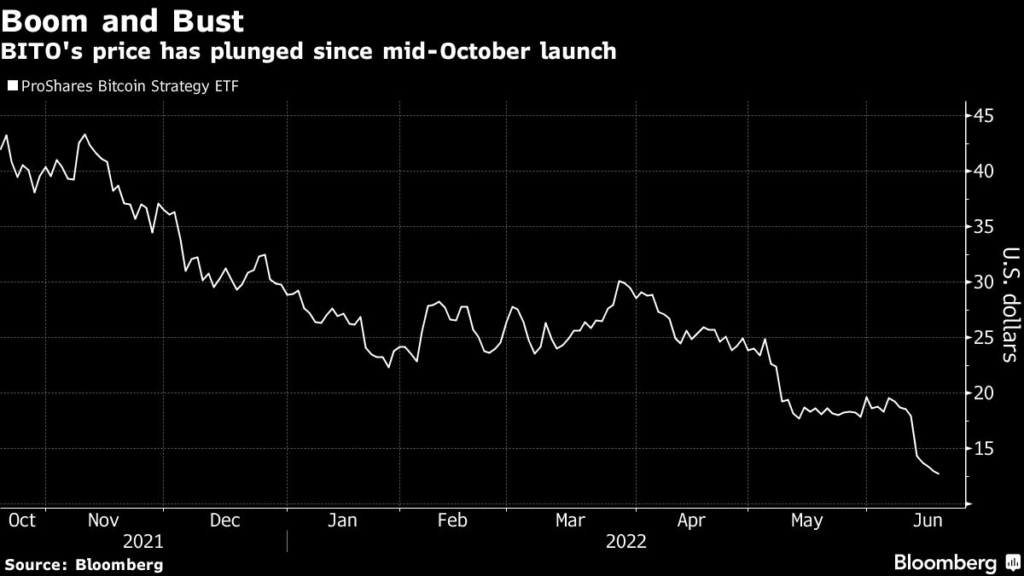
ProShares was also behind the first US ETF linked to Bitcoin back in October, the Bitcoin Strategy ETF (BITO). That enjoyed one of the biggest launches in ETF history, but its debut turned out to mark roughly the top of the digital-asset boom. 

BITI charges an expense ratio of 0.95%, matching that of BITO. While that’s higher than the bulk of actively managed funds, the spot borrowing rate for shares of BITO — one measure of the cost of shorting the fund — currently stands near 13.9%, according to data compiled by S3 Partners.


The catch is that, like most inverse ETFs, the new product is designed for only short-term use. It returns the inverse performance of its underlying index for one day at a time, meaning it effectively resets every day. Investors who hold onto the ETF for longer periods therefore risk underperforming because of its ongoing costs.

The ProShares product is the first bearish Bitcoin ETF to launch, with similar filings from rivals Direxion and AXS still in the pipeline. Direxion filed for a such a fund in October following BITO’s launch, but pulled the application at the request of US regulators.

More stories like this are available on bloomberg.com

©2022 Bloomberg L.P.

Musk Says Bots Are a Problem for Twitter Deal, Not China

(Bloomberg) — Elon Musk cautioned there are a number of issues to iron out before he can complete his $44 billion takeover of Twitter Inc., including getting an accurate measure of bots on the social media platform and completing financing for the deal.

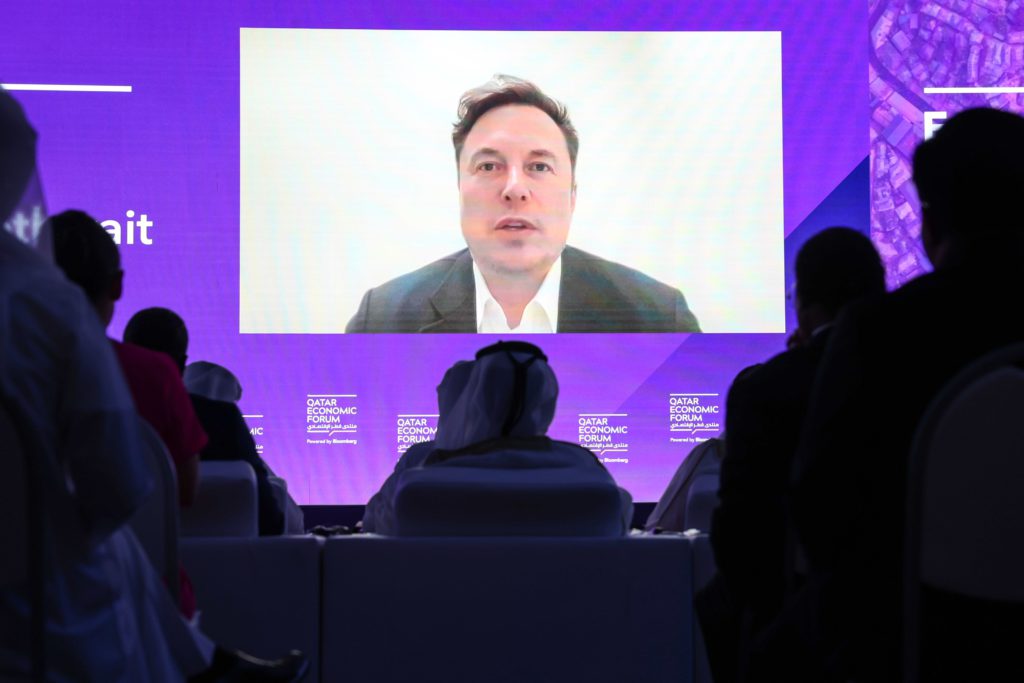
The proportion of fake, spam and bot accounts on the service is “still a very significant matter,” Musk said in an interview with Bloomberg News Editor-in-Chief John Micklethwait at the Qatar Economic Forum in Doha. “And of course there is the question of, will the debt portion of the round come together, and then will the shareholders vote in favor.”

Musk, after cutting a deal to acquire Twitter for $54.20 per share in April, has repeatedly questioned its disclosures about fake accounts, fueling speculation he wants to cut the price of the deal or walk away completely. His lawyer has said Twitter must cooperate by providing the data requested so that Musk can secure the debt financing necessary to consummate the deal. 

Banks have committed to provide $13 billion of debt financing to back Musk’s acquisition. The lenders include Morgan Stanley, Bank of America Corp. and Barclays Plc.

The 50-year-old entrepreneur did make clear during the forum he’s thinking about how to improve the service. He said he would take responsibility for “driving the product” at Twitter, as he does at Tesla Inc. and Space Exploration Technologies Corp., though he doesn’t necessarily plan to be the chief executive officer.

“Ideally, I’d like to get like 80% of North America and perhaps, I don’t know, half the world or something ultimately on Twitter in one form or another,” he said. “And that means it must be something that is appealing to people. It obviously cannot be a place where they feel uncomfortable or harassed or they’ll simply not use it.”

Musk said he didn’t foresee his business operations in China causing problems if he takes control of Twitter. The Tesla CEO, also the world’s richest person, counts on China as a key production base and growing consumer market for his electric vehicles. 

Twitter is officially banned in China, but the country uses it to spread its message overseas — sometimes with the help of its own spam bot armies. Amazon.com Inc. founder Jeff Bezos alluded to the potential conflicts in a tweet shortly after the Twitter takeover announcement, asking “Did the Chinese government just gain a bit of leverage over the town square?”

Read more about the regulatory and regional challenges ahead for Twitter under Musk

Striking a less ebullient tone than he adopts when discussing his Tesla ventures or humanoid robots, Musk on Tuesday declined to say with conviction the Twitter deal is going through. He has repeatedly raised the bot issue as an unresolved matter, suggesting he is keeping the door open for this deal to fall apart.

Musk has said he wanted to put the takeover “on hold” while he investigated how many of Twitter’s users are real people, and later filed a formal letter with the Securities and Exchange Commission in which he told Twitter executives he might walk away from the deal if the company didn’t do more to prove the size of its user base. Twitter responded by giving Musk access to its full fire hose of public tweets, though it’s unclear if that data is truly helpful in calculating the number of bots.

Twitter shares closed Friday at $37.78, 30% off the proposed takeover price.

In May, Musk dropped plans to partially fund his purchase of Twitter with a margin loan tied to his Tesla stake and increased the size of the deal’s equity component. While Musk’s agreement to buy Twitter isn’t subject to any financing conditions, the terms of the transaction require Twitter to provide any reasonable cooperation Musk requests to help with the financing arrangements.

Qatar’s Ministry of Commerce and Industry, Qatar Investment Authority and Investment Promotion Agency Qatar are the underwriters of the Qatar Economic Forum, Powered by Bloomberg. Media City Qatar is the host organization.

(Updates with Musk’s comments on China)

More stories like this are available on bloomberg.com

©2022 Bloomberg L.P.

UK Rail Strikes Get Under Way After Unions Reject Late Offer

(Bloomberg) — UK train services were brought to a near standstill on Tuesday after workers started the country’s biggest rail strike in more than three decades, with union leaders and government at odds over issues such as pay.

A proposal from 13 train operating companies was turned down on Monday, National Union of Rail, Maritime and Transport Workers General Secretary Mick Lynch said in statement broadcast from near Euston Station, north London. Some 40,000 staff began the walkout from midnight, with further stoppages planned for Thursday and Saturday.

The failure of negotiations means employees at the train firms and track manager Network Rail aren’t at work, while a separate action by 10,000 London Underground staff has hobbled transport within the capital. Only about 20% of national rail services are running, with Scotland and Wales among areas hit hardest.

Although train operators reported quiet stations during the usual morning peak, suggesting most people had found other ways to get to their jobs or were working from home, Transport Minister Grant Shapps said the walkout is “taking us back to the bad old days of union strikes.” 

“It’s not acceptable to disrupt businesses that are just getting back on their feet — they are hurting precisely the people they claim to be protecting,” he told Sky News. 

Shapps pledged to prepare for any future industrial action should the dispute continue, though measures such as bringing in temporary workers were condemned by the RMT’s Lynch, also on Sky, who said they would not be adequately trained.

“We will go on strike again if we don’t get a settlement to the issues,” he said.

Train operators including Arriva Plc-owned CrossCountry, Avanti West Coast and Great Western Rail all reported a lack of chaos as train users heeded government warnings and stayed at home. A spokesman for Avanti West Coast, majority owned by FirstGroup Plc, said a London-Birmingham train that was in operation Tuesday a.m. filled only 100 of about 600 seats. 

Budget Cuts

Lynch blames the government for the crisis, saying the root of the problem is £4 billion ($4.9 billion) of budget cuts — £2 billion each for Transport for London and the national railways. 

“That is hobbling this industry and it’s forcing the companies to implement transport austerity and massive cuts to our system,” he said. Other grievances include pay that’s not keeping pace with inflation, job cuts and a lack of guarantees against compulsory redundancies. 

Shapps had earlier called that analysis a “fundamental misunderstanding,” and said the money missing from the railways budget is down to lower takings from fares after passenger numbers failed to recover to pre-pandemic levels.

Pandemic Hit

Figures released by the Office of Road and Rail on Thursday showed total journeys at only 62% of the pre-pandemic tally in the quarter through March. That’s partly due to changing commuter habits in the wake of coronavirus lockdowns, with more people continuing to work from home.

Prime Minister Boris Johnson said in a statement late on Monday that “too high demands on pay will also make it incredibly difficult to bring to an end the current challenges facing families around the world with rising costs of living.” 

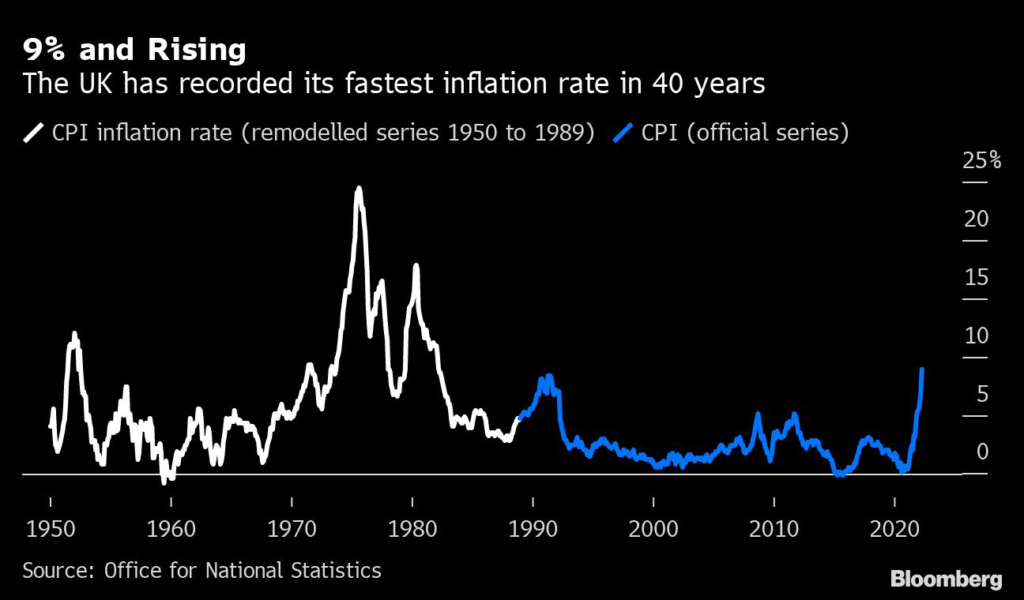
Johnson’s ministers have suggested that restraint on pay rises is needed to rein in inflation, which is already at a four-decade high. Johnson was expected to tell the cabinet on Tuesday that his government seeks to enforce pay restraint on public sector workers, according to a statement from his office.

Shapps said the strikes are “orchestrated by some of the best-paid union barons representing some of the better-paid workers in this country.” He said the median wages of train drivers are well above salaries of nurses and other professions.

Yet the RMT argues that many of the strikers are among the lowest paid on the railway networks, including cleaners. The union representing most train drivers, ASLEF, is not joining the national strike.

Labour’s transport spokeswoman Louise Haigh accused Shapps of “washing his hands” of responsibility. “On the eve of the biggest rail dispute in a generation taking place on his watch, he has still not lifted a finger to resolve it,” she said.


More stories like this are available on bloomberg.com

©2022 Bloomberg L.P.

UK Rail Walkout of 40,000 Staff Brings Services to Near Halt

(Bloomberg) — UK train services were brought to a near standstill on Tuesday after workers started the country’s biggest rail strike in more than three decades, with union leaders and government at odds over issues such as pay.

A proposal from 13 train operating companies was turned down on Monday, National Union of Rail, Maritime and Transport Workers General Secretary Mick Lynch said in a statement broadcast from near Euston Station, north London. Some 40,000 staff began the walkout from midnight, with further stoppages planned for Thursday and Saturday.

The failure of negotiations means employees at the train firms and track manager Network Rail aren’t at work, while a separate action by 10,000 London Underground staff has hobbled transport within the capital. Only about 20% of national rail services are running, with Scotland and Wales among areas hit hardest.

Although train operators reported quiet stations during the usual morning peak, suggesting most people had found other ways to get to their jobs or were working from home, Transport Minister Grant Shapps said the walkout is “taking us back to the bad old days of union strikes.” 

“It’s not acceptable to disrupt businesses that are just getting back on their feet — they are hurting precisely the people they claim to be protecting,” he told Sky News. 

Shapps pledged to prepare for any future industrial action should the dispute continue, though measures such as bringing in temporary workers were condemned by the RMT’s Lynch, also on Sky, who said they would not be adequately trained.

“We will go on strike again if we don’t get a settlement to the issues,” he said.

Train operators including Arriva Plc-owned CrossCountry, Avanti West Coast and Great Western Rail all reported a lack of chaos as train users heeded government warnings and stayed at home. A spokesman for Avanti West Coast, majority owned by FirstGroup Plc, said a London-Birmingham train that was in operation Tuesday a.m. filled only 100 of about 600 seats. 

Budget Cuts

Lynch blames the government for the crisis, saying the root of the problem is £4 billion ($4.9 billion) of budget cuts — £2 billion each for Transport for London and the national railways. 

“That is hobbling this industry and it’s forcing the companies to implement transport austerity and massive cuts to our system,” he said. Other grievances include pay that’s not keeping pace with inflation, job cuts and a lack of guarantees against compulsory redundancies. 

Shapps had earlier called that analysis a “fundamental misunderstanding,” and said the money missing from the railways budget is down to lower takings from fares after passenger numbers failed to recover to pre-pandemic levels.

Pandemic Hit

Figures released by the Office of Road and Rail on Thursday showed total journeys at only 62% of the pre-pandemic tally in the quarter through March. That’s partly due to changing commuter habits in the wake of coronavirus lockdowns, with more people continuing to work from home.

Prime Minister Boris Johnson said in a statement late on Monday that “too high demands on pay will also make it incredibly difficult to bring to an end the current challenges facing families around the world with rising costs of living.” 

Johnson’s ministers have suggested that restraint on pay rises is needed to rein in inflation, which is already at a four-decade high. Johnson was expected to tell the cabinet on Tuesday that his government seeks to enforce pay restraint on public sector workers, according to a statement from his office.

Shapps said the strikes are “orchestrated by some of the best-paid union barons representing some of the better-paid workers in this country.” He said the median wages of train drivers are well above salaries of nurses and other professions.

Yet the RMT argues that many of the strikers are among the lowest paid on the railway networks, including cleaners. The union representing most train drivers, ASLEF, is not joining the national strike.

Labour’s transport spokeswoman Louise Haigh accused Shapps of “washing his hands” of responsibility. “On the eve of the biggest rail dispute in a generation taking place on his watch, he has still not lifted a finger to resolve it,” she said.


More stories like this are available on bloomberg.com

©2022 Bloomberg L.P.

Elon Musk Says Tesla Job Cuts Will Reduce Workforce by 3.5%

(Bloomberg) — Elon Musk confirmed the salaried workforce at Tesla Inc. would be cut by about 10% over the next three months, but said the overall reduction in the electric-car maker’s headcount would only be some 3.5% as hourly staff numbers are still expected to grow.

“We grew very fast on the salaried side,” Musk said in an interview with Bloomberg News Editor-in-Chief John Micklethwait at the Qatar Economic Forum on Tuesday. “A year from now, I think our headcount will be higher” in salaried and hourly workers, but for now the reduction will be 3% to 3.5%, he said.

The comments brought more clarity to the situation with Tesla’s staffing, after Musk made varied internal and public statements about reductions over the past month.

Six Takeaways From What Elon Musk Said at Qatar Economic Forum

Tesla, now headquartered in Austin, Texas, has grown to about 100,000 employees globally, hiring rapidly as it built new factories in Austin and Berlin. The cuts, which have affected human resources representatives and software engineers so far, caught many by surprise, with several employees told they were being terminated immediately. Two workers at Tesla’s battery factory near Reno, Nevada, allege the company didn’t comply with the 60-day notification requirement under the Worker Adjustment and Retraining Notification Act, according to a lawsuit they filed late Sunday in federal court in Austin.

“Let’s not read too much into a preemptive lawsuit that has no standing,” Musk said in Tuesday’s interview via video link. 

The reductions come as Musk, 50, wades into the debate over work-from-home, a polarizing issue for employees and companies alike as they navigate the return to normality as the pandemic recedes. Earlier this month, the Tesla chieftain issued an ultimatum for staff at the company to return to the office — or leave. 

“Everyone at Tesla is required to spend a minimum of 40 hours in the office per week,” Musk wrote in an email titled “To be super clear.” “Moreover, the office must be where your actual colleagues are located, not some remote pseudo office. If you don’t show up, we will assume you have resigned.”

“The more senior you are, the more visible must be your presence,” Musk wrote. “That is why I lived in the factory so much — so that those on the line could see me working alongside them. If I had not done that, Tesla would long ago have gone bankrupt.”

The mandate has also spooked workers at Twitter Inc., who have had a work-from-anywhere policy throughout the Covid-19 pandemic. Before sealing his deal to buy the social-media platform, Musk floated the idea of turning its San Francisco headquarters into a homeless shelter because “no one shows up anyway.” 

In contrast, he has praised workers at Tesla’s Shanghai factory. Many lived and worked on-site to keep production running through much of the Chinese city’s two-month Covid lockdown earlier this year. 

“I am very impressed with the car companies in China, just in general companies in China,” Musk said Tuesday. “I think they’re extremely competitive, hard-working and smart.” 

As for competition from the world’s leading automakers, Musk said Tesla doesn’t really think about possible rivals. The main issues the company face are to do with supply chains and its own production capacity. 

“Demand for our cars is extremely high and the wait-list is long,” he said. “We really don’t think about competition — we just think about how do we address the limiting factors in the supply chain and in our own industrial capacity.”

“Basically, we need to build the factories faster,” he said. “And then we need to look ahead to whatever the choke points are in the whole lithium-ion battery supply chain from mining and refining to cathode and anode production and cell formation.”

For more on Musk at Qatar Economic Forum, click here for our TOPLive blog. Or read a full transcript of the interview. 

Qatar’s Ministry of Commerce and Industry, Qatar Investment Authority and Investment Promotion Agency Qatar are the underwriters of the Qatar Economic Forum, Powered by Bloomberg. Media City Qatar is the host organization.

(Updates with more comments from Musk in second and third paragraphs.)

More stories like this are available on bloomberg.com

©2022 Bloomberg L.P.

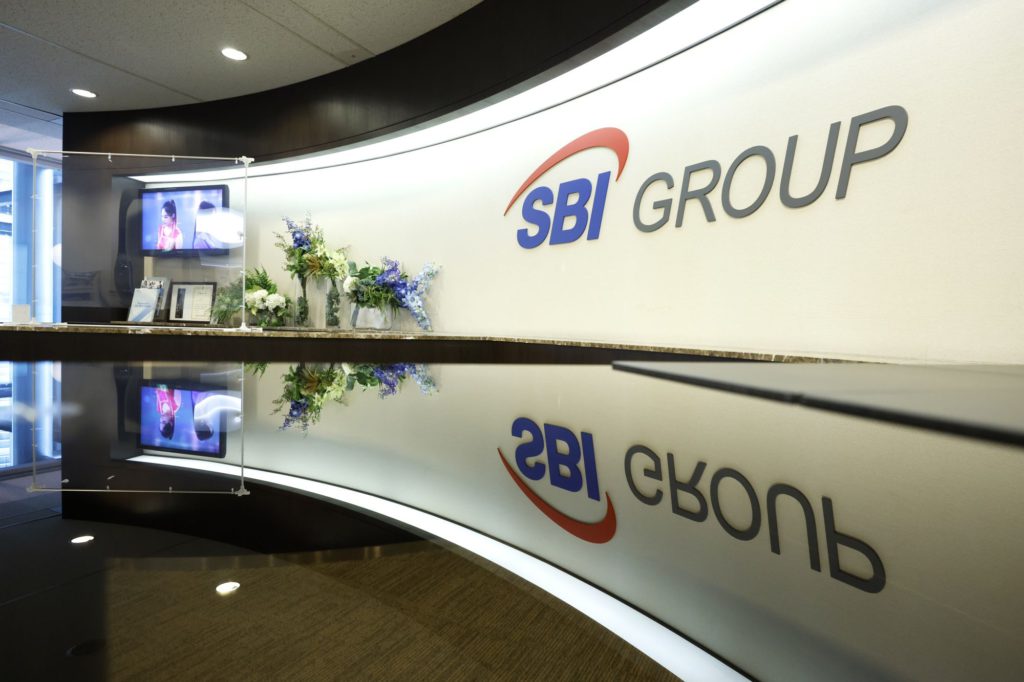
Sumitomo Mitsui Is Said to Take 10% Stake in SBI Holdings

(Bloomberg) — Sumitomo Mitsui Financial Group Inc. is preparing to take a stake in SBI Holdings Inc., according to a person familiar with the matter, marking a major alliance between two Japanese financial giants. 

Japan’s second-largest banking group plans to hold as much as 10% of SBI, a stake valued at about 60 billion yen ($443 million), the person said, asking not to be identified because the discussions are private. 

The Tokyo-based companies will collaborate on the securities business, the Nikkei reported earlier Tuesday, citing a person it didn’t identify. 

Representatives for SBI and Sumitomo Mitsui said nothing has been decided.

The deal would mark another significant acquisition for Sumitomo Mitsui after a string of deals. Speaking in an interview late last year, Chief Executive Officer Jun Ohta said he would weigh more transactions in the future after spending more than $3.3 billion in Asia in 2021. 

SBI, Japan’s biggest online brokerage, has been expanding its banking operations by purchasing stakes in regional banks. It took control of mid-sized Japanese commercial lender Shinsei Bank Ltd. last year, and is pursuing efforts to strengthen investment banking such as merger advising and securities underwriting.

Read how SBI’s maverick CEO is shaking up Japan finance

In 2020, the two companies agreed to cooperate in a strategic and capital alliance where their units would cooperate in digital and other fields. They also planned to work together in smartphone-based securities, over-the-counter securities, and to set up a fund to invest in fintech ventures, the firms said at the time. 

(Updates with Sumitomo Mitsui comment in fourth paragraph.)

More stories like this are available on bloomberg.com

©2022 Bloomberg L.P.

Google Maps Restrictions Probed by German Antitrust Watchdog

(Bloomberg) — Alphabet Inc.’s Google is under investigation by Germany’s antitrust watchdog amid concerns over potentially illegal terms for the use of its maps platform.

The Federal Cartel Office said Tuesday it opened a formal probe after initial findings suggest that the US giant is limiting options to use alternative map providers when app developers and other businesses seek to combine their offerings with maps. The regulator is also looking at the terms for Google’s Automotive Services, according to the statement.

Officials are concerned Google limits the option to embed position data from Google Maps, Street View or the search function on maps of other providers, Andreas Mundt, the agency’s president said.

“We will check whether Google could extent its predominance in certain map services via this practice,” Mundt said.

The probe is the third the German regulator has opened using newly extended powers pursue Big Tech, including Google. Officials are already taking a close look at the company’s News Showcase service and its use of data.

Google said in a statement that it’s cooperating with the authorities and would answer any questions they may have. It said many customers choose to use rival map services for various reasons.

The Cartel Office will now interview Google customers and competitors.

(Updates with Google statement in fourth paragraph.)

More stories like this are available on bloomberg.com

©2022 Bloomberg L.P.

Elon Musk’s Interview in Full: On Twitter, Recession and Trump

(Bloomberg) — Tesla Inc. Chief Executive Officer Elon Musk discussed his planned acquisition ofTwitter Inc., recession fears and the US presidential race with Bloomberg Editor-In-Chief John Micklethwait at the Qatar Economic Forum on Tuesday.

During the chat he also clarified how much of Tesla’s workforce would be laid off and said he hoped to unveil his prototype humanoid robot to the world by the end of September.Here’s the Q&A session in full:

Q:  Elon Musk, thank you very much for coming and talking to us. You could argue at the moment that we in the media have at least three Elon Musks to deal with: We have the proposed buyer of Twitter; we have the CEO of Tesla, SpaceX and much else;  and we have Musk, the emerging political force —  and that’s before we discover or discuss all the different provocations and tweets and so on. But maybe we can run through those three, and let’s begin with Twitter.  And I suppose my question for you is, what is the status of the $44 billion deal to buy the company? If you look at the deal spreads at the moment, the investors seem to be betting that it won’t happen, I suppose. And right here you have the Qataris, who are amongst your backers. What are you going to say to them and to us?

A: First of all, I’d like to say, Your Highness, Your Excellencies and distinguished guests, thank you very much for hosting me virtually. It’s an honor to be here, or be there virtually, and I actually wish I could be there in person. So with respect to the Twitter transaction, there’s a limit to what I can say publicly given that it is somewhat of a sensitive matter. So I like to be measured in my responses here, such as not to generate incremental lawsuits.

Q: That seems to be a risk you sometimes manage to overcome.

A: Yes, deposition minimization, I think, is important.

Q: Has Twitter given you enough information?

A: Well, there are still a few unresolved matters. You’ve probably read about the question as to whether the number of fake and spam users on the system is less than 5% as Twitter claims, which I think is probably not most people’s experience when using Twitter. So we’re still awaiting resolution on that matter, and that is a very significant matter. So we’re awaiting resolution on that. And then of course, there is the question of, will the debt portion of the round come together? And then will the shareholders vote in favor? So I think those are the three things that need to be resolved before the transaction can complete.

Q: What about the general state of the economy? Does that weigh on you when you think about this? I mean, you described you have a super-bad feeling about the economy. Are you still in that position? I just said to you earlier, Joe Biden has just come out and said that a recession in America is not inevitable. How do you feel about the economy?

A: Well, I think a recession is inevitable at some point. As to whether there is a recession in the near term, I think that is more likely than not. It certainly isn’t a certainty, but it appears more likely than not. And what do you think?Q: I’m with you. I agree with you, I think it’s more likely. Can I ask you one particular thing to do with the Twitter bid, which is you are one of the biggest and fastest-growing investors in China. Tesla — you’ve talked about it being a third of your sales going forward. You’ll now buy Twitter, the kind of public forum for free speech. The Chinese historically don’t tend to be very enthusiastic about free speech. Are you worried about whether you can keep those two particular horses running? Is buying Twitter going to get you in trouble with the Chinese?A: Well, Twitter does not operate in China. And I think China does not attempt to interfere with the free speech of the press in the US, as far as I know. Because I assume you’re not under pressure at Bloomberg from China. I don’t think this is going to be an issue.Q: In terms generally of that issue of freedom of speech and Twitter, you’ve talked about Twitter, making it even freer and letting more people onto it. Is there a limit at all to who you think should be allowed onto Twitter?

A: Well, my aspiration for Twitter or in general for the digital town square would be that it is as inclusive — in the broader sense of the word —  as possible. That it is an appealing system to use. So I mean, ideally, I’d like to get like 80% of North America and perhaps half the world or something ultimately on Twitter in one form or another. And that means it must be something that is appealing to people. It obviously cannot be a place where they feel uncomfortable or harassed, or they’ll simply not use it. And I think there’s this big difference between freedom of speech and freedom of reach in that one can, obviously, let’s say in the United States go in the middle of Times Square and pretty much yell anything you want. You’ll annoy the people around you, but you’re kind of allowed to just sort of yell whatever you want in a crowded public place, more or less, apart from “this is robbery” — probably that would get you in trouble. So but then whatever you say, however controversial, does not need to then be broadcast to the whole country. So I think generally the approach of Twitter should be to let people say what they want to do within the bounds of the law, but then limit who sees that based on any given Twitter user’s preferences. So if your preferences are to see anything, or read anything, then well, you’ll get that. But if your preferences are well, you prefer not to see comments that you find offensive in one form or another, then you can have that as a setting and not see it. But I think one way or another, one needs to take the steps that entice most people to want to be on Twitter, and enjoy it and find it informative and entertaining and funny and useful — as useful as possible. 

Q: It sounds like you want to be involved. Is your plan to be CEO of Twitter? And if you do that, would you still keep being CEO of Tesla and SpaceX?

A: Well, I would drive the product, which is what I do at SpaceX and Tesla. So I’d drive the product and technology. Whether I’m called the CEO or something else is much less important than my ability to drive the product in the right direction.

Q:  Can I jump toward Tesla then? For most people, it’s very obvious that you have changed the car industry in a dramatic way. I’m quite intrigued by one thing — your competitors. Where do you see competition coming from? Do you see it coming from the old carmakers coming back at you? I just saw a forecast that maybe in a couple of years’ time, Volkswagen would be bigger than you in electric cars. Or do you see it coming from a new place? Do you believe that? 

A: I believe that forecast was from you.

Q: Yes, it was. And do you agree with that? 

A: I would not agree with that forecast, no.

Q: But do you see people like Volkswagen and General Motors as the opponents or do you see people like China, the new Chinese companies? Where do you see the most vibrant competition in electric cars?

A: I have to say that I am very impressed with the car companies in China and just in general with companies in China. I think they’re extremely competitive, hardworking and smart. And I think there’s going to be just a massive wave of Chinese products going out into the world. There already are. For example, almost all the iPhones are made in China by contract manufacturers for Apple. But I think we’ll see just a large wave of products being exported from China in many industries.

Q: In electric cars, do they have an advantage at all?

A: Well I should say from a Tesla perspective, we don’t really think about other competitors. Our constraints are much more in raw materials and being able to scale up production. So our constraints are not imposed upon us by competitors, but rather just imposed upon us by the realities of the supply chain and building up manufacturing capacity. So as anyone knows who has tried to order a Tesla, the demand for our cars is extremely high and the wait list is long. And this is not intentional. We are increasing production capacity as fast as humanly possible. So like I said, we really don’t think about competition at all, we just think about how do we address the limiting factors in the supply chain and in our own industrial capacity. Basically, we need to build the factories faster, and then we need to look ahead to whatever the choke points are in the whole lithium-ion battery supply chain, from mining and refining to cathode and anode production and cell formation.Q: Can you set the record straight on one thing, which is this issue about the layoffs? I think you’ve said initially that at Tesla, 10% of the workforce would be cut; then 10% of salary would be cut; then salary would stay flat and overall headcount would go up. What is the number? I know there’s already a lawsuit about the 10%. Is  10% the goal to reduce the workforce? What is the number that we should think about or that you’re planning?

A: Tesla is reducing the salaried workforce roughly 10% over the next probably three months or so. We expect to grow our hourly workforce, and I should be quite clear that we expect to grow our hourly workforce. But we grew very fast on the salaried side. And we grew a little too fast in some areas, and so it requires a reduction in the salaried workforce. We’re about two thirds hourly and one third salary. So I guess technically a 10% reduction in the salaried workforce is only roughly a 3%, 3.5% reduction in total headcount.Q: I think that number is important legally, isn’t it? Because I think people are trying to say, if you’re going to lay off 10% of your workforce, you have — even in America — to make an announcement about that.

A: We did make an announcement on that. Let’s not read too much into a pre-emptive lawsuit that has no standing, that is a small lawsuit of minor consequence. Anything related to Tesla gets big headlines, whether it is, you know, a bicycle accident or something much more serious. It seems like anything related to Tesla gets a lot of clicks, whether it is trivial or significant. I would put that lawsuit you’re referring to in the trivial category. So a year from now, I think our headcount will be higher in both salary and obviously in hourly, but in the short term of the next few months, we expect to see, like I said, roughly a 10% reduction in salaried workforce, which is actually just really only a 3%, 3.5%  reduction in total headcount and not super material.

Q: Should we jump to that third Elon Musk, the uncontroversial one in politics? You’ve indicated that the Florida Governor Ron DeSantis is someone you could get behind if he ran for president. I’m wondering if you’re still in that position, and whether you would, for instance, think about supporting Donald Trump if he were to run?

A: Well, I was simply asked if I had decided on who I would be supporting in the next presidential race, and I said I had not decided who I would support. Then I was asked, well, who might you be leaning towards? I said possibly DeSantis.

Q: Now I’m asking you about Trump, whether you would consider him?

A: I think I’m undecided at this point on that election.

Q: You talked about putting money behind a super-moderate super PAC in the US. And I wondered, how much money do you think you’re going to put into that? What kind of support would you push?

A: I’ve not decided on an amount, but it would be some non-trivial figure, I think.

Q: Non-trivial could mean a lot of money with you, I was guessing.

A: Well, I’ve not decided on an exact amount, but perhaps it would be $20 million or $25 million.

Q: Just on that issue. I mean, again, you look at what DeSantis says, you look at what Trump says. And those sort of politicians, they are, again, the people who make a large noise about China, and I wondered whether you thought that was also an issue for you in terms of business in China?

A: Well, no, I don’t think so.

Q: You’re a brave man. Can I ask you, over the weekend, you tweeted your support of one cryptocurrency. You’ve seen the kind of carnage that has been happening in cryptocurrencies at the moment. What is happening? And do you still think people should invest, or is it a more selective approach?

A: Well, I have never said that people should invest in crypto. In the case of Tesla, SpaceX, myself — you know, SpaceX and Tesla, for example, all did buy some Bitcoin, but it’s a small percentage of our total cash and near-cash assets. So, you know, not all that significant. I also bought some Dogecoin and Tesla accepts Dogecoin for some merchandise and SpaceX will do the same. And I intend to personally support Dogecoin because I just know a lot of people who are not that wealthy who, you know, have encouraged me to buy and support Dogecoin. So I’m responding to those people and just people that, when I’ve walked around the factory at SpaceX or Tesla, they’ve asked me to support Dogecoin, so I’m doing so.

Q: Because Dogecoin, I think, has come down a lot. It’s down about 80%, 90%, or it’s down a lot. And that’s the reason why you came out and said that you still thought there was value there.

A:  I said I support Dogecoin and I’m doing that.

Q: Can I ask you one last question as I notice that you’re going to unleash a humanoid robot, to be unveiled on September 30. I wonder if there’s anything more you could tell us about that?

A: Well, I hope that we will have an interesting prototype to show people. We have a very talented team at Tesla that I’m working with closely to have a prototype humanoid robot ready by the end of September. And I think we are tracking to that point. And there’ll be a few other exciting things that we talk about at the Tesla AI Day. We have these sort of AI Day events to just emphasize that Tesla is a lot more than a car company and that we are, in my view, the leading real-world AI company that exists.

Q: Did you see at all the drama at Google where at least one engineer thought that what was happening in terms of their AI machinery was closer to human thought than had been seen before and had a personality? Is that something that you think about at all or you worry about?

A: I think we should be concerned about AI. And I’ve said for a long time that I think there ought to be an AI regulatory agency that oversees artificial intelligence for the public good. And I think that for anything where there is a risk to the public, whether that’s say, the Food and Drug Administration or Federal Aviation Administration or the Communications Commission, whether it’s a public risk or a public good at stake, it’s good to have a sort of a government referee and a regulatory body. And I think we should have that for AI, and we don’t currently. And that would be my recommendation.

Q: Elon Musk, you’ve been incredibly kind with your time, not least because I think it’s 3 a.m. in the morning in New York.

A: Yes. 

Q: It’s been a heroic performance. Thank you very much for talking to the Qatar Economic Forum and for talking to Bloomberg, thank you.

A: You’re most welcome, thanks for having me.

Qatar’s Ministry of Commerce and Industry, Qatar Investment Authority and Investment Promotion Agency Qatar are the underwriters of the Qatar Economic Forum, Powered by Bloomberg. Media City Qatar is the host organization.


  • Do you own an electric car? US residents, Bloomberg Green wants to learn more about your experience with EVs. Take our brief survey.

More stories like this are available on bloomberg.com

©2022 Bloomberg L.P.

Six Takeaways From What Elon Musk Said at Qatar Economic Forum

(Bloomberg) — Elon Musk covered everything from the state of his deal to buy Twitter Inc. to the direction of the American economy and planned job cuts at Tesla Inc. in an appearance at the Qatar Economic Forum Tuesday.

The chief executive officer of Tesla and Space Exploration Technologies Corp. even waded into US politics, saying that he was yet to decide who to back in the next presidential election when asked directly if he’d consider supporting Donald Trump. 

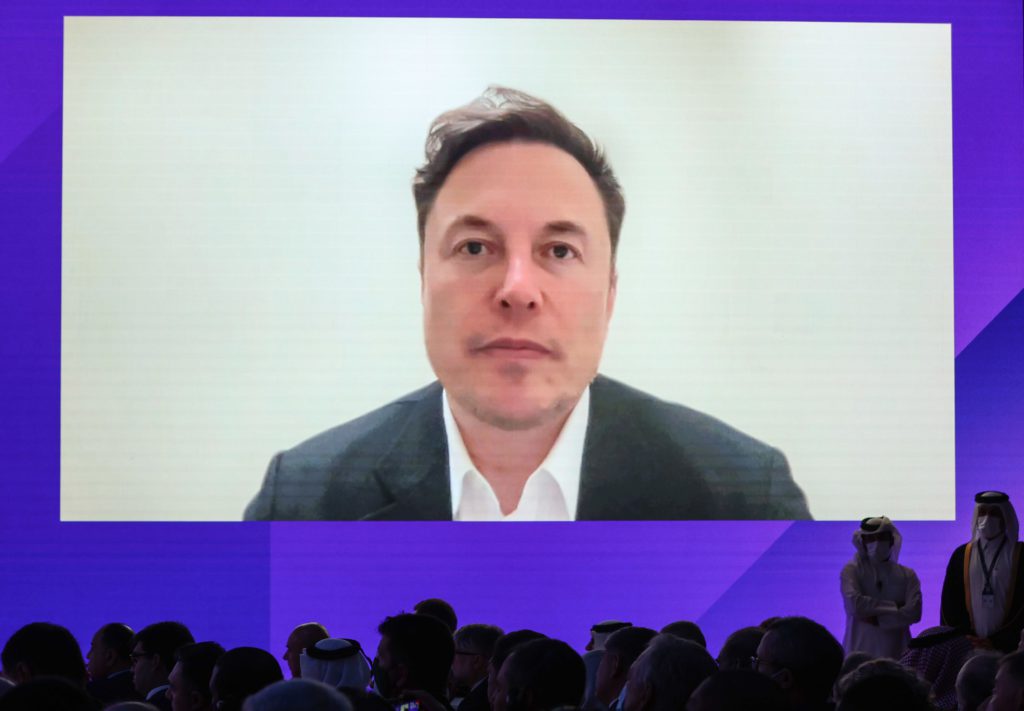
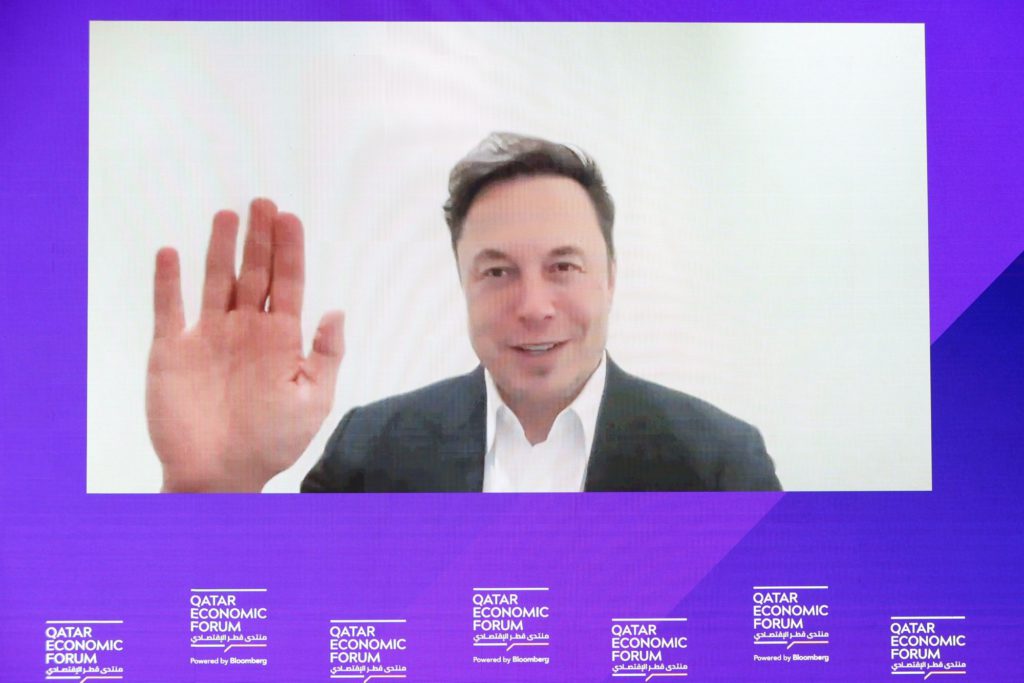
Wearing a white shirt and gray suit jacket, the world’s richest man was articulate and to the point in the video link-up, fielding a raft of questions over the 20-minute discussion. 

Here are the top things Musk spoke about in an interview with Bloomberg News Editor-in-Chief John Micklethwait:

‘Unresolved matters’ remain on Twitter deal

“There is the question of, will the debt portion of the round come together and then will the shareholders vote in favor,” Musk said.

The billionaire said last month that he was putting the takeover “on hold” while he investigated how many of Twitter’s users were real people, and later filed a formal letter with the Securities and Exchange Commission in which he told Twitter executives he might walk away from the deal if the company didn’t do more to prove the actual size of its user base. 

Musk told the forum on Tuesday he would focus on “driving the product” at Twitter, though he doesn’t necessarily plan to be the CEO.

Watch the full Musk interview here. 

US recession “inevitable” at some point

The electric-car pioneer told Tesla executives earlier this month that he had a “super bad feeling” about the economy, according to an internal email seen by Reuters. Seeking to quell a surge in living costs, the Federal Reserve accelerated its monetary-tightening campaign last week with its biggest interest-rate increase since 1994. 

A recession in the US is inevitable at some point, he said Tuesday. “As to whether there is a recession in the near-term, that is more likely than not.”

Tesla job cuts

“Tesla is reducing its salaried workforce roughly 10% over the next three months or so,” Musk said, reiterating plans revealed in an email earlier this month. “We expect to grow our hourly workforce. We grew very fast on the salaried side, grew a little too fast in some areas.”

But he also provided more clarity on the employee-reduction plans Tuesday, saying the cuts will result in an overall reduction of some 3% to 3.5% in total headcount at Tesla, as hourly staff numbers are still expected to grow, Musk said. 

Tesla, now headquartered in Austin, Texas, has grown to about 100,000 employees globally, hiring rapidly as it built out new factories in Austin and Berlin. The cuts, which have affected human resources representatives and software engineers, caught many by surprise, with several employees told they were being terminated immediately. 

“A year from now, I think our headcount will be higher” in salaried and hourly workers, he added. 

Supply chain issues

Supply constraints are the biggest brake on Tesla’s growth, rather than competition from rival automakers.

“Our constraints are much more in raw materials and being able to scale up production,” he said. 

Musk earlier this month said the EV pioneer has had a “very tough quarter” as it struggles with supply-chain snags and urged workers to help get production back on track. 

“As anyone knows who has tried to order a Tesla, the demand for our cars is extremely high and the wait list is long,” he said. “This is not intentional and we’re increasing production capacity as fast as humanly possible.” 

Trump and US politics

Asked whether he would support Trump in the next US presidential election: “I’m undecided at this point on that election.” 

His comments are significant as last week Musk indicated that he was leaning toward supporting Florida Governor Ron DeSantis, who has positioned himself as a staunch conservative and heir apparent to Trump. 

Musk said last week that he voted Republican for the first time in the primary election in Texas.

Praising China 

Musk has long had a cosy relationship with China, including being the only foreign automaker allowed to wholly own its local operations there and receiving support for its Gigafactory near Shanghai. 

Asked Tuesday whether he sees any issue with balancing his Tesla interests in China with the future acquisition of Twitter, Musk said the social-media and discussion platform doesn’t operate in the country and “China does not attempt to interfere with the free speech of the press in the US, as far as I’m aware.”

He went on to praise Chinese firms, saying “I am very impressed with the car companies in China, just in general companies in China. I think they’re extremely competitive, hard-working and smart.”

Click here to read the TOPLive blog of the Musk-Micklethwait interview. You can read a full transcript here. 

Qatar’s Ministry of Commerce and Industry, Qatar Investment Authority and Investment Promotion Agency Qatar are the underwriters of the Qatar Economic Forum, Powered by Bloomberg. Media City Qatar is the host organization.

More stories like this are available on bloomberg.com

©2022 Bloomberg L.P.
Close Bitnami banner
Bitnami