Bloomberg

Musk Says ‘A Few Unresolved Matters’ on Twitter Deal

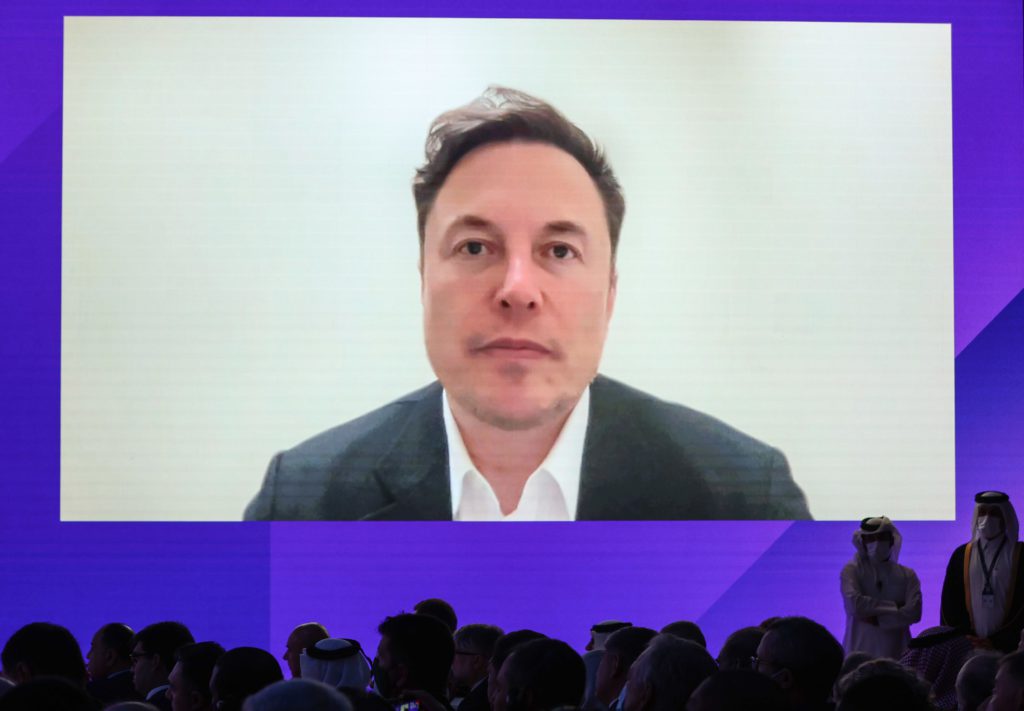
(Bloomberg) — Elon Musk says there are still a few “unresolved matters” about Twitter Inc., and is still waiting for a resolution on the matter of how many bots are on the social media platform.

“There is the question of, will the debt portion of the round come together and then will the shareholders vote in favor,” Musk added in an interview with Bloomberg News Editor-in-Chief John Micklethwait at the Qatar Economic Forum in Doha.

Musk has said he wanted to put the takeover “on hold” while he investigated how many of Twitter’s users are real people, and later filed a formal letter with the Securities and Exchange Commission in which he told Twitter executives he might walk away from the deal if the company didn’t do more to prove the size of its user base. Twitter responded by giving Musk access to its full fire hose of public tweets, though it’s unclear if that data is truly helpful in calculating the number of bots on Twitter.

Musk told the forum he would focus on “driving the product” at Twitter though he doesn’t necessarily plan to be the CEO.

Qatar’s Ministry of Commerce and Industry, Qatar Investment Authority and Investment Promotion Agency Qatar are the underwriters of the Qatar Economic Forum, Powered by Bloomberg. Media City Qatar is the host organization.

For more on Musk Speaks at Qatar Economic Forum, click here for our TOPLive blog.

More stories like this are available on bloomberg.com

©2022 Bloomberg L.P.

Hong Kong Telco HKBN Sale Stalls on Market Volatility

(Bloomberg) — A sale of Hong Kong telecommunications provider HKBN Ltd. has stalled as potential buyers expressed concerns over valuation amid market volatility, according to people familiar with the matter.

Challenges in securing financing have also diminished the prospects of a transaction, said the people, who asked not to be identified as the discussions are private. While the deal has been put on hold for now, it could resume once conditions improve, the people said.

Rising interest rates and the war in Ukraine have spooked dealmaking globally. Royal FrieslandCampina NV’s plan to sell its Friso infant nutrition brand is also stalling amid valuation concerns, Bloomberg News reported earlier this month. 

HKBN offers broadband internet services to residential and corporate customers in the city. It also provides other enterprise telecom solutions, runs data centers and offers Wifi connectivity. Its major shareholders include buyout firms TPG Inc. and MBK Partners as well as Singapore’s GIC Pte.

KKR & Co. and PAG were among suitors considering bids for HKBN, Bloomberg News reported last month.

Shares of HKBN have fallen about 4% this year in Hong Kong, giving it a market value of about $1.5 billion. The company’s enterprise value stands at around $3 billion, according to data compiled by Bloomberg.

Representatives for HKBN, KKR and PAG declined to comment.

More stories like this are available on bloomberg.com

©2022 Bloomberg L.P.

EasyJet Places Order for 56 More Airbus Jets: The London Rush

(Bloomberg) — Here’s the key business news from London-listed companies this morning.

EasyJet Plc: The low-cost carrier has agreed to buy 56 A320neo family aircraft, in a deal that should help the airline through “up gauging, cost efficiencies and sustainability enhancements”.

  • The order, which also includes converting some orders to another type, would be worth $6.5 billion at 2018 list prices, but it will actually cost the company “very substantially lower” because of price concessions

Ocado Group Plc: The grocery delivery company raised about £575 million from capital markets overnight, in a deal that it says will help fund its growth. 

  • It also signed a £300 million credit facility as it makes a bid to expand its automated grocery-fulfillment technology around the world

DS Smith Plc: The packaging producer has managed to fight off the effects of inflation by raising prices, and currently expects volume growth of 2% to 4%.

Payment Systems Regulator: The UK based NGO plans to carry out two market reviews focusing on Mastercard and Visa’s card fees.

  • The regulator said it is carrying out the review because a previous investigation found that the fees paid by acquirers had “increased significantly from 2014 to 2018”

Outside The City

Rail workers will begin Britain’s biggest rail strike in three decades today after unions rejected a last-minute offer from train companies. 

Meanwhile, rides on London’s public bike-rental network have hit record levels in each of the past nine months as subway strikes blight the capital’s transport system.

In Case You Missed It 

The government is studying plans to relax restrictions on executives’ remuneration to make the City of London more appealing to businesses post-Brexit.

Looking Ahead

UK inflation data due tomorrow is set to show consumer prices continuing to rise even higher, boosted by a cocktail of higher fuel and food costs.

On the earnings front, software solutions provider Micro Focus International Plc and property developer Berkeley Group Holdings Plc are expected to report on Wednesday.

More stories like this are available on bloomberg.com

©2022 Bloomberg L.P.

China’s Electric Car Exports More Than Double, Mostly to Europe

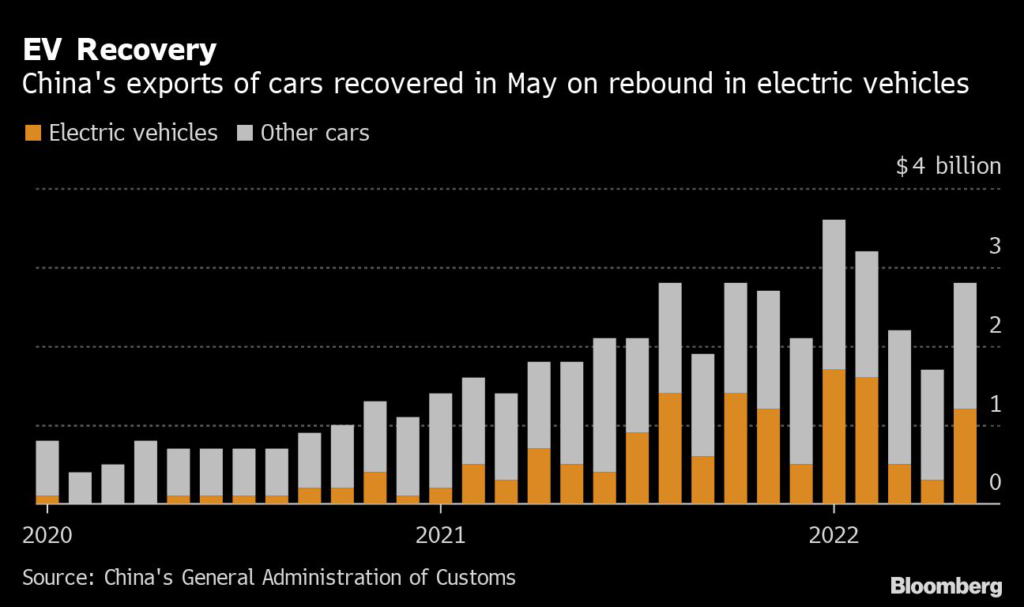
(Bloomberg) — China’s shipments of cars rebounded in May, with electric vehicle exports more than doubling, as Covid lockdowns gradually ended.  

Car manufacturers in China shipped $1.2 billion worth of electric passenger vehicles, up 122% from a year earlier and almost triple the level in April, when car factories in Changchun and Shanghai such as those run by Telsa Inc were shuttered or barely open. Passenger cars worth $2.8 billion were exported, the fourth-highest monthly total in the past few years. 

With domestic sales falling for 11 of the past 12 months, car companies in China have boosted their sales overseas, with exports in just the first five months of this year exceeding the whole of 2020. The biggest market is Europe, which took nearly half of shipments in May and about three-quarters of electric car exports, with much of the rest going to Asia. 

China’s current excess EV production capacity and low domestic sales mean it will continue to be a significant exporter in the medium term, according to Stephen Dyer, managing director at Shanghai-based consultancy AlixPartners. China made up almost 60% of global exports of electric vehicles in 2021 and the trend continues in 2022, although Tesla’s new factory in Europe may slow exports from China, he said.

Tesla shipped more than 22,000 cars overseas last month, after exporting only 60 in March and none in April, when it halted assembly due to the lockdown in Shanghai. 

“The production resumption in Shanghai has made a great contribution to car exports,” Cui Dongshu, secretary general of China’s Passenger Car Association, said in a briefing earlier this month. Electric vehicle exports were 21% of total shipments, he said, underpinned by the recovery of major automakers including Tesla and SAIC Corp., which are both based in Shanghai.

More stories like this are available on bloomberg.com

©2022 Bloomberg L.P.

Reliance Fined by India Regulator for Late Meta Deal Disclosure

(Bloomberg) — India’s market regulator imposed a combined penalty of 3 million rupees ($38,444) on Reliance Industries Ltd. and two company officials for failing to disclose information promptly about stake sale in one of its units to Meta Platforms Inc., Silver Lake Partners and Vista Equity Partners in 2020.

The Securities & Exchange Board of India initiated proceedings against billionaire Mukesh Ambani’s oil-to-retail conglomerate and its compliance officers, Savithri Parekh and K. Sethuraman, for alleged non-adherence to the fair disclosure principles around unpublished price-sensitive information, it said in a order on its website late Monday evening.

Reliance’s shares slipped as much as 0.6% during trading in Mumbai on Tuesday before recovering the losses. A Reliance Industries representative declined to comment on the regulatory action.

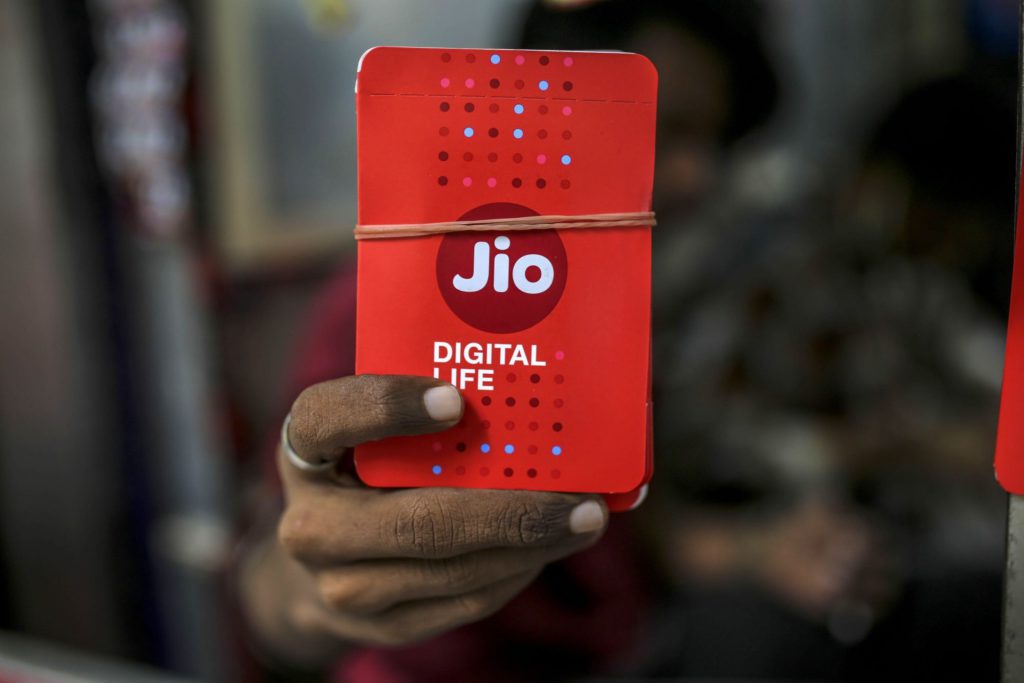
The penalty, although a small one, marks another instance of regulatory censure on the conglomerate helmed by Ambani, Asia’s richest person. The group raised more than $20 billion in exchange for a 33% stake in Ambani’s technology venture, Jio Platforms Ltd., that lured partners including Meta, then known as Facebook, and Google. Meta invested $5.7 billion in Jio Platforms in 2020.

Ambani Sold a Tech Dream for $27 Billion. Now He Has to Deliver

As part of its probe on stake sales in Jio Platforms, SEBI order said that there was a lot of news flow around Meta investing in Reliance’s digital unit in March and April, 2020, prior to the corporate announcement on April 22. A March 24, 2020 news report on this deal by Financial Times was widely circulated in Indian media but Reliance and its compliance officers did not issue any clarification on the development.

SEBI regulations require that “the listed entity may on its own initiative also, confirm or deny any reported event or information” to stock exchanges, according to the order.

One Day Late

Reliance announced on May 4 that Silver Lake Partners would invest about $753 million in Jio Platforms and on May 8, about Vista’s $1.5 billion investment. These two stake sales were announced one day later than the stipulated window of disclosures, the order said.

“Companies would be unsure on the timing of making crucial disclosures, and on responding to speculation in media,” said Shriram Subramanian, founder of proxy advisory firm InGovern Research Services Pvt. Ltd. “While PIT (prohibition of insider trading) regulations need to be taken seriously by companies and the principle of “when in doubt, disclose” applies, companies may also find it hard to disclose at the time of crucial negotiations in transactions.”

The SEBI order acknowledges that these transactions were finalized during “highly uncertain times of Covid-19” that made it hard to know that a deal was done “until the signatures of the counterparty were actually received.”

SEBI had last year ordered Ambani and Reliance to pay a combined penalty of 400 million rupees for allegedly violating share-trading rules about 13 years ago. That led to undue profits from the sale of shares in Reliance Petroleum Ltd., a former unit, in the cash and futures markets, the regulator had said in its order then. 

More stories like this are available on bloomberg.com

©2022 Bloomberg L.P.

Sergey Brin Seeks Divorce From His Wife of Three Years

(Bloomberg) — Sergey Brin, the Google co-founder and world’s sixth-richest person, filed for a divorce from his wife of three years, making him the third mega-billionaire to do so in as many years.

Brin filed a petition for dissolution of his marriage to Nicole Shanahan in January, citing “irreconcilable differences,” according to court documents cited in a Business Insider report this month. The couple, who have a three-year-old son, took steps to keep the details of the split private, requesting that documents be sealed by the court.

“Because of the high profile nature of their relationship, there is likely to be significance public interest in their dissolution case and any potential child custody issues,” according to the filing in Santa Clara, California.  

Brin, 48, has a fortune of $94 billion, according to the Bloomberg Billionaires Index, derived largely from his holdings in Google, the company he co-founded wth Larry Page in 1998 that later formed the holding company Alphabet Inc. Both he and Page left Alphabet in 2019, although they remain on the board and still are the controlling shareholders.

Brin’s earlier marriage to 23andMe co-founder Anne Wojcicki ended in divorce in 2015.

His most recent split comes a year after Bill Gates and Melinda French Gates announced the dissolution of their marriage and about three years after Jeff Bezos and MacKenzie Scott divorced. At the time, Gates and French Gates had a $145 billion fortune to divide, while Bezos and Scott had $137 billion at stake when they broke up. 

It’s likely Brin and Shanahan have a prenuptial agreement since the relationship began long after he became a billionaire, said Monica Mazzei, a partner at Sideman & Bancroft LLP in San Francisco. But because the case is being handled by a private judge, “we will never know the details” of the divorce, she said.

Bia-Echo Foundation

Philanthropy could also play a role in the divorce agreement, Mazzei said. Shanahan created the Bia-Echo Foundation, whose focus is on “longevity and equality, criminal justice reform and a healthy and livable planet,” according to its website. The foundation reported $16.7 million in assets and made $7.4 million in grants, according to its 2019 tax filing, the most recent available.

Mazzei said divorce agreements often include the support of an ex-spouse’s philanthropy because it’s mutually beneficial: The grantor gets a tax break and the grantee gets agency over their charitable giving. Brin was the only contributor to the foundation, according to the tax form, with a gift that year of more than $23 million.

A representative for the Bia-Echo Foundation didn’t return a call requesting comment. 

Scott has become the world’s most prolific philanthropist since her split from Bezos, granting billions of dollars to a wide range of causes thanks to the 4% stake in Amazon.com Inc. she ended up with in 2019. 

Following the Gateses’ divorce, their focus has also turned to philanthropy. Unlike Scott and Bezos, the former couple had already made their name as mega-donors with their Bill and Melinda Gates Foundation and there were questions about how the $50 billion charitable engine would be affected.

French Gates has since turned attention to her own philanthropic investment firm Pivotal Ventures, which was started in 2015 with a focus on implementing “innovative solutions to problems affecting U.S. women and families.” 

(Corrects month petition was filed in second paragraph of story initially published June 17.)

More stories like this are available on bloomberg.com

©2022 Bloomberg L.P.

Two Sigma Ramps Up China Hedge Fund Push After 22% Return

(Bloomberg) — Two Sigma Investments is stepping up its bid to tap the wealth of Chinese investors by asking them for a fresh round of cash for its outperforming fund and expanding local headcount. 

The US quant giant’s China private fund business — the local equivalent of a hedge fund — is seeking to raise about 1.2 billion yuan ($180 million) for its managed futures product, adding to about 3.8 billion yuan in assets the firm has amassed since early 2020, according to people with knowledge of the matter. The Shanghai-based unit also plans to double its local staff to more than 20 people this year, the people said, asking not to be identified discussing private information. 

New York-based Two Sigma, which obtained the China private fund license in 2019, joins Bridgewater Associates in expanding Chinese assets after establishing a solid local track record. After initially struggling to penetrate the world’s most promising wealth market, some global hedge funds are starting to impress Chinese clients as this year’s stock market rout pummels the often-dominant local stock funds. 

Two Sigma representatives declined to comment.

The fund, which invests in commodities and financial futures, gained 51% through April 30 since its inception two years earlier, suggesting an annualized 22% return, according to a marketing document seen by Bloomberg. It rose about 12% in the first four months of this year, beating a 4.3% average return for equivalent products tracked by Shenzhen PaiPaiWang Investment & Management Co.

The performance would be considered above average and the fund appeals to investors who expect its returns to be stable given Two Sigma’s global track record and risk controls, said Li Minghong, a Shanghai-based fund of hedge funds manager at Aichen Asset. “When they grow big, how they adapt to the local market remains key,” Li said. 

Such futures funds, also known as commodity trading advisors, were the only profitable hedge fund strategy this year through April in China, bolstered by a boom in raw materials and the fallout from the war in Ukraine. Hedge funds tracked by PaiPaiWang posted an 8% loss on average for the first four months. 

Bridgewater Associates’s China funds gained 4.8% in the first four months, ranking it the third among the best-performing hedge funds managing more than 10 billion yuan, according to PaiPaiWang. Ray Dalio’s firm last year became the only global firm in the top league after raising 8 billion yuan for its third onshore product.

The China fund leverages Two Sigma’s global research resources to build computer models before a local portfolio manager executes the strategy onshore, and the company has been developing models tailored for the China market, the people said. The local team of about 10 people, led by Carissa Xu, focuses mostly on execution and risk management.

The company is raising money from retail investors through a China Resources Trust product, distributed by brokerages including Citic Securities Co. and two banks. The feeder trust plan’s minimum subscription requirement for its investors, which can be individuals or enterprises, is 2 million yuan, compared to the 20 million yuan threshold in the Two Sigma fund itself, according to the people.

The fund targets 10% in annualized volatility and has been able to keep fluctuations within the designed range. The product’s biggest drawdown of about 5.4% was recorded in July 2020 as bets were made on the wrong side of the market, but the company has since adjusted the model, the people said. 

More stories like this are available on bloomberg.com

©2022 Bloomberg L.P.
Foreign Holding of Samsung Falls to Six-Year Low on Korea Exodus

(Bloomberg) — Concerns of slowing growth have driven an exodus of foreign funds from South Korean equities, cutting overseas ownership of the nation’s largest stock Samsung Electronics Co. to a six-year low.

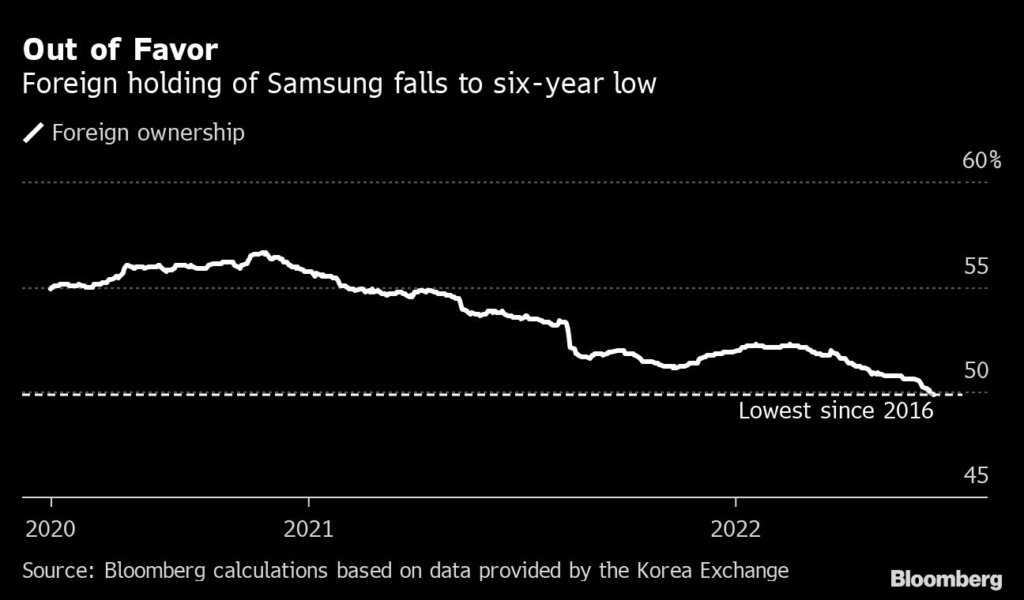
Foreign holdings of Samsung, the world’s largest memory chipmaker, fell last week to the lowest level since April 2016, according to exchange data and Bloomberg calculations. It’s dropped below 50% from over 58% in July 2019.

Investors have been selling growth shares amid concerns that higher interest rates in the US and elsewhere will strangle the global economy. The selloff has made South Korea, with its high proportion of technology companies, one the worst-performing stock markets this year.

Foreign funds have offloaded a net $11.9 billion of stocks in South Korea’s benchmark Kospi this year, including $6.4 billion worth of Samsung. That’s helped drive Samsung’s stock down about 25% in 2022 while the Kospi has fallen 19%.

Samsung’s home appliance and visual display divisions “will inevitably see lower earnings on global inflation and the war in Ukraine,” Kim Young-Woo, an analyst at SK Securities Co., wrote in a note this week.

Smaller rival SK Hynix Inc. has recorded a net foreign inflow of $406 million due to its perception as a “pure” memory stock. Samsung is more diversified, with mobile phone and other businesses that are expected to suffer from an economic downturn even as robust demand supports chip prices.

More stories like this are available on bloomberg.com

©2022 Bloomberg L.P.

MoonPay Expands Further Into NFTs Despite Crypto Slump

(Bloomberg) — Crypto payments company MoonPay is partnering with major entertainment brands as it expands further into the struggling nonfungible token market. Fox Corp., Universal Pictures, Creative Artists Agency and Death Row Records will create NFT collections using HyperMint, MoonPay’s platform for minting digital assets, the company plans to announce Tuesday.

MoonPay didn’t elaborate on exactly what kind of NFTs these brands would create, but Ivan Soto-Wright, MoonPay’s co-founder and chief executive officer, said the company is eyeing sports, film, music, fashion and gaming as areas that could benefit from the technology. For example, NFT tickets for football games could entitle fans to special experiences and memorabilia. And MoonPay could help companies like Universal Pictures release NFTs tied to movie releases. Soto-Wright is also interested in exploring NFT music licenses that would give artists more control over how they monetize their music.

MoonPay’s announcement comes as the price of NFTs has been slammed by the broader crypto downturn. While prices of digital currencies like Bitcoin and Ether continue to plummet, sales of NFTs have dropped as well. These tokens reached $3 billion in monthly global sales during the month of May, a 35% drop when compared to January, according to NFT data tracker CryptoSlam.

But Soto-Wright says that despite the volatility, NFTs as a technology still have room to grow. With HyperMint, MoonPay is hoping to find better real-world uses for the technology. “What NFTs look like today is not necessarily what NFTs are going to look like tomorrow,” he said.

Some of the new applications MoonPay’s HyperMint platform has already found include an NFT collection of digital clothing that corresponds with physical merchandise for UK department store chain Selfridges & Co., Soto-Wright said. The company has also partnered with esports organization FaZe Clan to create NFTs related to online gaming.

Based in Miami, MoonPay aims to make it easier for customers to purchase cryptocurrencies using a credit card. The company raised $555 million in November in a funding round from investors including Tiger Global Management and Coatue Management, and began building out HyperMint this year. The platform can mint hundreds of millions of NFTs over the course of a day and is compatible with multiple blockchains, Soto-Wright said.

Unlike other crypto companies that have been besieged by layoffs, such as Coinbase Global Inc., BlockFi Inc. and Gemini Trust Co., MoonPay is looking to expand its headcount, according to Soto-Wright. He said the company is interested in scooping up talent laid off by competitors and is prepared for ongoing volatility in the industry. 

“That’s just part of doing business in crypto,” Soto-Wright said. 

More stories like this are available on bloomberg.com

©2022 Bloomberg L.P.

British Factory Startup CloudNC Wins Autodesk, Lockheed Backing

(Bloomberg) — UK startup CloudNC has clinched the backing of two large US firms, software company Autodesk Inc. and aerospace giant Lockheed Martin Corp., in a fresh funding round.

The London-based company that’s seeking to automate the manufacturing of everything from airplanes to personal electronics raised $45 million in the Autodesk-led funding round, according to CloudNC’s Chief Executive Officer and co-founder Theo Saville.

Other backers include Atomico, the tech investment firm started by Skype co-founder Niklas Zennstrom, Episode 1 Ventures and British Patient Capital, an arm of the UK government’s British Business Bank.

The latest investment values CloudNC at as much as 200 million pounds ($245 million), according to people familiar with the matter, giving the company capital to to further develop its software and expand its manufacturing capability in Essex.

With global supply chains snarled by delays, rising costs and the impact of renewed coronavirus outbreaks in China, CloudNC is betting it can be part of the solution. 

“Autonomous manufacturing levels the playing field with respect to labor costs, making it a lot easier to have a local supply chain that’s more resilient and flexible,” Saville said in an interview.

The company’s software essentially cuts out manual machine programming by setting up factories to autonomously make more parts, quickly and with less waste. A user can upload a 3D model of any part and the software then determines the tools needed, their use and drafts the code to tell a machine how to make it.

More stories like this are available on bloomberg.com

©2022 Bloomberg L.P.
Close Bitnami banner
Bitnami