

Bloomberg

Eric Schmidt Urges US to Lean on TSMC, Samsung for Chip Security

(Bloomberg) — The US should do more to attract overseas chipmakers to build plants on its territory as a matter of national security, former Google chief Eric Schmidt wrote in an opinion piece published Monday.

Pointing to China’s accelerating investment in chip fabrication technology and capacity, Schmidt urged the US to reduce its dependence on Taiwan and South Korea for the most advanced semiconductors powering everything from smartphones to ballistic missiles and build out its own capabilities. Instead, it should be incentivizing national champions Taiwan Semiconductor Manufacturing Co. and Samsung Electronics Co. to partner with US chip designers and build more on US soil, he said.

International relations scholar Graham Allison, who shares the byline on the Wall Street Journal article with Schmidt, previously warned that the US and China could be on a path to war that neither country wants. The two men set out policy recommendations for improving American competitiveness in the chipmaking race so as to avoid a drastic imbalance between the two superpowers.

“If Beijing develops durable advantages across the semiconductor supply chain, it would generate breakthroughs in foundational technologies that the U.S. cannot match,” they wrote. “The U.S. can’t spend its way out of this predicament.”

Read more: US Sanctions Helped China Supercharge Its Chipmaking Industry

In addition to President Joe Biden’s proposed $52 billion investment plan — which is still under consideration by US legislators — the US should lean into its strengths of research and development, manufacturing less-advanced but more widely used slower chips through the likes of Intel Corp. and GlobalFoundries Inc., and redouble its efforts to bring TSMC and Samsung on shore.

Both Asian companies are constructing fabs in the US, but Schmidt and Allison’s message is that more needs to be done to ensure long-term US prosperity.

“America is on the verge of losing the chip competition,” they said, urging that “the U.S. government mobilizes a national effort similar to the one that created the technologies that won World War II.”

More stories like this are available on bloomberg.com

©2022 Bloomberg L.P.
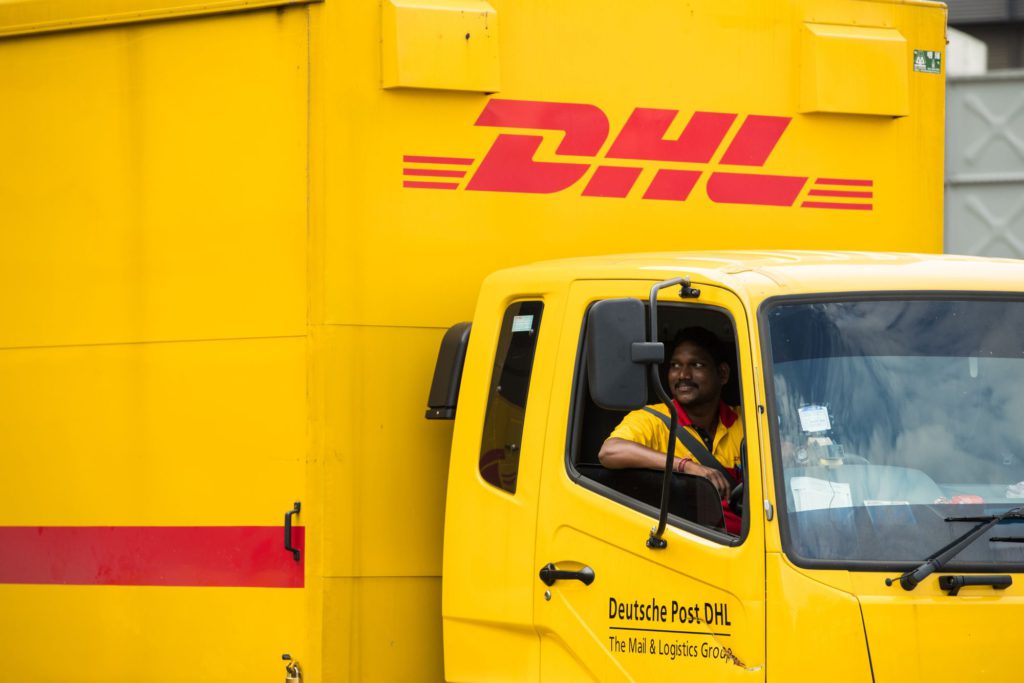
DHL’s Singapore Unit to Invest $5.8 Million Electrifying Fleet

(Bloomberg) — Delivery company DHL Express’s Singapore unit will invest S$8 million ($5.8 million) electrifying its fleet over the next five years to meet the city-state’s net zero emission goals.

The courier company will add 80 electric vehicles to its fleet by October, Managing Director Christopher Ong said in a statement Tuesday. Singapore is planning to phase out fossil fuel-powered vehicles by 2040, with only hybrids and zero emission vehicles to be sold from 2030 onward. 

The new EVs will be leased from Singapore-based ComfortDelGro Corp. and replace internal combustion engine vans, DHL said. The company plans to add 25 more EVs over the next 12 months and install 105 charging points across its service centers. The vans will have a range of 339 kilometers (210 miles) and a payload of 1,000 kilograms (2,200 pounds). 

“By transitioning to electric vehicles, DHL Express Singapore is set to eliminate a total of 323 tons of CO2 emissions yearly,” said Ong.  


More stories like this are available on bloomberg.com

©2022 Bloomberg L.P.
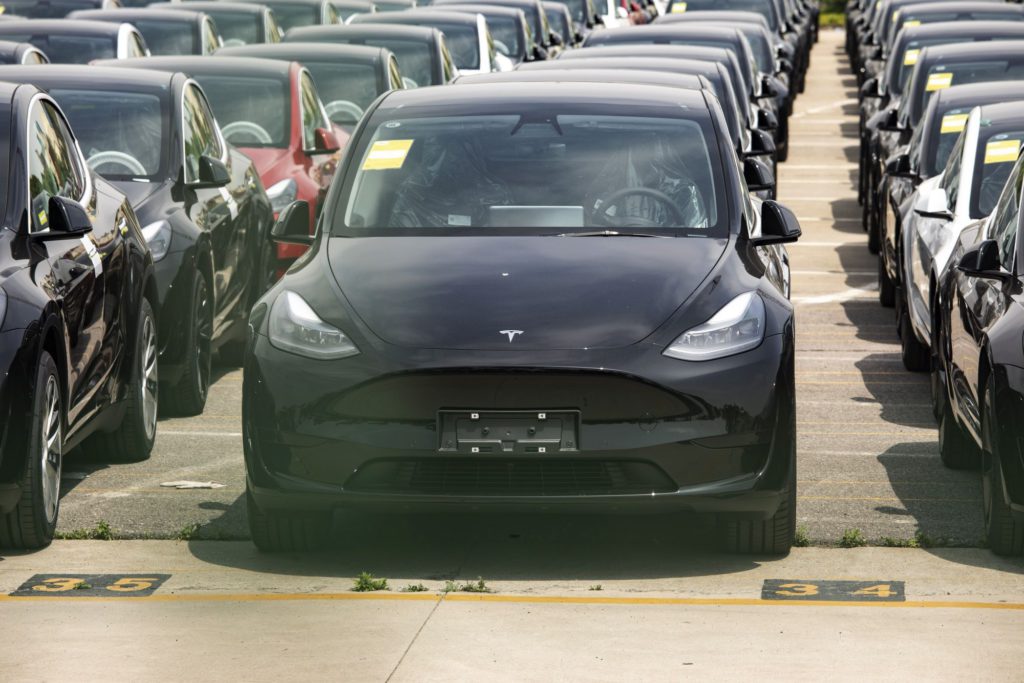
Teslas Banned From China Communist Party Resort Town: Reuters

(Bloomberg) — Tesla Inc.’s cars will from July 1 be barred from entering Beidaihe, a coastal district east of Beijing that hosts the Communist Party’s summer retreats, Reuters reported Monday, citing a local traffic police official.

The ban will last for at least two months, according to the report, which cited the official as saying the decision concerned “national affairs” and that an announcement would be made soon.

The US automaker has previously been prohibited from sensitive areas in China, including in March 2021, when Teslas were banned from military complexes and housing compounds due to concerns about their cameras collecting sensitive data. Elon Musk’s company pledged to store any data it collected in China in the country, the world’s biggest car market. It also said that cameras built into its cars aren’t activated outside North America. 

The traffic police bureau in Beidaihe didn’t respond to a Bloomberg News request for comment. A local Tesla representative also didn’t immediately respond to a request for comment. 

Tesla uses several small cameras, mainly located on the outside of the vehicle, to help guide parking, autopilot and self-driving functions. Most models also have an interior camera mounted above the rear-view mirror.

More stories like this are available on bloomberg.com

©2022 Bloomberg L.P.
Singapore Pushes Latest Laws to Regulate Online Content

(Bloomberg) — Singapore is joining global peers in proposing laws that will grant regulators the power to order social media services to remove or block online content deemed harmful especially to youths.

The envisioned rules also require social media platforms to implement community standards and content moderation processes to shield users from harmful content, communications minister Josephine Teo said in a Facebook post Monday. The guidelines, which will undergo public consultation starting next month, push social media companies to take greater responsibility for user safety, she said.

Singapore has long defended the need for laws to police content on the internet, saying the island is especially vulnerable to fake news and misinformation campaigns given it’s a financial hub with a multi-ethnic population that enjoys widespread internet access. But critics are concerned that recently enacted laws, such as ones barring foreign interference in local politics and governing online falsehoods, could be used to stem dissent or mis-applied because they’re too loosely defined. Meta Platforms Inc.’s Facebook are among those that have expressed concern with Singapore’s fake news law.

The Southeast Asian nation joins countries such as Australia, Germany and the UK, which have enacted or proposed online content and safety laws. US internet giants such as Meta and Alphabet Inc. are under growing pressure worldwide to curb the spread of misinformation on their globe-spanning platforms, most recently around the coronavirus pandemic. Governments are concerned about their influence in an era where more and more people get their news online and through social media.

Under the proposed laws, examples of content that could be blocked include live-streamed videos of mass shootings and viral social media challenges that encourage young people to perform dangerous stunts, according to the Straits Times. They will also take into account sensitive issues like race and religion, the newspaper added.

“Online safety is a growing concern and Singapore is not alone in seeking stronger safeguards for our people,” Teo said in her post. “There is a growing global movement pushing to enhance online safety, recognising harms come along with the good when people engage on social media.”

Read more: Singapore Defends Fake News Law as Weapon to Fight Coronavirus

(Updates with details from minister’s post from the first paragraph)

More stories like this are available on bloomberg.com

©2022 Bloomberg L.P.

Japan’s Latest Unicorn Is a Thailand Mobile Payments Firm

(Bloomberg) — Mobile payment gateway provider Opn Co. was valued at roughly $1 billion in a $120 million funding round last month, making it one of a handful of unicorns in Japan.

The Tokyo-based company, previously known as Omise, owes much of its success to its early entry into another Asian nation: Thailand. Entering the market in 2013, when it was heavily reliant on cash transactions, Opn seized a sizable share of mobile payments by helping small businesses make the digital transition and getting the major network operators to adopt its technology, the company said.

The Series C+ funding marks a rare success for a Japanese startup at a time when venture capital is bracing for a sharp industry downturn. JIC Venture Growth Investments and Mars Growth Capital Pte participated in the round, while Japan’s largest bank Mitsubishi UFJ Financial Group Inc. agreed to provide about $38 million as part of a loan guarantee program organized by the country’s trade ministry.

“Our priority now is on developing our product line and expanding our presence in both existing and new markets,” Jun Hasegawa, co-founder and chief executive officer of Opn said in an interview. “While we are always considering ways to grow our business, our options could later include a global IPO to expand our global reach.”

Opn designs software that helps merchants set up payments on their mobile or desktop websites. Its biggest market is Thailand, home to 41-year-old Hasegawa’s co-founder Ezra Don Harinsut. The firm’s clients include True, one of Thailand’s largest telecommunications conglomerates, and Total Access Communication Public Co., or DTAC. 

The startup plans to use proceeds from the funding to expand its services to new markets including Vietnam and the Philippines. Apart from Japan and Thailand, Opn currently operates in Singapore, Malaysia and Indonesia. Over the long term, Hasegawa aims to make Opn services available in at least 36 major countries including the U.S. and European economies.

“We want to have a footprint in every major country,” Hasegawa said. 

Despite increasing competition in mobile payments, Hasegawa says Opn’s years-long experience in Southeast Asian markets and ability to adapt to complex local regulations give it an edge against rivals. The company in April appointed Chris Misner, who had been general manager of Apple Inc.’s Asia-Pacific online store, to its board. 

Revenue has doubled every year since 2019 as more consumers opted for digital payments in the wake of the global pandemic, helping Opn reach 100 million transactions per year. The company didn’t disclose detailed earnings figures. 

But Hasegawa hasn’t always been successful with his ventures. In 2017, he brought in $25 million through an initial coin offering, an unregulated sale process that had exploded in popularity that year. His company was at the time working on facilitating payments with cryptocurrency, and its OmiseGo tokens were worth more than $2 billion at one point. They tumbled as the market crashed and the firm divested of OmiseGo in December 2020. 

“I’ve learned a lot from my past failures, and they’ve made me think about what is the one service that you always need, all the time,” Hasegawa said. Now, “we have a strong yearning toward creating global financial infrastructure, that’s what we’re after.” 

(Updates with board member information; an earlier version corrected the spelling of DTAC in fifth paragraph)

More stories like this are available on bloomberg.com

©2022 Bloomberg L.P.
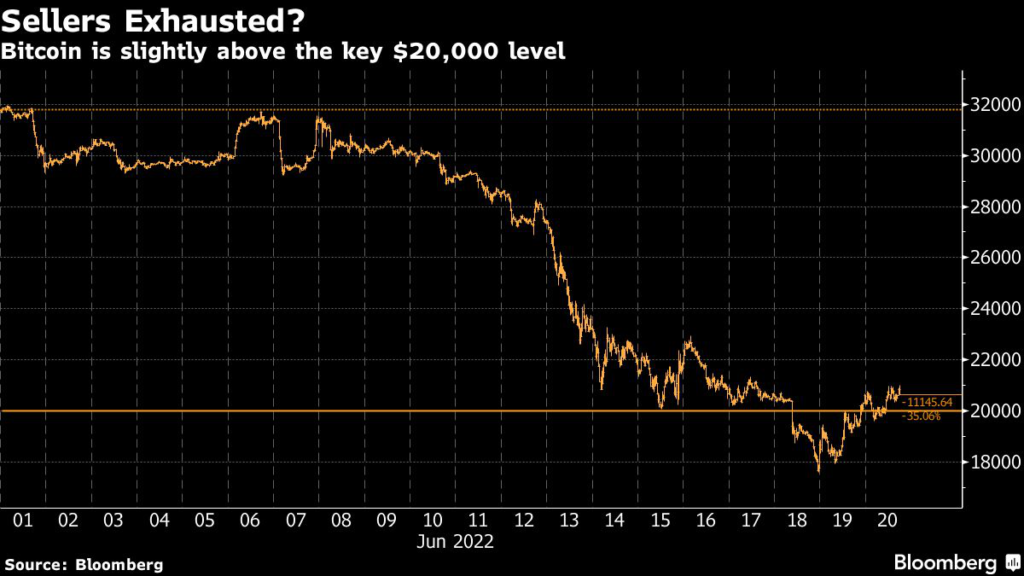
Bitcoin Holds Above $20,000 After Week of Forced Crypto Selling

(Bloomberg) — Cryptocurrencies showed tentative signs of recovering from last week’s rout as Bitcoin held above $20,000.   

Bitcoin rose as much as 1.6% on Tuesday in Asia and was trading at $20,665 as of 8:42 a.m. in Tokyo. The MVIS Cryptocompare Digital Assets 100 index climbed 1.5%. So-called altcoins like Solana and Polkadot were among gainers. 

After a turbulent week that saw Bitcoin plunge below the $20,000 level for the first time since 2020, some market watchers are pointing to possible signs that prices have bottomed — at least for now. Realized losses on Bitcoin holdings reached a record $7.3 billion last week, Glassnode said in a report Monday.

“With forced sellers appearing to drive much of the recent sell-side, the market might begin to eye whether signals of seller exhaustion are emerging over the coming weeks and months,” the report said. 

Marcus Sotiriou, an analyst at GlobalBlock, pointed to the Glassnode data to say that “a macro bottom, or temporary bottom, could be close,” according to a note on Monday. Altcoins haven’t suffered the same “cascade in liquidations” as Bitcoin and Ether, which are the tokens primarily used as collateral for leveraged positions, he said. 

Any market recovery could prove fleeting, with central banks around the world bent on draining liquidity to combat runaway inflation. 

The T3 Bitcoin Volatility Index, a measure of the token’s expected 30-day volatility, has jumped back toward the highs of mid-May, when the collapse of the TerraUSD stablecoin rocked markets.

“A toxic mix of bad news cycles and higher interest rates has hurt the crypto market and we can anticipate more volatility in the upcoming weeks,” said Feroze Medora, director of APAC trading at Cameron and Tyler Winklevoss’s Gemini crypto platform, in a note on Monday.

‘Chasing Liquidations’

Bitcoin has now seen two “distinct capitulation phases” since it peaked at close to $69,000 in November, Glassnode said. The first was triggered by the collapse of the TerraUSD stablecoin in early May, and the past week’s one was driven by “a massive industry-wide deleveraging, both on and off-chain.” 

Current trading patterns in Bitcoin and Ether indicate some large crypto holders are “chasing liquidations to profit from forcing other players out,” said Chiente Hsu, chief executive officer of decentralized finance platform ALEX.

Adding to the uncertainty is the intense pressure on DeFi applications. Their popularity as a source of high yields soared when pandemic-era stimulus drove a record-breaking crypto boom.

Now they are being forced to take unprecedented measures to protect themselves against a chain reaction of liquidations. Embattled crypto lending platform Celsius Network Ltd. said Monday it needs more time to stabilize its liquidity and operations after freezing deposits earlier in June.

More stories like this are available on bloomberg.com

©2022 Bloomberg L.P.
UK Rail Strikes to Proceed After Unions Reject Late Offer

(Bloomberg) — UK rail workers will begin Britain’s biggest rail strike in three decades on Tuesday after unions rejected a last-minute offer from train companies, bringing services nationwide to a near standstill. 

A proposal from track manager Network Rail was considered and rejected on Friday, and another one from train companies was turned down on Monday, National Union of Rail, Maritime and Transport Workers General Secretary Mick Lynch said in statement broadcast from near Euston Station, north London.

The failure of negotiations means some 40,000 staff at 13 train operating companies and Network Rail will walk out on Tuesday, Thursday and Saturday, bringing commuter services to a standstill nationwide and threatening to cause transport chaos in London. 

But Lynch blamed the government, saying the root of the problem is £4 billion ($4.9 billion) of budget cuts — £2 billion each for Transport for London and the national railways. “That is hobbling this industry and it’s forcing the companies to implement transport austerity and massive cuts to our system,” he said.

In the House of Commons, Transport Secretary Grant Shapps called that analysis a “fundamental misunderstanding,” and said the money missing from the railways budget was down to lower takings from fares after passenger numbers failed to recover to pre-pandemic levels.

Pandemic Hit

Figures released by the Office of Road and Rail on Thursday reveal the extent of rail’s retreat, with total journeys at only 62% of the pre-pandemic tally in the quarter through March. 

Lynch listed grievances including pay that’s not keeping pace with inflation, job cuts and a lack of guarantees against compulsory redundancies. 

But Prime Minister Boris Johnson said in a statement late on Monday that “too high demands on pay will also make it incredibly difficult to bring to an end the current challenges facing families around the world with rising costs of living.” 

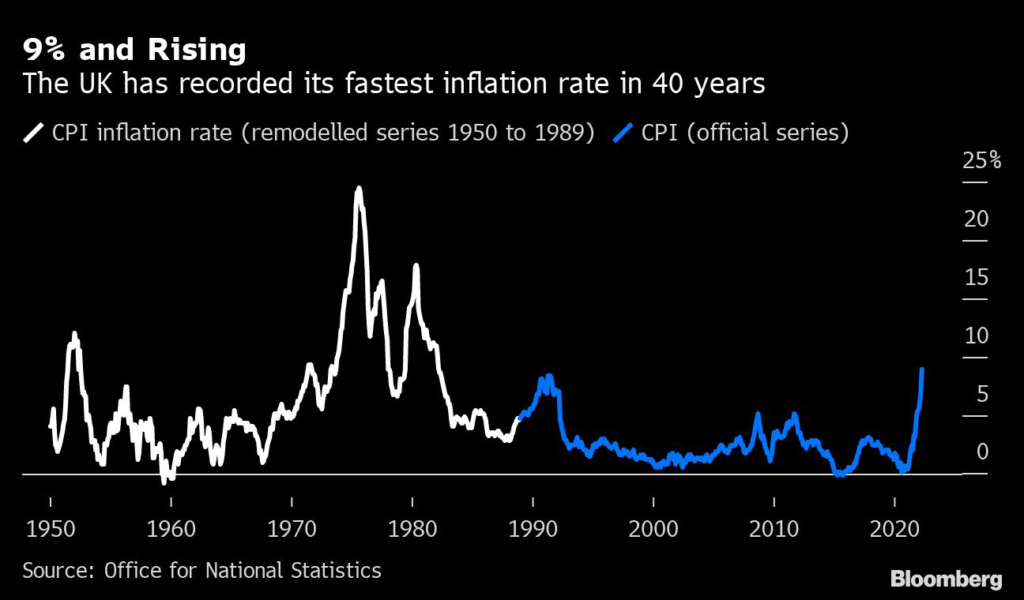
Johnson’s ministers have suggested that restraint on pay rises is needed to rein in inflation, which is already at a four-decade high. Johnson will tell the cabinet on Tuesday that his government seeks to enforce pay restraint on public sector workers, according to a statement from his office.

Inflation

“We have a responsibility to tackle inflation and stop it becoming entrenched,” Johnson’s office said. “To do this we must ensure that pay settlements are sensible and do not scramble to match inflation, and as a result drive up prices as the cost of goods and service increase to incorporate pay rises.”

Shapps said that the strikes are “orchestrated by some of the best-paid union barons representing some of the better-paid workers in this country.” He pointed to the median wages of train drivers being well above salaries of nurses and other professions.

Yet the RMT argues that many of the strikers are among the lowest paid on the railway networks, including cleaners. The union representing most train drivers, ASLEF, is not joining the national strike.

Labour’s transport spokeswoman Louise Haigh accused Shapps of “washing his hands” of responsibility. “On the eve of the biggest rail dispute in a generation taking place on his watch, he has still not lifted a finger to resolve it,” she said.

Service Disruption

Only about 20% of services will survive the stoppages, with Scotland and Wales hit hardest. Tuesday will also see action by 10,000 London Underground workers in a separate dispute over jobs and pensions. 

In a move that’s likely to inflame tensions with the unions further, Shapps said the government is planning to end a ban on the use of temporary workers to stand-in for those on strike. 

Both the Trades Union Congress and Unite condemned the plans, saying it would only prolong the conflict between employers and their staff.

(Updates with Johnson’s comments to cabinet from eighth paragraph.)

More stories like this are available on bloomberg.com

©2022 Bloomberg L.P.
Tax Reform Seen as Key for Japan’s $74 Billion Startup Push

(Bloomberg) — Tax reform is essential for Japan’s push to funnel 10 trillion yen ($74.4 billion) of investment into startups every year, according to the head of a ruling party group supporting emerging high-growth firms.

The government is set to put together a five-year plan by the end of 2022 that will seek to increase money going to startups tenfold, according to proposals from the ruling party. 

The plan should include revisions to crypto-related taxation, as well as an update on stock option rules and levies on angel investment, according to Takuya Hirai, who sees Japan’s startup eco-system as lagging behind those of other countries. Venture capital also has a key role to play, he added.

“We have to revamp taxes and regulations to create a startup-friendly environment,” said Hirai, who served as Japan’s first digital minister from late 2020. Encouraging startups has great significance as a growth strategy, together with investment in green and digital technology, he said.

Revamping the country’s attitude to nascent technologies and firms appears to be a key part of Prime Minister Fumio Kishida’s New Capitalism plan. If Kishida is to succeed in pulling off his dual vision of growth and distribution, he will need sources of concrete economic expansion.

Hirai said the current system that taxes firms’ crypto asset holdings on paper gains needs to be revamped so that only realized gains face corporate tax. He also called for a new set of laws that focuses more specifically on the needs of startups, rather than applying rules meant more generally for small and medium-sized firms.

“There should be a proper startup visa system,” said Hirai. “We need laws to define what exactly a startup is.” 

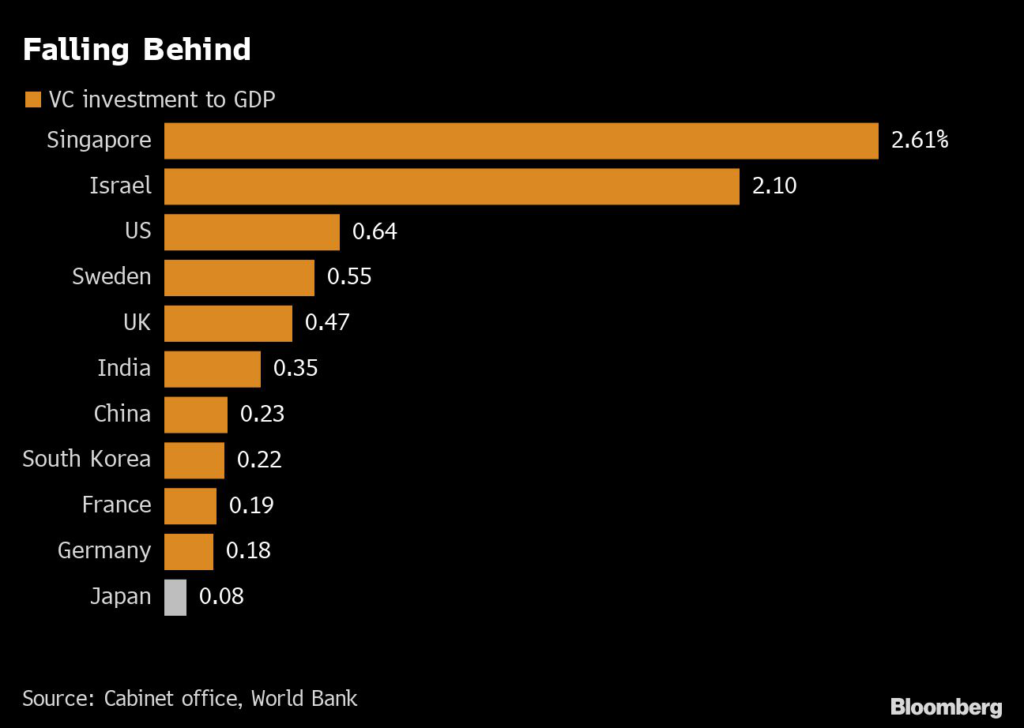
Venture capital investment in Japan relative to gross domestic product trails behind the other Group of Seven nations and beyond, he added. Firms that have key venture capital investment tend to have 60% higher productivity compared with those that don’t, Hirai said.

“The rate of acceleration’s totally different,” said Hirai, referring to the growth rate of big tech companies in the US helped by venture capital. “Look at GAFA, look at the US. Size is one thing, but there’s also speed.”

The ruling party has already suggested the Government Pension Investment Fund invests 1% of its assets in venture capital, as part of its digitalization proposals released in April. That would amount to around 2 trillion yen being poured into venture capital. 

Another recommendation is to seek investment of 1 trillion yen into startups by foreign venture capital, an idea modeled on a similar program in Israel. 

“If you look at institutional investors abroad, their returns are very high,” said Hirai, arguing that more risk could be taken as long as the approach was sufficiently explained to the general public. “It wouldn’t be surprising to have venture capital in the pension fund’s portfolio.” 

More stories like this are available on bloomberg.com

©2022 Bloomberg L.P.
US Sanctions Helped China Supercharge Its Chipmaking Industry

(Bloomberg) — China’s chip industry is growing faster than anywhere else in the world, after US sanctions on local champions from Huawei Technologies Co. to Hikvision spurred appetite for home-grown components.

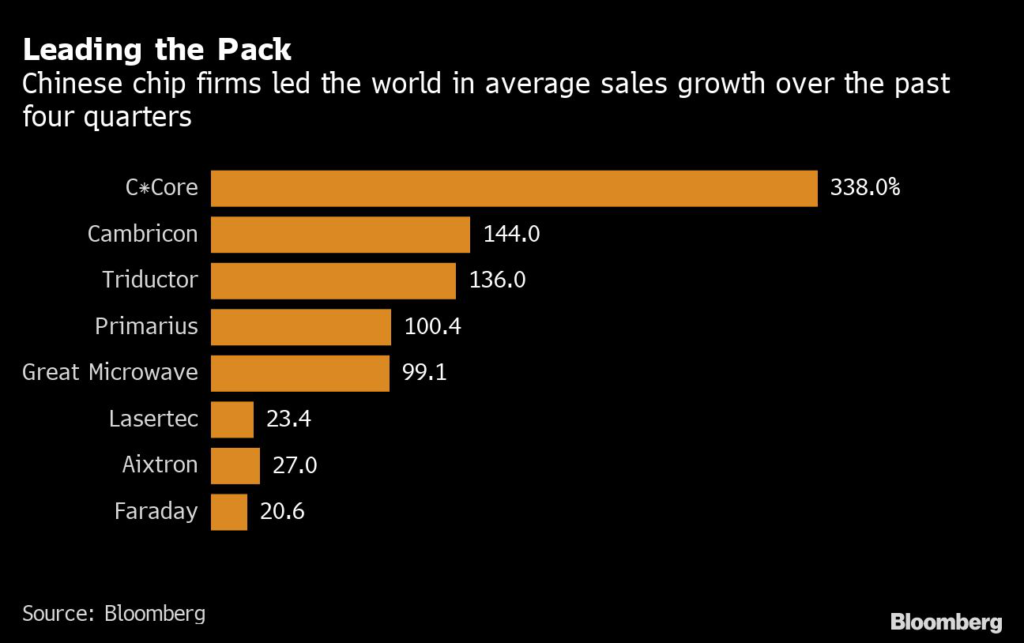
Nineteen of the world’s 20 fastest-growing chip industry firms over the past four quarters, on average, hail from the world’s No. 2 economy, according to data compiled by Bloomberg. That compared with just 8 at the same point last year. Those China-based suppliers of design software, processors and gear vital to chipmaking are expanding revenue at several times the likes of global leaders Taiwan Semiconductor Manufacturing Co. or ASML Holding NV.

That supercharged growth underscores how tensions between Washington and Beijing are transforming the global $550 billion semiconductor industry — a sector that plays an outsized role in everything from defense to the advent of future technologies like AI and autonomous cars. In 2020, the US began restricting sales of American technology to companies like Semiconductor Manufacturing International Corp. and Hangzhou Hikvision Digital Technology Co., successfully containing their growth — but also fueling a boom in Chinese chip-making and supply.

While shares in the likes of Cambricon Technologies Corp. have more than doubled from lows this year, analysts say there may still be room to grow. Beijing is expected to orchestrate billions of dollars of investment in the sector under ambitious programs such as its “Little Giants” blueprint to endorse and bankroll national tech champions, and encourage “buy China” tactics to sidestep US sanctions. The rise of indigenous names has caught the attention of some of the pickiest clients: Apple Inc. was said to consider Yangtze Memory Technologies Co. as its latest supplier of iPhone flash memory.

“The biggest underlying trend is China’s quest for self-sufficiency in the supply chain, catalyzed by Covid-related lockdowns,” Morningstar analyst Phelix Lee wrote in an email responding to inquiries from Bloomberg News. “Amid lockdowns, Chinese customers who mostly use imported semiconductors need to source homegrown alternatives to ensure smooth operations.”

Read more: China’s ‘Little Giants’ Are Latest Weapon in Tech War With U.S.

At the heart of Beijing’s ambitions is the impetus to wean itself off a geopolitical rival and more than $430 billion worth of imported chipsets in 2021. Orders for chip-manufacturing equipment from overseas suppliers rose 58% last year as local plants expanded capacity, data provided by industry body Semi show.

That in turn is driving local business. Total sales from Chinese-based chipmakers and designers jumped 18% in 2021 to a record of more than 1 trillion yuan ($150 billion), according to the China Semiconductor Industry Association. 

A persistent chip shortage that’s curtailing output at the world’s largest makers of cars and consumer electronics is also working in local chipmakers’ favor, helping Chinese suppliers more easily access the international market — sometimes with premiums tacked onto the best-selling products, such as auto and PC chips.

SMIC and Hua Hong Semiconductor Ltd., the biggest contract chip makers, have kept their Shanghai-based plants operating at almost full capacity even as the worst Covid-19 outbreak since 2020 paralyzes factories and logistics across China. With local authorities’ help, cargo flights from Japan delivered essential materials and gear to chip plants as the city went under lockdown. SMIC recently reported a 67% surge in quarterly sales, outpacing far larger rivals GlobalFoundries Inc. and TSMC.

Read more: China’s Chipmaking Power Grows Despite US Effort to Counter It

Shanghai Fullhan Microelectronics Co.’s revenue grew 37% on average because of high demand for surveillance products. The video chip designer has pledged to expand into electric vehicles and AI after winning its “Little Giant” designation. And design tool developer Primarius Technologies Co. doubled sales on average over the past four quarters, saying it’s developed software that can be used in making 3-nanometer chips.

Putting aside long-term profitability concerns, Morningstar’s Lee said the aggressive capacity build-up from Chinese players will elevate their presence globally. 

“There’s little doubt Chinese chipmakers can achieve revenue growth over the next few years from cars, consumer electronics and other devices,” he said.

Explainer: China’s Vast Blueprint for Tech Supremacy Over U.S.: QuickTake

More stories like this are available on bloomberg.com

©2022 Bloomberg L.P.

Rogers, Quebecor Rise Most Since 2020 After Sealing Mobile Deal

(Bloomberg) — Shares of Quebecor Inc. and Rogers Communications Inc. jumped the most since 2020 after the companies reached a deal that would see Quebecor acquire wireless assets in Ontario and Western Canada. 

Quebecor agreed to pay C$2.85 billion ($2.2 billion) for Shaw Communications Inc.’s Freedom Mobile division, the companies announced on Friday night. It’s a side deal that’s designed to resolve antitrust concerns that are holding up Rogers’ C$20 billion acquisition of Shaw. 

Quebecor rose 5.8% in Toronto, the biggest one-day increase since March 2020. Rogers was up 5.9% and Shaw soared 7.8% to C$37.34. he Rogers takeover offer is C$40.50 per Shaw share. 

Quebecor is getting Freedom Mobile — Canada’s fourth-largest wireless provider — at a reasonable price as its two rivals were forced to divest it, according to analysts. 

The headline figure for Freedom is below the consensus C$3 billion to C$4 billion value of Shaw’s wireless assets, according to Tim Casey, an analyst at BMO Capital Markets. The Quebecor deal includes most, but not quite all, of Shaw’s wireless assets: Rogers is trying to keep a small number of customers who are Shaw cable and internet consumers and also have phones under the Shaw Mobile brand.  

‘Biting the Bullet’

Rogers’ plan to acquire Shaw hit a regulatory roadblock in May after Canada’s Competition Bureau sued to stop the deal, citing anti-competitive concerns in the wireless business, where the companies’ operations overlap. Rogers and Shaw were already looking for a buyer for Freedom Mobile at the time. That’s when Quebecor stepped in. 

The deal with the Montreal-based communications firm may check the boxes the bureau is looking for, according to some analysts. 

Competition in the sector would increase because Quebecor would scale up Freedom Mobile’s operations after the deal closes, said Jerome Dubreuil, a telecommunications analyst at Desjardins Securities Inc. That would also keep Freedom a viable competitor in key markets like Toronto and Vancouver.

“Quebecor gets an attractive deal,” Dubreuil said in a note to investors. “Rogers is biting the bullet and making the right moves to increase the odds of gaining regulatory approval for its merger. Meanwhile, Quebecor is picking a ripe fruit and extending its growth runway with its core competencies for a reasonable price.”

The question now is whether Rogers and Shaw can persuade the antitrust body and the federal government to accept the Quebecor solution, preventing a protracted hearing at the Competition Tribunal, Canada’s merger court. The parties are expected to work through a negotiated settlement this summer, with the deal closing in July or August, said Adam Shine, an analyst at National Bank Financial.  

(Updates share prices)

More stories like this are available on bloomberg.com

©2022 Bloomberg L.P.

Close Bitnami banner
Bitnami
