
Bloomberg

Charts Showing African Startups Resilience Amid Global Chaos

(Bloomberg) — Africa’s technology-dominated startups will continue to attract investment, even if at a slower pace, following record venture capital funding last year.

The sector has seen inflows of $2.7 billion since January, more than double the $1.2 billion in the first five months of last year, according to data collated by Futuregrowth Asset Management.

“We still see that African venture capital will be up year-on-year, albeit at a more subdued growth rate,” said Ian Lessem, managing partner at Cape Town-based HAVAIC, which makes between four and eight investments in early stage companies across South Africa, Nigeria and Kenya every year.

The charts and map below show how funding surged last year and the markets that will continue attracting the most inflows in future. 

In 2021 Nigeria and South Africa led the way as investments surged to $5.2 billion, according to Cape Town-based Futuregrowth, which oversees about $12 billion across a number of asset classes. The financing will likely slow in the months ahead as US investors, who brought in most of the money last year, retreat amid a global market downturn.

“The fundamentals for a lot of the businesses in Africa remain very very strong,” Lessem said. “Good businesses will always raise capital. They may have to work a little bit harder.”

Nigeria, with a population of over 200 million, is a sizable market in and of itself, while Kenyan companies have usually operated across a regional trade bloc of more than 170 million people before expanding further. 

International funds, including Tiger Global LP, Softbank Group, Andreessen Horowitz, General Atlantic LP, Social Capital, Quona Capital Management Ltd. and Dragoneer Investment Group LLC, have invested about $4 billion in African startups in recent years, according to Futuregrowth.

The money has mostly gone to technology companies providing services in finance, trade, energy, agriculture and health. Some have seen their valuations grow to more than $1 billion, including Flutterwave Inc., Chipper Cash, Andela, OPay and Wave.

Africa-focused startup funds such as Norrsken 22, Novastar Ventures, Partech Africa and TLcom Capital Partners Ltd. are currently raising about  $700 million to expand their investment on the continent, according to Futuregrowth. 

Nigeria and South Africa attracted the most funds last year, followed by Egypt and Kenya. Senegal and Ghana are also putting themselves on the startup map, according to Futuregrowth research.

“Senegal is growing quite a lot,” said Amrish Narrandes, head of private equity and venture capital at Futuregrowth. Still, “you’ve got the players in those geographies, those three or four will dominate” into the future, he said. 

HAVAIC’s Lessem agrees that West Africa is an area to watch.

“You have an interesting new venture region that is bubbling, which is francophone Africa,” he said. “It’s quite a well functioning trade bloc, common currency, similar cultures, sizable collective population and markets and an ever growing tech savvy youth.”

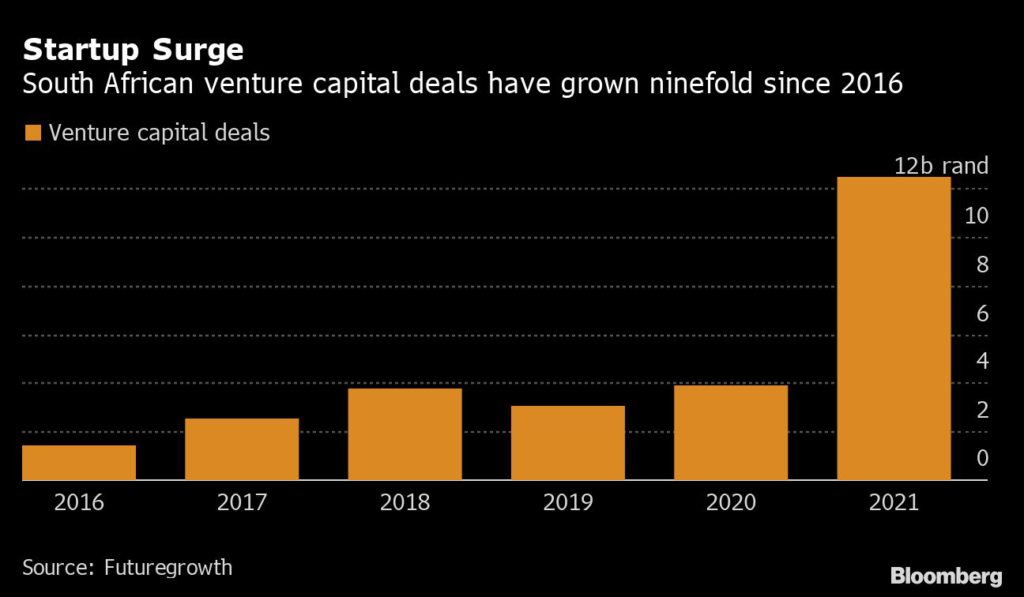
In South Africa, where the Futuregrowth High-Growth Developmental Equity Fund invests in startups, the value of venture capital deals has grown nine-fold since 2016.

Naspers Foundry, Knife Capital Ltd., HAVAIC and Allan Gray Ltd.’s E Squared are also helping to drive growth.

The relative depth of South Africa’s capital markets compared to other African nations will help shield it from a downturn in interest from foreign funders, Lessem said.

“With deep local capital markets that in recent years have started to allocate to venture, South Africa is not as reliant on foreign funding compared to other African markets,” he said. “Their local markets have far less depth.”


There were 122 deals in the country last year, with $832 million raised. The sector is now expected to “stabilize,” Narrandes said. 

South Africa’s market is probably too small to see startups get big enough to raise money through initial public offerings, he said. Instead they are more likely to be bought out by companies listed on the Johannesburg Stock Exchange.

“The size of the businesses don’t get large enough to justify an IPO locally,” he said. “Given the size of our economy, it makes more sense to be gobbled up by a JSE-listed company.”

(An earlier version of this story was corrected to reflect the correct spelling of the Futuregrowth executive’s surname.)

(Corrects Futuregrowth executive’s surname in 12th and 19th paragraphs.)

More stories like this are available on bloomberg.com

©2022 Bloomberg L.P.

Mounting Crypto Liquidations Make DeFi Go to Extremes

(Bloomberg) — The record-setting rout in cryptocurrencies has put a slew of decentralized-finance applications and their communities in a race to protect themselves against a cascade of liquidations — sometimes by employing unprecedented measures.

On Sunday, token holders of Solend, a lending app on the Solana blockchain, voted to temporarily take over a large user’s account that faced the threat of a large liquidation, an extreme move for DeFi that appears to be a first. That decision was reversed in a second vote on Monday.  

That all took place after MakerDAO, an app that supports stablecoin DAI and is run by a crypto community that formed one of the first decentralized autonomous organizations, suspended the token from being deposited and minted in DeFi crypto lending platform Aave.

DeFi apps — in which users can trade, borrow from and lend to each other without intermediaries like banks — are suffering because they tend to be interconnected, and troubles in one can have cascading effects on others. Users often put up tokens as collateral to borrow a coin in one app, to be deposited to get higher yields into another. When crypto prices tank as has happened recently, that can trigger margin calls on collateral, and users that don’t address this by adding more collateral get liquidated in a process triggered by software and executed by bots designed for this purpose.

Read more: Crypto Traders Turn Against Each Other in a Collapsing Market

When a user is ready to be liquidated, these bots — run by third-party programmers and traders — jockey to liquidate the positions so they can earn a bonus for doing so, a common practice in DeFi. As many bots compete to liquidate a position, that can clog a blockchain with transactions. Meanwhile, a dump of a slew of coins by liquidators can also further pressure token prices, prompting another cascade of liquidations. By stepping in, DeFi communities are trying to avoid all of this.

“A lot of DeFi protocols are reducing counterparty exposure during this volatile time,” said Paul Veradittakit, a partner at Pantera Capital.

The DeFi apps’ communities are also rallying to make sure their apps don’t get damaged by things like bad debt: If a liquidator can’t sell illiquid tokens, or if the tokens’ prices collapse as they are being sold, the apps can end up being held responsible for reimbursements.

Bold Move

In the case of Solend, holders on Sunday voted overwhelmingly in favor of a proposal to take over a large user’s account temporarily after the app reached out to the user to no avail, bringing the threat of a massive liquidation closer. 

With the first proposal, the explanation went like this: Should a rash of bots start competing to trigger the liquidation, “this could cause chaos, putting a strain on the Solana network.” 

By taking over the account, the Solend team could have attempted to liquidate the position in such a way that the liquidated tokens’ price was less affected, through an over-the-counter sale with a specific buyer. It’s assumed the owner of the account would have benefited from any coin sale proceeds upon liquidation. But the move was highly unconventional, breaching the norms of DeFi and causing some on Crypto Twitter to bristle. And a single crypto address accounted for the lion’s share of tokens that voted for the proposal, seemingly undercutting to some the idea of “community” espoused by DeFi.

Following the criticism, a second vote that concluded on Monday resulted in reversing the account seizure plan. Solend will “work on a new proposal that does not involve emergency powers to take over an account,” it said in a post announcing the vote, without providing details. The reversal passed with 99.8% “yes” votes.

Most DeFi apps are governed by their token holders, who can put forward and vote on proposals on how to change or improve the app. Typically, proposals can involve creating a new product, or changing an app’s fee structure. Until now, most people assumed that a proposal to take over someone’s account wasn’t a possibility in DeFi, which attracts some users in part because of the idea it can protect them from overreach by a traditional financial business or a tyrannical government.

Could another DeFi realistically try to pull off something similar? At many of them, a handful of token holders hold the majority of the coins, and can influence or even control the outcome of votes. So technically, voters of other apps could implement a similar proposal — though it may cause a public outcry as well.

DeFi in Debate

Solend’s moves come a day after MakerDAO, an app that supports stablecoin DAI, suspended the token from being deposited and minted in Aave’s crypto lending platform because of Aave’s exposure to a troubled derivative of Ether called stETH, which has become illiquid. The suspension prevents traders from borrowing DAI against stETH. On Aave’s governance forum itself, users are hotly debating how to reduce the risk from stEth, which DeFi risk tracker Gauntlet says “may pose further risk to the protocol.”

DeFi apps’ pain was triggered after centralized crypto lenders Celsius Network and Babel froze deposits, and the rumored collapse of fund Three Arrows Capital, which sent crypto prices down in the double digits over the past seven days. Celsius worked with many DeFi apps to earn high returns. About 30% of all stEth stuck on Aave, for example, is from Celsius, according to researcher Novum Insights. Three Arrows Capital, meanwhile, was an investor in Lido, which issued stETh, and is debating a change in how it’s governed.

As tracked by DeFi Llama, the total value locked in DeFi, the amount of crypto in use on apps, has plunged to $70.6 billion from $205.7 billion on May 5, just before the Terra blockchain’s implosion set off the year’s biggest crypto crisis so far. 

Explainer: What’s Crypto Lending? What Happened With Celsius?: QuickTake

(Updates with results of second Solend proposal.)

More stories like this are available on bloomberg.com

©2022 Bloomberg L.P.

Thai Police Charge Ex-Lawmaker With Insulting Monarchy in Tweet

(Bloomberg) — Thai police charged a former opposition lawmaker with lese majeste on Monday over calls to reform the country’s powerful monarchy as authorities step up crackdowns on royal critics.  

Piyabutr Saengkanokkul is the second former executive of the now-disbanded Future Forward Party, which came third in the 2019 general election, to be charged under the royal defamation law. Thanathorn Juangroongruangkit, the party’s leader and a high-profile government critic, was charged under the same law last year for slamming the nation’s vaccine strategy, which he claimed relied too much on a company owned by King Maha Vajiralongkorn. 

Piyabutr, who appeared before the police in Bangkok, was charged over a tweet in October last year, his lawyer Kritsadang Nutcharat said. The politician was greeted by dozens of supporters who gave him flowers and waved banners calling for the abolishment of the royal insult law, which mandates as many as 15 years in prison for each offense.

“How can the Thai society move forward when academic discussions can be prosecuted?” said Piyabutr, who has denied the charge. “We should be able to discuss the issue of monarchy reforms in a safe space, which has been my mission to establish.” 

Thailand’s monarchy has faced increased scrutiny in recent years, with an unprecedented protest movement in 2020 calling for more transparency and accountability from the institution. The government led by coup leader-turned-premier Prayuth Chan-Ocha has defended the use of the lese-majeste law, saying that protecting the monarchy is a matter of safeguarding national security. 

Royal insult charges are based on evidence and officials handle such cases carefully, police spokesman Kissana Phathanacharoen said.

More than 40 cases have been filed under the lese majeste law this year alone after Thailand’s Constitutional Court ruled last year that protester demands to reform the monarchy violated a provision in the military-drafted charter that bans any move to “overthrow” the royal institution. 

Last week, three social-media influencers were also charged with royal defamation over a video advertisement for e-commerce platform Lazada that royalists had said mocked members of the royal family. 

More stories like this are available on bloomberg.com

©2022 Bloomberg L.P.

Buy-Now-Pay-Later Lenders to Get Tighter Regulation in the UK

(Bloomberg) — The UK government is tightening rules on buy now, pay later loans to try to prevent borrowers from taking on unaffordable debts. 

After months of consultations, the Treasury confirmed that lenders will be required to carry out affordability checks on customers and ensure advertisements are fair. Providers will need to be approved by the Financial Conduct Authority and borrowers can take complaints to the Financial Ombudsman Service.

The rules will take time to change. The government aims to lay secondary legislation by mid-2023, after which the FCA will consult on its regulation. It comes as companies from Apple Inc. to Klarna Bank AB race to offer shoppers the chance to pay for small items in installments, which are interest-free if they pay on time. 

“By holding buy now, pay later to the high standards we expect of other loans and forms of credit, we are protecting consumers and fostering the safe growth of this innovative market in the UK,” said John Glen, economic secretary to the Treasury.

The government also confirmed that other forms of short-term interest-free credit, such as paying for dental work or larger items like furniture, will be required to comply with the same rules. With inflation at a 40-year high, UK regulators last week told lenders of all forms they need to offer more support to struggling borrowers. 

More stories like this are available on bloomberg.com

©2022 Bloomberg L.P.

EasyJet Curbs Summer Capacity After Disruptions: The London Rush

(Bloomberg) — Here’s the key business news from London-listed companies this morning.

EasyJet Plc: The low-cost carrier cut its flying expectations for the last two quarters of the year after it had to cancel flights across Europe due to staff shortages and other coronavirus-related disruption.

  • The airline said it is “proactively consolidating” a number of flights across airports affected by the tight labor market

Euromoney Institutional Investor Plc: The financial information company received an approach from Astorg Asset Management and Epiris on a possible cash offer for the company, valuing it at about £1.6 billion.

  • The consortium had made four other approaches, starting at £11.75 per share, eventually leading to the fifth and current approach at £14.61 per share

Associated British Foods Plc: The owner of Primark reported strong sales for the unit in summer holiday related products as well as successful Strange Things and Lilo & Stitch ranges.

  • Primark, who had previously resisted moving any of its sales online, will start trialing a click-and-collect service for its children’s products in the UK

Outside The City

This week, the UK will face up to surging inflation and labor strikes as well as a rising risk of recession in a series of setbacks that have echoes of the 1970s. That’s as close to three-quarters of respondents in the latest Bloomberg MLIV Pulse survey were bearish about the UK’s future. 

Meanwhile, Boris Johnson’s vote-winning power will be under scrutiny Thursday in two by-elections in areas where his “levelling up” agenda has stalled. 

In Case You Missed It 

UK house prices rose to a new record in June, but there’s mounting evidence the red-hot market is starting to cool.

And Glastonbury returns this week after a three-year Covid pause, and some festival goers plan to do it in style.

Looking Ahead

Packaging company DS Smith Plc and telecommunications and utilities supplier Telecom Plus Plc are due to publish updates tomorrow.

More stories like this are available on bloomberg.com

©2022 Bloomberg L.P.
Bitcoin’s Struggle to Hold $20,000 Keeps Crypto Market on Edge

(Bloomberg) — Bitcoin struggled to hold above the closely-watched $20,000 level, extending a period of marked volatility that saw huge weekend swings.

The largest cryptocurrency fell as much as 4.8% on Monday and was trading at $19,914 as of 7:32 a.m. in London. Ether at one point shed 7.8% but held above $1,000. Altcoins like Solana, Cardano and Dogecoin declined.

Bitcoin sank almost 15% on Saturday, then vaulted back above $20,000 with a surge of similar magnitude on Sunday. The pattern of swings suggest investor sentiment remains highly fragile as the Federal Reserve and other central banks go full throttle to fight inflation with interest-rate hikes that drain liquidity from markets.

The T3 Bitcoin Volatility Index, a measure of the token’s expected 30-day volatility, has jumped back to the highs of mid-May, when the collapse of the TerraUSD stablecoin rocked markets.

“A toxic mix of bad news cycles and higher interest rates has hurt the crypto market and we can anticipate more volatility in the upcoming weeks,” said Feroze Medora, director of APAC trading at Cameron and Tyler Winklevoss’s Gemini crypto platform, in a note on Monday.

As Bitcoin crashed below $20,000 last week for the first time since late 2020, attention has turned toward a cascade of liquidations that threaten to worsen the crypto rout. There were a total of $879 million worth of liquidations over the weekend, data from Coinglass shows. 

‘Chasing Liquidations’

Current trading patterns in Bitcoin and Ether indicate some large crypto holders are “chasing liquidations to profit from forcing other players out,” said Chiente Hsu, chief executive officer of decentralized finance platform ALEX.

Adding to the uncertainty is the intense pressure on DeFi applications. Their popularity as a source of high yields soared when pandemic-era stimulus drove a record-breaking crypto boom.

Now they are being forced to take unprecedented measures to protect themselves against a chain reaction of liquidations. Embattled crypto lending platform Celsius Network Ltd. said Monday it needs more time to stabilize its liquidity and operations after freezing deposits earlier in June.

“Expect more pockets of forced selling of Bitcoin and Ether as the market figures out who is swimming naked,” Arthur Hayes, co-founder of crypto exchange BitMEX, said on Twitter. 

He said he doesn’t know if the selling is over but “for those skilled knife-catchers, there may yet be additional opportunities to buy coin from those who must whack every bid no matter the price.”

(Updates with volatility measure in fourth paragraph.)

More stories like this are available on bloomberg.com

©2022 Bloomberg L.P.

Philippines’ PLDT Blocks 23 Million Texts in Sign of Scam Threat

(Bloomberg) — In just three days, Philippines-based telecommunications provider PLDT Inc. blocked more than 23 million text messages that try to get consumer’s personal data, showing heightened cybersecurity risks in the nation. 

The “malicious” messages, blocked from June 11 to 14, contained links to so-called phishing websites that posed as legitimate organizations such as banks, tour operators and recruitment agencies, PLDT said in a statement on Monday. 

Millions of Spam Messages Blocked in Philippines as Scams Surge

Philippine telecoms have boosted efforts to curb fraud. PLDT had blocked almost 78,000 SIM cards that tried to steal personal data, and invested 3 billion pesos ($55.6 million) last year to counter cyberthreats. Rival Globe Telecom Inc. said it blocked over a billion dubious mobile-phone messages last year.

The National Privacy Commission said in November that a global crime syndicate was behind a surge of scam messages soliciting personal information.

More stories like this are available on bloomberg.com

©2022 Bloomberg L.P.

NetEase Shares Plunge After Diablo Immortal Game Launch Is Postponed

(Bloomberg) — Chinese gaming giant NetEase Inc. plunged the most in nine months after delaying the launch of Diablo Immortal in the world’s biggest mobile app market, putting its sales recovery in question.

Shares slumped almost 11% in Hong Kong, leading declines on the benchmark Hang Seng Tech Index, which dropped as much as 2.5%. Tencent Holdings Ltd.’s closest rival in China said Sunday that it will postpone the original June 23 China launch of Diablo Immortal, the mobile game it co-developed with Activision Blizzard Inc.

The surprise postponement comes at a delicate time for China’s games industry, which is only just emerging from a months-long freeze on game licenses during a wide-ranging crackdown on tech firms. The official Diablo Immortal account on Weibo was blocked from posting for “violating relevant laws and regulations” last week, according to a banner notice affixed to the feed. It was unclear what content might have been in violation.

Diablo is one of Blizzard’s most popular franchises and the debut of its mobile iteration has been a hotly anticipated event. Immortal garnered 10 million downloads in the first week after its international launch outside of China on June 2, but the game’s devotees criticized its pay-to-win elements and in-app purchases, leading to a 0.4 out of 10 user score on rating site Metacritic. 

NetEase and Blizzard said on the game’s official website they needed additional time for content enhancement in pushing back the game’s availability in China. Blizzard also delayed its release in other Asia-Pacific markets such as Indonesia, Malaysia, Hong Kong and Taiwan, to July 8.

They did not specify a new release date for mainland China. Some analysts don’t see the postponement as indicative of a renewed move by Beijing to tighten conditions for games publishers.

“This is more specific to NetEase,” said Vey-Sern Ling, a senior analyst with Union Bancaire Privée, after the shares fell. “Maybe the market is worried that this is a larger issue with the regulators. Some Diablo contributions should already be penciled into 2H for consensus.”

In the worst case scenario, Diablo Immortal could run into a so-called black swan event similar to what happened with Tencent’s DnF Mobile, Morgan Stanley analysts wrote. Originally slated for an August 2020 release, that game has never rolled out in China, after Tencent initially said that it needed to upgrade its anti-addiction system.

China is expected to become Immortal’s largest market, where players are more accustomed to a freemium business model instead of buying copies outright. Immortal, which obtained its Chinese commercial license before the most recent gaming halt, is one of the few blockbuster launches expected in the country this year.

(Updates with analyst comment)

More stories like this are available on bloomberg.com

©2022 Bloomberg L.P.

Methane-Spewing Coal Mines Are Climate Test for Australia’s New Leader

(Bloomberg) — Australia’s coal mines cause more planetary warming in a typical year than emissions from all of the country’s cars. If Prime Minister Anthony Albanese wants to meet tougher climate targets, he’ll need to fix that.

Satellite observations suggest the best place to start is the Bowen Basin, the major coal hub in Queensland state, and an area where scientists have estimated the methane intensity per unit of production is 47% higher than the global average.

A satellite earlier this month spotted a plume of the potent greenhouse gas that geoanalytics firm Kayrros SAS estimated originated within about 25 kilometers (15.5 miles) of coal mines operated by Anglo American Plc, Stanmore Resources Ltd. and BHP Mitsubishi Alliance, known as BMA. The former two companies didn’t answer questions from Bloomberg asking if their mines emitted methane the day of the satellite observation. BMA said it estimates and publicly reports emissions in accordance with national requirements.

“Methane leaking from coal mines has been ignored for many years, but tackling it is the ‘low hanging fruit’ in Australia’s effort to combat climate change,” Sabina Assan, an analyst with environmental think tank Ember, wrote in a report released this month.

The Bowen Basin has become a global example of the disparity between reported coal mine methane emissions and independent measurements, according to the report. The powerful green house gas can leak from underground and open-cut coal mines and has 84 times the warming power of carbon dioxide during its first two decades in the atmosphere.

The most recent release, observed on June 3rd by the European Space Agency’s Sentinel-5P satellite, was estimated to have an emissions rate of about 12 metric tons of methane an hour and could have come from several mines, according to Kayrros. Coal production typically runs 24 hours a day, so methane is often emitted constantly from mines. Release levels might fall during maintenance, or rise if miners hit a gas pocket. If the rate estimated by Kayrros was consistent for a year, the gases would have the same short-term warming impact as the annual emissions from roughly 1.9 million US cars.

Australia’s new government, voted into office last month, on Thursday confirmed an election pledge to lower carbon emissions by 43% from 2005 levels by 2030, tightening a previous commitment for cuts of 26%-28%.In February, Australia disclosed it had revised the method used to calculate methane pollution from open-cut coal mines and said the change means total national emissions were on average 0.3% higher than previously stated for each year since 1990. That revision was prompted by the use of satellite data, which has improved capacity to estimate emissions, the government said.

The change isn’t currently reflected in national greenhouse gas reporting legislation.

BMA, which did not use the updated methodology, said based on site-specific measurements of methane and CO2 content in the coal seams and surrounding strata at its Broadmeadow, Peak Downs and Caval Ridge mines cumulatively emitted about 3.32 metric tons of methane an hour on June 3.

Read more: The Cheap and Easy Climate Fix That Can Cool the Planet FastWhen contacted about the June 3 release, Australia’s Department of Industry, Science, Energy and Resources didn’t say if it was aware of the emissions or investigating them. “Making reliable, ‘top-down’ estimates of emissions from the satellite data is difficult for a number of reasons, including challenges associated with a lack of ground-truthing, instrument and modelling errors, and attribution,” the department said.The agency emphasized that coal-mine operators are required to estimate and report company and facility level greenhouse gas emissions under reporting guidelines and that the country’s Clean Energy Regulator publishes reported emissions data annually.

But Australia has had problems with some operators who report their own emissions. Peabody Energy Corp. said in January it had made errors in data filed to the local regulator, and appointed an auditor to review its processes.In Australia’s latest report to the United Nations, the government reported that active and abandoned coal mines released about 1 million tons of methane in 2020, while cars generated about 40 million tons of carbon dioxide. 

(Updates to add BMA comment from third paragraph.)

More stories like this are available on bloomberg.com

©2022 Bloomberg L.P.

Troubled Crypto Lender Celsius Seeks Time to Stabilize Liquidity

(Bloomberg) — Celsius Network Ltd. will need more time to stabilize its liquidity and operations, the embattled crypto lending platform said in a blog post after it froze deposits last week.

Celsius, one of the biggest crypto lenders, has been struggling to raise funds in a fragile digital-assets market hit by tightening interest rates, liquidity and the collapse of the Terra blockchain last month.  

“We want our community to know that our objective continues to be stabilizing our liquidity and operations,” Celsius said in its blog on Monday. “This process will take time.”

Read about the Celsius crisis that rattled markets

The firm has also paused Twitter Spaces and Ask Me Anything, also known as AMAs, in crypto jargon “to focus on navigating these unprecedented challenges,” Celsius said in the post.

The rout in crypto markets, which has washed 70% off the largest tokens by market value — Bitcoin and Ether — was accelerated by the crisis at Celsius as investors panicked about liquidations and a cash crunch. Broader signs of stress were evident. Crypto hedge fund Three Arrows Capital suffered large losses while another lender, Babel Finance, also paused withdrawals. On Sunday, token holders of Solend, a lending app on the Solana blockchain, voted to temporarily take over the account of a large user who faced the threat of a large liquidation.

More stories like this are available on bloomberg.com

©2022 Bloomberg L.P.

Close Bitnami banner
Bitnami
