Bloomberg

Zilingo Founders Make Surprise Buyout Offer for Startup

(Bloomberg) — Zilingo Pte co-founders made a last-ditch offer to buy the embattled fashion e-commerce platform as the board debates its future, according to people familiar with the matter.

Co-founder Dhruv Kapoor on Sunday proposed a management buyout to the Singapore-based company’s board, according to the people, who asked not to be named as the matter is private. He has secured commitments from a small group of new investors including a US private equity firm, the people said.

Under the preliminary proposal, the investor group will inject $8 million in new equity in a newly incorporated entity in tranches, while the remaining assets and the old corporate entity will be liquidated in due course, according to Kapoor’s email sent to investors and seen by Bloomberg News. All outstanding debt owed to creditor Zorro Assets Ltd. will be frozen for three years, according to email. 

The move comes as Zilingo’s board is scheduled to meet on Monday to discuss the future of the company, according to people with knowledge of the matter. Allegations of financial irregularities in March prompted an investigation into the company, valued at $970 million in 2019, and led to the dismissal of co-founder Ankiti Bose as chief executive officer in May. Her ouster plunged the once high-flying startup into crisis and sent shockwaves through Singapore’s technology industry.

Read more: Zilingo Board Said to Approve Debt Repayment to Creditors

(Updates with industry context in fourth paragraph. A previous version of this story was corrected to amend the spelling of co-founder’s name.)

More stories like this are available on bloomberg.com

©2022 Bloomberg L.P.

Bitcoin Bounces Above $20,000 in Swift Rebound; Caution Advised

(Bloomberg) — Bitcoin snapped a 12-day slide on Sunday, clawing its way back above $20,000 and leading the cryptocurrency market in a swift turnaround after a record-breaking string of declines. 

The world’s largest cryptocurrency climbed 16% Sunday, recouping its losses from a steep drop Saturday that sent the token to as low as $17,599. Ether, which touched as low as $881 in the selloff, climbed 26% to $1,140, while alternative coins from Avalanche to Solana also enjoyed gains. Bitcoin stood at about $20,500 as of 8 a.m. on Monday in Singapore, largely holding onto Sunday’s rally.

“I think we started to hit levels near the bottom where institutional investors see a buying opportunity,” said Paul Veradittakit, a partner at crypto-focused hedge fund Pantera Capital.

The crypto market is known for its wild swings — particularly on weekends, when moves can be magnified — and the whipsaw of the past two days provided the latest example. Analysts caution that Sunday’s respite may be brief: The overall tone remains negative, with monetary tightening providing macro headwinds and crises within crypto raising concerns about widening distress. Even with Sunday’s rally, Bitcoin is down more than 30% this month and some 70% from its all-time high reached in November. 

Trading was heavier than normal this weekend, with Bitcoin volume approaching $40 billion in the 24 hours through midday Sunday New York time, according to CoinGecko. Last Saturday and Sunday, volumes stood at $25.6 billion and $22.5 billion, respectively.

Read more: Crypto Market Starting to See Even Old-Timers ‘Panic Selling’

Bitcoin’s leg down on Saturday pushed the coin below $19,511, the high it hit during its last bull cycle in late 2017. Throughout its roughly 12-year trading history, Bitcoin had never dropped below previous cycle peaks. 

The token also broke through a technical support level of $18,300, said Katie Stockton, managing partner and founder of Fairlead Strategies. Consecutive weekly losses below that level would increase the risk of falling toward the next support of $13,900, she added.

As for trading now, Stockton said a short-term, “counter-trend” technical signal “provides some hope that a rebound will unfold in the near term.” She cautioned against buying the dip, though, as “momentum is strongly negative.” Other voices on Crypto Twitter cited $20,000 as a key pivot point that could provide support if it is retaken and held in the next few days; otherwise, it could be a market ceiling of sorts.   

The $20,000 level is “significant” as it represents the 2017 high and “since then has acted as both support and resistance on multiple occasions,” said Mati Greenspan, founder of Quantum Economics. “If we can get and hold above that level it will be quite bullish.”

A toxic mix of bad news cycles and higher interest rates has hurt crypto in recent days, resulting in a record stretch of losses for Bitcoin in the 12 days ended Saturday. The Federal Reserve raised its main interest rate on June 15 by three-quarters of a percentage point — the biggest increase since 1994 — and central bankers signaled they will keep hiking aggressively this year in the fight to tame inflation. 

Adding to the mood, crypto hedge fund Three Arrows Capital suffered large losses and said it was considering asset sales or a bailout, while another lender, Babel Finance, followed in Celsius’s footsteps on Friday.

The risk-off sentiment can be seen from the redemption pressure in Tether, with the widely used stablecoin’s circulation dropping by more than $15 billion since the May collapse of the Terra ecosystem, the first big crisis to hit the market this year, according to pricing data from CoinGecko. Some $4.4 billion of those redemptions came in the last seven days.

The crypto market as a whole is now a fraction of the size it reached in late 2021, when Bitcoin traded near $69,000 and traders poured cash into speculative investments of all stripes. The total market cap of cryptocurrencies was around $900 billion on Sunday down from $3 trillion in November, CoinGecko data shows.   

More stories like this are available on bloomberg.com

©2022 Bloomberg L.P.

Upstart China Smartphone Maker Cracks Notoriously Tough India

(Bloomberg) — Last year, when a global chip shortage forced many smartphone makers to delay launches, upstart Chinese brand Realme took a gambit in India. With processors from global giants such as Qualcomm Inc. in short supply, Realme decided to buy them from a relatively unknown Shanghai manufacturer to be able to keep churning out new handset models.

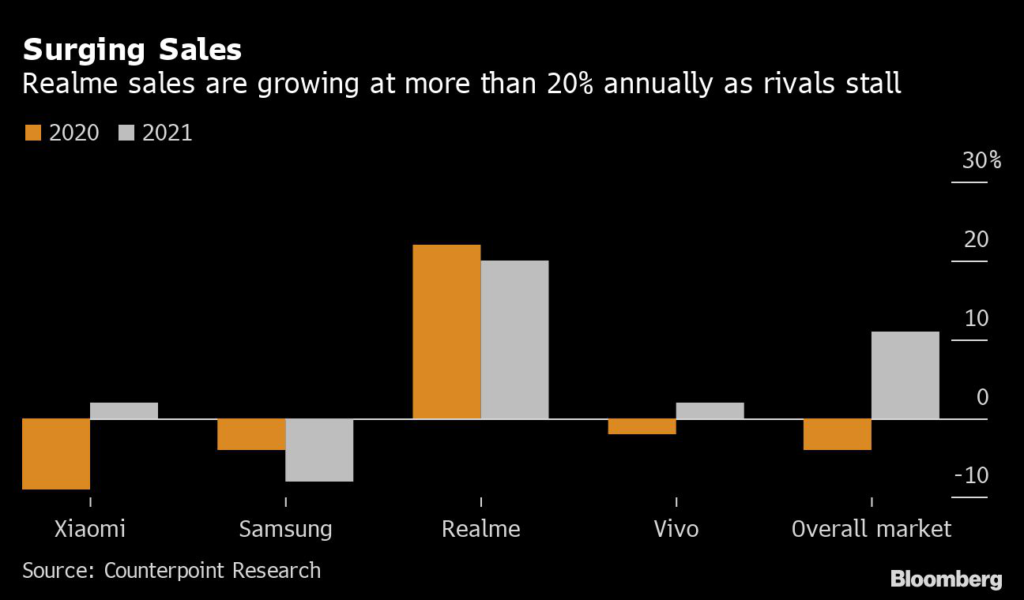
The move paid off, boosting the four-year-old newcomer’s sales and helping it reach the No. 3 position in the fast-growing market with about 600 million smartphone users. Only Samsung Electronics Co. and Xiaomi Corp. sold more devices in India in the latest quarter, with Realme closing in.

Closely held Realme has emerged as a force in the lucrative but treacherous Indian market where even global brands like Apple Inc. have struggled with regulatory hurdles. And in recent months, Prime Minister Narendra Modi’s administration has heightened the scrutiny of Chinese companies as the two nuclear-armed nations clash politically.

Yet Realme has so far escaped the government crackdown unscathed. All smartphones it sells in India are built in the country, boosting local employment. And Realme is helping India bring new users online with its Android smartphones that can cost less than $100, a fraction of what iPhones and pricier Samsung models go for.

“What I want to do is to bring more affordability to the India market,” Realme’s India boss Madhav Sheth said in an interview at a coffee shop next to the company’s local headquarters on the outskirts of New Delhi. Realme is in compliance with all Indian legal requirements and believes in cooperation with authorities, he said.

Realme’s relatively smooth sailing is in stark contrast with the obstacles its larger rivals have faced. Apple had to wrestle with the government for years just to open retail stores in the country and also had a protracted faceoff with authorities around a state-built spam-detection app that accesses users’ call logs. This year, the government cracked down on market leader Xiaomi with an anti-money-laundering agency moving to confiscate more than $700 million from the Chinese company, unnerving India’s entire fledgling electronics industry.

“Investing in India remains slightly risky for foreign companies as policies tend to change without enough of a forewarning,” said Shumita Deveshwar, senior director at investment strategy consultancy TS Lombard. “India has also been encouraging local companies to grow, and sometimes the politics of it makes the country an uncertain battleground, especially for foreign investors.”

Realme has taken advantage of rivals’ challenges by expanding its distribution to more than 40,000 stores and introducing aggressively priced devices such as last year’s 13,999 rupee ($180) Realme 8 5G, the cheapest fifth-generation wireless device at the time. Such tactics have helped it eat into Xiaomi and Samsung’s market share in India, said Tarun Pathak of tech researcher Counterpoint.

Realme commanded 16% of India’s smartphone market by shipment volumes in the first quarter of this year, up from 11% a year earlier. It only lags behind Samsung’s 20% and Xiaomi’s 23%, and was the only player to grow in double digits last year while rivals shrank, according to Counterpoint.

“Realme has held back the growth of Xiaomi and Samsung,” Pathak said.

Samsung and Xiaomi representatives didn’t respond to requests for comment.

Encouraged by its gains, Realme unveiled its first global flagship store in Modi’s home state of Gujarat this month. The 13,000-square-foot space in the city of Ahmedabad is part of Realme’s plan to become more of a premium player in India. The company also envisages India as a step toward global expansion, and has recently entered European markets.

But Realme, with links to more established brand Oppo, must tread carefully in India where Chinese companies have had to bear the fallout from a border faceoff in 2020 between the countries. New Delhi has since banned more than 200 Chinese apps and tax authorities have raided smartphone players including Xiaomi and Oppo.

“India has a complex relationship with China and there is bound to be a certain level of government scrutiny of China-based companies,” said Amitendu Palit, senior research fellow at the Institute of South Asian Studies at the National University of Singapore. “If there’s a thaw in the frosty relationship between New Delhi and Beijing, we are likely to see some sense of normalcy coming back to business, but if the relationship continues to sour we might see it spilling over to business.”

At the same time, India has worked to give local companies a boost. In 2020, the government announced a nearly $7 billion plan to give financial incentives to increase local production and export of smartphones. A key element of that plan was to create “local champions” or smartphone giants that can not only cater to domestic customers but compete with the best in the world.

Yet homegrown smartphone players like Lava and Micromax have failed to capitalize on such incentives, with Realme and other foreign brands winning over more customers because of a perceived quality advantage. Realme stands out by combining low prices with upscale features, said Vijay Shankar Kriplani, a Mumbai-based marketing professional.

“A better battery life and lower price led me to switch to a Realme smartphone two months ago,” said Kriplani, 39, who previously used a Samsung device.

Realme, which like its rivals uses the glitz and glamour of Indian cricket and Bollywood to sell its smartphones, doesn’t want its success to be confined to just mobiles. Its India expansion strategy includes plans for the local assembly of tablets and laptops starting as early as this month. The company will also invest 100 million rupees to make wireless earphones, open a design studio and double its network of single-brand stores to 600 in two years, said Sheth. Those moves are expected to help Realme grow its sales 50% over two years, he said.

Still, with macroeconomic challenges intensifying and larger rivals to contend with, Realme will have a hard time sustaining its high level of growth, said Rushabh Doshi of tech consultancy Canalys.

“Realme has done well in India so far, but it has to brace for testing times ahead due to rising inflation, longer phone replacement cycles and as a global recession looms,” Doshi said. “Deep-pocketed players like Samsung have other businesses to fuel the growth of their smartphones units in this environment but smaller companies like Realme will probably have to tighten their purse strings and that’ll probably be their biggest challenge.”


More stories like this are available on bloomberg.com

©2022 Bloomberg L.P.

Tencent-Backed Broker Chases Growth Overseas After China Rebuke

(Bloomberg) — Tencent Holdings Ltd.-backed Futu Holdings Ltd. plans to push deeper overseas to diversify its growth and is considering alternatives in case its New York listing is revoked, as China’s crackdown on private enterprise catches up with internet trading firms.

The online broker – which operates like Robinhood Markets Inc. in the US – is seeking to expand its presence in Hong Kong, California, Singapore and Australia while tapping into new markets, chief financial officer Arthur Chen said in an interview. 

“Going abroad, or internationalization, will be a very important strategy for Futu in the next two to three years,” Chen said in Hong Kong. “The total addressable market offshore is much bigger than China or Hong Kong, and we see great potential there.”

The global push underscores the dilemma facing the nation’s largest overseas-listed online broker as it awaits clarity from China’s regulators amid Beijing’s tightening controls over broad swathes of its economy. A senior central bank official has questioned the legitimacy of such trading firms, calling their services “illegal” at least twice since October. 

Futu and its main rival Up Fintech Holding Ltd. have been operating in a gray area for their mainland China businesses, allowing millions of local investors to evade capital controls to trade shares in markets such as Hong Kong and New York. Tencent is Futu’s second biggest shareholder after billionaire founder Leaf Li, himself a former senior executive at the internet platform company. 

Up Fintech, known as Tiger Brokers, is cutting about a fifth of its workforce after warnings that allowing Chinese to invest abroad may run afoul of the nation’s strict capital controls and data privacy rules, people familiar with the matter said in April.

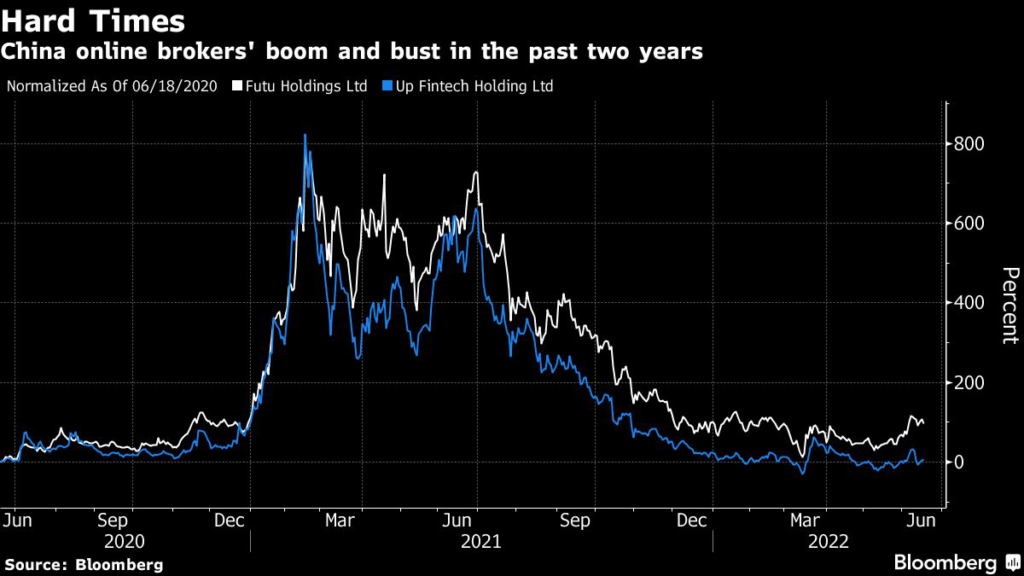
Meanwhile, Futu is taking a different approach. The online broker is boosting its research and development team to offset weaker growth as slumping global stocks burned retail investors. First-quarter revenue dropped 26% year-on-year, partly thanks to lower stocks trading volume.

Most of the headcount will be added in the southern technology hub of Shenzhen, according to Chen. The company is on track to meet its goal of adding 20% more staff this year, he said.

Awaiting Clarity

Futu has been actively communicating with Chinese authorities since October to keep regulators informed of how they service the nation’s clients, Chen said. 

“We’re waiting for more policy clarity on this front, and in the meantime trying to maintain a strategy that ensures relatively stable growth for us by shifting the focus to overseas markets,” he said. 

Chen expects Futu to gain a bigger share of Hong Kong’s segmented brokerage sector as smaller rivals exit amid the market downturn, and tap into Southeast Asia’s vast overseas Chinese population using Singapore as a stepping stone. Mainland China, Hong Kong and markets outside Greater China will each contribute about one third of the firm’s paying clients in the long run, he added.

The company has made some initial success in its effort to diversify, with over 80% of newly added paying clients in the first quarter coming from Hong Kong, US, Singapore and Australia.  

‘Plan B’

In addition to regulatory headwinds at home, Futu is already seeking to mitigate risks abroad. Almost 200 New York-traded Chinese firms are at risk of being delisted as soon as 2023 because of the decades-long standoff over allowing US officials to inspect their audits.

While Chen is upbeat Beijing and Washington can reach an agreement before the deadline, he said the company won’t rule out the possibility of seeking a listing in capital markets outside the US, without giving further details or a timetable. 

“We’ll try our best to comply and follow the directions as long as we have some more clarity, but from the company’s perspective we need to consider a Plan B,” said Chen. “We’ll keep other options open to mitigate the risk of a potential delisting.”

Listed in New York in 2019, Futu surged more than 400% in the two months after Christmas the following year in a short squeeze after Bill Hwang’s Archegos Capital Management had placed a massive bet against the online broker. It has since given back almost all the gains.

More stories like this are available on bloomberg.com

©2022 Bloomberg L.P.

Crypto Unicorns Are on Notice as VC Backers Gird for Slump

(Bloomberg) — The crypto market’s recent crises are prompting some major soul-searching among a very important constituency: the venture capitalists who have pumped billions of dollars into the industry over the past two years.

The startups backed by these investors have floundered amid a crippling market downturn. Layoffs have swept across some of the biggest names in blockchain such as Coinbase Global Inc., Gemini Trust Co. and Crypto.com. Companies like BlockFi Inc. are looking to raise capital at lower valuations and projects like the Terra blockchain and Celsius crypto lending platform are in crisis.

By backing these startups, venture capitalists helped create crypto’s cornerstones and cleared the way for greater mainstream recognition of digital currencies. But the latest series of tremors has helped trigger a crypto winter that could heighten the impression that the entire industry is more about hype than value.

“There’s going to be a lot of companies that go under,” said Vance Spencer, co-founder of Framework Ventures. “There’s going to be a lot of people who are under significant stress.”

Trials and Tribulations

The latest debacle stems from what unfolded at Celsius Network Ltd., which runs one of the biggest crypto lending platforms. The company said on June 12 that it was freezing withdrawals, swaps and transfers after being dogged for weeks with concerns that it would be unable to deliver the massive returns it promised customers.

The turmoil at Celsius came on the heels of the collapse of the TerraUSD algorithmic stablecoin and its Luna sister token. Celsius’s list of investors isn’t as star-studded as Terra and Luna’s, which includes Mike Novogratz’s Galaxy Digital Holdings Ltd., Pantera Capital Management, hedge fund Three Arrows Capital and Jump Crypto. But Celsius’s problems still seem to be contagious. Three Arrows Capital is now battling speculation that it is insolvent and Babel Finance, another crypto lender, froze withdrawals on Friday. 

The missteps of large, leveraged and risky entities like Terra and Celsius caused major shocks to crypto’s system, according to Alex Pack, co-founder and managing partner of crypto venture firm Hack VC.

“This was on our bingo card of what could go wrong,” he said in an interview, pointing out that his firm had been an investor in Terra, but sold its entire stake in the fourth quarter of last year.

Celsius and Terra’s troubles have caused crypto prices to plummet further, with Bitcoin falling below $20,000 over the weekend to notch a decline of more than 30% so far this month. As crypto descends further into a bear market, the white-hot valuations of the industry’s startups have been called into question, according to Joe Zhao, a partner at Millennia Capital. 

“A lot of the valuations that were given last year were based on growth,” Zhao said in an interview.

Venture capitalists poured more than $54 billion into crypto startups since the start of 2020, according to PitchBook, with companies like OpenSea and Alchemy scoring multibillion dollar valuations. However, startups should now focus more on staying afloat than unicorn status, according to Zhao.

“Surviving is winning in this environment,” he said.

Tom Schmidt, a partner at Dragonfly Capital, said he’s seen crypto deals fall through and funding leads pull out of investing rounds, and that companies at all stages are taking valuation hits, with some raising down rounds. BlockFi, for example, is looking to raise at a $1 billion valuation, a decline from its previous worth of $3 billion.

“That’s really detrimental for employees, previous investors,” Schmidt said in an interview.

He also said that a lot of crypto startups might have over-hired during the bull market, which has led to a wave of layoffs. Coinbase, for example, slashed 18% of its workforce, while Gemini trimmed 10% of its headcount.

“Cut fat if you’ve over-hired, fire now to make sure that you’re not avoiding a much more painful process down the line,” Schmidt said of the advice he gives to Dragonfly’s portfolio companies.

Bright Spots

Still, crypto venture capitalists see light amid a dark winter. Lauren Stephanian, a partner at Pantera, said in an interview that while it’s hard to hear about layoffs, smaller companies may be able to take a bigger drink from the talent pool.

“What has been a little bit more heartening is seeing all the protocols and earlier stage companies that maybe struggled a little bit to find talent, be able to quickly hire the talent that’s been laid off,” she said.

Hack VC’s Pack sees the downturn as a kind of fire sale that gives venture capitalists the opportunity to invest in companies at a lower cost.

“You get to buy it at half off, or a third off,” he said. “It’s probably pretty incredible if you zoom out long enough.”

Spencer of Framework Ventures said he doesn’t think this crypto winter will last as long as the previous one, which stretched from 2018 until 2020. He said the big difference between this bear market and the last downturn is that there are clearer purposes for blockchain technology that range from nonfungible tokens to decentralized finance to gaming.

“People should come back and use this stuff,” Spencer said. “It shouldn’t just be like this nuclear wasteland.”

More stories like this are available on bloomberg.com

©2022 Bloomberg L.P.
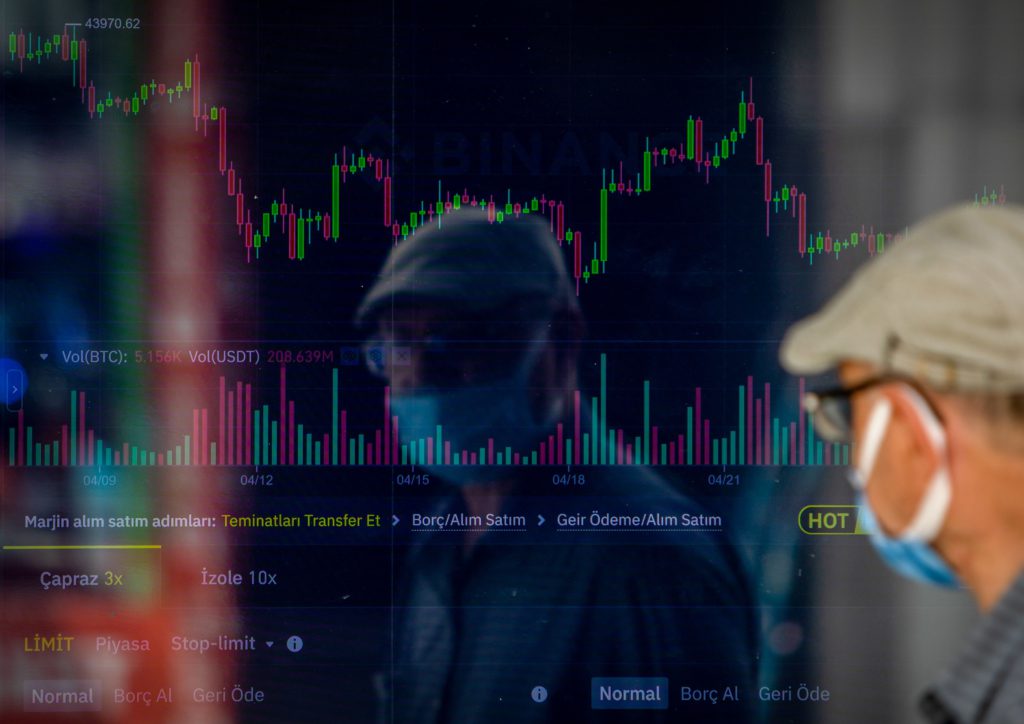
Bitcoin Bounces After Rout But Vibe Is Still ‘Strongly Negative’

(Bloomberg) — Bitcoin snapped a 12-day slide, bouncing along with the rest of the cryptocurrency market after a record-breaking string of declines. Analysts cautioned the respite may be brief.

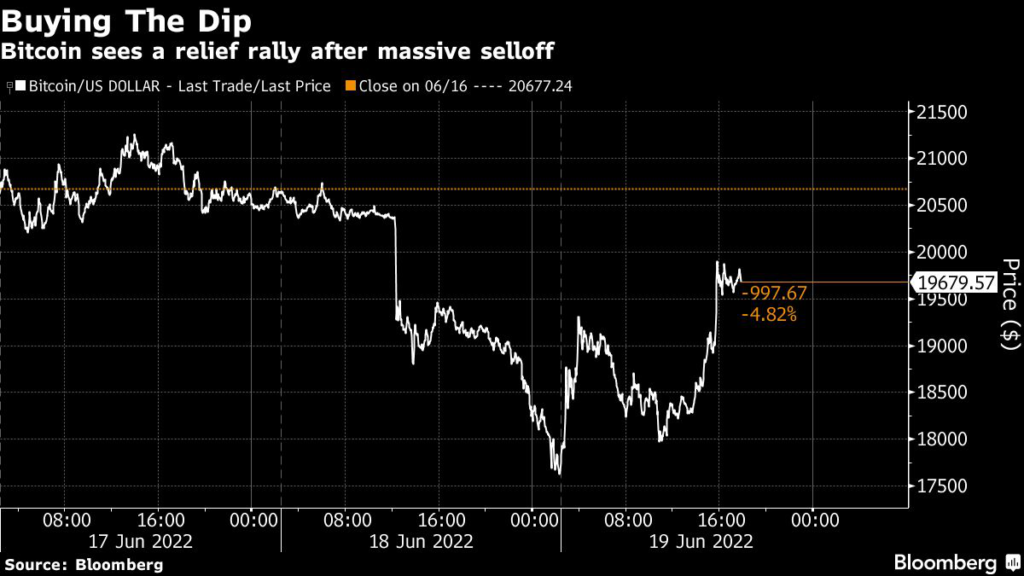
The world’s largest cryptocurrency climbed as much as 12% early Sunday, recouping much of its losses from a steep drop Saturday that sent the token to as low as $17,599. Bitcoin came tantalizingly close to retaking $20,000 at several points during the day, only to retreat, and stood at $19,450 as of 12:30 p.m. in New York. Ether, which touched as low as $881 in the selloff, climbed 17% to $1,060, while alternative coins from Avalanche to Solana also enjoyed gains. Even with Sunday’s rally, Bitcoin is down almost 40% this month and more than 70% from its all-time high reached in November.

“For those who like to buy low and sell high, I think most can agree that it’s the former now,” said Mati Greenspan, founder of Quantum Economics. 

The crypto market is known for its wild swings — particularly on weekends, when moves can be magnified — and the whipsaw of the past two days provided the latest example. Still, the overall tone remains negative, with monetary tightening providing macro headwinds and crises within crypto raising concerns about widening distress. 

Trading has been heavier than normal this weekend, with Bitcoin volume approaching $40 billion in the 24 hours through midday Sunday New York time, according to CoinGecko. Last Saturday and Sunday, volumes stood at $25.6 billion and $22.5 billion, respectively.

Read more: Crypto Market Starting to See Even Old-Timers ‘Panic Selling’

Bitcoin’s leg down on Saturday pushed the coin below $19,511, the high it hit during its last bull cycle in 2017, which it reached at the end of that year. Throughout its roughly 12-year trading history, Bitcoin has never dropped below previous cycle peaks. The token also broke through a technical support level of $18,300, said Katie Stockton managing partner and founder of Fairlead Strategies. Consecutive weekly losses below that level would increase the risk of falling toward the next support of $13,900, she added.

As for trading now, Stockton said a short-term, “counter-trend” technical signal “provides some hope that a rebound will unfold in the near term.” She cautioned against buying the dip, though, as “momentum is strongly negative.” Other voices on Crypto Twitter cited $20,000 as a key pivot point that could provide support if it is retaken and held in the next few days; otherwise, it could be a market ceiling of sorts.   

The $20,000 level is “significant” as it represents the 2017 high and “since then has acted as both support and resistance on multiple occasions,” Quantum Economics’ Greenspan said. “If we can get and hold above that level it will be quite bullish.”

A toxic mix of bad news cycles and higher interest rates has hurt crypto in recent days, resulting in a record stretch of losses for Bitcoin in the 12 days ended Saturday. The Federal Reserve raised its main interest rate on June 15 by three-quarters of a percentage point — the biggest increase since 1994 — and central bankers signaled they will keep hiking aggressively this year in the fight to tame inflation. Adding to the mood, crypto hedge fund Three Arrows Capital suffered large losses and said it was considering asset sales or a bailout, while another lender, Babel Finance, followed in Celsius’s footsteps on Friday.

The risk-off sentiment can be seen from the redemption pressure in Tether, with the widely used stablecoin’s circulation dropping by more than $15 billion since the May collapse of the Terra ecosystem, the first big crisis to hit the market this year, according to pricing data from CoinGecko. Some $4.4 billion of those redemptions came in the last seven days.

The crypto market as a whole is now a fraction of the size it reached in late 2021, when Bitcoin traded near $69,000 and traders poured cash into speculative investments of all stripes. The total market cap of cryptocurrencies was around $900 billion on Sunday down from $3 trillion in November, CoinGecko data shows.   

(Updates prices, adds commentary about $20,000 level.)

More stories like this are available on bloomberg.com

©2022 Bloomberg L.P.
Zilingo Co-Founders Make Surprise Buyout Offer for Startup

(Bloomberg) — Zilingo Pte co-founders made a last-ditch offer to buy the embattled fashion e-commerce platform as the board debates its future, according to people familiar with the matter. 

Co-founder Dhurv Kapoor on Sunday proposed a management buyout to the Singapore-based company’s board, according to the people, who asked not to be named as the matter is private. He has secured commitments from a small group of new investors including a US private equity firm, the people said. 

Under the preliminary proposal, the investor group will inject $8 million in new equity in a newly incorporated entity in tranches, while the remaining assets and the old corporate entity will be liquidated in due course, according to Kapoor’s email sent to investors and seen by Bloomberg News. All outstanding debt owed to creditor Zorro Assets Ltd. will be frozen for three years, according to email. 

The move comes as Zilingo’s board is scheduled to meet on Monday to discuss the future of the company, according to people with knowledge of the matter. Allegations of financial irregularities in March prompted an investigation into the company, valued at $970 million in 2019, and led to the dismissal of co-founder Ankiti Bose as chief executive officer in May.

Read more: Zilingo Board Said to Approve Debt Repayment to Creditors

More stories like this are available on bloomberg.com

©2022 Bloomberg L.P.
Crypto Market Starting to See Even Old-Timers ‘Panic Selling’

(Bloomberg) — As the crypto market crumbled this year, short-term speculators were among the first to dump their holdings. Now mounting losses have even some of the most steadfast investors looking like they’re bailing out.

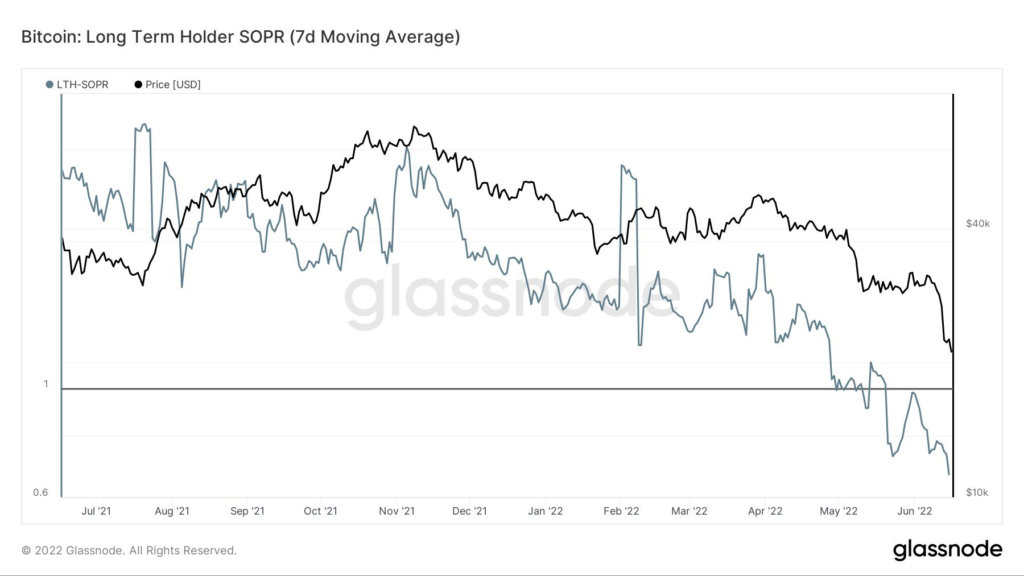
A measure called the spent output profit ratio, which tracks how much profit has been realized from market activity in digital currencies on a blockchain on any given day, has declined to its lowest level in a year, according to Glassnode data. 

The vanishing gains suggest long-term owners are coming under pressure, a potentially worrying sign for a market known for its hodlers — the staunch and stalwart base of backers who would ride out any slump no matter what. 

“The thought was not to worry, the long-term investors are holding strong,” Noelle Acheson, head of market insights at Genesis Global Trading, said in an interview. “Well, we’ve started to see the long-term holders sell as well. According to on-chain data, some of them seem to be panic selling, exiting at below cost.”

The spent output profit ratio offers a clue on sentiment and profitability over a given time frame and reflects the degree of realized gains for all coins moved on the chain, according to Glassnode. It shows an average and doesn’t necessarily mean all long-term holders are selling, nor that all those offloading are doing so at a loss. But it’s another point of concern for a market that’s endured a number of setbacks, with few evident catalysts to help it reverse course. 

Digital assets have been selling off all year along with other risky holdings as global central banks have shifted to hiking interest rates to quell soaring inflation. Bitcoin is down roughly 50% this year, and Ether has slumped 70%. An index of 100 of the largest coins was down more than 60% this year through Friday. 

The latest strains for cryptocurrencies have emerged from the lending space, where high-profile companies like Celsius Network and Babel Finance have frozen withdrawals. Meanwhile, a tweet by Three Arrows Capital, a major crypto hedge fund, raised concern about possible financial troubles at the firm, adding to the sense of broadening distress. 

“I am so, so glad that that is being flushed out as we speak — that needed to break, that needed to be out of the system,” Anastasia Amoroso, chief investment strategist at iCapital, said on Bloomberg’s “What Goes Up” podcast about the speculative froth getting wrung out of the system. 

Because crypto has such strong proponents backing it, market-watchers have been obsessed with figuring out who’s getting hurt and abandoning investments in this year’s bear market. 

Short-term retail holders who had bought over the past year and a half faced an early test as Bitcoin fell to the lowest levels since 2020. Then strategists at Glassnode said this month that the downturn had entered its “deepest and darkest” phase, with even long-term holders coming under duress.

Overall, the crypto market has shed more than $1 trillion in value this year. Some smaller coins have declined 90%.  

“The most stunning feature of this bear market in crypto is its monotonic relentlessness — there is no sneaky underlying bull narrative to catch the market short,” said Brent Donnelly, president of Spectra Markets. “What was once a massive flood of FOMO money trying to get in is now an equally raging torrent the other way.”

More stories like this are available on bloomberg.com

©2022 Bloomberg L.P.

Bitcoin’s Ferocious Selloff Pauses as Crypto Enjoys a Bounce

(Bloomberg) — Bitcoin snapped a 12-day slide, taking a breather to bounce along with the rest of the cryptocurrency market after a record-breaking string of declines. Analysts cautioned the respite may be brief.

The world’s largest cryptocurrency climbed as much as 12% early Sunday, recouping some of its losses from a steep drop Saturday that sent the token to as low as $17,599. It stood at $19,500 as of 9:15 a.m. in New York. Ether, which touched as low as $881 in the selloff, climbed 15% to $1,040, while alternative coins from Avalanche to Solana also enjoyed gains. Even with the bounce, Bitcoin is down almost 40% this month and more than 70% from its all-time high reached in November.

“For those who like to buy low and sell high, I think most can agree that it’s the former now,” said Mati Greenspan, founder of Quantum Economics.

The crypto market is known for its wild swings — particularly on weekends, when moves can be magnified — and the whipsaw of the past two days provided the latest example. Still, the overall tone remains negative, with monetary tightening providing macro headwinds and crises within crypto raising concerns about widening distress. 


Trading has been heavier than normal this weekend, with Bitcoin volume approaching $40 billion in the past 24 hours as of about 9 a.m. New York time, according to CoinGecko. Last Saturday and Sunday, volumes stood at $25.6 billion and $22.5 billion, respectively.

Bitcoin’s leg down on Saturday pushed the coin below $19,511, the high it hit during its last bull cycle in 2017, which it reached at the end of that year. Throughout its roughly 12-year trading history, Bitcoin has never dropped below previous cycle peaks. The token also broke through a technical support level of $18,300, said Katie Stockton managing partner and founder of Fairlead Strategies. Consecutive weekly losses below that level would increase the risk of falling toward the next support of $13,900, she added.

As for trading now, Stockton said a short-term, “counter-trend” technical signal “provides some hope that a rebound will unfold in the near term.” She cautioned against buying the dip, though, as “momentum is strongly negative.

A toxic mix of bad news cycles and higher interest rates has hurt crypto. The Federal Reserve raised its main interest rate on June 15 by three-quarters of a percentage point — the biggest increase since 1994 — and central bankers signaled they will keep hiking aggressively this year in the fight to tame inflation. Adding to the mood, crypto hedge fund Three Arrows Capital suffered large losses and said it was considering asset sales or a bailout, while another lender, Babel Finance, followed in Celsius’s footsteps on Friday.

The risk-off sentiment can be seen from the redemption pressure in Tether as the widely used stablecoin’s circulation has dropped by more than $15 billion since the May collapse of the Terra ecosystem, according to CoinGecko. Some $4.4 billion of those redemptions came in the last seven days.

More stories like this are available on bloomberg.com

©2022 Bloomberg L.P.
Guinea Gives Rio Tinto, Partners Ultimatum on Simandou Project

(Bloomberg) —

Guinea authorities have given a 14-day ultimatum to parties involved in the development of the giant Simandou iron ore deposit to form a joint venture and start the project.

The partners, made up of Rio Tinto, China-backed SMB-Winning Consortium and the government must ensure that funding for the project requiring $15 billion investment is “effective,” the head of Guinea’s ruling military junta, Colonel Mamadi Doumbouya, said at a meeting with miners broadcast Saturday on state-owned Radio Television Guineenne.

“Since March 25, we have noticed a gap between our vision of the implementation of the terms of the framework agreement and our expectations,” Doumbouya said. “This situation is not only regrettable but above all unacceptable.”

Simandou is the world’s biggest untapped iron ore resource. Rio Tinto and Aluminum Corp. of China, known as Chinalco, hold blocks 3 and 4 while blocks 1 and 2 are controlled by the Winning Consortium.

Read More: China-Backed Group Can Resume Simandou Operations: Guinea

More stories like this are available on bloomberg.com

©2022 Bloomberg L.P.
Close Bitnami banner
Bitnami


