Bloomberg

Ex-Amazon Cloud Worker Convicted of Massive Capital One Hack

(Bloomberg) — A former Amazon Web Services worker was convicted of hacking into the company’s cloud servers to steal customer data and computer power that she used to mine cryptocurrency.

Following a week-long trial in Seattle, Paige A. Thompson, 36, was found guilty of seven federal crimes, including wire fraud, which carries a prison sentence of as long as 20 years, US prosecutors said Friday in a statement. 

Prosecutors say Thompson, who went by the screen name “erratic,” created a tool that searched for misconfigured accounts on Amazon Web Services. She was able to hack into the accounts of more than 30 Amazon customers, including Capital One Bank, and download the personal information of more than 100 million people, they said. Capital One disclosed the breach in 2019 and paid regulatory fines of more than $80 million, along with $190 million to settle customer lawsuits.

Read More: Former AWS Worker Is Accused in Cloud Hack of Capital One

Aside from stealing data, Thompson planted mining software on servers that she used to harvest cryptocurrencies with the proceeds going to her online wallet, prosecutors say.

Thompson’s lawyers didn’t immediately respond to requests for comment.

She allegedly extolled her crimes in texts and online forums, which were shown at her trial. “She wanted data, she wanted money, and she wanted to brag,” Assistant U.S. Attorney Andrew Friedman said in closing arguments, according to the statement.

Read More: Alleged Capital One Hacker Struggled With Jobs, Personal Life

After deliberating for 10 hours, the jury found her guilty of wire fraud, unauthorized access to a protected computer and damaging a protected computer, according to the statement. She was found not guilty of access device fraud and aggravated identity theft.

US District Judge Robert S. Lasnik scheduled sentencing for Sept. 15.

The case is USA v. Thompson, 19-cr-00159, U.S. District Court, Western District of Washington (Seattle).

(Updates with jury deliberations in seventh paragraph. A previous version of the story corrected spelling of bank’s name.)

More stories like this are available on bloomberg.com

©2022 Bloomberg L.P.

Bitcoin Tumbles Below $20,000 for the First Time Since 2020

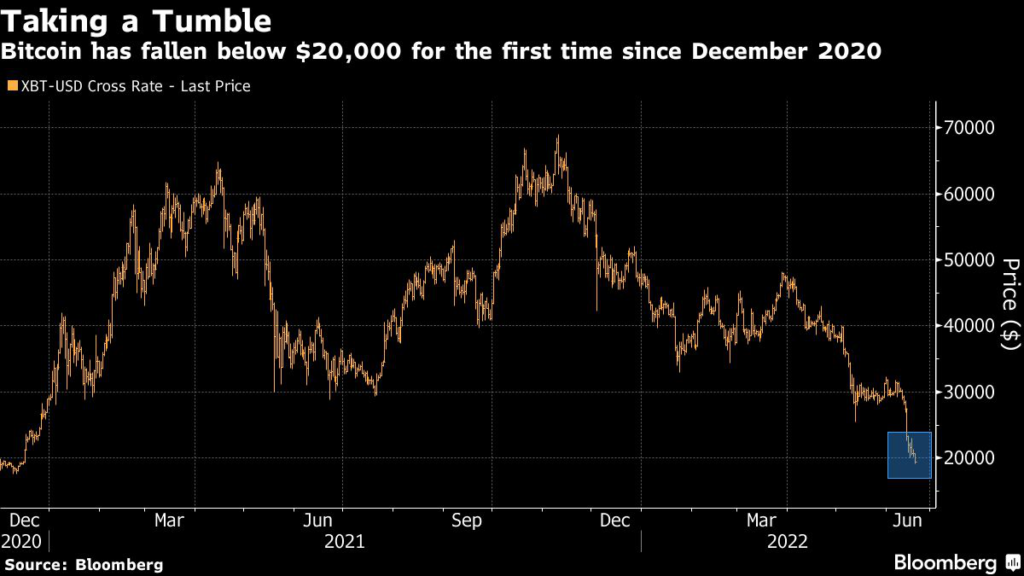
(Bloomberg) — Bitcoin dropped below $20,000 for the first time since December 2020 as evidence of deepening stress within the crypto industry keeps piling up against a backdrop of monetary tightening. 

The largest digital token by market value tumbled as much as 9.2% to $18,740 on Saturday, marking a record-breaking 12th consecutive daily decline according to Bloomberg data. Ether breached $1,000 and dropped almost 11% to $975.24, the lowest since January 2021. The two bellwethers of the crypto market are both down around 70% from all-time highs set in early November. 

“Global macro uncertainty combined with spectacular blow-ups in the crypto ecosystem has caused prices to fall at a rate that has surprised investors,” said Kunal Goel, a research analyst at Messari. 

Altcoins were no exception to soured investor appetite in the wake of Bitcoin’s fall, with every token on Bloomberg’s cryptocurrency monitor trading in the red. Cardano, Solana, Dogecoin and Polkadot recorded 24-hour falls of between 7% and 10% on Saturday, while privacy tokens such as Monero and Zcash lost as much as 9%. 

A toxic mix of bad news cycles and higher interest rates has been deleterious to riskier assets like crypto. The Federal Reserve raised its main interest rate on June 15 by three-quarters of a percentage point — the biggest increase since 1994 — and central bankers signaled they will keep hiking aggressively this year in the fight to tame inflation.

“Investors are continuing to position defensively following last year’s liquidity-driven digital asset bull market,” Alkesh Shah, head of crypto and digital assets strategy at Bank of America Corp., said in a note on Friday. “Although painful, removing the sector’s froth is likely healthy as investors shift focus to projects with clear road maps to cash flow and profitability versus purely revenue growth.”

Broader signs of stress emerged with last month’s collapse of the Terra blockchain, and worsened this week following crypto lender Celsius Network Ltd.’s recent decision to halt withdrawals. 

Adding to the mood, crypto hedge fund Three Arrows Capital suffered large losses and said it was considering asset sales or a bailout, while another lender, Babel Finance, followed in Celsius’s footsteps on Friday. Even long-term holders who have avoided selling until now are coming under pressure, according to researcher Glassnode. 

Read More Crypto’s Excruciating Week Has Traders Bracing for Next Crisis

Stablecoins — a type of crypto asset pegged to the value of a fiat currency like the US dollar — have also struggled. 

The top four stablecoins saw exchange net outflows last week that were 4.5 times larger than the prior week, Bank of America’s Shah said, having charted net outflows in eight of the 10 prior weeks. Stablecoins are often relied upon by crypto traders to move funds around the ecosystem without needing to exit into traditional currencies, so persistent outflows indicate that investors remain defensive, he added.

Even with the piercing of the key $20,000 level, historical data show that Bitcoin may find key support around that mark as previous selloffs demonstrate where the token usually finds points of resilience, according to Mike McGlone, an analyst for Bloomberg Intelligence. 

Bitcoin may “build a base around $20,000 as it did at about $5,000 in 2018-19 and $300 in 2014-15,” he said in a note on Wednesday. “Declining volatility and rising prices are earmarks of the maturing digital store-of-value.”

Read More Bitcoin Rout Hits ‘Darkest’ Phase With Entire Market Underwater

The crypto market now stands at a fraction of its heights in late 2021, when Bitcoin traded near $69,000 and traders poured cash into speculative investments of all stripes. The total market cap of cryptocurrencies was around $880 billion on Saturday, down from $3 trillion in November, according to pricing data from CoinGecko.   

More stories like this are available on bloomberg.com

©2022 Bloomberg L.P.

Crypto’s Excruciating Week Has Traders Bracing for Next Crisis

(Bloomberg) — It was one of the most dramatic weeks in the short history of the cryptocurrency market, bookended by the type of announcements investors fear the most from a counterparty: We’re sorry, but we just can’t return your money right now.

In between, a nascent technocratic industry with grand ambitions to reinvent the financial system was rocked repeatedly by echoes of past crises in the old system. It was a week of margin calls, forced selling and important collateral being exposed as way too illiquid in a time of crisis. There were rumblings of hedge-fund blowups, tales of opportunistic predatory trading, job cuts and loud denials of problems from key players proven wrong almost immediately. 

Amid it all, the myth was shattered once and for all that this new crypto financial system was somehow immune to — or even able to benefit from — the economic fundamentals currently punishing the old system.

It all started late Sunday, when a sort of crypto shadow bank called Celsius Network suspended withdrawals from depositors who had been enticed by sky-high interest rates that, in retrospect, were likely too good to be true. By the end of the week, on the other side of the world in Hong Kong, the digital-asset lender Babel Finance also froze withdrawals.

We’re working on it, both firms told customers, and no doubt they are. Yet speculation is growing that Celsius Network, at least, is drowning in what research firm Kaiko called a “Lehman-esque” position.

Like Lehman Brothers did almost 14 years ago, Celsius’s woes showed how interconnected big players in this financial system are and how fast contagion can spread, making this week’s drama the sequel to last week’s and the prequel to next week’s.

Many analysts have pointed to problems that Celsius is having with an Ethereum-linked token called staked ETH, or stETH — a coin designed to be a tradable proxy for Ether that’s widely used in decentralized finance. While every stETH is meant to be redeemable for one Ether after long-awaited upgrades of the Ethereum blockchain take effect, recent market turmoil has caused its market value to fall below that level. 

Terra Connection

Research firm Nansen has also identified Celsius as one of the parties involved when the UST stablecoin lost its peg to the dollar in May. The episode with that token, which was driven largely by algorithms, crypto animal spirits and untenable yields of 19.5% for depositors in the Anchor Protocol, triggered the loss of tens of billions dollars in the spectacular implosion of the Terra blockchain. 

Nansen’s analysis confirmed that Terra’s Anchor program had been an important source of yield for Celsius, according to commentary from crypto exchange Coinbase. “In our view, this likely begged the question of how Celsius could fulfill its obligations without that 19.5% yield,” wrote the institutional team at Coinbase. That firm, by the way, said this week it will lay off 18% of its previously fast-growing workforce, joining other pink-slip-issuing crypto startups such as Gemini and BlockFi that are struggling amid a relentless plunge in asset prices that’s been dubbed “crypto winter.”

The drama ramped up on Wednesday with an alarming tweet that seemed to confirm speculation that had been swirling around one of the most influential hedge funds in crypto, Three Arrows Capital. “We are in the process of communicating with relevant parties and fully committed to working this out,” one of the firm’s co-founders wrote, without revealing any details about what exactly the “this” was that it was working out. 

By the end of the week, the multi-billion-dollar fund’s founders had explained to the Wall Street Journal that they were exploring options that include a rescue by another firm and an agreement with creditors that would buy them time to work out a plan. Three Arrows, too, was a casualty of both the stETH woes and Terra’s collapse. The fund had bought about $200 million in the Luna currency used to back up the value of Terra’s UST stablecoin, according to the Journal. Luna, which sold for more than $119 in April, is now worth about $0.000059.   

Just as Bear Stearns’s hedge funds were among the first to reveal problems from the subprime mortgage crisis, Three Arrows is likely not alone. The “cockroach theory” springs to mind: If you see one of those nasty bugs scurrying across the floor, chances are there are plenty more hiding behind the fridge or under the sink.

Crypto Shark Tank

In fact, the hot trade in crypto now is no longer pumping coins “to the moon” with tweets full of rocket-ship emojis, but rather trying to find where those roaches are hiding and make a meal out of them. Some crafty traders have dispatched bots to prowl blockchains in search of highly leveraged positions in danger of forced liquidation because the value of their collateral is no longer enough to back up their loans. If successful, they get a 10% to 15% cut of the collateral sale — incentives paid out by automated protocols that are meant to protect them from insolvency. 

As the dust settled at the end of the week, the damage was startling. Bitcoin has notched 12 straight days of losses, its longest sustained slump, and it breached $20,000 early Saturday for the first time since 2020. Flailing against a backdrop of monetary tightening, the world’s largest cryptocurrency is now down more than 70% from its highs in November when it was approaching $70,000. Ether dipped below $1,000, having sold for as much as $4,866 seven months ago. What was once a more than $3 trillion industry is now valued at less than $1 trillion.

And despite the similarity of past crises in traditional finance, there is one big difference as the weekend approaches: Players in the old-fashioned markets at least get to turn their machines off on Saturday and Sunday to get some sleep and lick their wounds. As a three-day holiday weekend approaches in the US, with forecasts for sunny skies in New York, those with heavy exposure to digital assets will remain glued to their screens, where crypto winter’s deadly blizzard shows little sign of letting up. 

(Upates price ofs of Bitcoin, Ether.)

More stories like this are available on bloomberg.com

©2022 Bloomberg L.P.

Musk Signals ‘Maybe More Down the Road’ for Dogecoin After Merch

(Bloomberg) — Tesla Inc. CEO Elon Musk took to Twitter again on early Saturday to express his views on cryptocurrencies. 

Responding to a tweet by Dogecoin’s co-creator Billy Markus, who said that he desires that people actually “use it for something,” Musk wrote “Tesla and SpaceX merch, maybe more down the road.” In January, the cryptocurrency with a Shiba Inu meme founded in 2013, surged after Musk said that it could be used to buy Tesla merchandise. 

Tesla briefly accepted Bitcoin as payment for its vehicles last year, but Musk U-turned on the decision three months later due to the token’s energy inefficiencies.

More stories like this are available on bloomberg.com

©2022 Bloomberg L.P.

Bankman-Fried’s Alameda Lends $485 Million to Crypto’s Voyager

(Bloomberg) — Crypto broker Voyager Digital Ltd said it secured loans from Alameda Research, the trading outfit from FTX founder Sam Bankman-Fried, to shore up protection for customer assets while activity in the digital asset market remains highly volatile.

Voyager said it had signed a non-binding term sheet for a $200 million credit facility from Alameda, compiled using a mix of cash and USDC, a stablecoin tied to the value of the US dollar. The sheet also included a revolving line of credit for 15,000 Bitcoins, worth roughly $285 million on Saturday morning in London as crypto prices tumbled.

The loans are intended to be used as a safeguard for client assets in light of the “current crypto market conditions,” Voyager said in a statement published on its website Friday, adding “and only if such use is needed.”

The crypto sector is going through one of its most painful weeks on record, as token prices crash and companies struggle to stay above water. Crypto lenders Celsius Network and Babel Finance both suspended customer withdrawals as liquidity disappeared from the market, while hedge fund Three Arrows Capital is battling to secure additional financing. A number of firms also announced plans to lay off staff, including Coinbase Global Inc., Gemini Trust Co Llc and BlockFi Inc.

Crypto’s Excruciating Week Has Traders Bracing for Next Crisis

“Today’s actions give Voyager more flexibility to mitigate current market conditions and strengthen our relationship with one of the industry leaders,” said Stephen Ehrlich, chief executive of Voyager.

The facilities each have a term expiring on Dec. 31, 2024, with an annual interest rate of 5% payable on maturity. Voyager said it already has more than $200 million on its balance sheet, in addition to the new funds.

More stories like this are available on bloomberg.com

©2022 Bloomberg L.P.

Bitcoin Falls Below $20,000 for the First Time Since 2020

(Bloomberg) — Bitcoin dropped below $20,000 for the first time since December 2020 as evidence of deepening stress within the crypto industry keeps piling up against a backdrop of monetary tightening. 

The largest token by market value tumbled more than 9% to $18,740.52 by early morning in London on Saturday, marking a record-breaking 12th straight day in the red according to Bloomberg data. Ether breached $1,000 and dropped almost 11% to $975.24, the lowest since January 2021.

“Investors are continuing to position defensively following last year’s liquidity-driven digital asset bull market,” Alkesh Shah, head of crypto and digital assets strategy at Bank of America Corp., said in a note on Friday. “Although painful, removing the sector’s froth is likely healthy as investors shift focus to projects with clear road maps to cash flow and profitability versus purely revenue growth.”

A toxic mix of bad news cycles and higher interest rates has been deleterious to riskier assets like crypto, contributing to a roughly 70% slide in Bitcoin from its all-time high in November. The Federal Reserve raised its main interest rate on June 15 by three-quarters of a percentage point — the biggest increase since 1994 — and central bankers signaled they will keep hiking aggressively this year in the fight to tame inflation.

Broader signs of stress emerged with last month’s collapse of the Terra blockchain, and worsened this week following crypto lender Celsius Network Ltd.’s recent decision to halt withdrawals. 

Adding to the mood, crypto hedge fund Three Arrows Capital suffered large losses and said it was considering asset sales or a bailout, while another lender, Babel Finance, followed in Celsius’s footsteps on Friday. Even long-term holders who have avoided selling until now are coming under pressure, according to researcher Glassnode. 

Read More Crypto’s Excruciating Week Has Traders Bracing for Next Crisis

“Surging recession fears are crippling appetite for risky assets and that has crypto traders remaining cautious about buying Bitcoin at these lows,” Edward Moya, senior market analyst at Oanda, said in a note on Thursday. “The news flow has been terrible for cryptos.”

Altcoins were no exception to soured investor appetite in the wake of Bitcoin’s fall, with every token on Bloomberg’s cryptocurrency monitor trading in the red. Cardano, Solana, Dogecoin and Polkadot recorded 24-hour falls of between 7% and 10% on Saturday, while privacy tokens such as Monero and Zcash lost as much as 9%. 

Stablecoins — a type of cryptoasset pegged to the value of a fiat currency like the US dollar — have also struggled. 

The top four stablecoins saw exchange net outflows last week that were 4.5 times larger than the prior week, Bank of America’s Shah said, having charted net outflows in eight of the 10 prior weeks. Stablecoins are often relied upon by crypto traders to move funds around the ecosystem without needing to exit into traditional currencies, so persistent outflows indicate that investors remain defensive, he added.

Even with the piercing of the key $20,000 level, historical data show that Bitcoin may find key support around that mark as previous selloffs demonstrate where the token usually finds points of resilience, according to Mike McGlone, an analyst for Bloomberg Intelligence. 

Bitcoin may “build a base around $20,000 as it did at about $5,000 in 2018-19 and $300 in 2014-15,” he said in a note on Wednesday. “Declining volatility and rising prices are earmarks of the maturing digital store-of-value.”

Read More Bitcoin Rout Hits ‘Darkest’ Phase With Entire Market Underwater

The crypto market now stands at a fraction of its heights in late 2021, when Bitcoin traded near $69,000 and traders poured cash into speculative investments of all stripes. The total market cap of cryptocurrencies was around $880 billion on Saturday morning, down from $3 trillion in November, according to pricing data from CoinGecko. 

“Sentiment in crypto markets is that the unknown unknowns are the most significant at this point in time,” Ainsley To, Noelle Acheson and Konrad Laesser of Genesis Trading said in a note on Thursday. “The resurgence of counterparty risk is a reminder that not everything that matters in risk management can be precisely quantified. Risk is what is left over after you think you’ve thought of everything.”

(Updates pricing in second paragraph, adds comment and context from third paragraph)

More stories like this are available on bloomberg.com

©2022 Bloomberg L.P.

Bitcoin Breaches $20,000 for the First Time Since 2020

(Bloomberg) — Bitcoin fell below $20,000 for the first time since December 2020 as evidence of deepening stress within the crypto industry keeps piling up against a backdrop of monetary tightening. 

Bitcoin fell as much as 6% to $19,377.08 at 2:54 pm Hong Kong on Saturday. The largest token by market value has fallen for 12 straight days. 

“Surging recession fears are crippling appetite for risky assets and that has crypto traders remaining cautious about buying Bitcoin at these lows,” said Edward Moya, senior market analyst at Oanda, in a note on June 16. “The news flow has been terrible for cryptos.”

The Federal Reserve raised its main interest rate on June 15 by three-quarters of a percentage point — the biggest increase since 1994 — and central bankers signaled they will keep hiking aggressively this year in the fight to tame inflation. A higher-rate environment has been deleterious to riskier assets like crypto, contributing to a roughly 70% slide in Bitcoin from its all-time high in November.

A market that started sliding late last year on expectations of a less accommodative Fed is now showing signs of broader distress, after last month’s collapse of the Terra blockchain and the recent decision by crypto lender Celsius Network Ltd. to halt withdrawals. Adding to the mood, the crypto hedge fund Three Arrows Capital suffered large losses and said it was considering asset sales or a bailout. Even long-term holders who have avoided selling until now are coming under pressure, according to researcher Glassnode. 

Even with the piercing of the level, historical data show that Bitcoin may find key support around $20,000, as previous selloffs demonstrate where the token usually finds points of resilience, according to Mike McGlone, an analyst for Bloomberg Intelligence. 

Bitcoin Rout Hits ‘Darkest’ Phase With Entire Market Underwater

Bitcoin may “build a base around $20,000 as it did at about $5,000 in 2018-19 and $300 in 2014-15,” he said in a note June 15. “Declining volatility and rising prices are earmarks of the maturing digital store-of-value.”

The crypto market now stands at a fraction of its heights in late 2021, when Bitcoin traded near $69,000 and traders poured cash into speculative investments of all stripes. The total market cap of cryptocurrencies is around $900 billion, down from $3 trillion in November, according to CoinGecko. 

“Sentiment in crypto markets is that the unknown unknowns are the most significant at this point in time,” said Ainsley To, Noelle Acheson and Konrad Laesser of Genesis Trading, in a note Thursday. “The resurgence of counterparty risk is a reminder that not everything that matters in risk management can be precisely quantified. Risk is what is left over after you think you’ve thought of everything.”

More stories like this are available on bloomberg.com

©2022 Bloomberg L.P.

China’s No. 2 Online Mall Sees Slow Consumer Recovery

(Bloomberg) — China’s No. 2 online retailer sees worrying signs that shoppers are reluctant to reopen their wallets even as major cities emerge from bruising Covid lockdowns, suggesting consumer spending may take months to recover.

The months-long closure of cities like Shanghai has caused a fundamental shift in how people spend their money, with a pullback in discretionary spending continuing even after the lockdown of the financial hub ended a few weeks ago, according to Xin Lijun, chief executive officer of JD Retail. 

“The impact in the Covid-stricken cities are obviously larger and we are seeing that at the end of the outbreaks, there is no rapid recovery, which is very worrying to us,” said Xin, who heads a subsidiary of JD.com Inc.

“The outbreak this year has completely cut off the supply chains both internationally and domestic, and this has indeed impacted people’s livelihoods, which will probably take longer to recover,” he said in an interview with Bloomberg Television. 

Retailers large and small have been buffeted for months by Beijing’s aggressive efforts to control outbreaks of the virus, with lockdowns of tens of millions of people and major cities paralyzing factory output and supply chains, as well as undermining consumer spending. The slow recovery now means it will be even harder for China to achieve the full-year economic growth target of around 5.5%, especially if there are further large-scale Covid outbreaks. 

Even with policy makers promising more support for private investment and the platform economy to mitigate the Covid shocks, economists have continued to cut their forecasts for growth this quarter and this year. Online retail sales will likely only grow in the low single-digits this year after expanding 12.5% last year, Fitch economists said on Thursday, with the slowing economy, rising unemployment, and expectations that the government will not give up on its Covid Zero policy this year all factors undercutting that expansion. 

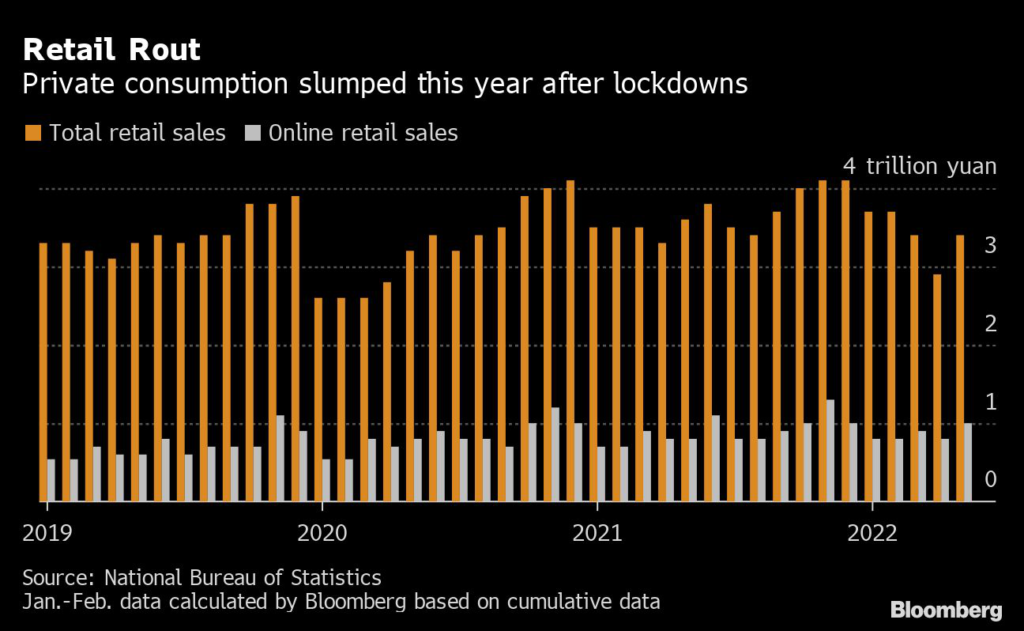
Total retail sales shrank for a third straight month in May, according to official data this week, as consumers pulled back on spending and added record amounts to their savings. Online shoppers have fundamentally changed what they buy, according to Xin, with growing demand for essentials such as rice and oil as well as storage products like refrigerators, but spending less on things such as entertainment and fashion. 

“In the past, you had more of these types of non-essential consumption, but this has decreased now as incomes have been affected and people have become more cautious and calculating about what they spend money on,” Xin said. “You can very clearly see this kind of structural change in consumption trends and the implications for the future economic outlook.”

This was evident during the Shanghai lockdown, when products for storage and food stockpiling like refrigerators and freezers went out of stock and there was more demand for work-from-home essentials like printers and tablet computers, Xin said.

“The pandemic in 2020 was like a surprise to everyone, but people had strong faith that there will be rainbow after the storm,” he said. However, that’s not the case now. 

Unlike the aftermath of the Wuhan lockdown in 2020 when people splurged and quickly returned to their old shopping habits, this time there has been no sign of such “revenge consumption,” he said.


Logistical hurdles have also persisted as various places across China implement Covid Zero policies, including testing and travel restrictions, with varying degrees of aggressiveness. The State Council gave warnings this past weekend to provinces including Hebei, Anhui, and Shaanxi for excessive enforcement of policies that have blocked domestic supply chains. 

In one instance, officials at a highway toll gate in Hebei’s Zhangjiakou were forcing all drivers to take two different tests for Covid-19 to exit the highway. This wasn’t the first warning from Beijing to provinces telling them to be measured in enforcing the rules, indicating that this is a recurring problem. 

Xin was speaking days ahead of “6.18,” the annual June 18 online extravaganza during which major tech names from Apple Inc. to Xiaomi Corp. vie to ply shoppers with discounts. The scale of the gadgets-heavy event, which is watched as an indicator of consumer sentiment, should surpass 2021’s, he said, without elaborating.

Xin’s expectations for the rest of the year are cautious, given the sporadic city or district-wide lockdowns that have affected dozens of cities across China, including Shanghai, Shenzhen, northeastern China’s industrial hub of Changchun, or Suzhou and Hangzhou. 

At the same time, spending from consumers in smaller and less developed cities is picking up, particularly those less affected by Covid shutdowns. Spending growth in smaller tier-five and tier-six cities has greatly outpaced that of tier one and tier two cities like Shanghai and Shenzhen, he said.

(Corrects first sub-headline to clarify time period referenced)

More stories like this are available on bloomberg.com

©2022 Bloomberg L.P.

The Electric Bikes Facing Off Against Putin’s War Machine

(Bloomberg) — When Daniel Tonkopi founded Delfast in Kyiv, Ukraine, in 2014, he had no intention of building and selling electric bikes. He also never anticipated that his company would be caught up in a war with Russia or that his bikes would become military vehicles. But at 43, Tonkopi, a native of Almaty, Kazakhstan, now finds himself living in Los Angeles, running an e-bike company and remotely managing dozens of employees living in a war zone. In May, Tonkopi made headlines when he shared images on Facebook of Ukrainian fighters using Delfast bikes to carry anti-tank weapons to the front, demonstrating yet another use case for electrified two-wheelers.

“Our bikes are still working despite damages,” he told me on a video call earlier this month.

Tonkopi moved to Ukraine from Kazakhstan in 2009. He’d been working for KazMunayGas, the state-owned oil and gas company, as a project manager building gas stations when he decided to head to Kyiv to try his hand as an entrepreneur. The vogue at the time was to build clones of successful U.S. tech companies, so Tonkopi made a version of Yelp for Eastern Europe. It was, by his own admission, a flop, as were several attempts that came after. “I became an expert in all the possible mistakes and how to not make a startup,” he says.

  • Do you own an electric car? If you live in the US, Bloomberg Green wants to learn more about your experience with EVs. Take our brief survey.

Delfast began as a one-hour delivery company. (The name is short for “we deliver fast.”) Tonkopi wanted to use e-bikes for the service because they were cheap, quick, zero-emissions and didn’t require couriers to pedal for hours on end. When he couldn’t find bikes with long enough battery life to work all day, he decided to try building his own. His Frankenstein creations turned heads. “We heard a lot of asks from random people. ‘Hey, are you selling these bikes?’” he says. So, in 2017, Delfast launched a crowdfunding campaign, raised $165,000 and sold 44 e-bikes.

Over the next three years, Delfast functioned both as a courier company and an online e-bike shop. In 2020, a few days after Covid lockdowns began, Tonkopi sold the delivery business to a direct-to-consumer meat vendor in Ukraine. Delfast now sells a single e-bike model, the Top 3.0, via its website and a small network of independent bike shops. It has a top speed of 50 miles per hour, a range of up to 200 miles and a sticker price of $6,999. Last year, Delfast sold about 200 units, mostly to customers in the US. So far this year, says Tonkopi, sales are running at triple that pace.

Last fall, after realizing that 80% of the company’s customers were in the US, Delfast opened an office in Whittier, California, outside Los Angeles, where Tonkopi and a few others work. The remaining 30 employees are still in Ukraine. Tonkopi spoke with Bloomberg about e-bikes as weapons, managing a startup through war, and the Delfast product pipeline. The conversation has been edited for clarity and length.

You’ve got 30 or so people in Ukraine. How have you managed that workforce since the war began?

Starting from February 24th, those were tough weeks, especially the first week, when we didn’t know what was happening and what to do. We had some financial reserves, enough for three months of salary for all our personnel, so we told everybody, ‘You don’t have to worry, you will have your salary no matter what, at least for three months.’

And we provided some of them with support to relocate. We found some houses and apartments in safer places. For example, one woman used to live in Kherson, a city fully occupied by Russia. At one point, Russian police or military forces came to her house. They asked her to show them her smartphone, her laptop and so on. They found anti-Russian messages and memes in her phone. So they deleted all the information in her phone and said, ‘Okay, now your smartphone will have a new life. And you will come to our police station tomorrow at 11 a.m. And you will have new life as well.’ That was really scary. She didn’t want to have any kind of new life with Russia. So one of our sales manager helped to find her a car in Kherson and to escape. She left to Odessa that night. Odessa is under attack as well. There is no safe place in Ukraine, but it’s relatively safer.

Are people now able to do their jobs?

Yes. That was the first weeks. People are still sitting in bomb shelters. They live in their apartments or houses but when they hear air-raid sirens, they have to go into bomb shelters. It is constant bombing. Every Monday starts with a Zoom call with everyone, we ask them how they are, if they are safe, what’s going on, and then we move on to our usual business issues.

What is crazy is that during the war, our engineers have developed a totally new product. They were tired of sitting in the basement and tired of being afraid, and they wanted to move their energy and inspiration into something new. And they created a new model for the US market, which we are going to unveil in the beginning of August.

Do you have a name for it?

We do, but it is still under consideration. It has a smaller battery and lower speed than our Top bike. We will do our best to make it affordable so more people will be able to use it.

How did some of your e-bikes wind up in the war? 

When the war began, we decided that we are going to help the people of Ukraine and we are going to donate 5% of all our sales revenue as a company. And we’ve donated three e-bikes — two of our Top 3.0 bikes to Ukrainian military forces and one prototype to the volunteer division. They are using this prototype for their medical staff. Three bikes are what we had in our facilities at the beginning of the war. We deliver parts and semi-assembled bikes from China to California. And we have our stock here in Los Angeles. We have just an R&D center in Ukraine. We didn’t have many spare parts in Kyiv.

The military adjusted them. They made an additional rear trunk for holding rocket launchers. They say it works well. According to their feedback, our bike is maneuverable, it is quiet and it cannot be spotted by heat sensors. So they can come to a position, do whatever they need to do, and then immediately leave without being spotted. They have a tough situation. Russian troops are attacking our army. It’s hot. It’s really hot. Our Ukrainian soldiers, sometimes they come back wounded and with some damages on their cars and vehicles. Our bikes are still working despite damages. It operates well in the hottest conditions.

 And you are also fundraising now?

Yes, about a year ago, in the beginning of 2021, we did an equity crowdfunding round at fundable.com. People from Ukraine believed in our company. Three hundred of them invested. The average check was about $10,000. So we raised $3.4 million. That helped us to create our R&D center in Ukraine, to move our headquarters to California and to create a stock of bikes. We invested a lot into our supply chain, into logistics, and we decreased our lead time from four months, one year ago, to two weeks today.

Then we launched a Series A venture round at the beginning of this year. We paused at the end of February, but now I am back at it. The goal for the round is $20 million. We’ve received $2 million and right now I’m in negotiation for another $5 million. We have a product, we have a product plan, we have a platform, we have proprietary technologies, we have sales, and we are growing, even without outside investment. We need investment to make the growth faster. We are growing at 3x. We want to grow 20x. I’m building a multibillion-dollar company here.

More stories like this are available on bloomberg.com

©2022 Bloomberg L.P.

Ex-Amazon Cloud Worker Convicted of Capital One Hack

(Bloomberg) — A former Amazon Web Services worker was convicted of hacking into the company’s cloud servers to steal customer data and computer power that she used to mine cryptocurrency.

Following a week-long trial in Seattle, Paige A. Thompson, 36, was found guilty of seven federal crimes, including wire fraud, which carries a prison sentence of as long as 20 years, US prosecutors said Friday in a statement. 

Prosecutors say Thompson, who went by the screen name “erratic,” created a tool that searched for misconfigured accounts on Amazon Web Services. She was able to hack into the accounts of more than 30 Amazon customers, including Capital One Bank, and download the personal information of more than 100 million people, they said. Capital One disclosed the breach in 2019 and paid regulatory fines of more than $80 million, along with $190 million to settle customer lawsuits.

Read More: Former AWS Worker Is Accused in Cloud Hack of Capital One

Aside from stealing data, Thompson planted mining software on servers that she used to harvest cryptocurrencies with the proceeds going to her online wallet, prosecutors say.

Thompson’s lawyers didn’t immediately respond to requests for comment.

She allegedly extolled her crimes in texts and online forums, which were shown at her trial. “She wanted data, she wanted money, and she wanted to brag,” Assistant U.S. Attorney Andrew Friedman said in closing arguments, according to the statement.

Read More: Alleged Capital One Hacker Struggled With Jobs, Personal Life

The jury found her guilty of wire fraud, unauthorized access to a protected computer and damaging a protected computer, according to the statement. She was found not guilty of access device fraud and aggravated identity theft.

US District Judge Robert S. Lasnik scheduled sentencing for September 15.

The case is USA v Thompson, 19-cr-00159, U.S. District Court, Western District of Washington (Seattle).

(Corrects spelling of company name in headline)

More stories like this are available on bloomberg.com

©2022 Bloomberg L.P.

Close Bitnami banner
Bitnami