
Bloomberg

In Prevalence of Selling, This Is a Market Rout Without Equal

(Bloomberg) — You can look but you won’t find a stretch of futility as pervasive as the one that is landing on Wall Street.

Even in the long and storied history of market meltdowns, the breadth of losses is without equal, based on data that goes back to the Great Depression. In five of the seven sessions through Thursday, at least nine in 10 S&P 500 stocks dropped, a record run of widespread losses, according to Sundial Capital Research.

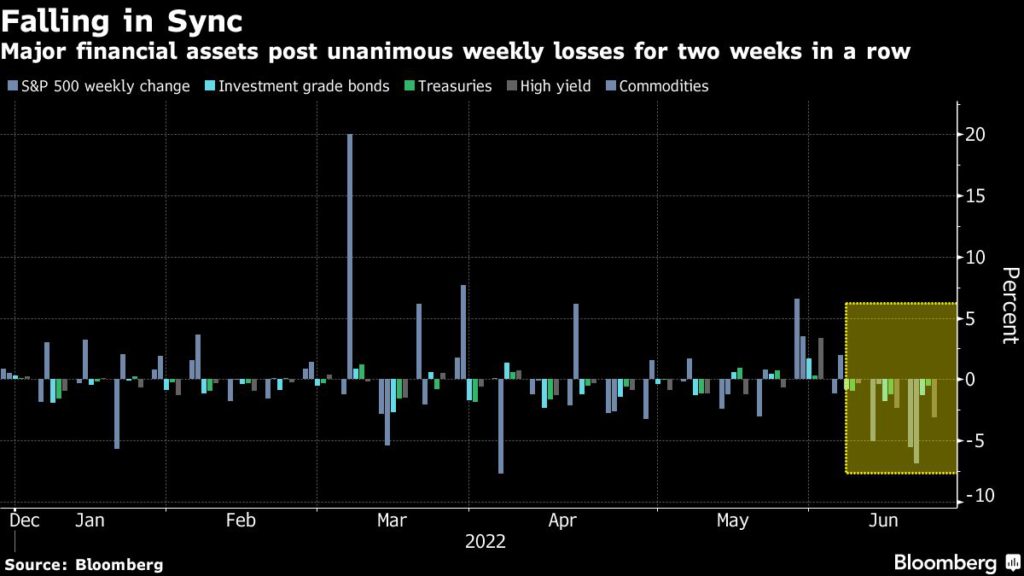
A similar if slightly less harrowing picture prevailed across asset classes. From Treasuries to corporate bonds and commodities, everything was down for a second straight week, a stretch of sweeping declines that hasn’t happened since the 2013 taper tantrum. 

If your view is that bear markets end in bangs rather than whimpers, the last week or so provides evidence that something approaching capitulation is occurring. History, however, shows it doesn’t always work like that. As often as not, first bursts of catharsis give way to extended seasons of inertia in which enthusiasm isn’t so much trampled as drained. 

“There’s been really no place to hide and it’s a jarring environment for people who simply aren’t used to it. And most of us aren’t,” said Michael Vogelzang, chief investment officer at CAPTRUST. “This is a valuation markdown and every financial asset and eventually real assets will begin to soften up because interest rates are the price of money.”

Such is the reality faced by investors who are grappling with the most aggressive tightening of monetary policy by the world’s central banks since the 1980s. With hopes for peak inflation dashed following a hotter-than-expected reading in US consumer prices, trepidation over an economic recession is building. 

Hedge funds and quant traders have been falling over themselves to exit stocks. Down in 10 of the past 11 weeks, the S&P 500 plunged into a bear market for the second time since the 2020 pandemic outbreak. The index lost 5.8% for its worst week since March 2020.

In the benchmark this month, only 11 stocks are up, none more than 5%, while 38 are down by percentages that round to 20% or more. The median performer, Boston Scientific, has fallen 12% since the start of June. In the Nasdaq 100, the biggest drop belongs to Docusign at 28%, followed by Micron Technology at 25%, then Applied Materials at 23% and Marvell Technology at 22%.

The specter of a recession has prompted investors to start to dump everything, even assets seen benefiting from inflation like commodities. In those declines — congregating suddenly in the few stocks that were up this year — were signs that selling has become something other than voluntary, perhaps liquidations forced by margin calls. 

Take Monday, when the S&P 500 tumbled almost 4%, and energy shares ranked at the biggest loser despite a rise in oil prices.

“You’re getting selling really across sector, across company size, across geography. This is a global repricing of equities based on central banks,” said Tom Hainlin, national investment strategist at US Bank Wealth Management. “We’ll start to hear from companies shortly thereafter. The question will be, is this just a repricing based on the Fed, or are you now having to incorporate lower-than-expected earnings growth?”

That’s a question of increasingly extreme urgency. Even with everything that is going wrong, from the Fed to inflation to war and disease, there remains a vocal minority of analysts who believe the selloff is way overblown. 

The view isn’t baseless. For all the upheaval, the economic markers that are arguably most relevant for stocks — earnings and earnings forecasts — have barely budged, and while consumer sentiment has frayed, consumer spending remains solid.

“We’re going to avoid recession. This is more like a mid-cycle hiccup that we have a lot in the second year of a bull,” said Jim Paulsen, chief investment strategist at Leuthold Group. “If I’m looking at the next year, I think you’d be happy if you had stayed in here or bought right now.”

But Wall Street has shown a pretty spotty record in predicting downturns. For instance, at the start of 2008, the eve of the global financial crisis, analysts at the time predicted a 15% gain in S&P 500 profits. They ended up falling 72%.

As tempting as it is to call a bottom, history suggests bear markets usually take time to find a floor, especially when they are accompanied by a recession. What seemed like a cathartic selloff in June 2008 — a loss almost identical to April’s of this year — was followed close behind by three months that were appreciably worse and two more of almost equal size.

The same was true during the bursting of the internet bubble. After posting two straight quarters of giant losses in early 2001, the S&P 500 dropped more than 10% in three of the following six periods. 

Examples of much speedier resolutions of course exist, including to the last bear run, in 2020, which turned out to be the fastest ever at just one month. That happened because of unprecedented monetary and fiscal stimulus, something that’s now out of question with the Fed laser-focused on fighting inflation. 

For bulls looking for signs that stocks have fallen too far, too fast and are poised for a rebound, there is evidence to support the view. During the five sessions through Thursday, fewer than 1.6% of stocks in the S&P 500 held above their 10-day moving averages, a reading of extremely low breadth that’s been matched only twice before in recent decades, Sundial data shows. 

While charts like this can be viewed as flashing an imminent inflection point for the market, such signals appear to have lost their merit this year, according to Jason Goepfert, chief research officer at Sundial. 

“One-sided behavior like this has a strong history of being contrarian, but that was also the case in May, and here we are at lower lows,” he wrote in a note. “Everything is horrible, and there is no sustained interest among buyers.”

More stories like this are available on bloomberg.com

©2022 Bloomberg L.P.
Retail Traders Who Drove Meme Frenzy Bail Out in Bear Market

(Bloomberg) — Stock traders who whipped up the meme craze that took Wall Street by storm last year are furiously rushing to the exits.

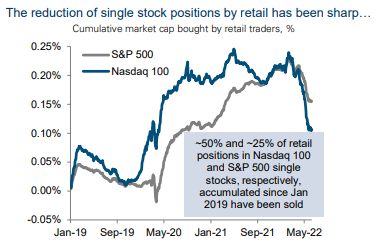
Roughly 50% of single-stock retail positions in the Nasdaq 100 and a quarter of those in the S&P 500 that had been accumulated since January 2019 have been sold, according to data from Goldman Sachs Group Inc. In another sign their exuberance has faded, call-option volumes have reversed about 70% of their increases from the start of 2019 to November 2021, when tech stocks and Bitcoin peaked. 

“While historically retail investors have bought the dip, this time they haven’t,” wrote John Marshall, head of derivatives research at Goldman Sachs. 

Wall Street had been obsessed with how at-home traders were behaving during the pandemic when it came to the market. The boredom-markets-hypothesis — which postulated that many of those were stuck at home with little to do turned to stocks to fill their time and satisfy their boredom — became just about settled science. Stocks only go up, the saying went at the time, with indexes notching impressive returns even as the pandemic raged. 

Hordes of day traders flooded social-media forums like Reddit and Twitter and fed each other information and trading tips. Their collective efforts famously pushed up shares of GameStop Corp. and AMC Entertainment Holdings Inc., among others, dealing a blow to big-name short sellers who had bet against those stocks. 

But the tides have turned and 2022 has offered only rough trading and much gut-wrenching volatility. The gumption among the retail crowd to buy the dip has come to a test, with the strategy not faring as well in a market that’s seen the S&P 500 lose more than 20% and the Nasdaq 100 drop 30% this year. In fact, a retail-investor behavior measure by TD Ameritrade shows they have been cutting exposure to equities all year.

“The way that they’re likely going to be trading going forward is likely selling dips as they try to protect any gains that they may have or reduce further losses,” said Eric Johnston, head of equity derivatives and cross asset at Cantor Fitzgerald. “We can no longer count on the individual investor to be a backstop for this market.”

All manner of investments have lost value in 2022. Among the retail crowd, tech and biotech have been heavily sold, according to Goldman. Meanwhile, a basket of retail-favored stocks tracked by the bank has lost more than 40% year to date, and another made up of companies most frequently mentioned on social-media forums is down roughly 50%. Crypto, another individual-investor favorite, has also been stuck in the gutter. 

A key concern for economists, now that the Federal Reserve is working on cooling the economy and inflation, is how the consumer will bear it out. And while a debate rages over the central bank’s ability to engineer a softish landing or over-correct into a recession, even a mild one, consumers have already shown some signs of pulling back. Data this week showed retail sales in May unexpectedly declined for the first time in five months. 

Charles Schwab surveyed over 1,000 of its retail clients in April and found that 57% of respondents have a bearish outlook on the U.S. stock market for the second quarter of 2022, an increase of 29% from the same time last year. The primary driver of the negative outlook is the higher cost of living, followed by geopolitical concerns, according to Schwab.

“Consumers are pulling back,” said Chris Gaffney, president of world markets at TIAA Bank. “We’re seeing most investors sit this out, which is probably smart, sitting out the volatility.” 

Still, Goldman says retail investors are continuing to put money toward exchange-traded funds, especially and dividend-focused ones, which have seen more than $30 billion of inflows this year.

“There has been a regime shift from the old FAANG megatech names to more defensive, income plays,” said Jane Edmondson, CEO and founder of EQM Capital.

(Updates with new commentary.)

More stories like this are available on bloomberg.com

©2022 Bloomberg L.P.
Meta Sued Over Claims Patient Data Secretly Sent to Facebook

(Bloomberg) — Meta Platforms Inc. was sued over claims that private medical data is being shared secretly with Facebook when patients access web portals for some health-care providers.

Facebook’s Pixel tracking tool redirects patient communications and other supposedly “secure” information without authorization and in violation of federal and state laws, according to the lawsuit filed Friday in San Francisco federal court as a proposed class action on behalf of millions of patients.

The world’s largest social network has been sued and investigated by regulators over privacy issues frequently over the last decade, most often over allegations that the company illegally collects information on users that it uses for targeted advertising. The Pixel case is different because it alleges Facebook grabbed confidential data while acting as a service provider on a hospital web portal.

The plaintiff, who wasn’t identified, described himself in the complaint as a patient who has used a Baltimore health system’s portal to review his lab results, make appointments, and communicate with his providers. 

He seeks compensatory and punitive damages for breach of contract, violation of the federal Electronic Communications Privacy Act and a constitutional claim for invasion of privacy, among other allegations.

Read More: Sandberg’s Legacy Is an Internet of Targeted, Automated Ads

On Thursday, The Markup, a non-profit news organization, published an investigation that found that 33 of Newsweek’s top 100 hospitals use Pixel on their appointment scheduling pages, which the report alleged may violate federal health information privacy laws. Several of the identified hospitals have since removed Pixel, according to the report.

The lawsuit alleges the scope of the problem is much more widespread. It cites at least 664 hospital systems or medical providers whose websites have received patient data via the Pixel.

Meta didn’t immediately respond to a request for comment. 

The company’s business help center page says: “If Meta’s signals filtering mechanism detects Business Tools data that it categorizes as potentially sensitive health-related data, the filtering mechanism is designed to prevent that data from being ingested into our ads ranking and optimization systems.”

The case is John Doe v. Meta Platforms, 3:22-cv-3580, US District Court, Northern District of California (San Francisco).

(Updates with allegations in complaint)

More stories like this are available on bloomberg.com

©2022 Bloomberg L.P.

Do You Own an Electric Car? Tell Us About Your Experience

(Bloomberg) — Do you own an electric car?

We want to learn more about your experience with EVs — Why did you choose an EV? Is your plug-in electric model your primary mode of transportation? Where do you typically charge the battery?

As the national average for a gallon of regular gasoline continues to rise, Americans increasingly are considering electric cars for their next vehicle purchase. That’s a strong motivator. So are the consequences of extreme weather and climate change that today affect more portions of the country — from heat waves in California and New Mexico, to hurricanes and storms in Texas and Louisiana.

Plug-in electric vehicles, which produce zero emissions while on the road, will help to reduce CO2 levels across the US. Today, the transition to electric cars in the US is picking up speed: 60% more plug-in electric cars were sold in the first quarter of 2022 compared to the same period a year earlier. They now represent 4.6 % of all car sales nationwide. 

Automakers have launched dozens of electric models  — and dozens more are queued up in factories, waiting to be rolled-out in the months to come. There are lots of choices and considerations around purchasing an EV. You’ve heard about range anxiety — that’s still a determining factor for prospective buyers. Cost can make all the difference, with only a few models priced at or under $30,000, to start. That’s where federal and state incentives come into play and can reduce your final cost substantially. Did a rebate from your state persuade you to buy?

HOW TO TAKE THE BLOOMBERG GREEN EV SURVEY

Visit this link to answer our questions about electric car ownership. The survey takes about 3 minutes to complete. And help us reach more EV owners by sharing the survey link with friends, family, neighbors and coworkers. Our findings will be the basis for future reporting on electric car ownership. 

More stories like this are available on bloomberg.com

©2022 Bloomberg L.P.

Gorillas Explores Options, Weighed Deals With Delivery Rivals

(Bloomberg) — Gorillas Technologies GmbH, seeking to navigate a sudden shift in the startup funding environment, met with competitors in the rapid delivery industry to discuss the prospects for mergers or the sale of its business, people familiar with the talks said.

Representatives for the German startup spoke with multiple companies, including Gopuff and Jokr, about a possible deal, said the people, who asked not to be identified because the talks are private. Some of those conversations took place in the last several weeks. Gorillas is working with advisers from JPMorgan Chase & Co. to evaluate options, some of the people said.

The talks were exploratory, and it’s possible no transaction materializes. But they underscore the challenges facing all startups this year as venture capitalists put many investments on hold over fears of an economic recession. The problem is especially acute for the young class of delivery startups that amassed customers but rapidly burned capital by promising groceries at your doorstep within minutes.

Representatives for Jokr, JPMorgan, Gorillas and Gopuff declined to comment.

Initially buoyed by demand from couch-bound customers early in the Covid-19 pandemic, rapid delivery companies raised $9.7 billion globally in 2021, according to the research firm PitchBook. However, the sector has begun to contract amid rising pressure from investors to demonstrate profitability. The change was driven by a plunge in public technology stocks and signs of economic concern, including rising inflation and interest rates.

Co-founded in May 2020 by Chief Executive Officer Kagan Sumer, Gorillas last raised $1 billion in October that valued the business at about $3 billion. In February, Sumer told Bloomberg that he planned to take in $700 million or more in new financing this year to help recalibrate the business for profitability.

Then last month, the company slashed office staff by half and said it will explore strategic options for various non-core markets where it operates. Gorillas is burning as much as $80 million a month, said two people with knowledge of its finances who asked not to be identified because they weren’t authorized to discuss the information. 

Read more: Gorillas Startup Dream of Food Delivery and Office Raves Falters

The company, which halted expansion to other US cities like Los Angeles and Chicago in the fall to focus on building its footprint in New York, is now pumping the brakes there, too, the people said. Plans to open additional warehouses in New York are on hold, they said. 

Gorillas entered New York last year and has benefited from the recent implosion of rivals by taking over some of their warehouses, known as dark stores. Still, Gorillas has struggled to keep busy its network of delivery couriers — many of whom enjoy full-time employment benefits — partly because the company reduced the discounts it offers to customers, the people said. As a result, Gorillas cut hours for some delivery drivers and is increasingly opting to hire on a part-time basis.

More stories like this are available on bloomberg.com

©2022 Bloomberg L.P.

Robots Will Answer Your Tax Questions in IRS Wait-Time Call Fix

(Bloomberg) — The IRS is expanding its use of voice bots to help taxpayers quickly set up or modify payment plans without having to wait long periods on the phone.

“We continue to look for ways to better assist taxpayers, and that includes helping people avoid waiting on hold or having to make a second phone call to get what they need,” IRS Commissioner Chuck Rettig said in a statement Friday.

The Internal Revenue Service was only able to answer about 20% of the calls coming into the agency in the latest tax-filing season, Rettig told lawmakers earlier this year.

Pandemic-related stimulus payments and unemployment benefits made individual taxes more complex the past two years, spurring a wave of calls to the IRS. That in turn left the agency with record-low answer rates.

The IRS has been using voice bots since the start of the year to do some simple tasks, with over 3 million calls answered, said Darren Guillot, an official in the IRS’s small-business unit.

AI Technology

The technology is powered by artificial intelligence, with callers identifying themselves using a pin number. Human representatives can still be reached if needed.

Guillot told reporters Friday that the bots, which are available at all times, have saved about 17 to 20 minutes per call. He said there’s a 40% satisfaction rate with the bots used so far — a rate consistent with private-sector experience. 

The IRS also plans to introduce voice bots in other languages besides English and Spanish, he said. Other moves, expected later this year, include voice bots providing callers their payment history, informing them of balances owed, and providing tax-return transcripts.

“Taxpayers understandably become frustrated and demoralized when their good-faith efforts to reach the IRS are met with extended hold times and ‘courtesy disconnects,’” Erin Collins, the IRS taxpayer advocate, wrote in a blog post earlier this year.

Rettig has said he hopes to reach a 70% call-answer rate in the coming year.

More stories like this are available on bloomberg.com

©2022 Bloomberg L.P.
Boohoo, Tesco Latest UK Companies to Face Investor Revolts

(Bloomberg) — Boohoo Group Plc and Tesco Plc met significant investor opposition to some key resolutions Friday as shareholders continue to punish the management teams of British companies this annual general-meeting season. 

In a vote that was expected to be contentious, about 33% of shareholders in Boohoo voted against the brand’s annual remuneration report and 25% rejected a new incentive plan, according to a statement Friday. While far fewer shareholders – about 8% – objected to Tesco’s remuneration report, the grocer faced a surprise revolt when nearly 30% of shareholders voted against the re-election of Bertrand Bodson. 

Bodson, a former chief digital officer at drug giant Novartis, was appointed a non-executive director of Tesco last June. Tesco said it was disappointed so many investors voted against the re-election of Bodson, who “continues to make an effective and valuable contribution” to the board. 

“Throughout the year Bertrand has demonstrated his commitment to the company and the ability to dedicate sufficient time to his duties, with 100% attendance record for board and committee meetings,” the grocer added in a statement. 

Investors are increasingly using annual meetings to express frustration, most often over pay at a time when many workers are facing a decline in real wages amid the worst inflation in 40 years. 

Already this season, companies including Ocado Group Plc, Informa Plc, and Whitbread Plc among others have faced shareholder revolts over pay and bonuses. J Sainsbury Plc is facing a resolution that could force the grocer to commit to worker wage levels calculated by a campaigning organization at its annual meeting next month. The supermarket has advised shareholders to vote against the resolution.

Sainsbury Urges Investors to Vote Against Living Wage Resolution

Boohoo shareholders objected to a new program that seeks to pay a bonus equivalent of 200% of salary to co-founders Mahmud Kamani and Carol Kane, Chief Executive Officer John Lyttle and Chief Financial Officer Neil Catto. 

The proposed new bonus plan is on top of an existing program, which could result in a £150 million ($183 million) bonus pool for managers including the co-founders. However, it is unlikely to pay out as it’s linked to Boohoo’s share price which has never fully recovered following a labor scandal in 2020.

Influential investor advisory firm Glass Lewis & Co. previously advised Boohoo’s shareholders to vote against the retailer’s remuneration report and “excessive” bonus plan.

Boohoo said Friday that the board will “reflect” on the protest vote and continue to engage with shareholders. 

More stories like this are available on bloomberg.com

©2022 Bloomberg L.P.
YouTube Edits Trump Clip From Jan. 6 Hearing, Citing Falsehoods

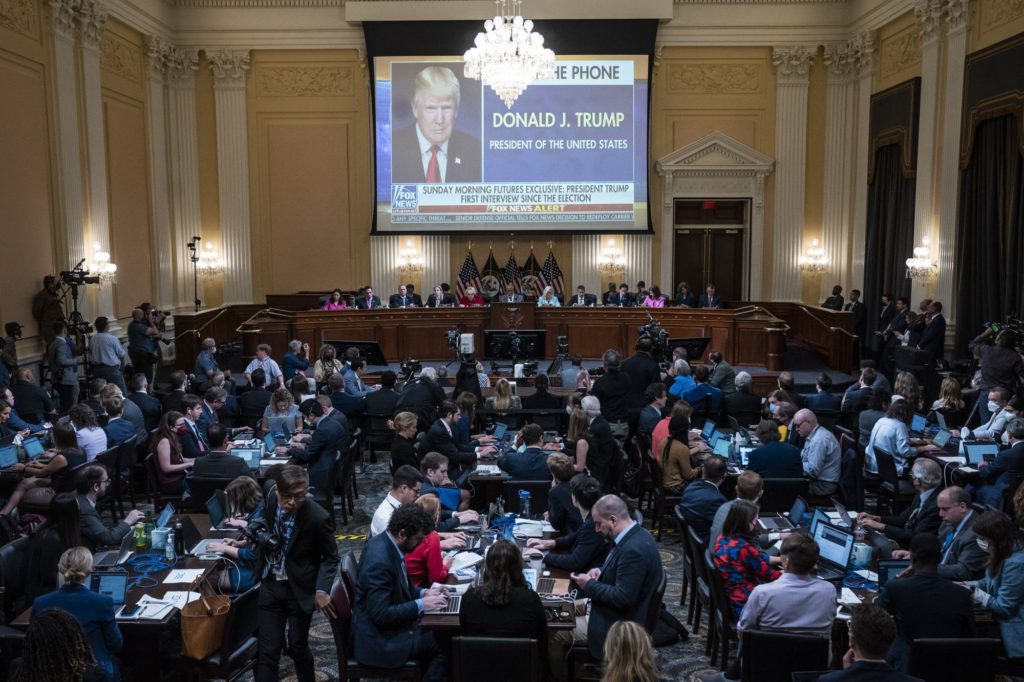
(Bloomberg) — YouTube removed a video clip of part of the US congressional hearings over the Jan. 6 riots because it contained comments from former President Donald Trump that the company considered to be misinformation that violated its policy on election integrity.

The House select committee has been investigating the Capitol riots in a series of televised hearings that have also been uploaded through YouTube to the committee’s official website. 

The excerpt contained testimony of former US Attorney General William Barr, but also a clip of Trump promoting lies about the election on the Fox Business news channel, the New York Times reported. The clip didn’t include Barr’s perspective that Trump’s claims that the election was stolen from him were wrong, even though Barr made the assertion several times throughout the hearing. 

“Our election integrity policy prohibits content advancing false claims that widespread fraud, errors or glitches changed the outcome of the 2020 U.S. presidential election, if it does not provide sufficient context,” YouTube spokesperson Ivy Choi said in a statement. “We enforce our policies equally for everyone, and have removed the video uploaded by the January 6th Committee channel.”

YouTube, which is owned by Alphabet Inc.’s Google, does permit content with false claims about the election in some instances, but only if there is additional context, such as countervailing views in the video’s description.

More stories like this are available on bloomberg.com

©2022 Bloomberg L.P.

Pimco Stops Sponsoring Ex-Credit Suisse Boss’s SPAC

(Bloomberg) — Fund management giant Pimco has ended its role as a sponsor of former Credit Suisse Group AG Chief Executive Officer Tidjane Thiam’s fintech SPAC.

Pimco, which was one of the financial backers behind the creation of Thiam’s Freedom Acquisition I Corp., has agreed to sell its entire stake in the sponsor vehicle for the blank-check firm to an affiliate of China Bridge Capital, according to a June 8 filing.

Jamie Weinstein, Pimco’s head of corporate special situations, has resigned from the board of the special purpose acquisition company effective June 6. China Bridge Capital founder Edward Zeng has been appointed as a director in his place, Freedom Acquisition said in the filing. 

It’s very rare for one of a SPAC’s early backers to end their sponsorship after it starts trading. Blank-check firms often attract investors based on their sponsors’ credentials. 

Sponsors help front the money to set up a blank-check firm and, in return, stand to benefit handsomely from a successful deal. That’s become less of a sure bet as souring sentiment leaves hundreds of SPACs scrambling to find a target in a difficult environment. 

Soured Market

Freedom Acquisition raised $345 million in its February 2021 initial public offering after Thiam increased the size of the transaction. It’s seeking a merger with a technology-enabled business in the financial services industry, according to previous filings. One of Pimco’s private funds was part of its sponsor group and committed to buying shares in the IPO. 

There’s been a sharp turnaround in sentiment from last year, when high-profile investors were flocking to support SPACs from financiers in Europe. Thiam’s blank-check IPO attracted investors including Francois Pinault, the billionaire founder of luxury conglomerate Kering SA. 

The listing recorded an oversubscription level in the mid-teens, and about a third of the deal went to rich individuals’ family offices, Bloomberg News reported at the time.  

Thiam is executive chairman of the SPAC, which is run by one of his key lieutenants, ex-investment banker Adam Gishen. Freedom Acquisition, which is still hunting for a deal, has until February 2023 to complete a transaction or it will need to return investors’ capital. 

Silicon Valley venture capital firm Tribe Capital announced this month it’s ending the sponsorship of a SPAC it helped set up. The investment firm will no longer back the sponsor of Tribe Capital Growth Corp. I, which started trading last year and hasn’t found a target yet. 

(Clarifies description of Pimco’s action in headline, paragraphs 1, 4, 7 of story originally published June 9.)

More stories like this are available on bloomberg.com

©2022 Bloomberg L.P.
Crypto Tumult Spreads as Lender Babel Puts Freeze on Withdrawals

(Bloomberg) — In a sign of deepening turmoil in the crypto community, Babel Finance became the second major digital-asset lender this week to freeze withdrawals, telling clients it is facing “unusual liquidity pressures” as it contends with recent market declines.

“The crypto market has seen major fluctuations, and some institutions in the industry have experienced conductive risk events,” the Asia-based lender and asset manager said in a notice on its website to explain the temporary measure. A spokesperson at Babel told Bloomberg that the team has faced “some pressure” and “are working on it.”

The news came just a few days after Celsius Network, another crypto lending platform, paused withdrawals, swaps and transfers in an attempt to stop the digital-asset equivalent of a bank run. Meanwhile, a tweet this week by Three Arrows Capital, a major crypto hedge fund, raised concerns about financial troubles at the firm, adding to the sense of broadening distress. A recent market downdraft has sent the value of all crypto below $1 trillion, a precipitous drop from its highs of $3 trillion late last year.

Hong Kong-based Babel is considered one of the bigger lenders in crypto and often serves as a bridge between Asia and the West, with about 500 clients and a business focused on Bitcoin, Ether and stablecoins. In May, Babel reached a $2 billion valuation in a funding round with investors including Jeneration Capital and 10T holdings. Babel’s website shows that Sequoia Capital and Tiger Global are listed as its current investors. At the end of 2021, the firm had an outstanding loan balance of more than $3 billion,

While Babel’s main clients have included many Bitcoin and Ethereum miners, its focus has shifted to include more institutions since China’s industry ban. Celsius, by contrast, has more retail investors among its customers, with more than a million people entrusting their savings to the firm, by Celsius’s count. 

Both firms have come under pressure as market declines reverberate across an industry still reeling from the implosion last month of the TerraUSD stablecoin and its sister Luna, an experiment in the loosely regulated world of decentralized finance that went spectacularly wrong. Three Arrows, an influential hedge fund with a diverse range of different cryptoassets, participated in a sale of Luna tokens earlier this year and is also among firms in DeFi whose use of leverage is now causing a severe pinch as market declines threaten forced liquidations. 

Read more: Crypto Traders Turn Against Each Other in a Collapsing Market

Three Arrows raised alarms earlier this week that it was under duress when co-founder Zhu Su tweeted that the firm was “in the process of communicating with relevant parties and fully committed to working this out.” On Friday, the Wall Street Journal reported that Three Arrows is exploring options including asset sales and a rescue by another firm, according to co-founder Kyle Davies.

(Adds more on Babel, market disruptions.)

More stories like this are available on bloomberg.com

©2022 Bloomberg L.P.

Close Bitnami banner
Bitnami
