Bloomberg

Kremlin Says Cyberattack Delays Putin’s Forum Speech By 1 Hour

(Bloomberg) — Russian President Vladimir Putin was forced to delay a highly anticipated speech at the St. Petersburg International Economic Forum on Friday after a cyberattack disrupted the system handling access badges to the venue, Kremlin spokesman Dmitry Peskov said.

Putin will speak at 3pm, an hour later than planned, Peskov said, to give technicians time to repair the damage and ensure audience members can enter the hall. 

The system was hit by a DDOS attack starting Thursday, Peskov said, without elaborating on the possible source. “Problems arose with the distribution of badges and confirmation of access to the main plenary session,” he said. “We will fix it, but it will take time.”

A person at the forum said audience members were able to enter the main hall without difficulty but noted that mobile internet access in the area appeared to be cut off. 

Putin, known for his tardiness to public events, is scheduled to make one of his first major public addresses since Russia’s Feb. 24 invasion of Ukraine at the session. Chinese President Xi Jinping has sent a video address, as well, according to the Kremlin.

More stories like this are available on bloomberg.com

©2022 Bloomberg L.P.

New CNN Boss Seeks to Create a Less Divisive News Network

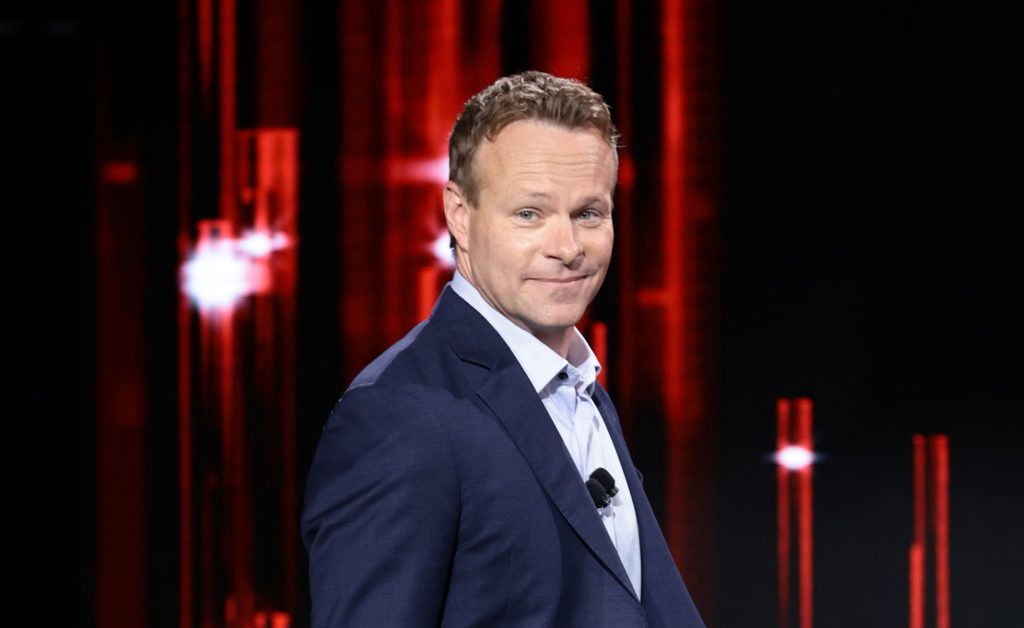
(Bloomberg) — Throughout much of his career in TV, Chris Licht has obsessed over ratings, often scrutinizing viewership data on a minute-by-minute basis to diagnose when viewers lost interest. Once, he skipped a close friend’s wedding because it was scheduled during “Sweeps Week,” the period when audience levels take on greater importance. Another time, while recovering in the hospital from a brain aneurysm, he found himself unable to resist checking the numbers on the morning show he was producing.

Now, as the new leader of CNN, Licht is exploring ways for the cable news network to depend less on TV ratings to make money. One idea would be for CNN to create new show segments that advertisers can sponsor—similar to how brands have attached their names to a fast-paced montage of headlines called the “Eye Opener” on “CBS This Morning,” where Licht was previously the executive producer. Licht also wants to invest in CNN’s international channels, particularly CNN en Espanol, and is considering a premium section of CNN’s website that would only be available to paying subscribers.

The business strategy, which was described by people familiar with Licht’s thinking, could bolster CNN at a time when viewership has fallen. While Fox News and MSNBC have declined, CNN has dropped further. This season, CNN is averaging 178,000 viewers in the key 25 to 54 demographic, down 63% from a year ago. CNN’s net advertising revenue fell 2% last year due to lower ratings, according to S&P Global Market Intelligence’s Kagan.

The search for new revenue is part of the next chapter at CNN under Licht, where the focus, at least for now, is more on refreshing the network’s reputation than on jumpstarting its ratings. (Through a CNN spokesperson, Licht declined to be interviewed). During nine years under Licht’s predecessor, Jeff Zucker, CNN didn’t just cover the story, it often became the story, generating headlines when its anchors confronted former President Donald Trump and his allies who labeled the network “fake news.” Ratings soared. But CNN could often seem “scoldy and preachy when the facts themselves can tell the story,” said former CNN US president Jon Klein.

Now, Licht wants to turn down the volume. He’s told CNN’s non-primetime anchors they should leave opinions to the on-air guests. He has instructed staff to avoid presenting the extreme right and left of political issues, saying there “needs to be room for nuance.” He has called for CNN to use the “breaking news” banner less often.

“We are truth-tellers, focused on informing, not alarming our viewers,” Licht wrote in a memo to employees.

A less divisive CNN could be more appealing to advertisers and, perhaps more importantly, to cable-TV distributors who have come under pressure to drop politically controversial channels. Of CNN’s $1.8 billion in revenue last year, about 60% came from pay-TV providers such as DirecTV and Comcast.

“People wrongly think that audience size is the business model for cable news channels,” said Andrew Tyndall, author of a website that monitors broadcast television newscasts. “So much more money comes from the fees that cable providers pay. The model is to make it unthinkable that CNN would be dropped from the bundle.”

CNN is now owned by Warner Bros. Discovery Inc., a media giant formed by the recent merger of WarnerMedia and Discovery Inc. Growing CNN’s business would help the company chip away at its massive pile of debt, while the network’s large international presence could provide fresh programming for the company’s streaming service, which is in a global race for subscribers with Netflix and others.

Licht, 50, first fell in love with broadcast news at a young age, growing up in Newtown, Conn. He started his career in local TV news in Allentown, Pa., then jumped to an NBC station in Los Angeles, where he met his future wife, who was working in TV news in San Diego. In 2007, he became the first executive producer of MSNBC’s “Morning Joe.” 

Early in his career, Licht struggled to control his temper. “If somebody screwed up, I could go off like a roadside bomb,” he wrote in his 2011 memoir, “What I Learned When I Almost Died: How a Maniac TV Producer Put Down his BlackBerry and Started to Live His Life.”

In 2010, at the age of 38, he suffered a brain aneurysm and nearly died. He describes the health scare as an “epiphany to let go of the anger.” The following year, he moved to CBS, where he became executive producer of “CBS This Morning.” Five years after that, he became executive producer and showrunner of “The Late Show with Stephen Colbert.” He’s been credited with improving the ratings at both shows.

Recently, CNN has been searching for some kind of boost of its own. 

At one point last fall, John Malone, a major shareholder in CNN’s new owner, told CNBC that he “would like to see CNN evolve back to the kind of journalism that it started with, and actually have journalists.” His comments angered many CNN employees who felt they already did journalism. In December, CNN fired anchor Chris Cuomo after new evidence emerged showing that he was closely involved in helping his brother, former New York Gov. Andrew Cuomo, combat sexual harassment claims. In February, Zucker resigned after failing to disclose a consensual relationship with a longtime co-worker.

By the time Licht took over CNN in the spring, the network was grappling with what one staffer described as an identity crisis, struggling to find a purpose after spending the Trump years doing hour-by-hour critiques of his presidency. In April, Licht’s first major move at CNN was to shut down CNN+, a new streaming service, a few weeks after its launch, resulting in layoffs.

“I know this organization has been through tremendous change over the last four months,” Licht recently noted in a memo to employees, “which is why I am approaching this process slowly and thoughtfully as we look at all parts of the operation.”

During his first month at CNN, Licht has met with more than 500 CNN employees. He’s gotten together with congressional leaders and President Joe Biden’s chief of staff, according to Politico. He’s led CNN’s coverage during a hectic news cycle, from the ongoing war in Ukraine to the debates over abortion and gun rights. And he’s cut through red tape to fill jobs despite a hiring freeze put in place while CNN’s owner completed its merger.

One of Licht’s first moves was to hire Chris Marlin — the same friend whose wedding he skipped during Sweeps Week years ago.  The two met as high school students in Washington D.C. during the inauguration for former president George H.W. Bush. As CNN’s head of strategy and business operations, Marlin’s job is to find new revenue sources for CNN. It’s a role that surprised some CNN employees because Marlin, a lawyer and former president of Lennar International, a homebuilding company, has minimal experience in the media industry. 

Moving forward, Licht is expected to be deeply involved in transforming CNN’s morning shows. At an event for advertisers last month, Licht said that “we are seeking to be a disruptor of the broadcast morning shows in this space.”

So far, Licht’s leadership style has been more hands-off than Zucker’s, according to multiple CNN employees. He offers fewer suggestions than his predecessor. One staffer said that Zucker ran CNN as if he was the full-time executive producer, while Licht only gets involved in the minutia of news coverage when he’s summoned by his subordinates to do so. 

Meanwhile, Licht and Marlin continue to explore new business ideas. For years, CNN had avoided having brands sponsor show segments as Licht is considering, because “we were hyper-sensitive to potential issues” around editorial independence, said Klein, who led CNN’s US operation from 2004 to 2010. But such deals are less controversial these days, Klein said. And they could help lure advertisers who are nervous about CNN’s controversial content by giving them more control over how their messages are integrated into the programming. In February, Applebee’s was criticized when one of its ads inadvertently ran directly alongside a dire CNN segment on the war in Ukraine.

“Licht is doing a lot of creative rethinking,” Klein said. “This won’t be the last of his outside-the-box ideas.”

More stories like this are available on bloomberg.com

©2022 Bloomberg L.P.

Crypto Traders Turn Against Each Other in a Collapsing Market

(Bloomberg) —

With crypto prices tumbling precipitously, traders have begun increasingly turning against one another to eke out ever-elusive profits.

Many shark traders scour blockchains — digital ledgers for recording transactions — seeking information on other traders, particularly those with highly leveraged positions, an anonymous user known as Omakase, a contributor to the Sushi decentralized exchange, said in an interview. 

The sharks then attack the positions by trying to push them into liquidation, and earning liquidation bonuses that are common in decentralized finance (DeFi), where people trade, lend and borrow from each other without intermediaries like banks.

Related strategies may have contributed to the collapse of the TerraUSD stablecoin, with shark traders making money off price arbitrage between the Curve decentralized exchange and centralized exchanges, according to Nansen, a blockchain analytics firm. 

Recent troubles at crypto lender Celsius Network were exacerbated by arbitragers as well. The price of stETh token that Celsius has a large position in started trading at a large discount from Ether, to which it’s tied. 

“As stETH goes down, arbitragers buy stETH and short ETH against it, sending ETH lower, which again lowers collateral values across DeFi,” effectively worsening Celsius’s position, according to a recent Arca note.

As Omakase put it, “In a downtrend environment, where yields are harder to access, what we are going to see is some actors utilize some more aggressive strategies, and that may not be necessarily good for the community.”  

“The environment has become more player vs player,” Omakase added.

With crypto prices under pressure, taking on leverage has presented an even greater peril. Last year, Sushi launched a margin-trading and lending platform. Most crypto exchanges offer margin trading, and in the past it has been as high as 100X, meaning that people were able to borrow 100 times what they put down as collateral. 

Most DeFi apps require traders to overcollateralize, however — effectively taking out less in loans than they put in.

Driving Down the Price

A trader may find out that others could get liquidated when a coin’s price drops to, say, $100. The trader could then build up a sufficient position in the coin, then sell in order to pull the price below $100, while also collecting the reward for liquidating the trader that most DeFi apps offer. 

“Most protocols offer a 10-15% liquidation fee,” Omakase said. “Triggering enough liquidations would cause a liquidation cascade where a motivated actor could simply hold a short position in order to profit for the subsequent secondary decrease.”

Other traders are simply profiting off liquidations they don’t trigger. Nathan Worsley runs a slew of bots — software programs — that search for traders who are about to get liquidated and gets paid a commission for liquidating them. 

“Recently the amount of liquidations has been huge,” Worsley said in emails. “However, liquidations is not a continuous strategy, you sometimes go for a week or more without any significant liquidations. However, when liquidations happen there are usually a lot at once. You basically have to work a long time while making $0 profit, in order to be ready for the big day or two when you might be able to make a million dollars at once.” 

His bots continuously scour blockchains, keeping a list of all the borrowers using a particular app and scrutinizing the health of their accounts. Once positions are ready for liquidation, “it’s usually a battle to be the quickest and perform the liquidation,” Worsley explained. 

“I would push back on classifying this as an ‘attack,’” he added. “The reason is because without liquidations, you can’t have a lending market. So even though no one enjoys being liquidated, it’s essential that people do get liquidated in order to make the market and protect the protocol from insolvency.”

Liquidations can be triggered after traders borrow from apps like Aave or Compound, and put up collateral — say, in Ether — that’s typically greater than what they borrow, perhaps 120% of the borrowed funds. If Ether’s price drops, that collateral may now be worth only 110% of what the trader borrowed.

‘Protect the Protocol’

“My job as the liquidator is to protect the protocol by closing your position,” Worsley said. “The protocol gives me a reward for being a liquidator to encourage this activity, because blockchains cannot move by themselves. You have borrowed $1,000 of Bitcoin, so I repay the $1,000 of Bitcoin you owe the protocol. In return, the protocol gives me $1000 of your Ethereum collateral, plus a $100 ‘liquidation bonus’ from your excess collateral. I have made a profit, you have been liquidated and your position is closed, and the protocol itself has been protected from bad debt.”

With liquidation targets becoming more and more tempting in a tumultuous market, Omakase offers this advice: “Generally everyone should stay safe, everyone should avoid the use of leverage.”

More stories like this are available on bloomberg.com

©2022 Bloomberg L.P.

The Investors Putting Billions Into Climate Tech Don’t Plan to Stop Now

(Bloomberg) —

Bill Gates is worried about a dark period ahead for the global economy. “We’re going to go through a winter period for a number of years,” he warned a room full of go-getting green entrepreneurs last week, lamenting at a TechCrunch event that their success had come up against bad timing.

Silicon Valley is bracing for an economic nosedive, and those working in clean energy and green tech might have a foreboding feeling of déjà vu. Fifteen years ago, venture capitalists started special funds to invest in the sector—only to disappear when markets soured.

In recent years, there’s been another boom in climate tech, with billions of dollars pouring into companies devoted to renewable energy and emissions reduction. Now, as markets spiral, industry veterans argue that there is enough actual money being made and a broader, deeper set of financial backers to avoid repeating history. “There’s too much vested interest to go back to clean tech 1.0,” says Bill Lese, a managing partner with Braemar Energy Ventures.

During that first wave, solar power, wind energy and electric cars were too costly and unproven; Tesla needed a government loan. This time around, renewables are cheaper than fossil fuels and investors tout “the Tesla mafia,” a crop of companies from alums of the electric carmaker. A decade ago, Peter Gajdoš, the climate lead at venture capital firm Fifth Wall, worked for Richard Branson’s Virgin Green Fund, an investment vehicle that then held $220 million, one of the largest at the time. Now Gajdoš works for a firm targeting twice that amount for a single fund. It invests in companies working on updates to smart grids, industrial motors and cement production.

According to BloombergNEF, a clean energy research group, climate tech startups raised $53.7 billion in 2021, including enormous piles of cash for electric scooters and fake chicken producers. Unlike the earlier boom, this influx includes big asset managers and corporations backing solutions for the climate crisis to hit their ESG goals or out of some moral compunction. That has brought huge financial commitments that still haven’t been invested, missing from the first clean tech rush. “This is fundamentally different,” said Jim Kapsis, a veteran of the clean tech pioneer Opower who runs advisory firm the Ad Hoc Group. “There will be deals that don’t get done. Probably, like the rest of the market, they were deals that shouldn’t get done.”

There’s also a prevailing sense the sector could excel while others making apps, cryptocurrency tech or business software falter. Gas price sticker shock and the war in Ukraine have put a premium on renewable energy sources.

That’s not to say climate tech is immune to damage. In May, stock market investors began pulling money from ESG equity funds. Venture capital funding in the sector slowed at the start of 2022, even before economic tailwinds, according to a recent report from Pitchbook. Investors are advising climate startups to be more conservative with their cash. They talk about “right-sizing” and “a flight to quality”—euphemisms for funding rounds and company valuations more in line with business realities. “The VCs will drown some of their own children,” says Kapsis. Although he adds that he hasn’t heard of any layoffs or down rounds in the sector yet.

Voyager Ventures, one of the newer climate-focused funds, which raised $100 million in April, has backed startups working on energy efficiency software and carbon-free production of nickel, a material whose price has swung wildly. Volatility in energy markets has only underscored the value of its portfolio, particularly in Europe, says Voyager co-founder Sarah Sclarsic. “The macro trends just point in this direction,” adds her partner Sierra Peterson. The partners say they haven’t changed their strategy despite the recent downturn.

There was little talk of changing course or right-sizing at the TechCrunch event this week. In the afternoon, the investor Gajdoš led a session titled, “Why the Next Big Entrepreneur Must Come from Climate Tech.”

Offstage, he said that many of his limited partners backers fleeing tech were still allocating money to climate funds, driven by corporate and government pledges to curb emissions. Some LPs are tapping the brakes, but not nearly as hard as they did during the prior clean tech bust.

Besides, he believes the sector now operates outside of regular market cycles. “Climate doesn’t care about inflation. The oceans are warming up. The forests are burning,” Gajdoš said. “These problems are still there, and someone needs to solve them, which creates opportunities.”

Mark Bergen writes the Cleaner Tech newsletter about the intersection of climate and technology.

More stories like this are available on bloomberg.com

©2022 Bloomberg L.P.
Can AI Gain Sentience? Maybe, But Probably Not Yet: Quicktake

(Bloomberg) — Media coverage of artificial intelligence tends to invoke tired references to The Terminator or 2001: A Space Odyssey’s HAL 9000 killing a spaceship’s passengers. Hollywood loves a story about a sentient robot destroying humanity in order to survive. In recent days, Google researcher Blake Lemoine grabbed headlines for getting suspended after releasing transcripts of a “conversation” with its Lamda artificial intelligence research experiment.  Lemoine believes that Lamda is sentient and aware of itself and describes the machine as a “coworker.” He told The Washington Post that part of his motivation for going public was because he believes that “Google shouldn’t be the ones making all the choices” about what to do with it. The overwhelming reaction among artificial intelligence experts was to pour cold water on these claims.  1.  What is Lamda?It’s an acronym for language model for dialogue applications. As the name might suggest, it’s a tool designed to create a “model” of language so people can talk to it. Like similar experiments GPT-3 (Generative Pre-trained Transformer 3) from Elon Musk-backed OpenAI and Google’s earlier BERT (Bidirectional Encoder Representations from Transformers), these experiments are best thought of as amped-up versions of the algebra you learned at school, with a twist. That twist is called machine learning, but before that we have to go back to the classroom and talk about algorithms. 

2. What is an algorithm? An algorithm is a step-by-step process that solves a problem. Take an input, apply some logic and you get an output. Addition, one of the most basic problems in mathematics, can be solved with many different algorithms. Humans have been using algorithms to solve problems for centuries. Financial analysts spend their careers building algorithms attempting to predict the future and tell them to buy or sell shares to make money. Our world runs on these “traditional” algorithms, but recently there has been a shift towards “machine learning,” which builds on these traditional ideas.

3. What is machine learning?Machine learning tools take inputs and outputs and create their own logic to connect the two, in order to be able to come up with correct outputs in response to new inputs. Google and OpenAI’s aims are to build machines that can learn the logic behind all human language, so the machine can speak in a way that humans can understand. The machine itself does not truly “understand” what it’s doing. Instead it’s following an incredibly detailed set of rules that it has invented, with the help of another set of rules invented by a human. Other big differences between “traditional algorithms” and “machine learning algorithm” techniques are in the quantity of the data used to create an algorithm and how that data is processed. In order for them to work, machine learning tools are “trained” on billions of books, online articles and sentences shared on social media that have been collected from the public internet and other sources. Increasingly, the result of that training is a model which can respond to human beings in an uncannily human way, creating the illusion of a conversation with a very clever being. This training requires huge amounts of computational power. Some estimate OpenAI’s GPT-3 cost about $20 million simply to create its model, and every time you ask GPT-3 to respond to a prompt, it burns through many hours worth of computer processing time.

4. So you’re actually talking to humanity?Lemoine is right when he says that Lamda “reads” Twitter, although “ingests and processes” is probably a more accurate description. And that’s how problems of bias creep in. The machine’s entire understanding of language is based around the information it’s been given. We know that Wikipedia is “biased” towards a Western viewpoint, as only 16% of its content about sub-Saharan Africa is written by people from the region. Machine learning inherits this bias because it almost certainly relies heavily on Wikipedia’s data.

5.  Why is everyone so excited about machine learning?As computational power increases and the cost of that processing falls, machine learning will get more powerful and more available, so it can be applied to more problems. Right now your smart speaker is mostly useful for setting timers or playing music.  But airlines and shipping companies have used traditional algorithms for decades to maximize the efficiency of their boats and aircraft. The dream is that with enough cheap computing power, machine learning tools can make new treatments for diseases like cancer, enable fully autonomous self-driving cars or create a perfect nuclear fusion reactor design. 

6. What’s actually happening when I talk with Siri,  Alexa or  Lamda?When you think you’re “conversing” with a machine language model, you’re actually talking to a very complicated mathematical formula which has determined in advance how it should respond to your words with the help of calculations based on trillions of words written by human beings. Artificial intelligence tools like GPT-3 and Lamda are designed to solve specific problems like speaking conversationally to humans, but the ultimate goal of companies like Google’s DeepMind is to create something called “artificial general intelligence” or AGI. In theory an AGI would be able to understand or learn any task that a human can, leading to a rapid speeding up of problem solving.

7. Could a machine learning-powered artificial intelligence become sentient?Any progress towards a machine that has an inner mind and can feel or express emotions might be possible, but the expert consensus is that it’s impossible with the current state of technology. Here’s what some had to say:

  •  Cognitive scientist Steven Pinker said Lemoine is confused. Writing on Twitter, he says Lemoine “doesn’t understand the difference between sentience (aka subjectivity, experience), intelligence, and self-knowledge. (No evidence that its large language models have any of them.)” These three concepts are what Pinker believes are required for any being to be conscious, and in his view Lamda is far from passing any of those bars.
  • Gary Marcus, author of “Rebooting AI,” said more bluntly in a blog post entitled “Nonsense on stilts,” that “In truth, literally everything that the system says is bullshit.” Marcus says there is no concept of meaning behind Lamda’s words, Lamda is just “predicting what words best fit a given context.”
  • Ilya Sutskever, chief scientist of OpenAI, tweeted cryptically in February  that “it may be that today’s large neural networks are slightly conscious.” Murray Shanahan, the research director at DeepMind, replied that Lamda is slightly conscious “in the same sense that a large field of wheat may be slightly pasta.”
  • It’s worth reading Alex Hern’s experiments with GPT-3,  another natural language machine-learning program, showing how easy it is to generate complete and utter nonsense if you tweak your questions. Randall Munroe, author of web comic XKCD, and his conversation with GPT-3 as William Shakespeare is informative too. Who knew that if he were alive today, he would add Shrek to Romeo and Juliet’s balcony scene?

8. Nothing to worry about then?Tom Chivers, author of the “The AI Does Not Hate You,” argued the thing we should really worry about is the competence of these systems, not their sentience. “AI may or may not be becoming conscious, but it is certainly becoming competent. It can solve problems and is becoming more general, and whether or not it’s got an inner life doesn’t really matter,” he said. There are already reports of AI-powered autonomous drones being used to kill people, and machine learning enabled deepfakes have the potential to make disinformation worse. And these are still early days. The doomsday bomb in Dr Strangelove that ends the world didn’t need to be intelligent or sentient to accidentally end the world. All it needed was simple logic (if attacked by the Americans, explode) applied in a really stupid way (the Soviets forgetting to tell the Americans). As Terry Pratchett wrote, “real stupidity beats artificial intelligence every time.”

The Reference Shelf

  • Bloomberg QuickTake  on the threat to human jobs from the rise of AI 
  • Read more on the Google debate over `sentient’ algorithmic bots
  • Article in the New Scientist about whether Lamda is really sentient

More stories like this are available on bloomberg.com

©2022 Bloomberg L.P.
Crypto and US Politics: Is Bipartisan Regulation Possible?

  • Listen to Bloomberg Crypto on the iHeartRadio App
  • Listen to Bloomberg Crypto on Apple Podcasts
  • Listen to Bloomberg Crypto on Spotify 

(Bloomberg) — In this episode, we’re taking another look at the US approach to regulating cryptocurrencies. There is a real drive on Capitol Hill to figure out how to define and regulate this asset class and protect consumers. The bipartisan duo of Democratic Senator Kirsten Gillibrand of New York and Republican Senator Cynthia Lummis of Wyoming are proposing sweeping legislation that tackles everything from who gets to regular crypto to Bitcoin mining. But can it pass? And how would it work? Bloomberg reporter Allyson Versprille tackles these questions.  

Follow us on Twitter @crypto, and subscribe to the Bloomberg Crypto Newsletter at https://bloom.bg/cryptonewsletter

More stories like this are available on bloomberg.com

©2022 Bloomberg L.P.

UK to Kill ‘Irritating’ Cookie Pop-Ups in Brexit Data Plan

(Bloomberg) — The UK set out a plan to roll back data protection obligations and cookie consent boxes in an attempt to boost business and research.

A planned Data Reform Bill will cut “burdens on businesses to deliver around £1 billion ($1.23 billion) in cost savings” over ten years, the Department for Digital, Culture, Media and Sport said in a statement summarizing the legislation Thursday. 

The announcement criticized the EU’s “highly complex” General Data Protection Regulation and promised a “clampdown on bureaucracy, red tape and pointless paperwork” to “seize the benefits of Brexit.”

Small British businesses will no longer be required to have a data protection officer and fill out “lengthy impact assessments.” Internet users will be given the option to opt-out rather than needing to opt-in for the collection of cookies — which track users around the internet. The government said the change will cut down on “the irritating boxes users currently see on every website”.

As Britain diverges from the bloc and faces legal action from Brussels for threatening the Northern Ireland protocol, Prime Minister Boris Johnson will have to balance apparent opportunities with the risk of jeopardizing a key deal signed last year guaranteeing data flows between the UK and the continent, which has a clause allowing for regular reviews.

A DCMS spokeswoman said that “as the Commission itself has made clear, EU adequacy decisions do not require countries to have the same rules. Our view is that these reforms are fully compatible with maintaining the free flow of personal data from Europe.”

The bill also increases fines for the perpetrators of nuisance calls and texts, and says researchers will not need to be as specific about why they’re collecting data: they could rely on a previous consent for “cancer research,” rather than getting a new approval for their particular study, for instance.

The government will also be able to exert more control over the country’s data watchdog, the Information Commissioner’s Office. Culture Secretary Nadine Dorries will have to approve its statutory codes and guidance before they are presented to Parliament.

The reforms look “modest” and less likely than some previous more radical suggestions to threaten data adequacy, Linklaters data lawyer Peter Church said via email. 

“This is hardly a surprise given data protection laws are now a global norm and the GDPR is the template upon which many of those laws are based,” he said, adding though that “it’s not clear how the new regime will adequately protect individuals from excessive and intrusive internet tracking.”

(Updates with quotes from sixth paragraph)

More stories like this are available on bloomberg.com

©2022 Bloomberg L.P.

ByteDance Disbands Shanghai Games Studio in Expansion Setback

(Bloomberg) — ByteDance Ltd. has shut down a game development studio it acquired just three years ago, slashing more than a hundred jobs in a major setback for its quest to challenge Tencent Holdings Ltd. in mobile gaming.

TikTok’s Chinese owner disbanded its 101 Studio in Shanghai this week, letting about half of the 300-plus staffers go and offering internal transfers to the rest, according to people familiar with the matter who asked not to be named discussing private information. 101 Studio had been one of a handful of key game-development houses that ByteDance had bet on to power its expansion into businesses beyond its core short-video business.

The closure marks a significant retreat from a once-booming gaming industry and the first time ByteDance has shut down a development unit altogether. The Beijing-based firm, now laboring under severe content and licensing constraints, had previously curtailed some gaming projects. It has another gaming unit under its wing that was downsized during the months-long hiatus in new game approvals that began in the summer of 2021.

ByteDance Plans Assault on Tencent’s Mobile Gaming Kingdom

Having disrupted the world’s social media landscape with TikTok and its China sibling Douyin, ByteDance sought to follow the tried-and-true path of bigger rival Tencent by building out its presence in mobile gaming. Games account for a huge chunk of mobile app revenues and help bring in more users for related services such as payments and social media. Tencent’s ubiquitous WeChat super-app channels users to its massive gaming portfolio and helps the company benefit from in-game purchases.

ByteDance’s gaming division Nuverse, which got its start in 2019, prioritizes so-called hardcore or less casual games. It has grown through acquiring publishing rights and creative studios, including 101 Studio, which was born out of the takeover of Shanghai developer Mokun Technology. Under the ByteDance umbrella, the Mokun team churned out several titles in genres like fighting and card-playing, but none made a huge splash in the $44 billion China market dominated by twin giants Tencent and NetEase Inc.

Some 101 staffers will be transferred to Nuverse’s publishing arm to work on its existing titles, said one of the people, while ByteDance is also considering letting Pico — the virtual reality headset maker it acquired last year — take over a VR game that had been under development at 101.

ByteDance did not respond to a request for comment.

ByteDance bought Mokun in March 2019 from its previous owner 37 Interactive Entertainment at a valuation of 110 million yuan ($16.4 million). It was among a string of gaming investments the company made ahead of Beijing’s antitrust and content scrutiny, including the $4 billion takeover of Moonton Technology, whose battle arena game Mobile Legends is popular in regions like Southeast Asia. But China’s historic crackdown on big tech and internet firms over the past year and a half has dented ByteDance’s ambition in games while an economic slowdown stymied its core ad business.

Over the course of the past year, ByteDance has shut down most of its online tutoring operations, disbanded its venture investment team and sold off a stock-trading app — an aggressive streamlining of operations as China’s tech giants resign themselves to a new era of slower growth and greater caution. Its push into casual gaming, through its Ohayoo publishing unit, also took a hit last year when the company cut some jobs and lost the division’s leader.

More stories like this are available on bloomberg.com

©2022 Bloomberg L.P.

Klarna’s Valuation Falls to $15 Billion, Journal Says

(Bloomberg) — Swedish payments firm Klarna Bank AB is looking to raise less capital than earlier planned and at a much lower valuation of $15 billion, the Wall Street Journal reported citing people familiar with the matter. 

The Stockholm-based company is currently in talks with investors about fresh funds totaling at least $500 million, which is about half its earlier ambition to raise up to $1 billion, according to the newspaper. 

The deal would value the buy-now-pay-later provider at about $15 billion, the people said, considerably lower than both the $46 billion valuation quoted in a financing round 12 months ago and the $30 billion mark discussed in May.

Klarna, billed as Europe’s most valuable startup in 2021, has seen its fortunes dramatically change amid a tougher climate for privately-held tech companies, sparked by soaring inflation and tighter monetary policy. Last month, the Swedish company announced it was laying off about 10% of its employees in an effort to cut costs. 

A Klarna spokesperson told Bloomberg News that the company would not comment on fundraising or valuation speculation.

(Adds Klarna’s decline to comment)

More stories like this are available on bloomberg.com

©2022 Bloomberg L.P.

China Budget Dilemma Is Whether to Boost Debt or Slow Growth

(Bloomberg) — China’s local governments are caught in an unexpectedly severe budget squeeze, creating a dilemma for officials over whether to boost debt or tolerate weaker economic growth.

Maintaining the Covid Zero policy is both slowing the economy and also adding huge extra costs to government budgets, which have to pay for regular mass testing, quarantine hospitals, as well as food provision and other services during lockdowns in places like Jilin or Shanghai. The mass-testing for Covid alone will add hundreds of billions of yuan, if not more, onto local authorities’ spending responsibilities beyond what was budgeted in early March.

Fiscal stress had been increasing even before the Covid spending pressures, with tax relief to businesses cutting government income and land sale revenue plunging because of a housing downturn. The broad budget deficit ballooned to a record of nearly 3 trillion yuan ($448 billion) in the first five months of the year, official data showed on Thursday.

READ:  China Budget Deficit Hits Record Due to Tax Rebates, Covid Pain

Authorities have two ways to deal with the revenue hole — borrow more or curb spending. A weakening economy makes the latter option less appealing, meaning the government may be forced to leverage up further, either by issuing more official debt or by loosening the curbs on off-balance sheet debt. Either one would mark a major setback to China’s efforts to deleverage.

If local governments don’t borrow more to pay for investment and stimulus, they could be forced to scale back spending in areas other than the fight against Covid, making the country’s annual growth target of around 5.5% even harder to reach.

“Since Beijing is less willing to expand central-government debt, it will probably also end up tolerating some further increase in hidden local debt” to pay for infrastructure spending, according to Gavekal Dragonomics analyst Wei He. “This will make the long-term campaign to control local debt harder to manage but that is not the major concern for policymakers at the moment.”

Here is a look at some of the factors contributing to the financial woes faced by China’s local governments.

Covid Testing

China’s strategy of containing Covid relies on regular and repeated testing of the whole population around an outbreak and then isolation of those infected or exposed. As outbreaks become more common with the highly transmissible omicron variant, more and more cities are telling residents to take regular nucleic acid tests to try and spot outbreaks quickly, with the costs so far borne by the public purse.

Around 814 million people, mostly urban dwellers aged between 5 and 64, could be covered by a Covid test mandate, according to Nomura Holdings Inc. Assuming 70% of them take a test every two days, that will cost local governments 300 billion yuan a year, according to Lu Ting, the bank’s chief China economist. 

That estimate is based on a per test cost of 3.5 yuan per person, and adds up to about 2.6% of budgeted local government general fiscal revenue this year, according to Bloomberg calculations. 

Land Sales

Land auctions and property transactions have been hit hard this year, with Covid restrictions and lockdowns in cities like Shanghai and Beijing compounding already weak demand caused by the ongoing property crisis. Consumers are also cautious about buying homes due to concerns about the future and worries that debt-laden developers’ may not deliver projects or could go bankrupt.

That pessimism and retrenchment means developers aren’t buying land from local governments. Land sales in 50 key cities tracked by China Real Estate Information Corp. sank 70% from a year ago in May. That’s better than the record 78% dive in January, but still represents a fifth straight month of declines. 

Tax Rebates

In an attempt to counter the economic slowdown, the Chinese government started returning some previously collected taxes to companies in April. It had returned 1.34 trillion yuan through the end of May, figures from the Ministry of Finance showed.

That refund was equivalent to 54% of the 2.47 trillion yuan in the country’s total general fiscal revenue earned in the two months, according to Bloomberg calculations based on government data. However, the impact of tax rebates could be temporary, given that officials have said they want to complete returns for small companies and manufacturing firms by the end of this month so that businesses can benefit sooner.

Debt Risks

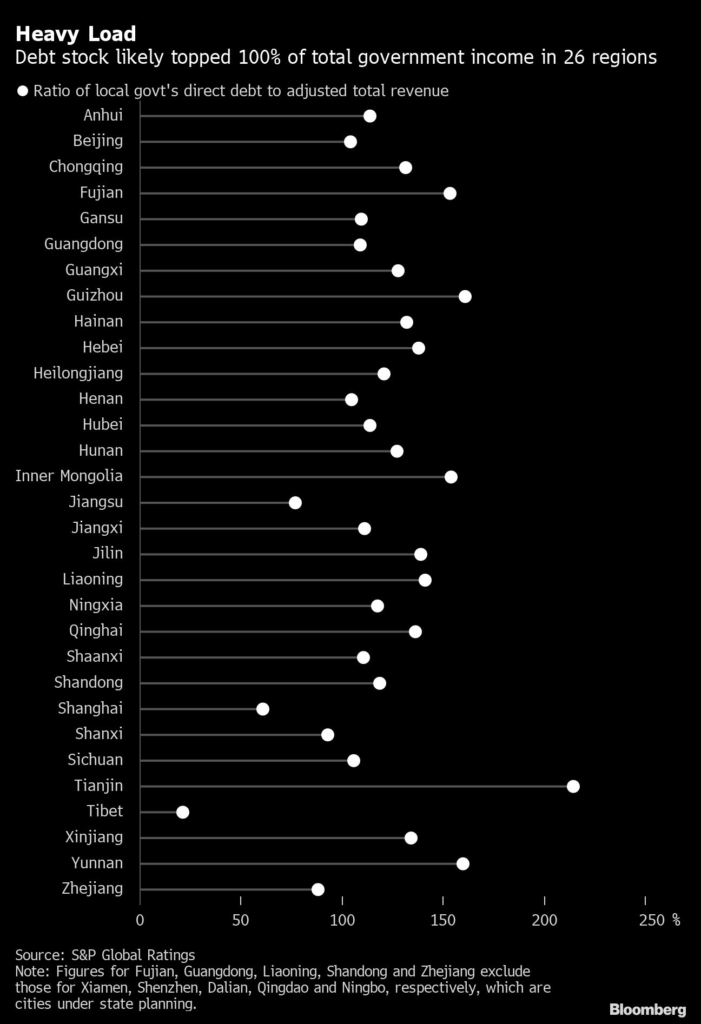
Rising debt is an issue in China and around the world, and Beijing is trying to make sure that local governments don’t take on more debt than they can manage, bring off-balance sheet debt back onto their books, and use the money productively. Even so, at the end of April 26 of 31 provinces had official debt worth more than 100% of their total 2021 revenue, according to S&P Global’s estimates. 

That was three more than at the end of 2021, showing how quickly the regions are borrowing money to support their economies. The northern port city of Tianjin tops the list with debt amounting to more than twice its annual income, followed by Guizhou and Yunnan in the southwest, Inner Mongolia in the north and Fujian in the east.

Efforts to control rising debt may make it more difficult for the regions to spend as required. That financial strain will likely become apparent in weaker regions first and hit them harder, increasing the possibility that towns and cities need to undergo what’s called “fiscal restructuring.” 

“Would there be another Hegang? We think it’s highly probable,” said Susan Chu, a senior director of S&P Global Ratings, referring to the first municipal-level government restructuring, which was revealed late last year. With China’s debt stock rising by 20% every year and interest expenses likely increasing at a similar pace, “the pressure of fiscal restructuring will emerge in smaller and poor areas this year and the next,” she said. 

(Updates with record budget deficit in the third paragraph.)

More stories like this are available on bloomberg.com

©2022 Bloomberg L.P.

Close Bitnami banner
Bitnami