

Bloomberg

China’s Newest Aircraft Carrier Shows Xi Jinping Catching Up With US

(Bloomberg) — China launched its third and most modern aircraft carrier, a watershed moment for President Xi Jinping’s efforts to modernize the armed forces and narrow his country’s military gap with the US. 

The new carrier, christened the Fujian, was launched from Jiangnan Shipyard near Shanghai on Friday at ceremony attended by military and civilian leaders, state broadcaster China Central Television said. The ship has an electromagnet catapult launch system — a feature previously deployed by only the US — rather than the “ski jump” deck of China’s two earlier carriers, CCTV said. 

While the Fujian will more closely resemble the newest US carrier, the USS Gerald R. Ford, it will likely fall short of Nimitz-or Ford-class nuclear-powered supercarriers in capabilities and range. The Chinese warship is expected to have a diesel engine and likely to be comparable in size to the US Kitty Hawk-class carriers, which the US operated from the 1960s to 2000s. 

Xi, since taking office, has pledged to modernize China’s once infantry-dominated military with particular focus on building the navy to project power beyond the nation’s coasts and protect increasingly far-flung interests including its expansive and disputed claims in the South China Sea. The new carrier would likely extend the People’s Liberation Army’s effective range beyond the so-called First Island Chain, which includes Taiwan, the Philippines and Japan.

The PLA released a six minute and 17 second propaganda video — a reference to the ship’s June 17 launch date — commemorating the development of China’s carrier program over the past decade. The video is dedicated to the Communist Party’s upcoming congress, in which Xi is expected to reshuffle top posts and secure a precedent-breaking third term as commander-in-chief. 

“Offense is our mission,” the video’s narrator said. 

Earlier Delays

The Fujian, which was previously known as the Type 003, will displace about 80,000 tons, according to CCTV, compared with about 100,000 tons for the Nimitz and Ford carriers. The shipyard working on the new carrier is operated by Jiangnan Shipbuilding Group, a subsidiary of China State Shipbuilding Corp., the world’s largest commercial shipbuilder. 

The Fujian’s launch is thought to have been postponed twice. Initially, the launch data was scheduled for April 23, but the PLA Navy delayed the date amid logistical problems arising from the country’s surge in Covid cases and lockdown in Shanghai. The second launch date was thought for June 3, to coincide with China’s Dragon Boat Festival, but it’s unclear why takeoff never happened. 

Once the warship set sail, it would need five years to reach initial operational capabilities to thoroughly test all of its satellite communications, drainage system and other equipment on board, Zhou Chenming, a researcher at the Yuan Wang military science and technology think tank in Beijing, told the South China Morning Post. 

The launch comes as the Chinese military has been taking increasingly assertive actions in Asia. Earlier this month, both Australia and Canada reported close encounters with Chinese military jets. China denied these claims, saying “no country is allowed to infringe upon China’s sovereignty and security.” 

(Adds details of military’s capabilities, previously posponed launches from fourth paragraph.)

More stories like this are available on bloomberg.com

©2022 Bloomberg L.P.
Nations Pull WTO Back From the Brink With Vaccine, Fishery Deals

(Bloomberg) —

The world’s top trade ministers on Friday approved a historic package of accords — including the reduction of fishery subsidies and a loosening of vaccine-production limits — after marathon talks that a day ago looked for many delegates to be destined for failure.

The agreements break the Geneva-based trade body’s seven-year negotiating drought and avert a damaging impasse for an organization that’s struggled to gain its footing after four years of attacks under former President Donald Trump, a pandemic, strained supply chains and Russia’s war with Ukraine. 

The alignment of the 164 members of the WTO, whose mission is to promote peace and prosperity through closer economic integration, is all the more impressive considering two of them — Russia and Ukraine — are currently fighting a war.

The outcome emerged after a grueling all-night negotiating session at the WTO’s headquarters on the shores of Lake Geneva and provides a sufficient basis for WTO Director-General Ngozi Okonjo-Iweala to claim her first negotiating success after just more than a year on the job. The pacts could put new momentum behind the WTO and its ability to govern the $28 trillion global trading system.

The agreements “show the world that WTO members can come together across political faultlines,” Okonjo-Iweala told reporters on Friday morning. “There were many moments when I feared we would come out of MC12 empty handed,” she said, referring to the 12th ministerial conference. 

Vaccine IP Waiver

Trade officials agreed to water down the WTO’s intellectual-property protections for Covid-19 vaccines — a key agreement that Okonjo-Iweala said was necessary to end the “morally unacceptable” inequity of vaccine access in poorer nations. 

But the negotiation took so long and the global vaccine-manufacturing effort worked so quickly that the WTO’s final deal may not have a meaningful impact on the production of Covid-19 shots at time when there is a global glut of jabs. 

As of May 2022 there were 2.1 billion excess doses of Covid-19 vaccines and the production of vaccines has consistently outpaced the number of jabs administered, according to data from the the European Federation of Pharmaceutical Industries and Associations. 

“The premise of an intellectual-property waiver for Covid-19 vaccines was flawed from the outset,” said Thomas Cueni, the director-general of the International Federation of Pharmaceutical Manufacturers and Associations. “To this day, there is no evidence that IP has been a barrier to Covid-19 vaccine production or access.” 

Fish, E-Commerce

WTO members separately agreed to a scaled-down agreement to curb harmful government fishing subsidies, fulfilling a key 2015 United Nations sustainability target aimed at slowing the rapid depletion of global fish stocks. 

The accord, which sets new limits on subsidies for illegal, unreported and unregulated fishing, aims to improve the jobs, economies and communities that depend on global fish stocks. The deal will expire four years after its entry into force unless WTO members agree to extend the restrictions to activities that contribute to overfishing and overcapacity. 

WTO members also agreed to temporarily renew the WTO’s 24-year-old moratorium on e-commerce duties — which averts the prospect of new tariffs on the digital economy after India and other developing nations threatened to scuttle the agreement. 

There were fears that if the 1998 accord were to lapse, it could open a new regulatory can of worms that may result in higher consumer prices for cross-border Amazon.com purchases, Netflix movies, Apple music, and Sony PlayStation games.  

“There was a lot of understanding amongst each other. There was a lot of sensitivity to each other’s concerns and needs,” Indian Commerce Minister Piyush Goyal told reporters. “The outcomes of the MC12 are being watched by the world as a signal that the multilateral order is not broken,” he said.

Food Security

Trade ministers agreed to language aimed at mitigating the impact of a looming global food crisis and pledged to deliberate India’s demands to water down the WTO’s subsidy rules for public stockholding programs aimed at feeding poor citizens. 

While WTO rules permit nations to buy food to help feed poor citizens, they restrict programs that do so by exclusively sourcing from local farmers, and prohibiting food exports from these programs. 

India has long been concerned that its program, which buys exclusively from Indian farmers and has exported in the past, could be challenged at the WTO as illegal.

WTO members will now work to resolve India’s concerns on the matter by their next ministerial conference. 

(Updates with comment from WTO director-general in fifth paragraph.)

More stories like this are available on bloomberg.com

©2022 Bloomberg L.P.

Huobi Thai Partner Shuts Platform After Losing License

(Bloomberg) — Huobi Thailand Co., a cryptocurrency platform, will halt its operations after the regulator revoked its license.

The platform will be shut “permanently” from July 1, according to a Huobi Thailand statement on its website. Huobi Thailand will no longer have any connections nor legal bindings with Huobi Group after the closure, the statement said.  

Services the platform had provided included trading of an array of digital assets such as Bitcoin and Ether. 

Thailand’s Securities and Exchange Commission in May revoked the firm’s crypto-exchange license after it failed to set systems and personnel in accordance with rules and regulations, the regulator said in statement Wednesday. The company’s operation had already been suspended by the SEC since September because of similar issues. 

“We have been trying our best efforts to contact all customers to withdraw assets,” the statement said. “However, there are still an amount of out of reach customers.”

(Corrects headline and lead to remove reference to Huobi Technology.)

More stories like this are available on bloomberg.com

©2022 Bloomberg L.P.
China Fines Social Media Influencer $16 Million For Tax Evasion

(Bloomberg) — China fined a social media influencer $16 million for tax evasion, the latest punishment meted out to one of the country’s top online personalities amid a nationwide crackdown.

Xu Guohao, who livestreams on Momo, was ordered to pay 108 million yuan ($16 million) in back taxes, late fees and fines for tax evasion from 2019 to 2020, according to a statement from State Taxation Administration. It plans to further strengthen tax supervision of people in the livestreaming industry, the statement said.

China Vows to Root Out Tax Evasion on Livestreaming Services (1)

China has ramped up enforcement of tax laws in the livestreaming sector for the past year to support president Xi Jinping’s common prosperity campaign. Streaming platforms are required to collect income taxes and deliver reports including the personal information of social media personalities to local authorities every six months, according to guidelines issued in March. 

One of the country’s most popular livestreamers — Huang Wei, known as Viya online — was fined $210 million in December last year. She has since disappeared from public view. Li Jiaqi, another top salesman in the once booming industry, also abruptly disappeared from the internet. There was speculation he offended censors by showing a cake shaped like a tank shortly before the anniversary of the Tiananmen Square massacre in 1989.

More stories like this are available on bloomberg.com

©2022 Bloomberg L.P.
China Budget Squeeze Means More Debt or Slow Growth for Regions

(Bloomberg) — China’s local governments are caught in an unexpectedly severe budget squeeze, creating a dilemma for officials over whether to boost debt or tolerate weaker economic growth.

Maintaining the Covid Zero policy is both slowing the economy and also adding huge extra costs to government budgets, which have to pay for regular mass testing, quarantine hospitals, as well as food provision and other services during lockdowns in places like Jilin or Shanghai. The mass-testing for Covid alone will add hundreds of billions of yuan, if not more, onto local authorities’ spending responsibilities beyond what was budgeted in early March.

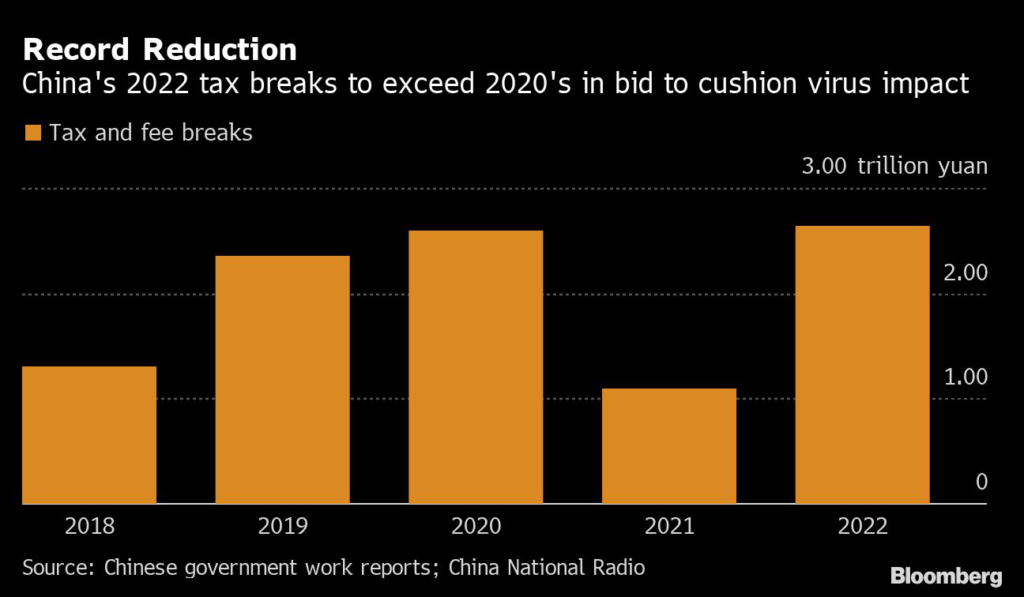
Fiscal stress had been increasing even before the Covid spending pressures. The government decided in May to offer more tax relief to businesses than the original plan of 2.5 trillion yuan ($370 billion) in reductions, giving up more income. On top of that, a slumping housing market and falling land sale revenue has dragged down local government fund income by 26% in the first five months of this year to 2.2 trillion yuan. 

Authorities have two ways to deal with the revenue hole — borrow more or curb spending. A weakening economy makes the latter option less appealing, meaning the government may be forced to leverage up further, either by issuing more official debt or by loosening the curbs on off-balance sheet debt. Either one would mark a major setback to China’s efforts to deleverage.

If local government’s don’t borrow more to pay for investment and stimulus, they could be forced to scale back spending in areas other than the fight against Covid, making the country’s annual growth target of around 5.5% even harder to reach.

“Since Beijing is less willing to expand central-government debt, it will probably also end up tolerating some further increase in hidden local debt” to pay for infrastructure spending, according to Gavekal Dragonomics analyst Wei He. “This will make the long-term campaign to control local debt harder to manage but that is not the major concern for policymakers at the moment.”

Here is a look at some of the factors contributing to the financial woes faced by China’s local governments.

Covid Testing

China’s strategy of containing Covid relies on regular and repeated testing of the whole population around an outbreak and then isolation of those infected or exposed. As outbreaks become more common with the highly transmissible omicron variant, more and more cities are telling residents to take regular nucleic acid tests to try and spot outbreaks quickly, with the costs so far borne by the public purse.

Around 814 million people, mostly urban dwellers aged between 5 and 64, could be covered by a Covid test mandate, according to Nomura Holdings Inc. Assuming 70% of them take a test every two days, that will cost local governments 300 billion yuan a year, according to Lu Ting, the bank’s chief China economist. 

That estimate is based on a per test cost of 3.5 yuan per person, and adds up to about 2.6% of budgeted local government general fiscal revenue this year, according to Bloomberg calculations. 

Land Sales

Land auctions and property transactions have been hit hard this year, with Covid restrictions and lockdowns in cities like Shanghai and Beijing compounding already weak demand caused by the ongoing property crisis. Consumers are also cautious about buying homes due to concerns about the future and worries that debt-laden developers’ may not deliver projects or could go bankrupt.

That pessimism and retrenchment means developers aren’t buying land from local governments. Land sales in 50 key cities tracked by China Real Estate Information Corp. sank 70% from a year ago in May. That’s better than the record 78% dive in January, but still represents a fifth straight month of declines. 

Tax Rebates

In an attempt to counter the economic slowdown, the Chinese government started returning some previously collected taxes to companies in April. It had returned 1.34 trillion yuan through the end of May, figures from the Ministry of Finance showed.

That refund was equivalent to 54% of the 2.47 trillion yuan in the country’s total general fiscal revenue earned in the two months, according to Bloomberg calculations based on government data. However, the impact of tax rebates could be temporary, given that officials have said they want to complete returns for small companies and manufacturing firms by the end of this month so that businesses can benefit sooner.

Debt Risks

Rising debt is an issue in China and around the world, and Beijing is trying to make sure that local governments don’t take on more debt than they can manage, bring off-balance sheet debt back onto their books, and use the money productively. Even so, at the end of April 26 of 31 provinces had official debt worth more than 100% of their total 2021 revenue, according to S&P Global’s estimates. 

That was three more than at the end of 2021, showing how quickly the regions are borrowing money to support their economies. The northern port city of Tianjin tops the list with debt amounting to more than twice its annual income, followed by Guizhou and Yunnan in the southwest, Inner Mongolia in the north and Fujian in the east.

Efforts to control rising debt may make it more difficult for the regions to spend as required. That financial strain will likely become apparent in weaker regions first and hit them harder, increasing the possibility that towns and cities need to undergo what’s called “fiscal restructuring.” 

“Would there be another Hegang? We think it’s highly probable,” said Susan Chu, a senior director of S&P Global Ratings, referring to the first municipal-level government restructuring, which was revealed late last year. With China’s debt stock rising by 20% every year and interest expenses likely increasing at a similar pace, “the pressure of fiscal restructuring will emerge in smaller and poor areas this year and the next,” she said. 

More stories like this are available on bloomberg.com

©2022 Bloomberg L.P.
Adobe Cuts Annual Sales Forecast on Summer Demand, Currency

(Bloomberg) — Adobe Inc. reduced its annual revenue forecast, saying its business would be affected by currency fluctuations, seasonal shifts in demand and the decision to end sales in Russia and Belarus after the invasion of Ukraine. The shares declined about 3.5% in extended trading.

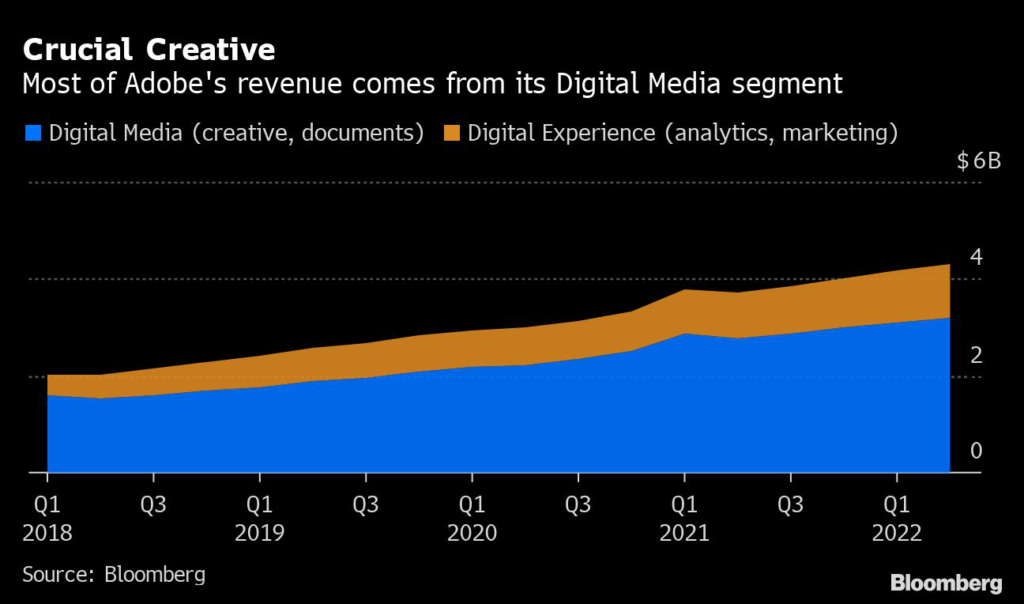
The forecast overshadowed a strong quarter for the maker of software for design professionals. Revenue increased 14% to $4.39 billion. Profit, excluding some items, was $3.35 cents a share in the period ended June 3, the San Jose, California-based company said Thursday in a statement. Both topped analysts’ estimates. 

Adobe said fiscal-year sales will be about $17.7 billion, a decrease from the company’s previous forecast of $17.9 billion. Profit, excluding some items, will be $13.50 a share from the earlier projection of $13.70.

Compared with some peers, Adobe is faring relatively well in a difficult macro environment, said Bloomberg Intelligence analyst Anurag Rana.

“The stock reaction to such a minor update to guidance is confusing, especially as bulk of the revenue guidance is due to FX,” he said.

Tech peers that have significant overseas exposure, including Salesforce Inc. and Microsoft Corp., have seen growth curtailed by a surging US dollar. Adobe, with more than 40% of its sales outside the Americas, said its revenue will be reduced about $175 million in the second half of the fiscal year by currency changes.

In addition to the currency headwinds, the reduced forecast is based on an estimated $75 million hit from pulling out of Russia and Belarus and “more pronounced summer seasonality” on demand from enterprise clients, Chief Financial Officer Dan Durn said during a conference call after the results were released.

Chief Executive Officer Shantanu Narayen said the company is being “a little cautious” as it relates to the next few months given the economic uncertainty. There’s a possibility that cost-cutting customers will delay purchases over the summer, which is traditionally a slower period, though the company is confident demand will return by the end of the year, he said.

“The question for us is timing,” Narayen said on the call.

Investors are increasingly skeptical about the dominance of Adobe’s line of software for design professions, which makes up about 60% of its revenue. The challenge comes from newer companies with more flexible offerings such as closely held Canva Inc., which BMO Capital Market’s Keith Bachman called “the primary threat.” Adobe has responded with an “express” suite of content creation tools aimed at nonprofessional users such as social media influencers and small businesses. It has also expanded its business over the past decade to include digital marketing, analytics and e-commerce products, which may be at risk in a struggling economy. 

Adobe’s core products targeted at professionals haven’t been hurt by competition, said David Wadhwani, president of Adobe’s digital media business, which includes Photoshop and other signature creative software. The real battleground is the rapidly expanding market for more-casual users, he said in an interview.

Revenue in digital media increased 15% to $3.2 billion in fiscal second quarter, Adobe said in the statement. Analysts, on average, estimated $3.16 billion. The company raised prices for its creative services abut a month before the end of the quarter, which generated an extra $10 million, Durn said. 

Sales in digital experience, the unit including analytics and marketing, rose 17% to $1.1 billion, compared with the average projection of $1.08 billion.

“We are winning in our established businesses and seeing significant momentum in new categories from content authoring for a broad base of creators to PDF functionality on the web to the leading real-time customer data platform for global enterprises,” Narayen said in the statement.

Shares dropped to a low of $340.26 in extended trading, then pared some of the loss after closing at $365.08 in New York. Amid an equity bear market that has particularly dented high-growth tech stocks, Adobe shares are down 36% this year. The company has been a favorite of Wall Street, with double-digit share gains nine of the past 10 years.

(Updates with comments from executive in the 11th paragraph.)

More stories like this are available on bloomberg.com

©2022 Bloomberg L.P.

China’s No. 2 Online Mall Warns Consumer Recovery Months Away

(Bloomberg) — China’s No. 2 online retailer sees worrying signs that shoppers are reluctant to reopen their wallets even as major cities emerge from bruising Covid lockdowns, suggesting consumer spending may take months to recover.

The months-long closure of cities like Shanghai has caused a fundamental shift in how people spend their money, with a pullback in discretionary spending continuing even after the lockdown of the financial hub ended a few weeks ago, according to Xin Lijun, chief executive officer of JD Retail. 

“The impact in the Covid-stricken cities are obviously larger and we are seeing that at the end of the outbreaks, there is no rapid recovery, which is very worrying to us,” said Xin, who heads a subsidiary of JD.com Inc.

“The outbreak this year has completely cut off the supply chains both internationally and domestic, and this has indeed impacted people’s livelihoods, which will probably take longer to recover,” he said in an interview with Bloomberg Television. 

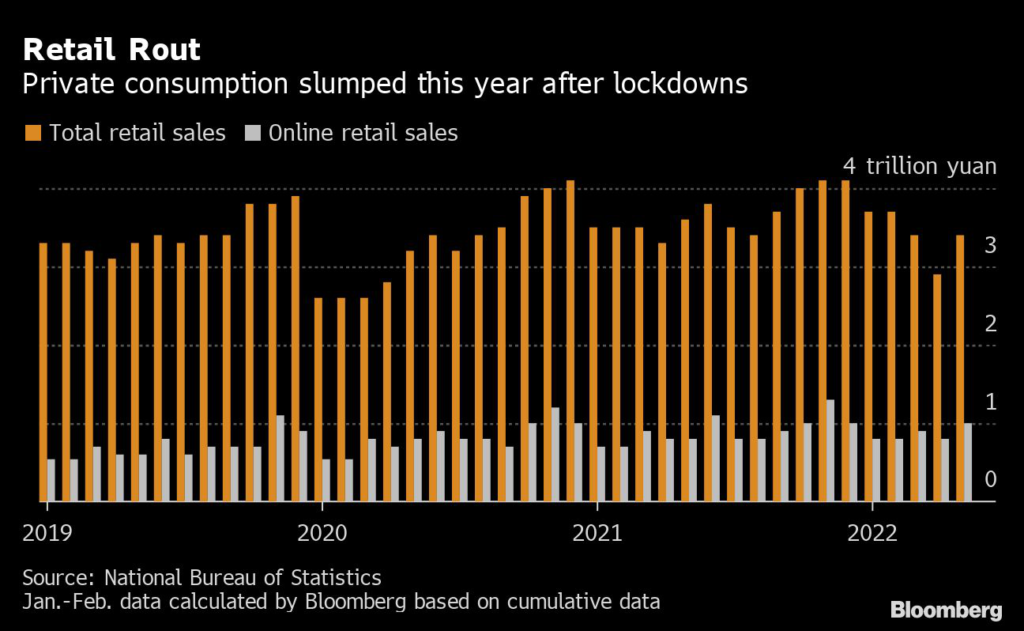
Retailers large and small have been buffeted for months by Beijing’s aggressive efforts to control outbreaks of the virus, with lockdowns of tens of millions of people and major cities paralyzing factory output and supply chains, as well as undermining consumer spending. The slow recovery now means it will be even harder for China to achieve the full-year economic growth target of around 5.5%, especially if there are further large-scale Covid outbreaks. 

Even with policy makers promising more support for private investment and the platform economy to mitigate the Covid shocks, economists have continued to cut their forecasts for growth this quarter and this year. Online retail sales will likely only grow in the low single-digits this year after expanding 12.5% last year, Fitch economists said on Thursday, with the slowing economy, rising unemployment, and expectations that the government will not give up on its Covid Zero policy this year all factors undercutting that expansion. 

Total retail sales shrank for a third straight month in May, according to official data this week, as consumers pulled back on spending and added record amounts to their savings. Online shoppers have fundamentally changed what they buy, according to Xin, with growing demand for essentials such as rice and oil as well as storage products like refrigerators, but spending less on things such as entertainment and fashion. 

“In the past, you had more of these types of non-essential consumption, but this has decreased now as incomes have been affected and people have become more cautious and calculating about what they spend money on,” Xin said. “You can very clearly see this kind of structural change in consumption trends and the implications for the future economic outlook.”

This was evident during the Shanghai lockdown, when products for storage and food stockpiling like refrigerators and freezers went out of stock and there was more demand for work-from-home essentials like printers and tablet computers, Xin said.

“The pandemic in 2020 was like a surprise to everyone, but people had strong faith that there will be rainbow after the storm,” he said. However, that’s not the case now. 

Unlike the aftermath of the Wuhan lockdown in 2020 when people splurged and quickly returned to their old shopping habits, this time there has been no sign of such “revenge consumption,” he said.


Logistical hurdles have also persisted as various places across China implement Covid Zero policies, including testing and travel restrictions, with varying degrees of aggressiveness. The State Council gave warnings this past weekend to provinces including Hebei, Anhui, and Shaanxi for excessive enforcement of policies that have blocked domestic supply chains. 

In one instance, officials at a highway toll gate in Hebei’s Zhangjiakou were forcing all drivers to take two different tests for Covid-19 to exit the highway. This wasn’t the first warning from Beijing to provinces telling them to be measured in enforcing the rules, indicating that this is a recurring problem. 

Xin was speaking days ahead of “6.18,” the annual June 18 online extravaganza during which major tech names from Apple Inc. to Xiaomi Corp. vie to ply shoppers with discounts. The scale of the gadgets-heavy event, which is watched as an indicator of consumer sentiment, should surpass 2021’s, he said, without elaborating.

Xin’s expectations for the rest of the year are cautious, given the sporadic city or district-wide lockdowns that have affected dozens of cities across China, including Shanghai, Shenzhen, northeastern China’s industrial hub of Changchun, or Suzhou and Hangzhou. 

At the same time, spending from consumers in smaller and less developed cities is picking up, particularly those less affected by Covid shutdowns. Spending growth in smaller tier-five and tier-six cities has greatly outpaced that of tier one and tier two cities like Shanghai and Shenzhen, he said.

More stories like this are available on bloomberg.com

©2022 Bloomberg L.P.

BlockFi Seeks to Quell Fear Amid Fallout from Crypto Hedge Fund Three Arrows

(Bloomberg) — Crypto lending platform BlockFi Inc. said it continues normal operations and no client funds are impacted, in an apparent move to allay concerns over contagion risks from the suspected troubles at crypto hedge fund Three Arrows Capital LLC.

BlockFi confirmed it recently had a large client that failed to meet its obligations on an overcollateralized margin loan, and it “fully accelerated the loan and fully liquidated or hedged all the associated collateral,” Chief Executive Officer Zac Prince said on Twitter, without naming the client. 

Earlier, the Financial Times reported that BlockFi was among companies that liquidated at least some of Three Arrows’ positions as the crypto hedge fund fails to meet margin calls. 

The crypto industry has been shaken by the fall from grace of major lending platform Celsius Network Ltd, which has frozen withdrawals since Sunday, followed by the apparent troubles at Three Arrows. Market participants are concerned that more companies will suffer from collateral damage. Crypto derivatives exchange Deribit, whose parent company counts Three Arrows as a shareholder, said on Twitter Thursday that it remains “financially healthy,” despite having a net debt that it now considers “potentially distressed.” 

Singapore-based Three Arrows is among the world’s biggest players in the crypto industry, holding investments and tokens in a wide range of crypto projects. On Tuesday, its co-founder Zhu Su tweeted that the company is committed to “working this out,” without providing further details. Three Arrows didn’t immediately respond to a request for comment by Bloomberg. 

Crypto Hedge Fund’s Ominous Tweet Is Latest Shock to Market

“We believe we were one of the first to take action with this counterparty,” BlockFi’s Prince said. BlockFi said it continues to actively lend and fulfill withdrawal requests. Based in Jersey City, New Jersey, the company recently cut headcount by 20%, and a spokesperson said its executive team, including founders Prince and Flori Marquez, took a pay cut due to the market condition. It is looking to raise new funding at a reduced valuation of about $1 billion, Bloomberg News reported earlier, citing people with knowledge of the plan. 

More stories like this are available on bloomberg.com

©2022 Bloomberg L.P.

UK to Kill ‘Irritating’ Cookie Pop-Ups in Post-Brexit Data Plan

(Bloomberg) — The UK set out a plan to roll back data protection obligations and cookie consent boxes in an attempt to boost business and research.

A planned Data Reform Bill will cut “burdens on businesses to deliver around £1 billion ($1.23 billion) in cost savings” over ten years, the Department for Digital, Culture, Media and Sport said in a statement summarizing the legislation Thursday. 

The announcement criticized the EU’s “highly complex” General Data Protection Regulation and promised a “clampdown on bureaucracy, red tape and pointless paperwork” to “seize the benefits of Brexit.”

Small British businesses will no longer be required to have a data protection officer and fill out “lengthy impact assessments.”  Internet users will be given the option to opt-out rather than needing to opt-in for the collection of cookies — which track users around the internet. The government said the change will cut down on “the irritating boxes users currently see on every website”.

As Britain diverges from the bloc and faces legal action from Brussels for threatening the Northern Ireland protocol, Prime Minister Boris Johnson will have to balance apparent opportunities with the risk of jeopardizing a key deal signed last year guaranteeing data flows between the UK and the continent, which has a clause allowing for regular reviews.

A DCMS spokeswoman didn’t immediately respond to a request for comment on maintaining a “data adequacy” arrangement.

The bill also increases fines for the perpetrators of nuisance calls and texts, and says researchers will not need to be as specific about why they’re collecting data: they could rely on a previous consent for “cancer research,” rather than getting a new approval for their particular study, for instance.

The government will also be able to exert more control over the country’s data watchdog, the Information Commissioner’s Office. Culture Secretary Nadine Dorries will have to approve its statutory codes and guidance before they are presented to Parliament.

More stories like this are available on bloomberg.com

©2022 Bloomberg L.P.

Musk Pledges No Changes at Twitter — for ‘Exceptional’ Workers

(Bloomberg) — Elon Musk, who met directly with Twitter Inc. employees for the first time since signing a $44 billion deal to acquire the social network, told staffers they shouldn’t worry about changes to their jobs once he takes over — as long as their work is “exceptional,” that is.

At an all-hands meeting Thursday, Musk prompted a flurry of snarky, frustrated and concerned commentary on internal message boards with his remarks on several topics, including potential plans for layoffs and his approach to remote work. In both instances, Musk said that employees would be safe from job cuts and can continue to work remotely if they are creating “exceptional work.”

“The bias definitely needs to be strongly towards working in person, but if somebody is exceptional, then remote work can be OK,” said Musk, according to people who attended the meeting. The billionaire, who is also chief executive officer of Tesla Inc., recently demanded that many employees at the electric-car maker return to the office, sparking consternation among Twitter employees who were given the freedom to work from anywhere in 2020 as the pandemic shut down offices around the world.

“If someone is excellent at what they do but can only work remotely, to then fire them even though they are doing excellent work would be insane,” Musk added. “So I’m definitely not in favor of things that are, like, mad. I’m in favor of things that build the business and make it better.”

When Musk was asked about possible job cuts at Twitter, he didn’t confirm a headcount reduction was coming, but hinted that the San Francisco-based company needs to better manage expenses. Twitter has already implemented a number of cost reductions, including canceling its scheduled all-company retreat at Disneyland in early 2023. 

“The company does need to get healthy. Right now the costs exceed the revenue so that’s not a great situation to be in,” he said. “Anyone who is like obviously a significant contributor should have nothing to worry about,” he added, noting that he won’t take “actions which are destructive to the health of the company.”

Read more: Five key takeaways from Musk’s meeting with Twitter employees

Musk’s appearance at the meeting did little to appease those concerned that the deal will lead to major upheaval at the company. An internal Slack channel devoted to discussions about Musk’s comments was mostly full of employees who were upset with his answers, with some openly mocking the would-be boss.

Employees took particular issue with Musk’s focus on workers who are “exceptional,” according to three people familiar with the interactions, and some of the comments joked about Musk providing special treatment to these employees.

“Friendly reminder that you can show up 10 minutes late to a meeting that was announced to the world and still be exceptional,” one employee wrote on Slack, referring sarcastically to Musk’s own tardiness to the all-hands on Thursday.

A few comments were supportive of Musk. One staffer posted that others were choosing to interpret Musk’s comments in the “least generous way possible,” though Musk supporters were in the minority, said the people, who asked not to be identified discussing internal business.

Musk joined the video call in a white button-down shirt and appeared to be dialing in from his phone. He rambled throughout parts of the call– at one point late in the discussion, he brought up aliens and the “meaning of life,” adding, “I have seen no actual evidence for aliens.”

Still, the conversation started with Musk on message for his audience, expressing a “love” for Twitter’s service. The social network is a great way to get his thoughts out to the public, he said, and pointed out that his tweets alone can generate full news stories. “Some people use their hair to express themselves. I use Twitter,” he said.

What Musk didn’t bring up was a clear, forceful intention to complete the deal. Some at the company took Musk’s appearance as a positive sign that he intends to fulfill his $54.20 per-share agreement, but Musk himself has cautioned in recent weeks that he might walk away from the accord if Twitter doesn’t do more to prove that its user base is predominantly real people and not bots.

Musk mentioned bot and spam accounts on the service at the meeting Thursday, saying it was important for there to be “transparency” on Twitter to build trust with users. He suggested that Twitter could start to authenticate a user’s identity through Twitter Blue, the company’s current subscription service.

The conversation was moderated by Twitter Chief Marketing Officer Leslie Berland, who summarized some employee questions that were submitted ahead of time. CEO Parag Agrawal introduced Musk, although he and other top executives like finance chief Ned Segal didn’t speak during the interview, which lasted about 45 minutes, according to attendees.

While there’s no way to know which executives might leave once Musk takes over, the Tesla CEO has made it clear he isn’t pleased with Twitter’s current management. Presumably that includes Agrawal, as well as Twitter’s top lawyer, Vijaya Gadde, whom Musk has criticized publicly for her role in enforcing the company’s policies around hate speech and misinformation.

While Twitter’s stock fluctuated throughout the meeting, and traded higher for a time even as the broader market fell, it ended the New York session down 1.7% at $37.36, more than 30% below the per-share price Musk has agreed to pay. 

More stories like this are available on bloomberg.com

©2022 Bloomberg L.P.

Close Bitnami banner
Bitnami