Bloomberg

NTT Data Teaming Up With Toyota for Overseas Connected-Cars Push

(Bloomberg) — Nippon Telegraph & Telephone Corp.’s data subsidiary is joining forces with Toyota Motor Corp. to develop connected cars that can collect and share data.

NTT Data Corp. will actively consider mergers and acquisitions to accelerate a push into overseas markets, Yo Honma, the networking and data subsidiary’s chief executive officer, said in an interview. Honma sees the company spending as much as 400 billion yen ($3 billion) for deals over the next four years. 

Toyota and other Japanese carmakers have been ramping up efforts to develop electric vehicles and connected cars, which can communicate with each other and outside networks to improve autonomous driving, performance and in-car features. New connected-car sales are on track to reach 94.8 million units globally in 2035, almost tripling from 2020, according to researcher Fuji Keizai Group.

“We’ll be planning a global roll-out after discussing with Toyota, once we have a product that is good enough to draw global attention,” Honma, 66, said. NTT Data will consider raising money from capital markets as needed, he added. The company hasn’t issued new shares since 1998. 

Telecoms giant NTT currently owns about 54% of NTT Data, according to data compiled by Bloomberg. Last month, NTT unveiled plans to transfer its overseas business unit to NTT Data. The move effectively brings all of the telecommunication group’s overseas activities under one umbrella. 

Woven Planet Holdings, Toyota’s advanced technology firm, has been on an acquisition spree since it was established last year to bolster its ranks of software engineers. The next-generation research unit said in September it will acquire Silicon Valley startup Renovo as a means to speed up its launch of a software platform for cars.

The latest move builds on a partnership between NTT and Toyota after they first formed a consortium five years ago to develop a connected-car ecosystem. NTT Data’s strength is in collecting data in a secure way and analyzing using artificial intelligence, Honma said.

More stories like this are available on bloomberg.com

©2022 Bloomberg L.P.

Crypto Selloff Resumes as Post-Fed Mood in Global Markets Sours

(Bloomberg) — The selloff in the digital-asset space accelerated Thursday, with losses in US equities also snowballing, a day after the Federal Reserve raised interest rates by the most in decades. 

Ether, down as much as 8.3% on Thursday to trade around $1,080, is facing a tougher road than most. The native token for the Ethereum blockchain is on pace to decline for a 10th straight day, the longest losing streak in Bloomberg records back to February 2018. It has lost about 40% since the start of June alone. 

Bitcoin, meanwhile, held up relatively better, though it still shed 4.2% at one point during the session. Many investors say the largest cryptocurrency by market value often serves a place of refuge for crypto investors during volatile periods.

“Bitcoin has proven its resilience time and again,” LMAX Group Chief Executive Officer David Mercer said at the Bloomberg New York office. “This is an asset that has been around 14 years now and it’s been through various cycles.” Still, he added that “Bitcoin today is a risk on-off asset. It’s no different from stocks. Why should anyone be surprised with the volatility?”

Cryptocurrencies and other risk assets have been under pressure, with the S&P 500 on Thursday falling to its lowest close since the end of 2020, and the tech-heavy Nasdaq 100 dropping 4%. It’s happening as the Federal Reserve raises interest rates to combat red-hot inflation, creating an unfavorable environment for speculative areas of the market. The prolonged downturn has led to a drop of more than $1 trillion in crypto market value this year. 

“It’s a speculative investment and really has been trading along with the tech shares,” said Chris Gaffney, president of world markets at TIAA Bank. “It’s more a tech play than anything else. It’s not a hedge against volatility. It’s not a hedge against currency and inflation.”

Meanwhile, Cardano, Solana and Dogecoin also stumbled. Polkadot lost roughly 10%. 

Crypto markets have served up gut-wrenching losses over the past month, but many have welcomed the wring-out of excesses and sky-high speculation. 

“The reality is we need to see capitulation where that ‘noobishness’ gets washed out,” said Max Gokhman, chief investment officer for AlphaTrAI, adding that “we need to see the asset class evolve to a more mature state, and I think it’s in the process of doing that.”

Terra, Celsius

Last month’s collapse of the Terra blockchain and the recent decision by crypto-lender Celsius Network Ltd. to halt withdrawals have also taken a toll, while a tweet this week from the co-founder of crypto hedge fund Three Arrows Capital fueled speculation that it had suffered large losses. 

Even long-term holders who have avoided selling until now are coming under pressure, according to researcher Glassnode.

“Crypto is a risk asset. It’s an expression of people taking where they are on the risk spectrum, whether they’re playing more risk-averse or if they’re playing more risk-seeking,” Anna Han of Wells Fargo Securities LLC said in an interview. 

All sorts of pockets in crypto have been beset by negative developments. A number of firms in the space have announced layoffs and hiring freezes, and many market-watchers are expecting further price declines. 

Michael Purves, founder and CEO of Tallbacken Capital, sees that risk for Bitcoin. “We continue to think that Bitcoin’s broader picture is bearish, and perhaps our $15k target is not bearish enough,” he wrote in a note. “Nonetheless, for the near term, we recommend taking profits on short positions.” 

(Updates prices throughout, adds comment in fourth, sixth paragraphs.)

More stories like this are available on bloomberg.com

©2022 Bloomberg L.P.

Revlon Files Bankruptcy Amid Supply Woes, Loan Controversy

(Bloomberg) — Revlon Inc. filed for Chapter 11 bankruptcy as the global supply chain crunch proved the tipping point for the debt-laden company that has struggled to tap into a broader cosmetics sales boom driven by social-media influencers.

The bankruptcy caps a tumultuous period for the cosmetics giant, owned by billionaire Ron Perelman’s MacAndrews & Forbes, which suffered during the pandemic after years of declining sales and endured financial controversies that the company said Thursday could “impede” its restructuring process. 

At issue is a disputed asset transfer largely in 2020, which saw Revlon stave off default by cutting a deal with lenders that moved collateral out of other creditors’ reach. The financing maneuver angered those who missed out and sparked years of litigation. It also inadvertently embroiled Citigroup Inc. after the bank helped arrange the deal, and later mistakenly paid some creditors nearly $900 million while intending to process a routine interest payment. 

That marked one of the industry’s most legendary snafus — leading to ongoing litigation over ownership of the $500 million not returned by recipients.

The company said in court filings Thursday that the resulting “uncertainty” over who holds a slew of term loans “is likely to impede” the Chapter 11 process. 

“We don’t know whether folks are going to want to challenge that transaction,” Paul Basta, a bankruptcy attorney for Revlon, said during the company’s first Chapter 11 hearing Thursday. “If this is going to become a dispute, it should be raised immediately and addressed so it doesn’t become a drain on the estate.”

At least one group of creditors said the 2020 debt deal will need to be addressed in the bankruptcy.

“My clients believe that transaction was improper,” James Savin of law firm Akin Gump Strauss Hauer & Feld said on behalf of a group of term lenders. “Basically, our collateral was stripped, your honor.”

Consumer Demand

Revlon sought court protection in the Southern District of New York late Wednesday. It listed assets totaling $2.3 billion as of late April, and debts of $3.7 billion, according to court papers. 

Chapter 11 filings allow a company to continue operating while it works out a plan to repay creditors. Revlon said in a statement that it’s lined up $575 million of so-called debtor-in-possession financing from existing lenders to fund itself during bankruptcy. 

“Consumer demand for our products remains strong – people love our brands, and we continue to have a healthy market position. But our challenging capital structure has limited our ability to navigate macro-economic issues in order to meet this demand,” Revlon Chief Executive Officer Debra Perelman said in a statement. 

The 90-year-old company got its start selling nail polishes in the throes of the Great Depression, and later added coordinated lipsticks to its collection. By 1955, the brand was international. 

Perelman’s holding company took control of Revlon in an acrimonious takeover in 1985, funding the deal with junk debt raised by Michael Milken. MacAndrews & Forbes at one point sued Revlon over the company’s acceptance of a lower offer from Forstmann Little & Co., resulting in a landmark Delaware court decision on the fiduciary duties of board members, sometimes dubbed the “Revlon Rule.”

The company’s debt load proved burdensome, especially after it sold more than $2 billion of loans and bonds to fund its acquisition of Elizabeth Arden in 2016. It also owns brands including Cutex and Almay, and markets in more than 150 countries. 

In recent years, Revlon has struggled to compete with newer brands and those owned by rivals L’Oreal SA and Estee Lauder Cos. that have turned to video bloggers and Instagram personalities to fuel growth. The pandemic provided another blow to sales.  

The case is Revlon Inc., 22-10760, U.S. Bankruptcy Court for the Southern District of New York. 

(Adds comments from hearing in sixth paragraph.)

More stories like this are available on bloomberg.com

©2022 Bloomberg L.P.

Stock Traders Coming to Grips With a Fed as Baffled as They Are

(Bloomberg) — Fifty or 75? Headline or core? Prices at the pump and in the basket, or expectations for what they’ll one day be?

Traders looking to bet on the path of Federal Reserve policy and its impact on the economy griped about being flummoxed after Chair Jerome Powell’s press conference Wednesday. With precious little to base an investment case on, it took them less than a day to decide to sell everything.

There was a time when investors could be relatively certain about where the central bank was headed, even in times of stress. Now, with inflation out of control and odds of a recession rising fast, figuring out what will happen next is proving impossible.

“This is tough to admit for everybody, including Fed Chair Powell, but we don’t have a crystal ball, the Fed does not have a crystal ball on inflation,” Anastasia Amoroso, the chief investment strategist at iCapital, said on an episode of the “What Goes Up” podcast. “We have capitulated to this view that we just don’t know what the next inflation print is going to look like. We cross our fingers, we hope it’s lower than it was the month before. But the reality is we don’t know.” 

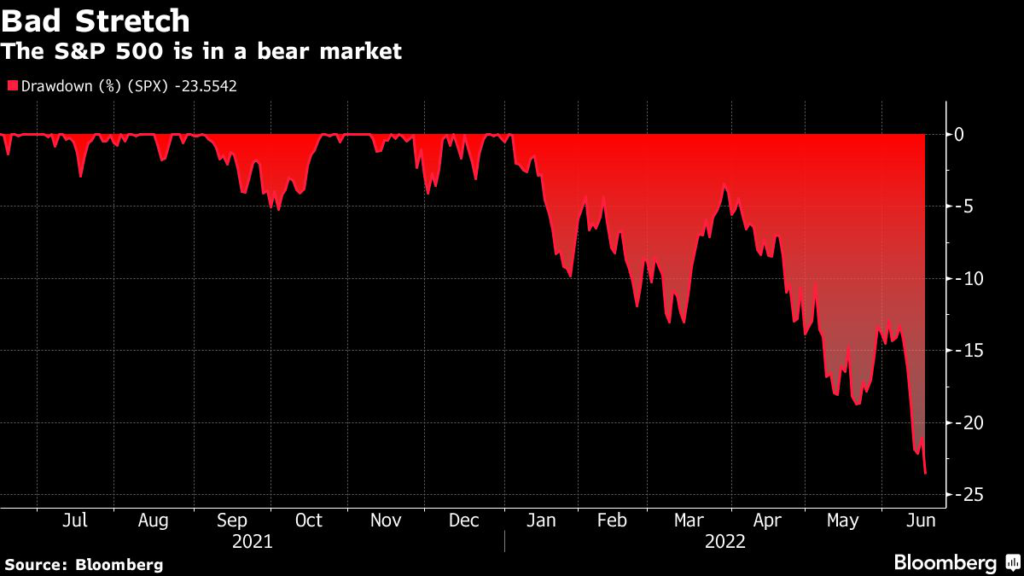
The S&P 500 lost 3.3% to trade at its lowest level since the end of 2020. That it was the worst session in only three days speaks to the chaos gripping markets of late. The Nasdaq 100 was down 4% Thursday. Bonds, Bitcoin, every sector in the S&P 500 dropped — little was spared.

Powell on Wednesday delivered the central bank’s largest interest-rate increase in nearly three decades while conceding that whether a recession will happen is in many respects out of his hands. The chairman also endorsed raising rates well into restrictive territory as he looks to steer the central bank through a cooling off period for the economy, something few people in his shoes have successfully achieved. 

One big question — whether the Fed will deliver a 50- or 75-basis-point hike next month — went unanswered. His focus on headline inflation figures, which include volatile food and energy price swings, also struck some as confusing.

The Fed’s forecasts and Powell’s commentary surfaced a host of “contradictions,” according to Bespoke Investment Group. Among them, a protracted discussion on the importance of headline inflation, at the expense of the central bank’s preferred measure that strips out energy and food costs. Powell said 75 basis-point hikes wouldn’t be common, then in the next breath that one of that size was possible in July. 

Traders were left unsure of how to handicap the next move, or which metrics to focus on as data rolls in during the coming six weeks.

“Chair Powell thinks consumer inflation expectations are at risk from headline inflation, but he also thinks that current headline inflation rates are not impacting expectations in any fundamental way,” Bespoke wrote in a note. “Which is it?”

After a decade of allocation decisions made easy — buy US large-cap tech, primarily — things are getting tough again, said Max Gokhman, chief investment officer for AlphaTrAI. Not only must investors predict what the Fed will do, but also what the market will be expecting it to do. “This means there may be tactical plays into cyclical sectors that pop should the Fed not prove more hawkish than consensus predictions,” he said. “The converse could mean that temporary shelter will be entirely outside of US assets.”

That makes it a nuanced market, Gokhman added. “Allocators have to work to earn their fees now.” 

Investors are definitely questioning whether the Fed has the answers, said Chris Gaffney, president of world markets at TIAA Bank. “Confidence is so important with central banks and I don’t think that the latest moves show a lot of confidence.” 

On Thursday, meanwhile, mortgages rates jumped the most since the 1980s, hurting homebuilders. That, among other data prints, is not exactly confidence-inducing, according to Simona Mocuta, chief economist at State Street Global Advisors. 

“The day after the Fed hiked 75 basis points, you got a bunch of bad data. So I’m like, OK, well, this is not quite that strong an economy,” Mocuta said. “The timing is a little disconcerting — to escalate the speed of timing so far. We were worried even before about a slowdown/recession. I think that those worries simply just intensified.”

More stories like this are available on bloomberg.com

©2022 Bloomberg L.P.

Leuthold Worst Case Has S&P 500 Overshooting Its Historic Floor

(Bloomberg) — Downward spiraling stocks are showing no signs of finding a floor. Brace yourself, because at least one forecasting framework says the bottom may still be a ways away.

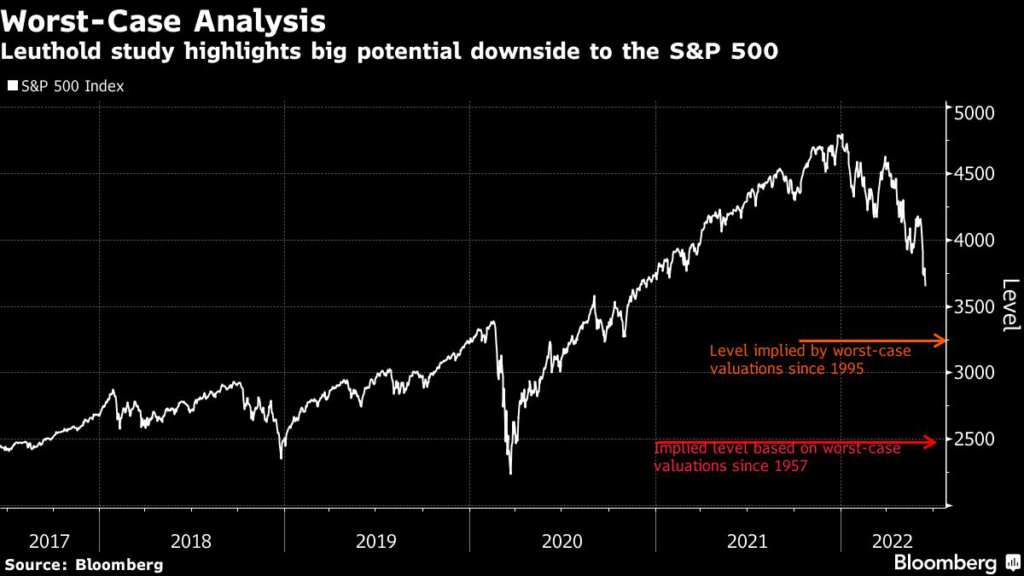
That’s an interpretation of data compiled by Leuthold Group, using a particularly bloodless standard of analysis that focuses not on investor psychology or positioning but strictly reversions to the valuation floors of past selloffs. In this historical lens, the Minnesota-based money manager sees precedent for an additional drop in the S&P 500 of between 11% and 32%.

Troubled times give voice to pessimists, and Leuthold’s downside studies are famously brutal, accentuating worst-case scenarios from past eras when investor faith was tried mightily. With the S&P 500 down 2% or 3% in four of the last six days, on the other hand, the time for a sober reckoning — however difficult — may have arrived.

“A secular bear market can drop well below the median valuation level,” Paula Mikl, senior vice president at Leuthold, said by phone. “If that happened to be the case, like 1973, 1974, or 2007 to 2009, there was significantly more downside.”

One of the reasons Leuthold’s model is still flashing downside is that it is based on valuation, a particular problem in today’s market, despite relentless selling pressure that is battering investors daily. Monetary stimulus and government spending last year sent the S&P 500 and Nasdaq Composite to levels relative to earnings and sales with few precedents since the dot-com bubble of the late 1990s.

Applying a suite of valuation metrics that compare shares prices to things like earnings, dividends and cash flows, Leuthold found that even after a decline of more than 20%, the S&P 500 still looks stretched when stacked against the historic norm. Against levels more common with the bottom of big selloffs, the picture gets uglier.

To be sure, no one can predict with confidence the proper multiples that shares can fetch. But in today’s market, when the Federal Reserve is raising interest rates at the most aggressive pace in decades to tame red-hot inflation, and the growth outlook gets murkier with the pandemic and war lingering, a case can be made that the current multiple contraction has a chance of overshooting on the downside. 

To account for that — basically to account for the fact that the S&P 500 is now in a bear market — Leuthold calculates the distance to a somewhat depressed historical valuation: the 25th percentile, to be exact. Based on that since 1957, the S&P 500’s implied level today is around 2,478. That represents a 32% drop from where it closed Thursday. Updated for a shorter interval — one that begins in 1995, a period of higher multiples and higher returns on intangible assets — the fall would be about 11%. 

Already, the market has endured one of the fastest valuation contractions in history. After peaking above 30 times earnings a year ago, the S&P 500’s multiple shrunk by 43% — almost matching the size of the contraction during the entire 2000-2002 crash. 

Brian Bost, co-head of equity derivatives in the Americas at Barclays Plc, is cautious, given a flurry of headwinds weighing on the market, from inflation to a hawkish Fed and geopolitical tensions. 

“It’s the culmination of all those that’s creating a little bit of a storm that is much more complex than just one asset bubble popping,” Bost said by phone, referring to a broad selloff across assets from bonds to cryptocurrencies.  “In order for things to get better, they definitely have to get worse first.”

More stories like this are available on bloomberg.com

©2022 Bloomberg L.P.

Revlon Says Bankruptcy Is Complicated by Financial Controversies

(Bloomberg) — Revlon Inc. filed for Chapter 11 bankruptcy as the global supply chain crunch proved the tipping point for the debt-laden company that has struggled to tap into a broader cosmetics sales boom driven by social-media influencers.

The bankruptcy caps a tumultuous period for the cosmetics giant, owned by billionaire Ron Perelman’s MacAndrews & Forbes, which suffered during the pandemic after years of declining sales and endured financial controversies that the company said Thursday could “impede” its restructuring process. 

At issue is a disputed asset transfer largely in 2020, which saw Revlon stave off default by cutting a deal with lenders that moved collateral out of other creditors’ reach. The financing maneuver angered those who missed out and sparked years of litigation. It also inadvertently embroiled Citigroup Inc. after the bank helped arrange the deal, and later mistakenly paid some creditors nearly $900 million while intending to process a routine interest payment. 

That marked one of the industry’s most legendary snafus — leading to ongoing litigation over ownership of the $500 million not returned by recipients.

The company said in court filings Thursday that the resulting “uncertainty” over who holds a slew of term loans “is likely to impede” the Chapter 11 process. 

Consumer Demand

Revlon sought court protection in the Southern District of New York late Tuesday. It listed assets totaling $2.3 billion as of late April, and debts of $3.7 billion, according to court papers. 

Chapter 11 filings allow a company to continue operating while it works out a plan to repay creditors. Revlon said in a statement that it’s lined up $575 million of so-called debtor-in-possession financing from existing lenders to fund itself during bankruptcy. 

“Consumer demand for our products remains strong – people love our brands, and we continue to have a healthy market position. But our challenging capital structure has limited our ability to navigate macro-economic issues in order to meet this demand,” Revlon Chief Executive Officer Debra Perelman said in a statement. 

The 90-year-old company got its start selling nail polishes in the throes of the Great Depression, and later added coordinated lipsticks to its collection. By 1955, the brand was international. 

Perelman’s holding company took control of Revlon in an acrimonious takeover in 1985, funding the deal with junk debt raised by Michael Milken. MacAndrews & Forbes at one point sued Revlon over the company’s acceptance of a lower offer from Forstmann Little & Co., resulting in a landmark Delaware court decision on the fiduciary duties of board members, sometimes dubbed the “Revlon Rule.”

The company’s debt load proved burdensome, especially after it sold more than $2 billion of loans and bonds to fund its acquisition of Elizabeth Arden in 2016. It also owns brands including Cutex and Almay, and markets in more than 150 countries. 

In recent years, Revlon has struggled to compete with newer brands and those owned by rivals L’Oreal SA and Estee Lauder Cos. that have turned to video bloggers and Instagram personalities to fuel growth. The pandemic provided another blow to sales.  

The case is Revlon Inc., 22-10760, U.S. Bankruptcy Court for the Southern District of New York. 

(Updates with additional details throughout)

More stories like this are available on bloomberg.com

©2022 Bloomberg L.P.

Fanatics Hires CEO for Its Billion-Dollar Collectibles Business

(Bloomberg) — Fanatics Inc. hired a former television executive to grow its trading card and collectibles business.

Mike Mahan, the former chief executive officer of Dick Clark Productions, will run a set of new businesses Fanatics acquired or created over the past year. He’ll be in charge of a growing portfolio of collectibles brands, including longtime baseball card incumbent Topps, pop-culture card label Zerocool and Candy Digital.

Fanatics said the collectibles business is approaching $300 million in profit. It expects the division to surpass $1 billion in revenue in 2022. By comparison, the company has said the e-commerce business will have $4.5 billion in revenue this year.

Fanatics CEO Michael Rubin has been growing collectibles through deals with sports leagues and players’ unions. Fanatics  bought Topps for about $500 million in January to fast-track the division’s growth. Then in March it created the Zerocool line of physical trading cards for culture and entertainment properties. Last week, Fanatics signed deals for college sports cards with more than 100 schools.

Candy, a digital collectibles business, has agreements with the likes of Major League Baseball and Netflix Inc. to sell non-fungible tokens based on their intellectual property. 

Fanatics has focused on sports-adjacent categories as it expands from its roots in licensed apparel for athletic teams. In April, Rubin said he expects the company to go public at some point.

Rubin said the collectibles business has seen “tremendous growth” over the past year. Trading cards in particular have been red-hot over the past two years for both hobbyists and investors looking to put their cash in alternative assets. At least 18 cards have sold for more than $1 million this year, including a Honus Wagner baseball card that went for $3.1 million at auction in March, according to card grader and price guide Beckett.Mahan will expand marketing in an effort to grow the number of collectors across the industry. He will report to Rubin in his new role.

More stories like this are available on bloomberg.com

©2022 Bloomberg L.P.

EVs Now Average Over $60,000 as Tesla, Rivian, Ford Raise Prices

(Bloomberg) — With gasoline prices in America topping $5 a gallon for the first time, the one vehicle that can alleviate pain at the pump — an electric car — is experiencing its own bout of runaway inflation.

Automakers pressed by consumer demand and rising material costs are charging more for electric vehicles across the board. Market leader Tesla Inc. is boosting sticker prices by as much as $6,000 a car, its third increase this year, Electrek reported. Ford Motor Co. has raised the price of its Mustang Mach-E, following a similar move by electric-truck startup Rivian Automotive Inc.  

And yet the buyers still keep coming.

“We’ve seen an actual acceleration in demand” at Rivian since the boost on March 1, Chief Financial Officer Claire McDonough said at a Deutsche Bank conference Thursday. “We had 10,000 new pre-orders with a $93,000” average selling price.

The average price of an EV reached $60,984 last month, well above the $46,634 mark for the overall market, according to automotive researcher Edmunds.com. That average excludes Tesla, which doesn’t share pricing data with research firms, but Electrek reported that the popular Model Y long-range model now starts at $65,990, up from $62,990.

“There is growing interest in EVs because of the gas shock, which has been going on for months and shows no signs of abating,” Jessica Caldwell, Edmund’s executive director of insights, said in an interview. “Along with growing demand, there is very limited supply. And if anyone is going to absorb these costs, it’s probably someone looking at an EV, who generally has a higher income.”

Rivian’s McDonough isn’t the only auto executive saying that EV buyers continue to accept higher prices, even as the broader auto market is starting to push back on inflationary sticker prices.

“If there’s one area where I do think we have some capability to price left, it’s on our electric vehicles,” John Lawler, Ford’s chief financial officer, said Wednesday at the Deutsche Bank Global Automotive Conference. “So far, the pricing is sticking.”

Read more: Ford says Mustang Mach-E profit wiped out by costs

Beyond demand, automakers are boosting EV prices because of runaway raw-material costs, which Ford sees as a $4 billion headwind for the company this year. Chief Executive Officer Jim Farley recently said it now costs $25,000 more to build a battery powered Mustang Mach-E than a gas-fueled Edge SUV. Lawler said higher costs have wiped out EV profits at Ford.

“It’s not just gratuitous, take-advantage-of-the-market type of price increases,” Caldwell said. “We are seeing commodity costs going up, including the mining costs for everything that goes into an EV.”

Boosting prices is one approach automakers are taking to get EVs back in the black as demand surges. Ford also is re-engineering the Mach-E on the fly to reduce cost and improve margins.

EV price inflation also is being stimulated by the ongoing semiconductor shortage, which has crimped the supply of battery-powered models because they require more chips than traditional cars.

That led Tesla Chief Executive Officer Elon Musk to declare in an internal memo this week that the automaker had endured a “very tough quarter” due to supply constraints, despite delivering a record 310,048 vehicles in the year’s first three months. “We need to rally hard to recover!” he wrote.

That recovery includes asking its buyers to pay more.


More stories like this are available on bloomberg.com

©2022 Bloomberg L.P.
Canada Proposes New Rules to Protect Personal Information

(Bloomberg) — New legislation to give Canadians more control over their personal information will include the steepest corporate fines among Group of Seven nations, according to the country’s industry ministry .

The proposed Consumer Privacy Protection Act establishes penalties of C$25 million ($19.4 million), or as much as 5% of global revenue, whichever is greater, for companies that breach privacy rules. 

The bill will allow Canadians to move their information from one company to another securely and request that data be deleted. It will also limit the collection and usage of minors’ information, and give the country’s privacy commissioner broad powers to order a company to stop collecting data or using personal information.

Industry Minister Francois-Philippe Champagne and Justice Minister David Lametti introduced the legislation on Thursday as part of the government’s Digital Charter Implementation Act. It comes amid broader calls by several business groups to reform Canada’s privacy law to be more closely aligned with those of key trading partners, including the European Union.

“Without updated privacy legislation, Canadian business finds itself at a disadvantage. The law has not kept up with the pace of change, nor with Canada’s international competitors,” Mark Agnew, senior vice president at the Canadian Chamber of Commerce, said by email. “Finalizing and passing this legislation must be a top priority when the fall session begins.”

Earlier this month, Tim Hortons Inc. was found to have violated privacy laws by collecting “vast amounts” of sensitive location data from people who downloaded the restaurant chain’s mobile app.

Champagne and Lametti also tabled the Personal Information and Data Protection Tribunal Act to create a new court to enforce the privacy law, and the Artificial Intelligence and Data Act to establish a new AI and data commissioner who will monitor company compliance to ensure technology is used responsibly.

More stories like this are available on bloomberg.com

©2022 Bloomberg L.P.
Activision Blizzard Gives Details for Overwatch 2 Game Release

(Bloomberg) — Activision Blizzard Inc. said the sequel to its hit video game Overwatch will be released in two separate segments, pushing part of the game into next year.

The free, multiplayer, competitive mode of Overwatch 2 will come out Oct. 4 and the story mode will be released sometime in 2023, Activision said at a press event on Thursday. 

Overwatch, which was first released in 2016, sold 50 million copies by 2020 based on its winning combination of satisfying shooter mechanics and lovable characters. Overwatch 2’s competitive multiplayer mode hews closely to its predecessor and acts as more of an expansion to the original than a separate game itself. Fans who have played an early version of Overwatch 2’s multiplayer competitive mode criticized its similarity to the original.

The game’s story mode is Activision Blizzard’s major addition to the franchise. Next year, players will be able to experience Overwatch’s charismatic characters and their back stories as part of player-versus-the environment battles. It’s unclear whether that mode will cost extra money. 

“Through the years, we’ve developed cinematics, animated shorts and graphic novels for our players who just want to get deeper into the lore,” said Overwatch 2 game director Aaron Keller. With the player-versus-environment mode, “we have an opportunity to go a step further, to go deeper into diverse storytelling in ways that we just really haven’t been able to before.”

Activision Blizzard also announced that Overwatch 2 won’t include loot boxes–a controversial monetization tool that critics and officials have compared to gambling. Instead, the game will make money in part through a mechanism popularized through Epic Games Inc.’s Fortnite. known as battle passes, the model rewards players with extra content through a tiered system of free and premium passes.

More stories like this are available on bloomberg.com

©2022 Bloomberg L.P.

Close Bitnami banner
Bitnami