Bloomberg

Online Brand Boohoo Mulls Charging UK Shoppers for Returns

(Bloomberg) — Boohoo Group Plc is considering charging customers to send back garments as an increasing rate of returns crimps sales at the fast-fashion retailer.

The British firm, whose business is purely online, is looking at returns across all markets, Chief Executive Officer John Lyttle said in a phone interview Thursday, at a time when many retailers are trying to manage logistics costs. While Boohoo already charges in some international markets, the move would be a first in some places, including the UK.

The company is weighing possible changes after Zara owner Inditex SA recently imposed fees for online returns to tempt customers into its brick-and-mortar stores. Lyttle said a number of sellers are beginning to charge shoppers who send back goods.

Boohoo and Asos Plc both reported slowing sales on Thursday as the retailers — which saw demand surge during pandemic lockdowns — contend with the return of normal shopping habits and persistent supply chain woes.

Shares of both companies plunged.

When slashing its guidance for the year, Asos said that a significant rise in returns in the UK and Europe had hurt net sales. It added that returns are having a “disproportionate impact on profitability.” 

Asos currently does not charge for returns and isn’t thinking of charging right now, said Asos Chief Executive Officer Jose Antonio Ramos Calamonte in a media call. 

Changing its returns policy could be significant for Boohoo, which has many young customers who tend to buy a number of low-priced items and then decide what to keep or send back.

Customers are becoming more selective and more likely to return items as they shop for clothes to wear at special events like weddings and parties, according to Boohoo’s Lyttle. A year earlier, pandemic restrictions meant that athleisure was the dominant fashion and the fit was less important, he said. 

“In the UK, the returns rate is a big factor and in international it’s taking us a lot longer to get parcels to customers,” said Boohoo Chief Financial Officer Neil Catto, speaking in the interview. “Those factors still continue and we’re not expecting those to improve this year.”

(Updates with additional information on Asos returns in sixth and seventh paragraph.)

More stories like this are available on bloomberg.com

©2022 Bloomberg L.P.

Musk, Tesla, SpaceX Are Sued for Alleged Dogecoin Pyramid Scheme

(Bloomberg) —

Elon Musk, SpaceX and Tesla Inc. were sued for $258 billion over claims they are part of a racketeering scheme to back the cryptocurrency Dogecoin.

Keith Johnson, “an American citizen who was defrauded out of money by defendants’ Dogecoin Crypto Pyramid Scheme,” sued Musk and his companies, claiming they constitute an illegal racketeering enterprise to inflate Dogecoin’s price.

“Defendants falsely and deceptively claim that Dogecoin is a legitimate investment when it has no value at all,” Johnson said in his complaint, filed Thursday in federal court in Manhattan.

Johnson is seeking to represent a class of people who have lost money trading in Dogecoin since April 2019. He is asking for $86 billion in damages, plus triple damages of $172 billion, as well as an order blocking Musk and the companies from promoting Dogecoin, and declaring that Dogecoin trading constitutes gambling under US and New York law.

Musk didn’t immediately respond to emails seeking comment on the suit. Representatives of SpaceX and Tesla, and Tesla’s legal counsel, also didn’t respond right away.

Dogecoin was trading on Thursday at about 5 cents and is down about 67% this year. It spiked to as high as 74 cents last year before giving up those gains.

The case is Johnson v. Musk, 22-cv-05037, US District Court, Southern District of New York (Manhattan).

More stories like this are available on bloomberg.com

©2022 Bloomberg L.P.

Tesla Stock Has More Than Twitter Weighing on It

(Bloomberg) — The Twitter overhang on Tesla Inc. shares is turning out to be among the least of investors’ problems.  

Elon Musk’s decision to pursue a takeover of Twitter Inc. contributed to the plunge in Tesla’s stock over the past couple months. Yet even if the billionaire, who plans to address Twitter employees Thursday, decides to walk away from the deal, the electric-vehicle maker’s shares face enough headwinds that they may not recover that lost value. 

Blame it on rapidly worsening investor sentiment, with US stocks entering a bear market because of soaring inflation and higher interest rates that threaten to trigger a recession. Technology and growth companies — whose valuations reflect expectations for big future profits — have seen the worst of the rout, and Tesla fits that description to a tee. 

“While there might be some short-term relief for Tesla if Musk walks away, if the wider stock market keeps on plummeting I do not think Tesla is going to be immune to further slides,” said David Jones, chief market strategist at Capital.com.  

Tesla shares are now down 39% since Musk first disclosed a stake in Twitter, while the the S&P 500 Index has fallen 19% over the same period.

The stock initially fell as Tesla shareholders fretted that Musk would be spread too thin if he tried to overhaul Twitter while also running Tesla and overseeing his Space Exploration Technologies Corp. He also planned to use some of his Tesla stock as collateral for loans to pay for the deal, though his latest financing doesn’t include share pledges.

The broader economic anxiety has taken the shine off of good news, while negative headlines have served to deepen the gloom. For instance, when Tesla announced a widely anticipated stock split Friday, its shares didn’t get a boost. In contrast, a similar move by the company in 2020 had led to a 60% jump in the share price from the day of the announcement to the execution date, and partly fueled a stratospheric rally. 

Then there are other troubles that the company faces, including climbing raw-material costs, supply-chain shortages and production disruptions in China that refuse to go away. All of which present big hurdles to any rebound rally.  

Also, it’s hard to think of any outcome of the Twitter situation that can be good for Tesla investors, market watchers said. A takeover of Twitter by Musk will revive worries that he’s spreading himself too thin, while a decision to quit the deal won’t be much cleaner either. 

“There are valid reasons to believe that any deal termination would come only after lengthy and difficult negotiations and/or litigation,” said Steve Sosnick, chief strategist at Interactive Brokers. “Neither is a great use of Musk’s time and energy.” 

Musk has publicly expressed reluctance about the acquisition, saying last month it was “temporarily on hold.” Still, the deal has continued to progress in the background, with Twitter executives telling staff they plan to enforce the deal agreement.

Given Musk’s penchant for surprising investors, anything is possible, according to Sosnick. 

“Sure, he could pull a rabbit out of his hat tomorrow or at some point in the future; he has done it before,” he said. “But the market doesn’t expect it right now.”

Tesla shares dropped as much as 6.1% on Thursday in New York.

Tech Chart of the Day

What a turnabout: Electric-vehicle startups Rivian Automotive Inc. and Lucid Group Inc., which surpassed Ford Motor Co. and General Motors Co. in market value late last year, have plummeted in 2022, diving 74% and 57% respectively. Rivian is now valued at $25 billion and Lucid fetches $27 billion, versus about $50 billion each for Ford and GM. Investors have fled from speculative growth stocks as the Fed tightens monetary policy. 

Top Tech Stories

  • Tesla has increased prices across its lineup by as much as $6,000, Electrek reported, as global automakers grapple with surging costs for raw materials, particularly battery components.
  • Microsoft Corp. introduced Viva Sales, a new program meant to connect its Office and video conferencing programs with customer-relationship management software — its own and that of rivals, a step that could help it garner revenue from Salesforce Inc. clients.
  • The equity-linked debt of some of the pandemic’s darlings has plunged to record lows and is now considered distressed. The convertible bonds of Peloton Interactive Inc., Ocado Group Plc, Just Eat Takeaway.com NV are trading between 45 cents to 75 cents on the dollar or euro — levels that are considered distressed territory by debt investors.
  • Twitter canceled a company-wide retreat scheduled for January at Disneyland, saying cost-cutting measures to reduce corporate travel led the event to be scrapped.
  • Nick Candy has walked away from making an offer for embattled UK online shopping emporium THG Plc, just hours after a rival consortium also dropped its pursuit.
  • Rapid delivery startup Jokr is pulling back from its US operations to focus on its core Latin America business, joining a growing number of similar companies that are paring down and prioritizing profitability amid fading investor enthusiasm.
  • Block Inc., the payments-processing company formerly known as Square, plans to give up its former San Francisco headquarters as it transitions to a more distributed workforce model, dealing another blow to a city struggling to bring back workers after the pandemic.
  • Two of Britain’s biggest online fashion retailers reported slowing sales in a fresh sign that the cost-of-living crisis in the UK is denting consumer confidence. Asos Plc slashed its profit and sales guidance while Boohoo Group Plc recorded the first UK sales decline in its history as shoppers bought less online and returned more goods.

(Updates charts, stock move in fifth and 14th paragraphs.)

More stories like this are available on bloomberg.com

©2022 Bloomberg L.P.

As USDC Stablecoin Gains Momentum, a Euro Version Is On Its Way

(Bloomberg) — Circle Internet Financial Ltd. is launching a euro-based version of its popular USDC stablecoin, which has been gaining traction after its closest rival Tether has come under increased scrutiny. 

Euro Coin — EUROC — will be available June 30 to institutional customers as a regulated, euro-backed stablecoin, issued under the same full-reserve model as USDC, Circle said in a statement Thursday.

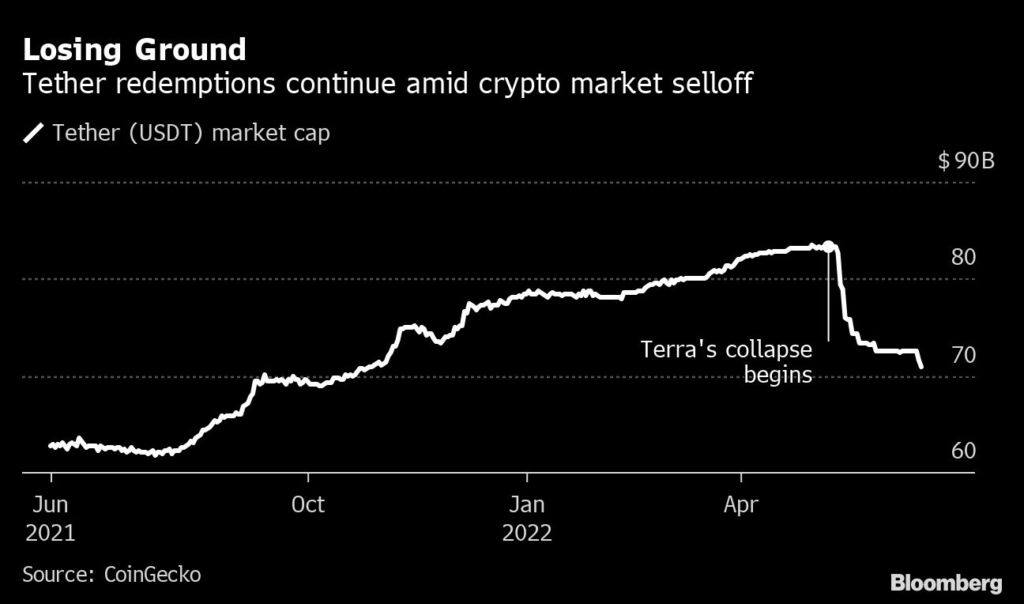
Tether briefly lost its peg to the US dollar last month, sending reverberations across the ecosystem of stablecoins, with investors seeking sanctuary in other crypto assets like USDC that aim to maintain a one-to-one peg with the dollar.

USDC “is much more transparent about its reserve holdings” than USDT, Citigroup strategists said in a note discussing the phenomenon. Last year, the company disclosed that some of the assets backing USDC included commercial paper and corporate bonds but then shifted them into cash and Treasuries.

Likewise, the Euro Coin will be fully-backed by euro-denominated reserves held in the custody of financial institutions within the US regulatory perimeter, beginning with Silvergate Bank, Circle said.

USDC’s market value has grown to roughly $55 billion from $42 billion at year-end, while redemptions in Tether has seen its value drop to about $70 billion from $78 billion, according to pricing from CoinGecko.

A representative for Tether didn’t immediately reply to an email seeking comment.

The growth of USDC has doubled the value of Circle’s planned merger with special purpose acquisition company Concord Acquisition Corp. to $9 billion. However, the date of the deal’s closing has been pushed back multiple times amid heightened scrutiny of SPAC mergers. 

Euro-based stablecoins haven’t taken off to the same extent as those based on the dollar. For instance, the value of Euro Tether, EURT, sits at $215 million, according to data from CoinGecko. 

Still, there is “clear market demand for a digital currency denominated in euros,” said Jeremy Allaire, co-founder and chief executive officer of Circle, in the statement. The euro has a 32% share of global trading after the US dollar’s 88% share, according to the 2019 triennial report from the Bureau of International Settlements. 

Euro Coin will debut on the Ethereum blockchain and Anchorage Digital, Binance.US, BitGo, Bitstamp, CYBAVO, Fireblocks, FTX, Huobi Global and Ledger will support Euro Coin at its launch, Circle said. Governance proposals will be submitted for inclusion on leading community-owned decentralized-finance (DeFi) protocols including Compound, Curve, DFX and Uniswap.

Like USDC, Circle would like to get EUROC on other blockchains in addition to Ethereum in future, said Dante Disparte, Circle’s chief strategy officer and head of global policy, in an interview.

“There’s work to be done still,” Disparte said. But “we think that over time this is an innovation Europeans will support.”

(Updates stablecoin market caps. A previous version corrected USDC’s year-end value.)

More stories like this are available on bloomberg.com

©2022 Bloomberg L.P.

Slack’s Subtle Redesign Aims to Make Users Feel Less Overwhelmed

(Bloomberg) — The Slack sidebar is getting an update, but you’re forgiven if you haven’t noticed.

Slack began rolling out the changes last Wednesday without fanfare, but it will take a few weeks to kick in for everyone. The new look is supposed to help users feel less overwhelmed, a frequent complaint heard by the ubiquitous workplace communications platform. Notification badges on the sidebar are now white instead of red, some extraneous icons are gone and there are more notification sounds to choose from. Overall, though, it doesn’t look much different.

The redesign, which took the better part of a year to complete, has so far flown under the radar. “We’ve literally heard no feedback, which is extremely unusual for our customer base,” Ali Rayl, Slack’s senior vice president of product, said in an interview. If no one really notices, she considers that a success. 

There’s a lot on the line: Slack is expected to bring in $1.5 billion in revenue in fiscal 2023, Salesforce said in its earnings call on May 31. For more than 12 million active daily users as of 2019, including those at some of the world’s biggest companies, Slack has become virtually synonymous with work. Rather than launch a full redesign with one big splash — which can cause disruption for  users —  this is just a start.

“At our scale, changes can make a huge difference in the aggregate,” Rayl said. “If these changes save each user a minute, that’s a massive net boost.”

Another change users can expect in the near future: seeing only those channels with unread messages in the sidebar, though the others will remain easily accessible. That’s meant to cut down on the “cognitive calories” users are spending to navigate the interface.

Critics question whether changing the app’s interface will actually add to net productivity. According to research by RescueTime, a productivity app that tracks how users spend their time, office workers check email or messaging apps like Slack every six minutes, on average. The steady flow of notifications, DMs and updates can take over workdays, disrupting focus and making employees feel like they have to be available. Cues like flashing banners or bright red badges create a sense of urgency and encourage users to click. But now, many tech and social media companies are pumping the brakes. Last week, TikTok released a new feature that lets users set regular screen breaks. 

Slack’s new, ghost-like notification badge is the redesign’s most obvious change. “It’s a way to lower the sense of urgency,” said Rayl. Right now, Slack has no way of knowing which messages are truly pressing, but the ultimate goal is to create an “infinitely intelligent” system that can use artificial intelligence to present one message at a time in order of importance. While it’s a powerful concept, it would be extremely difficult to get right, ethically and functionally, Rayl said.

For the time being users can customize their settings to limit work-disrupting notifications. If the ubiquitous “knock brush” sound is triggering, users can change it up with something new, like “hummus” or “ yoink.”


More stories like this are available on bloomberg.com

©2022 Bloomberg L.P.

Consumer Spending Is Running Out Of Steam and the Market Isn’t Ready For It

(Bloomberg) — A key source of US economic growth this year — consumer spending — is showing signs of losing steam, even before Wednesday’s round of Federal Reserve rate hikes kick in. 

Credit card data show that spending in May was just 10% higher from the same month last year, according to a Barclays report this week. For the rest of 2021, that monthly spending growth has averaged more like 20%. 

That slowing growth, combined with weakening home sales and declines in wage growth, would mean that monetary tightening is already hitting the economy hard. The Fed may be able to tighten less aggressively in July, according to Barclays, which is forecasting just a half percentage point rate hike next month. Rates markets indicate a strong chance of a three-quarter percentage point hike. 

The stock and corporate bond markets don’t reflect the risk of a weakening consumer, wrote Barclays strategists including Ajay Rajadhyaksha, Ryan Preclaw, and Hale Holden, in a separate Tuesday note. The slowing growth of consumer spending underscores how difficult the Fed’s job is now as it looks to contain inflation that’s running at a four-decade high, while trying to avoid tipping the economy into recession. 

The softening only started in the last four to six weeks, but it was visible among both high- and low-income consumers, the strategists said, based on a sampling of Barclays credit card data. And it’s consistent with a report on Wednesday that showed retail purchases fell 0.3% in May from the month before, the first decline this year.  

“Like Atlas with the world on his shoulders, the consumer has been supporting the US – and, to a large extent, the world – economy all year,” the strategists wrote. “But that might be about to change.”

Target, Walmart

Consumer spending accounts for about two-thirds of US economic activity, and in the first quarter, it was the segment that performed relatively well even as government expenditure fell and corporate investment lagged. But there are signs that Americans are growing less willing to spend and are generally weaker.

Inflation is taking a bigger bite out of incomes, forcing Americans to dedicate more of their spending to basics like food and gas and leaving less room for discretionary purchases. That’s leading to higher inventories at Walmart Inc. and Target Corp., and also pushed the savings rate in April down to the lowest since 2008.

Given these declines, full-year earnings estimates for consumer discretionary stocks probably need to fall 2.5% to 5% across Wall Street, the Barclays strategists wrote. Those kinds of declines have usually resulted in these securities performing more than 2 percentage points worse than the broader market.  

For high-grade corporate bonds, risk premiums were around 1.4 percentage point on Wednesday, according to Bloomberg index data. They will likely reach as wide as 1.5 percentage point by the end of the year, Barclays strategists said.  

Nothing’s Immune 

The slowdown in spending growth seems to be happening for both goods and services, Barclays wrote. Earlier this year, many strategists expected consumers to ramp up vacation traveling and go out to restaurants more often. While that was true for most of the year, in the last six weeks, services spending grew only 15% from the same period in 2021, compared with roughly 30% earlier this year.

And more subprime borrowers are falling behind on their car loans, according to S&P Global Ratings’ tracking of bonds backed by the consumer debt. Delinquency rates rose to 3.82% in April, rising back toward 2019 levels, compared with 2.49% a year earlier, the ratings firm said in a report on Tuesday. 

These figures tie in with a report last week that showed consumer sentiment plunging in early June to its lowest level on record, based on the University of Michigan’s sentiment index. The report aligns with the argument that US consumers might be starting to pull back, Barclays wrote. 

Borrowing costs are rising across the economy now as the Fed tries to tamp down inflation that’s running at around 8.6% a year. The Fed said it would hike short-term rates by 0.75 percentage point on Wednesday — the biggest increase since 1994 — and it expects more increases this year as it tries to get inflation closer to its 2% target.

Job Cuts

While the US job market is still strong, a June 2 report by outplacement firm Challenger, Gray & Christmas said that May saw a surge in job cut announcements in some industries, including construction and tech. The sectors cutting jobs tend to be more sensitive to rates or the struggling stock market.

Coinbase Global Inc., the largest US digital-asset trading platform, said it is cutting about 18% of its workforce on Tuesday, citing the plunge in crypto-currencies and worsening economic conditions. Real estate brokerages Compass Inc. and Redfin Corp. said they are laying off workers as mortgage rates rise and home sales fall. 

“An entire army of appraisers, loan originators, title company workers — hundreds of thousands involved in the machinery of refinancing mortgages — are vulnerable,” the Barclays strategists wrote.   

Bond investors are getting increasingly concerned about spending and layoffs, and are demanding higher interest payments when buying notes backed by consumer loans. The lowest rated part of a bond from auto lender Exeter Finance, backed by subprime auto loans, sold at a yield of 9.545% this week, according to data compiled by Bloomberg News.

That may be the highest yield for such a security since the financial crisis, said John Kerschner, head of US securitized products at Janus Henderson Investors, in a phone interview. The high level also reflects broader market turmoil this week, investors said.  

The Fed has no choice but to tighten further now, which will probably only cut into consumer spending more. 

“The Fed is in a very difficult spot with inflation,” said Cristian deRitis, deputy chief economist at Moody’s Analytics Inc, in a phone interview. “Consumers are facing multiple shocks as well from higher food and gas prices. Rising interest rates only add to the stress.”

More stories like this are available on bloomberg.com

©2022 Bloomberg L.P.

Telus to Buy Digital-Health Firm LifeWorks for $1.8 Billion

(Bloomberg) — Canadian telecommunications company Telus Corp. said it will acquire digital-health provider LifeWorks Inc. for about C$2.3 billion ($1.8 billion), expanding further into health services as it pursues a diversification strategy. 

Telus will pay C$33 for each LifeWorks share and is offering the option to take cash or stock or a mix of the two. It’s about an 80% premium to where LifeWorks closed in Toronto on Wednesday. 

Telus was down 3.1% to C$28.45, the lowest since November. LifeWorks rose 68.4% to C$30.65 as of 9:55 a.m. in Toronto. 

Telus to Buy LifeWorks in C$2.9B Transaction: M&A Snapshot 

Digital and telehealth services have become an important dimension of health care after the pandemic forced many patient interactions outside of hospitals and clinics. The combination will allow the companies to form a global provider of primary and preventative digital health care and wellness services, according to a statement by the companies. 

Telus has pursued a different strategy from major Canadian rivals BCE Inc. and Rogers Communications Inc., eschewing ownership of media assets and instead expanding in digital services and technology for companies and individuals. 

Last year, the Vancouver-based company took public Telus International CDA Inc., which provides services such as content moderation, IT support, mobile app design and work-from-home technology. It also has separate divisions offering technology and services to the agriculture and health sectors.

“This transaction is financially compelling and strategically attractive to Telus, and a natural complement to Telus Health, significantly accelerating our vision of advancing employer-based health care, increasing access to high quality, proactive healthcare and mental wellness for employees,” Chief Financial Officer Doug French said in a statement.

Toronto-based LifeWorks provides human-resources consulting, outsourcing, mental health services and other services to companies. It has about 7,000 employees and 25,000 clients. The firm was previously known as Morneau Sheppell and was once run by Bill Morneau, who went on to become Canada’s finance minister from 2015 to 2020. 

Telus will also assume existing LifeWorks debt, making the total value of the transaction C$2.9 billion. 

What Bloomberg Intelligence Says 

Telus is acquiring employee-benefits provider LifeWorks in a move that may help sustain top-line growth of 4-6% through 2025 by expanding its digital-health business and furthering a push into adjacent, high-growth segments to offset a slowdown in Canada’s wireless industry. The companies’ product portfolios are complementary, which sets up a good cross-selling opportunity, with potential run-rate synergies of C$170-C$200 million at a C$50 million cost to realize, according to Telus. 

— Bloomberg Intelligence analysts John Butler and Hoa Nguyen

(Updates share prices, adds Bloomberg Intelligence analyst quote. An earlier version corrected the takeover price per share in second paragraph.)

More stories like this are available on bloomberg.com

©2022 Bloomberg L.P.
BofA Banker Jhunjhunwala to Join KKR-Backed Voyager

(Bloomberg) — Aayush Jhunjhunwala, a banker in Bank of America Corp.’s technology, media and telecommunications team in Southeast Asia, is leaving to join private equity-backed fintech firm Voyager Innovations Inc.

Jhunjhunwala will run business development, mergers and acquisitions, equity capital markets and financing activities at Voyager, the people said, asking not to be identified as the details aren’t public.

Representatives for Bank of America and Philippines-based Voyager declined to comment.

Prior to joining Bank of America roughly a year ago, Singapore-based Jhunjhunwala spent more than 15 years at Citigroup Inc. and was a director covering TMT investment banking in Southeast Asia, according to his LinkedIn profile.

Voyager is the digital arm of PLDT Inc., the Philippine telecommunications company. Its investors include private equity firm KKR & Co., Chinese technology giant Tencent Holdings Ltd., and International Finance Corporation.

In April, Voyager raised $210 million from investors in a funding round that valued it at nearly $1.4 billion. The fundraising was led by the Asian venture capital unit of Susquehanna International Group.

More stories like this are available on bloomberg.com

©2022 Bloomberg L.P.

EU’s Once-Hyped Privacy Law Faces ‘Crunch Time’ for Revamp

(Bloomberg) — One of the architects of the European Union’s sweeping General Data Protection Regulation admitted the law needs a revamp to ensure it’s fit for purpose amid growing attacks on citizens’ privacy.

Four years after it took effect, European Commission Vice President Vera Jourova said “targeted improvements” are now needed to the GDPR “in the age of tools such as Pegasus” spyware. 

“I want to be honest with you, we are at the crunch time now,” she said, in prepared remarks for a speech she’ll give to data regulators on Thursday. “Either we will all collectively show that GDPR and its enforcement is effective and fit for purpose or others will do it for us.”

The law, seen as a path-breaker in 2018, empowered EU data regulators to levy penalties of as much as 4% of a company’s annual revenue for the most serious violations. Overnight, it turned Ireland’s watchdog into the bloc’s top regulator probing dozens of powerful U.S. tech firms with European bases in the nation — such as Meta Platforms Inc.

Read More: Europe’s Data Law Is Broken, Departing Privacy Chief Warns

Since then tensions have been building among authorities over who is in charge of big cases and the length of time that Irish colleagues have taken to complete major EU-wide probes. 

EU Justice Commissioner Didier Reynders said at the same event in Brussels that while more targeted improvements could bolster enforcement, he warned against declaring the situation “a crisis” or “as a reason to scratch completely the system.”

Opening up discussions on a total rewrite of the rules won’t be effective now, according to Reynders and Jourova. 

“This might seem tempting, but here risks are high,” said Jourova, according to the draft of her speech. “Old legislative battles would come back. That is for sure. Some would want to try to weaken what we already have.”

(Updates with comments from EU’s Justice Commissioner starting in fifth paragraph)

More stories like this are available on bloomberg.com

©2022 Bloomberg L.P.

Consulting Industry M&A Could Get Boost From EY’s Possible Split

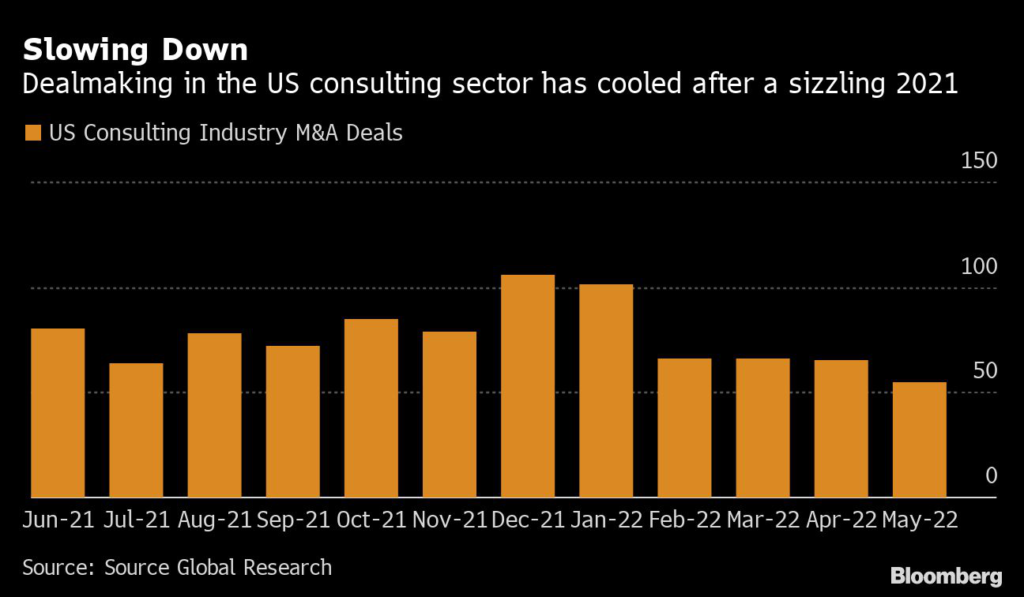
(Bloomberg) — Dealmaking in the consulting world has slowed after a record-setting pace in 2021, but demand for digital expertise along with a shakeup at one of the Big Four accounting firms should keep the deals flowing.

US consulting-industry mergers and acquisitions have cooled this year due to rising interest rates, Russia’s invasion of Ukraine and increased economic volatility, according to a report from London-based Source Global Research, which tracks the sector. 

Last month saw just 55 deals in the US where a consulting firm was the buyer or seller, the lowest level in the past 12 months. “A series of strong political and economic headwinds had an immediate impact on firms’ ambitions,” according to the report. The US is home to just under half of all consulting deals, Source Global has found. 

Activity should pick up as companies learn to operate in a more turbulent environment, and some big shakeups could be afoot. Big Four accounting firm Ernst & Young might separate its audit practice from its consulting arm as part of a broader restructuring, which could “significantly disrupt” the professional-services sector, said Source Global market trends analyst Ashok Patel. An EY spokeswoman said the firm is “in the early stages of this evaluation,” and no decisions have been made.

“Other firms are already exploring how to respond to the potential changes it would trigger in the competitive landscape,” Patel said. “But the reality is that there is already a big appetite for deals among consultants.” 

That appetite lately is focused on gobbling up firms with digital, artificial intelligence and data-analytics capabilities, according to Tom Rodenhauser, managing partner of Kennedy Research Reports, which tracks the sector. Deals for old-school strategy shops have gone out of favor as firms like Accenture and Deloitte move more into delivering technology products and platforms for clients, he said. When clients were polled by Source Global about what areas they’re planning or making big investments in, “digital transformation” topped the list.

Still, the big professional-services firms are grappling with an increasingly challenging landscape. EY, along with Big Four rivals Deloitte, PwC and KPMG, face increasing pressure from regulators in the US and Europe after high-profile audit failures and calls to prevent lucrative consulting work from weakening their auditors’ objectivity. 

Even if dealmaking declines, clients’ appetite for the work done by consultants at firms like McKinsey & Co., Bain & Co. and Capgemini continues to grow. Companies large and small need help with digital, technology implementations and, increasingly, advice on how to manage hybrid workforces and returning to the office. 

“Workforce and HR issues are expected to permeate the investment agenda in the near future,” Patel said. In a separate analysis, Source Global projects that revenue generated by the major US consulting firms will grow over 10% to $88.1 billion this year, a slight deceleration from the more than 11% expansion seen last year. 

More stories like this are available on bloomberg.com

©2022 Bloomberg L.P.
Close Bitnami banner
Bitnami