Bloomberg

Verizon Cuts Broadband Price to $25 a Month for Mobile Customers

(Bloomberg) — Verizon Communications Inc. is cutting its home broadband price to $25 a month for wireless customers in select areas where its Fios fiber network and wireless internet service are available.

Verizon said Thursday that the offer is available in more than 2,700 cities to customers with premium 5G mobile plans. The previous Fios offer had started at $40 a month.

The move is yet another enticement for mobile customers to move up to higher-priced plans as Verizon pushes faster 5G products. The company is also raising prices next month on limited mobile-data plans by $6 per line or $12 per family. 

Verizon pitched the offer as a cheaper alternative to cable for consumers grappling with the highest US inflation in 40 years.

“At a time when Americans are looking more closely at their finances, it’s important to know that you have a new choice for your home internet,” said Frank Boulben, chief revenue officer of Verizon’s consumer group, in a statement. “You don’t need to stay with an unreliable provider and you don’t have to sacrifice quality to save.”

Verizon says the $25 a month offer doesn’t require a contract or equipment fees. The speeds start at 300 megabits per second for fiber.

More stories like this are available on bloomberg.com

©2022 Bloomberg L.P.

Israel and Hong Kong Team Up to Test Digital Currency Cyber Risk

(Bloomberg) — The Bank of Israel is working with the Hong Kong Monetary Authority on a trial which will test a new digital currency, including against cyber security risks, the Bank of Israel said. 

The joint project, which will start in the third quarter, will use a two-tier central bank digital currency (CBDC), it said in a statement. It will be issued by the central bank and then distributed by financial intermediaries like banks. 

In fits and starts, Israel is coming around to explore the idea of a CBDC after shelving its initial effort in 2018, when a team set up by the central bank recommended against issuing a digital version of the shekel. 

Analysts at Bank of America Corp. have argued that central banks will inevitably launch their own digital coins to ward off the risk of losing monetary control to decentralized cryptocurrencies or widely adopted digital currencies like a digital dollar.  

The retail CBDC being tested by Israel and Hong Kong is designed to allow the intermediaries to handle it with no financial exposure to their customers, and will assess whether this makes it less vulnerable to cyber attacks.

The “exposure-free” CBDC is assumed to carry “less financial risk for the customer, more liquidity, lower costs, increased competition, and wider access,” the Bank of Israel said. 

The Bank for International Settlements’ Innovation Unit will also take part in the trial. 

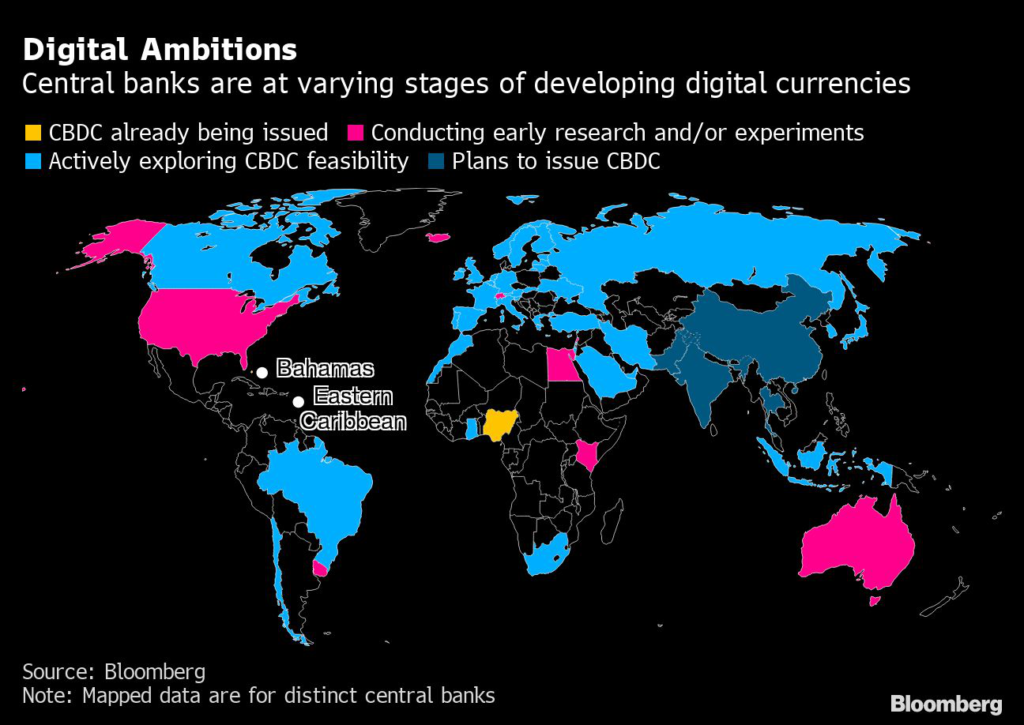
Although research into digital currencies is still in its infancy, around 100 countries have either rolled out CBDCs or are considering them, according to the International Monetary Fund. Among them is China, whose digital yuan has already been tested by around 140 million people, including fans at the recent Winter Olympics in Beijing. 

More stories like this are available on bloomberg.com

©2022 Bloomberg L.P.

Software Procurement Startup Vendr Gains $1 Billion Valuation

(Bloomberg) — Vendr Inc., a firm that centralizes business software purchasing and management, announced it was valued at $1 billion after a $150 million funding round that came as many startups are struggling to raise funds.

Traditionally, enterprise-level software acquisition requires months of discussions between procurement teams and salespeople. Vendr, founded in 2019, negotiates and manages contracts, and has processed more than $1.3 billion of transactions.

“Software is now a top-five line item for the vast majority of companies,” said Ryan Neu, Vendr’s founder who used to lead sales at HubSpot Inc. “We identified that most companies were overpaying on software by 20-25%.”

Vendr is particularly popular among mid-size companies without the leverage and procurement teams of a huge corporation that can lead to favorable deals. Its average customer has 750 to 1,000 employees. The list includes Canva Inc., DraftKings Inc. and the Washington Post. Typical customers have more than 180 applications under management, Neu said.

Craft Ventures — whose co-founder David Sacks sits on Vendr’s board — led the funding round alongside the SoftBank Vision Fund 2. The two VC firms were joined by Sozo Ventures, F-Prime Capital, Sound Ventures, Tiger Global and Y Combinator.

Fundraising started last month, or as Neu put it, “the eye of the storm” when it comes to the climate for tech investment. During the month, Sequoia Capital was warning its founders that the good times were over, and Lux Capital told founders that job cuts would be needed as “the world is falling apart.”

Meanwhile, Vendr was nearly doubling its valuation. Neu attributes this to the cost-cutting nature of the service, which becomes more valuable in a recessionary environment. “If you save money, reduce risk — that’s where the doors are still staying open.”

More stories like this are available on bloomberg.com

©2022 Bloomberg L.P.

Private Equity Faces ‘Crisis of Value’ Over Inflated Prices

(Bloomberg) — Private owners of assets face a “crisis of value”, after years of prices being driven higher by rock-bottom interest rates, according to two senior private equity figures.

“Right now in the private markets it has been a crisis of value,” Gabriel Caillaux, head of General Atlantic’s business in EMEA, said in a Bloomberg TV interview at the SuperReturn conference for investors in Berlin. “The excesses happened because valuations ran up and you had a whole new set of actors that came in who made the deal cycle a little bit too accelerated.”

Some deals have been mis-priced because of the sustained period of low interest rates, particularly in health and technology, Scott Kleinman, co-president of Apollo Global Management Inc. said. 

“When interest rates went to zero and stayed there for 14 years, it allowed for prices to go higher and higher in the public markets and the private markets,” Kleinmain said, also in a Bloomberg TV interview alongside the conference. 

“You’ve seen the S&P down 20%, the Nasdaq down 30%, some tech companies down 50%, 70%-plus,” Kleinman said.  “It doesn’t mean these are bad companies, it just means that the starting point of the valuations didn’t make a whole lot of sense.”

Private equity has been among the biggest winners in finance over the past decade as investors have deployed hundreds of billions of dollars into the asset class in a search for yield. The influx of capital combined with readily available leverage led to a deal-making frenzy and forced asset prices to record highs. 

With rising interest rates and the increasing likelihood of a recession, high prices paid previously for assets are likely to start eating into returns.

“I do think private valuations will fall,” Kleinman said. “The private equity industry has to return back capital to investors. The prevailing market prices when you go to sell those companies will determine what that shake out looks like.”

The tougher economy will also make it more difficult for private-equity firms to sell their assets or list them on public stock exchanges in the near term as investors adjust pricing expectations, according to Nikos Stathopoulos, a partner, chairman of Europe and member of the management committee at BC Partners. 

“Everyone is in a bit of a wait-and-see mode to see what impact this will have, mainly on valuations,” Stathopoulos added in a separate Bloomberg TV interview. “As in everything you have to adjust the valuation expectations of the buyers and the sellers and they have to converge at some point and that sometimes takes time.” Still, he said BC Partners is continuing to look for investments in areas such as health and telecommunications that it views as more protected from consumer trends. 

‘Indiscriminate’ Selling

A correction to reflect the worsening economic outlook is creating opportunities for some investors in the private capital industry.

“A lot of this reset is incredibly healthy and provides a lot of opportunity,” Caillaux said. “The sell down has been completely indiscriminate to the quality of the business.”

For Apollo, as the market starts to reprice, deal flow is likely to improve as more companies consider going private as volatility increases, according to Kleinman. 

In addition, a potential recession is prompting some companies to look to sell non-core parts of their businesses to shore up their balance sheets, Kleinman added.

(Adds further comments from BC Partners’ Stathopoulos from ninth paragraph.)

More stories like this are available on bloomberg.com

©2022 Bloomberg L.P.

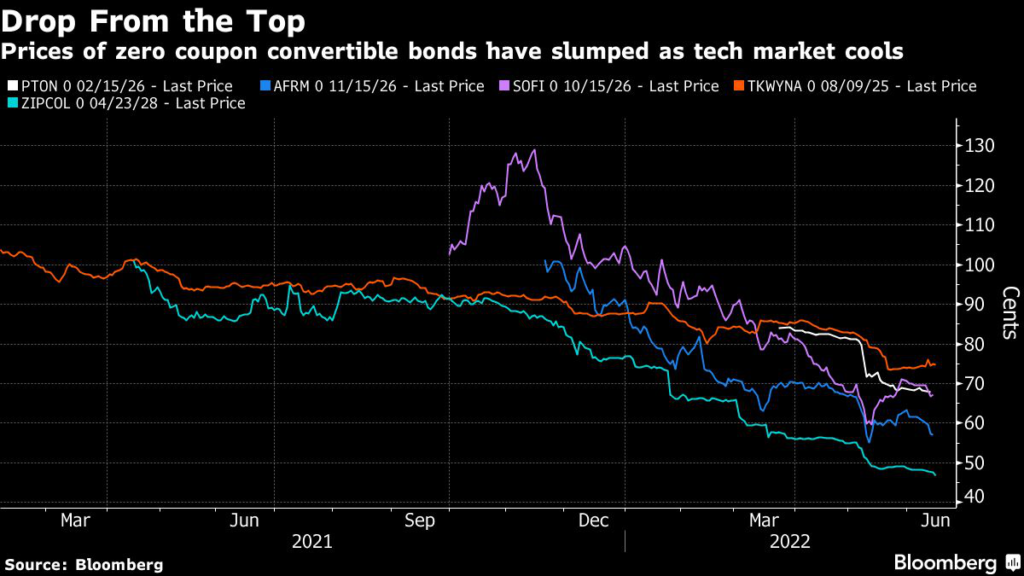
Tech Bear Market’s Latest Casualty Is Pandemic-Era Convertible Debt

(Bloomberg) — The equity-linked debt of some of the pandemic’s darlings has plunged to record lows and is now considered distressed.

The convertible bonds of Peloton Interactive Inc., Ocado Group Plc, Just Eat Takeaway.com NV are trading between 45 cents to 75 cents on the dollar or euro — levels that are considered distressed territory by debt investors.

It’s a dramatic turnaround from the frothy heights of 2021, when investors were clamoring for fast-growing technology stocks. Companies across the consumer cyclical and tech sectors sold a record $157 billion of convertible bonds — debt that can be converted into shares — in 2020 and 2021.

“This debt was issued when market sentiment was very positive and yields were very low, so there was a real rush to get exposure,” said Pierre-Henri de Monts De Savasse, a portfolio manager at BlueBay Asset Management LLP. “But equities corrected and some of these names were in the tech or tech-like sector with high multiples, so they corrected enormously.” 

The bonds from those companies paid little or nothing in the way of interest, so the big attraction for investors was the ability to exchange the securities for stock, assuming the shares rallied enough to surpass the conversion price.

But then the bear market happened, and the stocks are trading at a fraction of their previous highs. When the debt matures, the companies will face two options: find the money to pay back the debt or trigger the conversion, which may cause a massive dilution of existing shareholders. 

Peloton Bond

For example, Peloton’s $1 billion zero-coupon bonds convert at about $239 a share. With the stock trading at about $10, investors have no incentive to convert when the bonds mature in February 2026 unless it stages a remarkable recovery. 

Investors don’t seem confident this is possible: The bonds trade at 66.5 cents on the dollar, translating to a record high yield of about 11.5%, meaning that refinancing it will prove expensive.

It’s a similar story for Ocado and Just Eat Takeaway, as well as finance companies SoFi Technologies Inc., Zip Co. and Affirm Holdings Inc. They all have zero- or low-coupon convertible bonds trading at 45 cents to 75 cents and yields of 10% and above. 

This puts the market in distressed territory, said Andrew Feltus, US-based co-managing director of high yield at Amundi SA. “It’s been since the early 2000s that we’ve seen such a wide spread” between conversion prices and share prices, he said. 

Spokespeople for Ocado declined to comment on the convertible bonds while Peloton, SoFi and Affirm didn’t immediately respond to a request for comment. 

A spokesperson for Zip said the company “has narrowed its focus in response to a change in external market conditions” and remains engaged with its bond holders to ensure they are aware of “relevant developments.” Just Eat pointed to its March 2 earnings statement, in which it said the company’s debt maturities are “well aligned” with planned improvements in profitability, and that it has a strong cash position.

Investors snapped up tech and consumer cyclical company convertible bonds at a record pace in the pandemic. Issuance reached a record high in 2021 at $79.5 billion, surpassing 2020’s $77.5 billion, according to data compiled by Bloomberg. 

The advantage for companies is that investors are usually willing to settle for a lower interest rate, or coupon, in exchange for the option to swap the debt for shares at a future date at a fixed price. 

Market Concern

Most of this debt matures between 2024 and 2027, giving the companies time to prepare for this issue, and for market sentiment to shift. But while economists predict that central banks will stop raising interest rates if the global economy slows, market pricing suggests rates won’t be anywhere near the low levels they were in 2020 and 2021. 

The stronger companies will be able to mount a recovery or come up with a refinancing program, said Howard Needle, a portfolio manager at Wellesley Asset Management Inc.

“A company like SoFi or Affirm probably have many ways in which they can generate cash, or the stock may appreciate to the point where it looks healthier,” he said. “But there are a host of companies which have their debt trading in the 30s and 40s where there is genuine market concern.”

(Adds graphic)

More stories like this are available on bloomberg.com

©2022 Bloomberg L.P.

Revlon Files Bankruptcy as Supply-Side Woes Prove Breaking Point

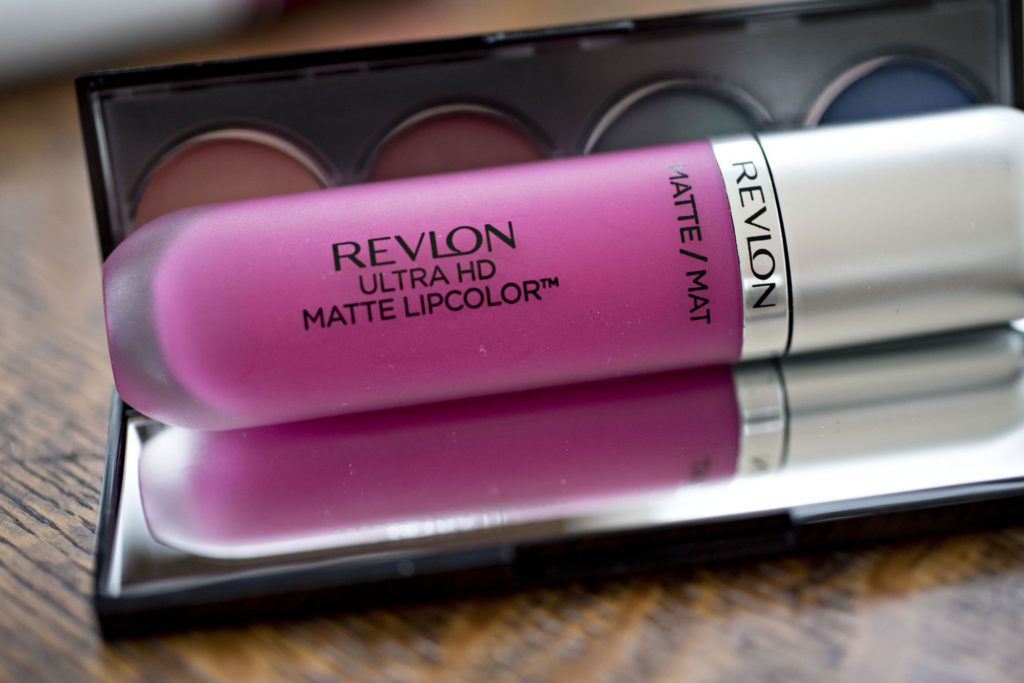
(Bloomberg) — Revlon Inc. filed for Chapter 11 bankruptcy as the global supply chain crunch proved the tipping point for the debt-laden company that has struggled to tap into a broader cosmetics sales boom driven by social-media influencers.

The cosmetics giant, owned by billionaire Ron Perelman’s MacAndrews & Forbes, sought court protection in the Southern District of New York late Tuesday. It listed assets totaling $2.3 billion as of late April, and debts of $3.7 billion, according to court papers. 

Chapter 11 filings allow a company to continue operating while it works out a plan to repay creditors. Revlon said in a statement that it’s lined up $575 million of so-called debtor-in-possession financing from existing lenders to fund itself during bankruptcy. 

The bankruptcy caps a tumultuous period for the company, which suffered during the pandemic and faced years of declining sales as consumer tastes changed and upstart brands ate into its market share. More recently, the company said supply-chain pain and inflation were challenging its ability to keep up with rebounding consumer demand. 

“Consumer demand for our products remains strong – people love our brands, and we continue to have a healthy market position. But our challenging capital structure has limited our ability to navigate macro-economic issues in order to meet this demand,” Revlon Chief Executive Officer Debra Perelman said in a statement. 

The 90-year-old company got its start selling nail polishes in the throes of the Great Depression, and later added coordinated lipsticks to its collection. By 1955, the brand was international. 

Perelman’s holding company took control of Revlon in an acrimonious takeover in 1985, funding the deal with junk debt raised by Michael Milken. MacAndrews & Forbes at one point sued Revlon over the company’s acceptance of a lower offer from Forstmann Little & Co., resulting in a landmark Delaware court decision on the fiduciary duties of board members, sometimes dubbed the “Revlon Rule.”

The company’s debt load proved burdensome, especially after it sold more than $2 billion of loans and bonds to fund its acquisition of Elizabeth Arden in 2016. It also owns brands including Cutex and Almay, and markets in more than 150 countries. 

In recent years, Revlon has struggled to compete with newer brands and those owned by rivals L’Oreal SA and Estee Lauder Cos. that have turned to video bloggers and Instagram personalities to fuel growth. The pandemic provided another blow to sales.  

Revlon narrowly staved off multiple previous defaults by cutting deals with creditors to rework its obligations out of court, and later found itself ensnared in one of the banking industry’s most infamous blunders when Citigroup Inc. — intending to process a routine loan interest payment — instead mistakenly paid some Revlon creditors nearly $900 million. 

The case is Revlon Inc., 22-10760, U.S. Bankruptcy Court for the Southern District of New York. 

(Updates with additional details throughout.)

More stories like this are available on bloomberg.com

©2022 Bloomberg L.P.

Ferrari Vows Electric Shift Won’t Eat Up Its Luxury Margins

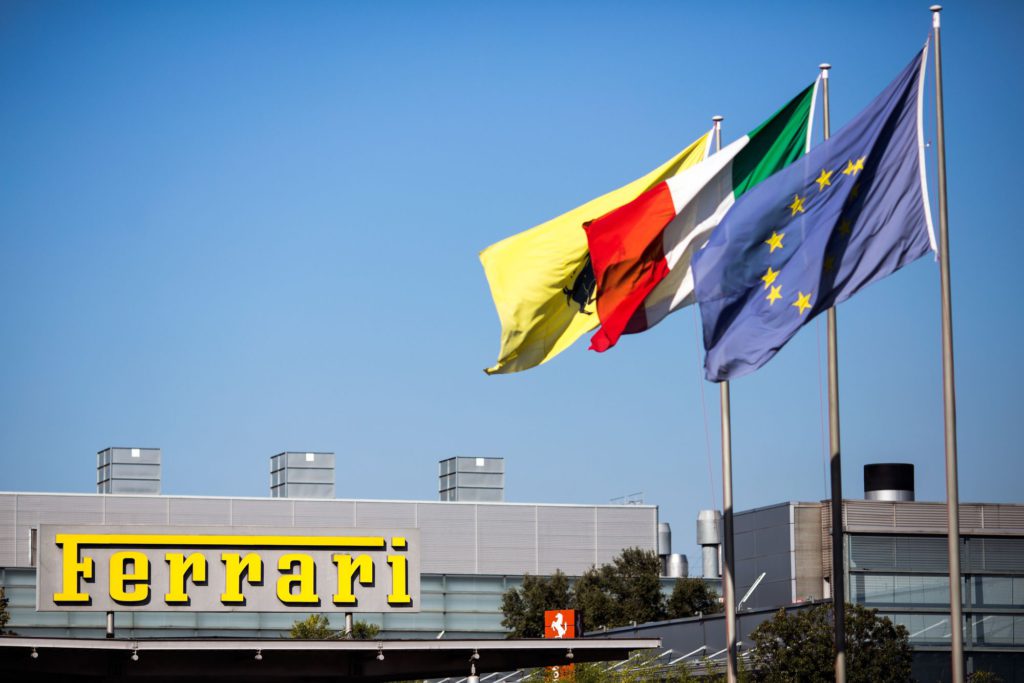
(Bloomberg) — Ferrari’s Maranello complex in northern Italy is a pretty cool place. There’s a space ship-looking wind tunnel designed by Renzo Piano, you can hop into a Formula One racing simulator, and a short stroll from the main factory, there’s a mouth-watering museum filled with shiny supercars like the 1990s F50. Now Ferrari is overhauling the site to make battery-powered cars.

Just a few hours ago in Maranello, CEO Benedetto Vigna presented his long-awaited strategy on how to electrify the brand synonymous with prancing horses. Ferrari will invest some 4.4 billion euros ($4.6 billion) to develop fully electric and plug-in hybrid models that will make up 60% of its portfolio by 2026. The company will retool Maranello to produce EVs and assemble battery modules — confirming a plan my colleagues Daniele Lepido and Chiara Remondini first reported last week. The first fully electric Ferrari will hit showrooms in three years.

The problem is that the Italian company is a tad late to the party, leaving it well behind not just battery pioneer Tesla but also Porsche and smaller upstarts like Rimac Automobili. Porsche’s popular Taycan EV has been on the road since 2019 and outsold the iconic 911 last year.

Vigna is now eager to catch up. The 53-year-old industry outsider — he joined from chipmaker STMicroelectronics last year — has rejiggered several divisions including product development to report directly to him to streamline decision-making. He’s also hired trusted tech executives from his former employer, and  partnered with chipmaker Qualcomm to work on more digital car cockpits.

Key for Ferrari will be that its electric cars evoke the same kind of passion as its roaring combustion-engine peers have done for decades. The nature of electric drivetrains means that even sedans like Tesla’s Model S come with race car-like acceleration, so Ferrari may well lose some of its gasoline-era performance edge.

Ferrari tried to dispel those concerns today, saying its EVs will leverage the company’s racing know-how to ensure they stand out when it comes to “engine power density, weight, sound and driving emotions.”

Aside from ensuring that drivers remain thrilled, Ferrari also has to please shareholders. While the company continues to command enviable profit margins, the stock has underperformed recently, in part due to investor concern about the costs associated with catching on electric technology.

Ferrari vowed its EV investments won’t come at the expensive of profitability. The company sees adjusted EBITDA of as much as 2.7 billion euros in 2026, up from around 1.5 billion euros last year, and targets a compounded annual growth rate of 9%. 

Part of that profit gain will be driven by the company’s supercars that will remain in that period, to a large degree, gasoline-fueled. That includes the Purosangue SUV to be unveiled in September. Ferrari has been “overwhelmed” by the early demand for the model, according to sales head Enrico Galliera.

And Ferrari executives said they’ll remain mindful of keeping the exclusive cachet of the brand — that applies to the Purosangue as well as the company’s future battery-powered models. 

“Ferrari will always deliver one car less than the market demands,” Vigna said, evoking the famous motto of company founder Enzo Ferrari.

More stories like this are available on bloomberg.com

©2022 Bloomberg L.P.
Europe’s Rubber Addiction Destroys Africa’s Tropical Forests

(Bloomberg) — Europe’s demand for rubber to make tires and other products is destroying tropical forests across Africa and proposals from Brussels to limit environmental damage currently do little to address the problem.

A new satellite data study by non-profit Global Witness links European Union rubber imports to the deforestation of 520 square kilometers in Cameroon, Gabon, Ghana, Ivory Coast Liberia and Nigeria since the start of the millennium. Rubber poses a bigger threat to Africa than the bloc’s imports of palm oil, yet it is not included in a law designed to stop trees being cut down outside of the EU.

The findings underscore the damage that demand for commodities has on ecosystems crucial to combating climate change. Forests in West and Central Africa absorb about three times as much carbon dioxide per year as France emits, according to World Bank data. 

“The EU’s voracious appetite for rubber is devastating indigenous communities and eroding a vital carbon sink,” said Giulia Bondi, senior EU forests campaigner at Global Witness. “Yet astonishingly a draft law to prevent deforestation-linked products from being sold in Europe doesn’t include rubber.”

Read: Cattle, Palm Oil Firms Miss Deforestation Targets, Report Finds

The EU currently imports about 30% of the rubber shipped abroad by Africa’s top producers, more than 12 times the value of the palm oil it buys, according to the study. Global demand for the commodity rebounded last year, rising by 9% from 2020, according to the Association of Natural Rubber Producing Countries.

Global Witness found that most of the rubber plantations where deforestation has taken place were owned by three companies: Singapore-based producers Olam Group and Halcyon Agri Corp., and Luxembourg-registered Socfin. They in turn supply tire firms such as Michelin and Continental AG. Europe’s banks are also major players in funding the industry, it said.

Socfin told Global Witness that it’s had a zero-deforestation policy since the end of 2016, adding that some plantations in Cameroon, Nigeria and Ghana were developed before that date by clearing degraded natural forest. The company didn’t immediately respond to a request for comment from Bloomberg News.

Halcyon said it has had a “no deforestation policy” in Cameroon since December 2018 and has developed a plan to help provide education and healthcare for local communities, according to a statement forwarded by Global Witness. A spokesman for Halcyon told Bloomberg News that the company was “steadfast” in its commitment to zero-deforestation.

Olam told the non-profit group that its operations in Gabon were developed on old logging concessions, secondary forests and degraded areas, and that the company also invested in education and health for neighboring communities. Protecting forests is a priority for the company, Olam said in a response to Bloomberg. 

While a pledge to end deforestation was one of the big breakthroughs at the COP26 climate summit last year, some agri industries are trying to weaken the proposed regulations, according to Greenpeace. That pressure may increase as food and commodities prices soar.

The European Commission’s proposal — covering beef, wood, soya, coffee and cocoa, in addition to palm oil — is designed to bring the greatest benefits in terms of prevented deforestation at the lowest cost for the operators involved, according to an EU official. The scope of the initiative could later be expanded, he said.

Christophe Hansen, lead negotiator for the EU’s deforestation law in Parliament, is pushing for rubber to be included in the list of sectors covered by the proposal. He says the European Commission was wrong in taking a cost-benefit approach on which sectors to include, and should have instead looked at the environmental footprint of the products.

The commission’s approach to include certain commodities, but not others, was not the right one, said Hansen, a lawmaker for the European People’s Party, said in an emailed response to questions. “The report clearly confirms my move to include rubber in the scope of the regulation,” he said.

(Updates with plantation companies in sixth paragraph)

More stories like this are available on bloomberg.com

©2022 Bloomberg L.P.

Taiwan Delivers Smaller-Than-Expected Interest Rate Hike

(Bloomberg) — Taiwan’s central bank delivered a smaller-than-expected increase to its benchmark interest rate in combination with moves to reduce liquidity in the banking sector as officials seek to rein in inflation without exacerbating slowing growth. 

The central bank increased its policy rate by 12.5 basis points to 1.5% on Thursday. Most economists surveyed by Bloomberg expected a 25 basis-point move after a surprise hike of that magnitude last quarter. 

The bank also raised its reserve requirement ratios by 25 basis points, which Governor Yang Chin-long said would take NT$120 billion ($4 billion) out of circulation. 

“This was a very difficult decision,” Yang said at a briefing following Thursday’s announcement. “Inflation is certain to rise further but we also had to consider the potential hurt to sectors reliant on domestic demand so that’s why we decided to raise the rate by a little less and implement liquidity controls.”

It is the first time Taiwan’s policy makers have combined two such hikes since 2008. Officials are seeking to strike a balance in taming persistently high inflation without hurting the economy at a time when Russia’s invasion of Ukraine and repeated Chinese Covid lockdowns are causing chaos to global supply chains. 

The central bank downgraded its forecast for economic growth this year to 3.75% from its previous estimate of 4.05% made in March. Officials also see inflation getting worse, raising their outlook for the year to 2.83% from their earlier projection of 2.37%.

“Taiwan’s policy makers cannot afford a bigger hike,” said Christopher Wong, senior foreign exchange strategist at Malayan Banking Bhd. in Singapore. “The central bank reverted to their typical pace of 12.5bps hike as some sectors of the economy, such as tourism and the self-employed, still need support and there are signs of growth momentum slowing ahead.”

The services sector has been affected by Taiwan’s first major Covid outbreak in recent months. The health authorities have reported tens of thousands of cases a day, even as they ease restrictions in a push to live with the virus. While border restrictions still remain, the government has signaled it intends to reduce the mandatory three-day quarantine on entry further in the coming months.

The central bank move followed the Federal Reserve’s interest rate hike of 75 basis points Wednesday, its biggest since 1994. A widening gap between borrowing costs in Taiwan and the US could exacerbate downward pressure on the Taiwan dollar. The currency has weakened about 6.5% against the greenback in the past six months, closing at 29.735. The local stock benchmark has fallen for the past six days.

Governor Yang has repeatedly said rates in the world’s major economies play a factor in the monetary authority’s decision-making process.

(Earlier story was corrected to show central bank raised rates in headline, first deckhead.)

(Updates to add stock performance in second last paragraph.)

More stories like this are available on bloomberg.com

©2022 Bloomberg L.P.
Property Entrepreneur Nick Candy Walks Away From Making THG Offer

(Bloomberg) — Nick Candy has walked away from making an offer for embattled UK online shopping emporium THG Plc, just hours after a rival consortium also dropped its pursuit. 

The property entrepreneur’s Candy Ventures Sarl vehicle said in a statement Thursday that it was withdrawing its interest in the retailer, confirming an earlier report by Bloomberg News. 

Candy’s decision to walk away comes after a rival consortium — Belerion Capital and hedge fund King Street Capital Management — also confirmed it would not make an offer for THG, in a statement Thursday. 

Shares in THG were down nearly 20% at 12:14 a.m in London. Overall THG’s stock has fallen more than 80% from its listing price. 

Manchester-based THG did not engage with either party or grant any due diligence access over concerns about the levels of debt in both proposals, according to people with knowledge of the matter. 

THG last month rejected a bid from the Belerion consortium valuing the firm at £2.1 billion ($2.5 billion), saying the offer of 170 pence per share “significantly undervalued the company.” Candy made two fully-funded approaches to THG that were also rejected. 

Both the Belerion consortium and Candy Ventures had until 5 p.m. Thursday to announce whether they would make a formal bid or walk away. Barclays Plc and Jefferies Financial Group Inc. are advisers to THG. Bank of America and Deutsche Bank advised Candy Ventures on its bid. 

Takeover speculation has swirled around THG since November when founder Matthew Moulding said he regretted floating the company and hinted he may take the business private again. 

Moulding started the business, formerly known as the Hut Group, in 2004 with John Gallemore, who now serves as chief financial officer. It began selling CDs but today operates hundreds of websites selling beauty, skincare and health-food products as well as helping rivals sell online via the Ingenuity division. 

THG was a stock market darling when it floated, attracting investment from SoftBank Group Corp., but has since been dogged with concerns about its governance and the growth prospects of Ingenuity. 

Moulding has also kept a tight grip on THG as a major shareholder, landlord, chairman and chief executive officer. In March, THG appointed Charles Allen as chairman, with Moulding relinquishing the role to focus on being CEO. Moulding also pledged to give up his golden share, which allows him to veto a takeover, smoothing the way for THG to move its listing to the premium segment of London’s Stock Exchange. 

THG said in a statement Thursday that all recent approaches have been unsolicited and significantly undervalued the company. “While THG is clearly aware of the macro-economic challenges, the company continues to perform well, and in line with its own expectations,” it said.

Belerion is an investment advisory firm that specializes in e-commerce investments and was founded by Iain McDonald, who is currently a non-executive director on THG’s board. 

Candy is best known for working alongside his brother Christian in driving the development of the One Hyde Park luxury residential development in London’s exclusive Knightsbridge district. 

(Updates with details of advisers in seventh paragraph)

More stories like this are available on bloomberg.com

©2022 Bloomberg L.P.
Close Bitnami banner
Bitnami