

Bloomberg

Binance’s $200 Million Forbes Deal is ‘Changing,’ CEO Zhao Says

(Bloomberg) — Binance Holdings Ltd.’s agreement to invest $200 million in Forbes is “changing” after the publisher’s deal to go public via a so-called SPAC fell through, the crypto exchange’s Chief Executive Officer Changpeng ‘CZ’ Zhao said.

In an interview with Bloomberg TV, Zhao reiterated that Binance still wants to make the investment, though he didn’t give any details on how the terms would change.

“It’s changed a little bit, but I believe that’s still in discussions,” Zhao said, noting that Binance’s commitment to invest in Forbes was part of a broader strategy to invest in traditional media outlets. 

Binance has also pledged to contribute around $500 million to Elon Musk’s $44 billion buyout of Twitter Inc., though sentiment around whether that deal will still go ahead has soured in recent weeks. Musk has complained of rampant spam bot networks dominating the social network, and cast doubt on whether Twitter’s user base is as big as the company claims.

“The Twitter deal, I don’t know what’s happening there but we’re still hoping that’ll come through,” Zhao added. “He’s leading, we’re following. If it goes through with the deal then we’re committed, if he doesn’t, then we’re off.” 

When asked if he was disappointed by Musk’s apparent lack of appetite for completing the buyout, the Binance boss responded: “A little bit to be honest, yeah, we were hoping to contribute to Twitter somehow.”

Read more Binance CEO Zhao Says Now Is a Great Time to Hire and Acquire

Forbes had agreed to go public last year through a merger with blank-check firm Magnum Opus Acquisition Ltd., a process through which Binance had expected to contribute $200 million in a strategic investment and take two Forbes board seats. Forbes announced on June 1 that its shareholders had terminated the deal with Magnum Opus. 

Bloomberg LP, the parent of Bloomberg News, competes with Forbes in providing news and financial information.

More stories like this are available on bloomberg.com

©2022 Bloomberg L.P.

Revlon Files Bankruptcy After Missing Social Media Makeup Boom

(Bloomberg) — Revlon Inc. filed for Chapter 11 bankruptcy, unable to manage its heavy debt load after failing to tap into a cosmetics sales boom driven by social-media influencers.

The cosmetics giant, owned by billionaire Ron Perelman, sought court protection in the Southern District of New York after the global supply chain crunch and steep inflation deepened its woes. 

Revlon has been unable to keep pace with rivals L’Oreal SA and Estee Lauder Cos. as well as upstart makeup and personal-care brands that have turned to video bloggers and Instagram personalities to fuel growth. 

In its court filings, Revlon listed assets totaling $2.3 billion as of late April. That stands in contrast to total debts of $3.7 billion, which include its 6.25% senior notes due in 2024, according to court papers dated June 15. 

Chapter 11 filings allow a company to continue operating while it works out a plan to repay creditors. The bankruptcy caps a tumultuous period for the company, which suffered during the pandemic and faced years of declining sales as consumer tastes changed and upstart brands ate into its market share. 

The 90-year-old company got its start selling nail polishes in the throes of the Great Depression, and later added coordinated lipsticks to its collection. By 1955, the brand was international. 

Perelman’s holding company, MacAndrews & Forbes Inc., took control of Revlon in an acrimonious takeover in 1985, funding the deal with junk debt raised by Michael Milken. MacAndrews & Forbes at one point sued Revlon over the company’s acceptance of a lower offer from Forstmann Little & Co., resulting in a landmark Delaware court decision on the fiduciary duties of board members, sometimes dubbed the “Revlon Rule.”

Apart from the dollar bond, Revlon has 10 loans with outstanding amount totaling about $2.6 billion and maturing in the next three years, Bloomberg-compiled data show. The company’s debt load proved burdensome, especially after it sold more than $2 billion of loans and bonds to fund its acquisition of Elizabeth Arden in 2016. It also owns brands including Cutex and Almay, and markets in more than 150 countries. 

In recent years, it’s struggled to compete with newer brands that advertise heavily on social media. The pandemic provided another blow, and more recently, the company struggled to address supply chain problems and inflation that dented margins. 

Revlon narrowly staved off multiple previous defaults by cutting deals with creditors to rework its obligations out of court, and later found itself ensnared in one of the banking industry’s most infamous blunders when Citigroup Inc. — intending to process a routine loan interest payment — instead mistakenly paid some Revlon creditors nearly $900 million. 

(Updates with financial details throughout)

More stories like this are available on bloomberg.com

©2022 Bloomberg L.P.

Bitcoin ‘Battle of Leverages’ Makes $20,000 Key Level to Watch

(Bloomberg) — A drop in Bitcoin below $20,000 could trigger large liquidations of leveraged positions, putting more pressure on an asset that has already slumped more than 50% this year, crypto executives said. 

Investors are using leverage to short these positions and force prices down in a “battle of leverages,” according to Bobby Lee, chief executive officer and founder of crypto storage provider Ballet Global Inc. This could trigger margin calls for firms that have borrowed against the world’s largest digital token, he said.

“I think we will test $20,000 and go to $19,000-$18,000,” Lee said in an interview with Bloomberg TV on Thursday. “There are lot of funds, large borrowers of Bitcoin who have liquidation positions in $20,000 range.” 

A decline in Bitcoin below the key level of $20,000 could snowball into a broader rout in the market that’s already reeling under tightening global liquidity. Bitcoin gained for the first time in 10 days on Thursday after falling to $20,081.95 on Wednesday. The asset has dropped 52.7% this year. 

“Given that there is blood in the water and there are sharks swimming around there is going to be lot of incentive for people to trade it down to pass that point for the long holders who are on leverage to capitulate,” Lee said.  

‘Short-Term Pain’

Lee’s comments echo concerns from Adrian Przelozny, chief executive officer of crypto exchange Independent Reserve, who said he wouldn’t be surprised if Bitcoin fell to $10,000.

“There’s a lot of Bitcoin pledged as collateral that might have to be sold if its price drops into the $15,000 to $20,000 range,” he said in an interview in Sydney on Wednesday. “But this is short-term pain. I am still very bullish longer term.”

Crypto started sliding late last year on expectations of a less accommodative Fed, with rising interest rates hurting the industry and its prospects. Last month’s collapse of the Terra blockchain and the recent decision by crypto lender Celsius Network Ltd. to halt withdrawals have also put pressure on the market, while a tweet this week from the co-founder of crypto hedge fund Three Arrows Capital fueled speculation that it had suffered large losses. 

Lee, who is usually bullish on crypto, also cautioned that the recent rout in cryptocurrencies could be the start of a long bear market.

“A few months ago I was more optimistic, but given that what has happened in the last few weeks I am starting to think that the top was indeed in November 2021 and that we are in the starting of a real bear market, which could last a few years,” he said.  

More stories like this are available on bloomberg.com

©2022 Bloomberg L.P.

Microsoft Targets Salesforce Clients With New Tools to Aid Sales Reps

(Bloomberg) — Microsoft Corp. introduced Viva Sales, a new program meant to connect its Office and video conferencing programs with customer-relationship management software — its own and that of rivals, a step that could help it garner revenue from Salesforce Inc. clients.

The program, available to preview next month, lets users of customer management programs synchronize information between those products and Microsoft’s Outlook address books and calendars or Teams conferencing and chat. Viva Sales also uses artificial intelligence tools to scan calls and interactions with clients, analyzing customer sentiment to see what actions and marketing material are working well, and provide feedback to the sales representative. 

Viva Sales is free for those who already use Microsoft’s Dynamics customer relations software. Pricing for Salesforce customers will be detailed later this year when the software is generally available, Microsoft said Thursday.

The new product offers the Redmond, Washington-based company a shot at capturing some revenue from users of Salesforce’s market-leading customer management software, which Microsoft has been trying to catch for nearly two decades. When Microsoft tries to win over Salesforce clients, some say they are interested in these kinds of features, but aren’t planning to rip out the customer relations software they already have, Judson Althoff, Microsoft’s chief commercial officer, said in an interview. Salesforce is also adding artificial intelligence capabilities to its programs  and last year acquired business chat app Slack to integrate with its offerings. 

“Sometimes we win, sometimes we lose,” Althoff said.  “If they choose to stay with Salesforce, they can still purchase Viva Sales separately and get all of the advancements that we’re bringing to bear, as well as the full integration with Teams and Office that customers have been asking for a long time. We do think this will be a big incremental revenue driver for us.”

The program lets sales reps mark certain contacts as customers in their Outlook contact list, which will enable interactions to be synced with their  customer-management program. Viva Sales connects with calendars, sees when customer meetings are coming up and shows the user which of their other contacts or LinkedIn connections are related to the customer. During a meeting held on Teams a sales rep can view all of the data related to the customer.

AI researchers have expressed concern about accuracy and bias issues in various sentiment analysis algorithms and a product with those issues could raise concerns if the analysis is used to determine decisions on compensation or influences performance reviews. Althoff said Viva Sales enables the analysis it provides sales reps to be reviewed for accuracy. It also lets users grade recommendations and learns from the scores.

Microsoft has been using the product with its sales teams for a year and has trained the AI, reducing some early issues, Althoff said. That means external customers won’t have to redo much of that work, he said.

“In our early experimentation days, we would get some pretty crazy recommendations in terms of the next best action,” he said. But “the system learns wicked fast and within a very short period of time, we were getting pretty astute recommendations.”

While initially Viva Sales will work automatically with Dynamics and Salesforce, the program includes the ability to manually connect data to other programs, Althoff said. 

Microsoft hopes the tools help eliminate much of the manual data entry and searching for information currently done by sales reps. 

“Companies are really trying hard to thread the needle on employee productivity and well-being at the same time, and we feel like this is a capability that actually helps make salespeople’s lives more effective, more efficient and more enjoyable,” he said.

More stories like this are available on bloomberg.com

©2022 Bloomberg L.P.

Belerion, King Street Drop £2.1 Billion Pursuit of THG

(Bloomberg) — A consortium backed by e-commerce investor Belerion Capital has decided to drop its pursuit of embattled UK online shopping emporium THG Plc. 

The investor group, which also includes hedge fund King Street Capital Management, “does not intend to make an offer for the company,” it said in a statement Thursday, confirming an earlier report by Bloomberg News. 

Manchester-based THG last month rejected a bid from the consortium valuing the firm at £2.1 billion ($2.5 billion), saying the offer of 170 pence per share “significantly undervalued the company.” The Belerion consortium had until 5 p.m. Thursday to announce whether it would make a formal bid or walk away. 

THG also drew interest from property entrepreneur Nick Candy who has the same deadline as Belerion to “put up or shut up” and declare its intentions. 

Takeover speculation has swirled around THG since November when founder Matthew Moulding said he regretted floating the company and hinted he may take the business private again. 

Formerly known as the Hut Group, Moulding started the business in 2004 with John Gallemore, who now serves as chief financial officer. It began selling CDs but today operates hundreds of websites selling beauty, skincare and health-food products as well as helping rivals sell online via the Ingenuity division. 

THG was a stock market darling when it floated, attracting investment from SoftBank Group Corp., but has since been dogged with concerns about its governance and the growth prospects of Ingenuity. 

Moulding has also kept a tight grip on THG as a major shareholder, landlord, chairman and chief executive officer. In March, THG appointed Charles Allen as chairman, with Moulding relinquishing the role to focus on being CEO. Moulding also pledged to give up his golden share, which allows him to veto a takeover, smoothing the way for THG to move its listing to the premium segment of London’s Stock Exchange. 

THG said in a statement Thursday that all recent approaches have been unsolicited and significantly undervalued the company. “While THG is clearly aware of the macro-economic challenges, the company continues to perform well, and in line with its own expectations,” it said.

Belerion is an investment advisory firm that specializes in e-commerce investments and was founded by Iain McDonald, who is currently a non-executive director on THG’s board. 

Candy is best known for working alongside his brother Christian in driving the development of the One Hyde Park luxury residential development in London’s exclusive Knightsbridge district. 

More stories like this are available on bloomberg.com

©2022 Bloomberg L.P.

Crypto Altcoins Pop as Post-Fed Rally Sweeps Across Risk Assets

(Bloomberg) — A rally in beaten-down cryptocurrencies stumbled Thursday on the prospect of a sustained campaign of Federal Reserve interest-rate hikes that will likely suck liquidity from global markets.

Everything from Bitcoin to smaller and sometimes lesser-known tokens — so-called altcoins — gave up the bulk of earlier gains. A prolonged selloff has led to a drop of more than $1 trillion in crypto market value this year. 

Bitcoin, which earlier added as much as 6.1%, trimmed the advance to 1.5% by 6:50 a.m. in London and was trading at about $21,940. Ether — which at one point added 6.6% to $1,256 — was little changed. Cardano, Solana and Dogecoin ranged from flat to up 6%.

Today was a “short-term crypto bear market rally,” said Eric Schiffer, chief executive officer of the private equity fund Patriarch Organization in Beverly Hills, California. “This bear market won’t go away until the Fed decides that it’s going to soften, which I expect at the end of third quarter.”

Crypto markets have served up gut-wrenching losses over the past month, but many have welcomed the wring-out of excesses and sky-high speculation. 

“The reality is we need to see capitulation where that ‘noobishness’ gets washed out,” said Max Gokhman, chief investment officer for AlphaTrAI, adding that “we need to see the asset class evolve to a more mature state, and I think it’s in the process of doing that.”

Crypto started sliding late last year on expectations of a less accommodative Fed, with rising interest rates hurting the industry and its prospects. 

Terra, Celsius

Last month’s collapse of the Terra blockchain and the recent decision by crypto lender Celsius Network Ltd. to halt withdrawals have also taken a toll, while a tweet this week from the co-founder of crypto hedge fund Three Arrows Capital fueled speculation that it had suffered large losses. 

Even long-term holders who have avoided selling until now are coming under pressure, according to researcher Glassnode.

“Crypto is a risk asset. It’s an expression of people taking where they are on the risk spectrum, whether they’re playing more risk-averse or if they’re playing more risk-seeking,” Anna Han of Wells Fargo Securities LLC said in an interview. 

Further Declines?

The Fed raised rates by 75 basis points Wednesday, stepping up the fight against inflation. Powell signaled another big hike in July but added “today’s 75 basis-point increase is an unusually large one and I do not expect moves of this size to be common.” 

Leaning against the risk of a string of jumbo moves initially becalmed global markets, before gloom over elevated price pressures and slowing economic growth again closed in.

All sorts of pockets in crypto have been beset by negative developments. A number of crypto firms have announced layoffs and hiring freezes, and many market-watchers are expecting further price declines ahead. 

Michael Purves, founder and CEO of Tallbacken Capital, sees that risk for Bitcoin. “We continue to think that Bitcoin’s broader picture is bearish, and perhaps our $15k target is not bearish enough,” he wrote in a note. “Nonetheless, for the near term, we recommend taking profits on short positions.” 

More stories like this are available on bloomberg.com

©2022 Bloomberg L.P.

Boohoo Posts First Ever Sales Drop in UK as Shoppers Get Picky

(Bloomberg) — Boohoo Group Plc recorded the first UK sales decline in its history as the online fashion retailer grapples with intense competition, supply-chain woes and waning pandemic consumer trends.  

The fast-fashion company reported a 1% fall in its British home market and an 8% drop in overall sales in the first quarter, according to a trading update Thursday. Boohoo blamed the fall on tough comparisons with last year when people were spending more online during lockdowns. 

Boohoo stuck to its guidance for the full year of low single digit revenue growth, which would be the smallest increase since its initial stock sale in 2014. Boohoo has also predicted that profitability will be much lower than its historical average. 

Boohoo warned last month that sales growth may grind to a halt in the first half as customers coming out of lockdown return more clothes and the nascent US business battles with supply chain disruption and freight costs. The company, whose other brands include PrettyLittleThing and Nasty Gal, already cut its sales projections twice last year and is recovering from a labor supply scandal in 2020 which sparked governance changes.

The shares have fallen 47% so far this year.


More stories like this are available on bloomberg.com

©2022 Bloomberg L.P.
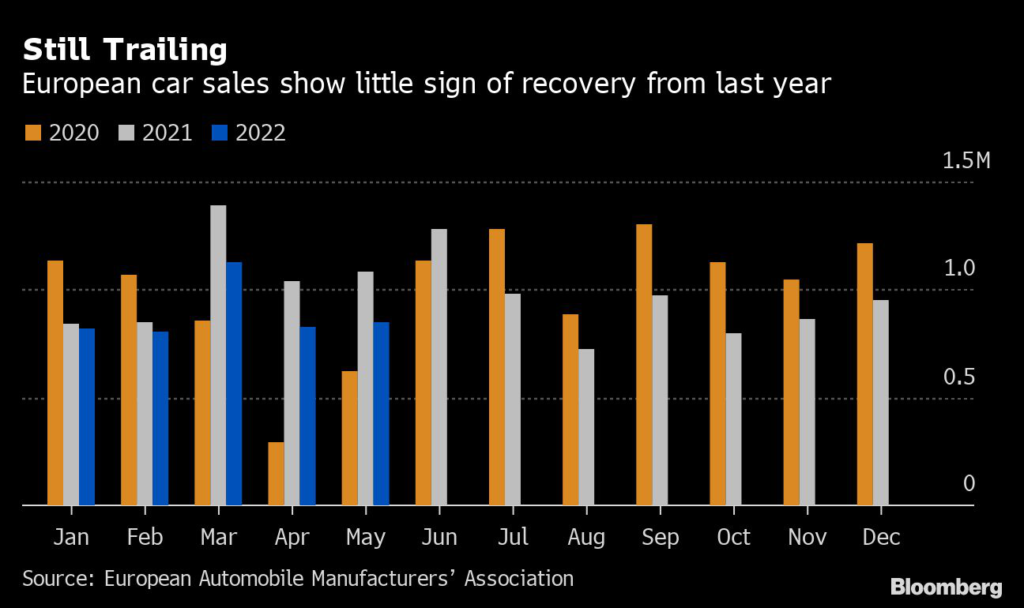
Europe Car Sales Decline in May to Fall for Almost A Year

(Bloomberg) — Europe’s new-vehicle sales slumped for an 11th consecutive month as record inflation and falling consumer confidence joined prolonged supply-chain disruptions.

Registrations fell 12.5% to 948,149 vehicles in May, the European Automobile Manufacturers’ Association said Thursday. Hardest-hit among major automakers was Volkswagen AG, which saw sales drop by more than 21% from the same month last year. 

After nearly a year of decline, carmakers have recently seen glimmers of improvement, reporting that some supply constraints — such as the lack of semiconductors — are beginning to ease. A Bloomberg Intelligence report predicts European car sales will pick up in the second half of this year.

Even so, the depth of sales losses during the first half of the year have taken a toll. Forecasters at LMC Automotive cut their estimate for full-year Western European passenger-car sales again this month, the fifth time this year. They now expect 9.8 million deliveries this year, a 7.4% decline from 2021. In January, LMC predicted sales would grow by 9%.

“Supply chain issues will constrain results through this year and into 2023,” LMC said in a report this month. 

But even as supply chains gradually improve, weakening demand due to record inflation and a slowing global economy are clouding sales forecasts. 

“The demand side situation is becoming increasingly gloomy,” LMC said, noting that consumer confidence in Europe is now lower than at the start of the pandemic in early 2020.

To make up for lost sales, many carmakers have raised prices and shifted production to their most expensive models that yield greater profits. But that strategy could face limits as consumers struggle more broadly with inflation. According to a recent poll by public broadcaster ARD, nearly half of all Germans plan to cut back spending this year.

Registrations fell by about 10% in both Germany and France, and by more than 20% in the UK.  

More stories like this are available on bloomberg.com

©2022 Bloomberg L.P.
Satellite Data Suggests China Infrastructure Push Gathering Pace

(Bloomberg) — China saw an uptick in new construction sites in May, according to satellite data, suggesting infrastructure investment is poised to accelerate from its currently sluggish pace.

The area of new construction sites in China’s three largest urban areas — around the cities of Beijing, Shanghai and Guangzhou — increased by 110% in May from the same month in 2021, according to Four Squares Technology Ltd., which analyzes satellite images. However, that increase was from a low base – the area around Guangzhou saw zero areas of new construction in May 2021.

The scale of China’s investment in infrastructure this year is one of the key factors deciding how fast the country’s economy will grow. Consumer spending has slumped due to coronavirus lockdowns since March, export growth is expected to slow, and investment into the property sector is falling due the housing market slump.

Read more: China’s Economy Shows Mixed Recovery With Consumers Under Strain

Looking at total area covered by construction projects, the increase in the three regions in May was just 1.3%, according to Four Squares, which provides alternative data products to financial institutions, such as investment banks, and hedge funds.

Road construction in 13 provinces showed a similar pattern, with an 188% increase in newly added construction area in May, while the total mileage of roads under construction in those regions increased just 3.2%, according to the Four Squares report. That was a clear improvement on April though, when the total road mileage under construction fell 8.5% from the previous year.

China is likely to see double-digit growth in infrastructure investment this year, the state-run Shanghai Securities News reported this week. However, that will require an acceleration in the rest of the year, as it only grew 6.7% during the first five months of the year, according to official data released Wednesday.  

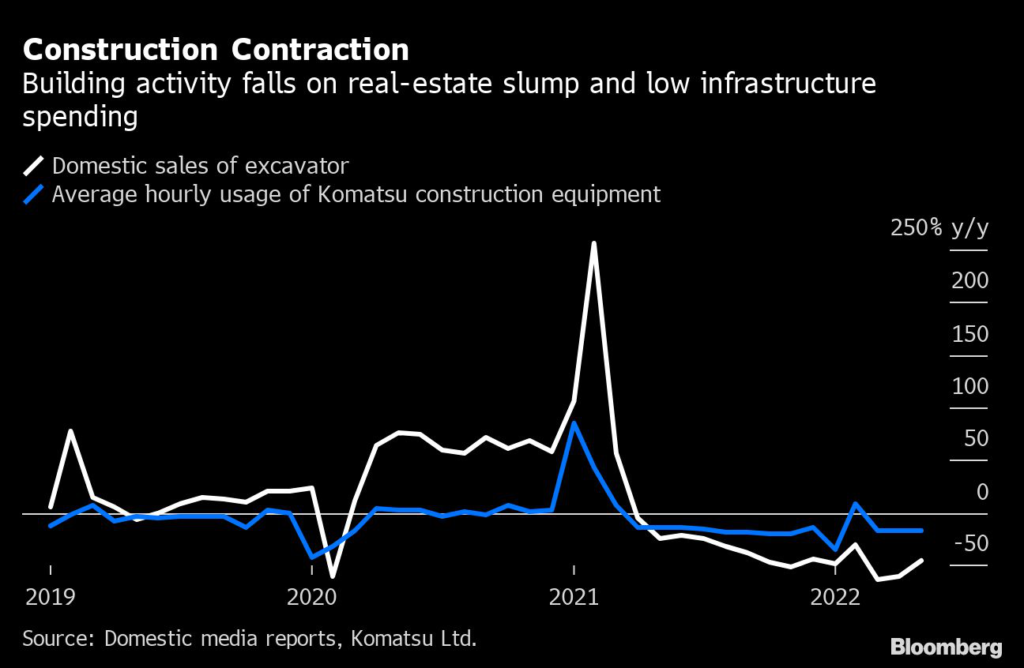
That data showed a plunge in newly started property projects as a slump in the real-estate sector which began last year was exacerbated by lockdowns. Data on the usage of heavy machinery from the Japanese company Komatsu Ltd. suggests overall construction work fell year-on-year in May, reflecting less building in sectors such as real-estate as well as infrastructure. 

The government is making efforts to turn that trajectory around, with President Xi Jinping called for an “all out” infrastructure push in April. To achieve that, Beijing has told local governments to complete the sale of 3.65 trillion yuan ($545 billion) of “special” bonds used mainly to fund infrastructure by the end of June, and ordered state-run policy banks to provide 800 billion yuan in credit for projects.

The economic planning agency has approved 121 billion yuan worth of investment projects in May, almost 62% more than the same month last year. For the first five months of this year, there were 654 billion yuan of newly approved projects, the National Development and Reform Commission announced Thursday. That was a 215% increase on the 208 billion yuan approved in the same period in 2021.

More stories like this are available on bloomberg.com

©2022 Bloomberg L.P.

UN Rights Chief Admits Her Trip to China Faced ‘Limitations’

(Bloomberg) — UN rights chief Michelle Bachelet said she was unable to visit detained Uyghurs and that she was accompanied by authorities while visiting Xinjiang, remarks that raise questions about the Chinese government’s efforts to influence her trip.

“I was not able to speak to any Uyghurs currently detained or their families during the visit,” Bachelet told a meeting of the Human Rights Council on Wednesday, adding that the visit to China faced “limitations, especially given the prevailing Covid restrictions.”

Bachelet did say the government helped her meet “all institutions I had asked to meet, such as senior members of key ministries, the judiciary, business, academia, and other relevant stakeholders,” and repeated that her trip wasn’t an “investigation.”

Human rights activists have criticized Bachelet’s visit to the Asian nation — the first by a UN human rights chief since 2005. Sophie Richardson, the China director at Human Rights Watch, said earlier it gave the Chinese government the lack of criticism on human rights that it desired.

US Secretary of State Antony Blinken’s press office also said Washington was concerned about Beijing’s efforts to manipulate Bachelet’s travels because conditions imposed by the government wouldn’t allow for an “independent assessment of the human rights environment.”

Rights issues have turned into a flashpoint in China-US ties. The topic is likely to become even more charged on June 21, when the US will start blocking imports from China’s far western Xinjiang region under the Uyghur Forced Labor Prevention Act unless companies can prove the goods weren’t made with forced labor.

China has called on the US to abandon the law and regularly denies it commits abuses in Xinjiang and elsewhere. The US, lawmakers in some nations and rights groups say China’s activities in Xinjiang amount to genocide against minority groups.

Blacklists, Trade and More U.S.-China Flashpoints: QuickTake

Chinese President Xi Jinping signaled his nation is unlikely to back down on the issue, writing in a Communist Party magazine this month that certain nations “have been forcibly promoting Western democratic human rights concepts and systems in the world and using human rights issues to interfere in the internal affairs of other countries, resulting in frequent wars, long-term social unrest and displacement of people in some countries.”

On Tuesday, the Netherlands issued a statement on behalf of the 47 members of the Human Rights Council that told Bachelet the members are “gravely concerned about the human rights situation in Xinjiang.”

The same day Cuba delivered a statement signed by 69 countries that said they supported Beijing’s position on Xinjiang, Tibet and Hong Kong issues, and opposed the use of human rights to interfere in countries’ internal affairs.

More stories like this are available on bloomberg.com

©2022 Bloomberg L.P.

Close Bitnami banner
Bitnami
