Bloomberg

New German KF51 Panther Battle Tank Is ‘Game Changer,’ Rheinmetall Says

(Bloomberg) — Rheinmetall AG unveiled a new main battle tank to replace the flagship Leopard 2 as demand for military equipment is poised to surge in the wake of Russia’s war against Ukraine.

The KF51 Panther will be a “game changer on the battlefields of the future,” Rheinmetall said this week when presenting the 59-ton vehicle at the Eurosatory 2022 defense exhibition in Paris.

“The main battle tank concept sets new standards in all areas — lethality, protection, reconnaissance, networking and mobility,” the company said in a statement.

The Panther would go head-to-head with a new model still being designed by KNDS, the consortium that includes French arms maker Nexter Systems SA and German producer Krauss-Maffei Wegmann, which developed the Leopard 2 in the 1970s. Rheinmetall makes the Leopard 2’s main gun and supplies ammunition and other systems.

The German arms maker expects revenue to surge by as much as 20% per year driven by growing demand for military equipment, according to Chief Executive Officer Armin Papperger. Rheinmetall is boosting capacity and can at least triple ammunition production within the next twelve months, he told Germany’s Bild am Sonntag in an interview. 

The company also is able to double military truck output “because a lot of Cold War infrastructure can be reactivated fairly quickly,” the CEO said.

Rheinmetall’s first modernized Marder light tanks are also ready for delivery, Papperger said, adding that when and where the vehicles get shipped depends on the German government. Berlin has faced criticism for what some see as tepid commitments to deliver weapons to Ukraine.

Rheinmetall is currently updating 100 decommissioned Marder vehicles, 88 Leopard 1 tanks and additional Leopard 2 versions. The vehicles could potentially be delivered to Ukraine or replace equipment dispatched by other countries.

(Updates with information on new tank in fourth paragraph.)

More stories like this are available on bloomberg.com

©2022 Bloomberg L.P.

Crypto Hedge Fund’s Ominous Tweet Is Latest Shock to Market

(Bloomberg) — A vague tweet by a founder of Three Arrows Capital, an influential hedge fund that has been liquidating crypto holdings as prices plummeted, is stirring fresh apprehension in an already shaken industry.

“We are in the process of communicating with relevant parties and fully committed to working this out,” former Credit Suisse Group AG trader Zhu Su tweeted from his verified account, without providing further details. Zhu and Three Arrows co-founder Kyle Davies didn’t respond to requests for comment.

Read More Ex-Credit Suisse Traders Amass Billions of Dollars of Crypto 

Zhu and Davies are thought to be among the world’s biggest crypto holders. Any sign of stress on their operations would be unwelcome news for industry bulls. Three Arrows was estimated in March to be managing around $10 billion in assets, according to blockchain analytics firm Nansen. While information on its trading strategies is sparse, Three Arrows is known to hold stakes in a diverse range of different cryptoassets. It also owned more than 5% of the Grayscale Bitcoin Trust — the world’s largest Bitcoin fund — as of December 2020, according to the latest available regulatory filings, though it’s unclear whether Three Arrows has maintained that position.

Three Arrows is among the highest-profile players in decentralized finance, an especially buzzy arena of digital commerce whose hallmark is the use of cryptocurrencies as collateral for major loans and leveraged bets. But when the market goes through rocky periods and token values decline, those positions can be automatically liquidated in quick succession, forcing hedge funds like Three Arrows to either spend more in support or face being wiped out. Mike Novogratz, the billionaire founder of Galaxy Digital Holdings Ltd., said earlier this month that he expects two-thirds of crypto hedge funds to fail during this market rout. 


Crypto markets had already witnessed two high-profile blowups since early May, roiling an asset class that was under pressure from tightening monetary policy. First, the Terra decentralized-finance ecosystem collapsed when an algorithmic stablecoin that was a key part of it crumbled from its dollar peg. About a month later, crypto lender Celsius froze withdrawals on a platform where it offered high returns, citing a need to “stabilize liquidity.”  

Read more: Fund Manager Who Called End of Crypto Winter Is Still Bullish

Three Arrows was among investors in a $1 billion sale earlier this year of Terra’s Luna cryptocurrency, the sister token of the TerraUSD stablecoin that lost almost all of its value in May when TerraUSD’s dollar peg broke. But recent attention around the fund has centered around its exposure to a cryptocurrency called staked Ether, or stETH, a token offered by a DeFi app called Lido Finance that has become widely used in the market. 

‘Big Haircut’

The stETH token is supposed to be redeemable for one Ether coin after a planned upgrade to the Ethereum network takes effect; Lido offers users an interest rate to lock up their Ether — allowing them to earn passive income without having to sell their Ether tokens. In exchange, they receive stETH, which they can then lend or trade on other platforms while they wait for the protocol to finish upgrading. Lenders like Celsius make their money by doing this on users’ behalf: taking their Ether in return for a small interest rate, then locking up that Ether on Lido in return for stETH for use in trades and lending. And funds like Three Arrows are also involved in trades like these.

Lately, though, selling pressure has caused stETH to uncouple from its relationship with Ether, creating further problems for users that used it in loans and investments. In the case of Three Arrows, the fund started withdrawing stETH from decentralized platforms last month, according to Nansen. As recently as Tuesday morning, it withdrew more than 80,000 stETH from decentralized lending project Aave in four transactions and then swapped 38,900 of the stETH for 36,700 Ether.

The trade may have resulted in a “big haircut,” said Andrew Thurman, content lead at Nansen. 

Read More Celsius Troubles May Spell Future Crypto Pain: Bloomberg Crypto

Swapping stETH into Ether at lower than 1-to-1 ratio could be an indicator of urgent liquidity needs, market observers say. The price of stETH has tumbled 41% in the past seven days to $1,055.14, while Ether has declined 39% to $1,116.17, according to CoinGecko. The total market value of cryptocurrencies tracked by CoinGecko has plunged to $944 billion from $3 trillion in November. 

Zhu said in late April that Three Arrows was planning to move its headquarters to Dubai from Singapore, citing opportunities to expand the business. The fund was at the “early stages of exploring” raising money, he said on the Signal messaging app at the time, without providing details. 

(Updates with context around stETH in seventh paragraph, Novogratz comment)

More stories like this are available on bloomberg.com

©2022 Bloomberg L.P.

UK Minister Wants Nation to Be a Crypto Hub, Minus the Criminals

(Bloomberg) — The UK’s digital minister reiterated the government’s ambition to make Britain a global crypto hub while sounding a cautious note about the potential criminal uses of digital assets. 

“We do intend the United Kingdom and London to be crypto centers,” Chris Philp said in an interview with Bloomberg Radio on Wednesday. “But of course we’ve got to do that in a way that protects the public and in particular pays attention to issues concerning for example money laundering, and making sure that crypto is not used as a way to circumvent things like sanctions.”

The UK Treasury in April announced plans to make the country a global crypto hub, soothing an industry that had sparred with the financial regulator over what it considered to be overly strict guardrails. Retail investors in the UK are barred from using crypto derivatives, and authorities are imposing tougher rules on marketing. 

The crypto industry has been the subject of accusations of regulatory failings and scams over the years. In April, a US regulator said Anchorage Digital Bank, a major cryptocurrency lender, failed to put in place controls to prevent money laundering and report suspicious transactions. Both the US and the EU have appointed teams dedicated to investigating and prosecuting illicit cryptocurrency schemes.

More recently, the crypto universe has wobbled under the weight of rising interest rates and a series of high-profile blowups, like last month’s collapse of the Terra blockchain. Bitcoin on Wednesday came close to falling below $20,000 for the first time since December 2020. 

“The Treasury are working closely with the Bank of England, the Financial Conduct Authority and the Prudential Regulation Authority to make sure that balance is struck in the right way,” said Philp.

Philp also said the London Stock Exchange was weathering a pullback from equity markets better than the New York’s Nasdaq.

“Talking to a couple of founders and CEOs at London Tech Week on Monday, a couple of them who had listed last year in London, they said that their stock price would have been hit much harder had they been Nasdaq-listed instead of London-listed, so I think the Nasdaq has actually suffered much more than the London Stock Exchange,” Philp said.

The Nasdaq Composite Index is worth about six times as much as the UK’s All-Share Index, and Britain is considering reforms to make its bourse more competitive and stop firms listing overseas. Philp’s comments come after Bloomberg reported late Tuesday that SoftBank Group Corp. is studying an additional UK IPO for chip design firm Arm Ltd. 

More stories like this are available on bloomberg.com

©2022 Bloomberg L.P.

Apple’s $2 Trillion Market Valuation on Shaky Ground 

(Bloomberg) — Apple Inc.’s run as a $3 trillion stock proved fleeting. Now its grip on a $2 trillion market value is looking wobbly, too.

After briefly surpassing $3 trillion in January, the iPhone maker has lost more than $800 billion in capitalization as tech stocks plunged. With concern growing that the Federal Reserve’s interest-rate increases could tip the US into recession, the $2 trillion milestone is looking precarious. Apple closed Tuesday at $2.15 trillion.

“In the same way that Apple benefited from the Fed-fueled bull market, it will suffer as the low interest rate and quantitative easing subsidies fade,” said David Trainer, chief executive officer at investment research firm New Constructs. 

Economists predict the Fed will raise interest rates Wednesday by at least half a percentage point, with some predicting a 0.75-point increase in the wake of Friday’s stronger-than-expected inflation data. Further increases are expected this year. All of that could deepen the selloff in tech stocks, which are particularly vulnerable to higher interest rates as they weigh on the current valuation of companies’ future profits.

The FAANG cohort — Facebook owner Meta Platforms Inc., Apple, Amazon.com Inc., Netflix Inc. and Google parent Alphabet Inc. — were poster children of the two-year bull market, rallying at breakneck speed to scale historic valuations. That quickly evaporated this year with the group losing a combined $2.6 trillion in market value as investors fled from growth names for safer assets. Amazon is also close to falling below $1 trillion. 

Analysts have grown cautious, too. Over the past three months, they’ve cut their estimates for Apple’s fiscal third-quarter earnings by 7.8%, according to data compiled by Bloomberg. Revenue projections are down about 4.2% over the same period. The stock also has the lowest share of analyst buy ratings in more than a year. 

KeyBanc Capital Markets sees signs of softer US demand, citing credit card data spending. Others have raised concerns about the pace of revenue growth at the company’s App Store, with Morgan Stanley adding that this poses risks to its estimates for Apple’s Services business. According to data compiled by Bloomberg, Apple derived 18.7% of its fiscal 2021 revenue and more than 30% of gross profit from services.

Apple’s stock woes have intensified this year with a 24% slump and Saudi Aramco snatching its title as the world’s most valuable company. Setting aside the headwinds that have broadly pressured tech stocks — rising interest rates, slowing economic growth and soaring inflation — the tech giant is also facing supply constraints related to Covid restrictions in China. In April, it warned that it could take a $4 billion to $8 billion hit to revenues for the current quarter. 

History shows that it can take years for technology stocks to climb back to the highs set in raging bull markets, assuming they ever do. Cisco Systems Inc., a star of the late 1990s tech frenzy, is still 46% below its all-time peak  of March 2000.

Behemoths Risk Fall From Peak in $2 Trillion Wipeout: Tech Watch

“I would say that if an investor under-owns these names, then this is an opportunity to add to positions,” said Mark Luschini, chief investment strategist at Janney Montgomery Scott, which has about $130 billion in assets. “However, there are always names that lead in some eras, but then it takes years for them to them to regain their record levels. Just because they will continue to grow, that doesn’t mean these names will regain their former leadership.”

Tech Chart of the Day

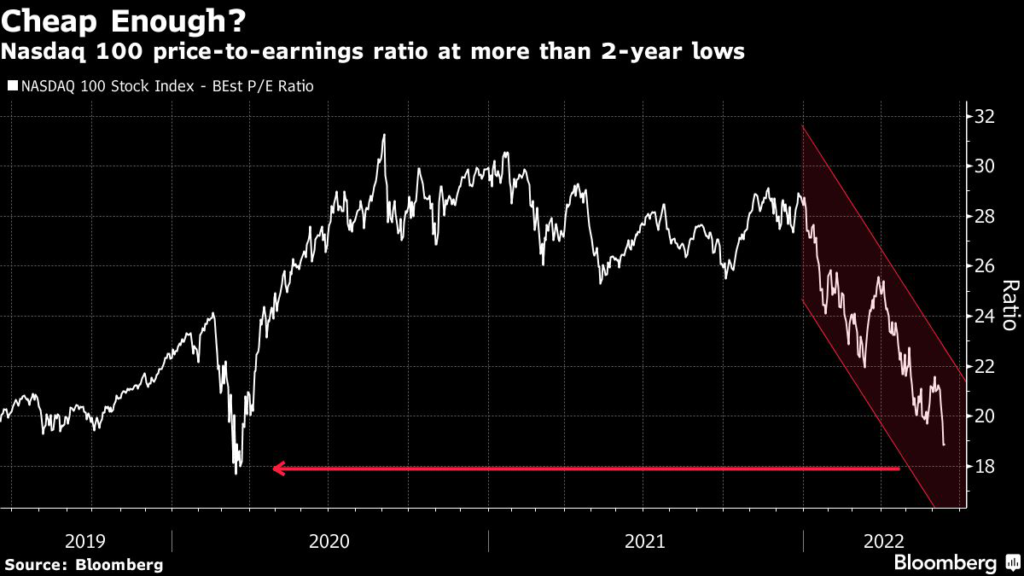
The stock market rout has pushed the Nasdaq 100 Index’s valuation down to 19 times earnings, the lowest level since the pandemic-induced selloffs of March 2020. The tech-heavy index’s price-earnings ratio had scaled a multiyear high of 31 times in September 2020 as stock markets rallied amid low interest rates and booming demand for tech gear because of pandemic lockdowns.

Top Tech Stories

  • Qualcomm Inc. won its bid to topple a 997 million-euro ($1 billion) European Union antitrust fine for allegedly pressuring Apple Inc. to only buy its 4G chips, after judges said regulators made a series of blunders in their case.
  • Walt Disney Co. could lose as many as 20 million of its Disney+ subscribers after being outbid this week for the streaming rights to Indian Premier League cricket matches.
  • SoftBank Group Corp. is considering listing some of its stake in chip designer Arm Ltd. on the London Stock Exchange, switching from an earlier plan to only use the US market, according to people familiar with the matter.
  • Microsoft Corp. is finally retiring its Internet Explorer on Wednesday, putting an end to a quarter-century-old app while also sparking a small panic among businesses and government agencies that built internal systems around the unpopular browser.
  • India will auction 5G airwaves by the end of July when three private-sector operators — Reliance Jio Infocomm Ltd., Bharti Airtel Ltd. and Vodafone Idea Ltd. — are expected to compete as they gear up to roll out ultra-speedy networks.
  • Billionaire Bill Gates, speaking at a climate conference, dismissed cryptocurrency projects such as nonfungible tokens as shams “based on the greater-fool theory,” reviving past criticisms of digital assets.
  • Apple has secured the long-term rights to stream Major League Soccer, taking another step in its growing ambitions as a sports broadcaster.
  • India’s UpGrad Education Pvt almost doubled its valuation to $2.25 billion in a funding round that included billionaire James Murdoch’s Lupa Systems LLC and US testing and assessment provider Educational Testing Service, according to a person familiar with the deal.

(Updates stock move in paragraph 8.)

More stories like this are available on bloomberg.com

©2022 Bloomberg L.P.
Xi in Call With Putin Reaffirms Support for Russian Security

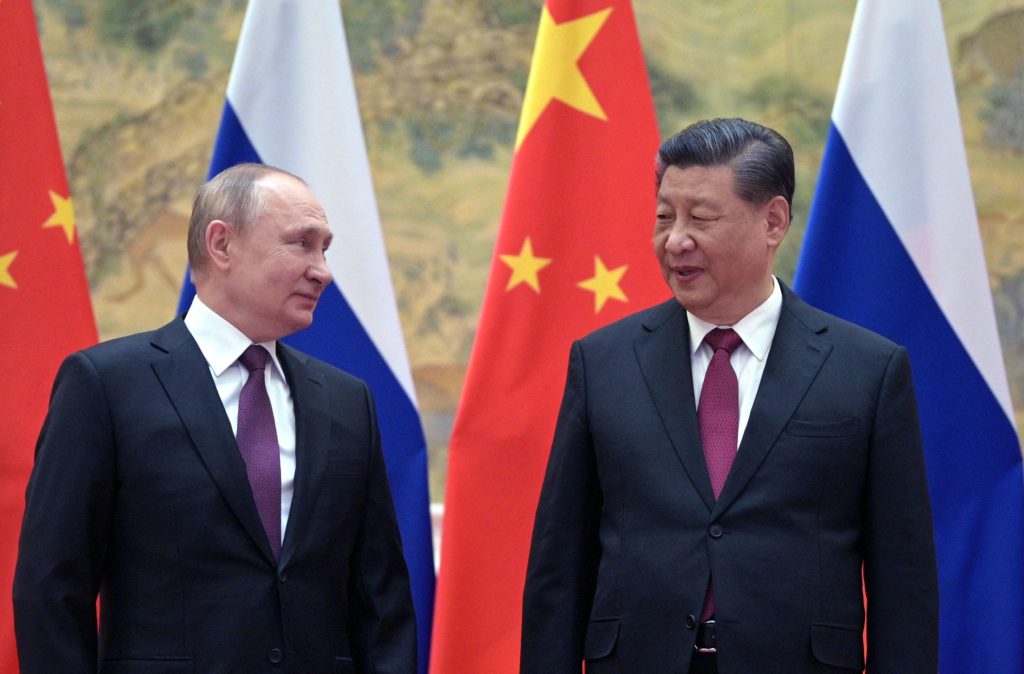
(Bloomberg) — Chinese President Xi Jinping held his second phone call with Vladimir Putin since his Russian counterpart invaded Ukraine in late February, where he reiterated support for Russia’s security concerns, state broadcaster CCTV reported. 

The report of the conversation, which took place on Xi’s 69th birthday, largely repeated China’s prior comments on Russia including a call for Putin and other nations to work toward a solution on Ukraine. 

“China is willing to continue mutual support with Russia on issues related to sovereignty, security and issues of major concern,” Xi said, according to the CCTV report. 

A Kremlin account of the call said the Chinese president noted the “legitimacy of Russia’s actions in protecting its fundamental national interests in the face of security challenges created by external forces.”  

The US has pressed Xi to take a more critical stance against Putin for the war in Ukraine. Beijing has not joined the sanctions imposed by the US, the European Union, Japan and others against Moscow in the aftermath of the invasion, although its companies have largely attempted to stay within the bounds of those penalties.

Xi and Putin have a longstanding rapport and have mostly taken the approach on foreign policy matters of staying out of each other’s affairs. The Kremlin said Wednesday that Xi plans to send a video address to Putin’s St. Petersburg International Economic Forum this week, an event that many foreign visitors are avoiding this year.

Still, Xi has been eager to position China as a responsible power as the world’s second-biggest economy. 

Xi told Putin that China has always made independent decisions on the Ukraine issue, according to the CCTV report. He urged other nations to play a responsible role in resolving the crisis. 

Putin in turn offered his support for China on issues including Xinjiang, Taiwan and Hong Kong, saying Russia opposes any interference in China’s affairs, according to the readout.

In their February call, Xi said China supports Russia and Ukraine to “resolve issues through negotiations.”

(Adds Kremlin statement from fourth paragraph)

More stories like this are available on bloomberg.com

©2022 Bloomberg L.P.

US Retail Sales Post First Drop in Five Months as Auto Purchases Plunge

(Bloomberg) — US retail sales fell in May for the first time in five months, restrained by a plunge in auto purchases and other big-ticket items, suggesting moderating demand for goods amid decades-high inflation.

The value of overall retail purchases decreased 0.3%, after a downwardly revised 0.7% gain in April, Commerce Department figures showed Wednesday. Excluding vehicles, sales rose 0.5% last month. The figures aren’t adjusted for inflation.

The median estimate in a Bloomberg survey of economists called for a 0.1% advance in overall retail sales from a month earlier and a 0.7% increase in the figure excluding autos.

Auto sales dropped 3.5% in May, reinforcing data from Wards Automotive Group that showed sales fell the most since August in the month. Meantime, spending at gas stations climbed 4%, likely reflecting higher fuel prices in the month. Excluding those categories, retail sales rose 0.1%, the smallest gain in five months.

The figures suggest that Americans’ demand for merchandise is softening, which could reflect the impact of the fastest inflation in 40 years or greater preference to spend to on services like travel and entertainment. As price pressures become more entrenched in the economy, spending will likely ebb either due to higher prices, higher interest rates, or both.

The figures come ahead of a decision later Wednesday by the Federal Reserve, in which the central bank is increasingly expected to raise interest rates by 75 basis points, the most since 1994.

“The weak sales report likely won’t influence the Fed, as it will need to see a sustained period of weakness in domestic demand and likely labor markets before breathing a sigh of relief on the inflation front,” Sal Guatieri, senior economist at BMO Capital Markets, said in a note.

Read more: US Retail Traffic Drops for Fourth Week as Inflation Bites

Spending in recent months has been supported by consumers dipping into savings and increasingly using credit cards. That dynamic could put overall retail sales growth at risk as Americans’ financial foundations weaken.

Six of the 13 retail categories showed declines last month, according to the report, including electronics, furniture and e-commerce. 

Grocery store sales advanced 1.2%, which could reflect higher prices rather than increased buying activity since the figures aren’t adjusted for inflation. Real spending data for May will be released later this month.

Several economists downgraded their forecasts for real spending and gross domestic product following the report.

“The report implies a very negative inflation-adjusted number on goods consumption, and the real-time GDP nowcasts are likely to be marked down significantly,” Alex Pelle, US economist at Mizuho Financial Group Inc., said in a note.

However, the data can be volatile month-to-month, and it’s too soon to draw any conclusions that consumers are buckling, said Stephen Stanley, chief economist at Amherst Pierpont Securities.

Restaurant sales, the report’s only services component, rose 0.7%.

So-called control group sales — which are used to calculate gross domestic product and exclude food services, auto dealers, building materials stores and gasoline stations — were unchanged in May.

(Adds more economists’ comments)

More stories like this are available on bloomberg.com

©2022 Bloomberg L.P.
Apple Named World’s Most Valuable Brand in New Survey

(Bloomberg) — Apple Inc. reclaimed its title as the world’s most valuable brand, according to a survey from Kantar BrandZ, knocking rival Amazon.com Inc. off the top spot for the first time in three years. 

The iPhone maker’s brand value reached $947 billion this year, while Amazon slipped to third, according to Kantar’s survey published Wednesday. Apple was last ranked the most valuable brand in 2015.

Louis Vuitton, the fashion label owned by LVMH SE, become the first luxury brand to reach the Top 10 after experiencing 64% growth in value to $124.2 billion, despite consumers slowly returning after the pandemic. Tesla Inc. jumped 18 positions to 29th place, becoming the top car brand due to a surge in interest in electric vehicles.

Kantar’s survey attempts to put a figure on the brand’s impact to the market value of a company and ability to generate sales. 

Apple notched close to 800 million subscribers in 2021 to services including entertainment and cloud, and its movie “CODA” this year became the first film from a streaming service to win Best Picture at the Oscars. Even so, its share price has fallen 25% so far in 2022.


More stories like this are available on bloomberg.com

©2022 Bloomberg L.P.
El Salvador’s Big Bitcoin Gamble Backfires to Deepen Debt Woes

(Bloomberg) —

An epic rout that has wiped out about two-thirds of Bitcoin’s value is exacerbating the debt crisis in the world’s most crypto-friendly country.

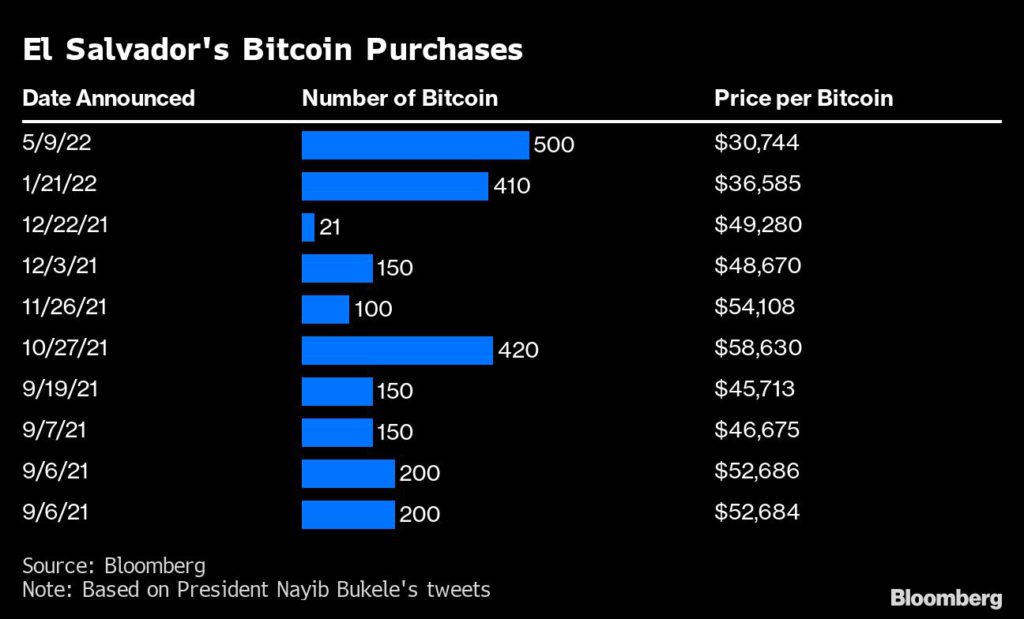
In the year since El Salvador approved Bitcoin as legal tender, the nation has lost almost $56 million by gambling on the digital asset, according to calculations by Bloomberg. That may not sound like much, but for a financially troubled country like El Salvador, every bit counts.

The losses now represent more than half of what President Nayib Bukele’s government spent to buy the 2,301 Bitcoin disclosed through announcements on Twitter. The crypto currency was tumbling for a ninth straight session on Wednesday, on pace for its longest losing streak since 2014. Still, the extent of the decline doesn’t seem to have cowed Bukele, who hinted in a Tweet on Tuesday that it may represent a buying opportunity. 

Based on the president’s tweets, the nation last purchased 500 Bitcoin a little more than a month ago.

Read more: El Salvador’s bonds fell to all-time low in May on Bitcoin turmoil

It highlights an important risk for investors in the cash-strapped Central American nation’s debt, which has been dragged lower by concerns surrounding wide fiscal deficits and an $800 million bond coming due in January. El Salvador’s dollar debt is the worst-performing in Latin America this year as it struggles to secure new financing through a stalled Bitcoin-linked bond.

Concern over the nation’s ability to get the funding it needs to roll over looming debts pushed S&P Global Ratings to downgrade the nation to CCC+ this month, a move that put it on par with Ukraine and Argentina.

More stories like this are available on bloomberg.com

©2022 Bloomberg L.P.
YouTube Reaches 1.5 Billion Users of Shorts, Its TikTok Rival

(Bloomberg) — YouTube said it has reached more than 1.5 billion monthly logged-in viewers of Shorts, its short-form video feature that launched in late 2020 as a response to the surging popularity of TikTok.

The video giant, part of Alphabet Inc.’s Google, announced the milestone on Wednesday, trumpeting the ascent of what executives called “the multiformat creator”—someone who produces both long and short videos. In 2021, YouTube started putting Shorts posts directly within its main app and has encouraged the platform’s biggest stars to produce videos tailored for the format.

The focus on Shorts is part of a broader trend in social media to challenge ByteDance Ltd.’s TikTok for the attention of viewers and creators. TikTok surged in popularity worldwide during the pandemic, including in the US, the tech giants’ most lucrative ad market. Meta Platforms Inc. has dramatically redesigned Instagram to feature Reels, its TikTok copycat. Instagram hasn’t disclosed a total number of users for its app, but says Reels comprises more than 20% of users’ time spent there.

Read more: how Meta is blowing up Instagram to catch TikTok

In its recent quarter, Google said that traffic on Shorts had eaten into YouTube’s main site in its most recent quarter, hurting the division’s margin. Google told investors ads were coming to Shorts soon. In 2019, YouTube declared that it more than two billion monthly visitors for its main site; the company hasn’t updated the figure since.

More stories like this are available on bloomberg.com

©2022 Bloomberg L.P.
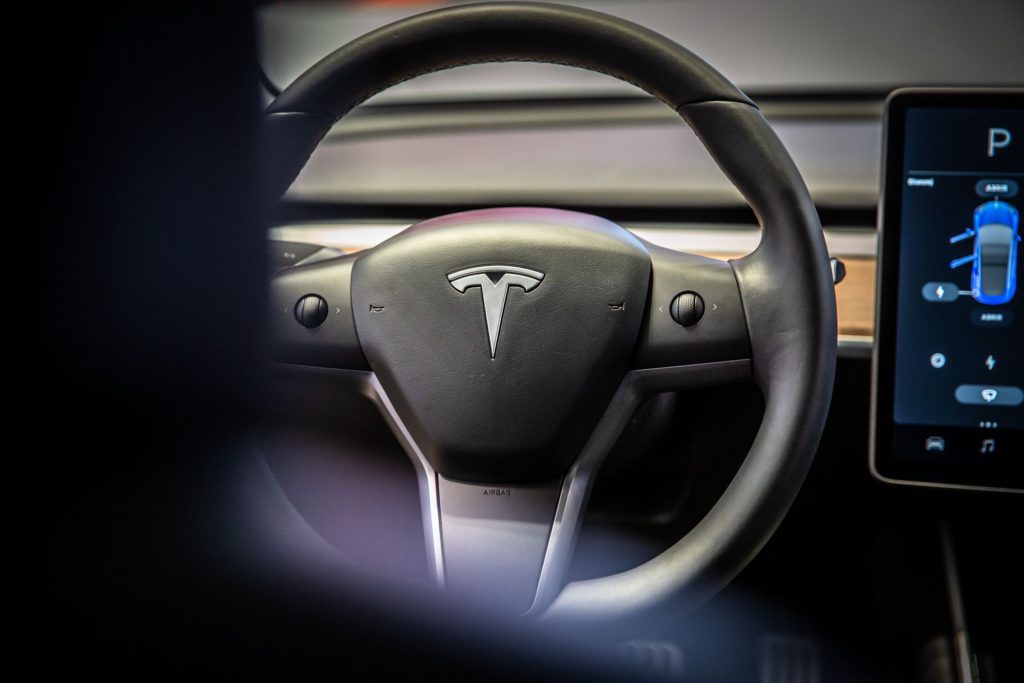
Tesla Reports Most Automated System-Involved Crashes, US Says

(Bloomberg) — Tesla Inc. reported the vast majority of crashes involving automated driver-assist systems that have been disclosed to the US National Highway Traffic Safety Administration, according to new figures from the regulator that it says are too limited to draw any safety conclusions.

Tesla accounted for 273 of 367 such crashes reported by 12 auto companies to NHTSA between July 2021 and May 15 of this year, the agency said. Across all reported accidents, serious injury or death occurred in 11 of the 98 collisions for which severity data was collected. A further 294 incidents lacked information about harm to vehicle occupants. 

Behind Tesla was Honda Motor Co. with 90 reported crashes, while Subaru Corp. disclosed 10 collisions. All remaining companies including General Motors Co., Ford Motor Co. and Toyota Motor Corp. cited five or fewer collisions.

The figures were included in the first public release of data collected about crashes involving so-called Level 2 automated driving systems, gathered under a June 2021 order demanding carmakers and technology companies report the incidents. Its release comes as safety advocates in Washington have called for more action from regulators and lawmakers to set firmer rules for so-called self-driving cars, as technologies such as Tesla’s driver-assist features gain popularity with customers. 

“These technologies hold great promise to improve safety, but we need to understand how these vehicles are performing in real world situations,” NHTSA Administrator Steve Cliff told reporters ahead of the release of the data.

At the same time, NHTSA said the figures shouldn’t be used to make safety conclusions. The data lacked contextual information needed to establish a rate of incidents, such as the number of vehicles in each manufacturer’s fleet that were equipped with driver-assist systems, how often drivers use them or the number of miles driven. Crash reports may also be duplicative, it said.

The new data comes soon after the agency escalated an investigation into whether Tesla’s Autopilot system is defective. It opened the probe into a possible defect of the electric-car maker’s partially automated driver-assistance feature in August 2021, when it began looking into how the system handles crash scenes following a dozen collisions with first-responder and other vehicles.

Read more: Tesla Autopilot Stirs US Alarm as ‘Disaster Waiting to Happen’

In spite of its limitations, NHTSA said the data will help it better understand how the systems are performing in the field, potential risks to pedestrians and other vulnerable road users, rule-making efforts and enforcement actions. The agency will also update the data on its website monthly, it said.  

“This will help our investigators quickly identify potential defect trends that could emerge, some of which will warrant further explore exploration,” Cliff said.

In December, NHTSA launched an evaluation after reports of Tesla car occupants playing video games on front-center touch screens. The carmaker told the agency it would work on a software update to lock the feature when vehicles are in motion.

Tesla has marketed driver-assistance features using the names Autopilot and Full Self-Driving that still require drivers to keep their hands on the wheel. The company has drawn criticism from the likes of the National Transportation Safety Board, former NHTSA leaders and members of Congress over issues including how it has branded the systems and whether it does enough to safeguard against inattentiveness and misuse.

More stories like this are available on bloomberg.com

©2022 Bloomberg L.P.
Close Bitnami banner
Bitnami