Bloomberg

Canada to Force Firms to Report Cyber Attacks, Remove Risky Gear

(Bloomberg) — Canada plans to require companies to share cyber threat information and to remove any product or service that could pose security risks.

Industry Minister Francois-Philippe Champagne and Public Safety Minister Marco Mendicino introduced a bill Tuesday titled an “Act Respecting Cyber Security” that will apply to four federally-regulated infrastructure sectors including telecommunications, transport, finance and energy. 

The bill aims to address cyber threats seen by governments around the world amid a rise in ransomware and other online attacks as more people work remotely during the pandemic.

Canada doesn’t currently have an explicit legal mechanism to compel action to address these threats. The bill would allow regulators to impose fines or issue summary convictions to ensure compliance.

The emergence of fifth-generation wireless technology will allow critical infrastructure to become increasingly interconnected and integrated with cyber systems, creating new threats and vulnerabilities, government officials told reporters on a briefing call before the announcement. 

Prohibiting the use and forcing the removal of Huawei Technologies Co. and ZTE Corp. equipment from telecommunication networks and facilities is an example of the bill’s usage, officials said.

Last month, Prime Minister Justin Trudeau’s government joined Canada’s closest intelligence allies in banning Huawei from 5G. The decision, which also applies to ZTE, had been delayed for years amid a diplomatic feud with China over the arrest of a top Huawei executive on a US extradition request in late 2018. 

More stories like this are available on bloomberg.com

©2022 Bloomberg L.P.

US Export Controls Are Putting a Stranglehold on Russia, Commerce Official Says

(Bloomberg) — US restrictions on exports and work with more than three dozen allies are cutting Russia off from the vast majority of technology that President Vladimir Putin needs to sustain his invasion of Ukraine, a Biden administration official said.

Global semiconductor exports to Russia have fallen 90% since Russia’s attack on Feb. 24, said Alan Estevez, under secretary of Commerce for Industry and Security. US shipments of all goods to the nation have plunged about 95% by value, while American sales in the aviation and aerospace industry have tumbled 99.9%, he said in a virtual conference hosted by the Center for a New American Security on Tuesday.

The US export controls, along with those of 37 other nations, have “essentially put a stranglehold on Russia’s ability to sustain its forces over time,” Estevez said, who has called himself the US “chief technology protection officer.” “Russia will not be able to sustain its military over time, because you need semiconductors to build just about any piece of top military gear.”

The Commerce Department’s Bureau of Industry and Security spent months prior to Russia’s invasion in late February coordinating potential export controls with global allies to make sure that Moscow wouldn’t simply substitute technology exports from another nation for those that were blocked by the US. The rules are being used to deny Russia access to products used in the defense, aerospace, and maritime sectors.

The department’s efforts have resulted in 37 nations including Japan, Australia as well as the European Union’s member countries joining the US in imposing expansive controls on goods that they export to Russia. Since the start of the war, the US also has suspended carriers including Aeroflot PJSC, Russia’s biggest airline, from receiving U.S. parts and services for their planes.

Much of recent BIS efforts has focused on Russia and China, and another official from the agency said last month that the US is looking at increasing the penalties for companies violating rules that limit export of products that threaten national security.

Read more: US Plans to Boost Penalty on Russia, China Export Violations

More stories like this are available on bloomberg.com

©2022 Bloomberg L.P.

MicroStrategy CEO Saylor Says No Margin Call on Bitcoin Loan

(Bloomberg) — MicroStrategy Inc. Chief Executive Michael Saylor told investors not to worry about a potential margin call on a Bitcoin-backed loan, saying the company has ample collateral to pledge if necessary. 

“As long as the Silvergate loan remains collateralized with an LTV less than 50%, there is no margin call,” Saylor wrote in a email to Bloomberg, referring to loan-to-value metrics. “We manage accordingly.”

The software firm said on a conference call in May that the price of the Bitcoin would need to fall to around $21,000 before a call would be triggered on its $205 million loan from a unit of Silvergate Bank, but that it may contribute more to the collateral package so it never gets there. Bitcoin was trading around $22,500 Tuesday after dipping as low as $20,800 earlier in the session.

“When @MicroStrategy adopted a #Bitcoin Strategy, it anticipated volatility and structured its balance sheet so that it could continue to #HODL through adversity,” Saylor tweeted earlier in the day.

Over the last two years the software-maker has shelled out $3.97 billion as it amassed nearly 130,000 Bitcoins. The firm’s average purchase price for those tokens has steadily risen with each additional purchase since 2020 and sits at $30,700 as of March 31, according to its latest quarterly filing with the US Securities and Exchange Commission. The paper loss for the firm’s holdings has reached roughly $1 billion.     

BTIG analyst Mark Palmer also said the company should have plenty of Bitcoin to meet any margin call as the firm has more than 95,000 Bitcoins to post as collateral. The firm is required to maintain a loan-to-collateral ratio of 50% or less and has at least $410 million worth of Bitcoin in a custody account.

“There is no liquidation provision here,” Palmer said in a phone interview, also noting there is a “vast amount of confusion” over the loan agreement. 

The company has about $2.2 billion in debt, roughly $44 million in annual interest expenses and is expected to generate $90 million of free cash flow in 2022, Palmer added.

MicroStrategy’s 6.125% notes due in 2028 last traded at about 80 cents on the dollar, according to Trace bond trading data. The bond was at par in January. 

Shares of MicroStrategy rose 6.5% to %162.02 as of 1:53 p.m. in New York. That had tumbled 25% on Monday, and are down around 70% this year.

More stories like this are available on bloomberg.com

©2022 Bloomberg L.P.

Apple to Stream Major League Soccer as Sports Ambitions Grow

(Bloomberg) — Apple Inc. has secured the long-term rights to stream Major League Soccer, taking another step in its growing ambitions as a sports broadcaster.

Apple will begin streaming the soccer matches next year as part of a 10-year deal. Fans will be able to watch the matches through a new subscription-based MLS product available through the Apple TV app, according to a statement. Some matches will be available for free to subscribers of Apple TV+, the tech company’s general-interest streaming service.

In March, Apple reached a deal with Major League Baseball to air Friday night games on Apple TV+ this season. The company has reportedly shown interest in picking up the NFL Sunday Ticket package now held by DirecTV.

Deals between the US men’s professional soccer league and Walt Disney Co.’s ESPN, Fox and Univision expire this year. More than a dozen companies expressed interest in acquiring the rights, including tech giants like Amazon.com Inc. and Apple and traditional media companies Warner Bros. Discovery Inc. and Paramount Global.

With viewership rising, the league aimed to collect much more than the $90 million a year it received under the previous agreement. Apple is paying a minimum guarantee worth $250 million per year, according to Sports Business Journal.

MLS struck a deal with Apple partly because it would allow the league to showcase its games in one place and boost MLS’s popularity globally, especially since the league features many players from foreign countries, according to Commissioner Don Garber.

“What we’re trying to do here is aggregate as much of our content together to make it easy for our fans, wherever they are, however they consume,” Garber said during a press conference Tuesday.

The agreement means that Disney’s ESPN+ streaming service will lose the MLS games it has been airing at the end of the year. The league is still in talks to sell their traditional TV rights. Asked about ESPN, Garber told reporters that “we’re in discussions for them to continue with us.”

MLS will handle the broadcast production for the matches. Every MLS season ticket holder will get a free subscription to the new streaming service. The service’s price wasn’t disclosed.

The deal is another sign of how soccer has become the go-to sports property of the streaming era. Paramount+ airs Italy’s Serie A matches. NBC’s Peacock has the English Premier League, which it renewed in November for more than $2.5 billion. ESPN+ has Spain’s La Liga and Germany’s Bundesliga.


(Updates with cost in fifth paragraph.)

More stories like this are available on bloomberg.com

©2022 Bloomberg L.P.

FedEx Heads Toward Biggest Gain in 29 Years on Overhaul Plan

(Bloomberg) — FedEx Corp.’s shares soared after the courier hiked its dividend and announced board changes in coordination with activist investor D.E. Shaw & Co., a bold shakeup just two weeks into the tenure of new Chief Executive Officer Raj Subramaniam.

The quarterly dividend will jump 53% to $1.15 per share, the Memphis, Tennessee-based company said Tuesday in a statement. That’s well above the 87-cent prediction by Bloomberg analytics. FedEx also said it would cut capital spending and rework its executive compensation program.

The shares surged 13% to $227.02 at 12:51 p.m. in New York, putting them on pace for the biggest one-day gain since 1993. The stock had dropped 22% this year through Monday.

The higher-than-expected dividend increase and reduction in capital spending will be accompanied by the addition of Amy Lane and Jim Vena as independent directors effective immediately, with a third new director to be named at a later date and agreed upon by FedEx and D.E. Shaw.

“We appreciate the collaboration with the D. E. Shaw group, a long-time FedEx stockholder, with whom we have maintained an ongoing and constructive dialogue in reaching this agreement,” Subramaniam said in the statement.

“Investors have been speculating about an activist at FDX for years, without one materializing,” Jack Atkins, an analyst with Stephens with an “overweight” rating on the stock, wrote in a note to clients. “Now, with a new leadership team and fresh voices on the board (including a proven operator like Mr. Vena), we are hopeful that a new day is dawning.”

Under New Management

The moves indicate that Subramaniam, who took over as CEO from founder Fred Smith on June 1, may be more open to addressing investor concerns as FedEx struggles to boost profit margins and has trailed the performance of its larger rival, United Parcel Service Inc. Smith, who started FedEx operations in 1973 with a handful of private jets converted to freighters, remained as chairman of the board. He is FedEx’s single largest stockholder with 7.5% of outstanding shares.

FedEx’s annual operating profit margins haven’t topped 7% since 2017 and lately the company has struggled to hire enough workers at its sorting hubs, hurting its on-time delivery performance. UPS, which hired former Home Depot Inc. CFO Carol Tome as CEO in June 2020, increased its profit margins to 13.2% last year, up from 9.1% in 2020, and has maintained its on-time service. 

The structural pressures on FedEx “are intensifying” as more retailers ship directly from the store, the US Postal Service expands operations and Amazon.com Inc. looks to extend its logistics service to also pick up packages, which will put the e-commerce giant in direct competition with FedEx and UPS, said Ravi Shanker, an analyst with Morgan Stanley in a note to clients. 

“While the market may welcome today’s ‘shareholder friendly’ actions, in our view none of this addresses the real pressures facing the business,” Shanker, who has a rating of “equal weight” on the stock, wrote in the note. 

FedEx is planning to hold its first investor day meeting in a decade at the end of this month and more changes are likely to be announced. Still, Smith has a big say in how to run the company and he appointed his son, Richard Smith, as chief of the company’s largest unit FedEx Express in March before announcing that Subramaniam would be his successor. 

“We are surprised that we have seen a prolonged slow drip of meaningful news items (CEO transition, today’s announcements) well before the marquee event,” Shanker said in the note. Management “will need to have more aces in hand to meet expectations at the event.”

Combine Units

Some investors have clamored for FedEx to combine its Ground and Express networks to improve efficiency and emulate UPS’s one network. That may be difficult because the Ground business is operated by independent contractors, a major structural difference from the Express business that owns aircraft and vehicles and has employees and pilots directly on payroll. 

As part of the agreement with D.E. Shaw, the company made several changes to board committees. Separately, FedEx also tied executive pay more to its total shareholder return.

D.E. Shaw owned about 1 million shares as of March 31, making it FedEx’s 35th largest holder, according to Bloomberg data. With $60 billion in assets under management, D.E. Shaw has pushed for changes at several companies in the past, including Exxon Mobil Corp., Bunge Ltd., and Lowe’s Cos., among others. 

Vena is a former railroad executive who worked at Canadian National Railway Co. and recently helped Union Pacific Corp. improve efficiency. Lane is a former Merrill Lynch & Co. banker who also sits on the boards of NextEra Energy Inc. and TJX Companies Inc. 

More stories like this are available on bloomberg.com

©2022 Bloomberg L.P.

Google Debate Over ‘Sentient’ Bots Overshadows Deeper AI Issues

(Bloomberg) — A Google software engineer was suspended after going public with his claims of encountering “sentient” artificial intelligence on the company’s servers — spurring a debate about how and whether AI can achieve consciousness. Researchers say it’s an unfortunate distraction from more pressing issues in the industry.

The engineer, Blake Lemoine, said he believed that Google’s AI chatbot was capable of expressing human emotion, raising ethical issues. Google put him on leave for sharing confidential information and said his concerns had no basis in fact — a view widely held in the AI community. What’s more important, researchers say, is addressing issues like whether AI can engender real-world harm and prejudice, whether actual humans are exploited in the training of AI, and how the major technology companies act as gatekeepers of the development of the tech.

Lemoine’s stance may also make it easier for tech companies to abdicate responsibility for AI-driven decisions, said Emily Bender, a professor of computational linguistics at the University of Washington. “Lots of effort has been put into this sideshow,” she said. “The problem is, the more this technology gets sold as artificial intelligence — let alone something sentient — the more people are willing to go along with AI systems” that can cause real-world harm.

Bender pointed to examples in job hiring and grading students, which can carry embedded prejudice depending on what data sets were used to train the AI. If the focus is on the system’s apparent sentience, Bender said, it creates a distance from the AI creators’ direct responsibility for any flaws or biases in the programs.

The Washington Post on Saturday ran an interview with Lemoine, who conversed with an AI system called LaMDA, or Language Models for Dialogue Applications, a framework that Google uses to build specialized chatbots. The system has been trained on trillions of words from the internet in order to mimic human conversation. In his conversation with the chatbot, Lemoine said he concluded that the AI was a sentient being that should have its own rights. He said the feeling was not scientific, but religious: “who am I to tell God where he can and can’t put souls?” he said on Twitter.

Alphabet Inc.’s Google employees were largely silent in internal channels besides Memegen, where Google employees shared a few bland memes, according to a person familiar with the matter. But throughout the weekend and on Monday, researchers pushed back on the notion that the AI was truly sentient, saying the evidence only indicated a highly capable system of human mimicry, not sentience itself. “It is mimicking perceptions or feelings from the training data it was given — smartly and specifically designed to seem like it understands,” said Jana Eggers, the chief executive officer of the AI startup Nara Logics. 

The architecture of LaMDA “simply doesn’t support some key capabilities of human-like consciousness,” said Max Kreminski, a researcher at the University of California, Santa Cruz, who studies computational media. If LaMDA is like other large language models, he said, it wouldn’t learn from its interactions with human users because “the neural network weights of the deployed model are frozen.” It would also have no other form of long-term storage that it could write information to, meaning it wouldn’t be able to “think” in the background.

In a response to Lemoine’s claims, Google said that LaMDA can follow along with prompts and leading questions, giving it an appearance of being able to riff on any topic. “Our team — including ethicists and technologists — has reviewed Blake’s concerns per our AI Principles and have informed him that the evidence does not support his claims,” said Chris Pappas, a Google spokesperson. “Hundreds of researchers and engineers have conversed with LaMDA and we are not aware of anyone else making the wide-ranging assertions, or anthropomorphizing LaMDA, the way Blake has.”

The debate over sentience in robots has been carried out alongside science fiction portrayal in popular culture, in stories and movies with AI romantic partners or AI villains. So the debate had an easy path to the mainstream. “Instead of discussing the harms of these companies,” such as sexism, racism and centralization of power created by these AI  systems, everyone “spent the whole weekend discussing sentience,” Timnit Gebru, formerly co-lead of Google’s ethical AI group, said on Twitter. “Derailing mission accomplished.”

The earliest chatbots of the 1960s and ’70s, including ELIZA and PARRY, generated headlines for their ability to be conversational with humans. In more recent years, the GPT-3 language model from OpenAI, the lab founded by Tesla CEO Elon Musk and others, has demonstrated even more cutting-edge abilities, including the ability to read and write. But from a scientific perspective, there is no evidence that human intelligence or consciousness are embedded in these systems, said Bart Selman, a professor of computer science at Cornell University who studies artificial intelligence. LaMDA, he said, “is just another example in this long history.”

In fact, AI systems don’t currently reason about the effects of their answers or behaviors on people or society, said Mark Riedl, a professor and researcher at the Georgia Institute of Technology. And that’s a vulnerability of the technology. “An AI system may not be toxic or have prejudicial bias but still not understand it may be inappropriate to talk about suicide or violence in some circumstances,” Riedl said. “The research is still immature and ongoing, even as there is a rush to deployment.”

Technology companies like Google and Meta Platforms Inc. also deploy AI to moderate content on their enormous platforms — yet plenty of toxic language and posts can still slip through their automated systems. In order to mitigate the shortcomings of those systems, the companies must employ hundreds of thousands of human moderators in order to ensure that hate speech, misinformation and extremist content on these platforms are properly labeled and moderated, and even then the companies are often deficient. 

The focus on AI sentience “further hides” the existence and in some cases, the reportedly inhumane working conditions of these laborers, said the University of Washington’s Bender. 

It also obfuscates the chain of responsibility when AI systems make mistakes. In a now-famous blunder of its AI technology, Google in 2015 issued a public apology after the company’s Photos service was found to be mistakenly labeling photos of a Black software developer and his friend as “gorillas.” As many as three years later, the company admitted its fix was not an improvement to the underlying AI system; instead it erased all results for the search terms “gorilla,” “chimp,” and “monkey.”

Putting an emphasis on AI sentience would have given Google the leeway to blame the issue on the intelligent AI making such a decision, Bender said. “The company could say, ‘Oh, the software made a mistake,’” she said. “Well no, your company created that software. You are accountable for that mistake. And the discourse about sentience muddies that in bad ways.”

AI not only provides a way for humans to abdicate their responsibility for making fair decisions to a machine, it often simply replicates the systemic biases of the data on which it is trained, said Laura Edelson, a computer scientist at New York University. In 2016, ProPublica published a sweeping investigation into COMPAS, an algorithm used by judges, probation and parole officers to assess a criminal defendant’s likelihood to re-offend. The investigation found that the algorithm systemically predicted that Black people were at “higher risk” of committing other crimes, even if their records bore out that they did not actually do so. “Systems like that tech-wash our systemic biases,” said Edelson. “They replicate those biases but put them into the black box of ‘the algorithm’ which can’t be questioned or challenged.”

And, researchers said, because Google’s LaMDA technology is not open to outside researchers, the public and other computer scientists can only respond to what they are told by Google or through the information released by Lemoine. 

“It needs to be accessible by researchers outside of Google in order to advance more research in more diverse ways,” Riedl said. “The more voices, the more diversity of research questions, the more possibility of new breakthroughs. This is in addition to the importance of diversity of racial, sexual, and lived experiences, which are currently lacking in many large tech companies.”

More stories like this are available on bloomberg.com

©2022 Bloomberg L.P.

Ford Recalls 48,924 Mustang Mach-Es in Setback for EV Plans

(Bloomberg) — Ford Motor Co. has told dealers to temporarily halt deliveries of the Mustang Mach-E over a potential safety defect, a setback for the carmaker as it tries to fortify its position as a leader in electric vehicles.

The automaker is recalling 48,924 Mach-Es from the 2021 and 2022 model years made at Ford’s plant in Cuautitlan, Mexico, a spokesperson for the company said Tuesday. Dealers can still sell the car, but cannot deliver it to buyers until the defect is fixed, Ford said. 

Ford submitted the recall to the National Highway Traffic Safety Administration, which didn’t immediately respond to a request for comment.

The issue involves the possible overheating of high-voltage battery main contactors, which can cause vehicles to lose power while in motion or fail to start. The defect is being corrected with a software update that owners can receive over the air or by going to their dealer, Ford said. It added that there are no open investigations with NHTSA.

Ford became the second-leading seller of electric vehicles in the US last year, behind Tesla Inc., on the strength of the Mustang Mach-E, which sold 27,140 models in 2021. Sales of the battery-powered crossover SUV were up 50% so far this year to 15,718 units, and the model had its best month yet in May.

Chief Executive Office Jim Farley has accelerated Ford’s push into EVs, with plans to build 2 million annually by 2026. This month, the automaker said it’s spending $3.7 billion to expand factories in the Midwest. That’s on top of the $11.7 billion Ford is investing with battery partner SK Innovation Co. to construct EV and battery plants in Tennessee and Kentucky.

Ford’s shares rose 3.3% to $12.20 at 1:07 p.m. in New York, rebounding after several days of declines.

CNBC earlier reported on the recall.

(Updates with additional details beginning in second paragraph. An earlier version corrected the description of the recall)

More stories like this are available on bloomberg.com

©2022 Bloomberg L.P.

Goldman Set to Offer FX Rates Lasting Days to Ease Hedging

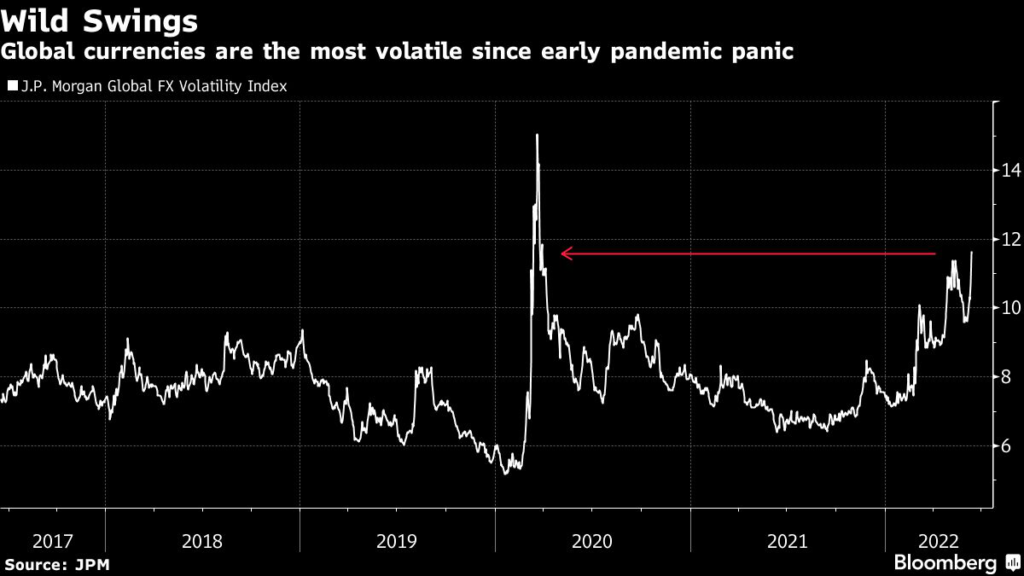
(Bloomberg) — Goldman Sachs Group Inc. is preparing to offer foreign-exchange prices that last for days to help fintechs, airlines and e-commerce firms avoid turbulence in the $6.6 trillion-per-day global currency market.

The Wall Street giant has begun quoting FX rates that last for minutes and plans to extend this in the coming weeks, according to Abbas Khamisa, executive director in FX solutions and structuring at the bank. The aim is to help firms hedge risk and protect them from having to do hundreds of transactions at different rates.

Several other banks have offered similar services, but clients have reported challenges in accessing quotes efficiently and transparently, according to Goldman executives.

For most corporate treasurers right now, FX needs are typically managed through a combination of the spot market and forwards: instruments in which they pay a bank an agreed sum to conduct a trade in, say, several weeks or months at a pre-determined price. Under Goldman’s offering, clients can expect to pay a premium, in the form of an added spread, to reflect the risk that exchange rates move against the bank’s position. The bank will vary its prices based on the volumes, currency pairs and amount of time the customer needs.

“Firms can request a quote ranging from minutes to hours, to days, to the weekend and eventually to months, with clients knowing exactly how much they are being charged,” Khamisa said in an interview. “We’ve had a lot of interest.”  

Companies from software giant Microsoft Corp. to dating conglomerate Match Group Inc. have warned investors and analysts of the perils of a strong dollar. Tinder owner Match said in its first quarter earnings call in May that it was estimating a $40 million increase in full year foreign-exchange charges compared with the prior year, due to a rapidly weakening Japanese yen and euro.

Sarah Boyce, an associate director at the London-based Association of Corporate Treasurers, expressed caution about Goldman Sachs’s offering. “Why is this better than me just doing a series of forward rates?” she said in an interview. “The thing to always remember is the treasury and finance team will need to explain it to the board, and they are not accountants or traders.”

Goldman’s guaranteed prices are different to forward rates because they give clients the flexibility to trade at a set rate rather than requiring them to do so, Khamisa said. “When the client has certainty on the timings and notional of their exposure, then they can execute a trade,” he said. “This allows clients to price their goods and services in multiple currencies, without the challenges of forecasting and risk managing potential exposures in advance.”

Tom Auld, a Cambridge University academic and former high frequency trader, said the plans would likely suit both sides — provided clients are meeting corporate needs and aren’t betting on market moves.

“It makes a lot of sense if you’ve got an unsophisticated client who is not going to try and arbitrage the price, and may not be able to make a quick decision,” he said. “Goldman Sachs will have to be very careful about who they field it to. They won’t give it to a hedge fund but they might give it to an SME or some other client that isn’t interested in arbitraging.”

Monex Europe Ltd., a client of Goldman’s, is preparing to offer the new service to its foreign exchange customers, according to Michael Quinn, a senior trader.

“Depending on how accurately Goldman’s solution is modeled — my understanding is that it remains a nascent product — this is potentially seismic for currency markets in applicable industries,” Quinn said in an email. “The closest analogy of a similar new product introduction in the currency markets would be in the mid 2000s when held rates, which were directly linked to specific underlying deals, subsequently helped fuel an M&A boom.”

(Adds context in sixth paragraph.)

More stories like this are available on bloomberg.com

©2022 Bloomberg L.P.

Ford Recalls 48,924 Mustang Mach-Es in EV Setback

(Bloomberg) — Ford Motor Co. has told dealers to temporarily halt deliveries of the Mustang Mach-E over a potential safety defect, a setback for the carmaker as it tries to fortify its position as a leader in electric vehicles.

The automaker is recalling 48,924 Mach-Es from the 2021 and 2022 model years made at Ford’s plant in Cuautitlan, Mexico, a spokesperson for the company said Tuesday. Ford submitted the recall to the National Highway Traffic Safety Administration, which didn’t immediately respond to a request for comment.

The issue involves the possible overheating of high-voltage battery main contactors, which can cause vehicles to lose power while in motion or fail to start. The defect is being corrected with a software update that owners can receive over the air or by going to their dealer, Ford said. It added that there are no open investigations with NHTSA.

Ford became the second-leading seller of electric vehicles in the US last year, behind Tesla Inc., on the strength of the Mustang Mach-E, which sold 27,140 models in 2021. Sales of the battery-powered crossover SUV were up 50% so far this year to 15,718 units, and the model had its best month yet in May.

Ford’s shares rose 3.8% to $12.26 at 11:12 a.m. in New York, rebounding after several days of declines.

CNBC earlier reported on the recall.

(Corrects description of recall in headline and first paragraph)

More stories like this are available on bloomberg.com

©2022 Bloomberg L.P.
Walmart Seeks UK Sellers for Its Online Marketplace

(Bloomberg) — Walmart Inc. is seeking UK retailers to join its online marketplace in an attempt to give British businesses another e-commerce alternative to Amazon and EBay Inc.

Approved British sellers will be able to sell their goods on Walmart.com, which is visited by more than 120 million people every month, the US shopping giant said in a statement Monday. In a bid to attract sellers, Walmart is offering a two-day shipping service within the US, once the goods are already stored in its warehouses, during non-peak times and access to other services to help them generate sales across the Atlantic.

Walmart is hosting a UK Sellers Summit in London on Friday and said manufacturers and exporters from an array of sectors, including fashion, sporting goods, beauty and entertainment, have been invited. 

UK companies already on Walmart’s marketplace include wearable technology firm Statsports, home and garden products seller BuyBox, sporting equipment company Nodor and generalist retailer Pertemba.

Walmart has a long history with UK retail and for years owned Asda, Britain’s third-largest grocer, before selling most of its holding to a consortium led by the Issa brothers over a year ago. The latest move to target British exporters comes as the UK government seeks to help businesses reach £1 trillion ($1.22 trillion) in exports by 2030 by focusing on non-EU markets such as the US, Australia, Canada or Japan. 


(Clarifies details of two-day shipping service in second paragraph)

More stories like this are available on bloomberg.com

©2022 Bloomberg L.P.

Close Bitnami banner
Bitnami